
Economy
Trump sacks Fed board member Cook, escalating thrust on central bank

U.S. President Donald Trump said Monday that he’s firing Federal Reserve Governor Lisa Cook, marking an unprecedented move that would constitute a sharp escalation in his battle to exert greater control over the central bank – which has long been considered an institution independent from day-to-day politics.
Trump said in a letter posted on his Truth Social platform that he is removing Cook effective immediately because of allegations that she committed mortgage fraud. Bill Pulte, a Trump appointee to the agency that regulates mortgage giants Fannie Mae and Freddie Mac, made the accusations last week.
Pulte alleged that Cook had claimed two primary residences – in Ann Arbor, Michigan, and Atlanta – in 2021 to get better mortgage terms. Mortgage rates are often higher on second homes or those purchased to rent.
Trump’s move is likely to touch off an extensive legal battle that will probably go to the Supreme Court and could disrupt financial markets, potentially pushing interest rates higher. Stock futures declined slightly late Monday, as did the dollar against other major currencies.
The independence of the Fed is considered critical to its ability to fight inflation because it enables it to take unpopular steps like raising interest rates. If bond investors start to lose faith that the Fed will be able to control inflation, they will demand higher rates to own bonds, pushing up borrowing costs for mortgages, car loans and business loans.
Cook was appointed to the Fed’s board by then-President Joe Biden in 2022 and is the first Black woman to serve as a governor. She was a Marshall Scholar and received degrees from Oxford University and Spelman College, and she has taught at Michigan State University and Harvard University’s Kennedy School of Government.
Her nomination was opposed by most Senate Republicans, and she was approved on a 50-50 vote with the tie broken by then-Vice President Kamala Harris.
The law allows a president to fire a Fed governor “for cause,” which typically means for some kind of wrongdoing or dereliction of duty. The president cannot fire a governor simply because of differences over interest rate policy.
Establishing a for-cause removal typically requires some type of proceeding that would allow Cook to answer the charges and present evidence, legal experts say, which hasn’t happened in this case.
‘Invalid removal’
“This is a procedurally invalid removal under the statute,” said Lev Menand, a law professor at Columbia Law School and author of “The Fed Unbound,” a book about the Fed’s actions during the COVID-19 pandemic.
Menand also said for-cause firings are typically related to misconduct while in office, rather than based on private misconduct from before an official’s appointment.
“This is not someone convicted of a crime,” Menand said. “This is not someone who is not carrying out their duties.”
Fed governors vote on the central bank’s interest rate decisions and on issues of financial regulation. While they are appointed by the president and confirmed by the Senate, they are not like cabinet secretaries, who serve at the pleasure of the president. They serve 14-year terms that are staggered in an effort to insulate the Fed from political influence.
While some presidents have pushed out Fed chairs before, no president has sought to fire a Fed governor. In recent decades, presidents of both parties have largely respected Fed independence, though Richard Nixon and Lyndon Johnson put heavy pressure on the Fed during their presidencies – mostly behind closed doors. Still, that behind-the-scenes pressure to keep interest rates low, the same goal sought by Trump, has widely been blamed for touching off rampant inflation in the late 1960s and ’70s.
President Harry Truman pushed Thomas McCabe to step down from his position as Fed chair in 1951, though that occurred behind the scenes.
Trump’s letter came days after Cook said she wouldn’t leave despite the president’s call for her to resign. “I have no intention of being bullied to step down from my position because of some questions raised in a tweet,” Cook said.
The Supreme Court signaled in a recent decision that the chair of the Fed is largely protected from removal by the president, but it’s unclear if that would apply to a governor.
Menand noted that the Court’s conservative majority has taken a very expansive view of presidential power, saying, “We’re in uncharted waters in a sense that it’s very difficult to predict that if Lisa Cook goes to court what will happen.”
Sarah Binder, a senior fellow at the Brookings Institution, said the president’s use of the “for cause” provision is likely an effort to mask his true intent. “It seems like a fig leaf to get what we wants, which is muscling someone on the board to lower rates,” she said.
Trump has said he would only appoint Fed officials who would support lower borrowing costs. He recently named Stephen Miran, a top White House economic adviser, to replace another governor, Adriana Kugler, who stepped down about five months before her term officially ended Aug. 1.
Trump appointed two governors in his first term, Christopher Waller and Michelle Bowman, so replacing Cook would give Trump appointees a 4-3 majority on the Fed’s board.
“The American people must have full confidence in the honesty of the members entrusted with setting policy and overseeing the Federal Reserve,” Trump wrote in a letter addressed to Cook, a copy of which he posted online. “In light of your deceitful and potentially criminal conduct in a financial matter, they cannot and I do not have such confidence in your integrity.”
Trump argued that firing Cook was constitutional. “I have determined that faithfully enacting the law requires your immediate removal from office,” the president wrote.
Among the unresolved legal questions is if Cook could be allowed to remain in her seat while the case plays out. She may have to fight the legal battle herself, as the injured party, rather than the Fed.
In the meantime, Trump’s announcement drew swift rebuke from advocates and former Fed officials.
Sen. Elizabeth Warren, D-Mass., called Trump’s attempt to fire Cook illegal, “the latest example of a desperate President searching for a scapegoat to cover for his own failure to lower costs for Americans. It’s an authoritarian power grab that blatantly violates the Federal Reserve Act, and must be overturned in court.”
Trump has repeatedly attacked the Fed’s chair, Jerome Powell, for not cutting its short-term interest rate, and even threatened to fire him.
Forcing Cook off the Fed’s governing board would provide Trump an opportunity to appoint a loyalist. Trump has said he would only appoint officials who would support cutting rates.
Powell signaled last week that the Fed may cut rates soon, even as inflation risks remain moderate. Meanwhile, Trump will be able to replace Powell in May 2026, when Powell’s term expires.
However, 12 members of the Fed’s interest-rate setting committee have a vote on whether to raise or lower interest rates, so even replacing the chair might not guarantee that Fed policy will shift the way Trump wants.
Ukrainian drones hit Russia’s biggest data center on Wednesday, part of a series of attacks appearing to target Moscow’s ambitions to develop Russian artificial intelligence capabilities on a par with those from the U.S. and China.
The strike on the Balakovo data center, owned by Sberbank, the country’s largest bank and technology company, followed three attacks in the past week on data centers owned by Russian technology group Yandex.
“We confirm that the data processing center was attacked. At the same time, all of Sberbank’s systems and services are operating normally and without disruption,” Sberbank First Deputy CEO Alexander Vedyakhin told reporters.
Russia’s state RIA Novosti news agency reported in 2024 that the Sberbank center hit on Wednesday would host Russia’s biggest supercomputer, which is scheduled to go into operation in 2027.
The Yandex data centers, hit earlier, hosted all three of that company’s operating supercomputers. Neither Yandex nor Sberbank has said whether supercomputers, used to train the AI models, were damaged in the Ukrainian attacks.
Along with Yandex, its main domestic rival, Sberbank is Russia’s leading developer of artificial intelligence. The domestic market is shared between Sberbank’s GigaChat model and YandexGPT.
Difficulties purchasing chips
Both companies have invested heavily in the development of their models but lag global leaders in the United States and China by up to nine months, according to Sberbank’s own estimates, partly due to Western sanctions which hinder Russia’s access to the most advanced hardware.
“It’s clear what difficulties we face when purchasing modern graphics processing units. Both we and Yandex suffer from this,” Sberbank’s CEO, German Gref, said on Sept. 29, calling it the biggest reason why Russia lags behind the US and China in AI.
Sberbank is in talks to buy chips from Chinese makers, but in an interview with Reuters on June 3, Vedyakhin said that U.S. chipmaker Nvidia’s monopoly on its CUDA software platform, which has become an AI industry standard, is an even greater problem.
Yandex said previously that its supercomputers operated on Nvidia A100 chips, a model launched in 2020 and since then succeeded by more advanced H100 chips.
Sberbank has two functioning supercomputers. The most advanced one, called Christofari Neo, ranked 167th in the Top 500 list of the world’s most powerful supercomputers, is located in Moscow and is based on Nvidia A100 chips.
Yandex’s most advanced Chervonenkis supercomputer is ranked 101st in the same list.
IT expert Mikhail Klimarev told Reuters it could take a long time to replace the chips due to Western sanctions, while damage to the supercomputers could set back the Russian AI industry, which already suffered from sanctions.
“The equipment is being imported, but it’s done at a high cost, through indirect routes. First, you need to negotiate so that someone is willing to sell it to you and is not afraid of sanctions,” he said.
Protect assets
Some commentators compared the lack of reported disruption at state-controlled Sberbank with Yandex – whose taxi and food delivery units had reported disruptions – saying it showed that Sberbank’s centers are better protected.
“This is a great example of what a business owner can do to protect their assets,” wrote military blogger Alexander Kots. Under an August decree by President Vladimir Putin, the state can take over administration of poorly protected facilities.
The Sberbank site is located close to the Balakovo nuclear power plant, which the data center uses as an energy source, and the Saratov hydroelectric power plant. No damage was reported to either plant from the attack.
Ukraine says it is responding to Russian attacks on its own data sites. Both countries have attacked each other’s refineries, power stations, ports and e-commerce companies.
Russia’s digital development ministry said this week it was in talks with the military on protecting the data centers, while some lawmakers called for them to be moved underground, where the hardware will be out of reach for drones.

Spain intends to buy 15 more Hürjet jet trainers on top of the 30 it has already contracted, Turkish Aerospace Industries (TAI) CEO Mehmet Demiroğlu said Tuesday.
Speaking at an event in Kastamonu, northern Türkiye, Demiroğlu said deliveries to Spain are scheduled to begin in 2028.
“Before we even started deliveries to our Air Force, Spain said, ‘I like it, I want to buy 30,’ and bought them. We signed the agreement,” he said. “We are working toward deliveries in 2028. It is planning to buy another 15.”
The 30-aircraft contract, worth about 2.6 billion euros (nearly $2.9 billion), was announced in late December 2025.
Demiroğlu also highlighted TAI’s production capacity. He said its campus brings together work on the homegrown Kaan fighter jet, the Hürjet and Hürkuş aircraft, helicopters, unmanned aerial vehicles, satellites and aircraft components.
He said testing and production across six different fields are carried out at the same site. He described the facility as a source of national pride and said TAI employs 16,500 people.
On the Hürkuş advanced trainer aircraft, Demiroğlu said deliveries had begun and would continue in the coming years. He named Azerbaijan as an export customer and said TAI hopes to win more overseas orders.
A total of 55 Hürkuş II aircraft are planned to be delivered through 2028, including 12 that are scheduled for delivery by the end of this year.
Demiroğlu said Türkiye’s defense industry successes had raised the country’s international standing and drawn growing interest in its technology.
“In the 2020s, particularly with the successes in the defense industry, tremendous admiration for Türkiye has emerged around the world,” he said. “They admire our products, what we do and our achievements.”
Demiroğlu also described deterrence as a central goal of Türkiye’s defense programs, including Kaan, saying the aim is to strengthen the country’s ability to prevent conflict. He added that both the armed forces and the country as a whole must be prepared for security threats.
“We are not working to wage war. We need to work to avoid war,” he said. “We do not want to use Kaan. We are building it so that we do not have to use it.”
Trade Minister Ömer Bolat said Wednesday that progress had been made in some areas of efforts to update Türkiye’s customs union with the European Union.
Bolat, speaking to reporters in Brussels, also said Ankara is lobbying hard against restrictions in a planned EU industrial law that could affect Turkish carmakers.
A day earlier, European Trade Commissioner Maros Sefcovic announced progress on two customs-related issues after the High-Level EU-Türkiye Trade Dialogue, and defended the bloc’s “Made in EU” proposals amid differences among member states.
This week’s trip marks Bolat’s third official visit to the de facto capital of the European Union in the past three months and fifth in the past year.
The trade chief held a series of high-level talks, including the trade dialogue with Sefcovic, and attended the Türkiye-EU Business Summit, which was dominated by calls for a modernized customs union, a place in the bloc’s industrial supply chains and a clearer accession perspective.
Customs union update
Bolat said the EU Council has not yet authorized the European Commission to open formal negotiations on updating the customs union, because of the position of some member states.
“Since the relevant issues have come up, the relevant authorities at the European Commission are conducting negotiations with us. We are making progress on a case-by-case basis,” he said.
Bolat said the four main topics of the update are e-commerce, public procurement, investment and agricultural products, and that progress has been made in each.
On public procurement, Bolat pointed to a law that Türkiye’s Parliament passed in July. He said the analysis phase for a bilateral agreement with the EU is complete and technical talks have started.
In digital trade, he said the EU coordinated with Türkiye while drafting its own rules. Türkiye was exempted from EU legislation that took effect on July 1 and imposes a charge of 3 euros ($3.36) per package, he said.
Steps announced after trade dialogue
Speaking at a news conference with Bolat on Tuesday, Sefcovic announced progress in addressing barriers linked to Türkiye’s import control system, TAREKS. He said Ankara had introduced several transparency measures to make the system easier for EU exporters to use.
The two sides also agreed on a mutual recognition agreement covering their Authorized Economic Operator (AEO) programs, which has been published in the EU’s Official Journal. Under the deal, each side will recognize the other’s trusted traders, allowing their goods to benefit from faster border procedures.
“This is a real step forward for smooth trade flows and customs cooperation within the current Customs Union framework,” Sefcovic said.
Industrial policies and ‘Made in EU’
Bolat said Türkiye has worked intensively for the past year on the EU’s regulations proposed under the draft Industrial Accelerator Act (IAA).
He stressed the draft contains restrictive provisions affecting future investment and electric vehicles, particularly in the automotive industry.
Türkiye is conducting intensive diplomacy to have those provisions removed, he said. Turkish officials have set out their expectations clearly to their counterparts and remain in contact, he added.
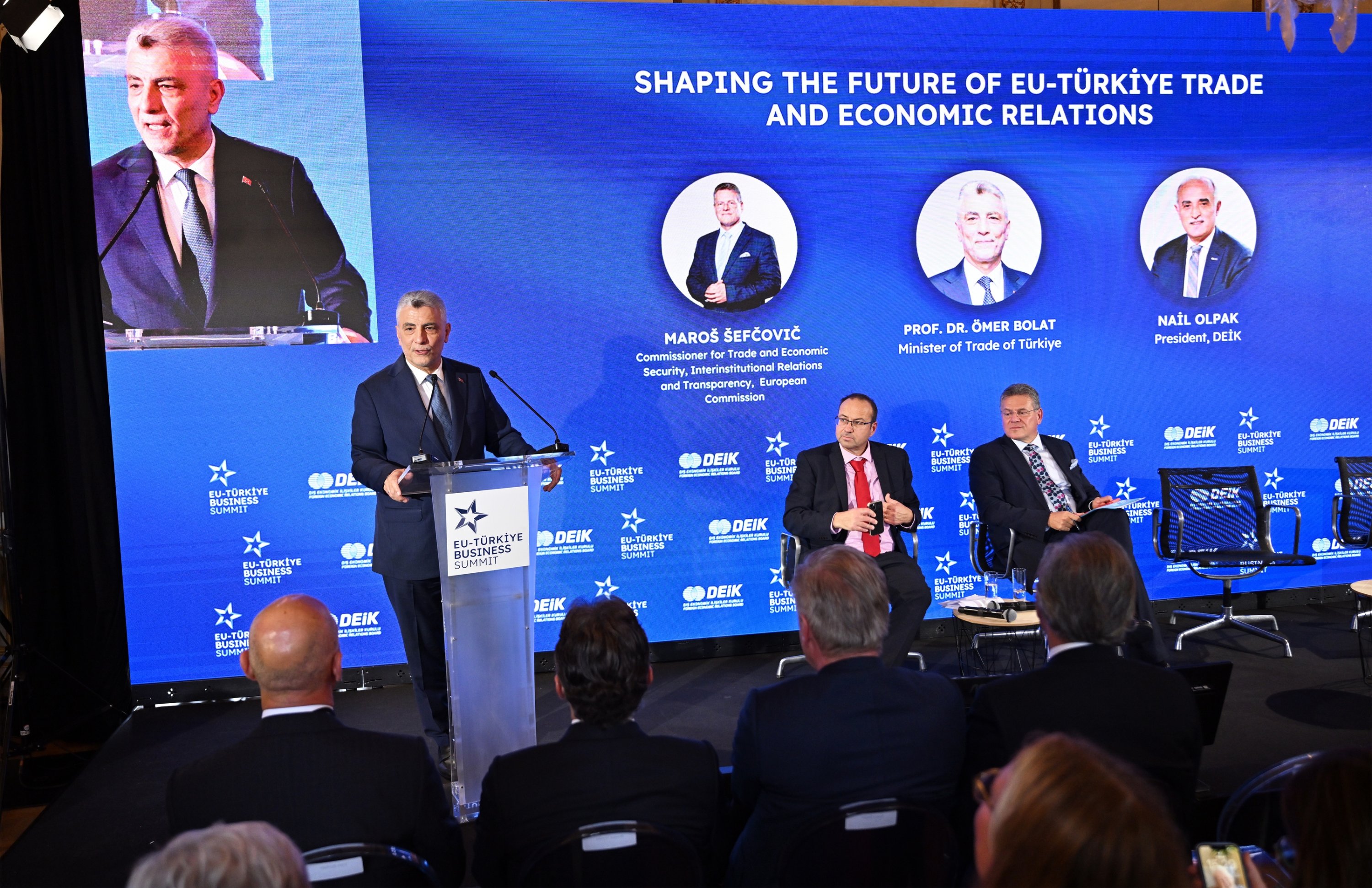
At the Türkiye-EU Business Summit, Bolat warned that excluding Türkiye from the “Made in EU” initiative would undermine decades of economic integration and established supply chains.
“We respect the (EU’s) ideal Industrial Accelerator Act, which is normal, and we suffer from the same grave concerns about huge imports from third countries. But the solution should not be to exclude trusted partners or the customs union,” he said.
Bolat stressed that Türkiye’s inclusion would serve the interests of both sides, particularly their auto industries and wider manufacturing sectors.
Sefcovic, for his part, said the Commission’s proposals aim to strengthen the bloc’s competitiveness and help it adapt to changing global trade conditions. He said they followed “very thorough reflection” on how to respond to concerns about state subsidies, trade-distorting practices and a European market flooded with goods, amid strong suspicions that some practices did not comply with World Trade Organization rules.
The EU, he said, is seeking new ways to address these challenges while maintaining its commitment to free and fair trade.
Asked about member states’ concerns over the proposed rules, Sefcovic noted that many of the proposals are in the legislative process and will go through the usual procedures in Parliament and the Council. “I believe that the goal is the same: to make sure that Europe is more competitive, stronger, and better fit for the current very volatile trade world,” he said.
The proposal has exposed differences among member states over which countries should qualify. France favors an EU-only approach, while Germany wants eligibility extended to trusted partners such as the United Kingdom, Canada and Japan, with Türkiye also potentially included.
The European Commission has put forward the proposal, and the European Parliament and EU Council are still to make decisions on it, Bolat told reporters on Wednesday.
He cautioned that an unfavorable outcome is possible once politics and parliaments are involved. But many EU officials, he said, believe Türkiye must be included under “Made in EU” rules.
He said the EU is not a single, uniform bloc and contains very different communities and nations, and that the number of friends and partners Türkiye has within it is growing.
“God willing, the result will be a good one,” he said.
‘Win-win relationship’
Bolat said economic ties are just as important for the EU as they are for Türkiye, and that many European partners recognize this.
“They want to continue close and strong economic relations with Türkiye,” he said.
Trade between Türkiye and the EU has grown since the customs union came into force three decades ago to $233 billion, he said. “So this is a win-win relationship.”
Türkiye’s exports to the EU rose 3.9% year-over-year to $81.5 billion in the first nine months of this year, according to official data.
Germany was Türkiye’s top European market, with exports rising 4.2% to $15.4 billion, followed by Italy with $9.6 billion, Spain with $8.3 billion and France with $7.9 billion.
Other leading export destinations included Romania and the Netherlands, with nearly $5.5 billion each, and Poland with $4.8 billion.
Türkiye’s total exports to its top four European markets (Germany, Italy, Spain and France) reached $41.2 billion in January-September.
The auto sector was the main driver of growth, with exports to the EU rising 4.8% to $22.9 billion, followed by the chemicals and chemical products sector with $10.2 billion and the ready-to-wear apparel sector with $7.3 billion.
The German Cabinet greenlit on Wednesday a new tax on sugary drinks, aiming to raise revenue and incentivize manufacturers to make healthier products.
The tax, which still requires parliamentary approval, would apply to sweetened drinks with a total sugar content of at least 5 grams per 100 milliliters. According to the Finance Ministry, these include lemonades, iced teas, energy drinks and fruit juices with added sugar.
Alcoholic drinks, non-alcoholic beers, wines and cocktails would not be affected. Pure fruit and vegetable juices, unsweetened fizzy drinks and those containing sweeteners – so-called zero drinks – would also be exempt.
Two tax bands are planned depending on sugar content. Exemptions are envisaged for small producers, though the precise thresholds have yet to be finalized.
The German government is seeking an exemption for all businesses producing a maximum of 1 million liters per year, but this requires authorization from the European Commission.
The new tax is due to come into force on July 1, 2027. It could generate 690 million euros ($772 million) for the federal government next year, with revenues of 925 million euros projected for 2028 and between 875 million euros and 890 million euros in subsequent years.
The revenue is intended to help keep contributions to the statutory health care system stable. At the same time, the tax is designed to incentivize beverage manufacturers to reduce the sugar content of their products.
Streaming giant Netflix is laying off 6% of its workforce, or roughly 1,000 employees, in its biggest cuts since 2022, according to a Reuters report on Wednesday citing an internal memo.
The layoffs come as the company faces tough competition for viewers from legacy rivals and YouTube.
The bulk of the job cuts would be in Netflix’s product, tech, legal and human-resources teams, the email Co-CEOs Greg Peters and Ted Sarandos sent to employees on Wednesday showed.
“Our mission – to entertain the world – is ambitious, and delivering on it requires us to be disciplined about where we prioritize our people and resources,” they said in the memo.
“Our business is strong and growing, and we remain on track to deliver our full-year forecast.”
Netflix shares, down around 25% so far this year, rose 0.7% on Wednesday. The company had about 16,000 employees at the end of last year.
This year, the streaming giant has faced doubts about its ability to sustain the growth that disrupted the U.S. media industry by putting pressure on cable TV businesses.
Engagement, or the amount of time users spend on Netflix, has become a key concern for investors as platforms such as YouTube and TikTok attract viewers with free-to-watch, user-generated content that gives them a cost advantage over Netflix.
A failed pursuit of Warner Bros. Discovery’s streaming and studio assets earlier this year deepened doubts about Netflix’s strategy. Paramount completed its $110-billion Warner Bros acquisition earlier this month to form Skydance.
“They haven’t been able to find like another line of major revenue,” said Ross Benes, senior analyst at eMarketer, adding the company remains reliant on a subscription business that could be approaching a ceiling.
“Eventually, because they’ve kind of nearing a ceiling with that, they’ll need another revenue stream to diversify, and that’s where it’s been more of a struggle.”
Netflix has been trying to expand beyond its subscription business by investing in an ad tier, live programming and gaming.
Its last major round of layoffs came in 2022, when it cut about 450 jobs in two rounds after losing subscribers for the first time in more than a decade.
The Wall Street Journal first reported on Wednesday’s memo.
Higher interest rates on France’s government debt are an alarm signal for the country, even though Paris retains bond investors’ confidence, the country’s finance minister said Wednesday, as concerns grow over the sustainability of the French budget.
“We have the confidence of the markets in the sense that we have no trouble issuing debt,” Roland Lescure told Franceinfo radio. “But it costs us more, and that is an alarm signal we all need to take on board.”
With investor worries mounting over France’s debt and the ability of the government to pay it down, Paris has to offer higher interest rates on the government bonds it issues to reward investors for the perceived additional risk.
France’s 10-year government bond yield has already neared 5% on the markets in recent weeks.
EU Economy Commissioner Valdis Dombrovskis told Agence France-Presse (AFP) on the sidelines of the IMF-World Bank annual meetings in Bangkok on Tuesday that “it’s important to have clarity about the budget” in France.
IMF chief Kristalina Georgieva warned meanwhile that it “would take time” before France’s debt levels could come down to levels “that are providing confidence – full confidence – to people and to the investor community.”
French public debt is projected to reach a record high of 121.7% of GDP in 2027 under the government’s budget proposal, up from 119% at the end of June.
The budget that the French government is seeking to push through parliament also envisages pushing down the budget deficit to 5% of GDP next year, from an estimated 5.4% for 2026.
But its lack of a majority in the lower house of parliament has made adoption of the budget an uphill struggle.
The situation is further complicated by France’s approaching presidential election, with President Emmanuel Macron, a centrist former investment banker, unable to seek a new term.
Front-running candidate Marine Le Pen of the far right, in an interview with The Financial Times published Wednesday, acknowledged the “gigantic, enormous debt… that could become uncontrollable.”
She wants to impose 140 billion euros in cost-savings that would come partly from slashing the French contribution to the EU budget.
“We know there will be a tough debate, even a trial of strength” with Brussels, she said.
Speaking in Bangkok, Bank of France Governor Emmanuel Moulin called on French political leaders to “shoulder their responsibilities” to ensure the adoption of a budget, in apparent reference to a constitutional provision that allows governments to force through legislation without a vote.


-

 Economy3 days ago
Top oil execs drop from major event schedule after Riyadh attacks
-

 Economy3 days ago
Türkiye says 17 funds settled, eyes Atlas deal this week
-
 Economy2 days ago
AI ‘slow-moving tsunami’ but holds global growth, IMF chief says
-

 Politics2 days ago
Troubled funds, terror-free Türkiye on the agenda as the Cabinet meets
-

 Sports1 day ago
Fenerbahçe hope to turn Champions League tables against Aston Villa
-

 Economy1 day ago
Business world wants fresh momentum in Türkiye-EU engagement
-

 Economy2 days ago
Türkiye says in talks with Saudi Arabia, Jordan, Syria on mega power link
-

 Economy1 day ago
IMF cuts Türkiye’s growth forecast to 2.7% in 2026, sees rebound