
Politics
Aleppo offensive against US-backed terrorists begins

The Syrian army’s deadline for the U.S.-backed terrorist group YPG to leave Aleppo ended on Thursday afternoon. Footage from Aleppo’s three neighborhoods where civilians were fleeing showed Syrian forces trading fire with YPG members on the streets.
Earlier on Thursday, the army ordered residents to evacuate.
It has released more than seven maps identifying areas it said would be targeted in strikes, urging residents to leave immediately for their safety. Its operations command announced a curfew in the neighborhoods of Sheikh Maqsoud and Ashrafieh from 3 p.m. (12 p.m. GMT).
The fighting, which erupted on Tuesday, has driven thousands of civilians from their homes and killed and wounded several people, state media reported.
The YPG said its members were engaged in intense clashes with Damascus-aligned factions and auxiliaries near Aleppo’s Syriac neighborhood, adding that it had inflicted what it described as heavy losses.
The violence and competing claims over responsibility highlight a deepening and increasingly deadly standoff between Damascus and the YPG, which has objected to integrating into the central government.
On Thursday, More residents were seen leaving Sheikh Maqsoud and Ashrafieh through designated safe corridors.
The YPG controls much of northeastern Syria and has been Washington’s main local partner.
It established a self-styled autonomous administration in the northeast and parts of Aleppo during Syria’s civil war.
Damascus reached a deal with the YPG last year that envisaged full integration of the group into the Syrian army by the end of 2025, but progress has been limited, with both sides accusing the other of stalling.
The U.S. has sought to mediate, holding meetings as recently as Sunday, though those talks ended without tangible results.
Diplomats warn that failure to integrate the YPG into Syria’s army risks further violence.

Belgium expressed solidarity with Türkiye on Wednesday after a ballistic munition launched from Iran toward Turkish airspace was intercepted by NATO air and missile defense systems.
“Belgium stands firmly with Türkiye. I welcome the swift and effective response by NATO air and missile defense assets, which intercepted the threat before it could cause harm,” Foreign Minister Maxime Prevot said on social media.
“Iran must stop its indiscriminate attacks across the region. Every new target, every new escalation makes a path back to stability harder. This must end,” he added.
A ballistic munition fired from Iran and directed toward Turkish airspace on Wednesday was intercepted and neutralized by NATO air and missile defense units in the Eastern Mediterranean, the Defense Ministry said earlier.
The ministry said on the Turkish social media platform NSosyal that the projectile, detected after passing through Iraq and Syria, was successfully engaged by air defenses.
The ongoing U.S.-Israel offensive, launched against Iran on Saturday, has killed several top Iranian leaders, including Supreme Leader Ayatollah Ali Khamenei. Tehran has responded with drone and missile attacks targeting Israel and U.S.-linked sites in Gulf countries.
Two Turkish journalists reporting live from Tel Aviv were detained by Israeli security forces on Tuesday, prompting strong condemnation from Turkish officials who described the move as a clear violation of press freedom.
CNN Türk Correspondent Emrah Çakmak and cameraman Halil Kahraman were taken into custody while covering developments in the Israeli capital, the network said. CNN Türk operates under a licensing agreement with the parent company of CNN International.
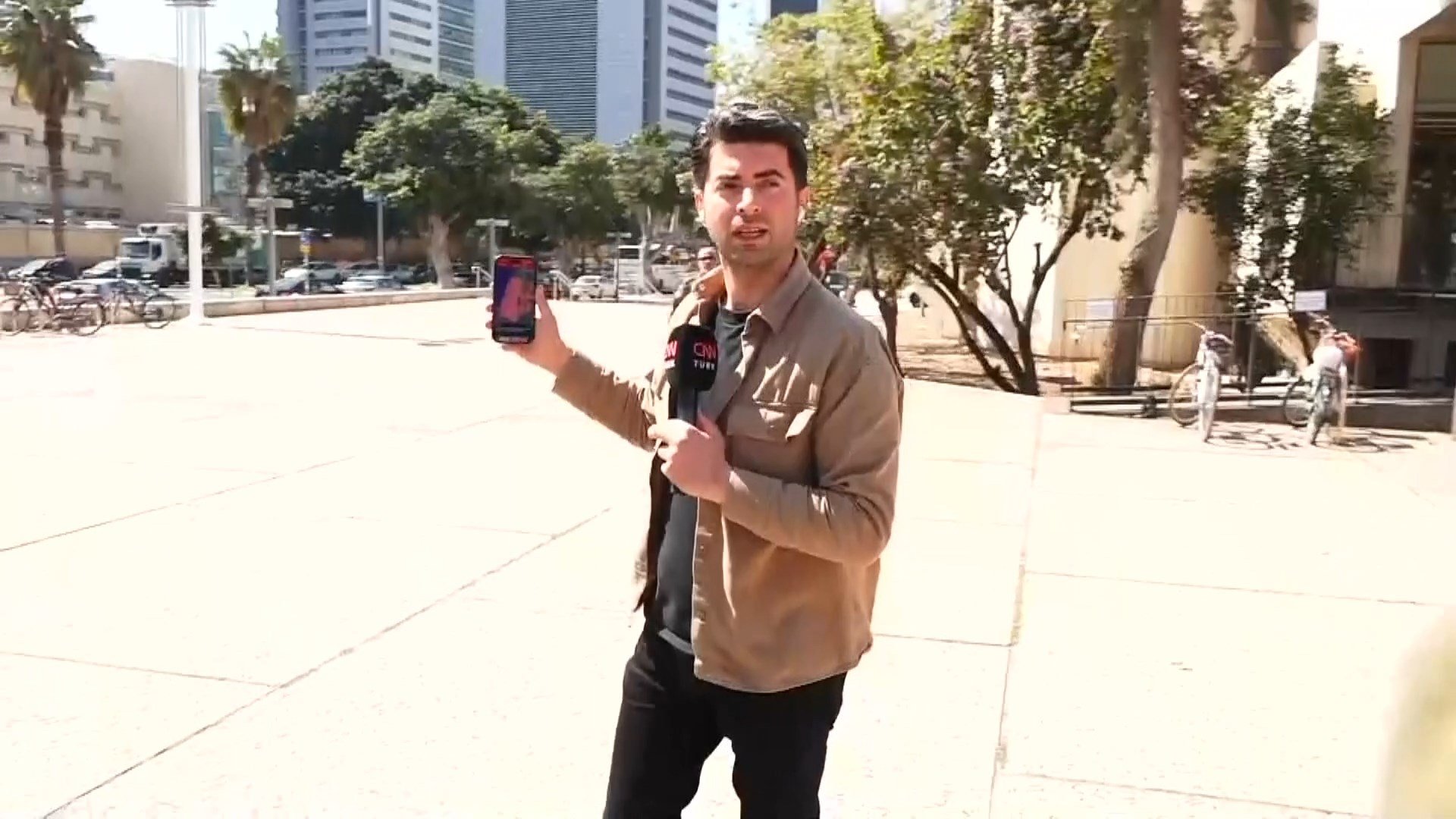
The ruling Justice and Development Party (AK Party) spokesman Ömer Çelik said the arrests amounted to an attack on the public’s right to information.
“This decision is unacceptable. Journalists must be released immediately,” he wrote on social media, adding that Ankara is following the situation closely.
Presidential Communications Director Burhanettin Duran said Israel was once again targeting journalists in an effort to suppress reporting.
“We are taking the necessary steps to secure their release and are monitoring the matter with great care,” he said.
Main opposition Republican People’s Party (CHP) Chairman Özgür Özel also condemned the detentions, stressing that no state has the right to restrict access to information through arbitrary measures.
Mehmet Danış, the head of Türkiye’s media watchdog RTÜK, denounced the detentions as another attempt to block the flow of truthful reporting. He said efforts to secure the journalists’ release were ongoing and that authorities were handling the process with “sensitivity and precision.”
Israel is notorious for its treatment of journalists and is responsible for two-thirds of the total number of journalists killed in the world in 2025.
Foreign Minister Hakan Fidan discussed regional developments with his British counterpart, Yvette Cooper, on the phone, diplomatic sources said Tuesday.
Fidan and Cooper discussed the diplomatic efforts that could be undertaken to end the ongoing conflict and establish stability, according to the sources.
Fidan also held calls with leaders and his counterparts from Qatar, Greece and Iraq’s Kurdistan Regional Government (KRG)-held region.
Turkish diplomatic sources said Fidan discussed the latest developments in the region with Qatari Prime Minister and Foreign Minister Mohammed bin Abdulrahman Al Thani, Greek Foreign Minister Georgios Gerapetritis and KRG President Nechirvan Barzani.
The calls came as a U.S.-Israeli military campaign, launched Saturday against Iran, has killed several senior Iranian officials, including Supreme Leader Ali Khamenei.
Tehran has retaliated with drone and missile strikes targeting Israel, as well as several neighboring countries that are home to US assets.
President Recep Tayyip Erdoğan said Tuesday that the post–World War II global system is “cracking at its foundations” and warned that the world is being dragged into a chaotic era where might is right once again shapes global politics, stressing that Türkiye will not remain neutral in crises affecting its region and humanity.
Speaking at an iftar with lawmakers at the Turkish Parliament, Erdoğan cautioned that global instability is deepening and that the international system is being pulled toward an increasingly chaotic phase, underscoring the need for responsible leadership and stronger diplomacy to prevent further turbulence.
“We are collectively witnessing a global axis shift,” he said, adding that international agreements have become “patchworks,” international law is being sidelined and multilateral principles symbolized by the United Nations are being hollowed out by the very countries that built the system.
“The system established after the Second World War is quite literally collapsing,” Erdoğan said. “The world is heating up to a point where the smallest spark could ignite a fire. Global injustice is widening and becoming chronic. As the old order crumbles, no one yet knows what will replace it.”
Erdoğan said recent attacks on Iran have once again exposed the fragility of the global order, adding that the normalization of lawlessness, confrontation and tension has become one of the most serious risks facing the international community.
He emphasized that Türkiye has a clear and principled stance: “We are never neutral on matters affecting our region and humanity. We stand on the side of peace and stability, not conflict. We stand for dialogue, diplomacy, justice and cooperation. We stand against killing, oppression, banditry and all acts that violate human dignity.”
Erdoğan said Türkiye will continue to defend the rights of the oppressed and oppose global injustices “with courage,” just as it has done in past crises. He vowed that the country will maintain its principled position despite attempts to suppress the truth or pressure Ankara into silence.
Turning to domestic security, Erdoğan said one of the key pillars of the “Century of Türkiye” vision is the goal of a Türkiye and a region free of terrorism. He praised Parliament’s capacity to address even the most complex national issues and highlighted the work of the newly formed National Solidarity, Brotherhood and Democracy Commission, which recently approved its final report with cross-party support.
“Our duty is to remain prudent, calm and steadfast,” Erdoğan said. “As missiles fly in our neighborhood, we will act with caution and patience – but also with strength in the face of injustice. We are preparing for the Century of Türkiye by strengthening our economy, diplomacy, military and national unity.”
Foreign Minister Hakan Fidan said a change in Iran’s leadership could create a rare opening to halt the conflict, as he warned against Tehran’s “self-destructive” approach to bomb Gulf neighbors.
Fidan said the Middle East is experiencing one of its most volatile moments in decades, but noted that the political transition in Iran could produce a diplomatic window the region has not had since the fighting began. “A new leadership structure may reshape Iran’s decision-making and create an opportunity to stop the war,” he told a live broadcast on TRT Haber news channel.
Fidan said the political transition now underway in Iran could create a narrow but meaningful opening to stop the conflict. “The new leadership in Iran may show greater flexibility at this stage,” he said, noting that decision-making is currently in the hands of a temporary three-member council until a permanent leader is chosen. “This could be a window of opportunity, if used wisely.”
He stressed that any diplomatic framework must balance concerns on both sides. “It must be a formula that does not humiliate the Iranians, while also addressing the legitimate worries of others,” he said. Otherwise, he warned, prolonging the war would carry “far worse consequences than any concession that might be made.”
“Iran’s indiscriminate bombing of all these Gulf countries is an unbelievably wrong strategy,” Fidan said.
Fidan said many Gulf states had worked intensely to prevent the outbreak of the war, stressing that he personally witnessed their efforts. He noted that Qatar’s prime minister and foreign minister were still trying to stop the escalation “until an hour before the attack,” acting in ways that were effectively in Iran’s interest at the time. Despite this, Fidan said Tehran launched widespread strikes without distinction, targeting Oman, Qatar, Kuwait, Bahrain, Saudi Arabia, the United Arab Emirates and Jordan. “Iran’s indiscriminate bombing of all these countries was an unbelievably wrong strategy,” he said, arguing that it heightened regional risks and was also counterproductive from Iran’s own perspective.
He added that several of these states had not allowed their airspace or bases to be used against Iran, had declared neutrality in advance and even worked to stop the war. Attacking such countries, he said, revealed how serious Iran’s threat perception had become. “It reflects a mindset of ‘if I go down, the region goes down with me,’” he said.
The top Turkish diplomat said the region is witnessing one of its most critical periods in decades, noting that the latest conflict involving Iran has intensified a cycle of instability that has already scarred the Middle East for the past 20 years.
Fidan said the course and duration of the conflict will depend largely on the goals of the actors involved. He noted two distinct objectives shaping the current military campaign: one focused on degrading Iran’s military capabilities, and another aimed at bringing about regime change.
“These are two very different concepts,” he said. “The length of the war, how it expands and the risks it creates will vary depending on which objective is pursued.”
He added that Türkiye has already begun coordinating with several countries to prevent the situation from deteriorating further. “Our priority is to form a common understanding with key partners and take steps that can stop the conflict from spiraling into something worse,” he said.
Fidan described a tense period in January, saying that the region came extremely close to a major war. One pivotal moment, he noted, was a phone call on Jan. 27 between President Recep Tayyip Erdoğan and U.S. President Donald Trump, which he called “historic.” At the time, Washington was close to deciding on a military strike. Fidan said U.S. officials contacted him directly during those days, indicating the seriousness of the situation.
On Jan. 30, Türkiye hosted Iran’s Foreign Minister, Abbas Araghchi, in Istanbul. Fidan said intense Turkish diplomacy produced a format for renewed talks. Washington had been pushing to resolve four issues simultaneously, while Iran rejected the approach. Türkiye proposed splitting the agenda: two issues would be discussed directly between Washington and Tehran, and two would be addressed by regional countries.
“When we explained the structure to the Americans, they immediately accepted,” he said. The Iranians asked for time to consult their leadership and eventually agreed to return to the earlier negotiation format.
Fidan said this effort effectively paused the immediate threat of war.
“A conflict that could have erupted within one or two days was temporarily halted,” he said. He publicly stated at the time that there was no war “as of now,” a comment he recalls making around Feb. 8 or 9. Talks continued in Umman on Feb. 6 and in Geneva on Feb. 26. But friction persisted, and the war eventually broke out on Feb. 28.
The foreign minister said the negotiation process should have ended formally if the United States decided the talks were no longer useful. “There should have been an official statement saying, ‘I am leaving the talks because they did not produce the result I expected,’” he said, arguing that such a declaration was necessary for diplomatic protocol.
Fidan said he met with all sides – Iran, the mediator and the United States – after the last Geneva meeting and realized the process was deteriorating. There was a gap, he said, between the pace Iran wanted and the urgency Washington felt, which was further intensified by Israeli pressure. Still, he believes a positive outcome on the nuclear issue was within reach.
“If the process had continued a little longer, a result could have been achieved,” he said, while acknowledging that both sides were demanding concessions that would have required time.
He added that Iran misread the pressure Trump was under. “If the Iranians had recognized the decision pressure Trump faced and put something on the table earlier, Israel’s pressure might not have been as effective,” he said. Instead, events unfolded differently, and the war began on Feb. 28.
Türkiye’s Communications Directorate denied Wednesday the claims circulating on social media that the United Arab Emirates (UAE) would become a legitimate target for Türkiye if it attacked Iran.
The Directorate’s Center for Countering Disinformation (DMM) said in a statement posted on its official social media accounts that the allegations were false and not based on any official statement by Turkish authorities.
“There has been no statement or assessment by the official institutions of the Republic of Türkiye suggesting such a position,” the statement noted.
The center added that Türkiye’s policy focuses on reducing regional tensions and promoting stability through diplomacy and dialogue rather than escalation.
The statement underlined, “Türkiye advocates a stance that prioritizes the preservation of peace and stability on the basis of diplomacy, dialogue and international law.”
Officials also urged the public to rely only on information released by official institutions when evaluating such claims.
President Recep Tayyip Erdoğan and Foreign Minister Hakan Fidan reiterated several times that preserving stability in Iran and across the wider region is critical, emphasizing that Türkiye is working intensively to ensure calm and helping reestablish a diplomatic track.
Ankara has engaged in intensive diplomacy over the past four days following joint U.S. and Israeli strikes on Iran.

Belgium voices solidarity with Türkiye after NATO intercepts missile

Breaking news | Ministry of National Defense announced: Ballistic ammunition fired from Iran was neutralized in the Eastern Mediterranean

Social Services Law was submitted to the Presidency of the Turkish Grand National Assembly! Maternity leaves are being increased
Belgium voices solidarity with Türkiye after NATO intercepts missile
Breaking news | Ministry of National Defense announced: Ballistic ammunition fired from Iran was neutralized in the Eastern Mediterranean
Social Services Law was submitted to the Presidency of the Turkish Grand National Assembly! Maternity leaves are being increased
-
 Daily Agenda21 hours ago
‘Iran’ warning from Minister Fidan: War is spreading throughout the region
-

 Politics1 day ago
Erdoğan urges diplomacy amid tensions in call with NATO’s Rutte
-
 Politics2 days ago
Türkiye seeks to broker peace as US-Israel-Iran conflict escalates
-
 Daily Agenda22 hours ago
War alert in the Middle East! Concern about internal conflict in Iran
-
 Daily Agenda2 days ago
Striking comment about the US-Israel and Iran war! Will there be a regime change after Khamenei? “If they want to achieve this…”
-
 Daily Agenda23 hours ago
Minister Gürlek gave the good news: “We will bring lawyer responsibility in the land registry for transactions exceeding a certain amount.
-
 Daily Agenda3 days ago
DMM denied the claim that “an American military base in Türkiye was hit”
-

 Sports3 days ago
Spain vs Argentina Finalissima tie at risk as Qatar halts football