
Economy
Canada’s AtkinsRealis contender to build Türkiye nuclear plant: Carney

Canadian engineering company AtkinsRealis is in the running to help build Türkiye’s third nuclear power plant, Prime Minister Mark Carney said Friday.
NATO allies Canada and Türkiye upgraded their relations to a “strategic partnership” during the first bilateral visit by a Canadian prime minister on Thursday, as Carney seeks new global trade partners to reduce reliance on the U.S.
The new partnership signed in Ankara following talks between Carney and President Recep Tayyip Erdoğan focuses on trade and investment, defense, security and energy. It aims to create jobs and opportunities for Canadian and Turkish companies to do more business together.
Carney arrived in Istanbul on Friday to meet with Turkish business leaders in strategic sectors such as energy, aerospace and critical minerals.
Canada and Türkiye announced a partnership agreement in the defense industry and have also identified potential for cooperation in nuclear energy.
Asked about talks on Canadian involvement in Türkiye’s planned third nuclear power plant, over which Ankara has also held talks with South Korea, Russia, China and Japan, Carney said the decision would ultimately be made by the Turkish government, but he believed Canada had better odds now.
“If you would have asked us a year ago how we would have pegged the chances, they would have been very low. Now there are good chances. There’s real competition, of course,” Carney told reporters in Istanbul, adding that there may be a decision on the issue before the end of the year.
He said the strength of Canada’s CANDU technology, partnership with some Turkish businesses, including on the construction side, and the ability to build out elements of the supply chain make it “quite a compelling proposition.”
Rosatom, Russia’s state nuclear energy company, is building Türkiye’s first nuclear power station at Akkuyu in the Mediterranean province of Mersin under a $20 billion accord from 2010. It said last week that it expected a year-end nuclear startup at the site.
Türkiye plans to build a second nuclear power plant in the Black Sea region of Sinop, with the third planned in the northwestern region of Thrace.
Reports before Carney’s visit said allies would discuss potential purchases by Türkiye of liquefied natural gas (LNG) from Canada, as well as critical minerals.
On Thursday, they said they had agreed to significantly increase collaboration across the energy sector, including in LNG, civil nuclear energy and renewable energy.
Turkish expertise in defense
Carney meanwhile also said Friday that Ottawa is “in need of Turkish expertise” to strengthen its defenses and reduce reliance on foreign military systems.
He said Canada was interested in both Turkish military technology and joint industrial partnerships, with an emphasis on developing capabilities together.
“I would lean toward the partnership end of the spectrum, where we’re providing complementary technology and we’re building up together,” Carney said.
He was more direct when asked whether Canadian companies could benefit from closer ties with Türkiye’s established defense industry, particularly its expertise in drones and autonomous systems.
“Candidly, we’re in a position where we’re more in need of Turkish expertise in terms of reinforcing what we need to do to protect Canadians and to serve as a full NATO ally at this stage,” he said.
Deal to strengthen export credit cooperation
Separately, Türkiye and Canada signed a memorandum of understanding to strengthen export credit cooperation and support joint projects in third-country markets, Trade Minister Ömer Bolat said Friday.
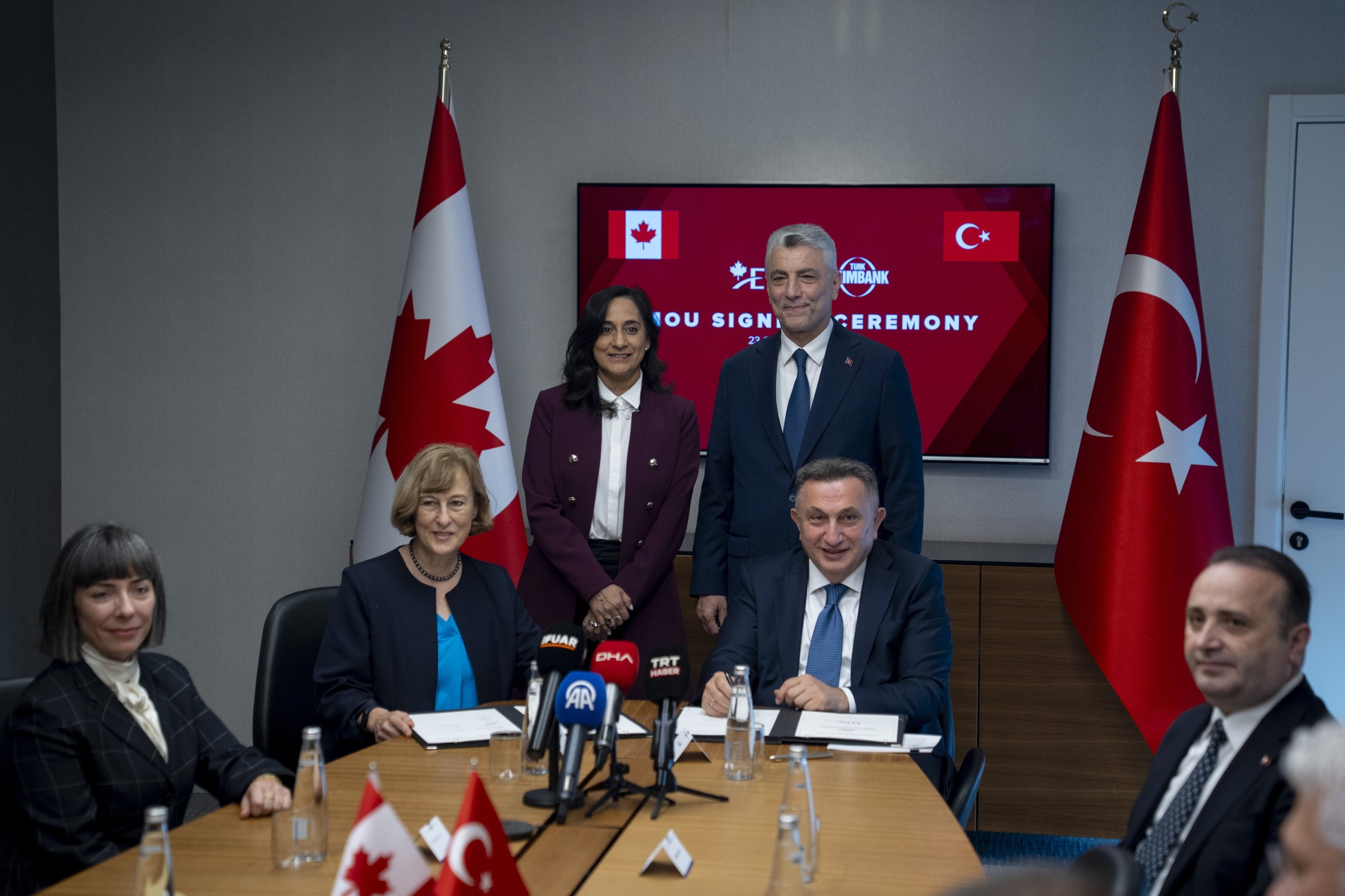
The agreement between Türk Eximbank and Export Development Canada (EDC) followed Bolat’s meeting with Canadian Foreign Minister Anita Anand in Istanbul.
In a statement on Turkish social media platform NSosyal, Bolat said the two discussed expanding bilateral trade and economic relations, alongside negotiations on a Türkiye-Canada free trade agreement.
Canadian and Turkish negotiators will kick off the first round of free trade talks next month in Ankara.
The memorandum aims to support Turkish and Canadian companies in developing joint projects in third-country markets, particularly in Africa, the Middle East, North Africa and Central Asia.
“We will continue our efforts to deepen trade and economic cooperation between our two countries and create new opportunities for our companies,” Bolat said.

Apple’s first folding phone, the iPhone Duo, hit stores around the world on Friday with a price tag of about $2,000 and less of the fanfare that accompanied previous launches.
From Singapore and Shanghai to London and Berlin, demand was strong, but with sales rationed, there were fewer of the round-the-block queues and overnight camp-outs that once marked new iPhone days.
Competitors such as Samsung Electronics and Huawei Technologies have sold premium foldable phones for years, and the Duo is a test of whether Apple can reinvent the small foldable mobile market the way the iPhone did for smartphones.
It is also an early challenge for Apple’s new CEO John Ternus, the former hardware chief who unveiled the phone barely a week after taking charge in September.
Apple’s estimated delivery dates for the Duo had slipped to late January within minutes of pre-orders opening a week ago, as demand outpaced supply. The U.S. company called the response “nothing short of extraordinary.”
Apple capped pre-orders at two handsets per customer and limited sales to walk-in shoppers. In China, France, Hong Kong, India and Japan, they were only available to those who had ordered online.
In Sydney, which was the first Apple store to sell the new passport-shaped phones on Friday, a queue formed outside before opening at 8 a.m. local time (2100 GMT).
“This is a bit of a luxury item for me, because it’s so expensive, but I just think, you know what? Life’s too short,” said Simon Krishnan, a 48-year-old engineer who paid A$3,899 ($2,734) for a 512GB Duo.
In China, a soft consumer market and rising memory costs have led to six straight quarters of declining smartphone shipments, although Apple’s market share has rebounded as some buyers trade up to premium devices.
Liu Wei, a 26-year-old healthcare professional, already has a foldable phone from Xiaomi, but still queued outside a Shanghai store from 6 a.m. for Apple’s first foldable.
“I’ve used Apple products for many years and I have more trust (in the brand), so I bought one on launch day to try it out,” he said.
Many queued to pick up pre-orders, while others hoped for limited stock or to browse display models.
Others were resellers.
In Hong Kong, May, 38, who declined to give his full name, bought a 256GB iPhone Duo, priced at HK$17,499 ($2,231.73), in an online pre-sale and planned to resell it for a profit of around HK$4,000. “A few meals’ worth of money,” he joked.
Paul Francis, 53, was one of several dozen fans who queued overnight outside London’s Regent Street store in pouring rain.
“Some people think it was mad. Including myself,” the charity manager said.
Mixed reviews
Early reviews have praised the Duo’s design as well as its sturdy and barely visible hinge, a major feat for phones whose prominent creased screen has long been a drawback and potential deterrent for buyers.
But reviewers said camera compromises, including no telephoto lens, and third-party apps still to be reworked for the new display size could disappoint some buyers.
They also said the folded Duo is less handy for the quick tasks most users do daily and several prominent reviewers recommended against it for many Apple customers.
“It’s been a lot of fun trying the Duo out for a week, but it feels like I’ve gotten to use an extraordinarily polished prototype – not a finished product that I’d want to buy and carry,” wrote longtime Apple commentator John Gruber.
Tech commentator Marques Brownlee said in a YouTube review that for a regular person who mostly texts and browses, “it is probably a no. But if the $2,000 doesn’t mean much to you, and you like the idea, after the learning curve and getting used to not having facial identification, it is a really fun phone.”
In Berlin, YouTube content creator Patrick Wolter was impressed that the Duo works as a phone and an iPad in one.
“I’ve always found it a hassle to carry around a separate tablet, especially since I already have a laptop and other gear,” he said. “In the long run, this will likely end up replacing those other devices.”
Tough to find
Apple’s entry into the relatively niche foldables market could bring the format to a much broader audience, said Francisco Jeronimo, vice president at market researcher IDC.
IDC expects Apple will take 44% of the foldable market value in 2026 on 31% of units. By 2027, it will become the market leader both in value and units shipped, IDC forecasts.
“Apple has made a convincing case for this form factor,” Jeronimo said after spending a week with the Duo.
“Now comes the next test: turning excitement into availability, adoption and a lasting new chapter for the smartphone market,” Jeronimo said.
Türkiye’s tight monetary stance and its shift to more conventional economic policies underpin its sovereign rating, according to S&P Global Ratings. Slower disinflation and the run-up to elections will test the central bank’s commitment to discipline, while the banking sector faces significant but manageable risks.
Karen Vartapetov, S&P Global’s director and sovereign lead analyst for Central and Eastern Europe and Türkiye, said the country’s BB- sovereign rating with a stable outlook reflects significant progress since 2023. That was when Ankara began reversing years of ultra-loose monetary policy aimed at boosting growth despite surging inflation.
Disinflation regained pace recently after higher energy prices and a succession of shocks halted the momentum following the start of the Iran war. Annual inflation last cooled to below 30% in September.
Weakening domestic demand, slowing retail sales and lower credit growth show that tight policy is feeding through to the economy, and Vartapetov said this will let the central bank keep focusing on disinflation.
“Disinflation has been delayed, but we believe not derailed,” he told Reuters.
The central bank cut its key interest rate to 36% on Thursday after lower-than-expected September month-over-month inflation data. It had held the rate at 37% for its previous five policy meetings.
Vartapetov said the new economic team has gained credibility but needs more. “It’s still not clear how sustainable these tight monetary and macroeconomic policies are in light of the upcoming electoral effects. That’s what we’re monitoring,” he said.
Presidential and parliamentary elections are scheduled for May 2028, though officials have said they could be held a few months early. S&P, whose assessment broadly mirrors those of Fitch and Moody’s, will review Türkiye’s rating in April next year.
Significant risks, but manageable
Regina Argenio, director of financial institutions at S&P Global Ratings, said the agency has just affirmed its Banking Industry Country Risk Assessment (BICRA) for Türkiye.
Argenio said the risks that the banking system faces are significant, but they consider the situation manageable given the progress in reducing inflation and a better economic outlook than expected at the start of the war in the Middle East.
S&P is closely watching banks’ ability to keep rolling over their sizeable external debt, and any disruption there could be problematic, she told Anadolu Agency (AA).
Credit, profitability
Argenio said credit volumes are shrinking because it is very hard for banks to expand lending at current high real interest rates. She said “next year could be better” if easing in monetary policy is reflected in pricing and lending.
SMEs and retail customers struggle with such extreme financing costs, and this is where S&P sees a potential basket of asset-quality risks for banks, said Argenio.
S&P expects net interest margins to improve next year, since lower rates would translate fairly quickly into cheaper Turkish lira funding. Foreign-currency funding costs could rise because of interest rate dynamics abroad. The outcome, Argenio said, depends on the timing and size of rate cuts and on the success of the disinflation program.
Fund crisis
Both analysts addressed the investment fund crisis, which erupted last month when regulators ordered the liquidation of more than 100 funds over allegations that assets had been manipulated and inflated in value.
Vartapetov said S&P views it primarily as a governance and supervision issue rather than a threat to financial stability. Most money withdrawn from the sector moved into lira deposits rather than foreign currency or gold, and policymakers responded quickly to contain the fallout.
“We treat that story as a governance story rather than a broad-based financial crisis,” he said. “What would be important is what sort of lessons the authorities learned and what sort of improvement in supervision is going to take place.”
Argenio said the impact should be limited if the problem proves isolated, and she called the policy response quite strong. Liquidity provided to the banking sector helped contain the effects.
It is still too early to judge the impact on external borrowing costs, she said, and S&P expects those to rise anyway because of global rate dynamics. Turkish borrowers could also face a higher risk premium, depending on how well the situation is contained and how quickly it is managed domestically.
A tanker carrying 40,000 metric tons of Russian diesel is heading toward New York, ship-tracking data showed on Friday, following an agreement reached this month between Moscow and U.S. President Donald Trump.
Trump announced the surprise dealto import Russian diesel as part of his efforts to bring down soaring diesel prices ahead of Nov. 3 U.S. mid-term elections.
Trump also waived parts of a new U.S. sanctions law against Russia and threatened Europe with a U.S. diesel export ban unless countries released more from their emergency reserves to help ease prices.
The Malta-flagged medium-sized tanker Agioi Fanendes was loaded with 40,000 metric tons of ultra-low sulphur diesel in the Russian Baltic port of Primorsk on Oct. 22, according to LSEG shipping data. It is expected to arrive in the United States on Nov. 7.
The identity of the buyer and seller was not immediately known. The cargo will be the first imported by the U.S. since former President Joe Biden announced a ban on imports of Russian oil and petroleum products in 2022.
Russian Deputy Prime Minister Alexander Novak has said that additional shipments will follow as Russian and U.S. companies work out contracts for the deliveries.
President Vladimir Putin’s envoy Kirill Dmitriev, who also heads Russia’s sovereign wealth fund, said last week that the U.S. Treasury had asked the fund to help sort out tricky payment issues relating to the agreement.
The deal also involved Russia agreeing to lift a self-imposed ban on diesel exports.
Trump announced on Oct. 9 that Russia would immediately export 300,000 metric tons, or 2.25 million barrels, to the US and global markets, followed by 500,000 tons in November and 1 million tons “immediately thereafter.”
Novak has said that Russia would be able to increase its diesel exports to its usual levels of 3-3.5 million tons per month by the end of the year.
Last week, export cargoes were loaded in the Russian Baltic port of Primorsk, but their final destinations are not clear, with most tankers signalling Gibraltar, the Atlantic Coast or Port Said, LSEG shipping data showed.
Since the EU imposed a full embargo on imports of Russian oil products in February 2023 over the war in Ukraine, Russia has exported diesel mainly to Brazil and Türkiye, as well as to African countries.
Shares in Swedish carmaker Volvo Cars plunged Friday after it said U.S. tariffs and strong competition from local brands in China pushed it into a third-quarter loss.
The company also said it would cut about 2,500 jobs worldwide.
Volvo Cars, controlled by Chinese group Geely, reported revenue of 66.9 billion kronor ($6.7 billion) for the third quarter, down nearly 23% from the same period last year.
It swung to a net loss of 5.7 billion kronor for the quarter from a net profit of 4.5 billion kronor a year earlier.
Volvo delivered about 141,300 vehicles globally in the three months to the end of September, 11% fewer than a year earlier.
Shortly after 0800 GMT, its shares were down almost 3%.
“We continue to operate in a very tough environment with strong external challenges: de-globalization, hypercompetition and climate change,” chief executive Hakan Samuelsson said in a statement.
In response, the company announced a new five-billion-kronor savings plan it said would lead to about 2,000 job cuts in Sweden and 500 more globally, “through natural attrition and by targeted exit packages to employees.”
Samuelsson cut jobs at the firm last year, leaving the company with an average of about 39,300 staff on board in the first nine months of 2026, compared with 43,000 in the same period a year earlier.
The company, which had bet heavily on electric vehicles, said the removal of consumer incentives for EVs in the United States under President Donald Trump had also hit its margins.
In 2024, Volvo Cars dropped a plan to transition to exclusively EV sales by the end of the decade.
“We are convinced that we have the right long-term strategy addressing these challenges,” Samuelsson said.
“However, in the short term, with severely challenged volumes, we need to reinforce our turnaround plan with additional decisive actions, lowering our break-even point and improving cash flows to make us more resilient.”
Struggling along with other European auto companies in the face of a difficult global landscape, Volvo Cars last year announced an 18-billion-kronor cost-cutting plan.
The company said in September that Samuelsson would resign when his contract ends, with Skoda Auto CEO Klaus Zellmer set to replace him “no later” than October next year.
Türkiye’s Parliament on Thursday passed a law governing the liquidation of certain funds caught up in last month’s turmoil, allowing interim payments of up to TL 1 million ($20,000) to investors.
It also creates a mechanism to recover losses from those behind the scandal, seize their assets and distribute the recovered money to investors.
President Recep Tayyip Erdoğan said on Wednesday that payments to investors in the funds being wound down would pick up speed once the bill takes effect.
The scandal broke over a month ago, after several investment funds said they were unable to satisfy redemption demands, prompting prosecutors to open an investigation into allegations of widespread market manipulation.
Regulators placed seven firms managing 131 funds into liquidation, affecting nearly half a million individual investors. The Justice Ministry says more than 80 people have been arrested.
The law covers funds whose liquidation the Capital Markets Board (SPK) ordered on Sept. 17 and which have not been fully liquidated when the law is published. It does not set up a general or permanent liquidation regime for other investment funds.
Earlier on Thursday, a statement following a meeting of the Fund Coordination Board, a body created to oversee the liquidation process, said 84 of the funds have been settled, with TL 49.7 billion paid out to 55,755 accounts.
Interim payments
For funds designated by the SPK, according to the law, interim payments will be based on each investor’s “net investment amount.”
Investors whose net investment amount is below TL 1 million can be paid that amount. Investors whose net investment amount is TL 1 million or more can be paid up to TL 1 million.
The interim payment cannot exceed the net investment amount calculated without indexation. In funds other than money market funds, the total value of the investor’s fund units at the end of the previous day will also act as a ceiling.
If the cash available cannot cover everyone’s calculated amounts, the SPK can set methods to make sure as many investors as possible receive payments.
The law does not mean every investor will definitely receive TL 1 million or that all losses will be covered. Payments will depend on each investor’s net investment, the fund’s resources and procedures set by the SPK.
Who is liable for losses
The law addresses how losses from assets unlawfully taken out of the funds will be recovered. Money, securities, goods, rights and receivables taken from fund assets can be treated as unlawfully removed if the transfer breached regulations.
The same applies if it appeared lawful but served no real economic purpose for the fund. This covers loans, advances, collateral, transfers, sales, repo transactions and similar deals with related parties, controlling shareholders, managers or third parties.
The portfolio management company that founded or manages the fund will be primarily liable. If the loss cannot be collected from the company in whole or in part, or it is clear it cannot be, the people and legal entities named by the SPK, as well as those found to have acted with them, can be held personally liable. Leaving a post does not remove liability for actions and decisions taken while in it.
Asset seizures
In investigations into acts linked to the funds, assets can be seized under the Criminal Procedure Code. Money and securities that can legally be returned directly to a fund can be returned to the fund or to a recovery account by order of a prosecutor, judge or court.
For assets that cannot be transferred directly, such as real estate, the Savings Deposit Insurance Fund (TMSF) can be appointed as trustee. The TMSF can sell or liquidate these assets without waiting for the outcome of the case.
Assets that a court orders confiscated, and that came from the fund or cover its losses, can be passed to the fund or its recovery account without being recorded as Treasury revenue.
Treasury and Finance Minister Mehmet Şimşek said this week that anyone who did not voluntarily return profits obtained through market-disrupting activities would face legal proceedings.
How recovered money reaches investors
The TMSF will set up a separate recovery account for each fund, held apart from its own assets and usable only for that fund’s liquidation and investor payments. The money cannot be used for other purposes, pledged as collateral, or seized, even for public debts.
After necessary costs, the remaining money goes to the liquidating institution if liquidation is still under way. If liquidation has finished, it goes to the Investor Compensation Center (YTM) to be paid to fund holders named by the SPK. The YTM will pay in proportion to unit ownership. Amounts below a minimum payment set by the SPK will be carried forward and added to later distributions until they reach the minimum.
The SPK will determine losses, responsible parties and their liability for each fund and notify the TMSF. The TMSF can then begin collection from those people’s assets under the law on collecting public receivables. Istanbul administrative courts will have jurisdiction over resulting cases.
Identifying investors
Fund holders will be identified by reconciling records with the Central Registry Agency (MKK).
Investors whose units were blocked because orders sent to the TEFAS electronic platform on or before Sept. 17 could not be carried out, because the fund defaulted or did not publish a unit price, will also be covered.
Türkiye is waiting for Qatar to send it a sale contract and a draft training program as part of its deal with Britain to procure Eurofighter Typhoon jets, the Defense Ministry said Thursday.
NATO allies Türkiye and Britain signed the deal for 20 jets last year, in a move aimed at deepening bilateral ties and bolstering Turkish air defenses. Ankara has said it was also seeking 24 more jets from Qatar and Oman.
Under the deal with Britain, Qatar and Oman can supply Türkiye with some of its own Typhoons, though that requires a separate sales contract.
At its weekly press briefing, the ministry said that talks on the procurement were continuing and that Turkish and Qatari delegations discussed technical and logistical matters in August and September. These included the scope of jets and ammunition to be procured, training for pilots and maintenance teams.
“It is expected for Qatar to prepare the draft training program and the sales contract to be sent to our country,” it said.
Britain, a leading partner in the Eurofighter program, had been Türkiye’s most vocal supporter, and the agreement followed long negotiations to overcome a German objection to the sale.
Türkiye’s interest in the Typhoons was first reported in 2022, as Ankara grew frustrated with prolonged negotiations over the acquisition of F-16 fighter jets from the U.S.
Türkiye is scheduled to receive the first of the batch of jets from the U.K. in 2030. The deal provides the option for the sale of more jets in the future.
Türkiye meanwhile signed an accord with Qatar, Pakistan and Indonesia on Wednesday to boost defense cooperation and strengthen defensive capabilities, including through joint development and production.
The ministry added that its defense budget was increased for 2027 due to ongoing domestic defense industry projects for air defenses and platforms, Türkiye’s indigenous Kaan fighter jet program, drone development and shipbuilding.
The homegrown fifth-generation warplane is sought to replace the Air Force Command’s aging F-16 fleet, which is planned to be phased out starting in the 2030s.


-
 Economy3 days ago
Canadian PM Carney due in Türkiye amid push for free trade deal
-
 Economy3 days ago
Turkish households’ confidence in lira remains resilient: S&P
-

 Politics2 days ago
Türkiye’s AK Party edges closer to reform local governance
-

 Sports17 hours ago
Beşiktaş hold Palace with 10 men, Trabzonspor beat Hearts
-
 Politics3 days ago
Turkish Cypriot leader vows continued diplomacy to end isolation
-
 Politics2 days ago
Merz hails Turkish workers’ role in building modern Germany
-
 Economy2 days ago
Türkiye, Qatar, Pakistan, Indonesia sign ‘Badr’ defense co-op accord
-
 Politics3 days ago
Former lawmaker returns to Türkiye’s AK Party as it boosts seat numbers