
Economy
Economic crisis in Gaza is worst ever recorded: UN

Gaza is suffering the world’s worst economic crisis ever recorded, with nine in 10 businesses destroyed and hundreds of thousands of people unemployed, a top U.N. development agency warned Thursday.
Israel’s genocidal military campaign devastated the Palestinian enclave of two million people before a patchy cease-fire was announced in October 2025.
“The collapse of the economy of Gaza is the world’s most severe economic crisis on record,” said Pedro Manuel Moreno, acting secretary-general of the U.N. Conference on Trade and Development (UNCTAD).
“It has wiped out decades of development and generated an acute economic crisis for its people,” he told reporters in Geneva as the organization released a new report.
It said 92% of Gaza’s “economic establishments have been damaged or destroyed.”
The territory’s daily per capita GDP is $0.58 a day, the report said. Prices are 274% higher than in 2022.
Israel’s attacks killed more than 73,000 people, according to the territory’s health ministry, whose figures are regarded as reliable by the United Nations.
It displaced virtually the entire population and damaged or destroyed most of its buildings.
‘Everyone in Gaza multidimensionally poor’
Before Israel’s campaign started in October 2023, “two out of three Gazans were poor. Today, everyone in Gaza is multidimensionally poor,” said Mutasim Elagraa, UNCTAD’s coordinator for assistance to the Palestinians.
Industrial activity and agricultural production have fallen by 94%, with only 1.5% of arable land accessible, forcing “total dependence on humanitarian food aid,” Elagraa said.
According to the report, the conflict has destroyed hundreds of thousands of jobs, leaving more than 90% of Gaza’s working-age population unemployed.
The report also detailed an economic and financial crisis in the occupied West Bank, citing “reduced access to land and natural resources linked to (Israeli) settlement expansion.”
The Palestinian government has borrowed heavily from local banks, drawn on the Palestinian pension fund and owes money to private contractors, Elagraa said.
The Palestinian territories risk a “banking collapse,” he warned. The “political and social and humanitarian consequences will be immense.”

President Recep Tayyip Erdoğan expressed confidence Thursday that Ankara would regain access to the U.S. F-35 fighter jet program, saying he expected “concrete” steps from Washington to that end.
U.S. President Donald Trump “expressed a positive willingness regarding Türkiye’s return to the F-35 program,” Erdoğan told reporters before boarding the plane to return from the U.N. General Assembly in New York.
“We expect this willingness to now translate into concrete steps,” he added.
“We are continuing our discussions on this matter. I am confident we will achieve results.”
Türkiye has long sought to resolve the long-running F-35 dispute with Washington, and the Trump administration has also shown willingness to draw a line under the matter.
In 2019, the U.S. removed Türkiye from the F-35 program, where Ankara was also a production partner, following its purchase of the S-400 systems from Russia. It later also imposed sanctions on its NATO ally.
Washington claimed the system would endanger the jets and is incompatible with NATO systems, while Ankara has repeatedly said there is no conflict between the two and has proposed a commission to study the issue.
Türkiye also said it fulfilled its obligations on the F-35s and that its suspension broke the rules.
At the NATO summit in Ankara in early July, Trump said he would lift U.S. sanctions and signaled a willingness to sell F-35 jets to Türkiye.
“We’re going to be taking the sanctions off,” Trump said. “It’s time. We don’t want to sanction friends.”
The European Bank for Reconstruction and Development (EBRD) expects Türkiye’s economy to expand by 3.0% in 2026, down from a 3.5% forecast made in June, the bank said in its new report published Thursday.
Growth is projected to accelerate to 4.0% in 2027, the bank said in its latest Regional Economic Prospects (REP) report.
The downward revision reflects weaker domestic demand amid elevated inflation and tight financial conditions, as well as the continuing impact of the conflict in the Middle East.
Growth is slowing across a range of emerging market nations, with economies in Iraq, Lebanon and Ukraine hamstrung by the effects of war, according to the development bank.
High energy prices, rising borrowing costs and issues ranging from drought in Europe to the ongoing closure of the Strait of Hormuz are combining to depress economic growth, the EBRD regional economic outlook found.
Across the 40 economies it covers, the EBRD expects growth of 2.5% this year, 0.6 percentage points below its June forecast and its second consecutive downgrade.
“What’s a cause for concern is that there are multiple pressure points, from diesel to cost of wheat to cost of borrowing,” EBRD chief economist Beata Javorcik said.
“Pressures are building up, and there are considerable downside risks to our forecast.”
The bank also warned about wheat prices and exports from Ukraine.
Wheat prices globally are up roughly 30% since February as Black Sea attacks cut Ukrainian exports to the lowest level since April 2022, Javorcik said.
Elevated wheat prices threaten food-importing economies, particularly countries such as Egypt that heavily subsidize bread and grain products. Russia and Ukraine combined account for roughly a quarter of global wheat exports.
The U.S. and China have agreed to extend a bilateral trade truce that would have expired in November for another two months, U.S. Treasury Secretary Scott Bessent said Wednesday as Chinese President Xi Jinping arrived for talks with President Donald Trump.
“We will extend what we call the Busan Agreement – the economic detente between the two countries that was scheduled to end on Nov. 10. That is going to be extended until Jan. 10,” Bessent said in an interview with Fox News.
“There are some deliverables that have not been perfect on the Chinese side, so we also want to see – now that we’ve sat down and told them our expectations – if over the coming months, they could be a bit more fulsome in enacting the agreement,” he added.
Bessent also hinted that there could be further announcements in the coming days from the Chinese delegation, such as agreements to buy more U.S. agricultural products and potential deals in the financial services sector.
Iranian airlines were forced to cancel some international flights Wednesday after the U.S. tightened sanctions on Iran’s aviation industry in a new effort to cripple its economy.
Separately, Tehran later Wednesday threatened to paralyze airports in neighboring countries if they cooperate with the U.S. by disrupting Iranian flights.
U.S. Treasury Secretary Scott Bessent said Monday that all Iranian airlines would be forced to stop operating Wednesday by the threat of secondary sanctions on air services providers, seven months into the war between the U.S. and Iran.
A travel agent in Tehran told Agence France-Presse (AFP) that flights to Baghdad, Muscat, Qatar, Georgia and Azerbaijan had all been suspended, but routes to multiple other destinations remained available, including China.
The new U.S. measures came as part of an earlier threat by the Trump administration to impose “economic D-Day” on Iran in an attempt to force it into submission.
But Iran’s aviation sector has already been a target of sanctions for years, and it remains unclear what the full impact will be and which other countries will comply.
Tehran issues threat
Even after the new sanctions took effect Wednesday, a flight from Tehran operated by Mahan Air, one of Iran’s biggest carriers, landed in Guangzhou in China, according to tracking data from FlightRadar24.
China said Tuesday that it opposed the U.S. sanctions, calling them illegal. A flight to Shanghai was also due to depart Wednesday, according to Tehran’s international airport.
Some flights to Istanbul were also scheduled, though others had been canceled, the travel agent in Tehran told AFP.
“The situation is unstable and we are no longer selling tickets for the time being for fear of cancelations,” the agent said, requesting anonymity.
A Mahan flight from Kabul was also expected to arrive in Tehran. According to the website for Tehran’s international airport, other connections to Türkiye and Armenia remained possible using smaller Iranian airlines, including Varesh.
Flights to Najaf in Iraq and Dubai in the United Arab Emirates (UAE) were also scheduled.
Bessent had vowed Monday to “shut down” Iranian carriers and punish anyone doing business with them.
“If they land, you cannot provide them with fuel, you cannot provide them with landing services, you cannot sell them tickets or you will be knocked out of the dollar system,” he warned other countries.
The restrictions will further complicate the ability of Iranians to travel abroad or return to their country.
If neighbouring countries cooperate with the U.S. by stopping Iranian flights, Iran will ensure their airports cannot function, Mohsen Rezaei, secretary of Iran’s Supreme National Security Council, said Wednesday in an interview with state TV.
Pilgrims
Iranian media also reported cancelations, with the Tasnim news agency Tuesday citing a civil aviation spokesperson as saying that Baghdad and Muscat airports “will no longer accept” Iranian flights.
The agency added that “other international flights, including Istanbul, will operate as scheduled.”
According to Tasnim, Iran’s aviation authorities were in talks to reroute Baghdad flights to Najaf, a major destination for Iranian pilgrims.
On Wednesday, the agency said its correspondent in Najaf had reported Iranian flights to the city were running as normal.
It quoted a source at the airport as saying no order had been received from Iraqi authorities to halt flights.
While the Iraqi government has not publicly announced plans to enforce the ban, several sources, including a senior government official, told AFP that Baghdad would comply with the U.S. measures.
The prospect of a suspension of flights between the two countries has sparked concerns among some Iraqi travel agents.
In Najaf, home to one of the most revered Shia Muslim shrines, agent Haidar Shamaa said “most travel companies in the city depend on booking flights” to Iranian airports.
Several travel agencies said panicked clients were calling for updates and were considering switching to land routes, which would mean much longer journeys.
Chinese tech giant Alibaba unveiled plans Wednesday to expand its overseas data centers, targeting markets across Europe and the Middle East.
Hangzhou-based Alibaba is one of the frontrunners in China’s artificial intelligence industry, with its Qwen model among the world’s most downloaded AI models.
The company said it would “establish its first cloud regions” in Türkiye, Finland and the Netherlands, while “expanding its data center footprint in Malaysia, Germany, the United Arab Emirates (UAE), France and Hong Kong” over the next 12 months.
The announcement came ahead of a highly anticipated meeting between Chinese President Xi Jinping and his U.S. counterpart Donald Trump in Washington, where the two leaders are expected to discuss trade tensions, among other topics.
Beijing and Washington are locked in a tech rivalry increasingly centered on frontier industries including semiconductors, AI and robotics.
Alibaba CEO Eddie Wu said Tuesday that the company was planning to train an AI model with five to 10 trillion parameters, which would make it several times bigger than the current largest Chinese model.
Alibaba is targeting more than 20 gigawatts of global data center capacity by 2032, Wu said during the firm’s annual flagship conference in Hangzhou.
The company also unveiled a new AI chip at the conference, the Zhenwu V900 – which it said would deliver three times the performance of its predecessor, Zhenwu M890.
“It’s the most powerful AI chip in China today,” Wu said.
The Zhenwu M890 is widely believed to be two times more powerful than the chip custom-made for the Chinese market by U.S. pace-setter Nvidia, the H20.
Washington has long tried to slow China’s progress with export controls on the advanced chips needed for cutting-edge AI, blocking access to top-end U.S. semiconductors such as Nvidia’s.
Beijing’s push for technological self-reliance has also encouraged Chinese technology companies to adopt domestic chips as alternatives to foreign products.
The challenges Türkiye has encountered recently are confined to a limited segment of its capital markets and do not represent a systemic structural weakness, Vice President Cevdet Yılmaz said Wednesday.
Yılmaz said administrative and judicial measures had been taken to address the issues.
Turkish authorities acted last week to support financial stability, including measures to boost Turkish lira liquidity and ease some capital and margin requirements after some funds struggled to meet withdrawals during a stock market sell-off.
“There is no structural problem in our capital markets. We are facing some specific issues in a limited area, and once we overcome them, our capital markets will continue on their path even stronger than before,” Yılmaz said.
“All necessary administrative and legal measures have been taken in this regard, and continue to be taken.”
He was speaking at the opening of the MÜSIAD EXPO 2026 and the International Business Forum (IBF) in Istanbul, organized by the Independent Industrialists and Businessmen’s Association.
Following the volatility last week, authorities filed criminal complaints over alleged market manipulation and ordered the liquidation of 131 funds managed by seven asset managers.
Türkiye’s capital markets regulator said Wednesday that almost half a million investors hold stakes in the investment funds said to be worth more than $18 billion.
Yılmaz went on to stress what he said were strong macroeconomic fundamentals of the Turkish economy.
He cited Türkiye’s low public debt, manageable budget and current-account deficits, stronger reserves and sound banking system.
“The banking system is extremely sound, and the capital adequacy ratio is high. In short, our macroeconomic fundamentals are strong; our citizens should have no doubt about this,” Yılmaz added.
He said the country’s current-account deficit had remained below 2% of GDP in recent periods, although energy prices that have surged amid the fallout of the Iran war could push it slightly above that level this year.
He also said Türkiye’s banking sector had high capital adequacy ratios and that the country’s credit default swap (CDS) premium had declined compared with previous periods.
Volatile period for global trade
Globally, Yılmaz said trade was facing a volatile period amid geopolitical tensions, rising protectionism and the green and digital transitions.
He said the Middle East conflict was weighing on expectations for global goods and services trade in 2026, while raising logistics costs and adding inflationary pressure through commodity prices, particularly energy.
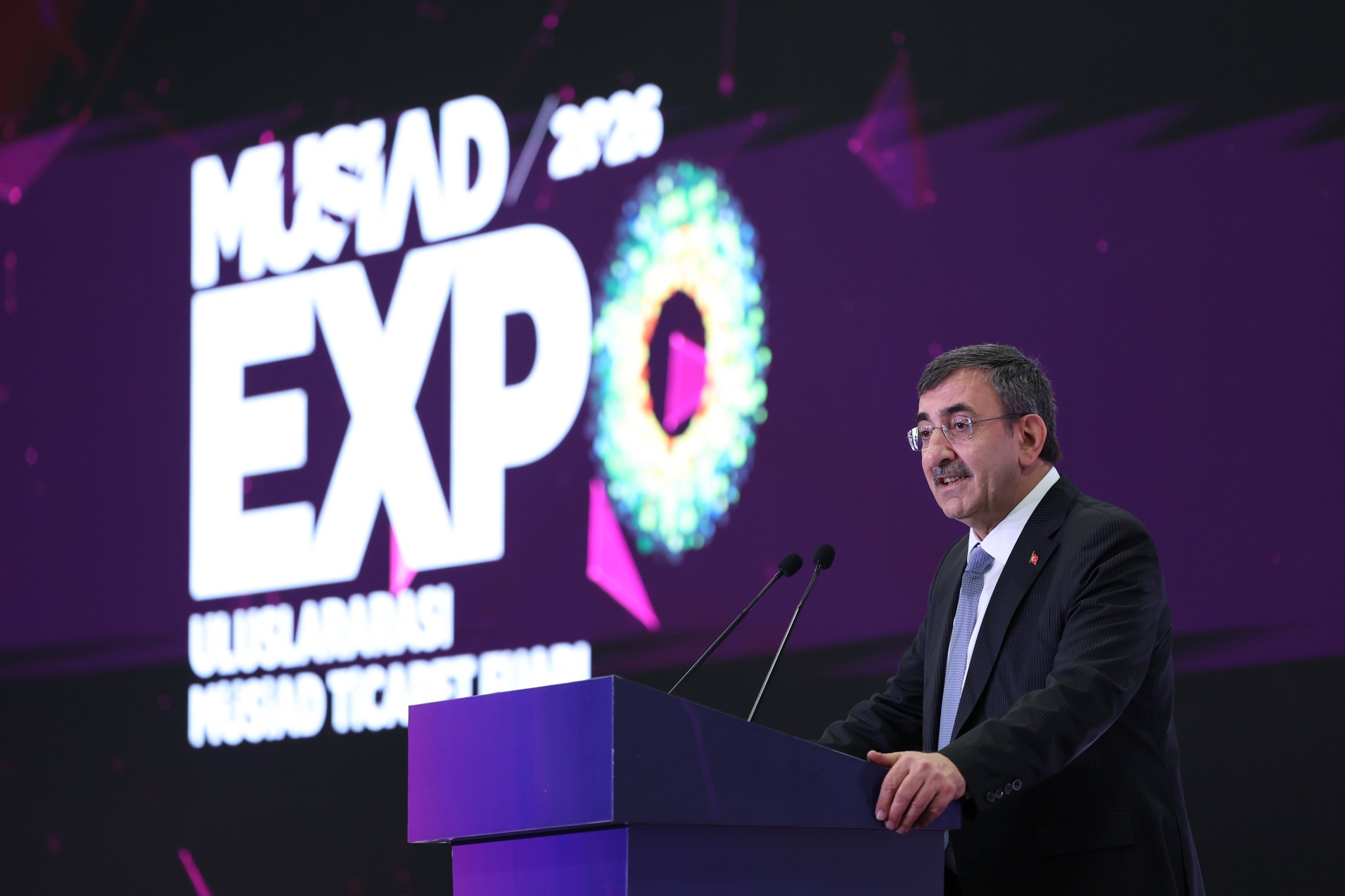
Yılmaz said Türkiye’s economy was showing a relatively positive performance thanks to its production capacity and export strength despite adverse global conditions.
He said the economy exceeded $1.6 trillion in 2025 and annualized national income surpassed $1.7 trillion in the first half of 2026. The government expects GDP to exceed $1.8 trillion by the end of the year.
Goods exports rose from $36 billion in 2002 to $273.2 billion in 2025 and reached an annualized $280 billion as of August 2026, according to Yılmaz.
Services exports increased from $14 billion in 2002 to $125 billion, while combined goods and services exports approached $400 billion in 2025, he said.
$450 billion export target
Türkiye aims to increase combined goods and services exports from around $400 billion currently to $450 billion by the end of 2029, according to the government’s Medium-Term Program (MTP).
Yılmaz said customs infrastructure, free zones and measures supporting green and circular economic transformation would also be developed to improve competitiveness.
Main markets face weaker growth
Yılmaz said Türkiye’s main export markets, particularly Europe and the Middle East and North Africa (MENA), were facing weaker growth.
He said countries accounting for more than 90% of Türkiye’s trade were expected to grow by around 1.6% this year, making 2026 a challenging year.
However, he said Türkiye’s trading partners were expected to grow faster than the global economy next year, partly due to base effects and developments related to the war.
Yılmaz said Türkiye was pursuing strategies to diversify its export markets, including efforts targeting distant markets, Islamic countries and African economies.
He also highlighted transport and logistics projects including the Development Road, Middle Corridor and Zangezur Corridor, saying Türkiye aimed to increase its role in east-west and north-south trade flows.
The government also plans to integrate ports, logistics centers, industrial zones and railway networks to strengthen Türkiye’s position as a production, logistics and trade hub, he said.
MÜSIAD EXPO kicks off
Meanwhile, the four-day MÜSIAD EXPO, which kicked off Wednesday, is a multisector trade fair bringing together producers, brands and international buyers from different industries.
Providing a meeting point for global trade professionals, the event offers participants the opportunity to build direct business connections in new markets.
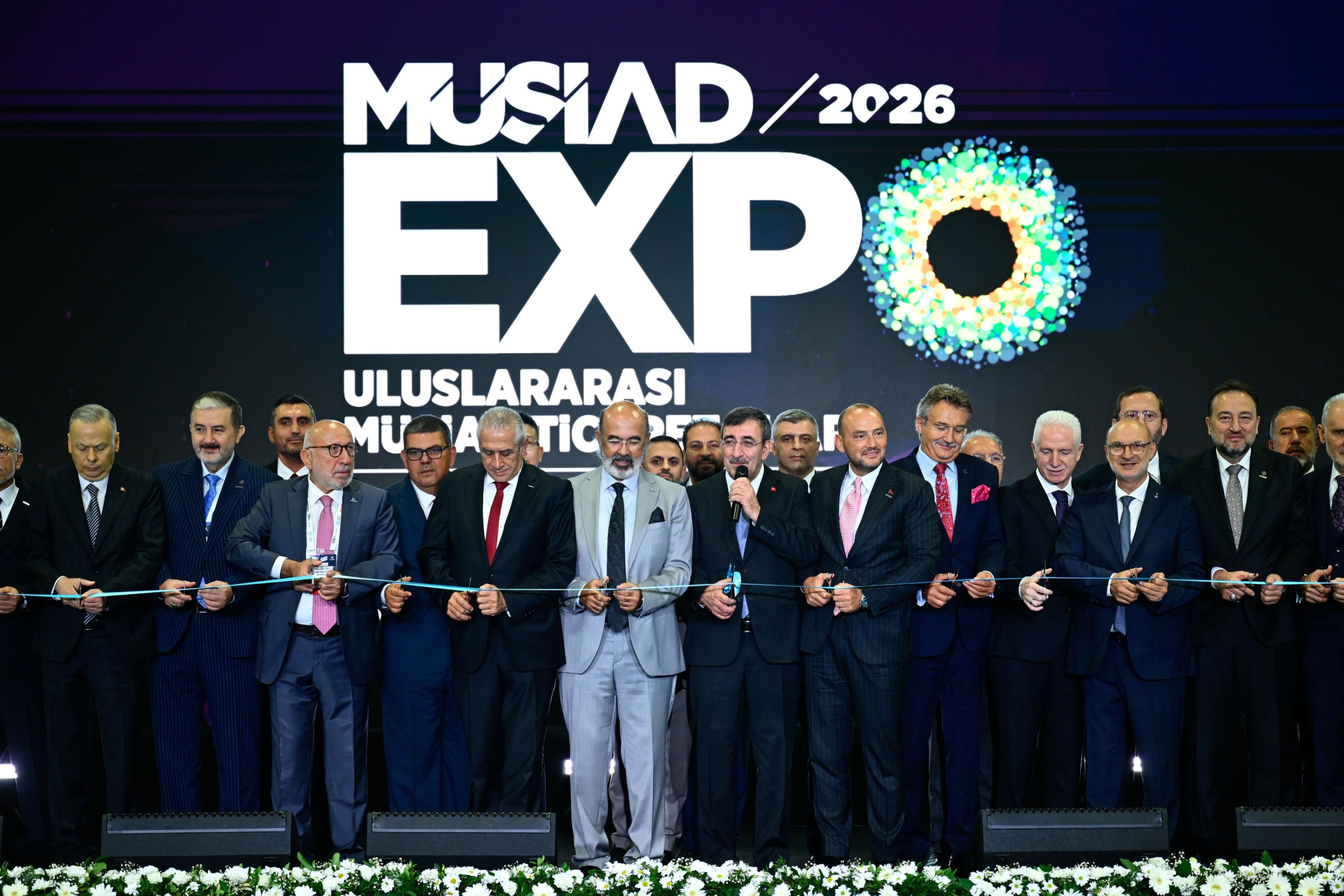
With an increasing number of participants every year, expanding sector diversity and a strong business network, MÜSIAD Expo is a trade platform that brings investors, industrialists, entrepreneurs and business representatives together.
Alongside the event, the 29th International Business Forum also began under the theme “The Transformation of Humanity and the Business World in the Age of AI.”
MÜSIAD Chair Burhan Özdemir noted that they gathered to discuss Türkiye’s determination to produce, its business ethics, and its global vision.
Özdemir reminded the audience that the first expo took place in late October 1993, and that they represented an approach centering on ethics in trade, responsibility in production, and trust in the business world.
He pointed out that the exhibition became one of the strongest trade gatherings not only in Türkiye but also in the broader region.
Organizers aim to host more than 50,000 visitors over four days at the fair, which represents 369 companies from 18 different sectors in an area of approximately 25,000 square meters.
He stressed that the main issue for them was transforming this gathering into new markets, partnerships, investments, and lasting relations of trust.
MÜSIAD expects the fair to generate at least $5 billion in trade volume.


-
 Politics3 days ago
Fidan urges US to use greater leverage on Israel for regional peace
-

 Economy3 days ago
Paramount settles states-led lawsuit, clearing path for Warner buyout
-

 Lifestyle2 days ago
Venice considers raising tourist entry fee to $34 to curb overtourism
-

 Politics3 days ago
Turkish authorities examine FETÖ-linked letters in Kozinoğlu death case
-

 Economy3 days ago
Türkiye manufacturing capacity utilization, business confidence edge higher
-
 Economy3 days ago
Türkiye says continues work with UK on Eurofighter procurement
-

 Politics3 days ago
Russia ‘works’ with Türkiye for Black Sea shipping safety
-
 Politics3 days ago
Türkiye leaves its mark in Africa with peace diplomacy