
Politics
Fellow inmate, prosecutor detained over Turkish intel officer’s death

Security forces detained four people on Thursday over the 2011 death of Kaşif Kozinoğlu, an intelligence officer, while in a prison in Istanbul.
Among the suspects detained are two former prosecutors whose jurisdiction covered the prison where Kozinoğlu was held and a former inmate who shared the same prison ward with Kozinoğlu at the time of his death. Authorities also issued a detention warrant for former Col. Hasan Atilla Uğur, who also shared Kozinoğlu’s ward, but Uğur remains at large; media outlets report he is currently on the island of Cyprus.
Kozinoğlu, a former soldier, was a senior figure in the National Intelligence Organization (MIT), mostly working in Central Asia, before his arrest in March 2011 as part of the notorious Ergenekon probe. Ergenekon was allegedly the name of a “deep state gang” that included influential figures, from generals to journalists. Kozinoğlu’s name came up during a search of the premises of a news website, specifically in a digital document that allegedly contained confidential information about MIT leaked to the website. Kozinoğlu was accused of leaking the information but died in prison on Nov. 12, 2011, before he had a chance to defend himself in court.
Years later, Ergenekon turned out to be part of sham trials orchestrated by judiciary and law enforcement infiltrators of the Gülenist Terror Group (FETÖ). FETÖ stands accused of fabricating evidence in the Ergenekon case in a bid to imprison critics of the terrorist group who opposed its infiltration of public institutions. According to media outlets, Kozinoğlu had prepared his defense before his death and was expected to claim that FETÖ had targeted him through the trial.
Media outlets also reported that Enver Altaylı, another former intelligence official imprisoned for links to FETÖ, sent letters to the terrorist group’s leader, Fetullah Gülen, warning about Kozinoğlu’s rise in MIT and claiming that Kozinoğlu would take action against FETÖ in Central Asia, where the group had a large network, if he were promoted to the top office of the intelligence organization.
At the time, a probe into Kozinoğlu’s death in prison ended with a decision not to prosecute, while his cause of death was listed as a heart attack.
The Justice Ministry recently ordered a new probe into Kozinoğlu’s death as part of a drive to investigate notable cases of the past that either remained unsolved or were treated as suspicious but concluded without further prosecution. Authorities recently ordered the exhumation of Kozinoğlu’s body as part of the investigation.
Media reports say one of the prison guards, who was later found to be linked to FETÖ, deliberately delayed in intervening when Kozinoğlu pressed an emergency button in the ward after suspecting that he was having a heart attack. Kozinoğlu was taken to a hospital but was pronounced dead there. The guard is among the wanted suspects in the case, while other prison guards and officials who worked at the prison at the time of Kozinoğlu’s death were detained earlier this month.
The new investigation also focuses on “Valley of Wolves,” or “Kurtlar Vadisi,” a popular TV show about the mafia and “deep state,” in which Kozinoğlu’s death was portrayed through a fictional character with striking similarities to the intelligence officer before his death. Prosecutors summoned screenwriters of the show to testify earlier this week, but the show’s creators claimed that it was simply a coincidence that Kozinoğlu died two days after an episode of the show in which other characters ordered the death of “Kazım Kaşifoğlu” was aired. In another episode aired a few weeks after Kozinoğlu’s death, the Kaşifoğlu character, a shady figure in the TV series, was killed by poisoning while in prison, like his real-life counterpart, and his death was covered up as a heart attack.
In a statement on Thursday, Justice Minister Akın Gürlek said that they were determined to shed light on any suspicious death “no matter how many years have passed.”
Gürlek said in a social media post that judicial proceedings were underway against four suspects and that they were investigating what happened on the night Kozinoğlu died, the course of the initial investigation and the fate of evidence collected during that investigation.

The head of Türkiye’s National Intelligence Organization (MIT) Ibrahim Kalın visited Afghanistan’s Kabul and Kandahar, security sources said Wednesday.
Kalın held talks with Afghan officials including General Directorate of Intelligence head Abdul Haq Wasiq, first deputy prime minister Abdul Ghani Baradar, Interior Minister Sirajuddin Haqqani and Defense Minister Mawlawi Mohammad Yaqoob Mujahid.
The talks focused on steps to deepen security and intelligence cooperation between Türkiye and Afghanistan, as well as bilateral relations.
Sources said Kalın’s talks focused on steps to enhance cooperation between the two countries on security and intelligence and the improvement of overall bilateral relations. Officials also discussed regional and global developments, including the U.S.-Israel-Iran war, the fight against terrorism, migrant trafficking and drug smuggling.
It has been 65 years since Adnan Menderes was hanged by a military junta, but the memory of the prime minister is still vivid. He is remembered as a beloved figure and one of the first victims of anti-democratic coups in the history of the Republic of Türkiye.
On Thursday, dignitaries, including Interior Ministry officials, attended a remembrance ceremony for Menderes in Istanbul, while President Recep Tayyip Erdoğan issued a statement denouncing the unfair sentencing of Menderes, Foreign Minister Fatin Rüştü Zorlu and Finance Minister Hasan Polatkan. Menderes was executed on Sept. 17, 1961, while Zorlu and Polatkan were hanged one day earlier.
Menderes, whose Democrat Party swept to power with 52.7% of the vote in 1950, governed for a decade and is remembered for liberalizing the economy, expanding religious freedoms by ending the ban on the Arabic call to prayer and steering Türkiye into NATO membership in 1952. His populist slogan, “Enough. The nation has the word,” earned him lasting popularity as “the people’s man.”
On May 27, 1960, a group of officers calling themselves the National Unity Committee seized power, dissolved Parliament and detained leading officials, including President Celal Bayar and Menderes. Their trials were held on Yassıada Island, where Menderes and other officials faced charges ranging from constitutional violations to mishandling unrest.
On Sept. 15, 1961, a special court sentenced 15 men to death. The junta approved the executions of Menderes, Zorlu and Polatkan. Menderes was hanged on Imralı Island near Istanbul. Bayar’s sentence was commuted due to his age.
The executions shocked the nation, and in 1990, Türkiye’s Parliament formally restored the trio’s honor. Their remains were moved to a state memorial in Istanbul. Yassıada, where the trials were held, was later renamed Democracy and Freedom Island.
Speaking at the commemoration ceremony by the graves of the three men, Interior Minister Mustafa Çiftçi announced that the body of his predecessor, Ismail Namık Gedik, would also be relocated to the memorial site. Gedik was arrested along with three men but died while in detention. He was buried in Ankara after a probe into his death was closed by the military junta, which ruled that he had died after jumping from the window of the military school where he was being held. Gedik’s family objected to the ruling. Çiftçi said the putschists claimed Gedik had committed suicide, but they rejected “that narrative conceived in the dark days of the coup.” “He is a martyr of the May 27 oppression,” Çiftçi stated.
The minister said at the ceremony that Menderes and the three ministers were representatives of the “nation’s will to have a say in its own future” and that this will “was hijacked” in 1960. He denounced the trial process on Yassıada. “(The putschists) thought the nation’s will would be erased when they removed Menderes, Zorlu, Polatkan and Gedik, but you cannot erase the nation’s love for them; you cannot erase the nation’s memory,” he said.
“Throughout the period stretching from the May 27 coup to March 12, from Sept. 12 to Feb. 28, from the April 27 e-memorandum to July 15, the tutelage mentality manifested itself in different forms,” Çiftçi said, referring to coups, coup attempts and ultimatums to elected governments by powerful military figures who portrayed themselves as guardians of Türkiye and collaborated with like-minded politicians while attempting to oust governments in 1960, 1971, 1980, 1997 and 2007.
On July 15, 2016, infiltrators from the Gülenist Terror Group (FETÖ) within the Turkish Armed Forces (TSK) again tried to seize power, only to meet strong public resistance, for the first time in the history of the Republic of Türkiye.
“On the night of July 15, our noble nation, taking to the streets and squares at the call of President Recep Tayyip Erdoğan, stood up to the tanks and said ‘enough’ to this chain of tutelage in a historic uprising. This noble nation will never forget either the men of the people who emerged from its own ranks and paid a price for the sake of the nation, or the tutelage mentality and the cruel coup plotters who fought against our people’s values, sacred beliefs, will and history,” Çiftçi said.
President Recep Tayyip Erdoğan’s chief adviser Mehmet Uçum, who also serves as deputy chair of the Presidency’s Legal Policies Board, clarified a debate over the date of the next elections. Speaking to journalists on Thursday, Uçum said the elections will most likely be held on April 16, 2028, the same date as a referendum held in 2017 on the switch to an executive presidential system. He also underlined that this would be the last election Erdoğan would be eligible to run in.
Uçum said the elections may be held on that date if Parliament approves the renewal of elections, something that would require the support of 360 lawmakers. He said the possibility of an election in the last quarter of 2027 was “low” amid calls from the opposition for an early election.
Under Turkish law, an election would normally be held in May 2028.
But the Constitution allows Parliament to trigger an early election if such a move has the support of 360 of the Turkish Parliament’s 600 lawmakers, which would open the way for Erdoğan to seek another term.
Erdoğan’s Justice and Development Party (AK Party) and its ally, the Nationalist Movement Party (MHP), have 326 seats in total. Earlier this week, MHP leader Devlet Bahçeli reaffirmed his party’s unwavering support for Erdoğan’s candidacy in the next election.
The government has repeatedly insisted that elections will be held on schedule. Erdoğan, who was elected prime minister in 2003, was elected president in 2014 after serving three terms as premier. Following Türkiye’s switch to an executive presidential system, he was re-elected in 2018 and again in 2023.
Terror-free Türkiye
Uçum also spoke about the terror-free Türkiye initiative, which advanced with the introduction of a new law last month. The law provides for the deferral of prison terms for members of the terrorist group PKK, which announced its dissolution in 2025.
The initiative still awaits confirmation of the PKK’s disarmament, something coordinated by the group’s jailed ringleader, Abdullah Öcalan. Öcalan’s status in the initiative, first proposed by Bahçeli, is widely debated, with critics of the process claiming Öcalan would be granted rights he did not deserve, such as being allocated “a villa” on the prison island where he is held.
Uçum said Öcalan’s status may be reconsidered, although he would remain in prison, more than two decades after he was sentenced to life imprisonment. Uçum said Öcalan was part of “a dialogue” to carry out the initiative.
“The goal is clear: dissolution of the terrorist group. Whoever founded it, he’d dissolve it. This is possible through dialogue, and Öcalan should be tasked with it. He should be accommodated in such a way as to facilitate dialogue; this is a requirement,” Uçum said.
President Recep Tayyip Erdoğan will meet U.S. President Donald Trump in New York on the sidelines of next week’s United Nations General Assembly, U.S. Ambassador to Ankara Tom Barrack announced. Details of the meeting, reported by Turkish media outlets, are not clear yet.
The two men last met on the sidelines of the NATO summit in Ankara last July, as the defense alliance charted its future amid the threat of a U.S. withdrawal under Trump, the U.S.-Israel-Iran war and the Russia-Ukraine conflict. The summit was also an opportunity to showcase the improving ties between the two countries under Trump, who often praises President Recep Tayyip Erdoğan’s political skills. Trump also signaled the lifting of sanctions against Türkiye.
Erdoğan met Trump at the White House in September 2025 during his first visit to Washington in six years and his first in-person meeting with Trump.
Relations between the two countries hit both lows and highs during Trump’s first term. They flourished during the president’s second term, as Trump built a good rapport with Erdoğan after returning to the White House in January 2025.
World leaders will gather in New York next week for the high-level general debate of the U.N. General Assembly’s 81st session, a gathering that Secretary-General Antonio Guterres will open for the final time before his mandate ends.
The General Assembly’s high-level week runs from Sept. 22 to Sept. 28, following the session’s formal opening on Sept. 8. Bangladeshi diplomat Khalilur Rahman is presiding over the 81st session, held under the theme “Restoring Trust, Managing Transformation: A United Nations That Delivers for All.”
Leaders are also expected to address the Cyprus issue, the conflict and worsening humanitarian crisis in Sudan, Myanmar’s political and humanitarian crisis, and the security crisis in Haiti, alongside the wars in Gaza, Iran and Ukraine, rounding out an agenda dominated by conflicts with no clear resolution in sight.
Türkiye on Wednesday strongly condemned a Houthi drone attack targeting the holy city of Mecca, reaffirming its support for Saudi Arabia’s sovereignty, territorial integrity and security.
In a statement, the Foreign Ministry said Ankara once again stands in solidarity with Saudi Arabia following the attack.
Türkiye also warned that such attacks threaten regional stability and security, calling for them to end immediately.
The ministry urged all sides to avoid actions that could further escalate tensions in the region.
The statement came amid a sharp rise in hostilities between Saudi Arabia and Yemen’s Iran-backed Houthis. Saudi authorities had issued emergency warnings for Mecca, Jeddah and Taif a day earlier following a series of missile and drone attacks, while Riyadh vowed a firm response to strikes that wounded civilians and targeted cities and infrastructure.
The latest incident marked a further escalation after the Saudi-led coalition said it intercepted a suspected Houthi drone headed toward Mecca. The Houthis disputed the Saudi account.
Türkiye is closely monitoring developments in the Aegean Sea, the Ministry of National Defense said Thursday after Greek Prime Minister Kyriakos Mitsotakis visited Kastellorizo island, near the Turkish coast, over the weekend amid rising tensions between the two neighbors.
“We invite Greece to adhere to its obligations under international agreements and avoid activities incompatible with the demilitarized status of the islands,” the ministry said in a statement after a weekly press briefing.
“The Greek prime minister’s visit to the island of Kastellorizo with his accompanying delegation and his contacts with military personnel stationed there have been closely followed. The deployment of military personnel and warships on Kastellorizo, which was ceded to Greece under the 1947 Paris Peace Treaty on the condition that it maintain a demilitarized status, and the public display of these military assets as part of high-level visits are incompatible with the island’s status and do not contribute to peace and stability,” the ministry said.
“We once again emphasize that efforts to create a de facto situation in violation of Kastellorizo’s demilitarized status, given its extremely close proximity to the Turkish coast, are incompatible with international obligations and will not be accepted by our country. While Türkiye advocates making the Aegean Sea and the Eastern Mediterranean areas of peace and stability and developing relations between Türkiye and Greece on the basis of good-neighborly relations and dialogue, this approach does not mean that we will tolerate the disregard of rights and obligations arising from international treaties or the creation of de facto situations on the ground.
“We call on Greece to abide by its obligations arising from international treaties and refrain from activities incompatible with the demilitarized status of the islands concerned. While our country will continue its constructive approach in favor of good-neighborly relations and dialogue in the Aegean Sea and the Eastern Mediterranean, it will remain determined to protect its rights and interests arising from international law,” the ministry added.
Mitsotakis said during the visit that the island did not pose a threat to Türkiye, describing it as “a Greek and European outpost.” The visit came weeks after Greece signed a major defense deal with Türkiye’s archfoe Israel and unveiled plans to boost its air defenses.
The ministry also responded to questions about the deployment of a commando brigade to Söke, a western Turkish town opposite the Greek island of Samos, saying it was “an arrangement made in line with the mission and operational requirements of the Turkish Armed Forces” and was approved in June following “evaluations.”
Turkish-Greek tensions also extend to the split island of Cyprus, which is home to Greek Cypriot and Turkish communities. The ministry said a recent U.S. decision to extend the suspension of an arms embargo on the Greek Cypriot administration until September 2027 was “a step that would affect the delicate balance and security environment on the island.”
The ministry said third parties were expected to avoid activities that may harm this balance and refrain from actions that ignore Turkish Cypriots.
“As a guarantor country, Türkiye will take measures for the security and prosperity of Turkish Cypriots as it did in the past, in cooperation with the Turkish Cypriot authorities,” the ministry said.
Türkiye launched its Peace Operation in 1974 after Greek Cypriot groups stepped up attacks on the Turkish Cypriot community on the island. It is one of three guarantor states, along with the United Kingdom and Greece, which seek a peaceful resolution to the decades-old Cyprus dispute.
Türkiye advocates a solution to the Cyprus issue based on respect for the sovereignty of the Turkish Republic of Northern Cyprus (TRNC).


-
 Economy3 days ago
Trump shifts US military aid toward Latin American allies
-

 Economy3 days ago
UniCredit reportedly wants Commerzbank CEO, chair to leave
-

 Economy3 days ago
Diesel prices in Türkiye near $2 per liter as fuel costs hit record high
-
 Politics2 days ago
39 suspects captured in Istanbul-based anti-terror ops
-
 Politics2 days ago
Türkiye concerned over Russia-Ukraine war spillover, vows work for peace
-

 Economy2 days ago
UK inflation picks up to 3.1% in August on rising fuel prices
-
 Economy2 days ago
‘Tipping point’: EU to use ‘all tools’ to rebalance China trade
-
 Politics2 days ago
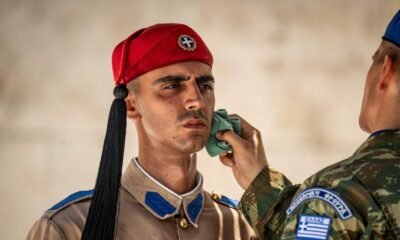
Türkiye warns Greece against alliance with ‘destabilizer’ Israel