
Economy
German factory orders slump in August as large contracts dry up

German factory orders dropped sharply in August, more than forecasted, as large-scale orders for aircraft, ships, trains and military vehicles declined, official data showed Tuesday, underscoring the fragility of a recovery in Europe’s biggest economy.
New orders, a key indicator of future business activity, were down 10.6% from a month earlier due to a drop in large-scale domestic orders, according to provisional data from Destatis.
It was the first decline in four months and more than the 1% decrease forecast by analysts surveyed by the financial data firm FactSet and Reuters.
The long-stagnant German economy has been slowly recovering on the back of massive public spending, with some recent data generally pointing to signs of growing strength.
The economy ministry said August’s order data thus represented a “marked setback.”
The decline was entirely attributable to a 61.5% slump in what the statistics office classifies as “other transport equipment,” a category that more than doubled in July due to an exceptionally high volume of large-scale orders of ships, railway rolling stock and aircraft.
When large-scale orders are excluded, new orders in August were 0.1% lower than in the previous month.
Weak figures likely to drag on Q3 growth
The weak figures suggest industry will weigh on third-quarter economic growth after helping to drive expansion in the first half of 2026, although analysts expect a rebound in the fourth quarter as government contracts pick up.
The German economy grew by 0.3% in the second quarter, prompting the government to raise its full-year forecast to 1.3%.
Much of the momentum seen in German industry so far this year has been driven by defense spending.
“Excluding these highly volatile large orders, bookings in the manufacturing sector have been treading water for months,” said Jupp Zenze, economic expert at the German Chamber of Commerce and Industry.
“Broad-based economic momentum remains absent.”
Economist points to full order books
The three-month comparison, which strips out some of the month-on-month volatility, showed that new orders in the period from June to August were 1.3% higher than in the previous three months.
Based on the figures available so far, the industrial sector likely slowed growth of the German economy in the third quarter, in contrast to the first half of the year, said Commerzbank senior economist Ralph Solveen.
However, Solveen expects this trend to reverse in the fourth quarter, as the government is likely to issue more contracts, which should have a positive long-term impact on sales and production.
“This outlook is also supported by the significant improvement in business sentiment over the past few months,” he said.
After revision of provisional data, new orders in July increased by 3.2% compared with the previous month, up from the previously estimated 2.5%.
According to the latest data from July, the order backlog provided coverage for a record nine months, said Marc Schattenberg, economist at Deutsche Bank.
“The disappointingly weak August figures should be viewed in the context of already very full order books,” Schattenberg said.
Foreign orders were down 5.4% in August on the month, with orders from the euro zone registering a decline of 5.4% and orders from outside the eurozone decreasing by 5.5%. Domestic orders declined by 17.3% on the month.

Spain’s government on Tuesday approved emergency measures to address the housing crisis, after an outbreak of violence in the coastal city of Barcelona the previous night that drew tens of thousands of people into the streets.
The Barcelona turmoil late on Monday followed protests across the country over the weekend that demanded measures to resolve a crisis sparked by the eviction of an 87-year-old woman in Madrid, the country’s capital.
In Barcelona, Spain’s second-largest city, a severe weather alert over the weekend had forced organizers to reschedule the protest for Monday. What began as a massive peaceful march turned violent when groups of hundreds of hardcore activists clashed with police, throwing stones and setting fire to trash containers.

Prime Minister Pedro Sanchez’s government approved measures similar to those rejected by Parliament last Friday, which prompted his call for early elections on Nov. 29. The measures will be sent for ratification by an interim legislature, which remains active until the elections.
The smaller, interim legislature – known as “permanent commission” – is composed of 69 members, compared to the 350 that sit in the regular Parliament.
Alejandro Quiroga, professor of political science at Madrid’s Complutense University, said the maneuver of having decrees approved by the interim legislature was constitutional but also a necessary political move by Sanchez.
“I don’t think Sanchez had an alternative,” Quiroga told the Associated Press (AP). “If you are calling early elections so you can keep the public’s focus on housing, you can’t just sit back and do nothing about it. That wouldn’t have been smart.”

The new measures are to extend protection against evictions for vulnerable Spaniards until 2030, regulate room rentals, impose a new tax on seasonal rentals, ban speculative real estate purchases and give tax breaks to landlords, Housing Minister Isabel Rodriguez told reporters last week.
Rising costs and a housing shortage are pricing many Spaniards out of the housing market, despite strong economic growth in Europe’s fourth-largest economy.
The protesters have been demanding stronger protections for tenants, measures to combat fraud and a ban on evictions when alternative housing is unavailable.
Dario Amodei took home $18 million last year as chief executive of Claude AI developer Anthropic, according to the company’s IPO filing, putting his compensation roughly in the middle tier among leading technology executives.
Anthropic is preparing for an initial public offering as early as this fall that could value it at more than $2 trillion, according to its IPO prospectus reported by Reuters. Amodei’s pay last year puts him above CEOs at Alphabet and Amazon, but behind those at Oracle and Nvidia.
Amodei’s pay leans heavily toward stock and other sorts of compensation, suggesting that, like many other tech founders, his yearly salary will account for just a fraction of his wealth.
Amodei and his sister, Anthropic President Daniela Amodei, each had their annual salaries doubled in July to $1.4 million. Stock and options awards made up the bulk of their packages in 2025, with Daniela Amodei receiving a total of $16.4 million last year.
Anthropic’s board this year granted the pair the promise of further equity in the form of restricted stock units, which promise a future payout if certain conditions are met. Some of that is tied to their remaining at the company, and some of it is tied to the IPO.
Chief Financial Officer Krishna Rao earned $720,250 last year. He was granted options to buy 1.4 million shares when he was hired in 2024, and exercised options worth $385,285 in 2025.
Middle of the pack
The rise in U.S. CEO pay in recent years has far outpaced the gains for the average worker, a dynamic critics worry could be exacerbated by AI’s widespread adoption.
S&P 500 CEO average annual compensation rose 21% to $22.8 million last year, and that does not include the extraordinary case of Tesla’s Elon Musk and his $158 billion restricted stock plan, according to the AFL-CIO.
Courtney Yu, director of research for executive compensation data firm Equilar, said Amodei’s $18 million haul “seems on the lower end for a company valued at $2 trillion, but it will be interesting to see how that changes once the company goes public” and his full ownership stake is shown.
With six other co-founders, Amodei may wind up getting a lesser share of the wealth created by the IPO compared with other major tech CEOs, Yu added.
Top executives at AI-focused tech firms earned amounts that varied widely in 2025, based on SEC filings.
At the high end, Oracle co-CEO Clayton Magouyrk earned $627.5 million, while the lowest was the $54,080 paid to Musk as CEO of SpaceX, before it went public. SpaceX has also promised super-voting restricted shares to Musk, already the world’s richest person, if the company’s market value grows to $7.5 trillion and the firm puts 1 million people on Mars.
Other giant companies pay less on a year-by-year basis, with executives benefiting from enormous stock ownership while having only salary and security costs reflected in annual filings.
For instance, Alphabet CEO Sundar Pichai made $10.9 million in 2025, including $8.8 million for personal security “due to Sundar’s significant public profile.” By “compensation actually paid,” Pichai earned $213.9 million last year, which, among other things, reflects the change in value of his unvested shares.
Amazon CEO Andrew Jassy made $2.1 million in 2025, a disclosure said, mainly reflecting travel and security. On an “actually paid” basis, Jassy received $13.2 million.
Living off the stock
Equilar’s Yu said the disclosures show how these executives don’t need to worry about year-by-year pay.
“Founder CEOs typically own enough equity that when the company does well and the stock price increases, they can just live off the wealth of the equity they already own, and typically don’t take in a lot in annual compensation,” Yu said.
Anthropic said in the filing it offered a mix of salary, equity awards, and other benefits. The S-1 statement reported by Reuters does not describe the founders’ share of ownership in the company, which could be worth billions of dollars, depending on the final terms and valuation of the IPO.
The Amodei siblings and their fellow co-founders pledged in the IPO filing to dedicate 80% of their personal Anthropic equity to charitable causes.
Asked about the 80% figure Monday, an Anthropic spokesperson noted an essay Dario Amodei posted earlier this year, where he wrote that wealthy individuals have an obligation to help address problems stemming from AI adoption, and decried that many wealthy people, particularly in the tech industry, “have recently adopted a cynical and nihilistic attitude that philanthropy is inevitably fraudulent or useless.”
German factory orders dropped sharply in August, more than forecasted, official data showed Tuesday, underscoring the fragility of a recovery in Europe’s biggest economy.
New orders, a key indicator of future business activity, were down 10.6% from a month earlier due to a drop in large-scale domestic orders, according to provisional data from Destatis.
It was the first decline in four months and more than the 1% decrease forecast by analysts surveyed by the financial data firm FactSet.
The long-stagnant German economy has been slowly recovering on the back of massive public spending, with some recent data generally pointing to signs of growing strength.
The economy ministry said August’s order data thus represented a “marked setback.”
But it also noted that without the fall in big orders, the situation was virtually unchanged from July.
August’s drop was driven by lower domestic orders. There was a more than 60% decrease in the category that includes military vehicles, aircraft, ships and trains.
Orders in this area have boomed in recent years as Germany spends huge sums on its military to face a hostile Russia and amid worries over U.S. security guarantees to Europe.
The ministry emphasized that the growing importance of public procurement meant that orders were “highly volatile.”
On a less volatile three-month basis, new orders from June to August were 1.3% higher than in the previous three months.
The energy shock from the U.S. war against Iran has added to headwinds for Germany’s recovery, but so far the economy has withstood the fallout better than initially feared.
Leading economic institutes recently doubled their growth forecast for this year to 1.3%.
Fast-food chain McDonald’s has been sued in federal court in Chicago in a proposed nationwide class action alleging that the company illegally coordinates menu prices across its franchises and company-owned restaurants by using an AI-powered pricing system.
The lawsuit, filed on Friday, said McDonald’s violated U.S. antitrust law by conspiring with independent franchisees to fix prices using algorithms trained on nonpublic data.
Reuters reported recently that McDonald’s pricing engine uses machine-learning algorithms to continually analyze data from millions of daily transactions across its nearly 14,000 restaurants.
The lawsuit cited the Reuters article, which said that other fast-food companies are also turning to AI to help with pricing and other operations.
“Independent businesses must set their prices independently,” the lawsuit said.
McDonald’s, in a statement on Monday, called the allegations speculative and uninformed.
“AI does not set the price of a Big Mac or any other menu item,” the company said.
It said franchisees make their own pricing decisions, and that the use of pricing recommendation tools and analytics is widespread across industries.
U.S. plaintiffs have filed a wave of class actions in recent years alleging that companies used algorithms or AI to illegally coordinate prices for hotel rooms, apartment rentals and other purchases.
Lark Turner, a lawyer for the plaintiff, said in a statement that McDonald’s is “leveraging its troves of data and its franchised system to nickel-and-dime consumers down to the last French fry.”
The plaintiff, an Illinois resident, is seeking to represent a class of potentially millions of McDonald’s customers, the lawsuit said.
Some of the world’s most prominent central bankers will attend the Istanbul Economic Forum this week to discuss inflation, monetary policy and the global economic outlook, the forum’s website said.
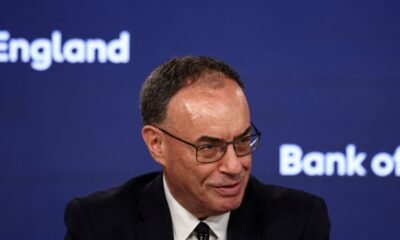
U.S. Federal Reserve (Fed) Governor Christopher Waller, Bank of England (BoE) Governor Andrew Bailey, Bank for International Settlements (BIS) General Manager Pablo Hernandez de Cos and Banque de France Governor Emmanuel Moulin are among those due to attend the two-day forum on Thursday and Friday.
Other expected attendees include the central bank governors of Greece, the Netherlands, Hungary, Saudi Arabia, Malaysia, Azerbaijan and Kazakhstan, according to the website compiled by the Central Bank of the Republic of Türkiye (CBRT).
In total, 16 central bank governors and eight deputy governors, as well as the finance ministers of Türkiye and Egypt and officials of international financial institutions, are scheduled to join the meeting.
The forum said participants will discuss topics including navigating a fragmenting global economy, monetary policy under uncertainty, debt dynamics, and the implications of artificial intelligence and digital innovation for macroeconomic policy.
The Federal Reserve website included Waller’s planned speech at the conference on its schedule for Thursday.
Türkiye plans to transform the Development Road project into a multi-billion-dollar link carrying oil, natural gas and electricity from Iraq and the Gulf to Europe, according to Energy and Natural Resources Minister Alparslan Bayraktar.
Bayraktar, who met with Iraqi Oil Minister Basim Mohammed Khudair in Ankara on Friday, said Türkiye aims to turn the Development Road into a strategic “energy corridor.”
Unveiled in May 2023, the project is a $20 billion regional infrastructure initiative designed to facilitate the transport of goods from the Gulf to Europe via the Grand Faw Port in Basra in southern Iraq. The port would be linked to Türkiye and subsequently to Europe through an extensive network of railways and highways.
In April 2024, Türkiye, Iraq, the UAE and Qatar signed a memorandum of understanding (MoU) for joint cooperation on the project.
Bayraktar said oil and natural gas transported along the route could alone generate an annual economic value of around $80 billion if the project’s energy infrastructure is developed alongside its transportation network.
“We are determined to build the Development Road as a strategic ‘energy corridor,'” he told Anadolu Agency (AA), noting that developing the energy infrastructure alongside the route will greatly boost its economic value.
Bayraktar said Iraq’s oil resources offered significant potential for the project’s energy dimension and that the route could eventually carry up to 2.5 million barrels of oil per day (bpd).
Iraq currently produces around 4 million bpd, while Kuwait has a production capacity of around 2 million bpd.
Qatari gas could be transported through Iraq
Bayraktar said the Development Road also had significant potential for natural gas transportation, particularly by providing an alternative route for Qatar’s gas exports to Europe.
Qatar, one of the world’s largest gas exporters, currently ships most of its gas as liquefied natural gas (LNG).
Bayraktar said Qatar’s LNG exports rely heavily on the Strait of Hormuz and that transforming the Development Road could provide an alternative route for some of the country’s gas.
He said the initiative could therefore evolve from a project aimed at strengthening trade and transportation links between Iraq and Türkiye into a multidimensional corridor encompassing oil, natural gas and electricity infrastructure.
Ceyhan could become global energy hub
Bayraktar said alternative routes to the Strait of Hormuz had become increasingly important at a time when energy security and supply diversification were gaining greater significance.
Extending the Kirkuk-Ceyhan pipeline, the current infrastructure connecting Iraqi oil to Türkiye’s Mediterranean export terminal at Ceyhan, to Basra and increasing its capacity could provide a strong alternative to the Gulf region and the Strait of Hormuz for oil transportation, Bayraktar stated.
Türkiye also aims for its state-owned Turkish Petroleum Corporation (TPAO) to play a more active role not only in the Kirkuk fields but also in other oil fields in Iraq, Bayraktar said.
“We will continue to strongly pursue concrete projects in close cooperation with the new Iraqi government,” he said.
“We aim to reach the target of supplying 1 million barrels of crude oil, increase trade and turn Ceyhan into a global energy hub,” Bayraktar said.


-

 Economy2 days ago
Revolut: $115 billion fintech taking on Europe’s biggest banks
-

 Economy2 days ago
Global M&A deal rush slowed down in Q3 as borrowing costs bite
-

 Economy23 hours ago
Brazilian assets rally as Flavio Bolsonaro tops first-round vote
-
 Economy1 day ago
Türkiye’s Halkbank after secondary offering amid strong interest: CEO
-

 Politics1 day ago
MP hints at more access for Öcalan amid terror-free Türkiye bid
-

 Economy1 day ago
Türkiye’s inflation drops below 30% for 1st time in nearly 5 years
-

 Economy19 hours ago
Türkiye says Development Road could become $80B ‘energy corridor’
-
 Economy18 hours ago
Top central bankers due in Istanbul to discuss policy challenges