
Economy
How much China influences climate fight with its clean tech sproot

China contributed $132 billion in clean technology and investments to developing nations last year, marking the highest amount invested by any country aimed at reducing carbon dioxide emissions.
In fact, the nation’s green-manufacturing juggernaut, built in part through heavy subsidies from Beijing, nearly matches the current total of grants, loans and private finance that all wealthy countries sent to poorer ones in 2024 to help fight climate change, according to a Reuters analysis.
Those loans and grants stemmed from a climate-finance program the world’s wealthiest nations agreed to at a 2009 United Nations climate conference on the premise that industrialized nations made outsized contributions to the climate crisis – and had outsized means to help poorer countries pay to clean it up.
A Reuters investigation in 2024 found that most global climate finance comes in the form of loans – and sometimes at market interest rates that funnel billions of dollars back to rich countries.
China took a different approach, funneling billions in subsidies into its own green-energy industries, serving its own national interest to dominate next-generation manufacturing domestically and globally.
The result: massive and rapid market-share gains in solar panels, batteries and battery minerals, electric vehicles, wind turbines and other green products.
China remains by far the world’s biggest greenhouse-gas emitter because of its large population, concentration of heavy industry and reliance on coal power. But its huge clean tech exports mean it has also become among the biggest global forces in reducing climate-damaging emissions.
The Reuters analysis used customs data to calculate the value of Chinese exports of clean technologies to countries classified by the Organisation for Economic Cooperation and Development (OECD) as developing nations.
Those exports alone will help the Global South avoid 257 million metric tons of carbon dioxide emissions (MtCO2) per year once deployed – an amount equal to the annual carbon dioxide emissions of France, according to analysis by Lauri Myllyvirta, co-founder of the Helsinki-based Centre for Research on Energy and Clean Air.
This year’s exports from China, meanwhile, are on track to avoid 337 MtCO2 in the Global South, the analysis shows.
Reuters was unable to find a reliable single estimate of how much greenhouse gas emissions are avoided as a result of global climate finance from rich to poor countries.
The OECD estimates a fifth of all rich world climate giving in 2024 came from the private sector.
The $132 billion figure derived by Reuters for China’s global climate contribution also includes an estimated $40 billion of Chinese foreign direct investment (FDI) into clean-technology projects in developing countries. The investment data was compiled by Mathias Larsen and Xiaokang Xue at the London School of Economics.
That brings China’s contribution to nearly equal to the $137 billion in climate finance that wealthy nations provided to poorer ones in 2024 under their U.N. climate pledges, according to the most recent figures provided by the OECD.
The figures are not directly comparable. China’s total largely reflects commercial transactions focused on clean energy development, while climate finance can also support other types of programs like developing climate-resilient agricultural techniques or cleaning up damage from major storms or floods.
But the comparison illustrates the extraordinary scale at which China’s manufacturing economy is now shaping the energy transition in poorer countries.
The findings point to a potential shift in the mechanics of the global energy transition, according to Li Shuo, a veteran observer of China at U.N. climate talks who heads the China Climate Hub at the Asia Society Policy Institute.
For years, climate talks focused on how much money and technology wealthy countries would provide to poorer ones to help them decarbonize. China’s manufacturing boom is creating another pathway: Driving down the price of clean technology through self-interested innovation and scale – until developing countries adopt it for economic reasons.
“You can align it to your economic agenda,” he said.
Diplomacy, engagement
Beijing has so far shown little interest in translating its commercial might into diplomatic leadership at global climate talks since U.S. President Donald Trump withdrew the United States from international climate cooperation in 2025.
China’s diplomatic role likely will take center stage as nations gather for the U.N.’s COP31 climate conference in Antalya, Türkiye.
Bilateral agreements between heavyweights Washington and Beijing have traditionally paved the way for international climate agreements, including the landmark 2015 Paris deal to limit global warming. But Beijing may be unwilling to go on alone without its geopolitical counterweight at the table, according to former climate negotiators.
Beijing may also be worried that taking a bold stance on global carbon reduction would bring unwanted pressure for China to give more climate aid or cut its own fossil-fuel emissions, observers say. China emits about a third of global carbon dioxide emissions and still burns coal for more than half its power.
“How China engages on different levels in the coming years is the most fundamental thing that is going to happen on climate because of both their role in clean-tech deployment … but also because of their emissions profile,” said Jennifer Morgan, Germany’s former climate minister.
China’s Ministry of Commerce said the country is an important contributor to the global green transformation, and that its wind and solar exports have cumulatively reduced global emissions by roughly 4.1 billion tons of carbon dioxide over the past five years – the equivalent of around 80% of the total emissions of the United States in one year.
“Against the backdrop of a global climate governance ‘action deficit,’ China will continue to uphold a responsible attitude, working with other countries to address challenges, overcome difficulties and jointly promote global green and low-carbon transformation and sustainable development,” it said.
Forcing out fossil fuels
Meanwhile, China’s manufacturing boom has made renewable energy more affordable in the developing world.
When Ethiopia banned combustion engine car imports in 2024, for example, it was the first country to take such a dramatic step toward electric vehicles. The decision was less about emissions and more about cutting its fuel import bill, its deputy minister of transport at the time told Reuters.
“No one in Ethiopia is asking COP to pay for any of this; the economics have just switched. It is just the cheapest and best solution,” said Larsen, a senior policy fellow at the London School of Economics, who built the database of Chinese green investment used by Reuters in this story.
China has been by far the world’s biggest supplier of electric vehicles over the past few years, as dozens of subsidized automakers have waged a fierce price war in China and dramatically increased exports.
The green transition has been similarly pragmatic in Pakistan, which imported 17 gigawatts worth of solar from China last year, according to data from Ember, roughly on par with Germany’s installations that year. Those panels will cut emissions and, more importantly, provide cheap, reliable power in a country that often has neither.
Nearly two-thirds of China’s exports of solar panels, and the cells needed to make them, went to the developing world last year, according to Reuters analysis of customs data.
The picture is different in wealthy countries like the U.S. and parts of Europe, which in recent years have imposed tariffs and other restrictions on Chinese clean technology to protect their domestic manufacturers from the surge in shipments.
The U.S., for example, imposes tariffs exceeding 100% on Chinese electric vehicles and has taken other measures to effectively block them from the market.
“What is striking is that policies originally designed to address climate change are now facing opposition not because of their climate impacts, but because of concerns about trade and competitiveness,” said André Corrêa do Lago, a veteran climate negotiator for Brazil, which hosted last year’s climate summit.
The export climate for Turkish manufacturers remained strong in October even as the main index tracking tendencies in top markets dropped to a three-month low, a survey showed on Monday.
Türkiye Manufacturing Sector Export Markets Climate Index fell to 52.5 in October from 53.2 in September, the Istanbul Chamber of Industry (ISO) said in a monthly bulletin.
The index measures the activity conditions in the main export markets of the Turkish manufacturing sector.
All figures measured above the threshold value of 50 in the index indicate an improvement in the export climate, while values below 50 signal deterioration.
Despite the decline, the index still indicated a significant ongoing improvement in demand conditions in export markets. Thus, the export market climate strengthened for the 34th consecutive month.
Among the countries monitored in the survey in October, the fastest increase in economic activity occurred in the United Arab Emirates (UAE), which accounts for 3.5% of Turkish manufacturing sector exports. In this country, production continued to grow rapidly, albeit at a slightly slower pace compared to September.
Similarly, growth in the U.S. remained significant despite a loss of momentum. With October’s increase in production, the expansion process in the world’s largest economy reached its 45th month.
Economic activity also continued to rise in many other export markets important for Turkish manufacturing products. In the U.K., production increased at the highest pace in the past eight months, while growth continued in Germany, Italy, Spain and the Netherlands.
A relatively negative development in October was the renewed decline in production in France and Romania. Manufacturing production in Poland continued to decline, but the drop was very limited, marking the slowest contraction of the five-month downturn.
In October, the sharpest decline in economic activity among the monitored countries occurred in Brazil.
In Brazil, production fell sharply for the fourth consecutive month, marking the fastest decline since the COVID-19 pandemic. Companies partially attributed this drop to disruptions caused by the presidential election.
Commenting on the results, S&P Global Market Intelligence economics director Andrew Harker stated that while demand conditions in export markets continued to improve in October, there were some signs of slowing compared to the rapid pace of global economic growth seen in September.
“Political instability and uncertainty in some economies such as Brazil and France are causing companies to postpone purchasing decisions, negatively affecting demand conditions. Therefore, Turkish exporters hope that the international political environment will become more stable by 2027, thus supporting growth expectations,” he said.

Senior Turkish and Chinese officials, alongside business leaders from both countries, gathered in Istanbul on Monday for the Türkiye-China Green Development Business Forum to expand bilateral economic cooperation.
Co-organized by the Foreign Economic Relations Board (DEIK) and the China Council for the Promotion of International Trade (CCPIT), the event brought together Vice President Cevdet Yılmaz and Chinese Vice President Han Zheng.
Industry and Technology Minister Mehmet Fatih Kacır, Trade Minister Ömer Bolat, China Energy Conservation and Environmental Protection Group (CECEP) Chair Liao Jiasheng and CCPIT Chair Ren Hongbin also attended the forum.
Addressing the opening session, DEIK President Nail Olpak said Türkiye and China stand out globally with their strong economic potential and development achievements.
“China is a leader in green technology, while Türkiye is a country that can become a production and export hub for these technologies through its proximity to Europe and the customs union,” Olpak said.
He stressed that both nations should utilize these two infrastructures as complementary assets amid shifting global competition and rising uncertainty.
Balanced trade emphasis
Olpak noted that achieving a more balanced bilateral trade relationship with China is vital for sustainability, adding that Chinese high-tech investments and incentives under the HIT-30 program and Istanbul Finance Center would support that goal.
Touching on the Belt and Road Initiative (BRI) and the Middle Corridor, Olpak said the Turkish side aims to play an active role in filling return-leg cargo containers along the route.
He added that DEIK plans to unite Turkish and international businesses during the COP31 process across areas ranging from clean energy and sustainable infrastructure to artificial intelligence.
DEIK Türkiye-China Business Council Chair Aydın Mıstaçoğlu said their primary priority is turning bilateral economic potential into concrete projects, mutual investments and long-term partnerships.
“Today, we are advancing our cooperation with a focus on green development and can develop joint projects in renewable energy, energy storage, electric mobility and low-carbon industry,” Mıstaçoğlu said.
He stated that they aim to launch the Türkiye-China Technology and Innovation Center with CCPIT support as a permanent platform for technology sharing, joint research and development and investment cooperation.
He also noted that both sides agreed to hold the fourth Türkiye-China Business Conference in Beijing during the first half of 2027, hosted by CCPIT.
The forum featured panel discussions on green energy supply chains and Middle Corridor trade balance before concluding with business-to-business meetings.
Bilateral talks
Separately, Yılmaz and his Chinese counterpart Han Zheng also discussed bilateral cooperation and regional and global developments.
In a post on the Turkish social media platform NSosyal, Yılmaz described the meeting as productive.
“In line with our goal of further advancing cooperation between our countries, we discussed areas of joint work, particularly the economy and trade, connectivity, tourism, the defense industry, science and technology, as well as regional and global developments,” he said.
He also emphasized Türkiye’s commitment to strengthening economic ties with China on the basis of mutual benefit.
“We attach importance to making our economic relations with the People’s Republic of China more balanced and sustainable on the basis of mutual benefit and to operating our existing cooperation mechanisms more effectively,” he said.
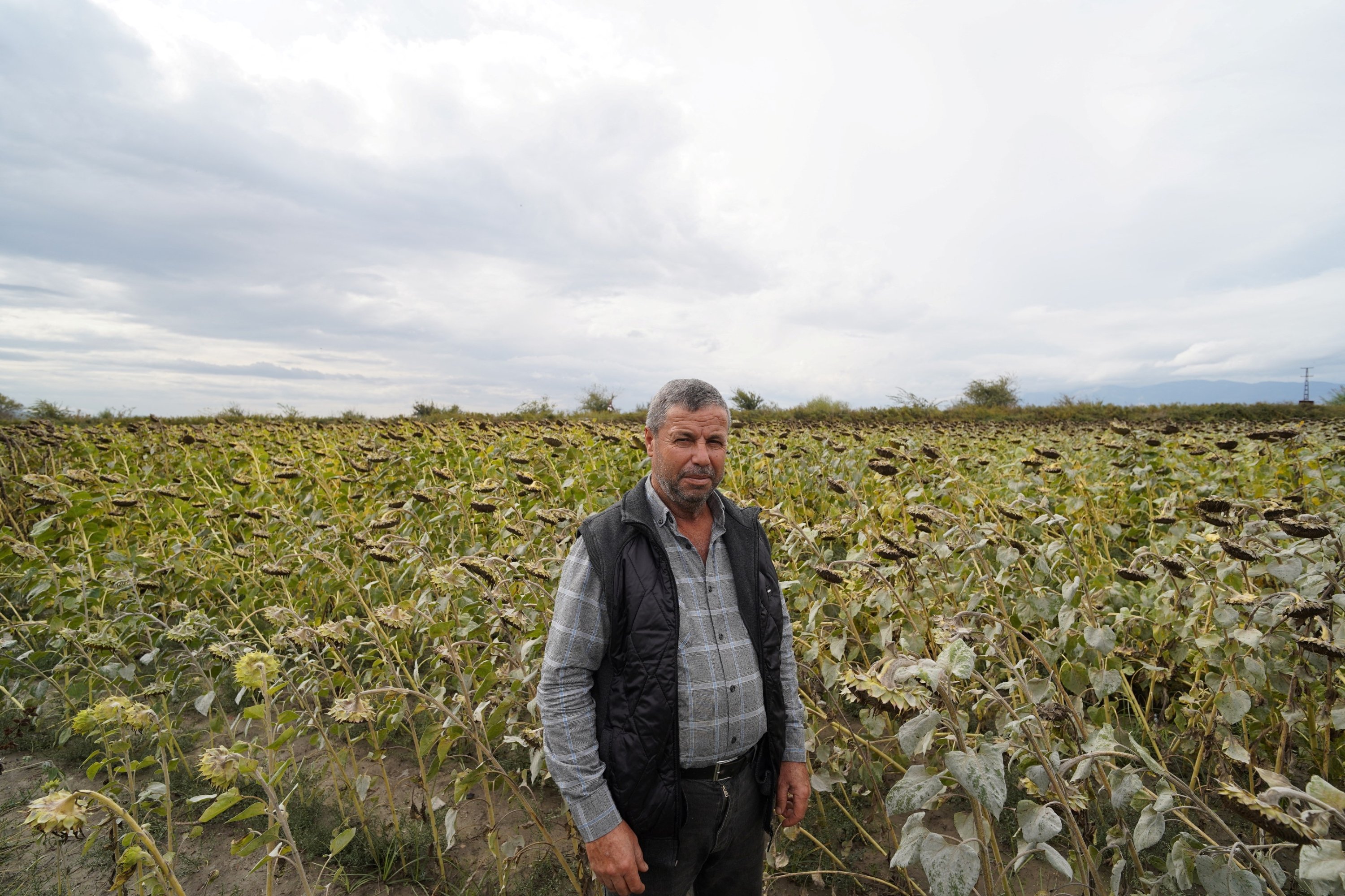
For decades, farmer Mehmet Kabak has cultivated cotton on his drought-prone land in western Türkiye. This year, however, he is switching to wheat and sunflower, partly because these crops use less water and are thus less expensive to produce.
Kabak is one of many farmers worldwide forced to find their own way to cope with a changing climate, rather than waiting for countries to settle long-standing arguments at annual climate talks over who should finance adaptation.
Agriculture accounts for around 5% of Türkiye’s economic output. It also consumes 79% of the country’s water, almost half of which is lost because of inefficient infrastructure and irrigation, the government has said.
As the next round of climate talks begins at COP31 in Antalya on the Mediterranean coast, 59-year-old Kabak, who farms 900 decares (about 220 acres) in Söke, hundreds of kilometers to the west, complained of higher irrigation costs “even though our harvest is damaged.”
Cotton output shrinks
Türkiye was the world’s eighth-largest cotton producer, according to 2023 data from the U.N.’s Food and Agriculture Organization (FAO), but its overall seed cotton output is expected to fall 38% year-over-year to 1.2 million metric tons in 2026, according to the Turkish Statistical Institute (TurkStat).
Drought and increased costs have led farmers in the Söke region to shrink cotton acreage by around 60% to around 120,000 decares in 2026, a local farming group said.
More than 30 farmers, lenders, companies and nonprofit organizations told Reuters in interviews that the sector needed more technical support and help gaining access to finance.
For agriculture, water is the most pressing adaptation issue.
Last year, Türkiye suffered the worst drought in more than 50 years. Rainfall was 27% below the long-term average. Dam levels have recovered to an extent, government data showed, but analysts say the reprieve is likely to be temporary.
Reuters analysis of data from the WWF and Lincoln Institute of Land Policy showed water use in Türkiye’s cotton-producing basins needs to fall 25% to 60% to sustain healthy ecosystems.
Existing infrastructure is inefficient. Water drawn from dams and rivers often arrives unfiltered, clogging drip hoses before infrastructure to clean it is built.
But farmers are reluctant to invest for a variety of reasons.
In some cases, switching to newer systems can lead to an initial drop in yield that farmers may struggle to absorb. In addition, many work on rented land, meaning they are reluctant to invest, industry representatives said.
State, private sector offer support
Türkiye said in October, when it laid out next year’s budget, the amount set aside for land and water resources management would rise 40.5%, with TL 174 billion ($3.5 billion) earmarked for agricultural irrigation investments.
The Agriculture Ministry told Reuters further support would be needed to supplement that, including from the private sector.
Türkiye’s largest private lender Işbank has opened 56 specialist agricultural branches and offers financing for drip and sprinkler irrigation with repayments tied to harvest cycles.
Şekerbank, which has a history of supporting farmers, says around a quarter of loans made under its sustainable-finance framework in the first nine months of 2026 went to agricultural water management and climate adaptation.
A lack of equity or collateral and the inability of some farmers to repay the loans, however, have limited the amount of help the private sector can deliver. Many farmers also have to pay upfront and get reimbursed later, if conditions are met.
“That makes it very difficult for them,” said Liam Chicca, country director for Türkiye at the International Fund for Agricultural Development (IFAD).
The fund, which has invested $850 million (about TL 42.6 billion) in the country since 1982, estimates that between 5% and 10% of Turkish farmers have virtually no capacity to finance major investments themselves.
For Türkiye, and others, failure to adapt could cost more than acting now.
World Bank analysis in 2022 estimated a 10% reduction in water supply could cost Türkiye 6% of gross domestic product (GDP), or about $50 billion because of the impact on agriculture.
Apart from the planned budget increase, the government has said private companies could help more by adopting water-efficiency certification and using green-finance instruments to fund adaptation, an approach it hopes to advance at COP31.
Those monitoring progress are keen that whatever is proposed amounts to more than the kind of nonbinding pledges that governments have made at previous U.N. conferences without delivering concrete change.
Last week, U.S. voters sent a quite strong message to the new Democratic congressional majority and President Donald Trump: Fix the damage inflation has done to the economy.
Trump, who campaigned on the idea that a Democratic victory in the midterms would trigger a 1929-style economic depression, has maintained that the economy is booming.
Since his party lost in Tuesday’s voting, he has claimed he is willing to work with Democrats in the House and Senate, though that’s not something he has done much of in the past.
“I’ll get along, probably, with the Democrats, unless they want to be destructive,” Trump told reporters last week.
After Friday’s strong jobs report showed employers adding 165,000 jobs and the unemployment rate dipping to 4.1%, Trump was defiant. “Democrats may control Congress, but I will NEVER stop fighting for you, and I will VETO anything that hurts America,” he said in a text message to his supporters.
Democrats are seeking to check Trump’s power and are preparing for early fights on government spending. Other challenges include chronic budget deficits, tariffs, artificial intelligence and difficult choices about a Social Security system that could run short of money in as little as six years.
But as long as rising prices keep making middle-class lives less affordable, Democrats and Republicans alike face the risk of angering and alienating voters in the next election cycle.
“Until inflation and interest rates are under control, the likelihood of change elections is going to be high on an ongoing basis,” said Marc Goldwein, senior vice president at the Committee for a Responsible Federal Budget.
Trump’s tariffs and the war against Iran that he launched in February contributed to the annual consumer price index (CPI) climbing to 3.7%. The president also tried to bully the Federal Reserve (Fed), an independent body tasked with keeping inflation low, to slash its benchmark interest rate in ways that could have worsened inflation.
The gridlock of a Republican White House and Democratic Congress gives the Fed more room to maneuver, possibly smoothing the central bank’s ability to return inflation to the 2% target it has failed to reach for nearly six years.
“I think that one of the surprise winners Tuesday was the Fed,” said Douglas Holtz-Eakin, an economist and president of the center-right American Action Forum.
The Democratic Senate could block Trump’s ability to fill potentially open spots on the Fed board, Holtz-Eakin said, removing “Trump’s incentives to meddle with the Fed” and clearing a path for Fed Chair Kevin Warsh “to follow his instincts and aggressively reduce inflation.”
Trump has maintained that the costs of oil, gasoline and diesel will all plummet once the Iran war ends. The problem is he refuses to say when or how the war will come to a conclusion.
John Cochrane, an economist at Stanford University’s Hoover Institution, stressed that the Fed’s efforts to combat inflation would be helped if the federal government reduced budget deficits.
“It takes monetary and fiscal restraint,” he said.
The U.S. government keeps amassing debt as tax revenues fall short of burgeoning spending on Medicare, Medicaid, Social Security and other programs. Paying the interest on the national debt now tops $1 trillion annually and exceeds spending on the military. The problem could spiral because investors have pushed up the interest rates charged on government debt over the past year.
Neither the White House nor Democrats ran on spending cuts. The president wants an additional $500 billion a year for the military, while some Democratic candidates have pushed for restoring Affordable Care Act subsidies that lapsed under Trump.
Since August, Treasury Secretary Scott Bessent has repeatedly said the administration would put forward a plan to trim the roughly $2 trillion annual budget deficit. Bessent is working with White House budget director Russell Vought on cuts they’re branding as a “fiscal consolidation plan,” to be released after the election.
Deficit reduction would likely require some combination of tax increases and spending cuts, Goldwein said. But he said that the lowest-hanging fruit would be to trim Medicare expenditures in ways that save money for both the government and patients.
“It’s not rocket science,” he said. “The most important thing you can do is reduce healthcare costs and find policies that lower the costs of Medicare, which will reduce deficits and interest rates.”
AI effect
When Harvard University economist Jason Furman thinks about the most important economic issues facing the United States, AI is at the top of his list.
“It’s the most screamingly obvious investment boom this country has ever had, or, possibly, second to railroads” in the late 19th century, Furman said.
Using AI, Furman has built an economic analysis tool called Econvitals that replicates some of the work done when he was chairman of the White House Council of Economic Advisers in Democratic President Barack Obama’s administration.
Econvitals parsed construction spending data on Tuesday and found an 80.6% increase in data center construction over the past year, while spending on building homes, schools, factories and offices had fallen.
The stock market sold off last week on concerns that Democrats could restrict the construction of data centers and impose guardrails on AI. But the American economy still needs the technology to keep fueling growth now and into the future.
Trump has been vociferous in promoting the sector and has taken a hands-off stance on regulating AI, insisting that existing laws and voluntary agreements signed by tech companies are enough. He has shrugged off public concerns about the risks of job losses and large-scale cyberattacks, but a majority in the AP Voter Poll, a sweeping survey of the American electorate conducted in all 50 states, says AI does more harm than good for the economy.
The dilemma is that AI is helping to propel demand in the economy and sustain the stock market. If those slipped, there could be less consumer spending, lower growth and many in the U.S. feeling even worse off financially.
“Every time you have a single strength in an economy, you are also having a big vulnerability,” Furman said.
Senators who won six-year terms last week will face the politically fraught challenge of working with Trump’s successor to find ways to save Social Security, which is projected to be unable to pay full benefits at the end of 2032.
Removing the cap on payroll taxes and increasing the retirement age are among the possible lifelines for sustaining the program that provides income to older Americans and those with disabilities. But any changes would likely need to be bipartisan to get enough votes to clear the Senate because Social Security overhauls cannot be made by party-line votes through the reconciliation process.
Sen. Elizabeth Warren, a Democrat, said she saw an opening earlier this year to fix Social Security when she overheard Sen. Bernie Moreno, an Ohio Republican, talk about the need to lift the cap on payroll taxes.
“I reached out to him in a matter of days,” she said in an interview this summer. The two senators went public with a plan that is still being formulated as legislation.
Warren, who worked with the Republicans on a law this year to encourage the construction of more homes, said other bipartisan efforts had failed because Republican lawmakers had been afraid to cross Trump.
But with Social Security, there is a need to act now. Experts say “the checks that go out to seniors will drop by nearly a quarter” after 2032, Warren said.
“Think what that means, literally, to millions and millions of Americans, who depend on those Social Security checks, or who have parents who depend on them. And Congress is doing nothing,” she said.
The war in the Middle East is poised to fundamentally reshape the region’s economic and security landscape, accelerating efforts to reduce strategic dependencies, diversify trade routes and strengthen regional cooperation, Treasury and Finance Minister Mehmet Şimşek said Saturday.
Speaking at the TRT World Forum panel titled “Towards a Rocky Recovery: National Economies After the Wars in the Middle East,” Simsek warned that the conflict had triggered a major supply shock, particularly in energy markets, with consequences extending well beyond the region.
“The one that we have been experiencing is two times the 1973-74 oil embargo and seven times the Russia-Ukraine energy destruction,” he said, referring to the scale of the disruption.
Şimşek noted that much of the region was already experiencing recession, while countries on the front lines had suffered substantial declines in exports and imports.
Globally, growth had slowed and financial conditions had tightened amid higher inflation, partly driven by the conflict.
Citing an International Monetary Fund (IMF) study examining 170 conflicts since 1946, he said wars typically resulted in output losses of between 3% and 7%, adding that sustainable recovery depended on achieving lasting peace.
“If there is no durable peace, it would be very hard to talk about a durable recovery,” he said.
Regional integration, Türkiye’s strategic position
Şimşek argued that the conflict would prompt countries to reconsider their strategic dependencies, particularly their reliance on critical maritime routes such as the Strait of Hormuz.
He said governments were likely to invest more heavily in alternative trade corridors, infrastructure, energy security and regional connectivity to reduce vulnerabilities to future disruptions.
The minister also highlighted the need to strengthen economic integration across the Middle East and North Africa (MENA) region, where interregional trade remains relatively limited compared with other parts of the world.
While trade within Europe accounts for approximately 67% of regional commerce and reaches 59% in East Asia and the Pacific, the figure stands at just 15% in Latin America and the Caribbean, according to the comparisons presented by Şimşek.
He said economic diversification would be essential to increasing trade within the MENA region.
Türkiye pursues mediation efforts
Turning to Türkiye’s position, he said that Ankara remained committed to rules-based trade and regional economic integration, despite growing protectionist tendencies worldwide.
Türkiye has 54 free trade agreements (FTAs) covering nearly 70% of its exports, while negotiations are ongoing with Japan, Indonesia, the Gulf Cooperation Council (GCC) and Canada for new-generation agreements.
He also highlighted Türkiye’s role in regional connectivity projects, including the Middle Corridor linking Beijing to London and the Development Road project connecting the Gulf and Iraq with Türkiye and European markets.
Şimşek said Türkiye was also pursuing diplomatic initiatives and mediation efforts, including work on the Armenia-Azerbaijan peace agreement, efforts to facilitate negotiations between Russia and Ukraine, and involvement in efforts to achieve peace in Gaza.
Strengthening defense capabilities
However, he stressed that investing in peace must be accompanied by strengthening defense capabilities.
Türkiye’s growing defense industry, which includes approximately 4,000 companies and between 1,400 and 1,500 ongoing projects, was becoming an increasingly important asset.
The minister said that Turkish defense equipment orders reached approximately $18 billion last year, while the country ranked 11th among global defense exporters.
He also pointed to Türkiye’s potential role in postwar reconstruction, estimating that reconstruction needs in conflict-affected neighboring regions could reach at least $1 trillion over the next decade.
Concluding his remarks, Şimşek said Türkiye was well-positioned to benefit from greater regional integration because of its industrial base, infrastructure and expanding services sector.
“Wars are not in our interest. We benefit most from stability, peace, and prosperity in the region,” he said.
Emirates Group reported on Thursday a sharp decline in first-half profits as they plunged 66% year-over-year amid the regional war and high fuel costs hitting the aviation sector.
Half-year profit after tax stood at 3.6 billion AED ($1 billion), the group said in a statement.
The Dubai-based group, which owns the largest airline in the Middle East, said its Emirates airline saw half-year profit before tax fall 68% to 3.7 billion AED, eroded by high fuel prices.
Since the Middle East war began in late February, energy prices have soared as Iran’s blockade on ships in the vital Strait of Hormuz disrupted supply.
But the wider group’s revenues were less affected, down 12% to 66.2 billion AED, it said, buoyed by a strong performance in its cargo business.
During the early months of the war, the United Arab Emirates (UAE) bore the brunt of Iranian drone and missile attacks, disrupting flights and putting off visitors to Dubai, which has become a tourist hub in recent decades.
Passenger traffic between April and September was down by 22% compared with the same period last year, at 21.8 million passengers.
“The first six months of 2026-2027 brought significant challenges to Emirates’ operations as intermittent airspace restrictions and closures across the region tested the airline’s operational agility, while government travel advisories reshaped consumer choices and travel flows,” the group said.
The airline, one of the world’s largest by international passenger traffic, said its performance was “remarkable” in light of the war.
The group was able to tap strong cash reserves to support its business needs, including pre-delivery payments for aircraft and servicing debt obligations, it said.
“It has been a demanding six months, and once again our business model and our people stood up to the test,” said Chairperson and CEO Sheikh Ahmed bin Saeed al-Maktoum.
He called the challenges of the period “unprecedented” and said the group had not paused investments despite the headwinds.
The group said Emirates airline had launched initiatives to boost customer confidence following the outbreak of war, including an industry-first comprehensive travel insurance that is unrestricted by government travel advisories, free date changes on booked tickets and generous refund policies.
It also broke ground in May on a $5.1 billion engineering and maintenance facility at Al-Maktoum International Airport in Dubai, with completion expected in the mid-2030s.


-

 Politics3 days ago
Turkish FM visits Cyprus ahead of key talks on island’s fate
-
 Politics3 days ago
Turkish Parliament approves defense pact with Pakistan, Saudi Arabia
-

 Sports2 days ago
Silva inherits Portugal captaincy after Ronaldo’s retirement
-

 Sports1 day ago
Turkish star Arda Güler steals spotlight in Real win over Valencia
-
 Politics3 days ago
Turkish FM Fidan signals openness to expanding Mecca alliance
-

 Sports1 day ago
UFC’s Dana White to meet Trump over White House press sec offer
-
 Politics23 hours ago
Turkish candidate for top UN post reflects Ankara’s reform ambition
-

 Sports2 days ago
5 suspects face charges 11 years after Fenerbahçe bus attack