
Economy
Italy to safeguard its ships in Bab al-Mandeb as concerns mount

Italy announced Thursday it would deploy warships to ensure the safe passage of its commercial ships through the Bab al-Mandeb Strait, as maritime security concerns mount off the coast of Yemen.
The country does not intend to wait for a joint decision by the European Union, Italian Defense Minister Guido Crosetto said. “We have the capabilities to protect the passage.”
Crosetto warned that if the waterway were to become impassable, this would have significant consequences for the economy and consumers.
“We cannot allow bureaucratic delays in decision-making to aggravate an already complex situation,” he noted.
Crosetto said he and Italy’s chief of defense staff had agreed to mobilize the navy to prepare “whatever is necessary” to guarantee the secure transit of Italian vessels.
The Bab al-Mandeb connects the Red Sea with the Gulf of Aden, one of the most important shipping routes between Europe and Asia.
Fears for shipping in the Red Sea have surged this month after the Iran-aligned Houthis brought the entire west coast of Yemen under their control and captured strategically located islands.
This has given the Houthis virtually unrestricted access to the strait, a development seen as a significant setback for Saudi oil exports rerouted from the Strait of Hormuz and international shipping.
The United States and the European Union have already been attempting to better protect merchant ships from attacks by the rebels through military operations.
Crosetto did not spell out what measures were being considered or what naval assets might be sent to the area.
He said that disruptions to major shipping lanes would drive up transport costs, delay deliveries and ultimately push higher prices onto families and businesses.
“Every economic crisis hits the most vulnerable people hardest, putting social cohesion and the country’s stability at risk,” he said.
The defense minister also highlighted the vulnerability of undersea infrastructure, including data cables and energy links.
“For a major maritime nation such as Italy, monitoring and protecting the seas, both above and below the surface, means safeguarding its security, its prosperity and its future,” he said.
“The Defense Ministry and the Italian Navy will continue to protect the sea, intervening with determination whenever necessary to safeguard national interests and the security of Italians,” he said.

The U.S. Department of State said Thursday it had approved the potential sale of Lockheed Martin’s F-35 Lightning II fighter jets to Saudi Arabia, as the kingdom is drawn deeper into war in the Middle East.
A sale would mark a significant policy shift from the U.S., potentially altering the balance of military power in the Middle East and testing Washington’s definition of maintaining its ally Israel’s “qualitative military edge.”
Saudi Arabia made a direct appeal for the jets in early 2025 to U.S. President Donald Trump and has long been interested in Lockheed Martin’s fighter. But Israel, the only country in the region to operate the jets, has objected to the sale.
The estimated $24.3 billion sale would include 48 of the military aircraft and 49 Pratt & Whitney engines along with communications equipment, spare parts and other support items, the State Department said in a statement.
The F-35, built with stealth technology that allows it to evade enemy detection, is considered the world’s most advanced fighter jet.
“The proposed sale will improve Saudi Arabia’s capability to deter current and future threats by strengthening its homeland defense, and improving interoperability with US forces,” the State Department said.
It “will also augment Saudi Arabia’s operational aircraft and enhance its air-to-air, and air-to-ground self-defense capability,” it added.
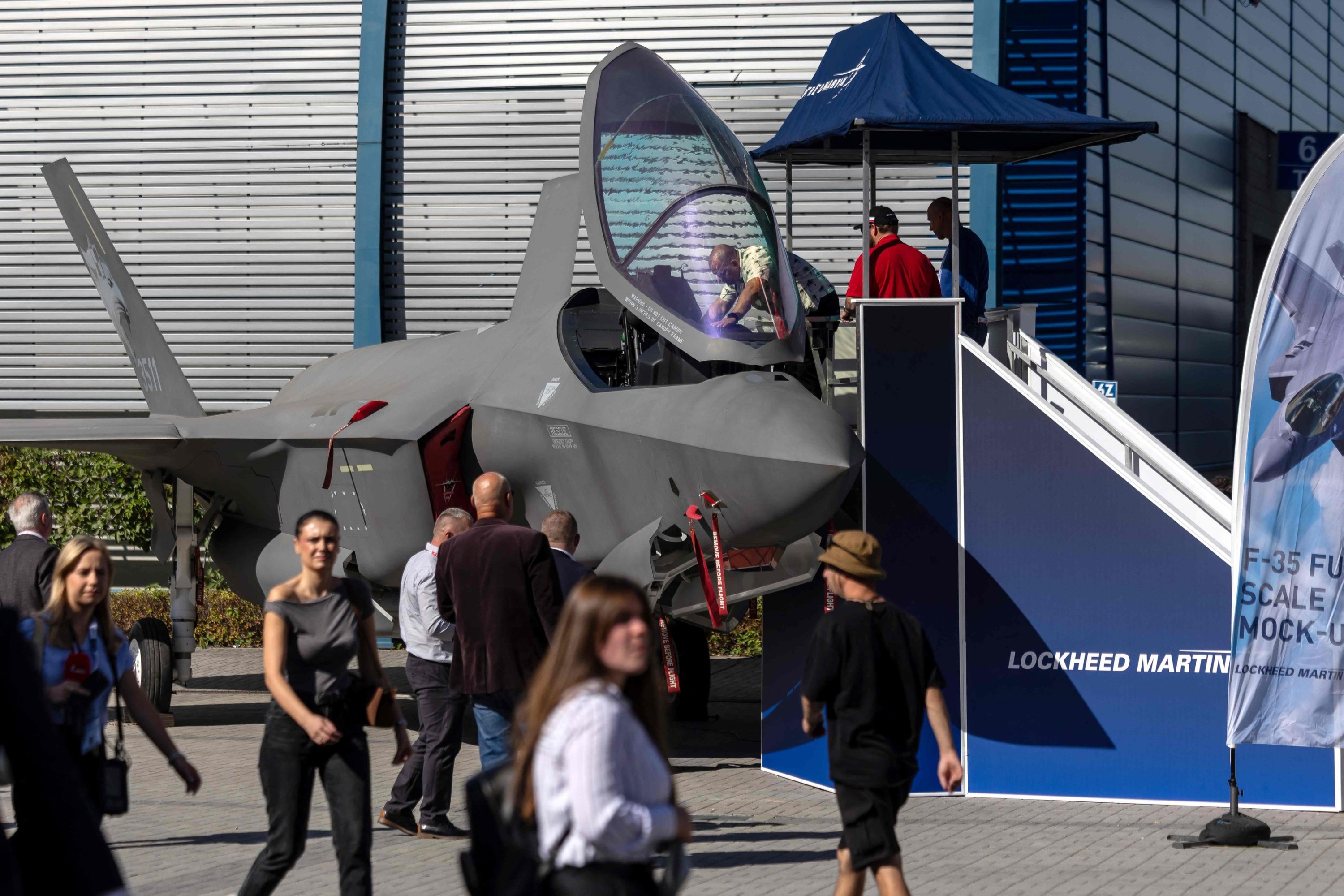
Saudi Arabia, the largest customer for U.S. arms, has sought the fighter for years as it looks to modernize its air force and counter regional threats, particularly from Iran. The kingdom’s renewed push for what would constitute two squadrons comes as the Trump administration has signaled openness to deepening defense cooperation with Riyadh.
The Saudi Air Force flies a mix of fighter aircraft, including Boeing F-15s, European Tornados and Typhoons.
The F-35 issue has also been intertwined with broader diplomatic efforts. The administration of former U.S. President Joe Biden previously explored providing F-35s to Saudi Arabia as part of a comprehensive deal that would have included Riyadh normalizing relations with Israel, though those efforts ultimately stalled.
Trump has made arms sales to Saudi Arabia a priority since returning to office. In 2025, the United States agreed to sell the kingdom an arms package worth nearly $142 billion, which the White House called “the largest defense cooperation agreement” Washington has ever done.
The State Department has notified Congress about the proposed sale, which would require the approval of U.S. lawmakers.
Saudi Arabia is pursuing ambitious economic and military modernization plans under Crown Prince Mohammed bin Salman’s Vision 2030 agenda. The kingdom has sought to diversify its defense partnerships in recent years while maintaining its decades-long security relationship with Washington.
A vast airspace security zone roughly the size of Italy is set to be established around Beijing, barring all but commercial, approved business and emergency flights, a report said Thursday, months after a small aircraft crashed into the Chinese capital’s tallest building.
A permanent 600-kilometer-wide circle of “Special Restricted Area” centered around Beijing will take effect from Sept. 20, Reuters reported, citing an aviation notice attributed to Beijing airspace control authorities and available through the U.S. Federal Aviation Administration’s public NOTAM search system.
The entire airspace, from ground to unlimited altitude, will be closed for all flights except for commercial airline flights, approved business flights and military, customs, police and fire-rescue flights, the notice showed.
The over 280,000-square-kilometer zone encompasses Beijing and Tianjin, much of Hebei, and extends into parts of Inner Mongolia, Shanxi, Shandong, Liaoning and the Bohai Sea. By a rough geographic estimate, some 100 million people and dozens of airports and smaller airfields fall within its bounds.
The zone is among the largest permanent airspace restrictions imposed over a capital city. It follows a rare breach of Beijing’s tightly controlled skies that raised questions about security gaps in the airspace around the Chinese capital.
A light sport aircraft crashed into the 108-storey CITIC Tower in Beijing’s central business district on June 26. Local authorities said the crash killed the sole pilot and injured 13 others who were not on board.
The 66-year-old pilot, who authorities said had repeatedly mentioned ending his life in his diary, deviated from his approved flight area and lost contact with a general aviation airport in Beijing’s suburbs from which he took off, official reports said.
Continuous surveillance
All exempt flights operating inside the new restricted zone must strictly follow the pre-approved flight plan, report and obtain approval for any potential deviation, and maintain continuous two-way radio communication with air traffic control, the notice showed.
Aircraft are required to have surveillance and identification equipment on board that would allow air traffic controllers to identify and track them continuously and electronically. Pilots must also report “security status” before entering the restricted zone, the notice said.
Chinese state media said over the weekend a “Capital No-Fly Zone” would be established over Beijing from Sept. 20, without specifying the exact size and scope of the restricted area.
“To strengthen airspace security management in the capital region, maintain order in aerial operations, and protect important targets on the ground and the lives and property of the public … China will designate a no-fly zone in and around the capital,” the state-run Beijing Daily said Sunday.
House sales in Türkiye declined 14.7% on a yearly basis to 127,410 units in August, official data showed Thursday.
Both new home sales and second-hand (existing) home sales dropped in the month, according to the data from the Turkish Statistical Institute (TurkStat).
Sales of new homes declined 4.5% year-over-year to 44,378 units, accounting for 34.8% of total transactions.
Sales of existing homes dropped 19.4% over the same period and stood at 83,032 units, representing 65.2% of the total.
Istanbul recorded the highest number of house sales among Türkiye’s provinces with 20,426, followed by the capital Ankara with 10,851 and the western province of Izmir with 6,532.
Mortgaged home sales, however, rose 7.2% from a year earlier to 22,131, making up 17.4% of all sales. Other home sales fell 18.3% to 105,279.
In seasonally and calendar-adjusted terms, sales of new homes increased 3.5% and sales of existing homes rose 0.7% from July.
During the January-August period, total home sales decreased 6.8% year-over-year to 950,529.
Sales to foreign buyers edged up by a marginal 0.1% year-over-year to 1,938 in August, accounting for 1.5% of total home sales.
Russian citizens purchased the most homes with 343 transactions, followed by Ukrainians with 147 and Iranians with 140.
In January-August, house sales to foreigners fell 6.3% from a year earlier to 13,141.
The economy of the former East Germany has transformed and grown since the defunct communist state reunited with the much wealthier West Germany in 1990, but decades later, it still lags behind the West in some key areas.
While the once huge gulf in unemployment rates has closed, households in the former East still have around half as much wealth on average. People earn less, although they can also spend less on outgoings such as rent.
Some residents in the East view such lingering differences as a sign that they remain “second-class citizens.”
The disparities have helped the rise of the far-right Alternative for Germany (AfD) party in the region. After its victory in this month’s Saxony-Anhalt state election, it is hoping to make gains in Mecklenburg-Western Pomerania on Sept. 20.
Following is a look at where the eastern German economy has largely caught up with the West – and where it hasn’t.
Employment mostly converged
For the first 15 years after reunification, Germany’s defining economic fracture was access to work after the collapse or painful restructuring of state-owned industry in the East.
Eastern German unemployment peaked near 20% – almost double the western rate in the late 1990s. As the economy stabilized, the gap narrowed, and by 2025, registered unemployment in the East stood at 8.6%, compared with 6.4% in the West.
Employment rates show even more convergence. By 2025, 75.9% of those of working age in the East were in employment, trailing the West by just 1.6 percentage points. Among women, the gap has closed entirely: 74.1% in the west are in work versus 74.0% in the east.
Household incomes come closer, but West still ahead
Household incomes in eastern Germany have risen substantially since 2008, and faster than in the west. In 2008, median disposable income in the eastern states, including Berlin, was about 82% of the western level. By 2024, it had climbed to roughly 92%.
But a meaningful gap remains. Median disposable income in the eastern states, including Berlin, was about 25,900 euros ($29,710) in 2024, compared with roughly 28,100 euros in the West – a difference of around 2,200 euros a year.
In 2025, median gross annual earnings for full-time employees were 46,013 euros in the east, excluding Berlin, compared with 55,435 euros in the west – a gap of 9,422 euros.
While households in eastern Germany earn less on average, living costs are also lower, particularly for housing. Asking rents in eastern states such as Saxony, Saxony-Anhalt and Thuringia are around 30%-40% below the national average, helping to partly offset the income gap.
A wider gap in wealth
The east-west wealth divide remains far wider than the gap in household income or employment.
In the eastern states, including Berlin, average net household assets, including property, investments, pension savings and goods, rose from 61,200 euros in 2013 to 125,500 euros in 2023. In the former western states average net assets increased from 140,300 euros to 257,100 euros over the same period.
Eastern households therefore held just under half – around 49% – of the average wealth of western households in 2023, a gap of around 132,000 euros per household.
The disparity is also likely to persist across generations.
East population continues to shrink
The demographic legacy of reunification is most visible in the population. The east has lost a far larger share of its working-age residents due to the post-reunification exodus of younger people, combined with lower birth rates and faster aging.
This means eastern employers are trying to recruit from a smaller pool, while a larger share is beyond working age.
In 2022, people aged 18 to 64 made up 57.5% of the population in the eastern states excluding Berlin, compared with 61.6% in the west.
From 1991 to 2024, net migration from east to west totalled about 1.2 million people, excluding Berlin. Since 2015, the east’s population has continued to decline while the west’s has grown.
Lower private investment adds to the challenge. East German firms invest around a quarter less per worker than those in the west, according to the Ifo economic institute.
The east’s older, shrinking workforce and weaker investment could make the remaining gaps in pay, wealth and economic capacity harder to close.
The Bank of England (BoE) left the benchmark interest rate unchanged at 3.75% in a meeting on Thursday, even though inflation in the Britian has risen to a five-month high as the fallout from the Iran war continues to ratchet up fuel prices.
The decision was widely anticipated, with six members of the Monetary Policy Committee (MPC) voting to keep rates unchanged, while three backed a quarter-point increase to 4%.
Though borrowing rates were kept on hold, financial markets think it’s more likely than not that the bank will back an increase at one of the next two policy meetings, either in November or December.
“So far, higher global energy costs have had a limited effect on price and wage setting in the U.K.,” said BoE Governor Andrew Bailey.
“But the longer this volatility persists, the bigger the impact it will have on inflation, and the more likely it is we will need to raise bank rate to ensure that inflation falls back to our 2% target.”
Like other central banks, the inflation outlook will be key. Some have already decided to start raising borrowing costs again, including the U.S. Federal Reserve (Fed) on Wednesday.
The minutes accompanying the Bank of England’s decision showed that inflation is now expected to rise to around 4% in the first quarter of next year from the current 3.1% as households face another increase in their domestic energy bills. That would take inflation further above the bank’s target rate of 2%.
Interest rates in the U.K. had been trending downward from a 15-year high of 5.25% until the U.S. and Israel attacked Iran in late February. The Iran war led to sharp increases in oil and gas prices, partly because the crucial Strait of Hormuz has been largely closed to traffic ever since.
As well as impacting the cost of personal loans and mortgages, the uptick in interest rate expectations is a growing problem for the British government, as the servicing of its debt accounts for a higher proportion of its spending.
Boeing is nearing finalization of a delayed order for 150 737 Max aircraft after Turkish Airlines had threatened to abandon the high-profile deal amid a dispute over maintenance with engine maker CFM, a report said Wednesday.
Part of a 225-jet package unveiled after a meeting between President Recep Tayyip Erdoğan and Donald Trump last year, the deal has been stalled by disagreement over the airline’s demand for an industrial arrangement covering engine maintenance.
But the agreement is back on course and may be signed next week, Reuters said Wednesday, citing sources familiar with the matter.
Boeing and engine maker CFM, co-owned by GE Aerospace and France’s Safran, declined to comment. Turkish Airlines did not respond to a request for comment.
Squeezed by recent supply chain shortages and rising spares prices, airlines are increasingly negotiating long-term engine deals at the same time as ordering new jets, injecting greater complexity into headline-generating aircraft deals.
Turkish media reports said Erdoğan and Trump are expected to meet again next week, coinciding with United Nations General Assembly gatherings in New York.
At the heart of the dispute is who should bear the most risk on the cost of long-term repairs, industry sources said.
‘Premier’ maintenance plant
Turkish Airlines is one of the world’s largest carriers with a mixed fleet of more than 400 Boeing and Airbus jets.
Weeks after announcing the broader Boeing deal last year, it threatened to ditch the 150 Max jets included in the order and switch to Airbus, citing a dispute with CFM over prices.
Industry sources later said the airline also wanted to open its own maintenance plant for engines that power the 737 Max by directly joining the top tier of CFM partners, a move that would grant accelerated access to the latest repair technology.
It was not immediately clear whether the two sides had reached agreement on the so-called “Premier” maintenance plant.
On Monday, a senior Turkish Airlines executive told an industry conference that the carrier continued to weigh more aircraft orders to feed the rapid expansion of its Istanbul hub.
The airline is studying regional jets such as the Embraer E2 or Airbus A220 while also comparing the much-larger Boeing 777X and Airbus A350-1000, Okan Baş, senior vice president in charge of finance, told the International Society of Transport Aircraft Trading (ISTAT) meeting.
He declined to comment on the pending Boeing Max order.


-

 Economy2 days ago
Trump shifts US military aid toward Latin American allies
-
 Economy2 days ago
Oil surges as attacks, pipeline outage worsen Saudi supply woes
-

 Politics2 days ago
FM Fidan vows Türkiye’s continued support for Syria after Damascus visit
-
 Economy2 days ago
Oil tops $107 as attacks, pipeline outage worsen Saudi supply woes
-

 Economy3 days ago
Türkiye completes production of spacecraft for 1st Moon mission
-
 Politics2 days ago
Türkiye becoming harder to ignore under Erdoğan, Israeli media says
-

 Economy3 days ago
Türk Telekom named digital transformation, tech supporter of COP31
-

 Economy3 days ago
Türkiye among countries with highest AI adoption