
Sports
NBA Europe projected to generate $2.2B for Istanbul economy

The proposed NBA Europe league is expected to deliver a major economic boost to Istanbul, with projections showing the city could generate $2.2 billion in economic activity over a 10-year period if it becomes one of the competition’s founding markets.
The new league, a joint venture between the NBA and FIBA, is expected to launch in October 2027 and aims to reshape the commercial landscape of European basketball while creating significant financial opportunities for host cities.
According to projections compiled from a report by The Sports Consultancy, Istanbul’s total economic impact between 2027 and 2036 would reach approximately $2.2 billion.
The estimate includes direct revenues such as ticket sales, merchandise, sponsorships and broadcasting rights, along with indirect benefits generated through tourism, supply chains, local businesses and full-time employment linked to the league.
The report also projects the league would contribute $819 million to Türkiye’s gross domestic product (GDP) over the same period.
During the first decade of operations, Istanbul is expected to stage 213 basketball events, attracting an estimated 3.6 million spectators while supporting an average of 176 full-time jobs annually across various sectors tied to the competition.
Istanbul among Europe’s premier host cities
The league is expected to feature 16 teams in its inaugural season, with 12 clubs receiving permanent licenses and the remaining four places awarded based on performances in FIBA competitions, including the Basketball Champions League.
Istanbul is among the cities expected to host one of the permanent franchises, alongside Rome, Milan, London, Manchester, Paris, Lyon, Madrid, Barcelona, Berlin, Munich and Athens.
NBA Europe said the competition is designed not only to elevate the level of basketball across the continent but also to become a significant driver of economic growth for participating cities.
Basketball’s rapid growth fuels expansion
The NBA believes Europe presents one of basketball’s biggest untapped commercial opportunities.
League research estimates basketball now has 270 million fans across Europe, making it the continent’s fastest-growing sport. While football remains Europe’s most popular sport, basketball has established itself as the clear second choice in terms of fan interest.
European influence inside the NBA has also never been stronger.
A record 71 European players were on NBA opening-night rosters at the start of last season, highlighting the region’s growing importance to the league.
European stars have also dominated the NBA’s biggest individual honor, winning the Most Valuable Player award five times in the past eight seasons.
NBA aims to unlock basketball’s commercial potential
Despite basketball’s growing popularity, the sport still captures less than 1% of Europe’s estimated $45 billion sports media and sponsorship market, according to industry estimates.
The NBA believes its nearly 80 years of operational expertise, global marketing reach of roughly 2 billion fans, and proven commercial model can help unlock that untapped potential and significantly increase the financial value of European basketball.
Speaking to Anadolu Agency (AA) in June, NBA Europe and Middle East Managing Director George Aivazoglou described Istanbul as a cornerstone of the league’s long-term vision.
“Istanbul is a world-class city with an incredible passion for sports, a powerful cultural influence and one of Europe’s largest and most dedicated fan bases. If European basketball is entering a new era, we believe Türkiye should be one of the countries helping shape that future,” Aivazoglou said.
If approved as planned, the NBA Europe league will operate under a semi-open competition format, combining long-term licensed clubs with merit-based qualification through FIBA competitions in an effort to strengthen both the sport’s competitive structure and commercial appeal across the continent.

Mixed martial arts, once banned in much of the U.S. and famously labeled “human cockfighting,” debuted at the Asian Games in Japan this week, a milestone organizers and fighters hope leads to an eventual Olympic berth.
Galastein Tan, director general of the Federation of International Mixed Martial Arts, said being at the Asian Games was “a big step.”
“As for any sport, the inclusion in the continental games is critical,” he told AFP in Nagoya.
“Obviously the inclusion means that you already have a good governance structure, you have enough members, athletes to be able to compete, your rule set, your officials are ready and therefore it is a significant one.”
At a compact gym akin to a school sports hall, men and women scrap it out in separate categories in front of a modest but enthusiastic crowd.
Many of the competitors are from countries with proud histories in fighting sports – Thailand, Kazakhstan, the Philippines and hosts Japan to name a few.
Inspiring a generation
For fans of the Ultimate Fighting Championship (UFC), the MMA promoter synonymous with the sport, there is one immediate difference.
In UFC, which in June held an event on the South Lawn of the White House, the rough and tumble takes place inside a caged octagon.
At the Asian Games competitors do battle on a white and grey mat, but they are not fenced in.
For martial artists used to fighting in a cage, this takes some adapting to – a fence “does not really align with Olympic values,” said Tan.
Getting everyone to agree on the rules of the competition, including what moves are allowed, is one major obstacle to MMA being at the Olympics.
Singapore’s Teo Hui Hoon, who is guaranteed to win at least a silver medal, said that Asian Games and Olympic recognition will encourage a generation to take up the sport.
“I think it will grow the talent pool a lot,” she said.
“It will encourage more children and teenagers to take up the sport and take it seriously.
“Because now there’s a clear pathway, right? You can join a national team, the next step you can go to the Olympics.”
‘We are ready’
MMA is not the only sport debuting at Asia’s premier sporting event and hoping one day to get into the Olympics.
So too is teqball – roughly a crossover between football and table tennis – and there is also the fast-growing racquet sport of padel.
It makes for a crowded field, and there are many other sports with Olympic ambitions.
Plenty of hard work and political lobbying lies ahead if MMA is to make it.
“We have been in talks with the IOC and other relevant stakeholders that have influence or decision on the recognition,” said an upbeat Tan.
The sport does have Dana White in its corner – the UFC chief is openly supportive of Olympic inclusion.
Of the other issues on the long path to Olympic recognition there is a perception in the eyes of some that MMA is too violent.
Still, driven by the phenomenal success of the UFC, MMA is now mainstream – a far cry from the 1990s when U.S. Sen. John McCain likened the early version of the sport to cockfighting.
Getting the whole of MMA to coalesce around one governing body is also essential if an Olympic place is to one day come.
Los Angeles in 2028 is too soon, and then comes Brisbane four years later.
“Nothing is impossible,” said Tan.
“We hope that MMA is a sport that the Olympics finds relevance to and the ability to connect with both adults and also the youth.
“(It is) a sport which has global appeal and a sport that is ready and capable of fitting into a major Games schedule.
“So if the IOC or LA28 comes and say, MMA, would you like to be in as a medal sport or demo sport, we are ready.”
Surprise package Amed Sportif claimed top spot in the Turkish Süper Lig heading into the international break after securing a 3-2 victory over Beşiktaş Sunday, capitalizing on Galatasaray’s midweek loss, while Fenerbahçe made history with a record-breaking 8-0 thrashing of Eyüpspor.
The sixth week of the Süper Lig season concluded with significant movement at the top of the standings. Amed Sportif moved to 13 points, edging ahead of defending champions Galatasaray on goal average.
Beşiktaş, however, missed an opportunity to take sole possession of first place following their defeat in Diyarbakır. Fenerbahçe, in the meantime, delivered a historic attacking display in Istanbul that prompted the immediate resignation of Eyüpspor head coach Özhan Pulat.
Beşiktaş humbled
Beşiktaş entered the match under manager Vincenzo Italiano sitting in second place with 12 points, just one point behind Galatasaray. Following Galatasaray’s 4-0 loss to Trabzonspor, Beşiktaş needed only a draw to move to the top of the table. However, home side Amed Sportif established early dominance through pressuring defense and clinical finishing.
Gift Orban opened the scoring for Amed Sportif in the 13th minute. Capitalizing on a turnover generated by high pressing, Orban struck a long-range, right-footed effort into the bottom left corner.
The hosts doubled their lead in the 22nd minute. Following a long distribution from the goalkeeper, Samuel Ballet dispossessed Beşiktaş defender Rıdvan near the penalty area and connected with Orban. Orban delivered a backheel pass to Dia Saba, who struck a firm, low shot into the net from the edge of the box.
Beşiktaş sought to respond in the 28th minute when Orkun Kökçü attempted a direct shot from a free kick on the left wing, but the home goalkeeper punched the ball clear. Play was briefly paused in the 38th minute when the stadium’s automated field-sprinkler system unexpectedly activated, causing a one-minute delay before action resumed.
The visitors reduced the deficit in the 55th minute. Following a corner kick from the right, Fabio Miretti found Orkun inside the left side of the penalty box. Orkun shifted the ball to his right foot and fired a shot that was saved by goalkeeper Alban Lafont. Dusan Vlahovic converted the rebound, with the goal confirmed following a Video Assistant Referee (VAR) review.
Amed Sportif restored their two-goal cushion four minutes later through a defensive error. Beşiktaş goalkeeper Alexander Nübel played a short pass toward Salih Özcan, but Furkan Soyalp made a sliding interception to win possession. Spotting Nübel off his line, Furkan lifted a lob into the far corner to make it 3-1.
The host side was reduced to 10 men in the 84th minute when Cisse received a second yellow card for a late challenge on Beşiktaş forward Hyeon-gyu Oh near the left touchline.
Beşiktaş applied pressure in the closing minutes. In the sixth minute of stoppage time, Orkun’s shot struck Amed Sportif defender Mehmet, prompting handball appeals.
Following a VAR review, the referee awarded a penalty kick. Orkun converted from the spot in the 98th minute to cut the deficit to 3-2, but Amed Sportif held on through the remaining moments to secure the victory and top the Süper Lig table.
Eyüpspor thrashed
At Kadıköy, Fenerbahçe delivered the most decisive victory in Süper Lig history, defeating cross-town rivals Eyüpspor 8-0. The margin surpassed Fenerbahçe’s previous record for their largest Süper Lig win, having previously recorded six 7-0 victories and two 8-1 wins.
The hosts opened the scoring in the fifth minute. Following a VAR review that determined Eyüpspor’s David Costa had fouled Vedat Muriqi inside the penalty area, Mason Greenwood converted the resulting spot kick.
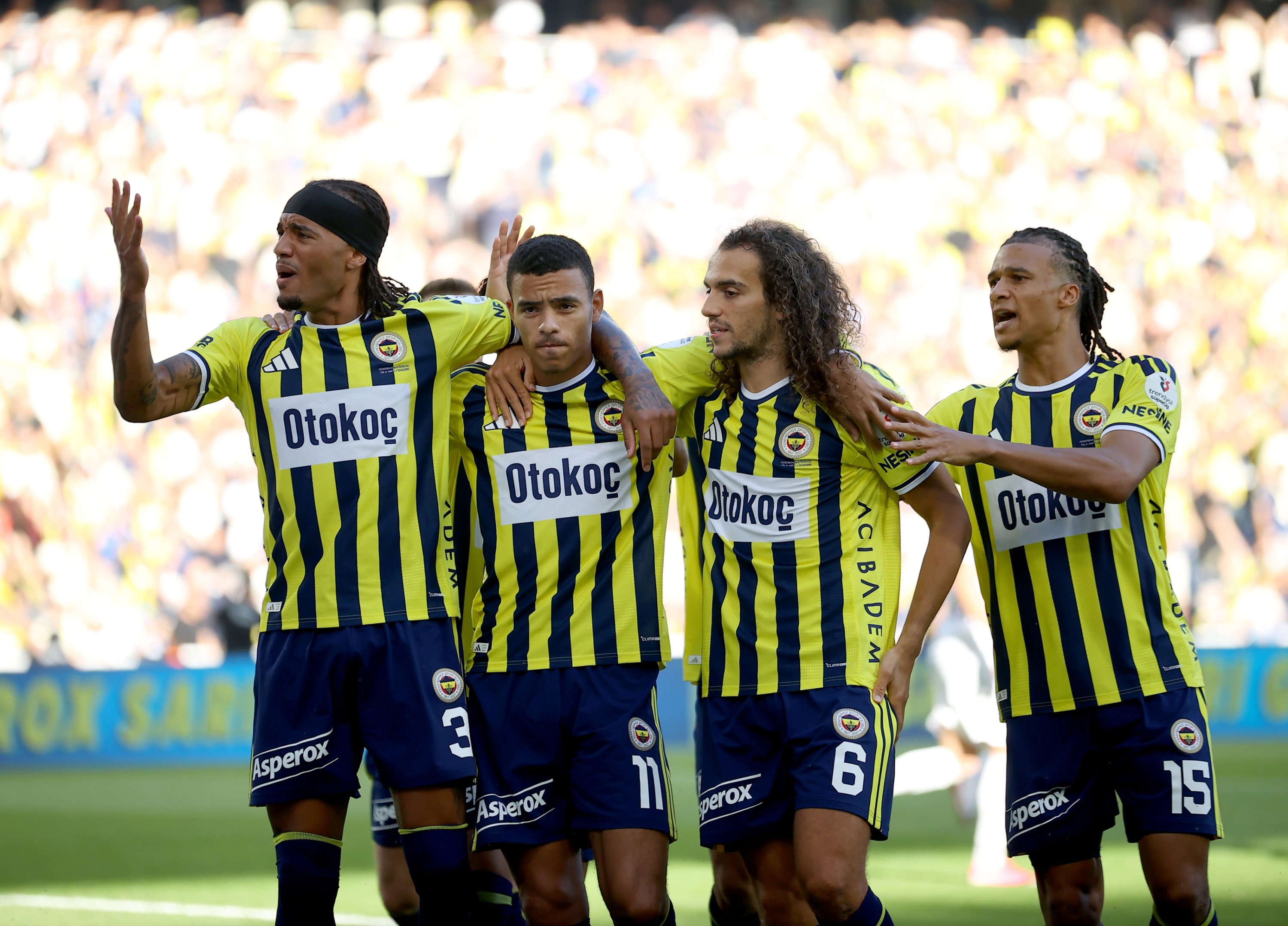
Fenerbahçe extended the lead two minutes later when Kerem Aktürkoğlu delivered a cross to the far post, allowing Muriqi to finish into an open net.
Muriqi added his second goal in the 21st minute, converting a rebound after Eyüpspor goalkeeper Horațiu Moldovan saved an initial attempt from Greenwood.
Matteo Guendouzi made it 4-0 in the 38th minute with a strike from outside the box following a pass from Irfan Can Kahveci.
Kahveci then scored Fenerbahçe’s fifth goal in first-half stoppage time, finishing from close range off a setup from Greenwood.
Fenerbahçe, in the process, became the first team across Europe’s Top 10 leagues to score five goals in the first half of a match this season.
Muriqi completed his hat trick in the 47th minute with a finish at the near post, then added his fourth goal of the match in the 55th minute by heading in a corner kick from Kahveci.
The strike marked Fenerbahçe’s seventh goal in 55 minutes, setting a league record for the fastest seven goals scored by a club in Süper Lig history.
Greenwood concluded the scoring in the 80th minute, converting from close range following an assist from Oğuz Aydın.
Following the historic defeat, Eyüpspor head coach Özhan Pulat submitted his resignation to the club’s board of directors. The board accepted Pulat’s resignation following a post-match meeting.
In other 6th-week action across the league, Erzurumspor FK earned a 1-0 home victory against Samsunspor. Meanwhile, Göztepe played to a 2-2 draw at home against Çaykur Rizespor.
Great Britain secured their spot in the Davis Cup Finals with a 3-0 win over Ecuador in London Sunday, while U.S. Open finalist Alexander Zverev helped Germany reach the quarterfinals.
Henry Patten and Neal Skupski wrapped up the victory for Britain with a 6-3, 6-4 win over Diego Hidalgo and Gonzalo Escobar, consolidating the work done in the singles the day before by Toby Samuel in his debut and Arthur Fery.
Top-ranked doubles player Patten and his partner Skupski, the world No. 3, secured a sole break of serve in the first set to take control against their 91st- and 93rd-ranked opponents.
In the second set, the British duo took the lead in the ninth game, before promptly serving out the match for the 10-time Davis Cup champions.
“We’re feeling great,” Patten said on court.
“We’re very happy to get it done in the first match.”
Earlier Saturday in the British capital, 23-year-old Samuel overcame Andres Andrade and Wimbledon semifinalist Fery defeated Alvaro Guillen Meza to set up the victory.
Germany’s Zverev then led his country into the Finals. The world No. 2 beat 103rd-ranked Croatian Dino Prizmic 6-2, 6-4 to take Germany one step closer to a first Davis Cup title since 1993.
Zverev broke his 21-year-old opponent three times, without facing a break point himself, to win in 77 minutes in Halle.
Zverev had got the Germans off to a winning start against Croatia on Saturday with a straight-sets win against Matej Dodig.
Prizmic hit back instantly for the visiting Croatians but Kevin Krawietz and Tim Puetz’s win in the doubles rubber tipped the tie back in Germany’s favor.
Spain also stand on the brink of a return to the Finals as they lead hosts Chile 2-0 in Santiago following Daniel Merida and Rafael Jodar’s victories in Saturday’s singles rubbers.
Jaume Munar and Pedro Martinez will meet Tomas Barrios Vera and Alejandro Tabilo in the first of three possible matches on Sunday.
The winners of that final tie will join three-time defending champions and Finals hosts Italy, as well as Britain, Germany, the Czech Republic, South Korea, Austria and Canada in the Davis Cup Finals, which will run from Nov. 24-29 in Bologna.
KTM’s Pedro Acosta claimed his first MotoGP victory at Austria’s Red Bull Ring Sunday, while Jorge Martin’s second-place finish put the Aprilia rider atop the championship standings.
Aprilia’s Marco Bezzecchi finished third ahead of Ai Ogura of Trackhouse.
Ducati’s Marc Marquez, who entered the weekend tied with Martin atop the standings, finished fifth and now trails his rival by 12 points.
Acosta, who won Moto3 and Moto2 championships before moving to MotoGP in 2024, started third but fell to fifth by the end of the first lap.
The blip was temporary for the 22-year-old, who ran second by the end of lap four and battled Martin. On lap nine, he swept into the lead.
He held a similar position in Saturday’s sprint before sliding off near the end, but this time, after 15 previous podiums, he finally secured a MotoGP win.
“The first one is always special,” Acosta said, especially pleased to win on the home track of KTM sponsor Red Bull.
“Nice way to close a cycle with KTM in front of all the Austrian fans,” he said. “Many KTM teachers were involved. I’m super happy for them because they deserve it even more than me. The result was amazing.”
The playful Spaniard also paid tribute to his Saturday crash by laying his bike down on his winner’s lap on the spot where he slid into the gravel.
Martin, who benefited from that crash Saturday, finished 1.017 seconds behind him.
Marc Marquez started second but on a track unsuited to his Ducati, he had an up-and-down ride. Falling to fifth on the opening lap, he moved past Ogura on lap nine before an error that sent him off the track allowed the Japanese rider, KTM’s Brad Binder and Gresini’s Fermin Aldeguer to pass.
In true Marquez style, though, the seven-time world champion battled back from seventh to minimize damage to his hopes for an eighth title.
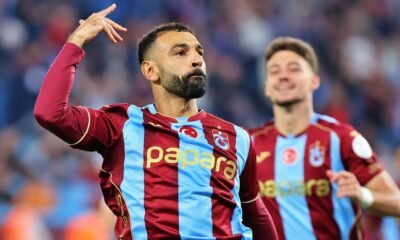
Mohamed Salah scored a hat trick and assisted another as Trabzonspor handed defending champions Galatasaray their first defeat of the Turkish Süper Lig season with a 4-0 victory Saturday, giving new manager Thomas Reis a triumphant start to his tenure.
Reis took charge of Trabzonspor earlier in the week following the departure of former head coach Fatih Tekke. The German manager oversaw just two days of training before guiding the Black Sea club to a dominant home performance against their Istanbul rivals.
With the victory, Trabzonspor moved up to fifth place in the Süper Lig standings with 10 points from six matches, pulling within three points of league leaders Galatasaray.
Salah set the tone early at the stadium, opening the scoring in the fourth minute. The Egyptian star latched onto a clearance in midfield, raced behind the Galatasaray defense and calmly slotted a low finish past goalkeeper Uğurcan Çakır.
Salah nearly doubled the advantage five minutes later when he found space inside the penalty box, though his effort went just wide of the post.
Trabzonspor extended their lead in the 39th minute through a clinical team combination. Salah turned provider, sliding a pass into the right side of the box for Noah Saviolo, who struck a low shot into the bottom corner.
The hosts effectively put the match out of reach just before halftime. In the 44th minute, Franculino Dju dispossessed Galatasaray defender Davinson Sanchez deep in opposition territory and played the ball to Salah, who applied a composed, low finish from inside the area to send Trabzonspor into the break with a 3-0 lead.
Galatasaray struggled to mount a comeback in the second half as frustration mounted on the visitors’ bench. Galatasaray head coach Okan Buruk was sent off in the 71st minute after receiving a red card for protesting a refereeing decision.
Salah completed his hat trick in the 80th minute in spectacular fashion. After receiving a pass from Ozan Tufan, the forward broke into the box on the right following an unchallenged run from his own half before placing a signature side-footed finish beyond Çakır.
Galatasaray were reduced to 10 men in the 85th minute when Lesley Ugochukwu was sent off following a Video Assistant Referee (VAR) review. Ugochukwu had initially received a yellow card for a foul on Tufan, but the penalty was upgraded to a direct red card.
Speaking after the match, Reis praised his squad’s tactical discipline and immediate adaptation to his instructions.
“I would like to start by expressing how happy I am,” Reis said. “We only had a two-day period before having the opportunity to go into this match with the team. I can say that we showed a performance that was very high and very good, perhaps to a degree that was not expected of us. There was good defense, there was good offense. It was a very important victory for us. I think we delivered a truly important performance.”
“I must also express this: I am very happy for our fans as well … this is an important and very special victory for me. There is a short break now. After resting a bit, we will continue working again and hopefully continue on our path in the same way,” he added.
Reis emphasized the collective effort of the squad, noting that while Salah’s individual brilliance was decisive, the victory was built on team unity and defensive stability.
“We spoke briefly with our players before the match, got their thoughts, and chatted with them,” Reis added. “We have teammates who are much more experienced than me as players, who have gained a lot of experience. We have players who have played at the Champions League level, at very top levels. Of course, they are also very valuable players. They made incredible contributions. Naturally, I am very happy to be Mohamed Salah’s coach. But at the same time, our defensive players, our midfielders, everyone did a great job. They helped him a lot.”
In other Süper Lig action on Saturday, Başakşehir recorded a resounding 4-0 home victory against Gençlerbirliği.
Meanwhile, Kocaelispor secured a 2-0 home win over Gaziantep and Alanyaspor earned a 2-1 away victory against Çorum FK.
Kylian Mbappe has ended his two-decade partnership with Nike and joined Swiss sportswear brand On, giving the fast-growing company a global football superstar as it prepares to enter a market dominated by Nike, Adidas and Puma.
The move is a major step for On, which built its reputation in running before expanding into tennis through its partnership with Roger Federer. The company plans to launch its first football boots in 2027, with former France star Thierry Henry serving as its director of football.
Mbappe, who has been associated with Nike since he was a child, will work with On’s product teams on the development and testing of its football footwear and apparel. The deal includes cash and equity components, although On has not disclosed its value.
The partnership gives On an immediate presence in football through one of the sport’s most recognizable players, but turning Mbappe’s star power into sustained sales will be a far more difficult task.
Football is among the most fiercely contested categories in sportswear. Nike, Adidas and Puma have spent decades building relationships with clubs, national teams and players while investing heavily in product development and marketing. At the 2026 FIFA World Cup, Adidas sponsored 14 national teams, while Nike and Puma sponsored 12 and 11, respectively.
“Football is one of the most expensive categories to enter and performance credibility cannot simply be bought,” Jefferies equity analyst Randy Konik said, arguing that the Mbappe deal shows On will need to increase spending to sustain its growth.
On’s challenge comes as the company itself faces pressure to maintain the rapid expansion that has made it one of the sportswear industry’s prominent challengers.
The company missed analysts’ estimates for second-quarter net sales last month, raising concerns about slowing growth. Its Americas business, which accounts for more than half of its revenue, has also struggled amid uncertain consumer spending. On’s shares have fallen more than 40% this year.
Still, On has continued to take market share from established rivals. Data from M Science showed the company gained share in the three months through August, while Nike continued to lose ground.
Its expansion into football therefore represents another attempt to find a new source of growth.
On has already used a similar strategy in tennis, where its partnership with Federer helped raise the brand’s profile beyond running. Federer acquired an equity stake in On after joining the company in 2019, and the Swiss star has remained closely involved with its product development and marketing.
The Mbappe agreement similarly includes an equity component, creating a structure that goes beyond a conventional endorsement deal. The French forward will have a role in developing On’s football products as the company builds its new category.
On says its LightSpray robotic manufacturing technology, already used in its running footwear, will be part of its approach to football boots. The company is positioning the technology and its engineering expertise as potential points of difference in a market where established brands have years of experience producing elite-level boots.
Yet industry analysts have warned that signing a superstar does not automatically create a successful football business.
Under Armour’s partnership with NBA star Stephen Curry offers one example. The collaboration helped establish Under Armour in basketball, but the company did not replicate the cultural reach or commercial scale of Nike’s Jordan Brand. Under Armour and Curry agreed to separate in 2025.
“The question is whether the deal is worth the cost, which is undoubtedly high,” Morningstar analyst David Swartz said.
Nike, meanwhile, is losing one of its most prominent football ambassadors at a time when the company is attempting to revive its business.
Mbappe became a central figure in Nike’s football marketing, particularly as Cristiano Ronaldo, another major Nike ambassador, moves into the later stages of his career. Nike has also recently lost Spain and Barcelona star Lamine Yamal to Adidas.
Nike said it was proud of its long relationship with Mbappe and wished him success in the next stage of his career.
Mbappe’s departure is unlikely to transform Nike’s fortunes by itself. Analysts said investors are more focused on the company’s product innovation and broader turnaround strategy under CEO Elliott Hill, who has sought to refocus Nike on major sports including football and running.
Nike still retains significant strength in football. The company has extended its long-running agreement to supply France’s national team kits through 2033-34 and remains one of the sport’s dominant global brands.
For On, however, Mbappe represents something different: a chance to establish credibility in football before its first boots even reach the market.
The company has brought together Mbappe’s global profile, Henry’s football expertise and its product-development technology as it attempts to build a new category from scratch.
Whether that combination can challenge decades of Nike, Adidas and Puma dominance will depend on more than the visibility of one superstar. On must persuade players and consumers that its football products can perform at the highest level, while building the distribution, club relationships and cultural presence needed to turn a headline partnership into a lasting football business.


-
 Sports2 days ago
Jordan tops all-time highest-paid athletes list, Ronaldo closes in
-
 Sports2 days ago
Mbappe swaps Nike for On as Swiss brand plots entry into football
-
 Sports2 days ago
Infantino invited to CAF strategy conference as FIFA election looms
-
 Economy2 days ago
Türkiye revokes license of Iranian Bank Mellat
-
 Politics2 days ago
Türkiye closely monitoring field as terror-free initiative advances
-

 Politics6 hours ago
Türkiye rejects disinformation targeting child protection operations
-
 Politics16 hours ago
Erdoğan leaves for UN General Assembly with Gaza in mind
-
 Sports1 day ago
Trabzonspor euphoric after Salah hat trick tames Galatasaray