
Economy
Nvidia CEO Jensen Huang reportedly targeted by Chinese spy

U.S. intelligence agencies concluded that a Chinese executive with close ties to Nvidia CEO Jensen Huang was gathering information for Beijing, but President Donald Trump took no action after being briefed, a report said Thursday.
The executive, Alice Huang – no relation to the CEO – also known as Huang Le, held a senior position at Singapore-based data center company Megaspeed, which was already under investigation over suspicions it helped China circumvent U.S. restrictions on advanced artificial intelligence chips.
Electronic surveillance identified her as a Chinese intelligence asset and revealed her close relationship with Nvidia’s chief executive, The New York Times reported, citing people familiar with classified intelligence findings.
Trump was briefed roughly a year ago but chose not to act, the report said.
It remains unclear what information Huang provided to Beijing or whether she obtained sensitive Nvidia information.
The newspaper said Jensen Huang had not received a defensive briefing warning him of the potential intelligence threat.
Nvidia dismissed concerns about the relationship, saying interactions with Megaspeed were routine business dealings.
“Meetings with customers are part of a CEO’s job,” Nvidia spokesperson John Rizzo said, adding that the company had not shared sensitive trade secrets or national security information.
Megaspeed said it had hired outside counsel to investigate the allegations and pledged cooperation with U.S. authorities.
The Chinese Embassy in Washington dismissed the allegations as “groundless smears and slanders,” according to the newspaper.
U.S. authorities have investigated Megaspeed since late 2024 over suspected chip diversion, with the case transferred to the Justice Department earlier this year, the report said.

Rising oil and gas prices will leave many European Union citizens struggling to pay their bills this winter, though the bloc does not expect supply shortages, a senior official said Thursday.
“We do not expect the security of supply issue as such. But for the citizens that are struggling to pay the bills, that might not matter,” European Energy Commissioner Dan Jorgensen said.
With high prices, it does not really matter how much gas or oil there is available on the market, Jorgensen told reporters after participating in a meeting of the bloc’s energy ministers held in Luxembourg.
Ahead of the meeting, he said nearly 50 million Europeans cannot adequately heat their homes and warned that number could rise as the bloc heads into what he called an even worse energy crisis than the one it faced four years ago. But he warned EU countries against over-subsidizing fossil fuels.
“We’re better situated at dealing with this crisis than we were in 2022 because we’ve reduced our gas consumption. We use 18% less gas now than we did in 2022. Also, we’ve diversified. We used to get 45% of our gas from Russia… now we get gas from different suppliers around the planet,” Jorgensen told reporters.
“But on the other hand, this crisis is also worse because this is also oil and oil products. We’ve even seen situations where there was a threat to our security of supply last summer on jet fuel. We’re not there now.”
The EU is entering the winter heating season with gas storage sites 75% full, down from 83% a year earlier.
European wholesale gas prices briefly touched 100 euros per megawatt-hour on Wednesday for the first time since December 2022, when Europe was reeling from the loss of most Russian pipeline gas supply. Prices have climbed as the Middle East conflict has escalated and are now around three times higher than before the Iran war.
Fighting has damaged refineries across the Middle East and Russia, and disrupted oil and gas flows through key shipping routes including the Black Sea, Red Sea and Strait of Hormuz.
Pledge to release over 42 million barrels of oil
The European Commission began talks with refiners on Wednesday on ways to boost output, including by potentially easing some technical specifications. Western powers also agreed this month to accelerate the release of more than 400 million barrels from emergency oil stockpiles following U.S. pressure.
A dozen European countries pledged Thursday to jointly release more than 42 million barrels of oil in the coming months, Jorgensen said.
“EU member states have reaffirmed their commitment to an accelerated release of 42.6 million barrels from strategic reserves over the next months, and around half of this will be diesel,” he noted.
The 12 countries, including France, Germany and Italy, said in a statement they would release the oil from strategic reserves by the end of January 2027, including 20.5 million barrels of diesel.
The other European countries involved are Belgium, Denmark, Greece, Latvia, Lithuania, Luxembourg, the Netherlands, Portugal and Sweden.
The International Energy Agency – to which all 12 nations belong – made a similar call in mid-October for its members to step up the release of oil stocks ahead of winter.
U.S. President Donald Trump ramped up the pressure on Europe to release reserves after the Iran war sent energy prices skyrocketing, coming back to bite him at home with high fuel costs that have become a key issue ahead of congressional elections next week.
The European Union and Canada aim to deepen cooperation on AI, climate, energy and security as they explore the possibility of Canada becoming the union’s first “associate member,” European Commission President Ursula von der Leyen said Thursday.
The term, which many EU countries oppose, has no legal meaning.
Deeper ties to Europe are part of Prime Minister Mark Carney’s strategy to reduce Canada’s economic and security reliance on the US since President Donald Trump imposed tariffs on Canadian goods. Still, Canada’s efforts to draw closer to the EU risk angering Trump as trade talks between Canada and the U.S. continue.
“Our idea is simple: it is an association without accession,” von der Leyen said in a speech in Montreal at a Canada-EU summit. “We can build a partnership that comes closer to membership than anything we have done before.”
“We can work on everything, from AI and climate to energy or security,” she said.
Canadian and EU leaders, however, dropped the idea of associate EU membership from their joint declaration, seen by Reuters, agreeing instead to an “ever closer association.”
The declaration, which officials plan to make public on Friday, said work to define the Canada-EU relationship would continue until another summit next year.
Von der Leyen first floated the idea of associate membership for Canada six weeks ago, prompting a rebuke from countries led by Germany that argued they could not agree to a concept that had no legal status and had not been fleshed out, diplomats said.
A U.S. cruise ship on an around-the-world voyage that touted its cabins as floating homes suspended its three-year journey in Cambodia due to fuel costs, forcing hundreds of passengers to disembark.
The MV Odyssey set sail two years ago on a voyage to the seven continents marketed as combining long-term living at sea with global travel. Its operator had offered to “make the Odyssey your permanent home,” with the purchase price of a suite for the lifetime of the vessel starting around $230,000.
For now, it is docked at the Cambodian port of Sihanoukville on the Gulf of Thailand, with no certain departure date.
The ship has been carrying 203 passengers, mostly Americans, along with 156 crew members, according to Cambodian officials. It has a 650-passenger capacity.
Its Florida-based operator, Villa Vie Residences, said monthly fuel expenses per cabin that historically averaged $1,800 have reached an estimated $6,000 to $8,000 in parts of Asia due to the war in Iran. The company said it sought to reduce fuel consumption by slowing the itinerary and spending more time in port, but was unable to offset the surging costs.
Traffic has been curtailed in the Strait of Hormuz since the war in Iran began, squeezing supplies of all kinds of petroleum-based fuels, especially in Southeast Asia, and sharply increasing prices.
“We have been unable to continue carrying the resulting operating losses,” Villa Vie Residences said in a statement issued Tuesday. “Passing the full increase on to residents is not a realistic solution. Our focus now is on supporting residents, crew, and employees,” while it tries to restructure.
“The company is working with residents to coordinate disembarkation and identify temporary living arrangements,” it said.
Those on ship hoped to sail for years to come
Passengers, however, said they received no support and had to make their own arrangements after being given seven hours’ notice on Tuesday to disembark. Some were devastated and expressed hope a new company could rescue the venture so life at sea can continue.

Paul and Lynn Montoya, a retired couple from Wyoming, said they bought a window cabin and had expected to sail for years. They boarded the ship 17 months ago in Panama.
Paul praised the concept of residential cruising but said the shipowner lacked the expertise to make the business financially sustainable. While rising fuel costs had been cited publicly as the reason for the suspension, he said the company had already been struggling. Changes to itineraries, unreliable internet access and declining food quality had pushed many residents to leave the ship in recent months, he said.
Lynn said residents were repeatedly asked to contribute additional money for fuel and other expenses, including a fresh call to raise funds for fuel to get out of Cambodia. She said the crew members were also not paid.
“We were tired of every two to four weeks being asked for money for fuel, money for everything,” she said. “We had hopes, but they just kept sinking further and further into the hole through mismanagement.”
For some, venture was risk worth taking
Yet for some, even the financial and logistical turmoil couldn’t outweigh the extraordinary experience of traveling the world and living at sea.
Carol Larson, 69, and her sister Crystal Lavering, 72, occupied separate cabins aboard the ship for 18 months. The siblings, from California, described the suspension as heartbreaking, and hoped the cruise would be resurrected.
“I hope there is a movement for the residents to buy the ship and I am hoping that goes through because it’s a dream to live on the ship and I don’t want it to end,” Larson said.
Lavering said her health improved during her time on the ship, and that she didn’t need to use a cane to walk anymore. “You come to this ship to live … it’s just sad that it’s all over.”
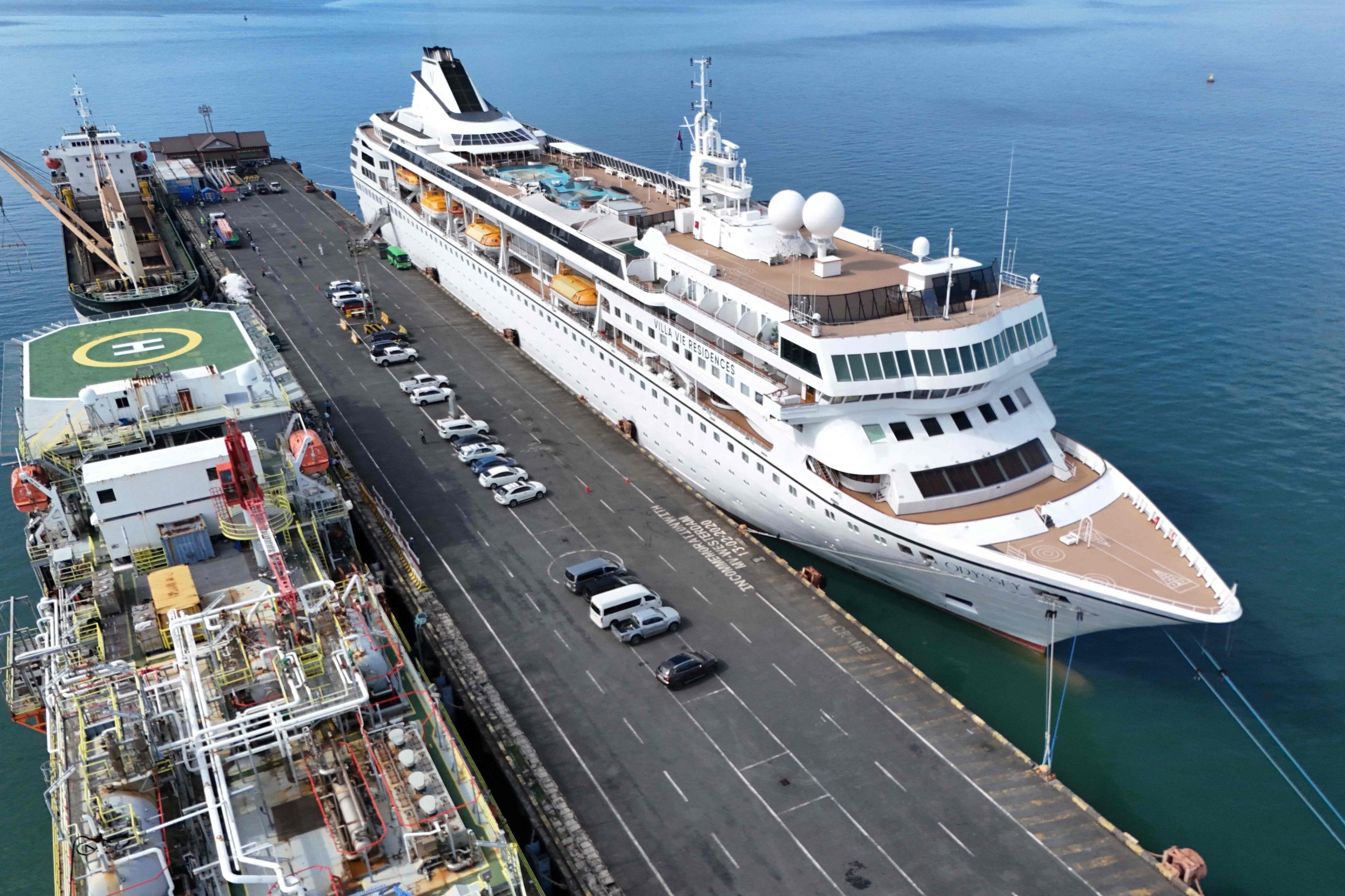
Larson bought her cabin for $120,000, paid in installments, in addition to monthly maintenance fees, under a plan that had promised the possibility of living aboard for up to 15 years. She said she blamed U.S. President Donald Trump for the ship’s woes as fuel costs spiked due to the Iran war, in addition to poor management. But she said she didn’t regret her investment.
“Because it was a startup company, I believe that it was a risk. From the very first day, I said to myself that if it lasts a year, I can walk away and feel like I got my money’s worth … I still feel that way,” she said.
Cruise began in Northern Ireland in 2024
The ship arrived in Sihanoukville last Friday and was scheduled to depart Wednesday, according to a statement from Long Dimanche, the deputy governor of Preah Sihanouk province. He said it was now expected to refuel and depart Cambodia on Saturday, but the ship’s operator has not yet publicly confirmed any date.
Built in 1993 and operated under different names by several cruise lines over the years before being becalmed by the coronavirus pandemic in 2020, the Odyssey was bought by Villa Vie Residences in 2023.
Its current cruise, originally intended to last 3 1/2 years, began in October 2024 in Belfast, Northern Ireland, where the ship had been refitted. A second cruise had been tentatively scheduled to end in August 2030.
Türkiye aims to raise the combined share of high- and medium-high-technology sectors in its manufacturing industry exports to 48.5% next year and increase total manufacturing exports to $276 billion (TL 13.7 trillion), according to a recent report citing data from the 2027 Presidential Annual Program.
The share of high-technology industries in manufacturing exports, which is expected to stand at 4% this year, is projected to rise to 5.5% next year. The share of medium-high-tech industries is also targeted to increase from 40% to 43%, the data compiled by Anadolu Agency (AA) suggested.
Thus, the combined share of the two technology groups is planned to reach 48.5%, up 4.5 percentage points from the estimated 44% level for this year.
To achieve this, the focus will be placed on investments, financing and R&D activities.
Manufacturing industry exports are projected to increase to $276 billion next year from an expected $266.2 billion this year. The target represents an increase of $9.8 billion in exports.
The manufacturing industry’s share of gross domestic product (GDP) at current prices is also targeted to thus rise from 15.5% to 15.9%.
Weight of medium-high-tech sectors
An examination of the structure of the manufacturing industry by technology intensity, as outlined in the program, highlights the significant weight of high- and medium-high-technology sectors in production and value added.
High-technology sectors account for 0.8% of businesses in the manufacturing industry, 2.9% of employees, 3.6% of production value and 6% of value added.
At the same time, medium-high-technology sectors held a much larger share, accounting for about 12.6% of the number of businesses and 20.5% of employees.
These sectors make up 27.5% of production value and 29.4% of value added.
The weight of these sectors in the technological composition of exports is also increasing. The combined share of high- and medium-high-technology sectors in total manufacturing exports increased from 36.4% in 2021 to 43.4% in 2025.
Support of tech transformation
Moreover, as part of efforts to support technological transformation in production through financing, the share of medium-high- and high-technology sectors in total loans is targeted to increase to 7.6% next year from an estimated 6.9% this year.
The share of high- and medium-high-technology exports in the export credit agency, Türk Eximbank’s loan volume is also projected to rise from 45% to 45.3%.
Similarly, the share of the manufacturing industry in KOSGEB support programs is planned to reach 90% in 2027.
Efforts are also to be carried out in microelectronics, semiconductors, quantum technologies and next-generation communications to develop high-technology production capacity.
The share of priority sectors in the manufacturing industry exports is planned to increase to 43.5% in 2027 from an estimated 40.1% this year.
Automotive exports target at $45.5 billion
In line with this, automotive industry exports – which is the leading group of Turkish exports – are targeted to rise to $45.5 billion next year from an expected $41.6 billion this year.
The sector’s share of manufacturing exports is also projected to increase from 15.6% to 16.5%.
Exports of electrical equipment are also targeted to rise to $22.8 billion from $20.9 billion, while machinery exports are expected to increase to $19.8 billion from $19.2 billion.
In the electronics sector, exports are targeted to increase to $4.5 billion from $4 billion.
Christine Lagarde’s decision to leave the role of the president of the European Central Bank (ECB) months before the end of the planned term would conclude an eventful seven years at an institution she was never expected to lead.
The former French finance minister and head of the International Monetary Fund (IMF) arrived in Frankfurt in 2019 as the first ECB chief with no formal economics training or central banking experience – prompting some market participants to label her a “credibility risk.”
In fact, she knew so little about the institution that Lagarde, 70, later said she had accepted the job thinking the presidency was a five-year mandate, rather than eight.
Yet after a tenure dominated by a COVID-19 pandemic, two energy shocks and the worst inflation spike in the eurozone’s history, Lagarde leaves with a record that defied the sceptics.
“Her seven years at the ECB have been, on the whole, pretty good,” said Willem Buiter, an economist and former Bank of England (BoE) official, noting that the ECB managed to bring inflation back down faster than peers in Britain and the U.S.
Her exit, however, threatens to be as political as her arrival.
By walking away before her eight-year term ends, Lagarde gives European Union leaders a chance to pick her successor before a French election next spring that opinion polls suggest far-right candidate Marine Le Pen will win, replacing President Emmanuel Macron.
For an institution that fiercely guards its independence from political meddling, the timing has drawn sharp criticism from central bank watchers.
“This is debasing the institution and just following the purely political calculus of the French president,” said Paul De Grauwe, a professor at the London School of Economics.
Lagarde and Macron have not addressed such criticism directly. Lagarde has said she would not be a candidate for the French presidency but would advocate for pro-European values in her home country “in whichever capacity” she deemed most efficient.
‘Better with butter’
Throughout her career, Lagarde has stood apart from more technocratic colleagues through a mix of charm, consensus-building and folksy pragmatism.
Favoring plain-speaking homilies over dense economic theory, the then-IMF chief famously declared that “everything is better with butter” when discussing growth and told governments to “fix the roof while the sun is shining.”
Unorthodoxy was a hallmark of Lagarde’s career, and the subject of her upcoming autobiography “Lady First.”
A former corporate lawyer who spent years in Chicago, she entered French politics in 2005 as an outsider.
Early missteps earned her the domestic moniker “Madame Lagaffe,” but she soon became one of then-President Nicolas Sarkozy’s sharpest operators, steering French banks through the 2008 crash.
She led the IMF through Europe’s debt crisis, navigating a messy Greek rescue that imposed harsh austerity, and sparked outrage in Athens when she bluntly urged suffering citizens to “pay their taxes.”
Her appetite for high-stakes bets showed again in 2018 with a record $57-billion lifeline for Argentina to back then-President Mauricio Macri. The gamble unravelled, failing to halt a currency collapse or avert a deep recession, and left the IMF bound to its most troubled debtor.
The spreads crisis and the tribal clique
Her occasional unfamiliarity with the nuances of central banking still peeked through.
In March 2020, as the pandemic rattled sovereign debt markets, Lagarde told a press conference the ECB was “not here to close spreads” between Italian and German borrowing costs.
The comment triggered an immediate selloff in bond markets and forced her to swiftly walk it back.
Under Lagarde’s watch, the ECB swiftly rolled out emergency bond-buying that stabilised markets as COVID-19 spread.
It launched its fastest series of interest-rate hikes to bring inflation under control following Russia’s 2022 invasion of Ukraine, although it later acknowledged it had been slow to recognise the full impact of spiking energy prices.
As ECB president, she once described economists as a “tribal clique,” a provocative jab at the profession’s establishment, though she later softened the blow by saying she hoped to join the tribe.
A ‘more political’ ECB president
Lagarde also used her political skills to repair rifts.
Unlike her predecessor Mario Draghi, whose top-down style embittered some hawkish northern European peers, she worked to build consensus among the euro zone’s 21 national central bank chiefs.
Her willingness to wade into politics remained evident: in January, Lagarde walked out of a World Economic Forum (WEF) dinner in Davos during a speech by U.S. Commerce Secretary Howard Lutnick that criticized Europe, an episode that underscored fraught trans-Atlantic relations.
Whoever succeeds her when she leaves the ECB on Feb. 7 will face fresh challenges, including strains in French bond markets ahead of next year’s election and a Middle East conflict that threatens a new bout of inflation.
Ultimately, Lagarde’s legacy may be a paradox: an outsider who showed that political diplomacy could steer a central bank through historic shocks, but whose early departure served as a final reminder of her political instincts.
“She was put there for a reason: being more political than her predecessor and, on that mission, I think she largely succeeded,” Frederik Ducrozet, head of strategy and macro research at Pictet Wealth Management, said.
The U.S. economy expanded at a healthy 3.4% in the third quarter of 2026, the Commerce Department said Thursday, beating market expectations and providing a slight boost to President Donald Trump ahead of midterm elections next week and concerns over higher fuel prices.
“The contributors to the increase in real GDP (gross domestic product) in the third quarter were increases in investment, consumer spending, and government spending that were partly offset by a decrease in exports,” the department’s Bureau of Economic Analysis (BEA) said in a statement.
Thursday’s data was an advance estimate released by the BEA, with two further estimates due in the coming weeks that could see the number revised.
The BEA said the acceleration in GDP growth was driven by an increase in investment and an upturn in government spending, which were partially offset by a decrease in exports.
Imports, which are a subtraction in the formula for GDP, also increased more in the third quarter than the previous one.
Trump’s Republican Party faces a stiff test from the Democratic Party for control of Congress in polls next Tuesday, with the president’s handling of the economy a key issue for voters.
Trump’s war on Iran has sent global energy prices skyrocketing due to Tehran’s retaliatory action, with U.S. consumers paying an average of 42% more at the pump for regular gasoline, according to data from the AAA motor club.
His wide-ranging tariff policies have also upended global trade and fueled inflation.
On Thursday, new data showed the preferred gauge for inflation of the Federal Reserve (Fed) rose by 3.6% year-over-year in September, an increase from the previous month.
The Fed prefers to use the Personal Consumption Expenditures (PCE) price index when gauging inflation, as it takes into account a broader range of household expenditures than Consumer Price Index (CPI) inflation.
On Wednesday, the U.S. central bank voted to keep interest rates steady, citing the need for more data to gauge how best to battle the surging inflation.
Chair Kevin Warsh reiterated the Fed’s commitment to its long-term 2% target for PCE inflation, which it has not achieved for more than five years.
He termed current inflation levels “too high,” but cautioned against moving too quickly, saying the Fed had seen some tightening of financial conditions in response to the Fed raising interest rates in September, its first hike in three years.


-
 Economy2 days ago
Canada, UAE sign major trade deal amid tensions with US
-

 Politics2 days ago
Turkish opposition CHP confirms it will field candidate in next election
-
 Politics1 day ago
Türkiye confirms hosting Libya east-west reunification talks
-

 Politics1 day ago
Turkish main opposition holds primaries to cement Özel’s rule
-
 Politics2 days ago
President Erdoğan hosts MHP leader to discuss key political issues
-
 Politics1 day ago
Erdoğan, Macron discuss UN leadership, bilateral ties in call
-

 Politics3 days ago
Mecca Defense Alliance reps meet in Iran for regional coordination
-

 Economy2 days ago
French consumer sentiment hits 2013 low amid protests