
Politics
Syria cease-fire extended amid Daesh prisoner transfers

As tensions decline in Syria after days of clashes between the US-backed terrorist group YPG and the Syrian army, the Defense Ministry announced that the cease-fire with the group was extended for 15 days, starting Saturday night. The announcement came hours after the expiry of an initial cease-fire announced last Tuesday.
The extension aims to support a U.S. operation to evacuate Daesh detainees currently held in prisons run by the YPG and transfer them to Iraq.
The U.S. military’s Central Command (CENTCOM) announced Tuesday that it launched a mission to transfer Daesh detainees from northeastern Syria to Iraq to ensure the terrorists remain in secure detention facilities.
The mission began with U.S. forces transporting 150 Daesh fighters from a detention facility in northeastern Hassakeh province to a secure location in Iraq, with plans for up to 7,000 detainees to eventually be transferred to Iraqi-controlled facilities.
The Syrian Presidency announced separately earlier this week that a “mutual understanding” had been reached with the YPG on the future of eastern Hassakeh province.
Under the understanding, the YPG was given four days to conduct consultations and prepare “a detailed plan for practical integration of the areas,” the presidency said.
If an agreement is reached, Syrian forces will not enter the city centers of Hassakeh and Qamishli and will instead remain on their outskirts, the statement added.
The presidency said the two sides agreed to integrate all YPG military and security forces into the structures of the Defense and Interior Ministries, while consultations continue on technical details.
According to the statement, YPG head Ferhat Abdi Şahin will nominate a candidate for deputy defense minister, as well as one for Hassakeh governor. The group will also submit lists of nominees for representation in the People’s Assembly and for employment in various state institutions.
Syrian forces will also not enter Kurdish villages, the presidency said, noting that no armed forces will be present there except for local security units drawn from the residents of those areas. The YPG claims to represent Syrian Kurds.
Though no all-out clashes have been reported since the cease-fire began, the Syrian army remains on alert. The army on Saturday said that the YPG was bringing reinforcements from Iraq to several areas of Hassakeh, specifically from the terrorist group PKK. The YPG is the Syrian wing of the group, which killed tens of thousands of people in Türkiye since the 1980s.
The command also said that the YPG committed “widespread violations” in those areas, including arrests, forced displacement and the torture of people who oppose its policies.
The military warned the terrorists against continued provocations, as well as the dissemination of false claims and selectively edited video footage.
On Saturday, Syrian security forces in the northeastern Raqqa province released 126 inmates from a prison that had been run by the YPG, all of them under the age of 18, Alikhbaria Syria TV said.
Quoting an unnamed security source, the channel said: “Internal security released 126 prisoners from Al-Aqtan prison in Raqqa, all of them under 18.”
Information Minister Hamza al-Mustafa said on the U.S. social media company X that footage posted by the Syrian Arab News Agency (SANA) showed the detainees’ release.
“These children are not merely detainees; they are sons and daughters whose childhoods were stolen. They should have been in schools and playgrounds, not behind prison walls. Every face among them carries a story of fear, separation and lost innocence,” he added.
Al-Mustafa stressed that “there is no slogan, justification, or security reason that can explain the presence of a child in a prison cell,” saying that their plight wounds the conscience of humanity.
On X, presidential spokesperson Ahmed Muaffaq Zaidan called the detention a “full-fledged scandal carried out by gangs outside the bounds of time and place.”
On Friday, the Justice Ministry announced that it had officially taken over Al-Aqtan prison after YPG elements withdrew from it as part of extending state authority and restoring institutions to operate under the law. The Interior Ministry also began a review of the detainees’ files.
On Friday, the Syrian Army announced that its units had begun transferring YPG elements from Al-Aqtan prison and its surroundings in Raqqa to the city of Ayn al-Arab, east of Aleppo, saying this represents the first phase of implementing the Jan. 18 agreement paving the way for the government to take over the facility.
The YPG faced a comprehensive offensive by the Syrian army earlier this month when the group failed to honor a deal with Damascus for its integration into the post-Assad army. Syrian forces first forced out the YPG from two neighborhoods in Aleppo that it occupied and then moved forward to clear out areas west of the Euphrates River, where the YPG maintained control thanks to a security vacuum during the Syrian civil war. The YPG still holds strongholds in the east of the Euphrates, including the so-called capital of a self-styled autonomous region, but lost several key areas, including oil hubs.
Türkiye supports Syria’s operations against the YPG, though it is not a direct support, unlike cross-border offensives the Turkish army carried out during the Syrian civil war, in order to end YPG occupation in towns near the Turkish border. The YPG is still a concern for Türkiye, which seeks to end the scourge of terrorism by the PKK through a new initiative. Under the new initiative, the PKK agreed to disarmament, but Ankara aims to expand this disarmament, now largely confined to terrorists in Iraq, to the YPG as well. The terror-free initiative emphasized Turkish-Kurdish unity in a bid to save Kurdish communities spread across Türkiye, Iraq and Syria from the grip of the terrorist group.
Foreign Minister Hakan Fidan said Friday that the YPG does not represent Syrian Kurds, as he spoke to Turkish news channel NTV.
“These are not independent actors. They are not actors that represent Syrian Kurds,” he said. “This is a reality. These people are the Syrian branch of an illegal structure with political objectives spanning four parts.”
Addressing possible different influence groups within YPG and the role of YPG leader Ferhat Abdi Şahin, Fidan stressed that Şahin is “a figure put on display,” while underlining that the group is an extension of the PKK. The YPG avoided joining the PKK in the disarmament drive, insisting it should not be associated with the group, although PKK’s jailed ringleader Abdullah Öcalan acknowledged ties between the two.
Fidan noted that if there is goodwill, the process should start with the removal of non-Syrian PKK members from Syria. Pointing to the sensitivity of the situation on the ground, Fidan underscored that the presence of U.S. forces and Daesh prisoners made the dispute between the YPG and government forces more complex.
Commenting on the rapid advances made by the Damascus government against the YPG on the ground in the last two weeks, Fidan noted that developments came as no surprise to him.
“When Arabs in Arab-populated areas rise up against the occupying force, knowing that government forces are behind them and that the Americans have already withdrawn their support from this misguided practice, there is no meaning in staying there,” he said.
He reaffirmed that President Donald Trump’s foreign policy aimed at avoiding direct US involvement in regional problems and instead encouraged regional countries to take ownership of the issues, which overlaps with Türkiye’s policy for the region.
“Türkiye’s sensitivity in the fight against Daesh is already clear. When you also consider the importance we attach to Syria’s unity and territorial integrity, as well as to the cultural identities of minorities, ethnic groups and religious communities, and put all of this together, there is frankly no other reason for America to remain there from its own perspective,” he said.
Fidan also reiterated the need to properly understand the core assumptions of the “terror-free Türkiye” process.
“Saying ‘I will not carry out terrorist acts in Türkiye’ does not mean you have reached a terror-free Türkiye. While tens of thousands of armed individuals remain across the border and have not abandoned their intent toward you, believing that you will remain terror-free here would be self-deception,” he said.
Violence in Europe
The YPG’s withdrawal from occupied places prompted violent riots by supporters of the terrorist group in Europe throughout the week. The latest instance of the violence was in London. YPG supporters gathered at Trafalgar Square on Saturday to protest the Syrian army’s advances on YPG and marched to Downing Street. Along the route, YPG supporters attacked two women for an unknown reason. London police intervened and dispersed the crowd.
Belgium’s federal prosecutor said three people were arrested for injuring police officers during unrest in Brussels, involving supporters of the YPG.
In a written statement issued after an inquiry from an Anadolu Agency (AA) reporter, the federal prosecutor said the investigation was launched following disturbances caused by YPG supporters on Jan. 21.
The statement said protesters threw various objects at police, including stones, glass bottles and street furniture. Nine police officers were injured. Brussels Capital Region police detained four suspects between the ages of 19 and 47, the statement said, noting that three of them had prior records for assault and battery. Prosecutors decided to refer the case to an investigating judge on charges including intentional assault and battery, causing a police officer to be unable to perform their duties, as well as armed rioting.
An investigating judge issued arrest warrants for three of the four suspects, the prosecutor said.
A day earlier, supporters of the group had clashed with police during protests in front of European Union institutions in Brussels, prompting a forceful police response.
Separately, supporters of the YPG protesting in front of the United Nations’ Geneva office forced their way into the U.N. compound.
During the protest, some demonstrators suddenly ran toward the U.N. compound, jumping over fences and entering the premises while carrying banners bearing the group’s symbols.
Those who entered the compound without authorization were quickly removed by U.N. security officers, who then formed a barrier at the gate to prevent further breaches.
Geneva police later arrived at the scene and moved demonstrators away from the U.N. entrance, taking necessary security measures.
U.N. officials told AA that the protesters were removed from the premises before any damage could occur.
The name of Lütfü Türkkan, a lawmaker from the opposition Good Party (IP), came up in an investigation into judiciary officials accused of taking bribes. Prosecutors in Istanbul separated the case of Türkkan and referred it to Ankara on Monday for further investigation.
The Bakırköy Chief Prosecutor’s Office in Istanbul has recently ordered the arrest of eight suspects in an investigation into judges accused of taking bribes in exchange for verdicts in favor of defendants in some cases. The investigation specifically focused on a former judge working at the Court of Enforcement who was accused of receiving millions of Turkish liras in bribes.
Suspects in the case are also accused of running a criminal organization apparently thriving on bribes. Authorities are now looking into cases handled by several Istanbul courts between 2022 and 2024, on suspicion that some businesspeople, politicians and lawyers sought to influence trials and get verdicts in their favor in exchange for bribes, employing judges and court staff. In connection with the case, the Board of Judges and Prosecutors suspended five people, including judges and prosecutors.
In one instance of the suspicious cases, investigators are looking into the claim that M.Ş. and Y.A., identified only through their initials, served as mediators in a case involving lawmaker Türkkan and secured a verdict in favor of the lawmaker, reports by Turkish media outlets say.
In a social media post on Sunday, Türkkan rejected claims, though he acknowledged that a case he was party to was handled by one of the arrested judges. He said that being a party to a trial involving the suspect did not mean that he should be associated with “allegations (of bribery).” He said his lawyers were looking into the case and he never met the judge in person during the trial.

Foreign Minister Hakan Fidan will be joined by National Defense Minister Yaşar Güler and Chief of General Staff Selçuk Bayraktaroğlu on a visit to Saudi Arabia’s Riyadh on Monday.
They will attend a meeting of the Strategic Political and Defense Committee of the historic Mecca Joint Defense Alliance, formed by Türkiye, Saudi Arabia and Pakistan in August. The meeting comes amid rising threats to Saudi Arabia by the Houthis in Yemen.
Foreign Ministry sources said on Sunday that Fidan would reaffirm Türkiye’s strong solidarity with and support for Saudi Arabia in the face of Houthi attacks and underline that provocative acts targeting sacred sites are unacceptable. Saudi Arabia is the birthplace of Islam and home to its most sacred site, the Kaaba, located in Mecca. Mecca has recently come under fire from the Houthis.
The Houthi group said on Saturday that it targeted Saudi oil company Aramco in Riyadh with ballistic missiles and drones in response to attacks on the Yemeni capital, Sanaa.
The operation “successfully achieved its objective,” causing fires at the targeted sites, Houthi military spokesperson Yahya Saree said in a televised statement.
Saree added that Sanaa and other provinces had been subjected to 60 airstrikes over the last 24 hours, bringing the total number of strikes to 1,420. He attributed the attacks to Saudi Arabia.
The spokesperson warned that the group would respond to “blockade with blockade, and escalation with escalation.”
Meanwhile, Turki al-Maliki, spokesperson for the Saudi-led coalition supporting Yemen’s government, said in remarks carried by Saudi media, including Asharq Al-Awsat, that Houthi claims of targeting Riyadh on Saturday were “misleading.”
He added that the Houthis were trying to “divert attention from the scale of their losses and growing public anger over the militias’ conduct and their ties to foreign agendas that have brought chaos and destruction to Yemen.”
Since March 2015, Saudi Arabia has led a military coalition supporting Yemen’s internationally recognized government against Houthi forces, which have controlled Sanaa and several other governorates since September 2014.
In July this year, the Houthis announced a naval blockade on Saudi Arabia, saying the move was in response to a Saudi naval and air siege on areas under their control in Yemen. The group has since targeted energy infrastructure in the kingdom.
President Recep Tayyip Erdoğan, Pakistani Prime Minister Muhammad Shahbaz Sharif and Saudi Crown Prince and Prime Minister Mohammed bin Salman Al Saud signed the Mecca agreement for joint defense in Mecca on Aug. 7, 2026. The agreement aims to bolster the security of Türkiye, Pakistan and Saudi Arabia through joint deterrence and defense, and reflects the three countries’ commitment to developing regional solutions to regional issues and their shared strategic vision centered on regional security and stability.
A Strategic Political and Defense Committee, comprising the foreign and defense ministers and chiefs of general staff of the three countries, was established to guide activities under the agreement. The committee held its inaugural meeting in Istanbul on Aug. 31, 2026. At the meeting, foundational decisions were adopted, and technical work toward institutionalizing the alliance was reviewed. Accordingly, the alliance’s secretariat is expected to be established in Riyadh as soon as possible. Retired Pakistani Lt. Gen. Nauman Mahmood has been nominated to serve as its first secretary-general.
The foreign ministers of the three countries held a meeting in New York on Sept. 24, 2026, on the sidelines of the High-Level Week of the 81st United Nations General Assembly. Regional developments were discussed at the meeting. In a joint statement issued afterward, the three countries condemned attacks targeting the holy city of Mecca and Saudi Arabia’s civilian and economic infrastructure. The chiefs of general staff of the three countries met in Riyadh on Sept. 25, 2026.
Turkish sources said Fidan would convey Türkiye’s views on the next steps for the alliance and its institutionalization process. He will also offer Türkiye’s assessment of threats to peace and stability in the Middle East and views on regional developments related to the joint security of the allies. He is also expected to highlight how the alliance’s progress in a short time has proved valuable for the prospects of lasting stability in the region, as well as the importance of the alliance both in building capacity for a joint and efficient response to existing threats and in preventing regional crises.
Fidan is also expected to underline the prioritization of peaceful means to resolve conflicts in the region and the need to avoid steps that may escalate tensions. He will also stress the importance of ensuring the freedom and security of navigation on international trade routes and discuss how Israel has continued to undermine efforts for regional peace and stability.
In an interview last month, Fidan said the alliance had reached an advanced stage, with efforts underway to establish its headquarters and assign personnel, describing the initiative as a “very game-changing platform.” Fidan also implied that Türkiye stood ready to provide technical assistance to Saudi Arabia amid an escalating conflict with the Houthis in Yemen.
Fidan stated that there is “a very strong will” behind the alliance and that Ankara is working to turn that political will into action.
“The Mecca alliance is really at a good stage. There’s a very strong will that has been put forward. We’re working with all our strength to put this will into action,” Fidan told broadcaster NTV last month.
He said steps toward institutionalizing the alliance are underway, particularly work to establish a secretariat envisaged under the agreement and a military headquarters affiliated with it. He added that detailed preparations for both structures have “almost been completed” and that the three countries have reached a common understanding of how they will operate.
“There are steps currently being taken toward institutionalization. In particular, the work on establishing the secretariat mentioned in the agreement and bringing an affiliated military headquarters into operation is almost complete. We have reached a common understanding. From now on, the remaining stage is to send personnel and make the headquarters operational. I am pleased with the process on this issue,” Fidan said.
He said that once institutionalization steps are completed, talks could be held with the other two founding countries on admitting new members.
“There is such a principle decision because our president said this from the beginning. If this does not grow, then it would not be an alliance area. We would have created a bloc. Our regional vision is for as many countries in the region as possible to come together and establish a common defense area.
“This defense area is not against outsiders; it is about solving problems within the region better through regional ownership and creating an environment of trust that has not existed before, in order to prevent new crises from emerging. The basic point of departure for all of this is the search for regional solutions to regional problems,” Fidan said.
He stressed that the alliance was not intended to create a new regional bloc against other countries but to establish a common defense framework based on regional ownership.
“It is an alliance open to the countries of the region,” he said.
Vice President Cevdet Yılmaz was among the dignitaries attending the International Bediüzzaman Symposium, held under the theme “Quranic Solutions to Global Crises,” in Istanbul on Sunday. The occasion was also a remembrance of prominent 20th-century Muslim scholar Said Nursi, who also carried the honorific Bediüzzaman, or “wonder of the age.”
Speaking at the symposium, Yılmaz explained how the Gülenist Terror Group (FETÖ) sought to portray itself as followers of Nursi and how the scholar fought against imperialist forces during his lifetime.
The two-day event hosts scholars from across the world. Along with Yılmaz, Mohammed Abu al-Khair Shukri, Syria’s minister of Awqaf, or Endowments, in charge of managing religious affairs; Safi Arpaguş, head of Türkiye’s Presidency of Religious Affairs; and Necmettin Bilal Erdoğan, head of the board of trustees at Türkiye’s Foundation for Dissemination of Knowledge, attended Sunday’s symposium.
Nursi, who passed away in 1960, was a Kurdish scholar best known for his Risale-i Nur collection of writings on the Quran. Early in his life, he was instrumental in the fight against the Russian occupation of eastern Türkiye, where Nursi originated. He was also a staunch opponent of Western powers invading present-day Türkiye in the last days of the Ottoman Empire. Nursi inspired several movements that came to be known as “Nurcular.” FETÖ also claimed to follow Nursi’s teachings but evolved into what it is known today: a terrorist group that tried to seize power in 2016 through its military infiltrators.
In his speech at the symposium, Yılmaz delved into FETÖ’s scheme to brainwash people into doing its bidding. “Unfortunately, we confronted a network exploiting the name of Bediüzzaman and his writings, a network that stirred up strife in our country. FETÖ is a terrorist network serving international powers and intelligence agencies. It is also a structure treating its members as slaves who do not question the leader. The Quran teaches us to use our minds. FETÖ held people’s minds hostage,” Yılmaz said.
Yılmaz, who also heads a board overseeing the terror-free Türkiye initiative, spoke at length about the process that aims for the full dissolution of the terrorist group PKK. The PKK, exploiting disillusioned Kurds deprived of their rights, carried out a campaign of violence since the 1980s that killed tens of thousands of people across Türkiye. In 2024, Türkiye launched the initiative by highlighting the need to strengthen unity between Turks and Kurds against external threats. Yılmaz said they wanted to remove terrorism from Türkiye’s and the wider region’s agenda permanently.
He lamented that, for a long time, the very imperialist powers Nursi fought against sought to pit people against each other in the region.
“As the Republic of Türkiye, we have to end those conflicts, this ethnic and sectarian strife, and act in unison. We have to create a region where terrorism is no longer an issue, where foreign powers are not able to exploit our resources,” he said.
“Bediüzzaman Said Nursi was a man of these lands. He fought against imperialists. He did not flee to another country to incite strife in Türkiye as certain people did,” he said, referring to Fethullah Gülen, who died in Pennsylvania, United States, where he spent his last years in a self-styled “exile” while facing multiple arrest warrants issued by Türkiye for his role in the 2016 coup attempt.
The Turkish Parliament will begin its weekly session on Tuesday, following the inauguration of the new legislative year last Thursday. Parliament’s General Assembly will debate a new bill on the Turkish Red Crescent, while the Planning and Budget Committee will hear from Central Bank Governor Fatih Karahan.
The bill on the Turkish Red Crescent would make the Turkish Red Crescent, the International Federation of Red Cross and Red Crescent Societies, the International Committee of the Red Cross, and the national Red Crescent and Red Cross societies of other countries the sole authorized entities for receiving and using in-kind and cash assistance sent to Türkiye during ordinary or extraordinary circumstances. Cash compensation will also be paid to personnel of the Turkish Red Crescent who are actively serving in the field to carry out the organization’s activities during extraordinary periods and times of disasters, war and conflict. In provinces and districts where Red Crescent branches and representative offices are located, the heads of the provincial and district Red Crescent branches will also become members of the boards of trustees of the Foundations for Social Assistance and Solidarity, the state entities overseeing social aid schemes for disadvantaged individuals.
On Tuesday, Central Bank Governor Fatih Karahan will make a presentation to the Parliamentary Planning and Budget Committee. Karahan is expected to deliver a comprehensive presentation on global developments, the Turkish economy, inflation and the monetary policy framework at the meeting.
The Parliamentary Public Works, Reconstruction, Transport and Tourism Commission will also convene to discuss the bill on Foreign Digital Accommodation Platforms.
On Tuesday and Wednesday, parliamentary group meetings of the political parties represented in Parliament will be held.
Cemil Tugay, the independent mayor of Türkiye’s third-largest province, Izmir, who resigned from the opposition Republican People’s Party (CHP), will join the ruling Justice and Development Party (AK Party) this week, media outlets reported Sunday. Tugay met President Recep Tayyip Erdoğan at the Presidential Complex on Sept. 30, fueling rumors about the switch. Tugay and Erdoğan reportedly met to discuss the needs of Izmir, but media outlets said the mayor later met officials at the AK Party’s Izmir branch, leading to further speculation about the switch.
Erdoğan will officially welcome him to the party at the AK Party’s parliamentary group meeting on Oct. 7. Along with Tugay, the mayors of two district municipalities in Izmir are expected to join the AK Party, media reports said. Pro-opposition Sözcü newspaper reported that Tugay canceled all appearances after meeting with Erdoğan and has not returned calls from journalists.
If the switch takes place, it will be the first time the AK Party has taken over a municipality in Izmir, a longstanding CHP stronghold. The CHP is already in tatters after former Chair Özgür Özel founded the New Party (YP) in July, taking dozens of lawmakers from the CHP with him. The YP is now the main opposition party thanks to the sheer number of its lawmakers in Parliament, while several mayors have signaled that they would join the party soon.
The number of mayors elected under the CHP banner who have since joined the AK Party has risen to 44.
The latest switches include the mayors of the Çerkezköy, Çiğli, Elmalı, Şenkaya and Marmara districts, continuing a series of defections from the CHP since the 2024 local elections.
President Erdoğan presented party badges to the nine mayors during the party’s Expanded Provincial Chairs Meeting in Ankara last month and wished them success in their work.
The CHP won 420 municipalities across Türkiye in the 2024 elections. With 44 mayors having since resigned from the party and joined the AK Party, the figure represents roughly one in every 10 mayors elected on the CHP ticket, according to the figures.
Turkish security forces detained 52 irregular migrants in separate operations across four provinces, while four suspected migrant smugglers were arrested, authorities said Monday.
Security forces detained 10 foreign nationals in the northwestern province of Edirne after determining they had entered Türkiye through illegal routes. Another seven irregular migrants were detained in neighboring Kırklareli.
The migrants were transferred to provincial migration authorities and a repatriation center following processing.
In the western province of Izmir, gendarmerie teams stopped a minibus near the Karaburun toll booths on the Çeşme highway on Oct. 1 as part of an operation targeting migrant smuggling.
Authorities found 16 irregular migrants inside the vehicle, including one Nigerian, three Chadian, 10 Ethiopian and two Sudanese nationals.
The minibus driver, identified by the initials B.Y., was detained on suspicion of organizing the journey and was later arrested by a court. The migrants were transferred to migration authorities.
Türkiye, a key transit route for migrants seeking to reach Europe, has stepped up border controls and security operations in recent years as part of its efforts to combat irregular migration and migrant smuggling.
Separately, security forces detained 19 Afghan irregular migrants during a joint coast guard and gendarmerie operation in Demre, in the southern province of Antalya, on Oct. 2.
One suspected Turkish smuggler was detained on land, while two others allegedly linked to the operation were caught aboard a sailboat at sea. All three were later arrested and sent to prison.
Authorities seized the sailboat used in the alleged smuggling operation.
Investigators identified four additional suspects believed to have been involved in the smuggling network, and efforts to apprehend them are continuing, authorities said.
Türkiye has intensified nationwide operations in recent years amid rising regional migration pressures.


-

 Economy1 day ago
Revolut: $115 billion fintech taking on Europe’s biggest banks
-
 Politics3 days ago
Turkish officials urge end to attacks after Medina power station hit
-

 Economy1 day ago
Global M&A deal rush slowed down in Q3 as borrowing costs bite
-
 Politics3 days ago
Sumud Flotilla repairs ships in Türkiye for new Gaza voyage
-
 Economy3 days ago
Teknofest Southeast combines technology, local culture in Şanlıurfa
-
 Economy2 days ago
Egypt’s Sisi calls for peaceful solutions to Africa’s conflicts
-
 Economy3 days ago
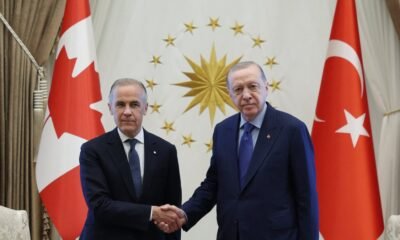
Canada’s PM Carney plans Türkiye visit for talks with President Erdoğan
-

 Sports1 day ago
Marked by teen stars, marred by mishaps: 2026 Asian Games end