
Economy
Trump orders steep tariffs on medicines, overhauls metal duties

U.S. President Donald Trump on Thursday ordered new tariffs on certain medicines and an overhaul of metal duties, doubling down on his trade agenda a year after launching trade wars on virtually all partners.
The two orders he signed pile pressure on pharmaceutical companies to manufacture more in the United States, while separately targeting firms that officials accuse of “artificially manipulating” metals prices.
Finished products containing substantial amounts of steel, aluminum and copper will also face a 25% tariff on their full value instead of being targeted for the specific amount of metal they contain, a move intended to simplify the system for firms.
It is not immediately clear how these moves will affect consumer prices, but a senior U.S. official told reporters the administration does not expect to see an effect on affordability.
The moves come on the anniversary of what Trump dubbed “Liberation Day,” when he announced varying tariff rates on goods from dozens of economies last year, roiling financial markets and snarling supply chains.
Although the Supreme Court struck down those global tariffs in February, Trump has been working to reinstate duties using different authorities. His goal for “Liberation Day” was the rebirth of American industry, bringing an influx of jobs and an investment boom – although critics argue these have largely not materialized.
Making good on a threat from last fall, one of Trump’s orders Thursday imposes a 100% tariff on patented pharmaceuticals made abroad unless countries strike trade deals for lower rates or companies commit to building plants in the United States.
Large companies will have 120 days to commit to “reshoring plans” before the steep duty kicks in, while smaller companies have a 180-day buffer, a senior U.S. official said.
“We expect the lion’s share of the world’s patented pharmaceuticals to be building in America,” the official said.
Those who commit to building manufacturing plants – to be completed by the end of Trump’s second term – will face a 20% tariff instead. The European Union, Japan, South Korea and Switzerland will be excluded from this plan and face a 15% pharmaceutical duty due to previous trade deals with Washington.
Britain, meanwhile, has secured a deal allowing U.K.-made medicines tariff-free access to the United States for three years as part of a broader pact, the U.S. Trade Representative’s office said.
Drug companies that reach “most favored nation” pricing deals with the Trump administration while also building plants in the United States can also be exempt from the sharp pharmaceutical tariff. Generic products are not currently subject to tariffs, a decision the White House said will be reassessed in a year.
Affordability concerns
The second order Trump signed reshapes his 50% tariffs on steel, aluminum and copper, requiring importers to pay the duty based on prices American buyers are facing. It is set to take effect at 12:01 a.m. EDT Monday, a White House official told Agence France-Presse (AFP).
The senior administration official charged that “foreign countries were artificially manipulating” prices of imported metals to pay lower tariffs.
The same proclamation called for finished products made with more than 15% steel, aluminum and copper to face a 25% tariff on their full value, rather than being targeted based on metal content.
“It’s a simplification and a fairness issue,” the official said.
Asked about cost-of-living concerns, which have flared ahead of the 2026 midterm elections, the official maintained that the moves should not impact households. “These will not have impact on the price of the good on the shelf,” the official insisted.

SpaceX has pushed its target IPO valuation past the $2 trillion mark, a report said on Thursday, setting Elon Musk’s rocket and satellite company for what could become the largest public listing the stock market has ever seen.
SpaceX and its advisers are floating the figure to prospective investors in its initial public offering, Bloomberg News reported, adding that deliberations are ongoing and details of the IPO could still change.
The startup submitted confidential IPO paperwork with the U.S. Securities and Exchange Commission recently and is targeting a market launch later this year.
The Starbase, Texas-headquartered firm could raise as much as $75 billion, according to the report, surpassing the 2019 IPO of Saudi Aramco, which remains the largest on record.
An earlier expectation of a $1.75 trillion valuation was already sparking debate over how much of that value was driven by SpaceX’s cash-generating Starlink business and how much of a premium could be applied to its dominance in space launches, and unproven ventures such as Starship and space-based AI.
The IPO comes after Musk merged SpaceX with his artificial intelligence startup, xAI, in a deal that valued the rocket company at $1 trillion and the developer of the Grok chatbot at $250 billion.
The rocket maker has been lining up anchor investors well ahead of its stock market debut. It has had discussions with Saudi Arabia’s Public Investment Fund about taking an anchor stake of around $5 billion in the IPO, Reuters reported on Thursday.
U.S. consumers are on course for record fuel prices at the pumps just ahead of the country’s peak summer travel season, market experts said on Thursday, after President Donald Trump’s used his address to the nation to vow more aggressive strikes on Iran.
Americans expected Trump’s speech on Wednesday to outline a plan to end the Iran war and reopen the Strait of Hormuz, as blockade of the global oil conduit has sent oil and fuel prices skyrocketing, pinching consumers’ wallets. But instead, Trump vowed to bomb Iran back into the “Stone Ages” and said the strait would just open “naturally” when the war ends.
The comments sent U.S. crude oil prices surging more than 10% on Thursday, and U.S. average retail gasoline prices are now set to climb to between $4.25 and $4.45 a gallon by next week after crossing $4 a gallon for the first time since 2022 at the start of this week, said Patrick De Haan.
The pain could worsen. If there is no viable plan to reopen the Strait of Hormuz, the U.S. average price of gasoline will likely cross $5 a gallon and hit record levels within a month, De Haan said.
Wholesale markets had begun moving higher on Thursday, with midmorning increases of 17 cents a gallon in the Great Lakes, Great Plains, Northeast and West Coast markets, and a 19-cent-a gallon hike in the Gulf Coast, said Tom Kloza, chief energy adviser to Gulf Oil on social media.
Meanwhile, diesel prices, less visible to consumers but arguably more impactful as they are directly tied to the cost of making and moving goods, could hit a record high within two weeks, De Haan said.
The national average retail diesel price is set to climb from $5.47 a gallon on Thursday to between $5.80 and over $6 a gallon within the next two weeks, De Haan said. The record U.S. average retail price was $5.83 a gallon in 2022.
The central bankers around the world may be attempting the impossible: to get into the psyche of business executives, labor unions and ordinary households in real time to try to understand how they are navigating their finances through what appears to be yet another major energy shock.
Policymakers are contemplating whether to jack up interest rates to combat rising inflation. But they will only pull the trigger if they think a surge in energy costs induced by the Iran war will filter into other prices, lifting inflation expectations across the entire economy.
The problem is that measuring such expectations is notoriously difficult. Central banks have a trove of surveys, gauges and indicators at their disposal, but all of them have blind spots if not outright faults.
Since the COVID-19 pandemic, they have developed new tools to fill gaps in data about behavior. But measuring expectations remains more of an art than an exact science.
That could raise the bar for rate hikes as policymakers are wary of gut-feeling decisions and usually prefer to wait for more evidence to narrow the risk of a policy error.
Behaviors have changed
Policy-makers at the Bank of Canada acknowledged that global uncertainty meant they “would need to rely on judgment more heavily than usual” to plot the path of the economy, according to minutes of its March 18 meeting at which it kept rates on hold.
Others describe the effort involved in the process.
“I try hard to get into the thoughts of price-setters and how they are seeing it – trying to calibrate their confidence in pricing power,” Richmond Federal Reserve Bank President Tom Barkin told Reuters.
“The ‘hike’ case would be around inflation expectations starting to finally move,” he said. “I don’t have a sense that they’ve broken out at this point.”
One complication is that behaviors change.
In 2022, consumers and firms had little experience with rapid inflation, making price- and wage-setting a rather rigid exercise.
“But now people have lived through a painful episode of inflation, and this may mean that inflation expectations are more fragile, and so they could be more sensitive to such an energy price shock,” European Central Bank (ECB) board member Isabel Schnabel said in a university lecture on Friday.
For companies, changing their selling prices was a cumbersome process before the pandemic and so they limited adjustments, often to once a year. This became untenable and the frequency of changes skyrocketed, Schnabel argued.
This makes the frequency and not just the magnitude of such changes a good indicator that expectations are shifting.
Traditionally, central banks relied on surveys and market indicators to assess expectations. But surveys are not done frequently enough to capture rapid changes and their time horizon is often out of sync with that of policymakers.
Market indicators of expected inflation are also imperfect because they include the extra return, or risk premium, that investors demand for holding a particular financial instrument. This changes with market sentiment, blurring shifts in actual price expectations.
The stakes are high: investors now expect the ECB to raise rates two or three times this year, the Bank of England (BoE) twice, and have given up on any Fed rate cuts in 2026.
Innovating to cover knowledge gaps
To compensate for such information gaps, central banks have developed an array of new tools. They track expected wage changes, including via major pay deals announced by unions, which may be a signal to others negotiating their own pay.
They survey firms directly and speak to executives to gauge expected behavior, and they take on board ever-larger numbers of external surveys with forward-looking indicators.
Central bank staff track the frequency of price changes, correct existing surveys to fill data gaps and have revised their own projection models to address shortcomings that missed 2022’s inflation surge caused by the pandemic and Ukraine war.
Also key to their judgment call is trying to understand how this inflation shock differs from four years ago.
The consensus on this seems firm: conditions are fundamentally different.
Interest rates are already higher, government purses are tighter, there is growing slack in the labor market, and – unlike during the pandemic, when they were unable to spend – households are not sitting on piles of cash.
“We’re coming into this situation with the gradual disinflation that we were having, the labor market is softening (and) growth is a little bit below potential,” Bank of England Governor Andrew Bailey told Reuters.
“And one of the consistent messages we get from businesses is, for most sectors of the economy, a real lack of pricing power.”
Using their enhanced insight, central banks are, for now, confident that longer-term inflation expectations are holding firm around their targets.
But the longer the war drags on, the longer energy prices will stay high, and as consumers see everyday costs like fueling their cars rise, the more likely it is that inflation expectations will move upwards. When exactly this happens will not be clear, leaving policymakers to judge for themselves.
“Economics itself is not an exact science,” ECB policymaker Primoz Dolenc said.
“It’s of course based on analytics, but by definition, there is also a perception and judgment element.”
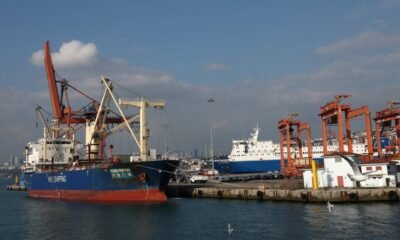
Turkish exports declined 6.4% in March, while imports surged 8.4% compared to a year earlier, a top official said Thursday, announcing the preliminary trade data, which thus indicated that the country’s trade gap widened over the same time.
Exports totaled $21.9 billion (TL 974.49 billion) in March, down 6.4% from a year earlier, Trade Minister Ömer Bolat said at a gathering organized in the eastern province of Van. Imports stood at $33.2 billion, according to the minister.
Consequently, the country’s foreign trade deficit widened 56.6% year-over-year to $11.3 billion in March, while the exports-to-imports coverage ratio stood at 66.1%, he added.
In the January-March period, exports fell 3.1% annually to nearly $63.3 billion, while imports increased 4.7% to $92 billion, he also said.
The foreign trade deficit in the first three months of the year rose 27.5% from a year ago to $28.7 billion, with the exports-to-imports coverage ratio at 68.8%.
Elaborating on the data, Bolat attributed the decline in exports to the war conditions, the long holiday period, and the calendar effect, referring to the Eid al-Fitr holiday and shipments varying according to the days of the week.
“When this happens, it negatively affects exports in particular. There is also a $350 million decrease in gold exports as processed products,” he said.
Bolat also stated that there is “a fluctuating trend” in exports this year when looking at the first three months, adding that it is likely to continue this way. “We will close this gap in April, but again in May there is a long holiday, and in June we will compensate. It will continue like this,” he added.
Moreover, he informed that on a 12-month rolling basis covering April 2025 to March 2026, exports rose 3% to $271.3 billion and imports climbed 6.3% to $369.6 billion. The foreign trade gap in the period increased 16.4% to $98.3 billion, while the coverage ratio was 73.4%.
EU top trade partner
According to the data, Germany was Türkiye’s top export destination in March with $1.8 billion, followed by the U.S. with $1.4 billion and Italy with $1.3 billion.
On this, Bolat said that the European Union “once again stood out as Türkiye’s strongest foreign trade partner.”
“Our exports reached $28.3 billion in the first three months. Türkiye gained a trade surplus of $1.4 billion with the EU,” he furthered.
By sectors, manufacturing accounted for the largest share of exports in March at $20.5 billion, while agriculture, forestry, and fishing contributed $800 million and mining and quarrying $400 million.
By broad economic categories, intermediate goods made up the largest portion of exports at $11.6 billion, followed by consumer goods at $6.7 billion and investment goods at $3.1 billion.
Sector-wise, the automotive industry was the top exporting sector in March, with exports reaching $3.3 billion. Chemicals and chemical products ranked second with $3 billion, while the steel sector came in third with $1.6 billion.
Excluding energy and gold, Türkiye’s exports-to-imports coverage ratio came in at 78.9% in March, while the top 10 export markets accounted for 46% of total exports.
Türkiye boosted its steel production to 3 million tons in February, marking a 3.4% surge in output on an annual basis, according to the Turkish Steel Producers’ Association (TCUD) on Wednesday.
The Turkish crude steel production volume for the first two months of the year reached 6.4 million tons, posting a 4.7% rise.
Final product consumption climbed 11.3% on an annual basis to 3.2 million tons in February and 4.1% to 6.7 million tons in the January-February period, the data showed.
Türkiye’s steel product exports surged 8.6% year-over-year in February to 1.1 million tons, while falling 9.2% in value to $714.8 million.
Exports in January-February fell 13.5% on an annual basis to 2 million tons, while declining 15.2% in value to $1.3 billion.
As for imports, Türkiye imported 1.5 million tons of steel products in February, up 9% year-over-year.
Imported steel products cost $1 billion, marking a rise of 7.2% in value.
In January-February, Turkish steel product imports declined 10.8% in volume to 2.7 million tons and 11.7% in value to $1.9 billion versus the same period last year.
The export-to-import ratio, standing at 72.5% in the first two months of last year, fell to 69.7% in January-February this year, the data showed.
Leading German economic institutes have more than halved their forecasts for the country’s growth on Wednesday, warning that the energy shock caused by the Middle East war would hit Europe’s top economy hard.
A group of leading institutes slashed their joint growth forecast for 2026 to 0.6%, down from a September prediction of 1.3%.
Inflation is now forecast to rise to 2.8%, up from 2.0%, “weighing on household purchasing power.”
“The energy price shock triggered by the Iran war is hitting the recovery hard,” said economist Timo Wollmershaeuser of the Ifo institute, adding that increased government spending was nevertheless “preventing a stronger slide.”
Oil and natural gas prices have surged since the end of February, when the U.S. and Israel attacked Iran, killed its supreme leader and plunged the Middle East into war.
Iran has since closed the Strait of Hormuz to ships of countries it considers allied with the U.S. and Israel, effectively blocking a sea lane that normally transports about a fifth of the world’s oil and gas trade.
Higher inflation in Germany would hit consumer spending, the institutes said, weighing on an already weak economy that has barely grown since a burst of pent-up demand after the COVID-19 pandemic in 2022.
‘Zero growth’
Germany’s economy, struggling with fierce Chinese competition in sectors from cars to chemicals, was in the doldrums even before U.S. President Donald Trump last year imposed sweeping new tariffs before starting the Mideast war in late February.
Chancellor Friedrich Merz, who took office last May, vowed to borrow and spend hundreds of billions for a special infrastructure fund over the coming years in what was dubbed a spending “bazooka” aimed at getting Europe’s top economy back on its feet.
But the economists said that much of the money was simply paying for day-to-day spending.
“Government expenditure on consumption is rising much more sharply than investment,” economist Oliver Holtemoeller of the Halle Institute for Economic Research said. “That was not the idea behind changing the financing rules.”
The outlook for the longer term was also dire.
Citing low productivity, industrial decline and an ageing population, the institutes warned that Germany’s economy would soon be unable to grow sustainably.
“We have also reassessed the structural changes in the German economy and, in particular, revised our forecast for industrial growth downwards,” Wollmershaeuser said.
In an era when “demographic change is hitting with full force,” he said, “potential growth will come to a standstill by the end of the decade, and we will have to get used to average GDP growth rates of zero percent.”
In this phase of “multiple transformations,” the institutes recommend the German government “increase incentives for employment” and ease regulations to “improve conditions for investment and innovation.”


-

 Daily Agenda23 hours ago
Sümeyye Erdoğan Bayraktar: Women are now an important part of the development vision
-

 Daily Agenda3 days ago
Let’s say ‘stop’ to food waste in the world together
-
 Daily Agenda1 day ago
SON DAKİKA… AK Parti Sözcüsü Ömer Çelik: Bölge büyük kaosun içine çekiliyor
-
 Economy10 hours ago
Turkish exports down in March amid Eid, calendar base, war impact
-
 Daily Agenda22 hours ago
Minister Gürlek’s call for cooperation to the Netherlands: “We have an extradition request for 217 FETO members and 8 PKK members.”
-

 Daily Agenda10 hours ago
İmamoğlu’s expert claims turned out to be unfounded
-
 Economy9 hours ago
Central banks’ dilemma: How to respond to another energy shock
-
 Daily Agenda9 hours ago
President Erdoğan: There will be water conflicts in the coming periods