
Economy
Türkiye in advantageous position regarding global debt: Şimşek

Türkiye is in an “advantageous” position regarding global indebtedness, Treasury and Finance Minister Mehmet Şimşek said Thursday, noting that the country’s low total debt level enhances its resilience to economic shocks.
“The ratio of total debt to global output has exceeded 300% globally and 230% in emerging markets. Türkiye is in an advantageous position in this respect,” Şimşek told the 19th Verona Eurasian Economic Forum held in Istanbul.
“The low level of indebtedness in Türkiye enhances its resilience to economic shocks. Thanks to low indebtedness, the ability to respond to economic shocks and sustain growth is higher,” he added.
His remarks came amid growing concerns about high public debt in some countries, including France, which has recently been rocked by massive nationwide protests and riots.
Speaking at the opening of the forum, Şimşek also evaluated the importance of connectivity amid global supply shocks, also suggesting that protectionism has become the new normal for the world economy since the global financial crisis.
The 19th Verona Eurasian Economic Forum kicked off in Istanbul on Thursday, bringing together political, diplomatic, academic, and business representatives from more than 30 countries. It is organized with the support of the Independent Industrialists and Businessmen’s Association (MÜSIAD) and Ibn Haldun University.
The two-day forum, held at the Çırağan Palace under the theme “Challenges of a Changing World and a Changing Economy,” was set to focus on major shifts in the global economy and geopolitical landscape.
The minister, as part of his remarks, also reiterated that Ankara’s approach regarding regional conflicts is to advocate for peace and stability, and he also underscored the importance of trade agreements and work on enhancing relations with more partners within the framework of “rules-based trade.”
On the question of debt, Şimşek noted that Türkiye’s budget deficit-to-GDP ratio is about half of the global average for emerging markets, and the public debt-to-GDP ratio is about one-third of that average.
Moreover, he mentioned that an aging population has become a significant global problem, stressing that the decline in fertility rates and the decrease in the working-age population pose new challenges for countries. However, he pointed out that Türkiye still, according to their calculations, has an 18-20 year window of opportunity in this respect, as its working-age population growth is still positive.
He also evaluated AI preparedness, noting that Türkiye is ahead of developing countries in terms of readiness for artificial intelligence, but not at the same level as advanced economies, and acknowledged that there is more to be done in this area.
On the broader macroeconomic picture, he reaffirmed the goal of taming inflation.
“We expect our national income to reach approximately $1.8 trillion this year at current exchange rates, and about $4 trillion based on purchasing power parity,” he said.
“(Despite our advantages), of course, we have challenges too. We are implementing holistic policies to overcome high inflation,” he said.
“As President Erdoğan and his team, we are business-friendly. If you choose to conduct all or part of your business in Türkiye, we want to assist you.”

British banking giant Barclays said on Thursday it plans to cut around 5,000 jobs, or roughly 5% of its global workforce, by the end of the year in an AI efficiency drive.
The announcement came alongside an earnings update that showed Barclays’ net profit grew 13% in the third quarter, fuelled by surging income across its equities division.
Barclays said in an earnings presentation that it was implementing “organizational simplification and technology change efficiency driven by AI.”
“About 60% of the job losses relate to support functions, including fewer developers as AI makes our people more productive,” it added.
The bank’s profit after tax grew to 1.65 billion pounds ($2.2 billion) in the third quarter from 1.46 billion pounds in the July-September period a year earlier.
Barclays chief executive C. S. Venkatakrishnan noted “ongoing momentum of… operational and financial performance” and said the investment bank division “delivered strong equities performance.”
Revenue from equities jumped 47% year-over-year, while total group income for the quarter climbed three percent to 7.37 billion pounds.
Barclays’ share price was up slightly following the news updates.
The AI “announcement comes as the company failed to match expectations with its third-quarter performance – with the unveiling of a healthy share buyback failing to entirely ease investors’ disappointment,” noted AJ Bell investment director Russ Mould.
“Across the wider group, costs went up and Barclays shareholders are also having to contend with two major clouds over the business.
“The first being a widely expected increase in tax on the sector in next week’s (U.K.) budget and the other being a reported probe into possible misrepresentation of risks in its private credit portfolio.”
Rising government borrowing costs across eurozone markets are reviving fears of a repeat of the debt crisis that rocked the bloc 15 years ago. Panic not, say analysts and investors: Banks are better prepared.
Shaky public finances in the past created a so-called doom loop. Losses on holdings of government debt hit lenders, in some instances forcing state-backed bailouts and a further drain on budgets.
Funding costs will rise, and market perceptions will matter, say analysts, as banks remain exposed to their countries’ fiscal fortunes. But capital buffers and tighter supervision should help banks weather the turmoil, according to investors, analysts and data collated by Reuters.
“There is a limit to which you can insulate yourself from the domestic credit,” said Simon Ainsworth, a senior banking analyst at Moody’s Ratings. “Banks come from a better starting point, but they are not immune.”
Since the 2010s crisis, the bloc has revamped banking supervision and armed the European Central Bank (ECB) with tools to intervene, while banks have improved their defences, helped by years of record profits.
Yet sovereign concerns contributed to a 10% drop in European bank stocks over the past six weeks – five times the wider market’s fall – a decline that follows a prolonged rally to 16-year highs.
For France’s top three lenders, the fall has been 17% over the same period.
With its debt costs hitting 25-year highs amid a large deficit, social unrest and a 2027 presidential election where far-right and far-left candidates lead opinion polls, the eurozone’s second-largest economy is in the eye of the storm.
Safe assets
Banks are allowed to treat government bonds as risk-free assets on their books. They count toward regulatory liquidity requirements and are used as collateral to borrow from central banks and other lenders.
Eurozone banks’ net sovereign bond holdings have doubled since the crisis, reaching 4.3 trillion euros ($4.8 trillion) at the end of June, a Reuters analysis of European Banking Authority (EBA) data showed.
However, banks’ capital buffers have risen even more, lowering the ratio of sovereign holdings to capital lenders keep to cover potential losses below 2.5 from 2.7 in 2013.
The lower the ratio, the greater the banks’ ability to sustain the hit from falling sovereign bond prices.
Both Axiom Alternative Investments Chief Investment Officer David Benamou and WisdomTree equity strategist Aneeka Gupta calculated that exposure to domestic debt for large French banks stands at roughly 15% to 30% of their best-quality capital.
That compares with more than 100% for banks in Italy in 2011-2012, the country at the forefront of the crisis then, Gupta said.
Still, falling government bond prices – which move inversely to yields – can saddle banks with losses if lenders need to align the book value of their bonds to market prices, or sell them to raise cash.
Proposals to strip government bonds of risk-free status or impose concentration limits have so far failed. But the European Commission has included further diversification of sovereign bond portfolios among steps needed to strengthen the banking sector, and will present its proposals in early 2027.
Holding to maturity
Even without formal rules, the ECB has prodded eurozone banks to reduce exposure to their home country’s debt.
Domestic government bond holdings accounted for 41% of the total in mid-2026, the Reuters analysis of the EBA data showed, compared with more than 50% in 2013.
Also, banks have tripled to 60% the proportion of their bonds they value at cost – an accounting rule that enables lenders not to record losses when market prices fall.
By classifying bonds as financial assets “held to maturity,” banks can avoid booking capital-depleting losses on their holdings, unless they are forced to sell, a risk which Moody’s Ainsworth said had shrunk because lenders rely less today on short-term funding.
Still, for Morningstar DBRS analyst Maria Rivas, the key question for banks is how investors view portfolios carrying unrealized losses regardless of the accounting considerations.
“If this is a temporary situation, it should not significantly affect investor sentiment. However, if it lasts over time, it could weigh on risk perception,” she told Reuters.
‘Battle-tested mechanisms’
Christos Megalou, CEO of Greek bank Piraeus, expects more volatility in government bonds but plays down the risk that it could snowball into a crisis.
Greece is now servicing its debts at average rates significantly below where Britain is borrowing today, he told Reuters, a sea change from a decade ago, when the country was recovering from a financial crisis and a string of bailouts.
France, now in the spotlight, is also in a different position than Greece was back then. “France is a very big economy and therefore has a lot of triggers to pull,” Megalou said.
“The regulators, the policymakers, but also the banks, have battle-tested mechanisms to make sure that, most likely, we will not have a similar mega-problem again,” he added. “Obviously we are doing stress tests in our portfolio all the time.”
Yet higher sovereign bond yields can hurt banks more directly by raising their funding costs because they come at a premium to government borrowing rates.
French banks are the largest wholesale debt issuers in the EU, so a permanently higher yield would raise their “cost of money every time they refinance, and that compounds,” WisdomTree’s Gupta said.
A former senior banking supervisor, speaking on the condition of anonymity, agrees with that assessment.
Banks are competing more aggressively for deposits, a reflection of the funding pressures, and the outlook for the sector will ultimately depend, at least in part, on perceptions, the person said.
President Recep Tayyip Erdoğan said on Wednesday that payments to investors in funds being liquidated will pick up speed once a bill before Parliament takes effect.
Erdoğan said the government’s response will also include holding those who profited unjustly to account and putting measures in place to prevent a similar crisis.
He was speaking at a group meeting of his ruling Justice and Development Party (AK Party) in Parliament.
The scandal broke just over a month ago, when several investment funds said they were unable to satisfy redemption demands, prompting prosecutors to open an investigation into allegations of widespread market manipulation.
Regulators placed seven firms managing 131 funds into liquidation, affecting nearly half a million individual investors. The Justice Ministry says more than 80 people have been arrested.
Separately, Turkish police on Wednesday detained 26 people, among them an ex-finance ministry bureaucrat and investment fund executives, as part of the investigation.
Erdoğan described the government’s approach as three stages.
He said the Fund Coordination Board and the government’s economic team meet regularly and announce their decisions to the public transparently.
“After the bill on our parliament’s agenda comes into force, the payment process will speed up a bit more,” he said.
Liquidation is split into ordinary and extraordinary procedures. Ordinary applies to firms whose finances are relatively manageable.
Treasury and Finance Minister Mehmet Şimşek said this week that TL 40.8 billion has been paid to 45,747 accounts under ordinary liquidation. Interim payments of up to TL 1 million for the remaining funds depend on the bill.
‘Baseless rumors and ravings’
The second stage, Erdoğan said, is to hold to account in court those who made unjust and excessive gains through manipulation, using methods outside law and morality and, at times, as part of an organization. He said chief prosecutors are acting on the evidence and on confessions.
Prosecutors on Wednesday said they had issued a warrant for 31 people, of whom 26 had been detained, with police looking for the other five.
Among those still sought was Nusret Altınbaş, owner of Altınbaş Holding, a large privately-held Turkish conglomerate. His brother is already in custody and family assets have been frozen, Anadolu Agency (AA) said.
It was not immediately clear on what charges Wednesday’s suspects were detained, but the list includes 16 executives and staff who worked for portfolio management firms already named in the scandal: Atlas, Pardus, Hedef, Tera and A1.
Erdoğan said prosecutors were working to hold “those who obtained unfair and exorbitant profits through manipulation, using illegal and unethical methods … accountable before the law.”
And he urged citizens to be wary of attempts to “manipulate public perception through the media and social media,” urging them to avoid “baseless rumors and ravings of those who are neck-deep in corruption.”
Return of excessive gains
Şimşek said authorities have identified people who profited from market-disrupting activity and stressed that anyone who did not voluntarily return excessive gains would face legal proceedings.
“First, those who made gains of TL 10 million or more will be approached. If there is no voluntary return, the justice ministry will initiate the relevant legal procedures,” he said.
Turkish law has an “effective remorse” mechanism under which anyone accused of market-manipulation offences can obtain immunity or a reduced sentence by paying back at least twice the profit obtained from wrongdoing.
If they repay before a criminal investigation has started, no sentence is imposed, but if it is during the investigation, their sentence is reduced by half, or by a third if payment happens during the trial stage.
Preventing repeat
Erdoğan said the third stage covers the steps needed to avoid facing a similar problem again.
He said that, drawing on a comprehensive report to be prepared by the State Supervisory Council (DDK) and other work under his instructions, “every kind of step” will be taken on institutional, individual and legislative matters.
He said the government takes the matter very seriously, since it affects not only the more than 455,000 investors in the liquidated funds but also many more people, including their families. “We are going after the matter without compromise,” he said.
Türkiye has increased its budget allocation for the procurement of weapons, ammunition, weapons systems and other defense equipment by 229% for 2027, Vice President Cevdet Yılmaz said on Wednesday.
Yılmaz said total allocations for defense and security would reach TL 3.45 trillion ($69.64 billion), including resources earmarked for the Defense Industry Support Fund.
The remarks came as he presented the government’s 2027 budget proposal to Parliament’s Planning and Budget Commission.
Yılmaz said total allocations for defense and security account for 12.7% of the central government budget, he said.
Government spending for 2027 is projected at TL 27.2 trillion and revenue at about TL 23.4 trillion. Revenue is expected to rise 37.5% from the previous year to TL 23.4 trillion, and tax revenue 36.5% to TL 19.9 trillion.
Yılmaz called it a “budget of resilience, prosperity and transformation” meant to strengthen the economy against external shocks.
He said price stability and sustainably stronger macroeconomic balances are preconditions for lasting prosperity, and that supporting disinflation is one of the budget’s main pillars.
Yilmaz said the government aims to bring consumer price inflation down to 21% in 2027.
Annual inflation fell below 30% in September and is forecast to end this year at 28.4%.
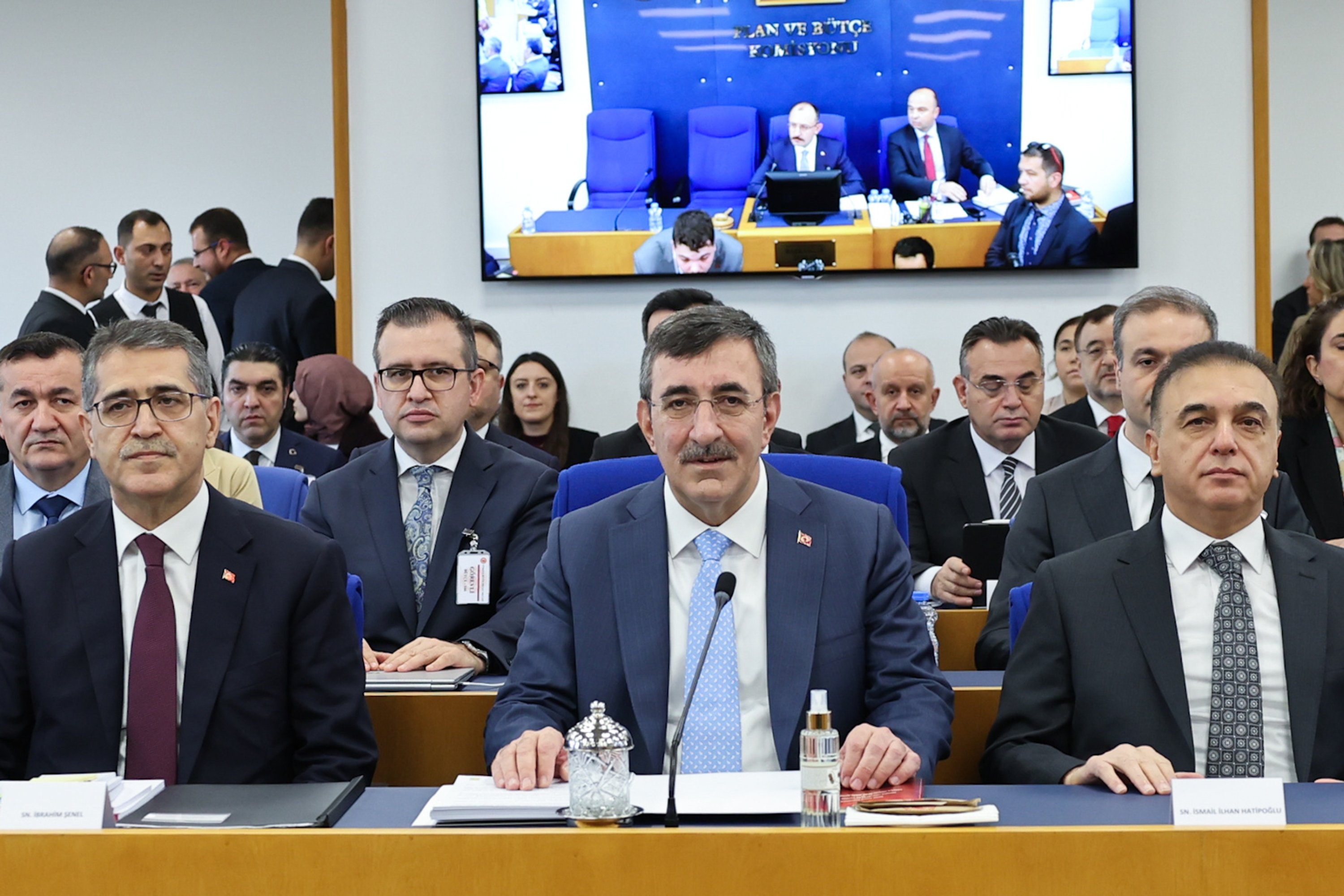
Yilmaz said the economy has kept its resilience and has grown for 24 consecutive quarters. He said Türkiye’s growth of 5.2% is above the world average.
The government aims to raise potential growth by 0.5 percentage points through productivity-focused policies, and expects growth of 4.2% in 2027 and 4.6% in 2028, reaching 5% by the end of the Medium-Term Program (MTP) period.
National income is expected to exceed $1.8 trillion in 2026, with income per person above $20,000, Yılmaz said. The aim is to pass $2 trillion during the MTP period.
The government aims to create an average of 711,000 additional jobs a year through 2029, with the goal of bringing unemployment down to single digits, according to Yılmaz.
Unemployment is forecast to fall to 8% next year from a projected 8.1% in 2026.
Yılmaz said goods exports are targeted to reach $292 billion in 2027, and the current account deficit is expected to be 1.9% of national income, below its historical average. He added that growth in global trade volume is forecast to slow in 2028-2029.
The government aims to increase housing supply through social housing and rental social housing projects, Yılmaz noted.
The economic links between Germany and Russia have weakened significantly since the start of the war in Ukraine, with trade volume dropping sharply and passenger traffic also hit, according to fresh German government data.
Trade has almost ground to a halt, with German imports from Russia falling by 96.4% in the first half of 2026 compared with the same period in 2021, before Russia’s full-scale invasion of Ukraine, the Federal Statistical Office reported on Wednesday.
The value of imports fell to just 500 million euros ($561 million) from 15 billion euros, largely due to the loss of Russian oil and gas supplies. Remaining imports consisted mainly of food and animal feed, metals and chemical products.
German exports to Russia also fell sharply, with companies shipping goods worth 3.4 billion euros in the first six months of 2026, around a quarter of the value recorded in the same period in 2021.
Pharmaceutical products accounted for 42.4% of exports, while machinery, food and animal feed continued to be exported in smaller quantities, the German statisticians said.
The number of Russian-controlled companies operating in Germany fell from 229 in 2021 to just 76 in 2024, according to the statistical office.
These companies generated revenue of 8.4 billion euros in 2024, down from 25.4 billion euros three years earlier. They accounted for just 0.2% of all foreign-controlled companies in Germany.
The number of German companies operating in Russia also declined significantly.
According to Germany’s central bank, the Bundesbank, 290 German companies were still active in Russia in 2024, generating annual revenue of around 13 billion euros. That compared with 481 companies and 38 billion euros in revenue in 2021.
Passenger traffic between Germany and Russia has also collapsed following the suspension of direct flights under EU sanctions.
Around 39,900 passengers travelling to Russia were recorded at German airports in the first half of 2026, compared with approximately 1 million in the first half of 2019.
Those still travelling to Russia had to take connecting flights through third countries such as Türkiye.
Migration from Russia to Germany has also declined since the start of the war.
In the first half of 2026, around 3,800 Russian citizens moved to Germany, while approximately 4,400 left the country.
By contrast, in 2022, when the war began, arrivals significantly outnumbered departures, with 12,700 Russian citizens moving to Germany and 3,400 leaving.
The number of Russian students enrolled at German universities has also fallen sharply, nearly halving from its 2014 peak to around 1,700.
NATO allies Canada and Türkiye are expected to sign a joint declaration aimed at deepening bilateral cooperation in four areas, including defense and energy, during Prime Minister Mark Carney’s visit later this week, a person briefed on the matter said.
The declaration is also expected to encompass the economy, looking to advance bilateral free trade talks, while boosting social and diplomatic ties. The countries would establish committees in all of the areas to draft action plans, the person said.
Carney will be the first Canadian prime minister to make a dedicated bilateral visit to Türkiye. He is set to meet with Turkish President Tayyip Erdoğan in Ankara on Thursday and then with Turkish business leaders in Istanbul on Friday.
The visit is part of Carney’s efforts to reduce trade dependence on the United States and strengthen partnerships with regional powers amid a damaging trade war with Washington and an increasingly adversarial relationship with President Donald Trump, who has repeatedly questioned Canada’s sovereignty.
At a Canadian government briefing on Tuesday, officials declined to confirm what specific declarations, agreements or deals might be signed during the trip.
Carney will meet Erdogan “to advance cooperation in trade and investment, energy, defense and security and people-to-people ties,” said a Canadian government official.
The meetings with Turkish companies on Friday are meant “to promote the strengthening of bilateral trade and investment and to foster new opportunities for commercial collaboration,” the official said, adding that Ottawa is most interested in Türkiye’s aerospace, defense, energy, mining, high-tech and agriculture sectors.
Talks may include nuclear power, LNG
Turkish Energy Minister Alparslan Bayraktar told the Kanal 7 broadcaster on Sunday that energy, namely nuclear power, would be among the top agenda items during Carney’s visit.
Ankara anticipates that energy discussions will also include potential purchases by Türkiye of liquefied natural gas from Canada as well as critical minerals, according to the person briefed on the matter. A working group is expected to be created to study the feasibility of a bid by Canada’s CANDU to build a planned nuclear plant on Türkiye’s Black Sea coast.
Türkiye has held talks with Canadian engineering firm AtkinsRealis ATRL.TO, which owns CANDU, as well as South Korea’s Korea Electric Power Corporation and China’s State Power Investment Corporation, about potentially building its planned second and third nuclear power plants. Russia’s Rosatom is building its first.
The discussions on the defense sector are expected to focus on drones and naval cooperation. In 2024, to help thaw bilateral ties, Canada removed weapons-export controls on Türkiye, including on optical technology used in drones that Türkiye exports to dozens of nations.
Carney will be accompanied on the trip by his Foreign Minister Anita Anand and Energy Minister Tim Hodgson.
He will meet executives from defense companies and firms with energy businesses, including Çalık Holding and Sabancı Holding, according to two other people familiar with the plans.
Turkish defense analysts have said Trump’s policies toward Canada had created opportunities for closer cooperation in ammunition production, drones and naval systems, but cautioned that major agreements were unlikely to materialize in the short term.


-
 Economy2 days ago
Turkish households’ confidence in lira remains resilient: S&P
-

 Sports3 days ago
Fenerbahçe seek Champions League reset against Slavia Prague
-
 Economy2 days ago
Canadian PM Carney due in Türkiye amid push for free trade deal
-
 Politics2 days ago
Turkish, Saudi FMs discuss regional security in phone call
-

 Sports2 days ago
Osimhen, Leao return to Lille as Galatasaray seek European lifeline
-

 Economy2 days ago
US bans govt agencies from using DeepSeek, China vows to protect firms
-
 Politics2 days ago
Erdoğan lauds work to spare Türkiye from turmoil amid Israeli tensions
-

 Economy3 days ago
Saudi Arabia delays its flagship investment conference after attacks