
Politics
Türkiye remembers iconic, controversial PM Ecevit

Thursday is the 20th anniversary of the passing of Bülent Ecevit, a prime minister who left his mark on Turkish politics both with controversies and remarkable achievements.
The leader of the Democratic Left Party (DSP) governed Türkiye five times as prime minister before his death at the age of 81 due to respiratory failure. It was during his tenure in the 1970s and 1990s that Türkiye launched the Peace Operation in Cyprus and captured the leader of the PKK terrorist group, two major turning points in the brief history of the republic. It was also Ecevit who was blamed for a major economic crisis in the 2000s and drew the hatred of Muslims for opposing a headscarf-wearing lawmaker during the notorious period after the 1997 coup.
A man of short stature and dark complexion, Ecevit was nicknamed “Karaoğlan” (reportedly by a supporter during his visit to the home of a friend in eastern Türkiye), which can be roughly translated as “dark son,” an affectionate expression in Anatolia.
Before his foray into politics, something he inherited from his lawmaker father, Fahri Ecevit, Ecevit worked as a journalist and translator. Along with translating the works of Rabindranath Tagore, T.S. Eliot and Ezra Pound into Turkish, Ecevit himself penned several poems. Yet, he found his true calling in politics. He became a member of the Republican People’s Party (CHP) in 1954, when the party was the main opposition after a lengthy rule. He served as a lawmaker for the CHP and later was appointed as labor minister between 1961 and 1965. In 1966, Ecevit’s political life took a new turn as he formed an opposition movement within the CHP with the “Democratic Left” faction of the CHP. After a major fallout with Chair Ismet Inönü, Ecevit challenged him and was elected as CHP chair in 1972. He was first elected as prime minister in 1974 in a coalition government the CHP formed with the National Salvation Party (MSP). Months after taking office, Ecevit faced a critical decision: dispatching troops to Cyprus to protect Turkish Cypriots against attacks by Greek Cypriots. The peace operation he ordered ensured Turkish Cypriot presence on the island and restored peace.
Like other politicians, Ecevit found himself briefly jailed by the military junta that seized power on Sept. 12, 1980, and faced a political ban. At that time, his wife, Rahşan Ecevit, founded the Democratic Left Party (DSP). After his political ban ended, Ecevit was elected chair of the DSP in 1987. The DSP struggled in the Turkish political scene in the early 1990s but found itself as the biggest left-wing party after the 1994 elections. Ecevit served as deputy prime minister and prime minister in coalition governments, a staple of the 1990s. During one of these tenures, Ecevit oversaw the capture of Abdullah Öcalan, the elusive leader of the terrorist group PKK responsible for the killing of tens of thousands of people across Türkiye since the 1980s. Öcalan was brought to Türkiye from Kenya and was jailed for life.
Ecevit was the prime minister of the coalition government formed by the DSP, the Nationalist Movement Party (MHP) and the Motherland Party (ANAP) after the 1999 elections. It was during this tenure that Ecevit incurred the wrath of the conservative electorate when he opposed Merve Kavakçı’s attendance at Parliament’s General Assembly. Kavakçı, of the Virtue Party (FP), was about to take the oath as the first headscarf-wearing lawmaker in Turkish politics. Ecevit made a fervent speech against Kavakçı while fellow DSP lawmakers sought to block her. He called on other lawmakers to take action against Kavakçı, who was forced to leave Parliament amid outrage from the secular elite and subsequently lost her citizenship.
In 2001, Ecevit was at the heart of another scandal. His quite public row with President Ahmet Necdet Sezer that ended with Sezer hurling a Constitution book toward Ecevit during a tense meeting paved the way for a severe economic crisis. His popularity plummeted, and the DSP lost the 2002 elections. Two years later, Ecevit quit politics. In his final days in office, Ecevit was criticized for clinging to power despite his apparently frail health.
He was hospitalized with a brain haemorrhage in May 2026 and died in intensive care about six months later.

Parliament is debating a bill Wednesday approving the Mecca Joint Defense Agreement, a trilateral pact with Saudi Arabia and Pakistan aimed at strengthening collective defense, military cooperation and regional security coordination.
The agreement identifies Türkiye, Saudi Arabia and Pakistan as its three founding members, referred to as “Core Parties,” and establishes mutual defense obligations based on respect for sovereignty, territorial integrity and international law.
Under Article 2, an externally initiated armed attack or military aggression against any signatory would be considered an attack against all three countries.
The provision draws on Article 51 of the United Nations Charter, which recognizes the inherent right of individual and collective self-defense.
However, military assistance would not be automatic or unconditional. The country facing an attack must first request support, after which the three parties would jointly assess the situation and determine the nature and scope of assistance through consensus.
Any deployment of Turkish troops abroad would remain subject to Article 92 of Türkiye’s Constitution, which regulates parliamentary authorization for overseas military operations.
Joint defense production
Beyond collective security commitments, the agreement outlines extensive cooperation in defense manufacturing, technological development and military logistics.
The three countries would pursue joint weapons production, research and development projects, technology transfers and specialized personnel training.
The framework also provides for coordinated logistical support, including supplies of ammunition, weapons, fuel and spare parts during peacetime, wartime and emergencies.
The agreement would establish a Strategic Political and Defense Committee comprising the foreign ministers, defense ministers and military chiefs of the three countries.
The committee would meet at least twice annually, with rotating host countries, while national leaders could convene once a year when necessary.
Saudi Arabia would host a permanent secretariat headed by a secretary-general serving a rotating three-year term. The first secretary-general would be a Pakistani national.
Articles 9 and 13 outline cooperation on counterterrorism and intelligence sharing through agreed secure communication channels.
Classified information would be protected under a “need-to-know” principle and could not be shared with third countries or companies.
The agreement would enter into force after the parties deposit their ratification documents with the secretariat and remain valid indefinitely.
Member countries would be prohibited from withdrawing during the first 10 years. After that period, withdrawal would require at least three months’ written notice.
Additional countries could join only with the unanimous approval of the founding members and would be required to uphold principles of sovereignty, territorial integrity and noninterference.
For Türkiye, the proposed pact represents an effort to expand defense cooperation with Saudi Arabia and Pakistan while coordinating diplomatic and security initiatives through a formal trilateral framework.
Türkiye, Pakistan and Saudi Arabia held the first meeting of the Strategic Political and Defense Committee established under the agreement in Istanbul on Aug. 31. At that meeting, the three countries agreed to take further steps to institutionalize cooperation and establish a secretariat in Saudi Arabia headed initially by a Pakistani secretary-general for a three-year term.
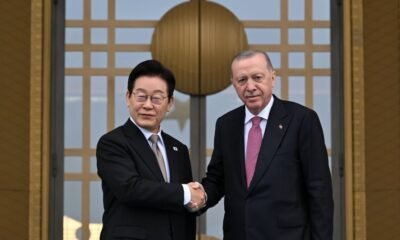
President Recep Tayyip Erdoğan was welcomed with an official ceremony in Seoul on Tuesday during a visit at the invitation of South Korean President Lee Jae Myung, as the two countries seek to strengthen their strategic partnership and expand bilateral cooperation.
Erdoğan and Lee joined the ministers of their countries as they signed memoranda of understanding in several fields, including nuclear energy. Under one of the deals, Ankara and Seoul will cooperate on financing Türkiye’s second power plant planned in the Black Sea province of Sinop.
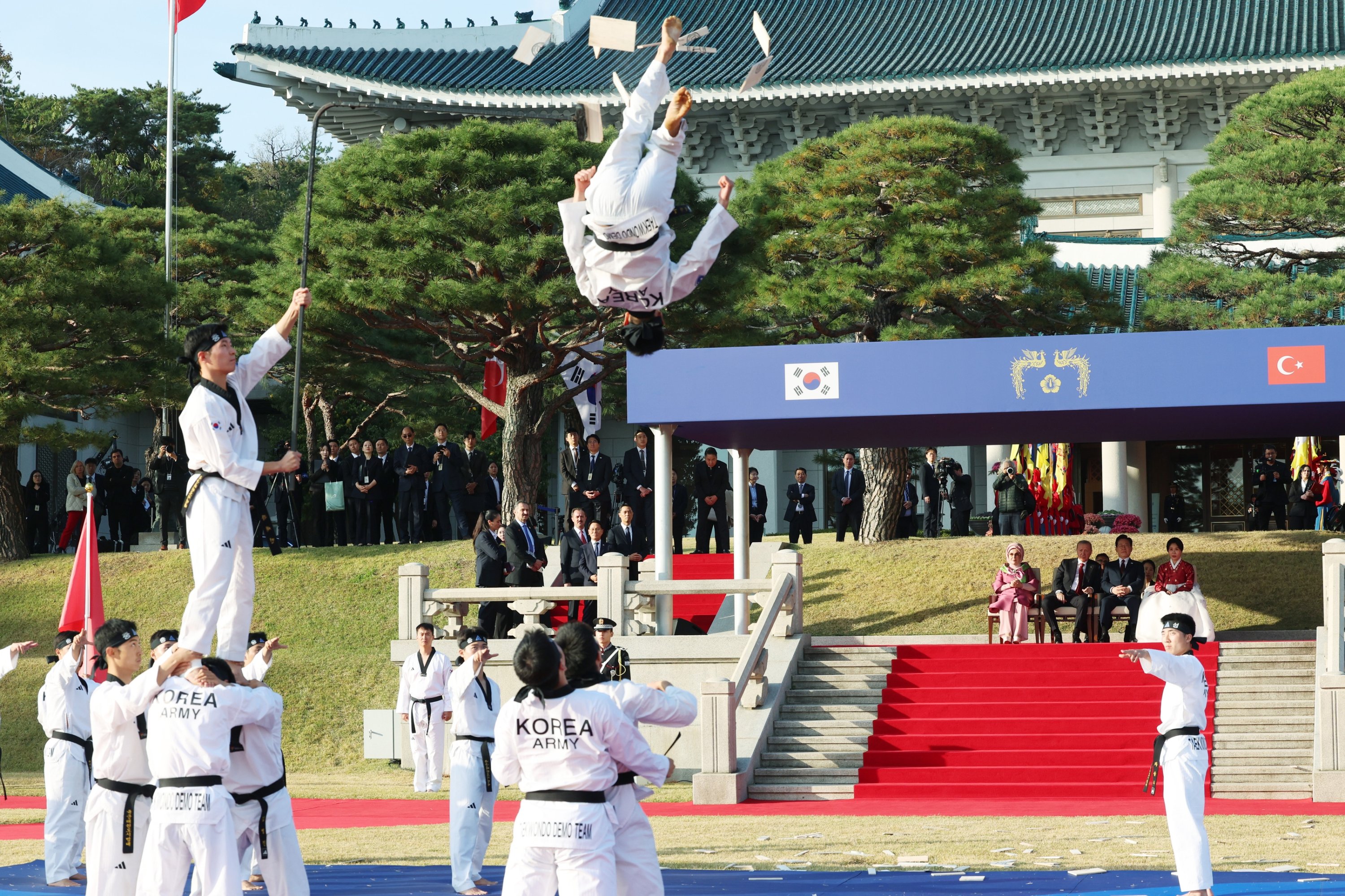
The president’s meeting with Lee and the signing of the deal were preceded by an elaborate welcoming ceremony for the Turkish leader, who was on his first official visit to the country in eight years.
South Korea’s National Taekwondo Demonstration Team showed off their skills in a lengthy performance on the lawn of the Blue House, amid impressed looks from Erdoğan.
Speaking at a joint news conference following one-on-one and delegation-level meetings at the Presidential Palace, Erdoğan thanked Lee for his hospitality and recalled the sacrifices made by Turkish soldiers during the Korean War 76 years ago, describing the historical bond as the foundation of a relationship that has developed into a strategic partnership.
Lee echoed those remarks, describing Türkiye as a “blood brother” of South Korea and paying tribute to approximately 20,000 Turkish troops who fought alongside South Korean forces during the war.
Both leaders emphasized their commitment to translating the historical relationship into concrete cooperation across strategic sectors.
Defense cooperation to expand
Defense cooperation emerged as a central issue during the talks, with both leaders highlighting existing joint projects and opportunities for further collaboration.
“Defense industry is one of the leading areas where our strategic partnership has produced concrete results,” Erdoğan said, pointing to joint projects involving Fırtına howitzers and Altay main battle tanks.
He stressed that the two countries should increase the number of such projects.
Lee said Ankara and Seoul had agreed to deepen defense industry cooperation through joint production, technology partnerships and efforts to help companies from both countries enter third-country markets.
He also highlighted progress in bilateral defense cooperation, including a joint defense industry and logistics committee meeting in July and a letter of intent on military ship cooperation signed in September.
Nuclear energy and mining were among the other major priorities discussed during the summit.
Erdoğan highlighted a memorandum of understanding signed in November 2025 between Türkiye’s nuclear energy company and Korea Electric Power Corp. (KEPCO), describing it as an important foundation for future cooperation.
Lee announced that the two countries had signed a memorandum of understanding on nuclear power project financing, building on ongoing cooperation concerning Türkiye’s nuclear power plant plans.
The leaders also agreed to strengthen cooperation in advanced technologies, including artificial intelligence, semiconductor manufacturing, battery production and advanced communications.
Under a newly signed science, technology and innovation agreement, the countries plan to convene their bilateral Joint Science and Technology Committee for the first time.
Additional agreements covering energy cooperation, natural resources and mining are expected to support investment, technological development and the diversification of critical mineral supply chains.
Lee also announced plans to establish a South Korea-Türkiye Energy Transition Forum to promote cooperation in clean energy, hydrogen and renewable energy.
$15B bilateral trade target
Economic relations featured prominently in the discussions, with Erdoğan reaffirming Türkiye’s goal of raising bilateral trade to $15 billion.
Recalling that trade volume between Türkiye and South Korea exceeded $10 billion for the first time in 2023, Lee said bilateral trade reached a record high last year.
“Last year, trade volume between Türkiye and South Korea reached $10.7 billion, setting a record since the establishment of diplomatic relations,” he said.
The leaders discussed updating their existing free trade agreement to reflect current economic conditions and addressing trade imbalances, customs delays and other barriers affecting businesses.
Erdoğan noted that more than 400 South Korean companies currently operate in Türkiye, adding that Ankara and Seoul are exploring joint projects in third-country markets.
Lee also highlighted cooperation in biotechnology, including plans involving South Korean company SK Plasma to establish a plasma-derived pharmaceutical production facility in Türkiye.
Regional security
Beyond bilateral cooperation, Erdoğan and Lee discussed international developments, including the Russia-Ukraine war, the situation in the Middle East and security on the Korean Peninsula.
Erdoğan reaffirmed Türkiye’s support for a dialogue-based approach aimed at achieving lasting peace and stability on the Korean Peninsula.
Lee welcomed Ankara’s continued support for Seoul’s policy toward North Korea and said the two countries would strengthen coordination on regional and international security challenges.
Both leaders pledged closer cooperation through multilateral platforms, including the United Nations, G20 and MIKTA, a grouping comprising Mexico, Indonesia, South Korea, Türkiye and Australia.
Erdoğan also announced plans for special events next year to mark the 70th anniversary of diplomatic relations between Türkiye and South Korea.
Lee described Tuesday’s summit as an important milestone in bilateral relations, pledging to work closely with Erdoğan to implement the agreements and deliver concrete results.
The expanded meeting, held behind closed doors, was also attended by Foreign Minister Hakan Fidan, Energy and Natural Resources Minister Alparslan Bayraktar, Defense Minister Yaşar Güler, Presidential Communications Director Burhanettin Duran and Presidency of Defense Industries head Haluk Görgün.
National Intelligence Organization (MIT) chief Ibrahim Kalın met with senior Emirati officials in Abu Dhabi to discuss regional security, as Türkiye and the United Arab Emirates continue to deepen their strategic partnership.
Kalın was received by UAE Vice President Sheikh Mansour bin Zayed Al Nahyan, Türkiye’s Ambassador to Abu Dhabi Lütfullah Göktaş said on X.
UAE National Security Adviser Sheikh Tahnoun bin Zayed Al Nahyan and Ali al-Shamsi, secretary-general of the Supreme Council for National Security, also attended the meeting.
The two sides discussed joint efforts to strengthen regional security and stability, according to Göktaş.
“We believe our strategic partnership with the UAE will make a serious contribution to consolidating regional security and peace,” the ambassador said.
Relations between Ankara and Abu Dhabi have warmed significantly in recent years after a long period of rivalry, during which the two countries backed opposing sides in the Libyan conflict. Sheikh Tahnoun’s visit to Türkiye in August 2021 marked the first major step toward mending ties. His brother, Sheikh Mohammed bin Zayed Al Nahyan, followed with a visit later that year.
A week of hearings on the “Imamoğlu criminal organization,” as prosecutors called it, will come to a close in a few days, but former Istanbul Mayor Ekrem Imamoğlu was already cornered, with statements from more eyewitnesses, plaintiffs and co-defendants speaking up at his trial for corruption.
Statements during the hearings at the massive courthouse-prison complex in Silivri on the outskirts of the city were damning, to say the least, and exposed an apparent cycle of bribery and fraud for doing business with the municipality.
Imamoğlu, presidential candidate first for the Republican People’s Party (CHP) and then for its spin-off New Party (YP), was arrested last year and has been held in custody since then, along with 46 other defendants in the sprawling corruption case. A total of 436 defendants are being tried and most of them were released with judiciary control. Among them are municipal bureaucrats accused of being associates of Imamoğlu in his criminal ring thriving on bribes and tender-rigging. Prosecutors are seeking thousands of years in prison for Imamoğlu and fellow defendants. Gürgen, a code-named secret witness, was among those heard in this week’s hearings and detailed the alleged wrongdoings of the said ring. He testified against Ali Sukas, head of a municipal subsidiary in charge of landscaping. Gürgen claimed that Sukas’ wife was nominated for a legislative seat and he instructed his subordinate Ümit Polat to extort money from companies doing business with the subsidiary. “They were threatened that the subsidiary won’t release the funds they are owed to if they don’t pay for (campaign for Sukas’ wife),” the witness said.
Uğur Kemal Gökbulut, who worked as general coordinator for a construction company, detailed how the municipality asked for extra cash for construction permits for a major project of his company. He said the deputy mayor of Şişli, where the project would be constructed, asked him to hand out cheques to several people he designated “for charity.”
“They wouldn’t give us permits if we hadn’t delivered the cheques,” he told the court. Sefer Kocabaş, an architect who was an eyewitness in the hearing, told the court that municipal officials forced owners of a major shopping mall to pay bribes for a permit for a parking garage inside the mall and when they refused, the municipality issued fines to the mall for irrelevant causes.
Ilker Aydın, an investment manager at a pharmaceuticals company, told the court the company’s owner had invested in a construction project in Istanbul’s Şişli district, but the project was incomplete as the municipality had not issued permits for remaining apartment and commercial blocks when the company refused to pay the $5 million requested by the municipality. Aydın said the company later agreed to pay $3.5 million as a bribe for approval of the project.
Another witness, Metin Karakoç, said he worked for a company mentioned in the indictment and that Istanbul Metropolitan Municipality (IBB) employee and mapping engineer Yakup Öner had requested a “donation” during a meeting with his boss, Mehmet Torun, who is both a defendant and a complainant in the case. Torun agreed to the request, he said. Claiming that the donation in question was subsequently converted into a conditional donation, Karakoç said they made the payment after their requests were approved by the municipal council.
A maritime jurisdiction deal Libya approved years after its signing with Türkiye was on the agenda of Devlet Bahçeli as he addressed fellow lawmakers of his Nationalist Movement Party (MHP), part of the ruling People’s Alliance, on Tuesday.
The deal, which confirms maritime delimitation between the two countries, has irritated the European Union, which counts Greece and the Greek Cypriot administration, two opponents of the deal, among its members.
Bahçeli told the parliamentary group meeting of his party in Ankara that they “noted that those disturbed by the friendly relations between Türkiye and Libya have voiced their outrage over this development.”
“It has immediately become clear that Greece, the Greek Cypriot administration, Israel, which is provoking them against Türkiye, and the European Union, which does not hesitate to criticize Türkiye based on Greek and Greek Cypriot positions under the guise of ‘union solidarity,’ are all troubled by this development. The joint press statement issued by the presidents of the European Commission and the European Council has exposed the EU’s contradictory approach and desperation,” Bahçeli said, referring to a statement that defined the agreement as “null and void” and an “infringement on the sovereign rights of third countries.”
“All officials in Brussels must understand that lecturing Türkiye, dictating its course and instructing it on what it can or cannot do is beyond the bounds of what Europe, like anyone else, can presume to do to a country such as Türkiye, which has the power and will to make and implement decisions fully independently and solely in line with its own interests. Neither Türkiye nor Libya is obliged to act in accordance with their expectations and demands. Furthermore, respecting the sovereign rights of countries bordering the Mediterranean would be the most legally and politically appropriate course of action for everyone,” he said.
Libya’s House of Representatives unanimously approved the maritime boundary agreement last month, marking a significant development in the long-running dispute over maritime jurisdiction in the Eastern Mediterranean.
Originally signed in November 2019 between Türkiye and Libya’s former U.N.-recognized Government of National Accord (GNA), the memorandum establishes maritime boundaries between the two Mediterranean countries.
Ankara maintains that the agreement safeguards both countries’ sovereign rights and counters what it considers excessive maritime claims by Greece and the Greek Cypriot administration.
Athens, however, rejects the agreement, arguing that it disregards the maritime rights of Greek islands and violates international maritime law.
“The reactions from the European Union, Greece and other actors carry little significance from a legal standpoint, as international law recognizes agreements concluded between sovereign states,” Ufuk Necat Taşçı, assistant professor of International Relations at Çanakkale Onsekiz Mart University, told Daily Sabah on Oct. 21, stressing that the agreement had already been registered with the U.N., and it now enjoys broad support across Libya’s political and military leadership, including the parliament, the western-based government and military forces in both eastern and western Libya.
Riots in Europe
Bahçeli was also sardonic about riots and protests that gripped Europe in the past few weeks, from France to Germany, as students and others dissatisfied with the state policies took to the streets. “The European Union should remind its member states about its sensitivity to basic rights and freedoms, as well,” Bahçeli said, in a pushback to criticism of Türkiye by the bloc in the past on rights and freedoms.
“The social movements that began in France and spread to other countries evolved in a short time into violent riots disrupting public order and peace. Europeans should examine the underlying causes of violent riots. Europe sought political gains for a long time through Islamophobia, Turkophobia and anti-migrant sentiments. Now, the seeds of strife they sowed have hit them,” he stated.
President Recep Tayyip Erdoğan issued a statement Tuesday on the anniversary of the Justice and Development Party’s (AK Party) first election victory in 2002.
“We opened the doors to a big, strong Türkiye in the Nov. 3, 2002, elections, when we received the blessings of our nation for the first time. We accomplished an Anatolian revolution 24 years ago,” Erdoğan said in a social media post Tuesday, during his visit to South Korea to seal new bilateral deals.
“We have been the servant of our revered nation for a quarter of a century with our projects and investments. We worked tirelessly under the motto ‘everything is for Türkiye.’ We know that we are walking a long, narrow path where, Allah willing, we will serve the country more and take Türkiye to a more advanced level in every field,” he said, using a line from a song by Turkish folk singer Aşık Veysel.
“Allah willing, we will continue serving this nation we fell in love with, this country we love,” he added.
The AK Party hosted a panel at its headquarters on Tuesday for the anniversary, and the party’s deputy chair Efkan Ala explained how the party ensured that the people’s will governed the country. He said in his speech at the panel that the AK Party had established itself as a brand in governance, describing management as the most important resource for any country.
Referring to Türkiye’s goal of becoming one of the world’s 10 most developed countries, Ala emphasized that a common characteristic of the 10 most developed nations was “well-functioning governance.” Recalling President Erdoğan’s remark that “the people founded the AK Party, we simply put up its sign,” Ala explained the circumstances behind the statement.
He said the Feb. 28, 1997, coup had taken place during a time when trust between society and the state had collapsed, the country was experiencing an economic crisis, and politics had failed to recover. It was against this backdrop, he said, that the AK Party was founded. Noting that the average government tenure was one year and seven months before AK Party governments took office, Ala said: “The AK Party has changed such a system. Look, we are now in our 24th year and have entered our 25th.”


-
 Economy2 days ago
TWF to be largest shareholder in Togg as Vestel, Anadolu sell stakes
-
 Politics2 days ago
Erdoğan begins South Korea visit, eyes new partnerships
-
 Economy2 days ago
German auto supplier Schaeffler to cut 3,460 jobs as crisis deepens
-

 Sports3 days ago
Antonelli becomes youngest F1 champion with 3rd place in Mexico
-
 Politics3 days ago
Erdoğan heads to South Korea to build on strong ties
-
 Economy2 days ago
Annual inflation in Türkiye edges up slightly to 29.77% in October
-
 Sports21 hours ago
Beşiktaş put Europa League record on line against off-color Celtic
-

 Sports2 days ago
Tenerife striker Jesus de Miguel dies after on-field collision