
Economy
Türkiye runs budget deficit of over $4.9 billion in January

Türkiye’s central government budget balance registered a deficit of TL 214.5 billion ($4.9 billion) in January, official figures from the Treasury and Finance Ministry showed on Monday.
That compared with a shortfall of TL 139.3 billion in the same month a year earlier.
The budget revenues in January rose by 55% to TL 1.42 trillion, mainly supported by rising tax revenues.
Expenditures also rose by nearly 55% year-over-year to almost TL 1.64 trillion, according to the ministry.
Türkiye’s tax revenues were at TL 1.18 trillion, the data showed.
Non-interest expenditures rose 32% to TL 1.18 trillion, while interest rate payments rose sharply by 180% to TL 456.4 billion.
Excluding interest rate payments, the budget posted a surplus of TL 241.8 billion, the data showed. That compared to a surplus of 23.8 billion in the same period of 2025.

Japanese economic growth fell quite short of market expectations in the last quarter of 2025, official data showed Monday, adding to pressure on Prime Minister Sanae Takaichi to stimulate activity after her recent landslide election win.
Fresh off a sweeping election victory, Takaichi’s administration is preparing to ramp up investment through targeted public spending to shore up consumption and revitalize economic growth.
Monday’s data also brings sharp focus to the challenge at hand for policymakers at a time when the Bank of Japan (BOJ) has reiterated its pledge to keep raising interest rates and normalize monetary settings from years of ultralow borrowing costs amid persistent inflation and a weak yen.
“PM Takaichi’s efforts to reflate the economy via looser fiscal policy look prescient,” said Marcel Thieliant, head of Asia-Pacific at Capital Economics.
Gross domestic product (GDP) in the world’s fourth-largest economy increased an annualized 0.2% in the October-December quarter, government data showed, well short of a median estimate of a 1.6% gain in a Reuters poll. It barely scraped back to growth from a larger revised 2.6% contraction in the previous quarter.
The reading translates into a quarterly rise of 0.1%, also weaker than the median estimate of a 0.4% uptick.
For the whole of 2025, Japan’s economy grew 1.1%, after a 0.2% contraction in 2024, the data showed.
“It shows that the economy’s recovery momentum is not very strong,” Meiji Yasuda Research Institute economist Kazutaka Maeda said. “Consumption, capital expenditure and exports – areas we hoped would drive the economy – just haven’t been as strong as we expected.”
The surprisingly soft momentum will keep investors on alert for Takaichi’s campaign pledge to suspend a consumption tax, an issue that sparked turmoil in Japanese markets worried about fiscal slippage in a nation with the heaviest debt burden in the developed world.
Takaichi became Japan’s first woman prime minister in October and called snap elections for Feb. 8. The vote saw her Liberal Democratic Party (LDP) win a historic two-thirds majority in the lower house.
“In fact, sluggish economic activity increases the chances that Takaichi will not only press ahead with suspending the sales tax on food but enact a supplementary budget during the first half of the fiscal year that starts in April, rather than wait until the end of this year,” Capital Economics’ Thieliant said.
In November, Takaichi’s government pushed through a 21.3-trillion-yen ($139-billion) stimulus package aimed at boosting growth. It included energy subsidies, cash handouts, and investment incentives in key fields like semiconductors and artificial intelligence.
It also included funds for expanded spending on defense, as China increases military activities in the wider region. Her spending plans, however, have worried investors, and the latest GDP data suggests they did begin to fully materialize as consumption remained dim, according to analysts.
Japanese stocks stuttered in the wake of the GDP data, while bonds were subdued.
Slower rate hikes?
Analysts, meanwhile, also project Japan will continue to expand at a gradual pace this year, though the fourth quarter’s weak outcome suggests the economy might struggle to fire on all cylinders.
“Whether the economy can achieve sustainable growth really depends on whether real wages can firmly return to positive growth,” Shinichiro Kobayashi, principal economist at Mitsubishi UFJ Research and Consulting, said.
A survey this month by the Japan Center for Economic Research showed 38 economists forecast an average annualized GDP growth of 1.04% in the first quarter and 1.12% in the second quarter.
Economists say the latest GDP report is unlikely to affect the Bank of Japan’s policy decisions, but Takaichi’s historic election win has heightened market attention to whether the dovish premier will renew her calls for interest rates to be kept low.
“Although GDP posted positive growth this time, the momentum was weak, and with the need to assess the impact of the December rate hike, the likelihood of an additional hike in the near term appears to have receded,” said Takeshi Minami, chief economist at Norinchukin Research Institute. The country’s inflation dynamic underscored the policy tensions between the government and the central bank.
Mitsubishi UFJ’s Kobayashi, for instance, expects the central bank to prioritize bringing inflation to heel.
“Rather than this rate hike causing the economy to stall, the BOJ’s focus is likely to be on how to contain inflation,” he said.
Private consumption, which accounts for more than half of economic output, rose 0.1% in October-December, matching market estimates.
It cooled from the 0.4% rise in the previous quarter, indicating that persistently high food costs remain a drag on household spending.
Trump factor
Capital spending, a key driver of private demand-led growth, also rose at a slow pace of 0.2% in the fourth quarter, versus a rise of 0.8% in the Reuters poll.
To be sure, historically, capex has been a volatile data set and future revisions could point to the economy carrying more momentum into 2026 than initial estimates suggest.
That still leaves the economy with a lot of catching up to do, especially as its key manufacturing industry struggles to adapt to a protectionist U.S. administration under President Donald Trump.
Indeed, net external demand, or exports minus imports, contributed nothing to fourth quarter growth, versus a 0.3-point drag in the July-September period.
Exports did post a milder drop after the U.S. formalized a baseline 15% tariff on nearly all Japanese imports, down from 27.5% on autos and initially threatened 25% on most other goods.
“The impact of tariffs appears to have peaked in July-September, but judging from the latest results, there is at least some possibility that firms will continue to take a somewhat cautious stance going forward,” Meiji Yasuda’s Maeda said.
Trade volume between Türkiye and the Kingdom of Morocco exceeded $5 billion for the first time last year, a senior official said on Monday, highlighting accelerating economic ties between the two countries.
Mohammed Ali Lazreq, Morocco’s ambassador to Ankara, said bilateral relations in recent years have gained “tangible momentum,” particularly in economic and commercial fields, driven by deep-rooted ties and high-level political will.
“Trade volume has, for the first time since the free trade agreement entered into force, surpassed the $5 billion level,” Lazreq told Anadolu Agency (AA).
According to data from the Turkish Trade Ministry, bilateral trade exceeded $4.9 billion in 2024. Figures from the Türkiye Exporters Assembly (TIM) showed Türkiye’s exports to Morocco rose above $3.9 billion in 2025.
The upward trend has continued into 2026, with exports in January increasing 18.7% year-over-year to more than $305 million.
Efforts to improve trade balance
Lazreq noted that while the growing volume reflects strong demand for Turkish goods and services, it also reveals a trade imbalance in Türkiye’s favor, pointing to a widening Moroccan trade deficit.
He said Rabat has begun consultations with Turkish authorities to develop mechanisms and a roadmap aimed at restoring a healthier balance in bilateral trade.
Meetings held in Ankara and Rabat have focused on boosting trade momentum while addressing structural imbalances, he added.
Investment appeal
The ambassador said Morocco remains an attractive destination for international investors, citing political and macroeconomic stability, strategic geographic positioning and modern infrastructure, alongside reforms and incentives designed to support investment.
He noted that Morocco aims to position itself as a competitive industrial and logistics hub linking Europe and Africa, offering favorable conditions for foreign companies, including Turkish firms, through tax incentives and investment support mechanisms.
Administrative procedures for company establishment and permits have also been simplified, particularly through regional investment centers.
Morocco’s key import sectors include automotive, textiles, energy and industrial raw materials, Lazreq said.
Call for deeper cooperation
Lazreq emphasized the importance of building a balanced, sustainable economic partnership based on mutual benefit and expanding bilateral investment opportunities.
He also highlighted Morocco’s preparations to co-host the 2030 FIFA World Cup with Spain and Portugal, saying the large-scale event would generate new investment opportunities through major infrastructure and development projects.
“We invite Turkish companies to explore investment opportunities in Morocco and benefit from the country’s logistical proximity, trade openness and sectoral incentives,” he said.
The founders of Turkish food and grocery delivery startup Getir are reportedly suing Abu Dhabi’s Mubadala Investment Company for at least $700 million, claiming the fund failed to hand over promised assets when the company was restructured, according to the Financial Times (FT) on Monday.
Getir’s co-founders, Nazım Salur and Serkan Borançılı, claim that they have “suffered significant loss” after Mubadala allegedly reneged on a 2024 agreement to transfer a group of assets to them, including a valuable tech finance app, Getir Finance, according to a lawsuit filed with London’s High Court on Friday, the report said.
The breach-of-contract claim comes as Mubadala and Uber announced last week that Getir’s food delivery business in Türkiye was being sold to Uber for $335 million.
Founded in Istanbul in 2015, Getir was one of the pioneers of the food and grocery delivery businesses that boomed during the COVID-19 pandemic. It was valued close to $12 billion in 2022 and has seen quick expansion into several European markets and the U.S., but slowing demand for delivery services around the world after the pandemic has seen it significantly scale back its operations.
In June 2024, the company said that it had agreed on a restructuring with Abu Dhabi sovereign wealth fund Mubadala to lead a $250 million cash injection and acquire majority control of its Turkish grocery operations.
Under the plans, the remaining assets would be housed in a standalone business, including its FreshDirect grocery service in New York, in which the founders would have a controlling stake.
However, Salur and Borançılı allege in the lawsuit that only the most unprofitable assets – FreshDirect and the online shopping platform n11 – were ever transferred.
They claim they are still owed assets such as Getir Finance, which was valued at $510 million last year, and that various Mubadala entities have conspired against them to breach the agreement, according to the FT, citing the lawsuit.
“The assets which were supposed to have been hived out and transferred to their control were never so transferred (save for the two most unprofitable and liability-laden entities),” lawyers for the founders said in the claim.
Instead, Mubadala made them an offer in December 2024 that “deviated considerably from the terms the parties had agreed […] and was on terms which were highly disadvantageous to the founders.”
In January 2025, Salur vowed to take legal action against the Emirati fund, suggesting that Mubadala “is completely breaching our binding agreement in June 2024 to split Getir into two groups.”
Mubadala declined to comment to FT. The sovereign wealth fund is yet to file a defense to the claim, the newspaper said.
Getir in Türkiye currently offers services in several categories, including market, food and water, while also having integrated the Getir Locals option, which offers users the ability to order from local markets such as butchers and flower shops. It has also integrated the BiTaksi service into the app, the ride-hailing company also founded by Salur, in 2013.
After a recent move to acquire the delivery arm of Türkiye’s Getir, Uber plans to roll out its delivery business into seven new European countries this year as it eyes expansion, according to a report on Sunday.
The expansion push comes as tech groups ramp up their efforts in the multibillion-euro food-delivery market, the Financial Times (FT) reported on Sunday.
Accordingly, the U.S.-based company, primarily known for its ride-hailing services, will launch services in markets including Czechia, Greece and Romania as part of a move it hopes will deliver an additional $1 billion in gross bookings over the next three years, the report said.
Susan Anderson, global head of delivery at Uber, told the newspaper it was time to “raise the bar, shake things up and deliver better value across the category.”
According to the report, the move will also see penetration into Austria, Denmark, Finland and Norway.
It also comes amid a wave of consolidation in the highly competitive European food delivery market. Several acquisitions took place last year.
Uber did not immediately respond to a Reuters request for further comment on Europe-related plans.
Türkiye operations
Earlier this month, Uber agreed to acquire the delivery arm of Türkiye’s Getir from Emirati-controlling shareholder Mubadala to expand its Turkish footprint.
Anderson said this would “complement” Uber’s existing operation, Trendyol Go, in the country.
“By bringing those two companies together, we’re able to continue to deliver to the restaurant merchants all the demand they’ve been used to, but also be able to consolidate and use our global tech within that market,” she told FT.
European expansion comes as Uber’s market share has continued to grow in its largest markets in Europe, including the U.K., Germany, France and Spain, the FT report said.
The push toward the food delivery segment also comes as Uber’s shares have come under pressure over the past few months, linked to investors’ concerns about the impact of rival groups expanding their driverless taxi services around the world.
The International Monetary Fund (IMF) said Friday that Türkiye’s efforts to curb inflation are yielding results, while economic growth continues at a stable pace under the current policy framework.
The IMF Executive Board completed the 2025 Article IV consultation with Türkiye, it said in a statement.
“Since the 2024 Article IV, Türkiye’s disinflation program has shown successes,” said the fund. “Inflation fell from 49.4% (y/y) in September 2024 to 30.9% in December 2025 on the back of strong fiscal consolidation, prudent income policies, and a tight monetary policy stance.”
It noted that following a temporary deceleration in mid-2024, GDP growth has remained strong, with a forecast at 4.1% in 2025. “Turkish Lira demand has strengthened, bolstering international reserves, and the current account deficit remains adequately financed,” it added.
Tight monetary policy expected
“Tight monetary policy, moderate wage growth, and broadly neutral fiscal policy are expected to support gradual disinflation,” it said, emphasizing that the current policy mix continues to balance disinflation with steady growth.
The statement said end-2026 inflation is expected at 23%, as domestic demand remains strong, and boosted by further policy rate cuts and rising confidence, growth is expected at 4.2% for 2026.
It also noted that the current account deficit would “remain adequately financed, while depositor confidence and strong gold prices would allow reserves to stay at around 80 percent of the IMF’s adequacy metric.”
While growth should remain solid and inflation will fall, the IMF said the approach bears risks and costs, noting that external risks remain elevated due to persistent global trade uncertainty and regional conflicts.
“The materialization of an adverse shock, like an increase of energy prices or a negative weather event, could further extend the period of still-high inflation. Moreover, the gradual approach to disinflation has weighed on the financial sector and slowed productivity growth,” the statement said.
Call for ambitious structural reforms
The statement included the executive board’s assessment, praising authorities for significant achievements under the disinflation program, which reduced macroeconomic imbalances, strengthened confidence and preserved strong growth.
Inflation remains well above the target and the economy is highly vulnerable to shocks, the IMF said, underscoring the need for a tighter macroeconomic policy mix and ambitious structural reforms to entrench disinflation, strengthen external buffers and support inclusive medium-term growth.
Authorities were commended for strong fiscal efforts last year, with the IMF urging continued fiscal tightening to reinforce disinflation.
“Directors emphasized the role of measures to broaden the tax base and improve compliance, together with further efforts to streamline expenditures through phasing out energy subsidies,” the statement said.
Directors also called for carefully sequenced and well communicated measures “to minimize second-round inflationary impacts while mitigating the impact on vulnerable households.”
“As fiscal space expands, additional resources could be redirected to social priorities. Directors also supported full alignment of wage policies with inflation targets, as well as stronger oversight of PPPs and SOEs,” the IMF said.
Financial sector remains robust
Directors stressed that the financial sector “remains robust,” supported by the authorities’ swift and effective response to market stress.
They generally urged tighter monetary policy to secure durable disinflation, while emphasizing the need for policy rate decisions should remain data-dependent and mindful of macro-financial effects.
“To bolster policy credibility and strengthen transmission, Directors emphasized the importance of a simplified monetary policy framework firmly centered on the policy rate, with enhanced central bank independence and communication,” the statement noted.
Directors also stressed that continued vigilance is warranted, particularly for still high FX liquidity risks, and supported ongoing efforts to strengthen the supervisory and resolution frameworks along with enhanced oversight, including of crypto assets.
The statement underlined that the directors urged structural reforms to foster productivity, resilience and medium-term growth, with top priorities including “improvements in labor, education, and governance and legal frameworks, support for SMEs, and raising the share of renewables in the energy mix.”
Economic indicators
According to IMF projections, Türkiye’s economy is expected to grow 4.1% in 2027 and 4% annually between 2028 and 2031.
The unemployment rate is forecast at 8.3% in 2026, 8.7% in 2027, and 9.1% during 2028-2031.
Inflation is projected to fall to 19% next year and then ease to 15% through 2031. The current account deficit is expected to equal 1.4% of GDP in 2026-2028 and 1.5% in 2029-2031.
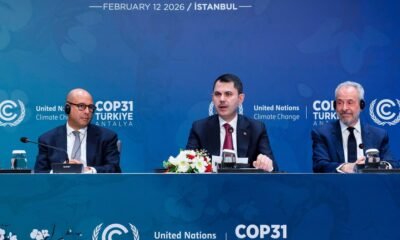
Türkiye is seeking to meet high global expectations as it prepares to host COP31, with Environment, Urbanization and Climate Change Minister Murat Kurum saying Ankara is determined to steer this year’s U.N. climate summit toward concrete, results-driven outcomes through dialogue, consensus and coordinated international action.
Speaking at a press conference in Istanbul alongside Simon Stiell, the executive secretary of U.N. Climate Change, Kurum, who is set to chair COP31, described Türkiye as the “natural center” of the global fight against climate change. Andre Correa do Lago, president of COP30, also attended the briefing.
Fully known as the 2026 United Nations Climate Change Conference, or Conference of the Parties to the United Nations Framework Convention on Climate Change (UNFCCC), the event is set to take place from Nov. 9 to Nov. 20 in Türkiye’s coastal city of Antalya.
Türkiye, in partnership with Australia, secured a bid to host the summit at the last climate talks in Brazil’s Belem.
As a first-time host and current president of the event, Türkiye will also organize a two-day World Leaders’ Summit. It will also be responsible for preparing official communications for the COP31 conference, overseeing operational and logistical arrangements, and appointing the U.N. High-Level Climate Champion, among other duties.
Australia, on the other hand, is assigned to “leading the negotiations agenda.” Moreover, building on the efforts of the COP30 Brazilian Presidency, Türkiye and Australia will work together, and with Pacific island countries, to strengthen and elevate the action agenda.
Speaking on Thursday, Kurum said they aim to carry out the COP31 process with a results-oriented approach. “We truly want COP31 to be successful,” he stressed.
He started his speech by noting that COP meetings “are very critical and valuable,” as “we are experiencing the devastating effects of the climate crisis more severely by each passing day.”
High expectations
“As Türkiye and Australia, we will work as one body with an understanding based on consultation and cooperation. We are all aware that the world’s expectations from COP31 are high,” he said.
“Our responsibility is to read these expectations correctly, to build trust among the parties and to produce results.”
“There is something we always say. We do not see COP31 merely as a conference, and no one should see it that way,” he maintained.
According to Kurum, Türkiye’s approach to COP31 is “clear.”
“We will not be a single voice but will engage in dialogue, we will act not with division but with consensus, and we will prefer action, not stagnation, in order to achieve results,” he said.
Emphasizing the understanding of responsibility that draws from the common memory of civilizations and reminds humanity of its ancient relationship with nature, the minister said they are approaching the talks with the idea and understanding that “they would hear, make heard and encourage everyone’s voice.”
Moreover, he described that climate change is no longer just an environmental crisis but instead “an existential issue,” which he said is affecting every aspect of human life, from trade and transportation to industry, food, energy and education.
At the same time, he suggested they would “respect countries’ development priorities,” while also pointing to the issue of financing, which is “of great importance in terms of advancing implementation.”
“Again, our local governments, our private sector, financial institutions and non-governmental organizations must continue to be the main actors of this process,” he further said.
Similarly, he underscored the significance of the Zero Waste Movement carried out under the auspices of first lady Emine Erdoğan. The initiative “has shown the entire world that climate action does not have to remain at the level of rhetoric, but can be carried into a results-oriented transformation framework,” according to Kurum.
Rebuilding trust in multilateralism
Emphasizing that as the COP31 presidency, they are determined to rebuild trust in multilateralism with “a strong vision focused on producing results,” the minister also drew attention to the nature and standing “with humanity.”
“At a time when climate change is sweeping across the entire world, Türkiye stands with humanity,” he proclaimed.
“The world is our common home, and we have nowhere else to go, no other home, no other shelter. With this awareness, we say that Türkiye is the natural center of the struggle to be waged against the global climate crisis,” he said.
Also expressing that Türkiye will be “a bridge” bringing together the north and the south, the east and the west, developed economies and developing societies, Kurum went on to say that “Türkiye is a country that has assumed the leadership of global climate justice, has proven and earned this claim by standing on the right side of humanity at all critical moments in history.”
“The future will take shape here, in Anatolia. A road map for a livable future for all humanity will be presented from here,” he added.
“We cannot stop, because those beautiful people on the Pacific islands that face the risk of being submerged are waiting for us.”
Climate action, investment
Stiell, for his part, said that one thing “is clear,” as he suggested that COP31 in Antalya will take place in extraordinary times, the times he described as “a new world disorder.”
“This is a period of instability and insecurity. Of strong arms and trade wars. The very concept of international cooperation is under attack. These challenges are real and serious,” he said.
“But climate action can deliver stability in an unstable world.”
“In the face of the current chaos, we can, and must, drive forward a new era of international climate cooperation,” he urged, referring to previous action and decisions and suggesting that “nations can deliver change on a major scale when they stand together.”
Stiell, in particular, addressed the investments in renewable energy. He cited that in the decade since the Paris Agreement, “clean energy investment is up tenfold.”
He said that in 2025, despite all the economic uncertainty and political headwinds, the global transition kept surging forward as the clean energy investment “kept growing strongly, and was more than double that of fossil fuels.”
“Renewables overtook coal as the world’s top electricity source,” he added.
“This is an era to speed up and scale up,” he also said.
“Climate action is indisputably in every nation’s self-interest.”


-
 Politics3 days ago
Erdoğan lambasts ‘fascist’ CHP over attack on minister
-

 Economy3 days ago
Logistics giant DP World replaces chair named in Epstein documents
-

 Sports3 days ago
LeBron becomes oldest player in NBA history to hit triple-double
-

 Politics3 days ago
93 tax inspectors detained in Türkiye over alleged FETÖ links
-
 Economy3 days ago
Aware of expectations, Türkiye eager to make COP31 successful
-
 Daily Agenda17 hours ago
“4th European Turkish Media Summit” was held in Germany
-

 Economy3 days ago
Türkiye touts sustainable current account despite wider 2025 gap
-
 Politics3 days ago
Erdoğan, Iraqi PM Al Sudani discuss boosting Türkiye-Iraq ties