
Politics
Erdoğan hits the road for Gaza, Somalia, visits UAE, Ethiopia

Regional issues top the agenda of President Recep Tayyip Erdoğan as he leaves for the United Arab Emirates (UAE) on Monday. On Tuesday, Erdoğan will fly to Ethiophia from Abu Dhabi, his second stopover. Both visits will combine Erdoğan’s diplomatic efforts for regional stability with Ankara’s efforts to enhance bilateral ties in the Gulf and Africa.
In the UAE, where he will hold talks with President Sheikh Mohammed bin Zayed Al Nahyan, along with bilateral relations, Erdoğan will discuss diplomacy to end humanitarian drama in Gaza, steps for recovery of the Palestinian enclave and second stage of U.S. President Donald Trump’s peace plan. Both countries support the plan. Foreign Minister Hakan Fidan hosted on Saturday Ali Shaath, head of the National Committee for Administration of Gaza. Fidan last month joined counterparts and heads of state as they came together for formal launch of the Board of Peace proposed by Trump.
Since 2023, Türkiye prioritized ending the conflict in Gaza, specifically the genocide by Israel, which has claimed more than 70,000 Palestinian lives. Ankara has joined almost all international initiatives to stop the bloodshed and is among main opponents of Israel which enjoys international support. As a cease-fire between Israel and Hamas holds despite Israel’s repeated, lethal violations, the international community strives to move forward the recovery initiative in the enclave which is a pale shade of itself after relentless Israel attacks that razed residential buildings to the ground all across the city.
Erdoğan is also expected to raise the issue of stability and development in Syria, which was liberated from oppressive Baathist regime in 2024. The president will highlight the need to support the new Syrian administration during his UAE visit, Turkish media outlets reported over the weekend. In addition, he will discuss the importance of territorial integrity of Yemen and Somalia. The UAE joined an international coalition in 2015 against Houthi rebels but recent developments demonstrate that the coalition, which included Saudi Arabia, has fractured. A group supported by the UAE launched an offensive against the government supported by Saudi Arabia last December.
Somalia’s territorial integrity also matters for Türkiye, which is a major partner of Mogadishu, especially in the wake of Israel’s controversial recognition of breakaway Somaliland. Ankara has joined other countries to condemn the recognition by its major foe in the Middle East which looks to expand its footprint in Africa, where Türkiye also emerged as a key actor in past two decades under the leadership of President Erdoğan.
The president visited Riyadh and Cairo earlier this month, prompting speculation that Türkiye took side of the UAE rival Saudi Arabia amid the growing regional rivalry. Erdoğan’s visit on Monday is expected to dispel these rumors. Although Ankara had relatively strained relations with both countries in the past decade, ties were improved in the past two years, thanks to Türkiye’s pragmatic diplomacy. Erdoğan’s July 2023 visit to the UAE marked a new milestone in relations as two countries decided to set up a high-level strategic council, essentially recognizing each other as strategic partners. Since then, commercial relations between the two countries significantly increased. Sheikh Mohammed was guest of Erdoğan last July for co-chairing the first meeting of the council, after Erdoğan’s last visit to his country in February 2024.
The UAE is Türkiye’s biggest trade partner in the Gulf and bilateral trade volume was about $16 billion in 2024. The two countries aim to increase it to $20 billion in short term and $40 billion in the medium term.
Türkiye and the UAE laid the foundation for a comprehensive economic partnership deal during Erdoğan’s 2022 visit to Abu Dhabi and the deal came into force in September 2023, strengthening commercial deals. The two countries implemented new customs regulations for tax discounts, boosting commercial momentum in defense industry, energy, logistics, real estate and technology. The UAE was the fourth country with most Turkish exports last year.
The UAE is also the seventh country with most investments in Türkiye. Türkiye hosts more than 300 companies with Emirati capital, mostly concentrated on real estate, energy, banking, logistics and agriculture.
Ties with Ethiopia
Erdoğan’s visit to Ethiopia will affirm Ankara’s commitment to peace between Addis Ababa and Mogadishu. Ethiopia’s deal with Somaliland for use of ports and access to sea has triggered a crisis with Somalia. In 2025, Türkiye stepped in and helped two countries sign the Ankara Declaration, by hosting their leaders in the Turkish capital, de-escalating tensions in the region.
Türkiye and Ethiopia boosted their trade volume in 2025, with a 5% increase. Their trade volume currently stands at $253 million. Türkiye is among four major investors in the African country.

An 18-member delegation of Palestinian judges and prosecutors is attending an international training program in Türkiye focusing on cybercrime and money laundering as Ankara and Palestine seek to expand cooperation in judicial education.
The delegation, led by Wesam Salayma, director of the Palestinian Judicial Institute, is taking part in the International Training Program on Combating Cybercrime and Money Laundering organized by the Justice Academy of Türkiye, according to a statement from the academy.
The Palestinian delegation traveled to Türkiye under a memorandum of understanding signed between the two sides to strengthen cooperation in the training of judges, prosecutors and assistant judges and prosecutors.
Speaking at the opening of the program, Justice Academy of Türkiye President Metin Yıldırım highlighted what he described as the historic and strong ties between Türkiye and Palestine.
Yıldırım said cooperation in judicial education would further strengthen the exchange of knowledge and experience between the judicial institutions of the two sides.
He also said the academy would continue its international judicial training activities and seek to deepen cooperation with judicial institutions in partner countries.
Referring to developments in Palestine and Gaza, Yıldırım expressed solidarity with the Palestinian people and emphasized the importance of continuing cooperation with Palestinian judicial officials in training and education.
The program aims to strengthen judicial training and the exchange of professional experience, with sessions focusing on crimes that have become increasingly diverse and transnational alongside rapid technological developments.
Academics and members of the judiciary are providing training on issues including crypto assets and criminal law, cyberbullying, crimes involving personal data, the collection of electronic evidence, technology-based investigative measures and the use of artificial intelligence in cybercrime.
The training is part of broader judicial cooperation between Türkiye and Palestine under the memorandum of understanding between their judicial training institutions.
The agreement provides for joint symposiums, conferences, workshops and training programs as well as exchanges of experts and academics.
It also envisages joint scientific research, the preparation of educational materials and publications, the development of digital training platforms, reciprocal internship programs and work on joint curricula.
The memorandum will remain in effect for five years after its signing and will automatically be renewed for successive three-year periods unless either side notifies the other that it does not intend to renew it.
A civil-society organization representing Turks in Western Thrace on Wednesday criticized remarks by Greek Deputy Education Minister Nikos Papaioannou linking the use of Turkish in minority education to what he described as efforts to bring the minority under a single identity.
The Federation of Western Thrace Turks in Europe (ABTTF) said in a statement that Turkish is the mother tongue of the Turkish minority in Western Thrace and an integral part of the community’s identity and educational autonomy.
The federation said Greece recognizes the special status of the minority education system in Western Thrace as stemming from the 1923 Treaty of Lausanne, while arguing that government policies have gradually weakened its autonomy in education.
The ABTTF also said minority schools have had their operations suspended one by one on the grounds of declining student numbers and that Turkish families face difficulties when seeking to enroll their children in minority schools.
The group rejected what it described as attempts to portray the Turkish language as a means of eliminating differences within the minority and bringing its members under a single identity.
It called on Greece to fulfill its obligations under the Treaty of Lausanne and to restore the autonomous structure of the minority education system.
The statement came in response to remarks by Papaioannou in the Greek parliament.
Responding to a parliamentary question from NIKI party lawmaker Yorgos Rountas, Papaioannou said the minority education system in Western Thrace was based on the Treaty of Lausanne.
He argued, however, that the prominent role of Turkish in minority education served to bring the minority under a single identity.
Papaioannou also rejected characterizations that minority schools were being “closed,” arguing that the”suspension of their operations” was the result of declining student numbers.
Ali Ihsan Yavuz, deputy chair of the ruling Justice and Development Party (AK Party), told journalists on Tuesday that they had concluded their work on a new constitution “to a point” and would soon present it to the party’s chair, President Recep Tayyip Erdoğan. Replacing the oft-patched, outdated and undemocratic Constitution, originally drafted upon the orders of the military junta that seized power in 1980, has been an ambition of Erdoğan.
Yavuz, a member of a committee formed by the party at Erdoğan’s instruction to work on a new constitution, said their ambition remained intact. “Sooner or later, we will accomplish drafting a new, civilian, democratic constitution,” Yavuz said at an event in the central province of Eskişehir on Tuesday. He said they were working to arrange a meeting with Erdoğan amid his tight schedule. “When the opportunity arises, the constitution will be shaped and implemented,” he said.
Since the founding of the Republic of Türkiye, constitutional design has served as the backbone of the country’s legal system. The current Constitution, adopted in 1982, has been repeatedly amended over the decades, most notably in 2017, when a national referendum paved the way for the country’s transition from a parliamentary model to an executive presidential system.
Despite numerous amendments over the decades, replacing the 1982 Constitution with a new, civilian-drafted charter remains a prominent issue in Türkiye’s political debate.
Erdoğan and Parliament Speaker Numan Kurtulmuş have repeatedly advocated for a new civilian constitution, arguing that the existing charter retains the legacy of the military rule under which it was drafted despite extensive subsequent amendments.
Kurtulmuş said in August 2026 that Türkiye’s political climate and level of dialogue had matured sufficiently for work toward a new civilian constitution, describing such a charter as a longstanding objective.
President Recep Tayyip Erdoğan used his address to the United Nations General Assembly on Tuesday to press the international community for stronger action over Israel’s genocidal conduct in Gaza, renewed recognition of Palestinian statehood and reform of the U.N. Security Council, while laying out Türkiye’s positions on conflicts and challenges stretching from Syria and Ukraine to climate change and artificial intelligence.
Erdoğan placed the Palestinian issue at the center of his speech as he addressed the 81st session of the General Assembly, saying Palestinian President Mahmoud Abbas was unable to attend the gathering for a second consecutive year and pledging that Türkiye would continue to raise the Palestinian people’s voice from the U.N. podium.
“This injustice against our Palestinian brothers and sisters deeply wounds our conscience,” Erdoğan said. “Just as last year, this year we will be the voice of a free and sovereign Palestinian state.”
He also called on countries that have yet to recognize Palestine to reconsider their position.
Describing the humanitarian situation in Gaza in stark terms, Erdoğan said the enclave had become not only “the world’s largest graveyard for children” but also the place with the highest rate of child amputees due to Israel’s genocidal attacks.
He said more than 74,000 Palestinians, most of them women and children, had been killed in Gaza over the past three years and that more than 70% of generators at hospitals in the enclave were out of service because of fuel shortages.
He said Israel killed more than 1,500 Palestinians even after a cease-fire was reached through the efforts of U.S. President Donald Trump and contributions from Türkiye and other countries.
“This is not a personal issue for Tayyip Erdoğan. It is a matter of humanity,” he said. “No one with humanity in their heart, with compassion and mercy, and with a sense of fairness and conscience can turn a blind eye to this tragedy.”
Erdoğan also described Gaza as “the most inhumane and shameful concentration camp of our time” and slammed Israel for pursuing a “genocidal mentality with an insatiable appetite for killing.”
Turning to the occupied West Bank and Jerusalem, Erdoğan said the West Bank was experiencing its worst period of Israeli illegal settler violence and criticized Israeli authorities for restricting Muslim and Christian access to holy sites in Jerusalem.
He also warned against attempts to dismantle UNRWA, the U.N. agency for Palestinian refugees.
Erdoğan urged countries gathered at the U.N. to increase pressure on Israel and reiterated Türkiye’s support for a two-state solution.
“I call on you to exert greater pressure on Israel. Attempts to suffocate Palestine will fail,” Erdoğan said.
“God willing, we will see the day when an independent and territorially contiguous Palestinian state, based on the 1967 borders and with East Jerusalem as its capital, becomes a reality.”
Erdoğan said the failure to halt conflicts extended well beyond Palestine, pointing to more than 60 wars and conflicts over the past year and saying some 250,000 people had been killed from Gaza, Ukraine and Russia to Myanmar, Darfur, Iran and Lebanon.
He argued that the scale of the violence showed the U.N. was increasingly unable to fulfill its founding responsibility of preserving international peace and security.
Beyond the Middle East, Erdoğan renewed his longstanding demand for changes to the structure of the U.N. Security Council, arguing that the current system gives disproportionate power to its five permanent members.
“A system in which the will of more than 190 countries is subject to the whims of five countries is neither fair nor capable of fully inspiring trust,” Erdoğan said.
He said the Security Council “must be reformed” in accordance with his longstanding principle that “the world is bigger than five,” referring to the United States, China, Russia, France and Britain, which hold permanent seats and veto power on the council.
Erdoğan outlined several principles for a fairer international system, including applying international law equally to powerful and weaker states, strengthening regional ownership of crises and putting cooperation and open diplomacy at the center of interstate relations.
He cited the Black Sea Grain Initiative as an example of Türkiye using regional diplomacy to contribute to both regional and global security.
Erdoğan also addressed growing competition over technology and the global economy, warning that “technological polarization and digital hegemony” were not in the interests of either the U.N.-centered international system or its member states.
He called for countries to jointly develop “a new paradigm” to confront deepening global income inequality.
Erdoğan also addressed artificial intelligence, warning that the technology was becoming increasingly difficult to control and calling for a common international legal framework.
He urged countries to accelerate efforts toward a U.N. international convention governing artificial intelligence.
On Syria, Erdoğan said the country had entered a new period following the Dec. 8 change in government and voiced support for President Ahmed al-Sharaa.
He said Syria was moving toward becoming a secure and peaceful country despite what he described as internal and external provocations and pledged that Türkiye would continue supporting the Syrian people.
Erdoğan also backed efforts to strengthen state authority and stability in neighboring Iraq, highlighting cooperation on transportation and energy projects, particularly the Development Road Project.
On the Russia-Ukraine war, Erdoğan said Türkiye hoped for an end to the conflict that preserved Ukraine’s sovereignty and territorial integrity.
He said Ankara remained in contact with the parties to restore navigational security in the Black Sea, protect food security and prevent the war from spreading.
Erdoğan strongly condemned attacks against commercial shipping in the Black Sea regardless of who carried them out.
He separately stressed the need to preserve freedom of navigation through the Strait of Hormuz and said Türkiye was working with regional actors to prevent conflicts in the Gulf from spreading further.
In the Aegean and Eastern Mediterranean, Erdoğan called for disputes to be resolved through international law and good-neighborly relations and renewed Türkiye’s proposal for an Eastern Mediterranean Conference.
On Cyprus, Erdoğan called for international recognition of the sovereign equality and international status of the Turkish Cypriot people.
“The inhumane isolation they have endured must finally come to an end,” Erdoğan said.
“I call on the international community to recognize the Turkish Republic of Northern Cyprus and establish political and economic relations with it.”
Erdoğan also emphasized Türkiye’s role in European security, arguing that the continent could not build an effective security architecture without Ankara.
“A Europe that excludes Türkiye from its security architecture cannot, let me say this clearly, become stronger or safer,” Erdoğan said.
He pointed to Türkiye’s NATO membership, growing defense industry and the NATO summit hosted in Ankara in July as evidence of the country’s role in European and trans-Atlantic security.
Erdoğan said Ankara wanted to shape its future relationship with the European Union through the same strategic perspective and expected Brussels to reciprocate.
Turning to the South Caucasus, Erdoğan voiced support for lasting peace between Azerbaijan and Armenia and praised Azerbaijani President Ilham Aliyev and Armenian Prime Minister Nikol Pashinyan for their commitment to reaching a settlement.
He said Türkiye would also continue its normalization process with Armenia.
Erdoğan highlighted growing cooperation within the Organization of Turkic States and said its 13th leaders’ summit would be held in Ankara on Oct. 30.
On Africa, Erdoğan expressed support for efforts toward a cease-fire and lasting peace in Sudan, stronger security and institutional capacity in Somalia and a Libyan-led reconciliation process in Libya.
He said Türkiye would continue supporting Libya’s political process and announced that the fourth Türkiye-Africa Partnership Summit would be held in Libya in December.
Erdoğan also said disputes in South Asia, including Kashmir, should be addressed through dialogue in accordance with the U.N. Charter and relevant resolutions.
Climate change and inequality also featured prominently in the address.
Erdoğan said Türkiye would host the COP31 climate summit in Antalya in November and wanted the gathering to become an “Implementation COP,” focused on fulfilling climate finance commitments, accelerating technology transfers and translating pledges into concrete action.
He highlighted the Zero Waste Movement launched by first lady Emine Erdoğan in 2017 and called for greater international efforts to tackle waste and food insecurity.
Erdoğan said more than 2 billion tons of food were wasted globally each year, arguing that there could be no genuine global justice while food was discarded on a massive scale as hundreds of millions struggled with hunger.
He also announced Türkiye’s nomination of Mehmet Mehdi Eker for director-general of the U.N. Food and Agriculture Organization.
Turning to social issues, Erdoğan warned of rising Islamophobia, xenophobia, cultural racism and antisemitism.
He said Muslim women and girls were increasingly subjected to discrimination and criticized headscarf bans in schools in some countries as violations of women’s fundamental rights.
Erdoğan also identified disinformation on social media as a growing threat to social peace, saying defending factual information had become increasingly important.
Concluding his address, Erdoğan pledged to continue using the U.N. platform to speak for people he described as oppressed, aggrieved and voiceless.
“As long as God grants me life, I will continue to be the voice of the oppressed from this podium,” Erdoğan said. “We will not remain silent in the face of injustice, nor will we ever accept oppression.”
Erdoğan said the international community ultimately faced two paths: deeper uncertainty driven by fear, conflict and isolation, or a future built through justice, solidarity and collective action.
“Türkiye has chosen the second path,” he said.
Türkiye, Egypt, Pakistan and Saudi Arabia called for diplomacy to defuse mounting tensions across the Middle East, while condemning attacks on Saudi Arabia and reaffirming support for Palestinian statehood and Sudan’s territorial integrity following high-level talks in New York.
The foreign ministers of the four countries met Monday on the sidelines of the 81st session of the United Nations General Assembly to discuss regional and international developments, according to a joint statement released after the meeting.
The ministers stressed the need for closer consultation and coordination among their governments to promote peace, security and economic stability across the Middle East and the broader region.
Against the backdrop of continued hostilities, they said dialogue and diplomacy remained the only viable route toward a sustainable settlement and emphasized the importance of upholding the Islamabad Memorandum of Understanding as part of efforts to secure lasting regional peace.
The four countries strongly condemned attacks targeting Saudi Arabia, including recent Houthi strikes, and expressed support for the kingdom’s sovereignty, territorial integrity and security.
They also affirmed Saudi Arabia’s right to defend its territory and population in accordance with international law and the U.N. Charter, while stressing the need to protect freedom and safety of navigation in regional waterways.
On Yemen, the ministers backed the internationally recognized government and the Presidential Leadership Council, calling for security, stability and development to be pursued through a political process and an inclusive dialogue among Yemeni parties.
The Palestinian issue also featured prominently in the talks, with the four countries describing a resolution of the conflict as central to achieving lasting peace and stability in the Middle East.
They reaffirmed the Palestinian people’s right to self-determination and backed the establishment of an independent, sovereign, viable and territorially contiguous Palestinian state along the pre-1967 borders, with East Jerusalem as its capital, in accordance with relevant U.N. Security Council resolutions.
Turning to Sudan, the ministers expressed support for the country’s sovereignty, unity, independence and territorial integrity and emphasized the importance of preserving its legitimate national institutions.
They rejected the creation of parallel governing structures that could undermine Sudanese sovereignty and called for an end to the illicit movement of weapons, mercenaries and foreign fighters into the conflict-hit country.
The four foreign ministers agreed to maintain consultations and strengthen coordination on regional and international developments, with an emphasis on collective security and long-term stability.
President Recep Tayyip Erdoğan held a series of high-level meetings in New York on Tuesday, engaging U.N. chief Antonio Guterres and the leaders of Britain, Qatar and Senegal on conflicts and diplomatic efforts spanning Gaza, Ukraine, Iran and Cyprus.
Erdoğan’s diplomatic meetings came on the sidelines of the 81st session of the United Nations General Assembly, where he earlier delivered an address focusing heavily on Gaza and wider regional and global challenges.
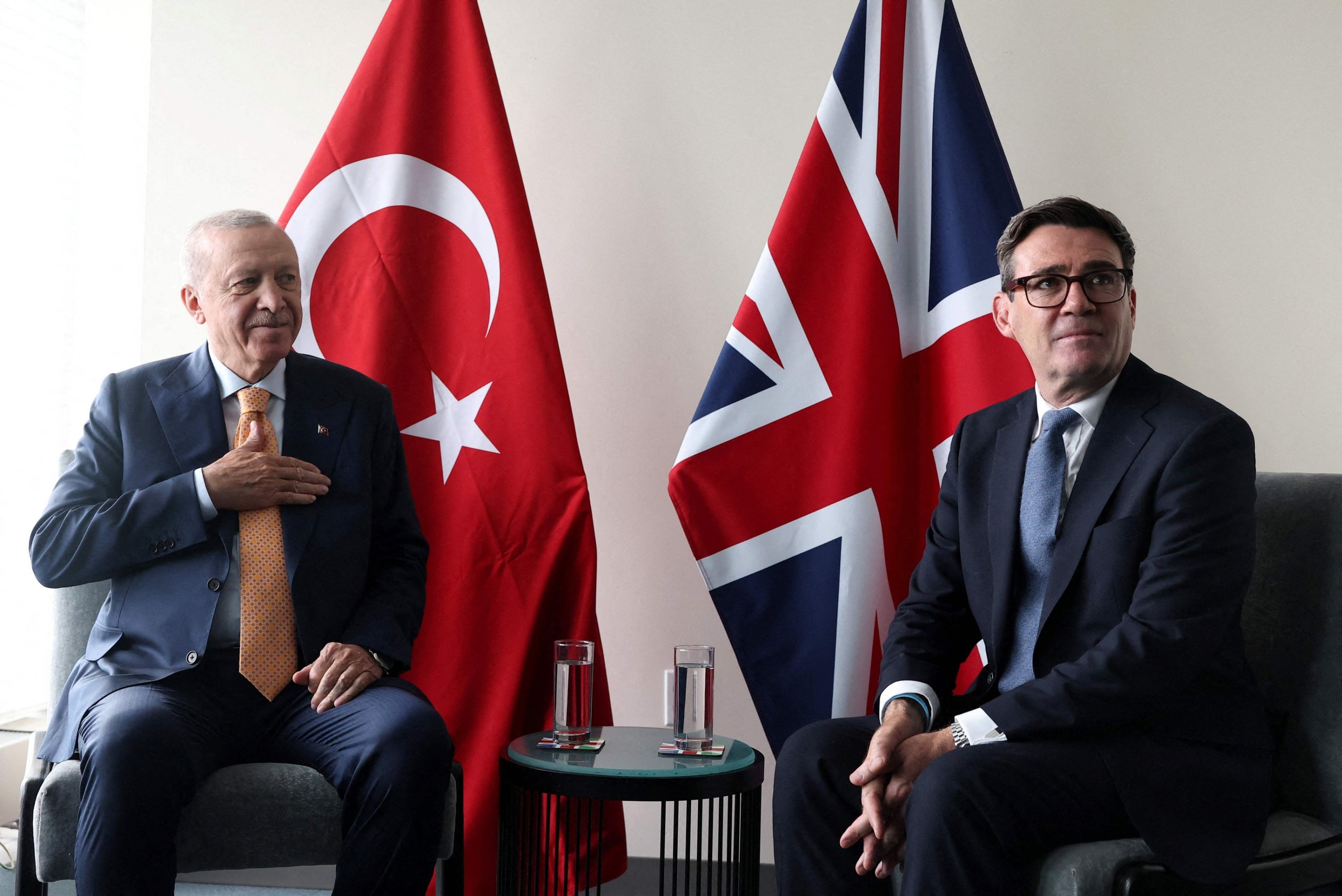
The Turkish president met British Prime Minister Andy Burnham as part of his bilateral engagements in New York. The meeting was held behind closed doors.
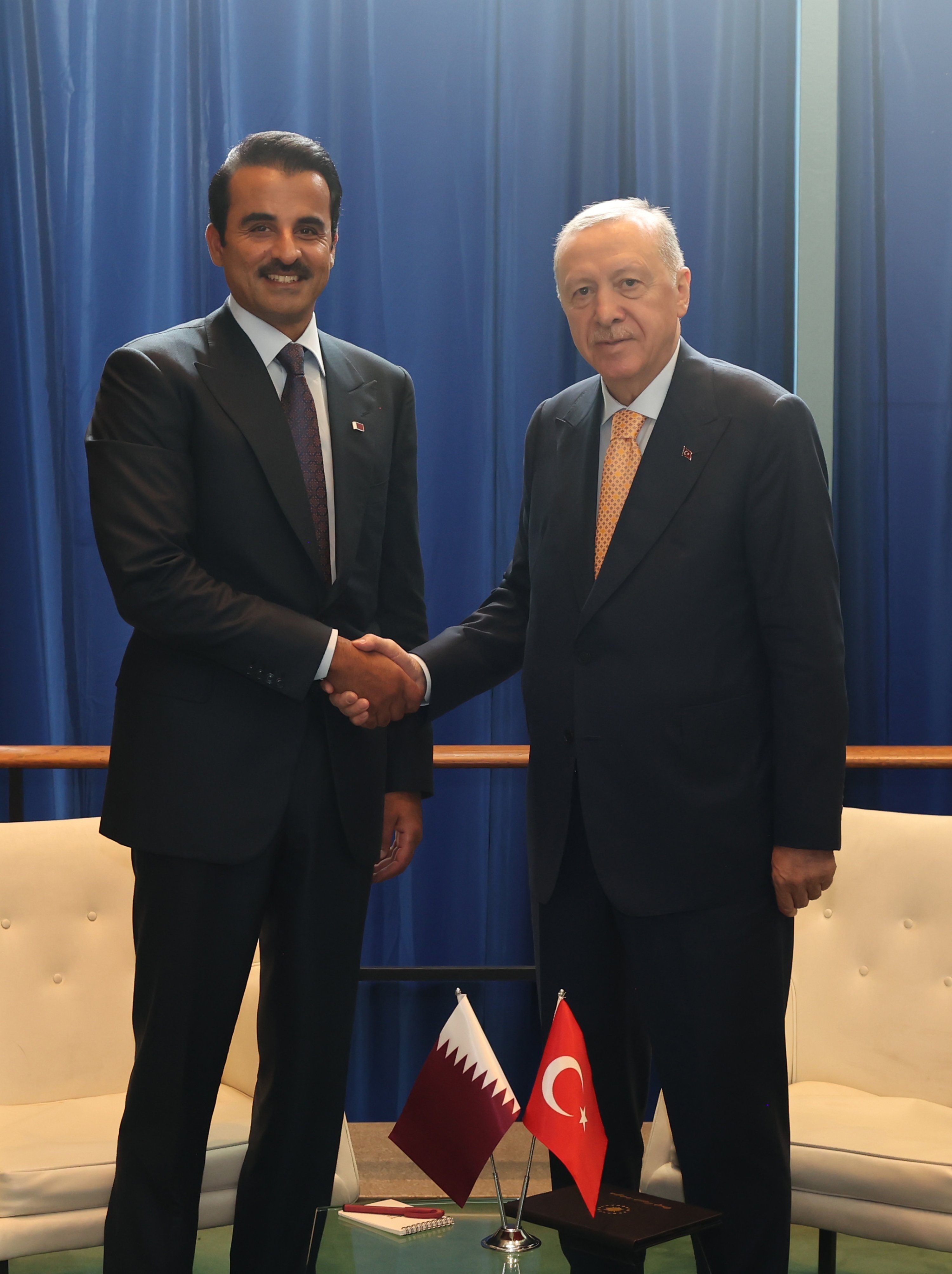
Erdoğan also met Qatar’s Emir Sheikh Tamim bin Hamad Al Thani, a close regional partner of Türkiye, as part of his General Assembly contacts. No immediate details of their talks were released.
In a separate meeting at U.N. headquarters, Erdoğan held talks with U.N. Secretary-General Antonio Guterres on developments in the Middle East, the war in Ukraine and Cyprus.
According to Türkiye’s Communications Directorate, Erdoğan said Ankara had worked closely with Guterres on numerous issues concerning international peace and security during the U.N. chief’s tenure.
Gaza featured prominently in their discussions, with Erdoğan saying Israel’s unwillingness to pursue peace had once again become apparent.
He also raised attacks by illegal settlers in the occupied West Bank and assaults on holy sites in Jerusalem, saying the developments had further aggravated the situation and stressing the importance of preserving the basis for a two-state solution to the Israeli-Palestinian conflict.
Erdoğan told Guterres that tensions surrounding Iran and the war in Ukraine should be reduced and said Türkiye would continue supporting diplomatic efforts.
He also said a process emerging from within the region could help address tensions surrounding the Strait of Hormuz.
On the Black Sea, Erdoğan voiced concern about attacks on commercial vessels and called on all parties to act responsibly to protect navigational safety.
The Turkish president also reiterated Ankara’s position on Cyprus, saying proposals that fail to recognize the sovereign equality and equal international status of the Turkish Cypriot people would not produce a viable solution.
The U.N. separately said Erdoğan and Guterres exchanged views on Cyprus, Ukraine and developments across the Middle East.
Erdoğan also met Senegalese President Bassirou Diomaye Faye behind closed doors on the sidelines of the General Assembly.
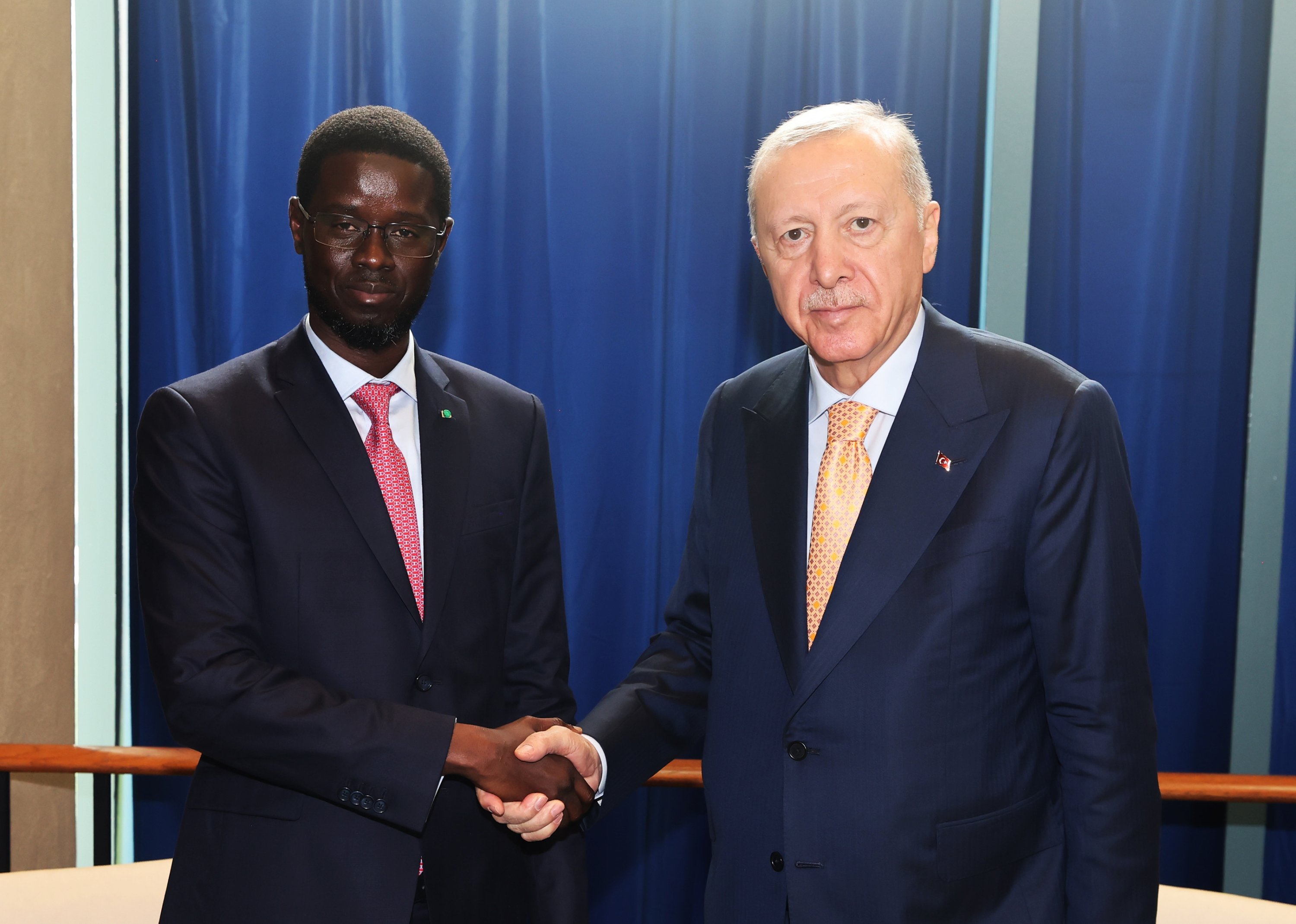
Türkiye and Senegal have expanded political, economic and cultural cooperation in recent years. Ankara opened its embassy in Dakar in 1962, one of Türkiye’s earliest diplomatic missions in Africa, while Senegal established its embassy in Ankara in 2006.
The meetings formed part of Erdoğan’s packed diplomatic schedule in New York as world leaders gathered for the annual U.N. summit amid continuing conflicts and heightened tensions across several regions.


-

 Economy3 days ago
AMD joins $1 trillion club as last chipmaker to cash in on AI rally
-
 Economy3 days ago
Türkiye extends funds liquidation process, freezes execs’ assets
-
 Economy3 days ago
US says all Iranian airlines to be ‘shut down’ Wednesday
-
 Politics2 days ago
Fidan urges US to use greater leverage on Israel for regional peace
-
 Politics3 days ago
Sea Wolf maritime drill begins amid tensions between Greece, Türkiye
-

 Economy2 days ago
Paramount settles states-led lawsuit, clearing path for Warner buyout
-
 Politics3 days ago
Türkiye rejects disinformation targeting child protection operations
-
 Economy3 days ago
Europe faces Q4 jet fuel deficit despite tapping far-flung suppliers