
Politics
Türkiye-Russia ties at new high, Erdoğan says as he meets Putin

President Recep Tayyip Erdoğan said Türkiye and Russia have brought their relations to an unprecedented level, highlighting deepening cooperation in energy, tourism and agriculture while signaling plans for new nuclear power projects after the Akkuyu plant becomes operational.
“Türkiye-Russia relations are truly at a much more advanced level today than at any previous period,” Erdoğan said during talks with Russian President Vladimir Putin on the sidelines of the Shanghai Cooperation Organization (SCO) summit in Bishkek, Kyrgyzstan.
Erdoğan pointed to the Akkuyu Nuclear Power Plant as one of the flagship projects underpinning bilateral cooperation, saying construction had entered its final stage.
“We are now waiting for the Akkuyu plant to be completed so that we can inaugurate it,” Erdoğan said. He added that Türkiye and Russia were preparing to take further steps toward additional nuclear power plants after Akkuyu begins operations.
Türkiye has previously explored plans for additional nuclear power capacity as part of efforts to diversify its energy mix, reduce dependence on imported fuels and strengthen long-term energy security.
Erdoğan also emphasized the importance of Russian visitors to Türkiye’s tourism industry, particularly in the Mediterranean resort hub of Antalya, where Russians remain among the largest groups of foreign tourists.
He said cooperation between Ankara and Moscow also remained strong in agriculture and energy.
Putin, for his part, described Türkiye as one of Russia’s “privileged partners” in both foreign policy and economic affairs and said major joint projects continued to move forward.
He expressed confidence that the first unit of the Akkuyu plant would be commissioned this year.
“You have set the goal of commissioning the plant’s first unit this year. This will happen,” Putin said.
The Russian president also highlighted growing people-to-people ties, noting that nearly 7 million Russian tourists visited Türkiye last year.
Foreign Minister Hakan Fidan and National Intelligence Organization (MIT) chief Ibrahim Kalın also attended the meeting.

One year to the next election and, amid growing public anger against Israel’s genocidal campaign in Gaza, the Mitsotakis government of Greece appears to be gambling away political fortunes with a major deal with Israel. The deal, signed on Monday, is one of the biggest for Israel and will reinforce Greece’s “Achilles Shield” aerial defense system. For Mitsotakis, however, it may be his Achilles’ heel in the 2027 election. A survey released by Pew Research Center in June shows that although the Greek public is still warm toward Israel, only 30% of the nation has a positive opinion of the country after the start of a new round of Palestine-Israel conflict in 2025.
Since 2025, Greece has been the scene of pro-Palestine demonstrations, denouncing genocide in Gaza. Earlier this month, a major protest was held in Piraeus as an Israeli cruise ship docked there. The protest has called on Greece to cease cooperation with Israel, but Athens responded with the 3 billion euros deal on Monday. “The security agreement signed today with Greece, one of the largest in the country’s history, is a direct continuation of the Eastern Mediterranean alliance we forged a decade ago with Greece and (southern) Cyprus. It serves as further proof of the tremendous capabilities of Israel’s defense and technological industries,” Prime Minister Benjamin Netanyahu said. “This move expresses Israel’s strength, the confidence in our defense exports, and the strengthening of regional alliances.”
“Deeply ashamed that, despite a sizeable majority of Greeks opposing the genocidal Apartheid state, we have allowed our ruling class to taint Greece through this despicable deal,” Greece’s former Finance Minister Yanis Varoufakis said in a social media post on Monday.
Varoufakis’ former party Syriza was also quick to denounce the government over the deal. Syriza said in a statement on Monday that the deal deepens Greece’s defense/military dependence on the “genocidal government of Israel,” “which violates international law.” Syriza said the government portrayed the deal as a triumph, but questions remained over how the country would remain independent in its air defense network. “Is our country really gaining greater strategic autonomy or is it integrating its defenses into the Israeli-American security system?” Syriza asked in its statement.
The Communist Party of Greece (KKE) termed the deal as a “dangerous decision” by the Mitsotakis government, “to accelerate war preparations and deepen the involvement of our country in imperialist wars and plans.”
“Strategic relations with the murderous state of Israel and joint war preparations add fuel to the imperialist plans in the region,” a statement by the party on Monday said.
For Israel, it is an alliance against “shared regional challenges,” as Israeli Defense Minister Israel Katz put it in a statement. Both countries are at odds with Greece’s neighbor Türkiye, and Katz, without naming Türkiye openly, said Israel and Greece would deepen their defense and strategic cooperation at a time “when actors with hegemonic ambitions are seeking to expand their influence.” Israel, which repeatedly carried out attacks in Syria since the fall of the Baathist regime in 2024 there, has recently bombed a military base under the pretext of preventing so-called Turkish plans to establish a foothold there.
Adonis Georgiadis, Greece’s health minister, was more blunt in defense of the deal’s target. Georgiadis, who was once denounced as anti-Semitic by Israeli circles, has been a champion of relations with Israel, defining the country as “a true miracle of humanity” in a social media post in May. In response to the opposition’s criticism, Georgiadis was quoted by the Greek media praising the deal. “It secures the freedom of Greece against a Turkish threat,” he was quoted.
Turkish authorities detained 10 suspects on Tuesday in an operation targeting the current information technology network of the Gülenist Terror Group (FETÖ), prosecutors said.
The Ankara Chief Public Prosecutor’s Office issued detention warrants for 13 suspects as part of an investigation into the group’s alleged organizational activities conducted through the encrypted messaging application Signal.
Investigators identified the suspects as allegedly operating within FETÖ’s current IT structure following efforts to decipher communications conducted through the application, according to prosecutors.
Teams from Türkiye’s National Intelligence Organization (MIT) and the Ankara Police Department’s Counterterrorism Branch carried out simultaneous operations on Sept. 1.
Ten of the 13 suspects were detained during the raids, while authorities continued efforts to apprehend the remaining three, prosecutors said.
Findings recently uncovered an alleged matchmaking network operated by members of the FETÖ through the encrypted messaging application Signal. Technical examinations of seized digital materials revealed that the matchmaking system remained active in January and February 2025.
Investigators found that unmarried members, divorcees or individuals whose spouses had died could apply to designated “matchmaking coordinators” within the group to find potential partners.
Authorities further determined that dismissed military personnel and other individuals linked to the group were included in the matchmaking process.
The investigation is part of Türkiye’s continuing operations against FETÖ, which is responsible for the July 15, 2016 coup attempt, which killed 253 people and injured thousands.
Turkish authorities have continued nationwide investigations into the group’s networks, focusing on its alleged structures within state institutions as well as its financial, educational and communications networks.
Proceedings against the suspects remain underway.
President Recep Tayyip Erdoğan was quite at home in Bishkek, Kyrgyzstan, on Tuesday, where heads of state from the Shanghai Cooperation Organization (SCO) gathered for a major summit. After a meeting with close ally Azerbaijani President Ilham Aliyev, Erdoğan addressed the SCO Plus event as a representative of SCO dialogue partner Türkiye and later held apparently warm meetings with Russian President Vladimir Putin and Belarusian President Aleksandr Lukashenko. In his address, Erdoğan described the SCO as a “rising star” and praised its potential to ensure peace and stability.
“Representing approximately 3.5 billion people and a combined gross domestic product (GDP) of $35 trillion, the Shanghai Cooperation Organization has, over the past 25 years, become an indispensable component of the multipolar order. We regard the organization, which brings the Asia-Pacific region and the Middle East together on a common platform, as a supporter and complement to the United Nations. Above all, the SCO has a structure that aligns with our multidimensional foreign policy, which places regional ownership at its center. As Türkiye, we are assuming responsibility for resolving the conflicts taking place around us through dialogue and diplomacy, and we will continue working for peace, tranquillity and stability both in our region and throughout the world,” Erdoğan said in his speech.
Under Erdoğan’s leadership, Türkiye has diversified its diplomatic instruments and substantially changed its approach to international affairs in its bid to become a global actor. Once pivoted primarily toward the West, it has explored ties with Asia-based international groups and championed reforms at the United Nations, particularly to the current structure of the UN Security Council.
“We believe that the organization can play a role not only in ensuring peace and stability, but also in areas such as establishing uninterrupted and secure transport corridors and ensuring energy supply security, which are of great importance for the prosperity of our peoples. I would particularly like to underline Türkiye’s critical role in facilitating the SCO’s access to Western markets, especially through the diversification of energy corridors and the management of geopolitical risks. We wish to further align the Trans-Caspian Middle Corridor Initiative with the Belt and Road Initiative, and in this context, we attach great importance to cooperation within the organization. We will endeavour to advance our cooperation with the Shanghai Cooperation Organization,” Erdoğan stated.
He noted that one of the fundamental objectives of the quest for a just order is to leave future generations a more stable, prosperous and liveable world.
“Issues such as climate change, irregular migration, terrorism, transnational crime and food security now pose threats to many countries. Türkiye aims to do its part in combating the adverse effects of climate change on different regions of the world. To this end, we will host the COP31 Summit in Antalya on Nov. 11-12, 2026. I would like to express my great pleasure at the prospect of welcoming you, our valued friends, at this important summit as well,” he said.
“Drawing motivation from the Shanghai Spirit, our organization will play an important role in building a truly multipolar world. I wish Pakistan, which will take over the chairmanship from Kyrgyzstan, every success, and I hope that our meetings will contribute to the well-being of our region and the shared future of our countries,” he concluded.
Türkiye joined the SCO as a Dialogue Partner in 2013 and was granted the chair of the international body’s Energy Club for one year in 2016. Ankara has previously expressed its desire for full membership in the SCO.
The SCO traces its roots to the “Shanghai Five” mechanism – China, Russia, Kazakhstan, Kyrgyzstan and Tajikistan – before Uzbekistan joined as the sixth member. Today, the organization includes 10 member states, two observers and 14 dialogue partners across Asia, Europe and Africa.
Mecca defense alliance
Erdoğan also spoke about the Mecca Defense Alliance, as it was officially named on Monday following a meeting of Turkish, Saudi and Pakistani officials in Istanbul.
“The alliance will make significant contributions to regional and global peace and stability,” Erdoğan said, noting that the alliance was based on regional ownership and collective deterrence.
“But as we speak about peace, let us remember that Israel’s attacks killed 74,000 people, mostly children and women, in Gaza and Lebanon. The entire region pays the price due to this aggressive policy,” he said.
Türkiye is working to broker a new agreement between Russia and Ukraine to restore safer grain shipments through the Black Sea, Foreign Minister Hakan Fidan said Monday, warning that escalating attacks in the region are threatening both maritime security and global food supplies.
Speaking to journalists in Istanbul, Fidan said Ankara remained in contact with both Moscow and Kyiv and was seeking to establish conditions for an arrangement similar to the previous Black Sea grain initiative.
“We have prepared a proposal and are in contact with both sides,” Fidan said. “As we did in the past, we hope to work toward an agreement similar to the grain deal if the necessary conditions emerge.”
Fidan described deteriorating navigation security in the Black Sea as a major concern extending far beyond the countries directly involved in the Russia-Ukraine war.
“This continues to be a serious problem,” he said, adding that disruptions preventing Russian and Ukrainian grain from reaching international markets were increasingly affecting global food security.
Türkiye has received appeals from several countries concerned about the disruption of grain supplies, Fidan said.
Russia and Ukraine are among the world’s major wheat exporters, making uninterrupted Black Sea shipping particularly important for countries heavily dependent on imported grain. Prolonged disruptions could drive up prices and exacerbate food shortages, particularly in vulnerable countries in Africa and elsewhere.
Fidan also warned that the continuing war had become increasingly destructive as both sides developed new methods of targeting each other, leaving fewer areas and assets beyond the conflict’s reach.
“The parties are constantly developing new methods, to the point where almost nothing remains outside the scope of targeting,” he said, warning that the conflict was evolving from a war of attrition into an increasingly destructive confrontation.
He said Türkiye was continuing diplomatic efforts aimed at preventing further escalation.
Ankara previously played a central role in brokering the Black Sea Grain Initiative alongside the United Nations in 2022. The agreement enabled Ukrainian agricultural exports to reach international markets through designated Black Sea routes before Russia withdrew from the arrangement in 2023.
Renewed concerns over Black Sea navigation have intensified amid attacks on vessels and maritime infrastructure. Fidan called for restraint, warning that further escalation could deepen risks to commercial shipping and food supplies.
The issue is also expected to feature in talks between President Recep Tayyip Erdoğan and Russian President Vladimir Putin in Kyrgyzstan on Tuesday.
Ukraine has backed efforts toward a renewed Black Sea cease-fire, while Russia has resisted recent proposals, arguing that revenue generated by Ukrainian exports could ultimately support Kyiv’s military campaign.
Türkiye, which maintains diplomatic channels with both Moscow and Kyiv, has repeatedly sought to mediate between the two sides while pushing for measures to safeguard commercial navigation and agricultural exports through the Black Sea.
New Party (YP) Chairperson Özgür Özel defended his vote in favor of legislation underpinning Türkiye’s terror-free initiative, saying a party that advocates resolving long-standing issues through Parliament could not oppose such a measure in the legislature.
Speaking in a live interview with broadcaster Halk TV on Monday, Özel said he personally took responsibility for voting in favor of the Law on Strengthening National Solidarity and Social Integration, while allowing his party’s lawmakers to vote according to their own judgment.
“A party that says these issues should be resolved in Parliament cannot oppose the law in Parliament. I voted ‘yes’ on principle, taking full responsibility,” Özel noted.
He said the party could not oppose, on principle, a process in which a terrorist group declares its dissolution and abandons armed violence.
Özel acknowledged differing sensitivities among voters across Türkiye, pointing to concerns in the Black Sea, Thrace, Central Anatolia and western regions.
Türkiye’s Parliament earlier this month passed a landmark 12-article law supporting the country’s “Terror-Free Türkiye” initiative, following months of political efforts led by President Recep Tayyip Erdoğan and Nationalist Movement Party (MHP) Chairperson Devlet Bahçeli.
The legislation outlines legal procedures for members of the PKK terrorist group who lay down their arms and surrender to Turkish authorities as the organization moves toward dissolution and disarmament. It includes provisions allowing the deferral of prosecution or prison sentences in certain circumstances, while establishing different legal procedures depending on an individual’s position within the organization and involvement in criminal activity.
The law does not constitute a general amnesty and does not eliminate existing convictions, change the legal classification of crimes or broadly remove criminal liability, according to the justification accompanying the legislation.
On the other hand, ahead of the parliamentary vote, Özel said he consulted 91 New Party lawmakers, 74 provincial chairs and seven former provincial officials in provinces without sitting chairs.
“There was no absolute ‘yes’ or ‘no.’ I said I would represent the party’s principled position and we would leave the rest to individual choice,” he said.
Özel remarked that subsequent feedback from lawmakers, opinion polls and social media monitoring had reinforced his belief that allowing a free vote was the right decision.
Turning to domestic political alliances, Özel stated that parties should work independently until elections approach rather than determining alliances years in advance, saying that strategy was a mistake in the previous election.
Asked whether New Party could form an alliance with the Republican People’s Party (CHP) if a leader elected through a party vote took office, Özel left the door open.
“Anything is possible. Anyone elected in the CHP or another party is welcome,” he said.
Özel also noted that the New Party (YP) had reached 600,000 members since its establishment and predicted membership would rise to 1 million in a short period.
He also addressed remarks by CHP politician Muharrem İnce, who recently said “forming a party is not like making pickles” and that establishing one with legitimate funding was difficult.
Özel said he was initially offended by the remarks but accepted İnce’s subsequent explanation that he was referring to difficulties he experienced while establishing the Memleket Party.
“I believe an old friend does not become an enemy,” Özel added.
The breakaway between the two parties follows months of internal turmoil within the CHP after Kemal Kılıçdaroğlu returned to the party leadership following a court ruling that invalidated the previous party congress, a decision widely referred to in Turkish political circles as the “absolute nullity” ruling.
The number of irregular migrants intercepted at sea in Türkiye fell 53% in the first eight months of 2026 compared with the same period last year, according to Coast Guard Command data, as authorities intensified efforts against irregular migration and migrant smuggling.
Coast guard teams intercepted 5,984 irregular migrants in 256 incidents through Aug. 30 this year, compared with 12,857 migrants in 494 incidents during the same period of 2025.
The number of incidents fell 48% year-over-year.
The figures also showed a broader decline since 2024. Authorities recorded 2,011 irregular migration incidents involving 55,726 migrants in 2024, while 20,078 migrants were intercepted in 767 incidents in 2025.
August recorded the highest monthly number of interceptions this year, with 988 irregular migrants apprehended at sea, followed by June with 942 and July with 902.
The coast guard, which operates around the clock to prevent unauthorized sea crossings and combat migrant smuggling, carries out patrols and surveillance using maritime and aerial assets.
Despite the decline in crossings, dangerous journeys continued to claim lives. Forty-six irregular migrants died at sea through Aug. 30 this year, according to the data. Türkiye recorded 44 deaths in 2024 and 59 in 2025.
Authorities also detained 143 suspected migrant smugglers in maritime operations through August this year, compared with 484 in 2024 and 363 in 2025.
Coast guard operations have also extended to land in coordination with police and gendarmerie units in an effort to prevent migrants from reaching the sea.
In 141 joint operations through Aug. 30, authorities intercepted 3,153 irregular migrants before they could set out to sea and detained 221 suspected migrant smugglers. August recorded the highest number of land interceptions, with 744 migrants apprehended.
The coast guard also continues search-and-rescue operations for people in distress at sea using boats, ships and aircraft.


-

 Sports2 days ago
Sole Çalhanoğlu strike secures narrow Inter win over Cagliari
-
 Economy2 days ago
US says world ‘cannot have China with $1.2 trillion trade surplus’
-

 Sports3 days ago
Galatasaray complete Rafael Leao signing from Serie A’s AC Milan
-
 Politics3 days ago
FM Hakan Fidan holds calls with Qatari, Egyptian counterparts
-
 Politics1 day ago
Civilians injured in PJAK terrorist attack in Iran
-
 Politics3 days ago
Ankara summons Ukraine’s ambassador over Black Sea attacks
-
 Economy2 days ago
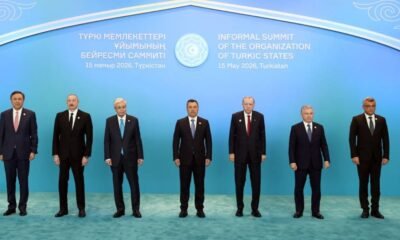
Türkiye’s trade with Organization of Turkic States members tops $10B
-

 Sports3 days ago
Chelsea sign Argentine shot-stopper Martinez from Aston Villa