
Economy
Türkiye to seek return of excessive gains as fund payouts advance

The liquidation of the Turkish funds caught up in last month’s turmoil is proceeding at the planned pace, but the final wind-down will take more time, Treasury and Finance Minister Mehmet Şimşek said Tuesday.
Investors in the funds still to be settled are expected to receive interim payments of up to TL 1 million once a liquidation bill now before Parliament becomes law, Şimşek told private broadcaster Habertürk.
He added that people who made real gains of TL 10 million or more from market-disrupting activity will be asked to return the money voluntarily, and will face legal action if they do not.
The scandal broke just over a month ago, when several investment funds said they were unable to satisfy redemption demands, prompting prosecutors to open an investigation into allegations of widespread market manipulation.
Regulators placed seven firms managing 131 funds into liquidation, affecting nearly half a million individual investors. The Justice Ministry says 85 people have been arrested.
Liquidation progress
“The liquidation process is going at the speed and within the framework we foresaw,” Şimşek said. “An interim payment has been planned in liquidation, because final liquidation will take time.”
Liquidation is split into ordinary and extraordinary procedures, with ordinary liquidation applying to firms whose finances are relatively manageable. The 66 funds run by A1 Capital, Bulls and Pardus have been wound down this way, completing three of the seven companies, Şimşek said.
A total of TL 40.8 billion has been paid to 45,747 accounts.
Hedef Portföy, which has 31 funds including four money market funds, will also go through ordinary liquidation, bringing the total to four of the seven companies, the minister noted, adding that the process would probably finish by the weekend.
Atlas Portföy’s owners are in talks with the liquidating institution and have shown willingness to put resources back, he said. The remaining firms are Tera and Pusula. Only two funds still involve a complicated process, he said, without naming them.
Investors in equity funds have received about 58% of what they had invested as of Sept. 17, Şimşek said, while those in money market funds earned a 1.43% return.
Recovering gains
Once the bill that is due to be debated at Parliament this week becomes law, payments of up to TL 1 million will be made quickly, depending on the resources in each fund, the minister said.
Small investors and money market funds will be paid first, covering a further 390,000 accounts and putting a large part of the process behind, he said.
The Savings Deposit Insurance Fund (TMSF), the Justice Ministry and the Central Registry Agency (MKK) are working together and have identified people who profited from market-disrupting activity, Şimşek said.
In the first stage, those with real gains of TL 10 million or more will be approached. If they do not return the money voluntarily, the Justice Ministry will begin legal proceedings.
Authorities also aim to recover assets that were transferred unlawfully to people and companies that benefited from the funds, in case the funds themselves lack enough money, he said. The personal assets of people who acted together will also be pursued.
Limited risk to banks, economy
The risks from the troubled funds have been contained and do not threaten the wider economy, Şimşek said. The problem area has been “quarantined” and direct effects limited, though some indirect effects are possible. “I am not underestimating indirect effects,” he said.
The risk of contagion to banks is very low, he said. Banks’ direct exposure to the risky funds is TL 1.3 billion, against total banking sector assets of about TL 56 trillion, and risky assets make up about 0.09% of the real sector’s total assets, he noted.
Outflows from the funds have largely stopped, Şimşek said. Net outflows total TL 647 billion, about half from foreign investors. Şimşek said most of the money has moved into bank deposits, which have risen by TL 685 billion since Sept. 17.
More regulation planned
The Fund Guide issued in late August was an important step that raised transparency and closed most gaps, but it is “not enough,” Şimşek said.
Further rules are being studied. The minister said sanctions against market manipulation and coordinated trading will be raised significantly, and supervisory institutions will be strengthened. “If necessary, we will transfer some of our tax inspectors to these institutions by law,” he said, adding that the government will also fill any gaps in legislation.
Measures under consideration include independent verification of reported free-float ratios and whether funds sold to retail investors should be open to the electronic fund trading platform TEFAS. Work on permanent reforms was drafted earlier, but the priority is to finish the liquidation first, Şimşek said. The government will consult the industry and weigh the risk of over-regulation.
Şimşek said opening hedge funds to TEFAS in 2019 was a decisive factor in the current problems and that they would not have arisen otherwise.
Türkiye’s $1.8 trillion economy cannot be financed by banks alone, he noted, and at least 30%-40% of financing should come from capital markets, which he said will emerge from this episode healthier. “This area is too valuable to be left to the greedy and the fraudsters,” he said.

Türkiye aims to rank as the world’s sixth-highest-earning country in the tourism sector, with a new budget of $244.5 million under the 2027 central government budget draft.
The funding, increased from $188.4 million this year, aligns with Ankara’s Medium-Term Program (MTP) and its tourism revenue targets of $70 billion in 2027, $73.5 billion in 2028 and $78.5 billion in 2029, according to a report on Tuesday.
Türkiye posted a record performance last year, generating $65.2 billion in tourism revenue, but the initial 2026 revenue target of $68 billion was revised downward to $65 billion due to ongoing conflicts between Russia and Ukraine, as well as the tensions in the Middle East.
The country is expected to improve its position in global tourism revenue rankings from a projected seventh place this year to sixth in 2027 as revenues increase, according to global tourism revenue data from the World Tourism Organization.
If the country achieves its $70 billion target next year and moves up in global revenue rankings, subsequent projections place Türkiye in fifth place by 2028.
Türkiye rose from 15th to seventh place in global tourism revenue, while climbing from eighth to fourth place in total tourist arrivals since 2017.
The country is expected to maintain its fourth-place ranking in total tourist arrivals throughout 2027-2029, while aiming to improve its standing in the World Economic Forum’s (WEF) Travel and Tourism Development Index (TTDI), moving up to 35th place from its projected 36th-place finish last year.
Ankara aims for 34th place in 2028 and 33rd by 2029, further cementing the country’s status as a top global travel destination.
The tractors entering Gela, a town on Europe’s southernmost edge, fly the Sicilian flag, decorated with Medusa, three bent legs and ears of wheat – a symbol of the island’s long-standing role as a breadbasket dating back to Roman times.
But the farmers are not bringing in a harvest. They are protesting.
As soaring fuel prices squeeze household budgets and businesses across Europe, cost-of-living pressures are driving unrest and giving fresh momentum to far-right parties ahead of elections next year in countries including France, Italy and Poland.
Parties once considered fringe had already been gaining ground, with voters from motorists in rural France to young men in Germany’s former Communist east looking for alternatives.
The U.S.-Iran war, which erupted in February and sent energy prices sharply higher, has compounded the challenge for governments already struggling to contain inflation, support growth and rein in spending.
The discontent has spilled onto the streets.
In France, demonstrations that began over deteriorating school facilities in Paris’ northern suburbs have morphed into some of the country’s worst unrest in decades, with shops looted, buildings torched and a 19th-century town hall in Limoges set on fire.
“Why am I here? Well, quite simply, I find the current cost of living truly terrifying,” said Quentin Leviloux, a 21-year-old protester in Nantes.
“Just think of people who earn barely the minimum wage, when you look at the cost of food, fuel, and everything else. It’s terrifying how incredibly expensive things have become.”
The European Commission estimates the Iran conflict has cost Europe roughly 100 billion euros ($112 billion) through disrupted trade and energy markets. Gas prices have jumped about 140% and diesel prices have doubled.
In a weekend address, French President Emmanuel Macron acknowledged the “legitimate demands” of protesters angered by rising living and fuel costs, while condemning those responsible for violence and looting.
“We must never confuse them with those who destroyed, vandalized and looted,” he said.
Protests erupt across Europe
Violence has also erupted elsewhere. In the wealthy northern Italian city of Milan, police clashed on Sunday with protesters hurling stones and looting stores during demonstrations over poor public services and rising living costs.
In Gela, on Sicily’s southern coast, farmers say fuel costs have made operating machinery prohibitively expensive. “We cultivate the land, we harvest debts,” said one banner.
“We are completely at a standstill,” said Arcangelo Gambino, a farmers’ representative in Caltanissetta province. “The (fuel) cost has more than doubled.”
Roadblocks by truckers, farmers and steelworkers have disrupted transport across parts of southern Italy, contributing to local fuel shortages and concerns over supermarket supplies.
Tens of thousands marched through Lisbon on Saturday over low wages, housing costs and the rising cost of living, increasing pressure on Portugal’s centre-right government.
In Spain, the eviction of an 87-year-old woman from her home sparked nationwide demonstrations over housing shortages and soaring rents, helping trigger a snap election next month.
Belgium has also seen demonstrations, while large rallies in Albania have been driven by anger over perceived government corruption, a lack of jobs and poor education standards.
The protests reflect broader economic anxieties that are increasingly shaping politics across the continent.
Concerns about purchasing power have become “a major driver of populist politics” across Europe, said Gilles Ivaldi, a political scientist at Sciences Po.
Politicians on both the hard right and hard left have increasingly argued that restoring energy ties with Russia would help lower costs, challenging Europe’s mainstream consensus on support for Ukraine.
Le Pen makes fuel prices campaign issue
The latest energy shock comes after years of economic strain following the COVID-19 pandemic and the fallout from Russia’s 2022 invasion of Ukraine.
In France, rising energy costs have provided an explosive backdrop to next April’s presidential election. Macron’s government is struggling with a ballooning budget deficit and pressure from bond markets.
Frontrunner Marine Le Pen of the far-right National Rally (RN) and hard-left veteran Jean-Luc Melenchon, have both made fuel prices central planks in their campaigns.
“Rising fuel prices are clearly an issue that boosts Marine Le Pen,” said Ivaldi. “I think this is an issue she has owned for quite some time.”
Since the Iran war began, Le Pen’s ratings have improved while Macron’s have slipped, according to polling by Elabe.
Le Pen’s proposal to sharply cut value-added tax on fuel has attracted broad public support. Analysts say the issue resonates strongly with her core voters in rural and semi-rural areas where car travel is often essential.
Calls to restore Russia ties
In neighboring Germany, the Alternative for Germany (AfD) is leading national opinion polls after strong gains in local elections. The cost of living topped Germans’ concerns for a fifth straight year in a survey published this month.
German inflation spiked to nearly a three-year high in September, with energy price inflation rising to 14.9%, handing ammunition to the AfD to attack Chancellor Friedrich Merz.
The AfD is pushing to restore energy ties with Russia, arguing that Berlin’s support for Ukraine is needlessly self-sabotaging at a time when Europe’s largest economy and many of its energy-hungry companies are struggling.
Past experience indicates a link between high energy prices and voter turnout for the AfD, said Jan Steckel, professor for the political economy of climate change at the Technical University of Munich.
“Populist parties often frame energy costs as avoidable and attribute them to government policy choices … rather than to the underlying geopolitical shocks that drive them,” he said.
“These geopolitical shocks are … much more difficult to explain. And I think this is why incumbent parties often struggle.”
The argument is gaining traction elsewhere.
In Italy, Prime Minister Giorgia Meloni faces growing competition from National Future, a new far-right party led by former army Gen. Roberto Vannacci that advocates restoring gas links with Russia.
In Poland, one of Ukraine’s staunchest supporters, concern over energy bills is helping boost support for the far-right Confederation of the Polish Crown. Its leader, Grzegorz Braun, has called for a return to buying Russian oil and gas, making the case alongside AfD politicians in Lubmin, where the damaged Nord Stream pipelines land in Germany.
“I love the smell of Russian gas in the morning,” he said.
A photo of a home-cooked lunch almost exposed Coco Li’s secret.
The 32-year-old, a former employee of a Chinese state-owned property firm, had been about to share it in her family group chat before catching herself. Her mother might ask why she wasn’t at work.
Li is one of many unemployed Chinese hiding their joblessness from relatives, wary of the concern and pressure that often follow in a labor market where finding work has become increasingly difficult.
“She would fall into an endless cycle of anxiety and eventually pass that anxiety on to me,” said Li, who quit more than six months ago, citing high workload and little recognition. Her mother’s concern “couldn’t really solve my problem,” she added.
Pretending to be employed may ease social tensions
The scale of online engagement suggests pretending to have a job is widespread.
Posts advising where to spend the day, how to dodge relatives’ questions about work, and chronicling the experiences of pretend-workers have drawn more than 70 million views on the Instagram-like RedNote app and 610 million views on Douyin, China’s TikTok. On X-like Weibo, related hashtags have drawn up to 320 million views.
Analysts say the phenomenon is a stark reflection of a weakening job market in an economy increasingly reliant on roaring exports. As Monday’s third quarter data showed, manufacturers are battling fierce competition by slashing prices and payrolls while piling heavier workloads onto remaining staff.
A prolonged property market crisis and tight local government finances have also hurt jobs and incomes, along with automation and rapid AI adoption.
Diana Fu, an associate professor of Chinese politics at Cornell University, says pretending to go to work allows people to save face and potentially defuse collective discontent.
This helps preserve social stability as Beijing pushes ahead with automation and its tech race against the U.S., she said.
“Pretend-workers are helping the Chinese government to stave off the hard choice between leaping ahead in automation and protecting job security, which is so essential to the social contract,” she said.
Parks, malls, libraries
Most social media posts share tips on how to spend the day away from home, drifting through parks, libraries, cafes and shopping malls, in scenes reminiscent of salarymen who hid their joblessness in South Korea and Japan during the Asian financial crisis in the 1990s.
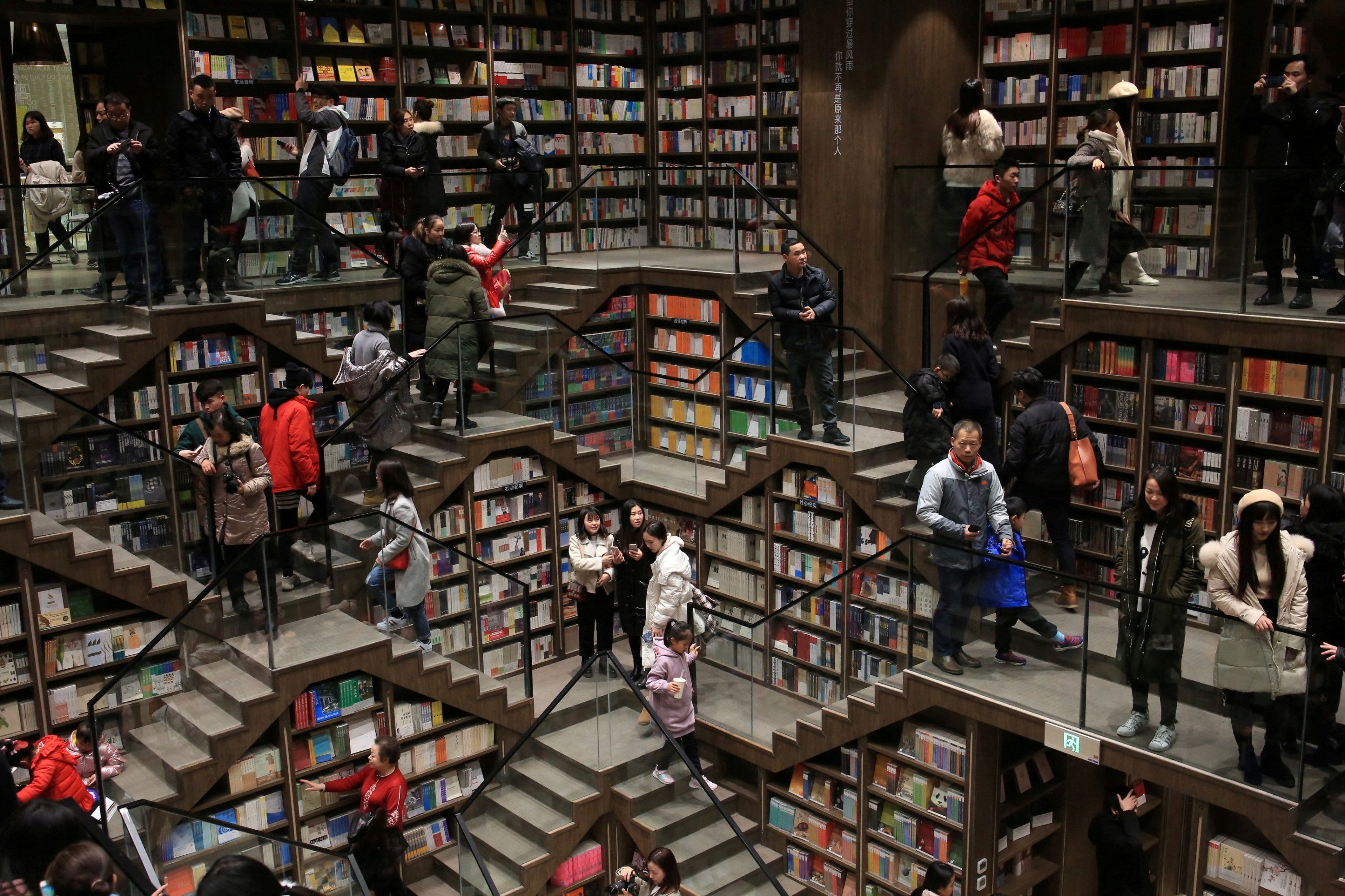
Li follows similar routines when her parents visit.
“I never would have believed the library would be completely full on a weekday,” said Zhang, 36, a visual effects producer who lost her job in AI-driven redundancies in August. She gave only her surname.
In other posts, users wonder if the people around them are in a similar predicament, or – echoing Li – explain why they hide and how it makes them feel.
Some posts are daily journals. In one titled “Day 30 of unemployment: a month pretending to work,” a user recounts 80 failed job applications.
Susan Sun, 28, has concealed her layoff from an internet company since late last year. The balancing act became more complicated in May when her mother and stepfather moved in with her in the megacity of Chongqing from their smaller hometown to look for work.
This forces her to leave home before 9 a.m. and return after 6 p.m.
Sun lives on 1,864 yuan ($278) per month in unemployment benefits and what remains of her severance package. She says she is happy living on little and not working. Her only pressure comes from her parents.
“They pass their anxiety on to me, through subtle, insistent expressions and tone of voice,” she said, especially when they advise her to save money because “the economy is bad.”
Yige Dong, an assistant professor of sociology at the University at Buffalo, says China’s relatively thin social safety net, compared with those in Japan and South Korea during the 1990s, could eventually make it harder for the unemployed to keep up the pretence.
At some point, “individuals would probably be more concerned with pooling resources from all available sources, including borrowing from family members and relatives,” Dong said.
The U.S. government on Monday instructed its civilian agencies to remove DeepSeek products and third-party services using the Chinese AI model from their IT systems, drawing opposition from Beijing, which said Washington “overstretched” the concept of national security.
China and the United States are locked in a race for dominance in the fast-moving artificial intelligence sector, trading accusations of stealing AI technologies and jeopardizing security in recent months.
The U.S. Department of Homeland Security on Monday banned products developed by DeepSeek – and tools created using DeepSeek by third parties – saying they risked sharing sensitive data with China.
Beijing’s Foreign Ministry opposed the ban on Tuesday, vowing to resolutely safeguard the legitimate rights and interests of Chinese businesses.
“China has consistently opposed the overstretching of the concept of national security and the politicisation of issues related to science, technology, and trade,” ministry spokesperson Mao Ning told a news conference.
The Department of Homeland Security can issue directions to civilian agencies, but not the military or intelligence services.
Its statement on Monday said that “DeepSeek’s models present multiple threat vectors” and must be removed from IT devices.
Use of DeepSeek AI tools “may result in the transfer of sensitive data to (China) if used by U.S. government employees or vendors,” the department warned.
Its servers are located in China, where the legal system permits the government “extensive authority” to access private company infrastructure, it claimed.
DeepSeek, one of China’s top AI labs, shook up the industry in January 2025 with a low-cost, high-performance chatbot, challenging assumptions of U.S. dominance.
The firm released a long-awaited new model, V4, in April and this month updated a faster, more lightweight version of V4.
The United States has accused DeepSeek and other top Chinese AI firms of systematically stealing the capabilities of cutting-edge models developed by American rivals.
Despite their fierce competition in the field, China and the United States in September agreed to set up a “communication channel” for AI incidents.
The topic is expected to arise again when the countries’ leaders meet next month at a summit in the Chinese city of Shenzhen.
Indonesian stocks climbed on Tuesday, recuperating slightly as authorities in Jakarta introduced measures, including to restrict selling after a record two-day $82 billion rout sparked by index provider MSCI’s warning of possible removal from its global indexes.
Jakarta’s benchmark index rose 4% on Tuesday, after hitting a six-year low in the previous session as the world’s worst-performing stock market this year dropped 14.8% over Friday and Monday. Still, the index is down about 40% this year.
MSCI on Friday said it was considering shifting Indonesia to “standalone” instead of “emerging markets” status, a more-severe-than-expected downgrade that shocked investors and officials and fueled fears of a sell-off by passive funds that track global indexes.
The index provider’s latest warning stemmed from concerns that Indonesia had yet to improve ownership transparency or clamp down on coordinated trading and was much worse than the January threat of a downgrade to “frontier” market status.
Relegation to “standalone” would be a devastating blow to Indonesia as Southeast Asia’s biggest economy grapples with eroding investor confidence over its fiscal health and central bank independence under President Prabowo Subianto.
After an online meeting with MSCI on Monday, the Indonesia Stock Exchange said it would exclude from its benchmark index any stocks with a high concentration of ownership by any person or entity.
“We are doing what is best for our market,” IDX President Director Jeffrey Hendrik said, adding the exclusion would provide a more accurate picture of the index’s movements. He said the affected stocks account for roughly 18% of the total index weight.
Gary Tan, portfolio manager at Allspring Global Investments, said excluding tightly held stocks should help address some investability concerns, but implementation would be key, given the potential for domestic pushback.
“From here, we think the bigger incremental risk to flows is likely to come from active rather than passive funds,” he said.
Jakarta aims to calm nerves with market measures
To slow the heavy selling on the market, the stock exchange this week halved the daily down limit on stock prices to 7% from 15%, while setting a 1 rupiah down limit on shares priced at 14 rupiah or less.
Also on Monday, Prabowo held talks with finance chiefs, including the head of the Financial Services Authority (OJK), the finance minister and the Bank Indonesia (BI) governor.
After the meeting, OJK chief Friderica Widyasari Dewi said the regulator would continue to advance Indonesia’s capital market reforms, particularly regarding transparency, liquidity, and law enforcement against various forms of violations.
“A particularly important special message is how we must continuously enforce regulations against those who have committed violations related to coordinated trading and other similar practices,” Friderica said.
Market watchers said the stock exchange had taken a constructive step in eliminating stocks with highly concentrated ownership from the benchmark index, but that would not automatically eliminate investors’ exposure to those companies either directly or through products such as mutual funds.
“We must ensure that even if a stock is delisted from the Jakarta Composite Index, concentration risk does not continue to accumulate within products purchased by the public,” said Liza Camelia Suryanata, head of research at stockbroker Kiwoom Sekuritas Indonesia.
Eyes on central bank
MSCI’s warning has weighed on the rupiah, which strengthened slightly to 18,000 per U.S. dollar on Tuesday but remained close to the record low of 18,190 hit in June ahead of a policy decision from Indonesia’s central bank.
BI is expected to hold rates steady on Wednesday, although some economists have raised the prospect of a rate hike to defend the currency, which is down 7% this year, making it the worst-performing currency in the region.
George Xu, a director in Fitch Ratings’ sovereigns team, said the latest concerns and substantial market sell-off reinforced the risks the rating agency identified when it revised the outlook on Indonesia to negative in March.
“From sovereign rating perspective, we do not anticipate the consultation announcement itself to have material immediate credit implications,” he said, but added that external pressure could raise the government’s borrowing costs and erode external buffers.
Saudi Arabia has decided to move the hosting of its flagship investment conference to next year, organizers confirmed on Monday, following recent deadly attacks by Houthis on the kingdom, as the Middle East conflict widens, posing fresh challenges for businesses in the region.
The Future Investment Initiative (FII) was planned for Oct. 26 to 29, but will now take place in 2027, with a new date to be announced “very soon,” the organizers said.
Reuters reported earlier Monday that the in-person event had been scrapped and organizers were weighing postponing the event.
The conference, set for its 10th edition, has become a must-attend event for some of the world’s top financiers.
Informally dubbed “Davos in the Desert,” in a nod to the World Economic Forum’s (WEF) annual meeting in Switzerland, the state-backed annual event has showcased the kingdom’s ambitious investment plans in a bid to attract billions of dollars needed to fund its economic transformation away from hydrocarbons towards tourism, sports and technology.
Expected speakers for this year’s event included Goldman Sachs CEO and Chairman David Solomon, Standard Chartered CEO Bill Winters and Citi’s CEO Jane Fraser, according to a draft program.
The U.S.-Israeli war with Iran this year has disrupted the Gulf’s busy calendar of events, with several conferences canceled, postponed, or retooled in the UAE and Qatar in the first part of the year, when the countries bore the brunt of the attacks while Saudi Arabia suffered fewer hits.
The kingdom in recent weeks has faced an escalating war with Yemen’s Iran-aligned Houthis, which have struck military, energy and civilian infrastructure across the country, including the state oil company Aramco’s headquarters and Riyadh’s international airport, where strikes killed at least 18 people and hundreds were wounded this month.
FII said it wanted to ensure the event delivered “the full scale, extraordinary quality, and unforgettable impact that our community has come to expect.”
Reuters reported last week that the FII organizers considered a hybrid format, allowing executives to tune in remotely.
Semafor reported on Monday that big banks and private-equity firms have privately relayed safety concerns about attending the event to Saudi Arabia’s Public Investment Fund (PIF) Governor Yasir Al-Rumayyan, adding that CEOs feel pressure to attend the four-day event.


-
 Politics2 days ago
Turkish Embassy rejects reports of FM Fidan’s ‘secret talks’ in Baku
-
 Economy2 days ago
US consumers withstand rising prices, but for how long?
-
 Economy2 days ago
Türkiye foresees spending over $20B on transportation next year
-

 Politics3 days ago
Sudan values Türkiye’s support as Ankara pledges continued backing
-

 Politics3 days ago
FM Fidan holds talks with OIC counterparts in Iraq
-
 Politics2 days ago
Turkish FM heads to Baghdad for OIC talks on Gaza, regional tensions
-

 Sports1 day ago
Fenerbahçe seek Champions League reset against Slavia Prague
-
 Politics2 days ago
Erdoğan touts Osman Gazi as Türkiye aims to double gas flow by 2027