
Economy
Ukraine accuses Hungary of detaining bank workers, seizing cash

Ukrainian Foreign Minister Andrii Sybiha accused Hungarian authorities early on Friday of taking seven Ukrainian employees of a state-owned bank hostage and illegally seizing a cash shipment that was traveling in a convoy across Hungary.
Sybiha was writing on the social media platform X after Hungarian Prime Minister Viktor Orban said Budapest would force Ukraine with “political and financial tools” to reopen the Druzhba pipeline carrying Russian oil to Hungary and Slovakia. They are the only EU countries still importing Russian oil due to EU sanctions.
Whereabouts and the well-being of the seven Ukrainians, employees of the state-owned savings bank Oschadbank traveling in two armored cars between Austria and Ukraine, were unknown, the minister said.
Ukraine demanded the immediate release of its citizens, with Sybiha adding that Kyiv was preparing more actions, including at the European Union’s level.
“Ukrainian consuls have still not been permitted access to seven Ukrainian citizens taken hostage in Budapest. The Hungarian side has not provided any explanation,” he said.
The armored cars were carrying cash as part of regular services between state banks, according to Ukraine.
In a separate statement, Oschadbank wrote that $40 million in American currency, as well as 35 million euros and 9 kilograms (19.8 pounds) of gold, had been apprehended by Hungary.
GPS data showed the vehicles were in the center of Budapest near one of Hungary’s law enforcement agencies, but the location of the bank employees remained unknown, the bank wrote.
Separately, Hungary’s tax authority on Friday confirmed detentions and said it is pursuing criminal proceedings on suspicion of money laundering. It also said one of the detainees was a former general of the Ukrainian intelligence services.
Tensions further inflamed
The incident further inflamed tensions between Hungary and Ukraine, which are embroiled in a bitter feud over Hungary’s access to Russian oil through a pipeline that crosses Ukrainian territory.
Oil shipments through the Druzhba pipeline have been interrupted since Jan. 27. Ukraine says a Russian drone strike damaged the pipeline’s infrastructure, and that repairing it carries risks to technicians and that even if restored, it would remain vulnerable to further Russian attacks.
Hungary’s government, however, has accused Ukraine of deliberately holding up supplies of Russian crude, and has vowed to take countermeasures against Kyiv until oil flows resume.
Hungary, along with neighboring Slovakia, has defied European Union efforts to wean off Russian fossil fuels and continued to purchase them despite Moscow’s invasion of Ukraine.
Without mentioning them directly, Prime Minister Orban alluded to the detention of the bank vehicles in statements to state radio Friday, saying: “We will stop things that are important to Ukraine passing through Hungary until we get the approval of the Ukrainians for oil shipments.”
Orban, who has maintained close relations with the Kremlin while escalating an aggressive anti-Ukraine campaign ahead of crucial elections next month, previously ceased diesel shipments to Ukraine, vetoed a new round of EU sanctions against Russia and blocked a major, 90-billion-euro ($106-billion) loan for Kyiv in retaliation for the interruption in oil shipments.
He’s also deployed military forces to key energy infrastructure sites across Hungary, accusing Ukraine of plotting disruptions.
On Thursday, Orban told an economic forum that Hungary would use “force,” including “political and financial tools,” to compel Ukraine to resume oil shipments.
On his post on X, the Ukrainian foreign minister took issue with Orban’s comments, writing: “We are talking about Hungary taking hostages and stealing money.”
“If this is the ‘force’ announced earlier today by Mr. Orban, then this is a force of a criminal gang,” Sybiha wrote. “This is state terrorism and racketeering.”
Sybiha added that Ukraine would take the matter up with the EU to clarify Hungary’s actions.

The chief of the European Bank for Reconstruction and Development (EBRD) said on Thursday that Türkiye must “stay on course” in its inflation fight, and she applauded measures taken by the central bank this week to tackle market fallout from the war in the Middle East.
Odile Renaud-Basso, the EBRD’s president, said the bank’s investment in Türkiye will remain “very high” this year, and that it was looking into potentially funding a big-ticket high-voltage electricity transmission system that Ankara plans over the coming decade.
“The central bank has already taken some measures very quickly,” Renaud-Basso said. “There is still some way to go and what is important is to stay on course and really finish this work,” she told an interview with Reuters at the EBRD’s offices in Istanbul.
Reassuring meetings with officials
Renaud-Basso was speaking at the end of a four-day visit that included meetings with Treasury and Finance Minister Mehmet Şimşek and Vice President Cevdet Yılmaz.
“Everything I heard reassured me (that) this progress is steady,” she said of inflation-fighting measures.
The Central Bank of the Republic of Türkiye (CBRT) has slashed interest rates by 900 basis points since mid-2025 to 37% as annual inflation slowed from over 40% at the beginning of last year to just over 30% in January.
But a rise to 31.5% last month signaled a slowdown in disinflation, and an escalating U.S.-Israeli war with Iran threatens to drive prices higher.
In response, the central bank already took a series of steps this week, including some $8 billion in foreign currency sales on Monday, pushing the market overnight rate to about 40%.
Asked about Ankara’s plans to invest some $30 billion in a high-voltage electricity transmission system over the next decade, Renaud-Basso said the EBRD is “looking into that.”
“It’s part of the discussion we have with the government,” she said.
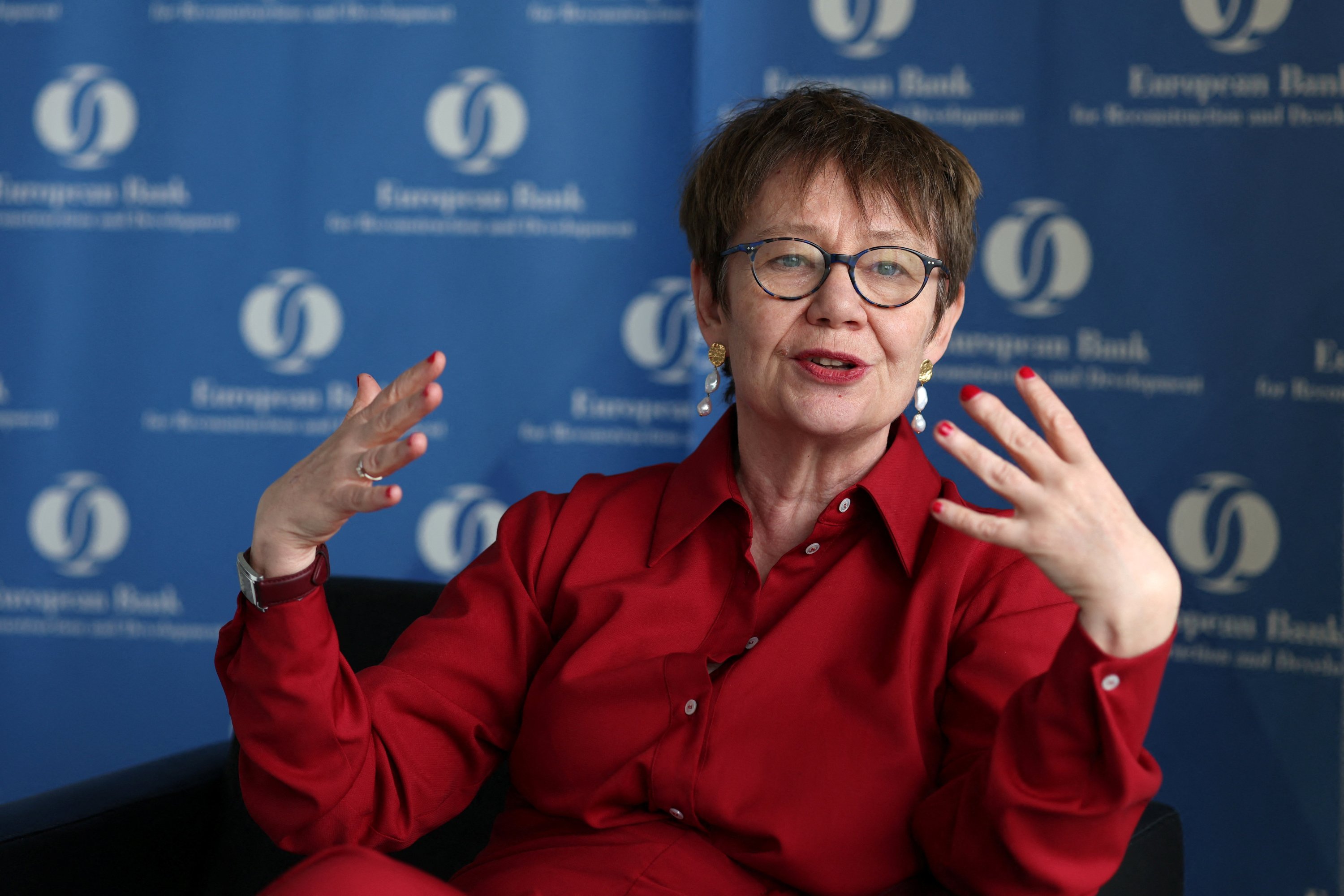
The EBRD committed last year a record 2.7 billion euros ($3.13 billion) to 54 projects in Türkiye, which is the number-one recipient of EBRD’s funds. This year’s funding could also include energy and renewables projects.
Türkiye aims to quadruple renewable energy generation capacity by the end of 2035 and build new nuclear power plants. The planned network would transfer electricity to consumption centers and also send surplus electricity to its European neighbors.
Türkiye has said it is in talks with the World Bank to secure up to $6 billion of funding for upgrading electricity transmission infrastructure.
Iran conflict risk to economic growth
Renaud-Basso said the widening U.S.-Israel war on Iran is a risk to economic growth, but noted that the fallout depends on how long the conflict lasts.
She said the conflict “can reduce risk capital” for the region – but that apart from Lebanon, the fallout thus far was contained.
“For the time being, it’s limited,” she said, adding that “the risk is on the downside.”
Last week, the EBRD pegged growth for the 41 countries it covers at 3.6% for this year and 3.7% in 2027, boosted by spending on big infrastructure projects in Europe, but offset by U.S. tariffs and trade uncertainty.
The war has effectively closed the Strait of Hormuz, a key shipping artery, sending crude prices up some 12% – and sounding an alarm for many of the energy-importing countries in which the EBRD works.
Renaud-Basso said that the length of the closure of the Strait of Hormuz and the duration of oil and gas price spikes were key, but that high global gas stocks could help cushion the blow.
The exception, however, is Lebanon, which she said is “very much at the core” of current turbulence.
“There we can expect quite a significant impact on the economic situation and broadly,” she said.
In Ukraine, Renaud-Basso said international funding for the year is unlikely to change despite the new conflict.
But more broadly, she said an extended spike in global energy prices could also drive inflation higher – making it tricky for central banks to cut interest rates.
“This is a new challenge in terms of monetary policy. I think that we need to be careful,” Renaud-Basso said.
A surge of cash leaving risk assets has unsettled emerging markets since war engulfed the Middle East, but some investors are wagering that solid fundamentals and geopolitical fragmentation will allow the year-long rally to resume.
The United States and Israel’s bombardment of Iran pressed emerging market currencies and stocks toward their biggest weekly losses in three years, while bonds also tumbled sharply.
JPMorgan reduced its overweight stance on emerging market foreign exchange and local currency bonds to marketweight, citing uncertainty. Citi also halved its emerging market foreign exchange exposure.
But veteran investors say emerging economies, barring further big shocks or prolonged high energy prices, can rebound, with green shoots already pushing through.
“I don’t think yet that we’ve seen … let’s call it real money, or crossover money, saying ‘I’m out,'” said Cathy Hepworth, head of PGIM fixed income’s emerging market debt team. “There are people on the sidelines who were waiting for a market correction to get in or to increase the degree to which they are involved.”
The end, or a pause?
From stocks to bonds to currencies, emerging markets had outshone all expectations until this week.
Flows into the asset classes had ballooned since U.S. President Donald Trump started his second term in office in January 2025. Emerging nations – led by Saudi Arabia, Mexico, Türkiye and Poland – issued a record amount of debt in January, equities soared and yield-hungry investors ploughed cash into local currency debt across frontier markets.
However, investors had already warned that some of the “hot” money from hedge funds and other non-specialist investors could leave quickly if the market turned. The U.S.-Israeli bombing campaign in Iran caused just this to happen, with investors fleeing to safer assets. The dollar rose, along with gold, and investors piled into cash as they sought a port in the storm.
“We’ve seen a big shock to markets…there is more to go, should oil prices rise further,” said James Lord, global head of FX and EM strategy at Morgan Stanley.
Data showed MSCI’s emerging market equities index lost more than a trillion dollars in market capitalisation from its peak last Thursday to Wednesday’s close.
One of the most notable drops was for Korea’s KOSPI equity index, which shed nearly 20% over the course of Tuesday and Wednesday in its biggest-ever crash. The index, heavily influenced by the rush to AI and chips, had been the top performer in emerging equities.
“That’s clearly panic selling in some sense,” said Jonas Goltermann, deputy chief markets economist with Capital Economics, adding that it was a sign of the “market machine” overriding underlying fundamentals. On Thursday, the KOSPI clawed its way back, gaining nearly 10% and it is still up more than 30% this year.
Strong fundamentals – and shield from the turmoil
Investors said that the years spent by many emerging and frontier markets to shore up their finances and bolster confidence in their central banks could also aid their appeal during a prolonged crisis.
Many central banks, Morgan Stanley’s Lord said, had taken “a very cautious and credible approach to the easing cycles,” getting inflation in check and underpinning currencies against the dollar.
Egypt and Nigeria, countries where it was once difficult to repatriate cash, reformed investor access. The outflows in recent days, some say, prove they are a reliable destination for the money.
“Frontiers that received a large amount of inflows are now demonstrating their ability to absorb the demand for foreign exchange and also demonstrating the FX flexibility, which we think is helpful in this context, to manage exogenous shocks of this nature,” said Yvette Babb, portfolio manager with William Blair.
“We think the fundamentals within EM are clearly strong to withstand an exogenous shock, as long as the story does not derail the global growth narrative.”
Oil threat
Oil prices are the biggest threat. A prolonged period above $100 per barrel could send global inflation soaring, dent growth and keep some emerging market central banks from continuing to cut rates.
However, Elias A. Elias, a portfolio manager with Templeton Global Investments, said Latin American commodity exporters could benefit from the higher prices, while cheaper valuations for emerging market equities more broadly bolstered their appeal despite the current turmoil.
“We’re very constructive on the EM equities as an asset class,” he said, adding emerging stocks remained at a roughly 28% discount to developed markets, with higher earnings growth expectations.
South-South support
The changing nature of risk and global money flows could also shield emerging markets from a broader rush for the exit. Trump’s return to the White House and his shifting tariffs, sanctions and combative foreign policy has changed how some investors calculate risk.
Additionally, increasing “South-South” investment, where cash flows from pools such as Asia’s growing wealth or deep-pocketed Gulf sovereign wealth funds, has provided a buffer for some economies, most notably the likes of Egypt.
Such investors are less likely to abandon emerging markets.
“Today, funds and excess capital in Asia (are) being produced, and they’re investing in other markets,” said Dhiraj Bajaj, Head of Asia Credit at Lombard Odier. “The dynamic is changing.”
About two dozen U.S. states filed a lawsuit Thursday challenging new global tariffs introduced by President Donald Trump after he suffered a major defeat at the Supreme Court.
The Democratic attorneys general and governors in the lawsuit argue that Trump is overstepping his power with planned 15% tariffs on much of the world.
Trump has said the tariffs are essential to reduce America’s longstanding trade deficits. He imposed duties under Section 122 of the Trade Act of 1974 after the Supreme Court struck down tariffs he imposed last year under an emergency powers law.
Section 122, which has never been invoked, allows the president to impose tariffs of up to 15%. They are limited to five months unless extended by Congress.
The lawsuit is led by attorneys general from Oregon, Arizona, California and New York.
“The focus right now should be on paying people back, not doubling down on illegal tariffs,” said Oregon Attorney General Dan Rayfield. The suit comes a day after a judge ruled t hat companies who paid tariffs under Trump’s old framework should get refunds.
The White House said Trump is acting within his power. “The President is using his authority granted by Congress to address fundamental international payments problems and to deal with our country’s large and serious balance-of-payments deficits,” said spokesman Kush Desai. “The Administration will vigorously defend the President’s action in court.”
The new suit argues that Trump can’t pivot to Section 122 because it was intended to be used only in specific, limited circumstances – not for sweeping import taxes. It also contends the tariffs will drive up costs for states, businesses and consumers.
Arizona Attorney General Kris Mayes pointed to a New York Federal Reserve Bank study that found Americans largely bear the cost of the tariffs, which has been estimated at $1,200 a year per household. “That is money out of the pockets of American families trying to buy groceries, pay rent and keep their small businesses afloat,” Mayes said.
Many of the plaintiff states also successfully sued over Trump’s tariffs imposed under a different law: the International Emergency Economic Powers Act (IEEPA).
Four days after the Supreme Court struck down his sweeping IEEPA tariffs Feb. 20, Trump invoked Section 122 to slap 10% tariffs on foreign goods. Treasury Secretary Scott Bessant told CNBC on Wednesday that the administration would raise the levies to the 15% limit this week.
The Democratic states and other critics say the president can’t use Section 122 as a replacement for the defunct tariffs to combat the trade deficit.
The Section 122 provision is aimed at what it calls “fundamental international payments problems.” At issue is whether that wording covers trade deficits, the gap between what the U.S. sells other countries and what it buys from them.
Section 122 arose from the financial crises that emerged in the 1960s and 1970s when the U.S. dollar was tied to gold. Other countries were dumping dollars in exchange for gold at a set rate, risking a collapse of the U.S. currency and chaos in financial markets. But the dollar is no longer linked to gold, so critics say Section 122 is obsolete.
Awkwardly for Trump, his own Justice Department argued in a court filing last year that the president needed to invoke the emergency powers act because Section 122 did “not have any obvious application” in fighting trade deficits, which it called “conceptually distinct” from balance-of-payment issues.
Still, some legal analysts say the Trump administration has a stronger case this time.
“The legal reality is that courts will likely provide President Trump substantially more deference regarding Section 122 than they did to his previous tariffs under IEEPA,” Peter Harrell, visiting scholar at Georgetown University’s Institute of International Economic Law, wrote in a commentary Wednesday.
The specialized Court of International Trade in New York, which will hear the states’ lawsuit, wrote last year in its own decision striking down the emergency-powers tariffs that Trump didn’t need them because Section 122 was available to combat trade deficits.
Trump does have other legal authorities he can use to impose tariffs, and some have already survived court tests. Duties that Trump imposed on Chinese imports during his first term under Section 301 of the same 1974 trade act are still in place.
Also joining the lawsuit are the attorneys general of Colorado, Connecticut, Delaware, Illinois, Maine, Maryland, Massachusetts, Michigan, Minnesota, Nevada, New Jersey, New Mexico, North Carolina, Rhode Island, Vermont, Virginia, Washington, Wisconsin, and the governors of Kentucky and Pennsylvania.
Investment banking giant Morgan Stanley is set to eliminate roughly 2,500 positions as workforce reductions persist throughout the financial sector this year.
The layoffs accout for roughly 3% of the workforce of the investment bank, news agencies The Associated Press and Reuters reported.
The job cuts were across the bank’s three major divisions, investment banking and trading, wealth management and investment management, but do not affect its financial advisors, the reports said.
Morgan Stanley reported a banner year in 2025, with annual revenue hitting a record at the investment banking giant.
It also beat Wall Street estimates for fourth-quarter profit in January, fueled by a 47% jump in investment banking revenue as dealmaking surged and debt underwriting fees nearly doubled.
Banking executives had struck an optimistic tone for 2026 on the back of healthy pipelines for mergers and acquisitions as well as initial public offerings.
Meanwhile, volatile markets amid worries of AI disruption to legacy technology businesses and geopolitical turmoil continue to boost trading desks as clients reposition portfolios to hedge against risks.
The cuts are based on strategy and individual performance, and the bank intends to add headcount in other areas, Reuters said.
Like other firms, Morgan Stanley aggressively hired during the pandemic, going from 60,000 employees in 2019 to 82,000 employees by year end 2022. The company had 83,000 employees at the end of 2025.
Tens of thousands of job cuts have already been made just two months into the new year, many of them white-collar. The financial sector has not been immune.
Citigroup and Blackrock have reportedly trimmed back their headcounts, and last week, financial technology company Block, which owns Cash App and the point-of-sale company Square, announced it would lay off 40% of its workforce.
While Block founder Jack Dorsey cited productivity gains in AI as the reason for the layoffs, industry observers noted that Block effectively tripled its workforce from 2019 to 2025, from 3,800 workers to 12,000.
The Wall Street Journal first reported the layoffs at Morgan Stanley on Thursday.
Türkiye welcomed the announcement of the European Union’s long-awaited industry policy aimed at strengthening its capabilities across strategic sectors, which would allow Ankara’s inclusion due to its customs union agreement, describing it as “a positive and constructive decision.”
Trade Minister Ömer Bolat said on Wednesday that the legal confirmation of Türkiye’s inclusion in the “Made in EU” policy marks “a significant step for trade relations.”
The European Commission unveiled earlier in the day a legislative proposal to strengthen Europe’s industrial base by introducing “Made in EU” and low-carbon requirements for strategic sectors.
The measure, also known as the Industrial Accelerator Act (IAA), targets industries, including steel, cement, aluminum, automobiles and net-zero technologies, while allowing for future expansion to energy-intensive sectors such as chemicals.
The new rules aim to bolster the bloc’s industries against fierce competition from China, in a push held up for months by wrangling over the scope and details of measures some see as protectionist.
Concerning strategic sectors including cars, green tech and steel, the proposal is a key part of a European Union drive to regain its competitive edge, reduce its dependencies and stave off job losses.
The draft regulation states that countries with an agreement creating a free-trade area or customs union with the EU would be considered local. That implies countries in the European Economic Area (EEA), such as Norway and Iceland, and also Türkiye, which has a customs union with the EU.
“It is a change in doctrine – one that was unthinkable just a few months ago,” EU industry chief Stephane Sejourne told a news conference.
Broadly, the rules aim to ensure that public and foreign investments support manufacturing inside the 27-nation bloc, explained an EU official. To that end, they say companies that want public money must meet minimum thresholds for EU-made parts and subject large investments from dominant foreign firms to conditions, including employing EU workers.
The European Commission said the package aims to bring manufacturing’s share of the EU’s gross domestic product (GDP) to 20% by 2035, up from about 14% in 2024.
Initially expected last year, the measures strongly backed by France were pushed back several times due to disagreements, with some arguing they run counter to the EU’s pro-free-trade spirit.
Much of the discord revolved around the geographical scope of “Made in Europe.”
Sceptics, including the EU’s largest economy, Germany, argued trade partners should be included in the definition under a “Made with Europe” approach.
Brussels settled for a compromise based on the principle of reciprocity.
Countries that have deals with the EU allowing for European companies to access public money on a par with local firms in the sectors concerned would be brought into the fold.
‘Important step’ for trade relations
Bolat said on social media that recognizing the existing customs union within the framework of the new industrial policy is a constructive decision for the continuity of investments and the competitiveness of European value chains.
“We are pleased that the intensive and constructive diplomatic engagements we have conducted in recent times with the European Union, based on mutual understanding in economic and trade matters, have yielded positive results,” he said in a post on X.
“As a result of the consultations conducted with the EU, the legal basis enabling the ‘EU origin’ requirement in the most recently published draft to encompass our country in principle within the framework of the customs union has been confirmed with the Industrial Acceleration Act, constituting an important step for our trade relations.”
Türkiye has a customs union with the EU dating back to the 1990s, and the two are major trading partners, with bilateral trade volume at over $200 billion yearly.
Of particular concern was the inclusion of Türkiye in the initiative due to its strong automotive base, where the country, in recent years, surpassed $40 billion in exports – large chunk of which is directed to European markets, such as Germany, France, Italy, Romania, and others.
Bolat expressed satisfaction with the positive results of the intensive and constructive diplomacy conducted with the EU on economic and commercial issues.
The minister emphasized that Türkiye is an inseparable and reliable part of European value chains in many critical sectors, particularly the automotive industry.
“This development is expected to further deepen sectoral integration between Türkiye and the EU, while accelerating the green and digital transformation of our value chains,” he added.
“The goal is to further strengthen Türkiye’s position within the European industrial ecosystem and to advance economic integration with the EU, including the modernization of the customs union. We would like to thank everyone involved, especially our trade minister, Mr. Ömer Bolat, for their great efforts in this process,” said Rifat Hisarcıklıoğlu, the president of the Union of Chambers and Commodity Exchanges of Türkiye (TOBB).
Strategic sectors push
The “Made in Europe” requirements, which also seek to boost industrial decarbonisation, would apply to “strategic sectors,” namely: steel, cement, aluminium, cars, and net-zero technologies.
Governments putting money behind infrastructure projects will have to ensure they include a minimum share of European low-carbon steel, cement and aluminium, among other provisions.
Electric-vehicle (EV) manufacturers will have to make sure at least 70% of their cars’ components are made in the EU to access public money.
Similar rules will apply to batteries, solar, wind, and nuclear.
The proposal, formally known as the “Industrial Accelerator Act,” also aims to ensure foreign companies partner with European firms to set up shop in the bloc.
To do so, it imposes conditions on foreign investments of over 100 million euros ($116 million) in “emerging strategic sectors” such as batteries and EVs.
Commercial shipping traffic through the Strait of Hormuz has dropped as much as 90% amid escalating conflicts in the Middle East, forcing global maritime trade to reroute around the Cape of Good Hope, located at the southern tip of the Cape Peninsula, about 50 kilometers (31 miles) south of Cape Town in South Africa.
After Tehran’s closure of the critical energy and oil waterway in response to joint U.S.-Israeli attacks on Iran, the U.K. Maritime Trade Operations (UKMTO) Center raised the security risk in the transport corridor to critical, prompting insurers to immediately cancel war coverage policies for vessels in the region.
Only four ships transited through the strait on March 3, marking a 90% drop versus the previous seven-day average, according to real-time tracking data from Windward.
The strait has historically handled an average of 138 vessels per day.
Oil tanker traffic also saw a similar 90% plunge compared to pre-attack levels, data from MarineTraffic showed.
Major firms suspend Gulf passages
Meanwhile, Cape of Good Hope transit saw 94 vessels on March 3, up 35% versus the route’s seven-day average.
Major shippers like Hapag-Lloyd, CMA CGM and Maersk suspended all Gulf transits and rerouted around the southern tip of Africa, which adds 10-20 days to delivery times and inflates transport costs.
Hapag- Lloyd told Anadolu Agency (AA) in a statement that the firm’s fleet has not transited through the Red Sea since December 2023, and the firm extended this decision in light of the current situation in the region and the related threats from Iranian-backed Yemeni Houthis.
French shipper CMA CGM announced it instructed all its ships in the Gulf and bound for the region to seek shelter, while passage through the Suez Canal has been suspended until further notice.
Maersk suspended voyages for vessels passing through the Suez Canal via the Bab el-Mandeb Strait, while rerouting all voyages from the Middle East and India to the Mediterranean and from the Middle East and India to the east coast of the U.S. around the Cape of Good Hope.
The Strait of Hormuz is a strategically vital waterway positioned at the mouth of the Persian Gulf. The transport corridor connects Middle Eastern oil and liquefied natural gas (LNG) production to global markets via the Arabian Sea and the Indian Ocean.
The waterway handles the transit of around 20 million barrels of oil and petroleum products per day while accounting for roughly one-third of all crude oil transported by sea.
China alone consumes 5.3 million barrels of crude oil transited through there, while India consumes 2 million barrels, Japan and South Korea 1.7 million barrels each, and other countries receive a combined 4.2 million barrels via the Strait of Hormuz, according to S&P Global data.
At the same time, Saudi Arabia is the largest exporter using the strait with 5.1 million barrels of crude oil shipped per day, followed by Iraq with 3.3 million barrels, the United Arab Emirates with 2.6 million, Iran with 1.7 million, Kuwait with 1 million, and other regional producers totaling 1 million barrels.
Meanwhile, the UAE and Saudi Arabia are the top exporters of 5 million barrels of refined petroleum products transiting the waterway daily, making up for 1.26 million and 1.04 million barrels per day, respectively.
Oil tankers began to divert to the Port of Yanbu on Saudi Arabia’s western coast, while loadings at the port surged to 2.44 million barrels per day so far in March, way above its six-month daily average of 650,000-940,000 barrels.
The Iraqi Oil Ministry halted production at the Rumania complex in Basra on Tuesday due to severe tanker constraints preventing vessels from entering the Gulf basin, pushing crude oil levels at domestic storage facilities to critical maximums.
Iraq’s Basra Port, which normally boasts a daily capacity of 3.5 million barrels, handled zero crude oil on Monday.
JPMorgan analysts say that major regional oil producers will be forced to shut down facilities if the disruption in the Strait of Hormuz persists for 21 days.
Tehran actively targeted regional oil and natural gas production plants by drone-striking Saudi Aramco facilities in the eastern Saudi city of Ras Tanura in retaliation for the U.S.-Israeli joint operation.
State-owned QatarEnergy reportedly halted production at its massive LNG facility in Ras Laffan after drone strikes on Monday, deepening global fears of a severe market tightening.
LNG competition between Asia, Europe may ramp up
Ross Wyeno, head of LNG short-term analysis at S&P Global, told AA that supply is insufficient to compensate for the massive imbalance caused by production halts in Qatar and the UAE.
Wyeno stated that the U.S. boasts the largest flexible LNG source in the world, so the freely loaded American LNG will go to Asia, where prices are the highest.
He said shipments from the U.S. will become more and more scarce if the situation does not improve, potentially impeding Europe’s efforts to fill its storage facilities and tighten the gas balance.
A recent development reflects this, as an LNG tanker originally bound for Europe reportedly changed course on Wednesday due to the price hike and was now headed for Asia on Thursday.


-
 Daily Agenda3 days ago
Minister Gürlek gave the good news: “We will bring lawyer responsibility in the land registry for transactions exceeding a certain amount.
-

 Politics3 days ago
Erdoğan urges diplomacy amid tensions in call with NATO’s Rutte
-
 Daily Agenda3 days ago
‘Iran’ warning from Minister Fidan: War is spreading throughout the region
-

 Daily Agenda3 days ago
War alert in the Middle East! Concern about internal conflict in Iran
-

 Economy2 days ago
Economic impact of Mideast war to depend on duration, damage: IMF
-
 Daily Agenda3 days ago
Devlet Bahçeli: The language of peace should prevail in our region
-
 Daily Agenda8 hours ago
President Erdoğan met with the Italian Prime Minister
-
 Daily Agenda14 hours ago
We must be alert to all kinds of difficulties