
Politics
MHP insists terror-free Türkiye committee will not undermine republic

Amid speculations that the separatist terrorist group PKK will obtain concessions in return for disarmament, Feti Yıldız, deputy chair of the Nationalist Movement Party (MHP), said a committee working on disarmament had “no mission” to undermine the principles of the republic and “united structure of the state.”
Yıldız represents his party at Parliament’s National Solidarity, Brotherhood and Democracy Committee, formed to advise on legislative steps for the terror-free Türkiye initiative. The initiative, first voiced by the MHP leader Devlet Bahçeli in 2024, seeks the dissolution of the PKK.
The PKK complied with the dissolution call by its jailed ringleader, Abdullah Öcalan, last February and started burning weapons in northern Iraq, where it has strongholds. Öcalan himself has consented to Bahçeli’s invitation to make the call as the MHP sought to “strengthen Turkish-Kurdish unity,” in Bahçeli’s words. The PKK exploited disillusioned members of the Kurdish community for decades, under the pretext of fighting for a self-styled “Kurdistan.” Critics of terror-free Türkiye claim that the PKK’s unilateral moves so far must have something to do with concessions by the Turkish state, namely, a secret deal for compromise in the PKK’s separatist demands. The MHP and other proponents of the initiative reject these claims.
In a statement on social media on Monday, Yıldız said that the parliamentary committee had no mandate, nor mission, to transform the unitary structure of the state of Türkiye. “It does not have the authority to change the foundation philosophy of the Republic of Türkiye, basic constitutional principles and democratic conduct. The Turkish state, territorial integrity, status of Turkish as the official language, and secular principles are common values that cannot be disputed,” Yıldız underlined.
He said that the parliamentary committee was working on a document that will “embrace the entire nation, outline causes and consequences of terrorism,” he said, referring to an upcoming report by the committee that will serve as a guideline for potential future bills on facilitating the PKK’s disarmament. Yıldız said they did not give concessions from the resolution on counterterrorism and did not deviate from the principle of supremacy of the law, adding that the document would also take national security concerns into consideration.
A joint report by the committee will be further discussed this week at Parliament. The report on the terror-free Türkiye initiative includes legislative proposals for the next steps for the disarmament.
Legislative steps are a tricky issue as authorities strive to clarify that it would not provide impunity to the PKK, which has killed tens of thousands of people in Türkiye since the 1980s. Nevertheless, the People’s Equality and Democracy Party (DEM Party), linked to the PKK, advocates that the terrorist group’s members should benefit from the initiative in exchange for laying down arms.
The so-called return home laws are expected to be included in the final version of the report, covering sentencing or non-prosecution for members of the PKK involved or not involved in acts of terrorism if they return to Türkiye. The PKK is currently based in northern Iraq, while its wings are active in Syria and Iran as well. A report by the Sabah newspaper says the return of PKK members to Türkiye would be subject to intense scrutiny, and even those without a criminal record would be subject to legal proceedings once they return to Türkiye. Those not involved in crimes while working for the PKK will be released with judicial control after they testify, the newspaper reported.
Meanwhile, a delegation from the DEM Party was scheduled to pay another visit to Öcalan at the island prison where he is incarcerated on Monday. The visit comes after the delegation was received by President Recep Tayyip Erdoğan earlier this month and about two months after it met Öcalan. The delegation serves as a messenger between Öcalan and Parliament and relevant state institutions, also relaying public messages to the PKK.

A civil-society organization representing Turks in Western Thrace on Wednesday criticized remarks by Greek Deputy Education Minister Nikos Papaioannou linking the use of Turkish in minority education to what he described as efforts to bring the minority under a single identity.
The Federation of Western Thrace Turks in Europe (ABTTF) said in a statement that Turkish is the mother tongue of the Turkish minority in Western Thrace and an integral part of the community’s identity and educational autonomy.
The federation said Greece recognizes the special status of the minority education system in Western Thrace as stemming from the 1923 Treaty of Lausanne, while arguing that government policies have gradually weakened its autonomy in education.
The ABTTF also said minority schools have had their operations suspended one by one on the grounds of declining student numbers and that Turkish families face difficulties when seeking to enroll their children in minority schools.
The group rejected what it described as attempts to portray the Turkish language as a means of eliminating differences within the minority and bringing its members under a single identity.
It called on Greece to fulfill its obligations under the Treaty of Lausanne and to restore the autonomous structure of the minority education system.
The statement came in response to remarks by Papaioannou in the Greek parliament.
Responding to a parliamentary question from NIKI party lawmaker Yorgos Rountas, Papaioannou said the minority education system in Western Thrace was based on the Treaty of Lausanne.
He argued, however, that the prominent role of Turkish in minority education served to bring the minority under a single identity.
Papaioannou also rejected characterizations that minority schools were being “closed,” arguing that the”suspension of their operations” was the result of declining student numbers.
Ali Ihsan Yavuz, deputy chair of the ruling Justice and Development Party (AK Party), told journalists on Tuesday that they had concluded their work on a new constitution “to a point” and would soon present it to the party’s chair, President Recep Tayyip Erdoğan. Replacing the oft-patched, outdated and undemocratic Constitution, originally drafted upon the orders of the military junta that seized power in 1980, has been an ambition of Erdoğan.
Yavuz, a member of a committee formed by the party at Erdoğan’s instruction to work on a new constitution, said their ambition remained intact. “Sooner or later, we will accomplish drafting a new, civilian, democratic constitution,” Yavuz said at an event in the central province of Eskişehir on Tuesday. He said they were working to arrange a meeting with Erdoğan amid his tight schedule. “When the opportunity arises, the constitution will be shaped and implemented,” he said.
Since the founding of the Republic of Türkiye, constitutional design has served as the backbone of the country’s legal system. The current Constitution, adopted in 1982, has been repeatedly amended over the decades, most notably in 2017, when a national referendum paved the way for the country’s transition from a parliamentary model to an executive presidential system.
Despite numerous amendments over the decades, replacing the 1982 Constitution with a new, civilian-drafted charter remains a prominent issue in Türkiye’s political debate.
Erdoğan and Parliament Speaker Numan Kurtulmuş have repeatedly advocated for a new civilian constitution, arguing that the existing charter retains the legacy of the military rule under which it was drafted despite extensive subsequent amendments.
Kurtulmuş said in August 2026 that Türkiye’s political climate and level of dialogue had matured sufficiently for work toward a new civilian constitution, describing such a charter as a longstanding objective.
President Recep Tayyip Erdoğan used his address to the United Nations General Assembly on Tuesday to press the international community for stronger action over Israel’s genocidal conduct in Gaza, renewed recognition of Palestinian statehood and reform of the U.N. Security Council, while laying out Türkiye’s positions on conflicts and challenges stretching from Syria and Ukraine to climate change and artificial intelligence.
Erdoğan placed the Palestinian issue at the center of his speech as he addressed the 81st session of the General Assembly, saying Palestinian President Mahmoud Abbas was unable to attend the gathering for a second consecutive year and pledging that Türkiye would continue to raise the Palestinian people’s voice from the U.N. podium.
“This injustice against our Palestinian brothers and sisters deeply wounds our conscience,” Erdoğan said. “Just as last year, this year we will be the voice of a free and sovereign Palestinian state.”
He also called on countries that have yet to recognize Palestine to reconsider their position.
Describing the humanitarian situation in Gaza in stark terms, Erdoğan said the enclave had become not only “the world’s largest graveyard for children” but also the place with the highest rate of child amputees due to Israel’s genocidal attacks.
He said more than 74,000 Palestinians, most of them women and children, had been killed in Gaza over the past three years and that more than 70% of generators at hospitals in the enclave were out of service because of fuel shortages.
He said Israel killed more than 1,500 Palestinians even after a cease-fire was reached through the efforts of U.S. President Donald Trump and contributions from Türkiye and other countries.
“This is not a personal issue for Tayyip Erdoğan. It is a matter of humanity,” he said. “No one with humanity in their heart, with compassion and mercy, and with a sense of fairness and conscience can turn a blind eye to this tragedy.”
Erdoğan also described Gaza as “the most inhumane and shameful concentration camp of our time” and slammed Israel for pursuing a “genocidal mentality with an insatiable appetite for killing.”
Turning to the occupied West Bank and Jerusalem, Erdoğan said the West Bank was experiencing its worst period of Israeli illegal settler violence and criticized Israeli authorities for restricting Muslim and Christian access to holy sites in Jerusalem.
He also warned against attempts to dismantle UNRWA, the U.N. agency for Palestinian refugees.
Erdoğan urged countries gathered at the U.N. to increase pressure on Israel and reiterated Türkiye’s support for a two-state solution.
“I call on you to exert greater pressure on Israel. Attempts to suffocate Palestine will fail,” Erdoğan said.
“God willing, we will see the day when an independent and territorially contiguous Palestinian state, based on the 1967 borders and with East Jerusalem as its capital, becomes a reality.”
Erdoğan said the failure to halt conflicts extended well beyond Palestine, pointing to more than 60 wars and conflicts over the past year and saying some 250,000 people had been killed from Gaza, Ukraine and Russia to Myanmar, Darfur, Iran and Lebanon.
He argued that the scale of the violence showed the U.N. was increasingly unable to fulfill its founding responsibility of preserving international peace and security.
Beyond the Middle East, Erdoğan renewed his longstanding demand for changes to the structure of the U.N. Security Council, arguing that the current system gives disproportionate power to its five permanent members.
“A system in which the will of more than 190 countries is subject to the whims of five countries is neither fair nor capable of fully inspiring trust,” Erdoğan said.
He said the Security Council “must be reformed” in accordance with his longstanding principle that “the world is bigger than five,” referring to the United States, China, Russia, France and Britain, which hold permanent seats and veto power on the council.
Erdoğan outlined several principles for a fairer international system, including applying international law equally to powerful and weaker states, strengthening regional ownership of crises and putting cooperation and open diplomacy at the center of interstate relations.
He cited the Black Sea Grain Initiative as an example of Türkiye using regional diplomacy to contribute to both regional and global security.
Erdoğan also addressed growing competition over technology and the global economy, warning that “technological polarization and digital hegemony” were not in the interests of either the U.N.-centered international system or its member states.
He called for countries to jointly develop “a new paradigm” to confront deepening global income inequality.
Erdoğan also addressed artificial intelligence, warning that the technology was becoming increasingly difficult to control and calling for a common international legal framework.
He urged countries to accelerate efforts toward a U.N. international convention governing artificial intelligence.
On Syria, Erdoğan said the country had entered a new period following the Dec. 8 change in government and voiced support for President Ahmed al-Sharaa.
He said Syria was moving toward becoming a secure and peaceful country despite what he described as internal and external provocations and pledged that Türkiye would continue supporting the Syrian people.
Erdoğan also backed efforts to strengthen state authority and stability in neighboring Iraq, highlighting cooperation on transportation and energy projects, particularly the Development Road Project.
On the Russia-Ukraine war, Erdoğan said Türkiye hoped for an end to the conflict that preserved Ukraine’s sovereignty and territorial integrity.
He said Ankara remained in contact with the parties to restore navigational security in the Black Sea, protect food security and prevent the war from spreading.
Erdoğan strongly condemned attacks against commercial shipping in the Black Sea regardless of who carried them out.
He separately stressed the need to preserve freedom of navigation through the Strait of Hormuz and said Türkiye was working with regional actors to prevent conflicts in the Gulf from spreading further.
In the Aegean and Eastern Mediterranean, Erdoğan called for disputes to be resolved through international law and good-neighborly relations and renewed Türkiye’s proposal for an Eastern Mediterranean Conference.
On Cyprus, Erdoğan called for international recognition of the sovereign equality and international status of the Turkish Cypriot people.
“The inhumane isolation they have endured must finally come to an end,” Erdoğan said.
“I call on the international community to recognize the Turkish Republic of Northern Cyprus and establish political and economic relations with it.”
Erdoğan also emphasized Türkiye’s role in European security, arguing that the continent could not build an effective security architecture without Ankara.
“A Europe that excludes Türkiye from its security architecture cannot, let me say this clearly, become stronger or safer,” Erdoğan said.
He pointed to Türkiye’s NATO membership, growing defense industry and the NATO summit hosted in Ankara in July as evidence of the country’s role in European and trans-Atlantic security.
Erdoğan said Ankara wanted to shape its future relationship with the European Union through the same strategic perspective and expected Brussels to reciprocate.
Turning to the South Caucasus, Erdoğan voiced support for lasting peace between Azerbaijan and Armenia and praised Azerbaijani President Ilham Aliyev and Armenian Prime Minister Nikol Pashinyan for their commitment to reaching a settlement.
He said Türkiye would also continue its normalization process with Armenia.
Erdoğan highlighted growing cooperation within the Organization of Turkic States and said its 13th leaders’ summit would be held in Ankara on Oct. 30.
On Africa, Erdoğan expressed support for efforts toward a cease-fire and lasting peace in Sudan, stronger security and institutional capacity in Somalia and a Libyan-led reconciliation process in Libya.
He said Türkiye would continue supporting Libya’s political process and announced that the fourth Türkiye-Africa Partnership Summit would be held in Libya in December.
Erdoğan also said disputes in South Asia, including Kashmir, should be addressed through dialogue in accordance with the U.N. Charter and relevant resolutions.
Climate change and inequality also featured prominently in the address.
Erdoğan said Türkiye would host the COP31 climate summit in Antalya in November and wanted the gathering to become an “Implementation COP,” focused on fulfilling climate finance commitments, accelerating technology transfers and translating pledges into concrete action.
He highlighted the Zero Waste Movement launched by first lady Emine Erdoğan in 2017 and called for greater international efforts to tackle waste and food insecurity.
Erdoğan said more than 2 billion tons of food were wasted globally each year, arguing that there could be no genuine global justice while food was discarded on a massive scale as hundreds of millions struggled with hunger.
He also announced Türkiye’s nomination of Mehmet Mehdi Eker for director-general of the U.N. Food and Agriculture Organization.
Turning to social issues, Erdoğan warned of rising Islamophobia, xenophobia, cultural racism and antisemitism.
He said Muslim women and girls were increasingly subjected to discrimination and criticized headscarf bans in schools in some countries as violations of women’s fundamental rights.
Erdoğan also identified disinformation on social media as a growing threat to social peace, saying defending factual information had become increasingly important.
Concluding his address, Erdoğan pledged to continue using the U.N. platform to speak for people he described as oppressed, aggrieved and voiceless.
“As long as God grants me life, I will continue to be the voice of the oppressed from this podium,” Erdoğan said. “We will not remain silent in the face of injustice, nor will we ever accept oppression.”
Erdoğan said the international community ultimately faced two paths: deeper uncertainty driven by fear, conflict and isolation, or a future built through justice, solidarity and collective action.
“Türkiye has chosen the second path,” he said.
Türkiye, Egypt, Pakistan and Saudi Arabia called for diplomacy to defuse mounting tensions across the Middle East, while condemning attacks on Saudi Arabia and reaffirming support for Palestinian statehood and Sudan’s territorial integrity following high-level talks in New York.
The foreign ministers of the four countries met Monday on the sidelines of the 81st session of the United Nations General Assembly to discuss regional and international developments, according to a joint statement released after the meeting.
The ministers stressed the need for closer consultation and coordination among their governments to promote peace, security and economic stability across the Middle East and the broader region.
Against the backdrop of continued hostilities, they said dialogue and diplomacy remained the only viable route toward a sustainable settlement and emphasized the importance of upholding the Islamabad Memorandum of Understanding as part of efforts to secure lasting regional peace.
The four countries strongly condemned attacks targeting Saudi Arabia, including recent Houthi strikes, and expressed support for the kingdom’s sovereignty, territorial integrity and security.
They also affirmed Saudi Arabia’s right to defend its territory and population in accordance with international law and the U.N. Charter, while stressing the need to protect freedom and safety of navigation in regional waterways.
On Yemen, the ministers backed the internationally recognized government and the Presidential Leadership Council, calling for security, stability and development to be pursued through a political process and an inclusive dialogue among Yemeni parties.
The Palestinian issue also featured prominently in the talks, with the four countries describing a resolution of the conflict as central to achieving lasting peace and stability in the Middle East.
They reaffirmed the Palestinian people’s right to self-determination and backed the establishment of an independent, sovereign, viable and territorially contiguous Palestinian state along the pre-1967 borders, with East Jerusalem as its capital, in accordance with relevant U.N. Security Council resolutions.
Turning to Sudan, the ministers expressed support for the country’s sovereignty, unity, independence and territorial integrity and emphasized the importance of preserving its legitimate national institutions.
They rejected the creation of parallel governing structures that could undermine Sudanese sovereignty and called for an end to the illicit movement of weapons, mercenaries and foreign fighters into the conflict-hit country.
The four foreign ministers agreed to maintain consultations and strengthen coordination on regional and international developments, with an emphasis on collective security and long-term stability.
President Recep Tayyip Erdoğan held a series of high-level meetings in New York on Tuesday, engaging U.N. chief Antonio Guterres and the leaders of Britain, Qatar and Senegal on conflicts and diplomatic efforts spanning Gaza, Ukraine, Iran and Cyprus.
Erdoğan’s diplomatic meetings came on the sidelines of the 81st session of the United Nations General Assembly, where he earlier delivered an address focusing heavily on Gaza and wider regional and global challenges.
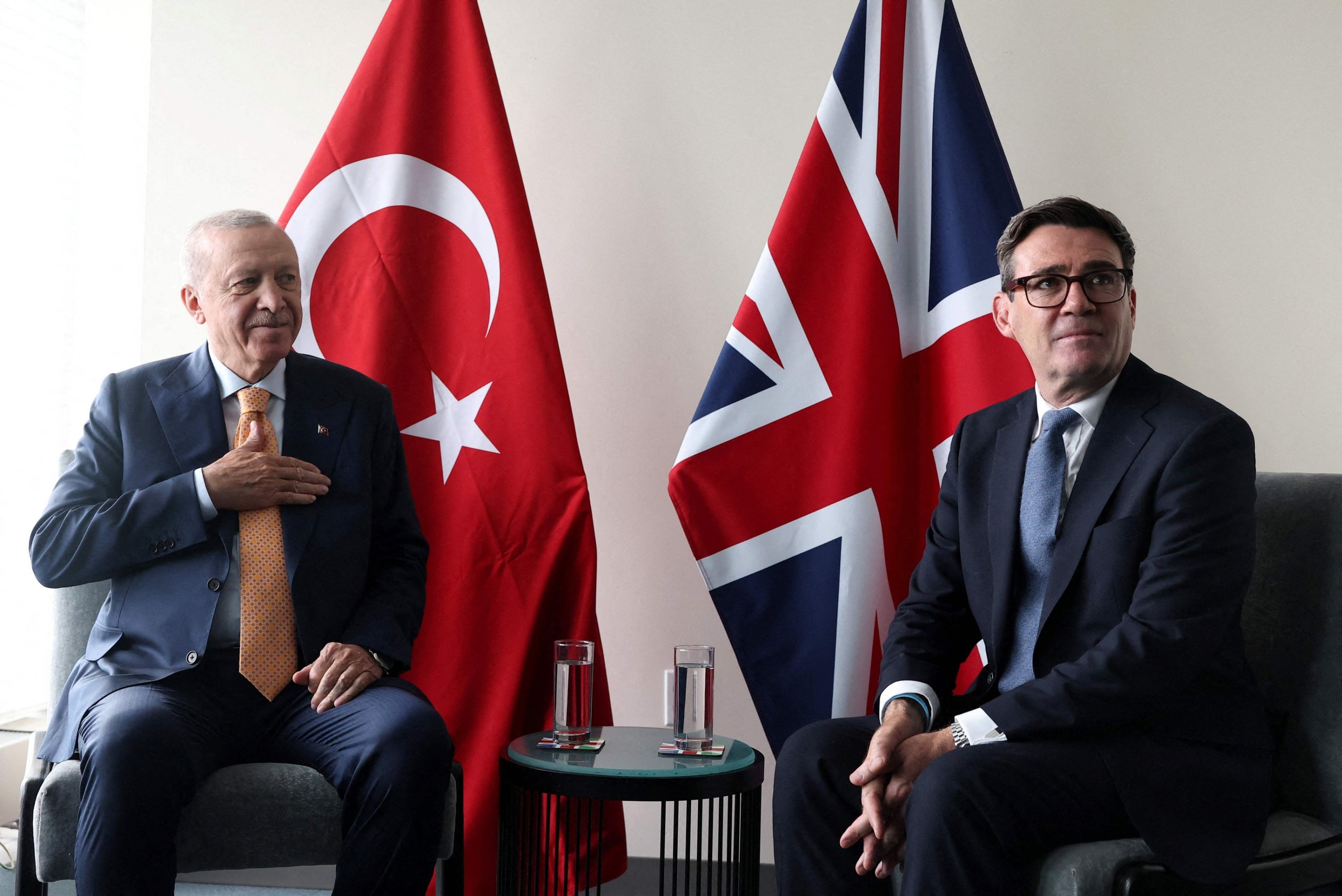
The Turkish president met British Prime Minister Andy Burnham as part of his bilateral engagements in New York. The meeting was held behind closed doors.
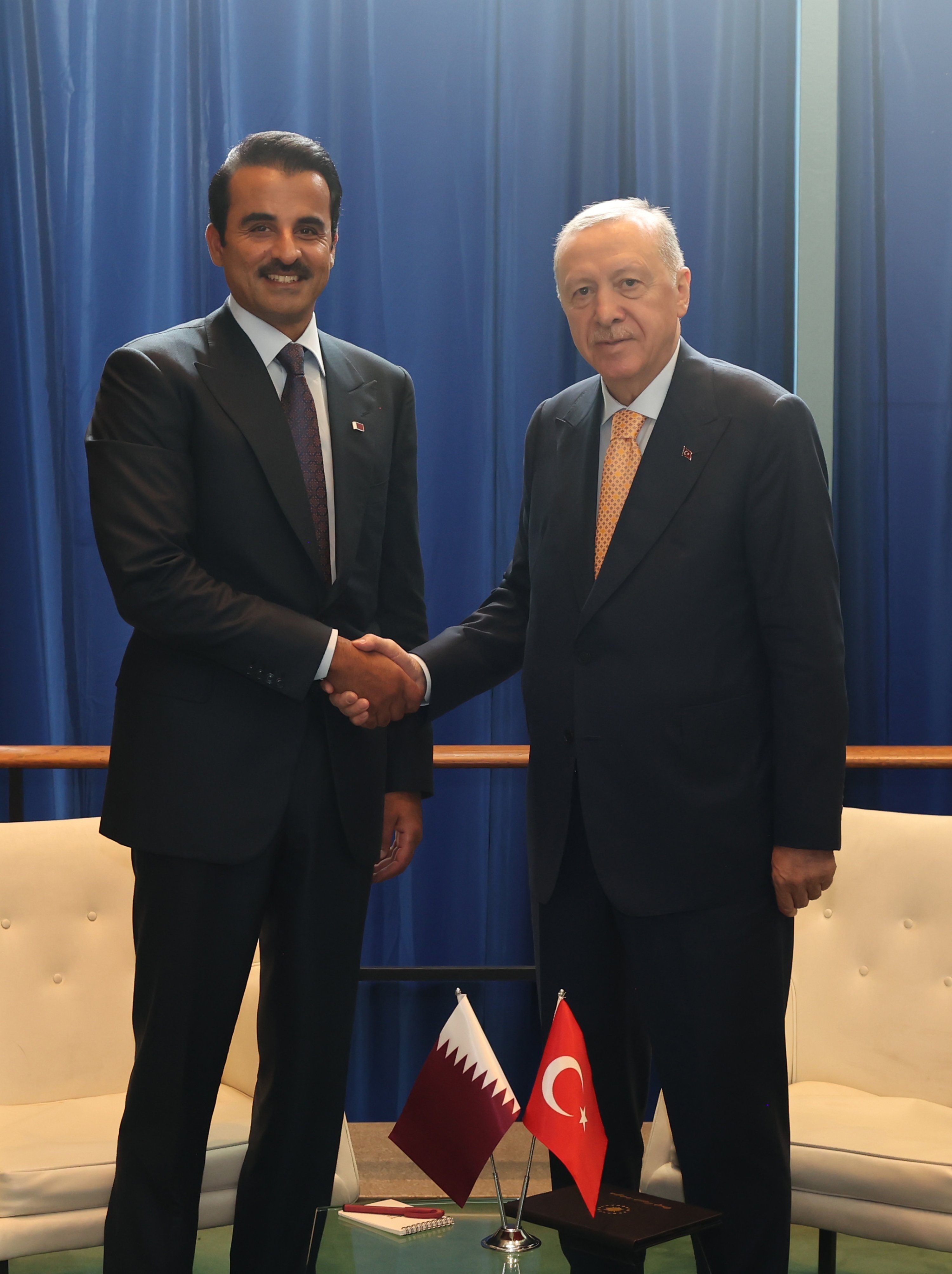
Erdoğan also met Qatar’s Emir Sheikh Tamim bin Hamad Al Thani, a close regional partner of Türkiye, as part of his General Assembly contacts. No immediate details of their talks were released.
In a separate meeting at U.N. headquarters, Erdoğan held talks with U.N. Secretary-General Antonio Guterres on developments in the Middle East, the war in Ukraine and Cyprus.
According to Türkiye’s Communications Directorate, Erdoğan said Ankara had worked closely with Guterres on numerous issues concerning international peace and security during the U.N. chief’s tenure.
Gaza featured prominently in their discussions, with Erdoğan saying Israel’s unwillingness to pursue peace had once again become apparent.
He also raised attacks by illegal settlers in the occupied West Bank and assaults on holy sites in Jerusalem, saying the developments had further aggravated the situation and stressing the importance of preserving the basis for a two-state solution to the Israeli-Palestinian conflict.
Erdoğan told Guterres that tensions surrounding Iran and the war in Ukraine should be reduced and said Türkiye would continue supporting diplomatic efforts.
He also said a process emerging from within the region could help address tensions surrounding the Strait of Hormuz.
On the Black Sea, Erdoğan voiced concern about attacks on commercial vessels and called on all parties to act responsibly to protect navigational safety.
The Turkish president also reiterated Ankara’s position on Cyprus, saying proposals that fail to recognize the sovereign equality and equal international status of the Turkish Cypriot people would not produce a viable solution.
The U.N. separately said Erdoğan and Guterres exchanged views on Cyprus, Ukraine and developments across the Middle East.
Erdoğan also met Senegalese President Bassirou Diomaye Faye behind closed doors on the sidelines of the General Assembly.
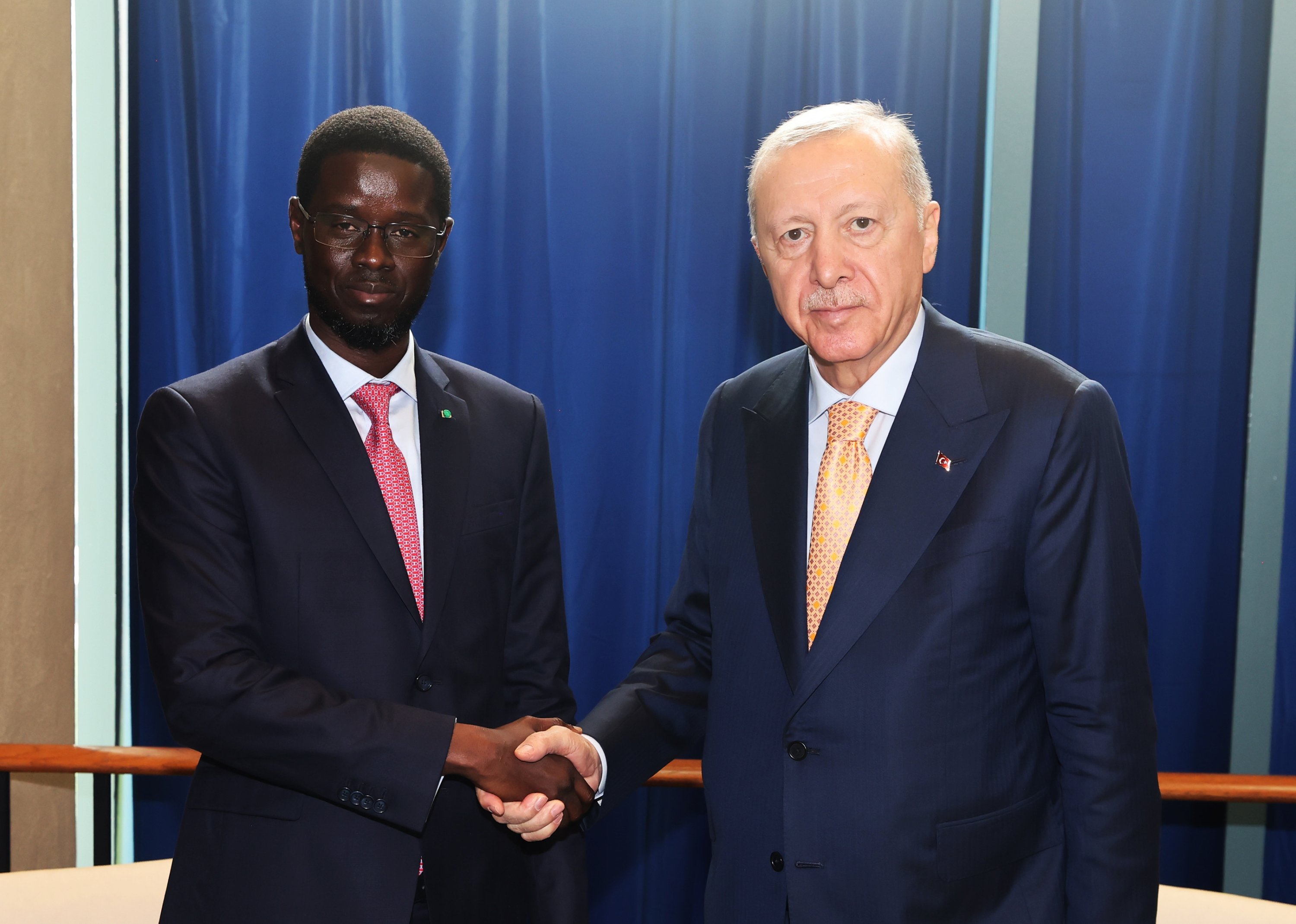
Türkiye and Senegal have expanded political, economic and cultural cooperation in recent years. Ankara opened its embassy in Dakar in 1962, one of Türkiye’s earliest diplomatic missions in Africa, while Senegal established its embassy in Ankara in 2006.
The meetings formed part of Erdoğan’s packed diplomatic schedule in New York as world leaders gathered for the annual U.N. summit amid continuing conflicts and heightened tensions across several regions.
Türkiye’s Foreign Ministry on Wednesday commemorated Muslim Turkish civilians killed in the Peloponnese (Mora) during the Greek War of Independence, marking the 205th anniversary of the 1821 Tripolitsa massacre.
In a statement shared on social media, the ministry said Muslim Turks living in the Peloponnese were systematically killed between 1821 and 1830 and that the violence was accompanied by the destruction of religious and cultural sites.
“This policy of extermination was accompanied by planned destruction and devastation extending from places of worship and madrasas to cemeteries and other elements of cultural heritage,” the ministry noted.
“On the 205th anniversary of the Tripolitsa massacre, we commemorate with mercy the Muslim Turkish civilian population who were brutally killed.”
On Sept. 23, 1821, Tripolitsa was captured by Greek revolutionary forces during the uprising against Ottoman rule, in which tens of thousands of Turks were killed.
In the early 19th century, Muslim Turks made up a large part of the population of Tripolitsa in the Peloponnese. Turks, Greeks and Jews lived in the city, where communities of different ethnic and cultural backgrounds had coexisted for centuries.
Tripolitsa was also home to many migrants who had arrived from Rumelia.
Earlier Greek uprisings against Ottoman rule had failed, but the revolt in the Peloponnese spread rapidly with support from European powers.
The Greek War of Independence, which ultimately led to Greece’s separation from the Ottoman Empire, resulted in the deaths of tens of thousands of people between 1821 and 1829.
Of the approximately 90,000 Turks who were living in the Peloponnese as of April 1821, the majority were killed by insurgents, while only a small number survived the violence.
Theodoros Kolokotronis, one of the Greek insurgent leaders who played a prominent role in the violence in the Peloponnese, came to be regarded as a national hero in Greece, with statues in his honor across the country.
Yüksel Özgen, former head of the Turkish Historical Society (TTK), described the Tripolitsa massacre as more than an uprising, saying it was aimed at eliminating the Turkish and Muslim population.
“The Greek uprising, which went down in history with the Tripolitsa massacre, was not merely a revolt but a brutal campaign aimed at uprooting the Turkish and Muslim population,” Özgen said.
He described the events as an early example of a broader pattern of ethnic cleansing that continued in Thrace, the Black Sea region and parts of Anatolia in subsequent years.
Özgen also noted that violence carried out by the Greek army and armed Greek groups in western Anatolia, Thrace and the Black Sea region between 1919 and 1922 caused extensive and lasting destruction.
He cited the burning of mosques and villages and the mistreatment of civilians, describing the period as one that left deep wounds not only on Turkish society but on “the conscience of humanity.”
A study by Istanbul University history professor Ali Fuat Örenç, published by the TTK, said Tripolitsa, like Monemvasia and Navarino, was besieged by Greek insurgents during the uprising in the Peloponnese.
By late September, residents of Tripolitsa had been devastated by hunger, thirst and disease, according to the study.
“Hundreds of people were dying of starvation every day. Homes and streets in the city were filled with bodies awaiting burial. As if these hardships were not enough, the insurgents intensified their bombardment of the city,” the study said.
The study also said women, infants and children were among those killed by Greek armed groups after the city fell.
It said the violence extended to a Turkish cemetery, where graves were reportedly opened and human remains removed and burned.
The city was extensively looted, while numerous Turkish women and children were taken captive and divided among members of the armed groups, according to the study. Families of senior Ottoman administrators in the city were also reportedly held for ransom.
The study cited the memoirs of Kolokotronis to illustrate the scale of the killings in Tripolitsa. According to the account, Kolokotronis recalled that after entering the city, his horse’s hooves did not touch the ground as he rode toward the government building because the streets were covered with bodies.
Earlier this year, Türkiye’s Foreign Ministry also referred to the 1821 Tripolitsa killings while responding to Greek commemorations concerning the Ottoman period, calling on Athens to address violence committed against Turks and other ethnic communities while approaching historical disputes in a way that supports peaceful bilateral relations.


-
 Politics3 days ago
Erdoğan leaves for UN General Assembly with Gaza in mind
-

 Economy3 days ago
AMD joins $1 trillion club as last chipmaker to cash in on AI rally
-
 Economy3 days ago
Türkiye extends funds liquidation process, freezes execs’ assets
-
 Economy3 days ago
US says all Iranian airlines to be ‘shut down’ Wednesday
-
 Politics2 days ago
Fidan urges US to use greater leverage on Israel for regional peace
-
 Politics3 days ago
Sea Wolf maritime drill begins amid tensions between Greece, Türkiye
-
 Politics3 days ago
Türkiye rejects disinformation targeting child protection operations
-
 Economy3 days ago
Europe faces Q4 jet fuel deficit despite tapping far-flung suppliers