
Politics
Iran accepts cease-fire as basis for ending war, FM tells Türkiye

Iran has accepted the cease-fire as a foundation for a complete end to the war and future talks with the United States, Foreign Minister Abbas Araghchi told his Turkish counterpart Hakan Fidan during a phone call.
Araghchi told Fidan that Iran accepted the cease-fire on the basis of its 10-point proposal, which will serve as the framework for negotiations with the United States.
Fidan held a phone call with Araghchi and expressed Türkiye’s satisfaction with the temporary cease-fire, Foreign Ministry sources said. He said Ankara would continue its efforts to establish a permanent peace.
Türkiye recently joined Pakistan and Egypt in diplomatic efforts to end the conflict.
After Araghchi, Fidan held a phone call with Qatari Prime Minister and Foreign Minister Mohammed bin Abdulrahman bin Jassim Al Thani. Sources said the two top diplomats discussed steps for elevating the temporary cease-fire to a permanent, regional truce.
U.S. President Donald Trump announced a two-week cease-fire with Iran on Tuesday, saying Tehran presented a “workable” 10-point proposal for negotiations.
Iran’s Supreme National Security Council said the 10-point proposal delivered to the U.S. through Pakistani mediation includes a key U.S. commitment to non-aggression, continued Iranian control over the Strait of Hormuz, acceptance of uranium enrichment, and the lifting of all primary and secondary sanctions.
The proposal also includes paying compensation to Iran, withdrawing U.S. combat forces from the region and ending the war on all fronts, including the war against Hezbollah in Lebanon.

Alihan Kuriş, the de facto leader of a group known publicly as “Süleymancılar,” was remanded in custody on Sunday, along with 31 others, in an investigation into a criminal gang he is accused of leading.
An investigation by the Ankara Chief Public Prosecutor’s Office has culminated in the detention of Kuriş and other senior figures of the group, which originated as a religious movement named after 20th-century Islamic scholar Süleyman Hilmi Tunahan, Kuriş’ great-grandfather. Authorities say the investigation is not directed against the religious movement and instead focuses on alleged financial wrongdoing by Kuriş and other figures in the group, which prosecutors have named the “Alihan Kuriş criminal syndicate.”
The detentions last week prompted followers of Kuriş, who is accused by his critics of hijacking the top position in the Süleymancılar community following the allegedly suspicious death of his uncle, to convene in Ankara in his support. The Gülenist Terror Group (FETÖ) was also quick to support Kuriş and his followers on social media, with fugitive FETÖ members claiming that another “religious movement” was being targeted by the government. FETÖ posed as a religious movement for decades, operating schools and infiltrating key institutions in the country before attempting to seize power in 2016 through a coup attempt.
Following the detentions, police launched raids on buildings owned or occupied by Kuriş and people close to Süleymancılar and discovered a large amount of cash and jewelry at one of Kuriş’ residences. He also faces charges of money laundering, defrauding public institutions and violating tax laws. While searching a location in Istanbul’s Ümraniye district, police discovered documents that were about to be destroyed as a group of Kuriş’ followers attempted to disrupt the proceedings. On Sunday, media outlets reported that 200 kilograms of gold nuggets of unknown origin had been discovered at a location owned by Hilmi Tuna Kuriş, the brother of Alihan Kuriş, who remains on the run.
The ruling Justice and Development Party (AK Party) marked its 25th anniversary on Friday. In power for more than two decades, the party looks forward to more feats under the leadership of President Recep Tayyip Erdoğan.
During the celebrations marking the anniversary, the party also rolled out a “vision paper.” The paper summarizes a strategy for growth and development across 10 chapters.
Comprehensive goals were laid out under headings covering a leading country in the global system, a high-tech and high value-added economy, national technology and digital sovereignty, a predictable legal system, a human-centric state, a strong family and prosperous society, women’s role in the “Century of Türkiye,” youth as architects of the future, green transformation, and Türkiye on the threshold of its second quarter-century. Erdoğan had earlier announced similar goals for what he called the “Century of Türkiye” vision, in reference to the centenary of the Republic of Türkiye in 2023.
In the first chapter, the document aims for Türkiye to transcend being merely a regional actor and become a global leader that inspires trust, builds partnerships, and shapes the international order. Key elements include an order-building foreign policy, a resilient security ecosystem, energy security, strategic production and a terror-free region.
Regarding economic growth, the focus centers on high-value-added production across industry, agriculture, and energy. Domestic production in the defense industry has expanded significantly, while agriculture emphasizes food security and farmer welfare. In health care, the target moves toward manufacturing health technologies, pharmaceuticals, and vaccines. For energy, goals include expanding renewables, diversifying through nuclear power and small modular reactors, and manufacturing solar, wind, and battery assets domestically.
Digital sovereignty initiatives emphasize artificial intelligence, cybersecurity and technological independence, ensuring technology serves the public good while addressing data protection, digital addiction, and cyberbullying under the Cyber Homeland framework.
In the legal realm, the vision targets the protection of fundamental rights, an independent judiciary, and a libertarian, inclusive constitution that balances individual freedoms with public order.
For governance and urban development, the document details plans for human-centric smart cities, data-driven local administration and expanded social housing, including building 500,000 social units and transforming 150,000 independent units annually across all 81 provinces.
To strengthen society, the 2026–2035 period is designated as the “Decade of Family and Population,” providing economic support for young families, housing access, and work-life balance. Policies for women focus on STEM education, AI literacy, entrepreneurship, flexible work options, and zero tolerance for violence. For youth, the strategy prioritizes support in science, arts, sports, and decision-making roles while combating addiction.
Environmental targets include advancing toward the 2053 net-zero emission goal, treating water security as a component of national security, adapting agriculture to climate change, and expanding public green spaces.
Finally, the strategy integrates a strong economy, robust democracy, inclusive constitution, effective public administration, qualified human resources, green transformation, defense capability, and active diplomacy as mutually reinforcing pillars for the next 25 years.
President Recep Tayyip Erdoğan marked the 25th anniversary of the ruling Justice and Development Party (AK Party) on Friday by highlighting Türkiye’s transformation in defense, infrastructure and public services over the past quarter-century while pledging that the party would not slow its push for further change.
Speaking at celebrations commemorating the party’s foundation on Aug. 14, 2001, Erdoğan said the AK Party had entered its second quarter-century after delivering on 90% of the commitments included in its party programs and election manifestos.
“Let no one expect us to grow tired,” Erdoğan said, stressing that despite what he described as major achievements over the past 25 years, the party’s work was far from finished.
Erdoğan pointed to Türkiye’s expanding domestic defense industry as one of the most significant changes under successive AK Party governments, saying the country had gone from importing even infantry rifles to producing its own warships, unmanned aerial vehicles, helicopters, tanks, missiles and submarines.
He also highlighted investments in the economy, health care, education and transportation, describing them as some of the largest projects undertaken in Türkiye’s history.

Erdoğan said the governments led by his party had used both their electoral mandate and public resources to expand the economy, promote development and strengthen the country.
Recalling the AK Party’s establishment, Erdoğan said the movement was founded under the message “Closed to darkness, open to light,” alongside the pledge that political authority and decision-making belonged to the people.
“Today is a very special and historic day,” he said. “We are marking our 25th anniversary with great pride.”
The president also cited the lifting of restrictions on women wearing headscarves in universities, schools and public institutions, as well as the abolition of a university admissions coefficient system that had disadvantaged vocational school graduates.
Erdoğan pointed to the reopening of Hagia Sophia for Muslim worship in 2020 as another pledge fulfilled during the party’s time in government. The landmark had operated as a museum for decades before being redesignated as a mosque.
Turning to Türkiye’s political system, Erdoğan said the presidential system of government had addressed what he described as the country’s long-standing problem of instability in governance. Türkiye formally transitioned from a parliamentary system to an executive presidency in 2018 following a 2017 constitutional referendum.
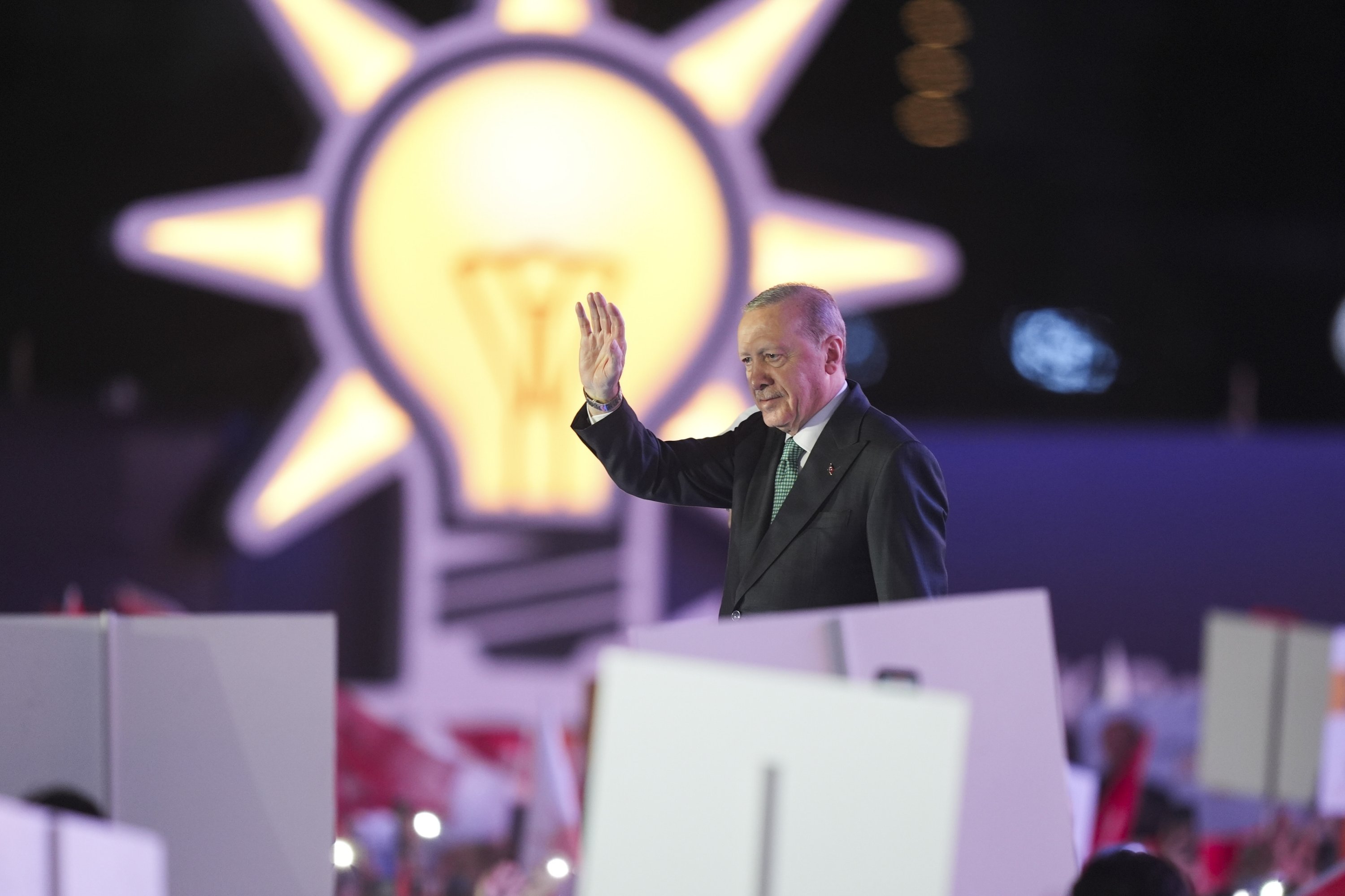
Erdoğan also thanked the AK Party’s partners in the People’s Alliance, which he said was forged during the failed July 15, 2016 coup attempt, for continuing to work together for Türkiye’s future and security.
He separately thanked Nationalist Movement Party (MHP) Chair Devlet Bahçeli for sending flowers to mark the anniversary and expressed appreciation to other political party leaders who conveyed their congratulations by telephone or message.
The AK Party was founded under Erdoğan’s leadership on Aug. 14, 2001, and first came to power after winning the November 2002 general elections. It has since remained the dominant force in Turkish politics, with Erdoğan serving first as prime minister and later as president.
Türkiye and Egypt agreed on the need for stronger measures to address Israel’s violations in Gaza as the two regional powers deepen cooperation on a range of regional crises, Foreign Minister Hakan Fidan said Thursday.
Fidan, speaking at a news conference alongside Egyptian Foreign Minister Badr Abdelatty in El Alamein, described Egypt as Türkiye’s “natural partner” and voiced hope that the growing relationship between Ankara and Cairo would soon evolve into a formal partnership.
“Our region has lost too much time to wars, occupations and internal conflicts. We have a significant gap to close,” Fidan said, stressing the need for closer regional cooperation.
Fidan said Ankara and Cairo were working closely on Gaza and had agreed that stronger measures were needed regarding the situation in the Palestinian enclave.
Noting that Israel’s failure to fulfill its commitments under the terms of the Gaza peace deal may push Ankara and Cairo and other mediators to take radical steps, Fidan said both countries expect the U.S. to apply necessary pressure on Tel Aviv.
“Otherwise, Türkiye, Qatar, and Egypt will have to take radical steps on this issue. This is a responsibility we owe to our nation, our people, and the Palestinians,” Fidan said.
He also emphasized the broader importance of cooperation between the two countries as they seek to coordinate their positions on conflicts and political crises across the region.
“Our region has lost too much time to wars, occupations and internal conflicts. We have a significant gap to close,” Fidan said.
“Egypt is our natural partner, and hopefully it will soon become our formal partner as well,” he added.
Fidan sharply criticized Israeli Prime Minister Benjamin Netanyahu and his government over their provocative policies in the region.
“We see that Israeli Prime Minister Benjamin Netanyahu and his team are increasingly escalating policies that trample on human dignity and are adopting an attitude that effectively provokes the entire international community,” he said.
On Libya, Fidan said Türkiye and Egypt were aligned on safeguarding the North African country’s territorial integrity.
“Türkiye and Egypt share the same view regarding Libya’s unity, territorial integrity, sovereignty and indivisibility,” he said.
Fidan also addressed regional tensions involving Iran, saying Ankara hoped for the restoration of a cease-fire between the United States and Iran and the reopening of the Strait of Hormuz.
“We hope that the cease-fire between the U.S. and Iran will be reestablished and that the Strait of Hormuz will be reopened,” he said.
Referring to the Mecca Joint Defense Agreement signed between Türkiye, Pakistan and Saudi Arabia, Fidan described the pact as a landmark development for regional cooperation.
“The Mecca alliance, by its very nature, has marked a historic moment for our region,” he said.
Abdelatty, meanwhile, emphasized the strength of the relationship between Ankara and Cairo and the need for sustained coordination as the region confronts multiple crises.
“Relations between Türkiye and Egypt are truly built on strong foundations,” Abdelatty said.
“We face many challenges in the region, and considering this, we must remain in constant consultation,” he said. “Today, we held constructive talks with Mr. Fidan, and senior officials also participated in these meetings. There is political will to advance our relations.”
Abdelatty said he expected bilateral relations to continue developing, including through greater coordination between the Turkish and Egyptian private sectors.
He said closer cooperation between the two countries could serve as an example to the international community.
Turning to Syria, Abdelatty said Türkiye and Egypt shared opposition to Israeli attacks targeting Syrian sovereignty.
“In our meeting with Minister Fidan, we expressed that we oppose and condemn all Israeli attacks on Syria’s sovereignty,” he said.
Abdelatty also highlighted the two countries’ shared position on Sudan amid the conflict there.
“We are in full agreement with Türkiye on supporting Sudan’s territorial integrity and categorically rejecting its partition,” he said.
The two ministers also signed three documents aimed at strengthening cooperation between Türkiye and Egypt following their talks and the second meeting of the Türkiye-Egypt Joint Planning Group in El-Alamein. The documents included the minutes of the Joint Planning Group meeting, a decision amending Protocol No. 3 on rules of origin under the Türkiye-Egypt Free Trade Agreement, and Egypt’s accession document to a memorandum of understanding on strengthening transport connectivity between Türkiye and African coastal countries.
The talks in El Alamein came as Türkiye and Egypt continue to strengthen bilateral ties following years of strained relations, while expanding coordination on Gaza, Libya, Syria, Sudan and other regional issues.
Ankara prosecutors have launched an investigation into main opposition Republican People’s Party (CHP) lawmaker Ahmet Baran Yazgan over allegations of sexual harassment and sexual assault, while his party referred him to disciplinary proceedings with a request for permanent expulsion on Friday.
The Ankara Chief Public Prosecutor’s Office said it launched the investigation over video footage circulating on social media and related allegations involving Yazgan, a CHP lawmaker representing the northwestern province of Edirne.
The investigation covers alleged offenses of “sexual harassment” and “sexual assault limited to molestation,” according to the prosecutor’s office.
CHP Deputy Chair and spokesperson Müslim Sarı separately announced that Yazgan had been referred to the party’s disciplinary board as a precautionary measure with a request for permanent expulsion.
“Within the framework of our party’s fundamental principles, bylaws and disciplinary provisions, Edirne lawmaker Ahmet Baran Yazgan has, as of today, been referred to disciplinary proceedings with a request for permanent expulsion,” Sarı said.
The developments followed an altercation at an apartment in Edirne early Thursday.
Police were dispatched to the residence in the city’s Cumhuriyet neighborhood after residents reported hearing sounds of a fight.
Yazgan told police that he had been assaulted, that his cellphone had been taken and that he was filmed during the incident. Officers later found his phone under a refrigerator and returned it to him.
Three people, including two women, were detained over the altercation.
The suspects told investigators that they had gone to T.A.’s residence following a birthday celebration, where they consumed alcohol with Yazgan before an argument escalated into a physical confrontation.
The parties filed complaints against each other. The suspects accused Yazgan of sexual harassment, threats and insults, while N.D. said she suffered a hand injury from a piece of glass during the altercation.
Footage purportedly showing parts of the incident is also being examined as part of the investigation.
The three suspects were later released by a criminal judgeship of peace under judicial control measures and were barred from traveling abroad.
The CHP said Yazgan had also been summoned to party headquarters for an internal inquiry into the incident.
Turkish ministers and political figures on Friday marked the 25th anniversary of the ruling Justice and Development Party (AK Party), highlighting President Recep Tayyip Erdoğan’s leadership and the party’s quarter-century in Turkish politics.
Interior Minister Mustafa Çiftçi recalled Erdoğan’s remarks at the party’s founding on Aug. 14, 2001, when he declared that, “Nothing in Türkiye will ever be the same again.”
Çiftçi said the statement opened the door not only to a new political movement but also to a new era for Türkiye.
“Exactly 25 years have passed since that day,” Çiftçi stressed, adding that Erdoğan and the party had faced numerous challenges during that period.
He said Erdoğan had left a significant mark on Türkiye’s recent history through his leadership and policies, while maintaining a strong connection with the public.
Citing Erdoğan’s statement that “the AK Party’s dough was kneaded by the nation,” Çiftçi noted public support had been at the core of the party’s political journey.
Environment, Urbanization and Climate Change Minister Murat Kurum also issued an anniversary message, saying the party’s establishment 25 years ago marked the beginning of a political movement built around what he described as the nation’s values and the vision of a stronger Türkiye.
“Under the leadership of our President Recep Tayyip Erdoğan, our AK Party, which placed the nation’s will at the center of politics and transformed Türkiye through its works, today represents 25 years of struggle, service and cause,” Kurum said.
AK Party spokesperson and Deputy Chair Ömer Çelik described the anniversary as an exceptional milestone in the country’s political history.
Çelik said reaching the party’s 25th year after such a long period in government was a rare political achievement, describing the anniversary as a “celebration.”
“We have carried out this entire process under the leadership of our president with uninterrupted rule in a way rarely seen in political history,” Çelik said.
He argued that the party’s longevity stemmed from its relationship with voters and Erdoğan’s approach to politics, saying public approval had provided the basis for its continued governance.
Furthermore, Mustafa Destici, chair of the Great Unity Party (BBP), also congratulated Erdoğan and the AK Party on the anniversary.
Destici said the AK Party had played a major role in Türkiye’s political life over the past quarter-century while confronting political, economic and social challenges, terrorist attacks and the July 15, 2016, coup attempt.
He also pointed to Türkiye’s growing regional and international role and developments, including the establishment of the Organization of Turkic States and the reopening of Hagia Sophia as a mosque.
Destici said cooperation within the People’s Alliance would continue around shared objectives, including national unity, economic strength, counterterrorism and greater independence in the defense industry.


-
 Sports3 days ago
6 Arab federations reaffirm support for Infantino amid FIFA rift
-

 Sports2 days ago
Ferran Torres joins PSG from Barcelona on contract through 2031
-

 Economy3 days ago
Hyundai launches IONIQ 3 production to embolden Türkiye’s EV ambitions
-

 Economy3 days ago
Can global oil stocks weather another 6 months of US-Iran war?
-
 Politics3 days ago
AK Party marks 25 years as Türkiye’s dominant political force
-
 Economy3 days ago
Azerbaijan overtakes Russia as Türkiye’s biggest pipeline gas supplier
-
 Politics3 days ago
FM Fidan meets Arab League chief, Egypt intel head in el-Alamein
-
 Politics3 days ago
Abbas meets Erdoğan as tensions stoked by Israel threaten Palestine