
Politics
Türkiye’s global influence continues to grow, Uzbek president says

Uzbek President Shavkat Mirziyoyev said Tuesday that Türkiye is strengthening its position as a reliable and influential actor in international affairs through its active diplomacy and expanding regional role.
Uzbek-Turkish relations have reached the level of a comprehensive strategic partnership thanks to the efforts of Türkiye’s President Recep Tayyip Erdoğan, Mirziyoyev said in a message to the participants of the 29th Eurasian Economic Summit in Istanbul, published on his website.
“The priorities of Uzbek-Turkish relations are fully aligned with the key goals of the Eurasian Economic Summit-expanding comprehensive multilateral partnership and sustainable development based on equality, trust and mutual respect,” he said.
The head of state noted that over the past decades, the summit has established itself as a platform for dialogue, bringing together leading politicians, business representatives, and members of the expert community.
“Holding the Summit in Istanbul carries special symbolic significance. For centuries, this unique city has served as a bridge between Europe and Asia, contributing to the development of cultural, trade, and economic exchange between the regions,” he noted.
Mirziyoyev pointed out that Modern Türkiye is consistently implementing President Erdoğan’s strategic Century of Türkiye vision.
“Türkiye’s prestige is growing as a reliable and influential player in international relations, capable of mobilizing efforts toward effectively resolving pressing issues on the global agenda,” he emphasized.
Mirziyoyev said one of the summit’s main themes-global responsibility in the face of water and green resource shortages-resonated with Central Asia, which is experiencing faster warming than the global average, along with shrinking glaciers and worsening land degradation.
Under those conditions, environmental sustainability has become a key priority for Uzbekistan’s development strategy, he added.
The Uzbek president highlighted the country’s Green Space project, under which 200 million trees are planted annually, including large-scale afforestation efforts on the dried bed of the Aral Sea.
He said Uzbekistan has reduced emissions by 35% and aims to cut them by 50% by 2035 as part of its transition to a green development model.
The president also mentioned efforts to improve water management through the implementation of water-saving technologies, which he said help save significant amounts of water each year.
“Uzbekistan intends to continue actively promoting the green agenda and contributing to the search for effective solutions to global environmental challenges,” he said.

Türkiye and France have signed a road map aimed at expanding defense and security cooperation, including intelligence sharing, air defense and joint military exercises, the Turkish Defense Ministry announced Thursday.
The agreement seeks to strengthen bilateral defense relations based on mutual interests and establish a more institutionalized framework for cooperation, the ministry said following its weekly press briefing at the Gölcük Naval Shipyard Command in northwestern Kocaeli province, marking the facility’s 100th anniversary.
Under the road map, the two countries plan to hold regular security consultations, enhance cooperation against hybrid threats, expand intelligence sharing and improve interoperability between their defense systems.
The agreement also envisages coordinated training and capacity-building activities in third countries to support regional stability.
Military cooperation will include expanded joint training programs, personnel exchanges between military academies, port visits and exercises involving land, naval and air forces.
In the defense industry, Ankara and Paris aim to develop joint projects, encourage technology and information sharing and increase engagement between defense companies.
The ministry said bilateral defense meetings would alternate between Ankara and Paris, with the first scheduled for the final quarter of 2026.
Israeli actions in Syria condemned
Separately, Defense Ministry spokesperson Rear Adm. Zeki Aktürk criticized Israel’s continued military activities in southern Syria, including raids, detentions, border violations and air and artillery strikes.
Aktürk accused Israel of violating the 1974 Disengagement Agreement by resuming trench-digging and road expansion activities under the Sufa-53 Line Project.
Israeli forces restarted excavation work last week west of al-Asha village in Syria’s southern Quneitra as part of a project known as the “Sufa Line,” or “Sufa 53,” according to Syria Alikhbaria TV. Military vehicles and bulldozers were seen digging near the separation line with the occupied Syrian Golan Heights, extending a route that runs through rural communities from northern to southern Quneitra. For residents, the project has meant the loss of agricultural land, damage to grazing areas and vegetation, and changes to the natural flow of rainwater in a province where many families depend on farming and livestock.
He urged the international community to take concrete measures against Israeli actions that threaten regional peace and stability.
Aktürk also highlighted ongoing military contacts between Türkiye and Greece under their 2026 Confidence-Building Measures Implementation Plan.
A delegation from Türkiye’s National Defense University visited the Hellenic National Defense College in Athens from Oct. 7-9, while another round of confidence-building talks was scheduled for Friday in Crete.
A Greek naval delegation is also expected to visit Türkiye’s Naval Forces Command from Oct. 13-15.
Border security operations
Addressing counterterrorism operations, Aktürk said one PKK terrorist surrendered to Turkish authorities over the past week.
He added that Turkish security forces apprehended 660 people attempting illegal border crossings and prevented another 1,383 from crossing during the same period.
According to ministry figures, 13,366 people have been apprehended attempting unauthorized crossings since the beginning of 2026, while another 53,870 have been prevented from entering illegally.
Türkiye’s domestically developed Bayraktar Akıncı unmanned combat aerial vehicles (UCAVs) are strengthening the Gendarmerie General Command’s surveillance and operational capabilities, conducting long-range missions across the country, officials said.
Developed by Turkish defense manufacturer Baykar, the Akıncı drones are capable of operating at altitudes of up to 40,000 feet and remaining airborne for up to 24 hours. The aircraft can conduct missions nationwide, from Edirne in the west to Iğdır in the east.
Maj. Ergin Sarıçiçek, a drone pilot stationed in Elazığ, told Anadolu Agency (AA) that the Akıncı represents one of the most advanced technologies currently used by the gendarmerie.
Equipped with an artificial intelligence-assisted triple-redundant autopilot system and satellite communications, the aircraft can conduct reconnaissance, surveillance and operational missions across Türkiye’s airspace.
“The aircraft can remain airborne for extended periods and carry out missions over large areas,” Sarıçiçek said.
Its advanced electro-optical cameras enable day-and-night surveillance, including under challenging weather conditions, providing intelligence to support counterterrorism and border security operations.
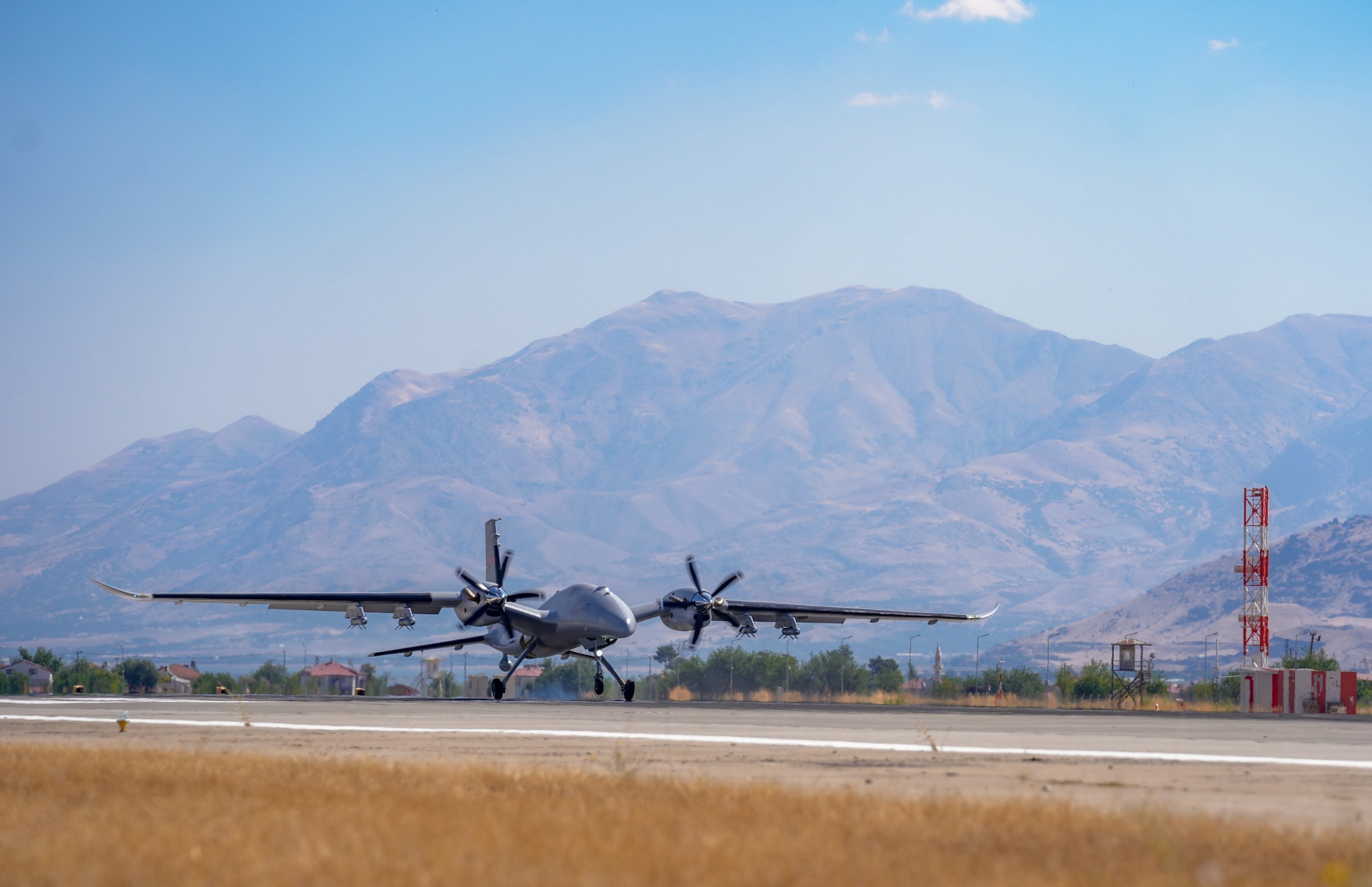
According to Sarıçiçek, the drones also contribute to combating smuggling, disaster response, crisis management and search-and-rescue operations.
He emphasized that the aircraft’s precision targeting capabilities allow security forces to respond to potential threats while reducing risks to personnel on the ground.
The Akıncı can carry up to 1,500 kilograms (3,300 pounds) of payload, including various domestically produced precision-guided munitions.
Its weapons systems include the MAM-L, MAM-C and MAM-T guided munitions, along with the Teber-82, Gözde, Tolun and İHA-230 systems developed by Turkish defense companies.
Sarıçiçek said the aircraft’s payload capacity, endurance and advanced surveillance systems distinguish it from other unmanned aerial platforms, expanding the gendarmerie’s ability to conduct complex operations across Türkiye.
The Ministry of Family and Social Services and the EU Delegation to Türkiye signed a protocol Thursday in Ankara to cooperate on social integration and education programs for foreign nationals in the country. Minister Mahinur Özdemir Göktaş and EU Ambassador to Türkiye Aivo Orav attended the signing ceremony.
The Social Safety Net with Education for Refugees protocol continues cooperation between the bloc and Türkiye that intensified during the escalating plight of Syrian refugees in Türkiye’s neighbor during the civil war there.
Göktaş told journalists that they already had two projects in cooperation with the EU and the Turkish Red Crescent (Kızılay) and were now merging them into a stronger assistance structure.
“This program will also help boost children’s school attendance, and we will provide support to their families,” she said.
Göktaş said the welfare state is the invisible force that keeps societies together.
“The welfare state is the backbone of society. It keeps families, children and the future together without allowing them to be shaken. It provides a secure source of support that people can rely on in difficult times. Türkiye’s approach to the welfare state is built on embracing all segments of society and making opportunities accessible to everyone,” she said.
Göktaş said that under the leadership of President Recep Tayyip Erdoğan, they had transformed this approach into a helping hand reaching every corner of the country.
“Through the extensive service network of social assistance and solidarity foundations, we have established a presence at the points closest to citizens. We have further expanded this structure with our field teams, who visit households one by one and listen to the concerns of every family. Through our Integrated Social Assistance Information System, we also deliver our support to citizens quickly, fairly and transparently. The World Bank and the Council of Europe cite this system as an example of good practice. With the Monitoring Unit we established last year, we closely track changes on the ground in real time,” she added.
“We reach families quickly, before their needs become more severe, and stand by them. Through this system, we identified more than 35,000 households within one year and directly reached more than 19,000 households. At the same time, our social risk maps allow us to identify in advance what is needed and where. We address vulnerabilities in different areas, from children and women to people with disabilities, older people and families, in a holistic manner. ‘Through the Family Guide and Children Are Safe’ programs, we regularly monitor households and quickly activate the services they need.”
Minister Göktaş said Türkiye is a country committed to sharing goodwill without regard to borders, adding that it embraces everyone who regards the country as home with compassion, extending a helping hand to those in need and opening its doors to those who knock.
Göktaş said the project they had been implementing since 2016 would be strengthened through the agreement, adding that they would launch a new structure for the Social Cohesion and Education Assistance Program for Foreigners.
Göktaş said they would continue to channel financial support provided by the European Union to vulnerable households through the program.
“We will continue to support families’ basic needs, such as food, shelter and education, through regular cash assistance. In this way, we will provide greater support to families in meeting their basic needs. We will help them integrate into society and lead their lives more safely. Through this program, we will also further strengthen children’s ties to school. We will continue to provide support to the families of children who attend school regularly.”
Aivo Orav, head of the EU Delegation to Türkiye, said another important step had been taken in the EU and Türkiye’s longstanding cooperation to support refugees, noting that Türkiye had assumed an extraordinary responsibility by hosting millions of refugees.
Orav emphasized that addressing migration issues through partnership, unity and close cooperation was the best approach, saying: “Today, with the signing of the Social Cohesion and Education Assistance Program for Foreigners, implemented with a contribution of 402 million euros ($449 million) from the European Union, we are reaffirming this commitment.”
Orav said they planned to provide an additional 203 million euros to the program next year, bringing total support to 605 million euros, and added that the program would help children build a better future.
Orav said poverty, education and child protection were interconnected, adding that the program aims to ensure children attend school regularly and strengthen their links with social services.
Speaking at a joint news conference with visiting Hungarian Foreign Minister Anita Orban on Thursday in Ankara, Foreign Minister Hakan Fidan said Türkiye was considering defense assistance to Saudi Arabia amid tensions with the Houthis in Yemen. He was answering questions about the Mecca Joint Defense Alliance, which was signed by Saudi Arabia and Pakistan. “This is a defense pact, not a pact of offense; Türkiye won’t send troops to another country for attacking another,” he said.
He also noted that the agreement on the alliance would soon be sent to Parliament for ratification.
Fidan and Defense Minister Yaşar Güler joined Pakistani officials in Saudi Arabia’s Riyadh on Oct. 5 for the Strategic Political and Defense Committee of the alliance. This second meeting of the alliance after its inauguration in Istanbul was followed by a blunt statement underlining the collective defense and a pledge of military assistance to Saudi Arabia amid attacks by the Houthis.
“The Mecca agreement is a defense agreement; it is not an agreement of offense. If one country that is a party to the agreement is attacked, you are required to stand with it for the defense,” he stressed.
“Türkiye will not send soldiers to another country for an assault. We are forming a defense cooperation with Saudi Arabia. We are discussing what type of defense measures are needed through our military delegations, and how Pakistan can contribute. Saudi Arabia already has a major military infrastructure; they have a high amount of weapons, munitions and defense elements accumulated over the years,” Fidan said.
The Turkish opposition also claimed that Türkiye would not be able to send troops to Saudi Arabia as the agreement on the alliance was not ratified by Parliament yet. Fidan responded to this and said that they had completed the work to send it to Parliament. “We presented it to the president on Wednesday and decided to send it to Parliament as soon as possible,” he stated.
Sabah newspaper reported on Wednesday that Türkiye would provide low- and medium-altitude aerial defense systems to Saudi Arabia along with assistance in drone technologies and electronic warfare. The newspaper also reported that Saudi Arabia was working on setting up a base for Türkiye. A Foreign Ministry official told Daily Sabah that the Saudi side conveyed “some expectations” to Türkiye and they would examine those.
The move is the most concrete step since the agreement was signed in August by top officials of Türkiye, Pakistan and Saudi Arabia to showcase the impact of the alliance in the broader region.
As civil war in Yemen flared up this summer, the Houthis spread it to Saudi Arabia, prompting the central government in Yemen to launch an all-out operation against the group this week. Saudi Arabia’s oil and military installations are among the main targets of the Houthis.
Black Sea security
Fidan also touched upon the issue of Black Sea security after reports of multiple attacks on commercial vessels that escalated during the Russia-Ukraine war. Turkish-owned vessels in particular suffered from the drone attacks. Syria reported that nine citizens working as sailors on a commercial ship owned by a Turkish company went missing after a drone strike off the coast of Bulgaria early Tuesday. Eighteen Turkish and Indian crew members were rescued from the ship that caught fire.
Fidan said Türkiye had worked since the beginning of the conflict to prevent its spillover into the Black Sea, citing Türkiye’s tight enforcement of the Montreux Convention for passage through Turkish straits and a landmark grain deal. He added that the spillover was happening now.
“Increasing attacks on civilian vessels pose a grave threat to the safety of people, commodities and routes in our region. Regional countries and the international community should not allow a new front in the Black Sea, but unfortunately, with the conflict spreading across multiple fronts, it is emerging in the Black Sea as well,” he said.
Media reports on Thursday revealed how a deputy mayor amassed an otherwise improbable fortune through corruption, along with a huge cache of munitions for pistols.
Security forces have recently raided several locations on allegations of corruption at the municipality of Yahşihan, a small town in Kırıkkale, a province neighboring the capital, Ankara. Nine suspects, including acting Mayor Aydın Demirdirek, were detained while a total of 2,031 properties suspected of being obtained through bribery and illicit gains were seized.
The investigation revealed that deputy mayor S.S.Y., detained in the operation, owned 1,630 properties while Demirdirek had 11. Assembly members F.D. and Ö.H. owned 32 and 22 properties, respectively, an unnatural wealth apparently accumulated through corruption. A search of the residence of S.S.Y. also led to the discovery of an unlicensed pistol and a record amount of 11,312 rounds of ammunition.
Investigators also listed other unusual findings in the case, including 336 properties owned by the spouse, mother-in-law, sister-in-law and another suspect linked to U.B., former head of the municipality’s department issuing zoning and construction permits. Authorities said the assets owned by the suspects sharply contrasted with their official declaration of income. U.B. is also accused of laundering money, based on a suspiciously high amount of cash transfers between him and other suspects in the case.
Two former mayors of Yahşihan, from the ruling Justice and Development Party (AK Party) and government ally Nationalist Movement Party (MHP), were among 15 suspects remanded into custody last month on charges of corruption.
Ahmet Sungur and Osman Türkyılmaz were detained along with their deputies, municipal assembly members and businesspeople on Sept. 24. They are accused of running a criminal organization, bribery, rigging public tenders and fraud.
A crackdown on municipalities where mayors are suspected of corruption began a few years ago in Istanbul and soon spread across the country. Most of those arrested or detained for corruption are from the opposition Republican People’s Party (CHP). Probably the most notable among them is Ekrem Imamoğlu, mayor of Türkiye’s most populous city, Istanbul. Imamoğlu was arrested last year.
The head of Türkiye’s National Intelligence Organization (MIT), Ibrahim Kalın, met with Syrian Foreign Minister Asaad Hassan al-Shaibani in Ankara to discuss bilateral security cooperation, the integration of former SDF elements, counterterrorism efforts and regional stability, Turkish security sources said Thursday.
Kalın held talks with Syrian Foreign Minister Asaad Hassan al-Shaibani in the capital Ankara, focusing on strengthening bilateral ties and coordinating efforts to address regional security challenges.
According to security sources, the meeting covered Türkiye-Syria relations, potential areas of cooperation, ties with neighboring countries and measures aimed at promoting regional stability.
The officials also reviewed the status of the integration process following the dissolution of the Syrian Democratic Forces (SDF), while emphasizing the importance of maintaining close coordination in the fight against terrorist organizations, including Daesh.
The discussions addressed continued Israeli attacks in southern Syria and their implications for the country’s security and territorial integrity.
Kalın and al-Shaibani also examined the impact of the lifting of U.S. sanctions on Syria, particularly the potential benefits for rebuilding and strengthening the country’s defense capabilities.
The talks come as Ankara and Damascus seek to consolidate security cooperation following the dissolution of the YPG-dominated SDF and its integration into Syrian state institutions.
The integration process stems from agreements reached between the Syrian government and the SDF in March 2025 and January 2026, aimed at bringing armed groups, security structures and civilian institutions under central government authority.
In August, the SDF leadership announced that the integration of its military, security and administrative structures had been completed. Türkiye subsequently welcomed the group’s dissolution, describing it as an important development for Syria’s stability and territorial unity.
Ankara considers the YPG the Syrian branch of the PKK terrorist group, which has waged a decadeslong insurgency against the Turkish state. Türkiye has consistently called for a unified Syrian army and the elimination of armed groups operating outside Damascus’ authority.


-

 Economy2 days ago
Inside Türkiye’s plan to repay investors caught up in fund turmoil
-
 Economy1 day ago
Trump says anyone who doesn’t call AI ‘super intelligence’ is ‘enemy’
-
 Economy3 days ago
CBRT chief vows cautious stance to preserve disinflation gains
-
 Politics3 days ago
Türkiye, Hungary launch new mechanism to deepen strategic ties
-
 Politics2 days ago
AK Party scores win as Turkish opposition stronghold’s mayor joins
-
 Economy2 days ago
Most Fed officials see another rate hike by year-end: Minutes
-
 Politics2 days ago
Turkish justice minister cites evidence of FETÖ link in Yazıcıoğlu death
-

 Politics2 days ago
Istanbul brings over 70 countries together for global justice summit