
Economy
High prices pressure airlines, but EU sees no jet fuel shortage

There are no signs of jet fuel shortages in Europe in the coming months despite the energy shock from the Iran war, though high prices are prompting airlines to cut uneconomic routes, the European Union’s transport chief said on Friday.
The Strait of Hormuz, a key shipping lane linking the Gulf to global markets, has been largely shut for the past three months, cutting oil supplies by about 14 million barrels per day, or around 14% of global demand.
The EU has so far weathered the disruption as the Middle East accounts for about 20% of its jet fuel imports, with U.S. and Nigerian supplies largely filling the gap.
Some routes cut, higher fares possible
“There is currently no jet fuel shortage in Europe. We have no signs that we will have a shortage in the coming period,” Sustainable Transport and Tourism Commissioner Apostolos Tzitzikostas told Reuters, adding regional airports were most at risk.
The main concern is the surge in price. The International Air Transport Association (IATA) says jet fuel accounts for 25-30% of airlines’ operating costs.
“This is why we see that some airlines are choosing to cancel some of their routes that didn’t make any economic sense,” Tzitzikostas said.
Passengers may not feel the full impact in higher fares until later this year or next as airlines’ hedges expire, though Tzitzikostas said the situation was “very different airline to airline.”
Analysts expect oil prices to average around $90 a barrel this year, up 40% from February.
Looking to the year-end, Tzitzikostas said the situation would be “very difficult” if Middle Eastern supplies remained disrupted.
“It’s critical that the war stops and that the Strait of Hormuz opens and this needs to happen as soon as possible …. We should always keep in mind that Europe is prepared. We have the emergency stocks in our member states,” he said.
He added that the Commission would coordinate any releases and there was no need to discuss redistributing reserves for now. “For the time being, there is a certain degree of stability.”
Tehran and Washington have held talks since an early April cease-fire, but with limited progress and repeated violations.
Sources told Reuters this week that even if a deal is reached soon, it is likely to be a temporary arrangement, with Hormuz staying under Iranian control.
Beyond aviation, a prolonged conflict could hit the global economy. The OECD has warned that it could sharply slow growth to levels last seen during the 2008-2009 financial crash or the COVID-19 pandemic.
“It’s not only an issue of jet fuel or fuels. We will have even possibly a global recession,” Tzitzikostas said.

The number of suspects arrested in a spiraling investigation into an investment fund scam in Türkiye has reached 45, officials said Friday.
Prosecutors are parsing the operations of 131 investment funds held by seven companies, whose assets are reportedly worth more than $18 billion.
Authorities took steps last week to support financial stability, with investigations focused on suspected share price manipulation in thinly traded stocks.
Justice Minister Akın Gürlek said Friday that prosecutors were investigating 76 suspects, of whom “45 have been arrested,” he posted on the social media platform X.
Among the arrested is Erkan Kilimci, a former deputy governor of Türkiye’s central bank, media reports said.
Gürlek said authorities had seized the assets of those who either owned or were involved in managing the now-liquidated investment funds, and those of their immediate family members.
The problems emerged in early September after Türkiye’s Capital Markets Board (SPK) changed its guidelines for investment funds, saying they could no longer invest all their assets in one stock but were required to diversify.
The move sought to address concerns that many funds were heavily investing in a small number of obscure or hard-to-sell stocks.
To comply, funds began selling stocks, spooking investors who started trying to cash in their investments.
But a scandal erupted last week when several companies admitted they were unable to satisfy investor redemption demands.
A day later, all 131 investment funds were placed into liquidation by the SPK, which said nearly half a million individual investors were affected.
Treasury and Finance Minister Mehmet Şimşek denied the rumours that he was preparing to resign.
“The allegations circulating about my resignation are baseless,” Şimşek posted on X late Thursday.
“The public should pay no heed to such speculative news intended to undermine our country’s economic stability,” he said.
Gürlek said investigators were pursuing their investigations to determine those responsible.
“No one is being shielded, and no one is receiving preferential treatment,” he said. “Those responsible will answer before the law, and the rights of affected citizens will be fully safeguarded.”
In his first comments, President Recep Tayyip Erdoğan said Thursday that those responsible will be held accountable, stressing that the liquidation of the funds posed no risk to Türkiye’s financial system or the wider economy.
Türkiye has formally established the legal framework for hybrid working, allowing employees to split their working time between the workplace and remote locations, according to a decree published Friday.
The decree in the Official Gazette officially integrates the mixed working model into the country’s labor legislation.
The amendment to Article 9 of the Remote Working Regulation, issued in March 2021, sets out the rules for arrangements in which work is performed partly at the workplace and partly remotely.
The hybrid model has been widely practiced since the COVID-19 pandemic, but lacked a clear definition in Turkish labor law.
Under the new rules, employers and employees can agree to a hybrid working arrangement. Employment contracts must specify which days employees will work at the workplace and which days remotely, as well as their daily working hours.
The change provides a formal contractual basis for hybrid work, which combines workplace-based and remote working rather than requiring employees to work entirely from either location.
Flexible working on government’s agenda
The regulatory change follows growing government emphasis on more flexible working arrangements.
Treasury and Finance Minister Mehmet Şimşek said last week that the government was considering more flexible working models, particularly as part of programs targeting young people who are neither in education nor employment.
“For these categories, a more flexible working model is in Türkiye’s interest,” Şimşek said.
Şimşek had also previously said the government would further develop flexible and remote-working models in the public sector.
Flexible working was also included in the government’s Medium-Term Program for 2027-2029, which calls for work arrangements to be developed with a focus on work-life balance and employee productivity, including adjustments to working days and flexible-duration employment models.
What is hybrid work?
Hybrid work is an employment model in which employees divide their working time between a physical workplace and a remote location. Unlike fully remote work, it combines office-based and remote working according to an arrangement agreed between the employer and employee.
The new regulation means such arrangements can now be explicitly incorporated into employment contracts, with working days, locations and daily hours defined in advance.
Mair Group of the United Arab Emirates (UAE) has signed an agreement to acquire a 70% stake in Eslab, the owner of Türkiye’s leading coffee chain Espressolab, reports said Friday.
That would be the group’s first international acquisition since it began trading on the Abu Dhabi Securities Exchange in late 2024.
Under the agreement, Espressolab’s founders and existing shareholders will retain a 30% stake in the company and continue to be involved in its growth and development, a report by the private broadcaster CNBC-e said.
The financial terms of the transaction were not disclosed.
The deal has yet to close, with the share transfer subject to regulatory approvals in the relevant jurisdictions and the fulfilment of other closing conditions.
Espressolab CEO Esat Kocadağ said the partnership with Mair Group represented an important next step in the coffee chain’s international expansion.
“Together, we aim to strengthen our franchise network, invest in the brand and customer experience and expand in existing and new markets while preserving the identity and entrepreneurial culture that define Espressolab,” Kocadağ said, according to the report.
Mair Group Managing Director and Group CEO Nehayan Hamad Alameri said the transaction would diversify the group’s investment portfolio beyond its core retail and commercial real estate operations in the UAE.
The deal would bring together Espressolab’s international reach and brand capabilities with Mair Group’s investment and organizational resources, he said.
Alameri said they look forward to partnering with Espressolab’s founders and management team to support the company’s continued growth in Türkiye and international markets, while creating long-term value for their shareholders.
As of this August, Espressolab operated a network of more than 400 cafes across 21 countries. More than 310 of its outlets are in Türkiye, where the chain has a presence in more than 50 cities.
Founded in 2014, Eslab operates the Espressolab brand as well as coffee sourcing and roasting, product procurement, franchise licensing, and retail and digital sales activities.
Mair Group is a strategic investment company based in Abu Dhabi and listed on the Abu Dhabi Securities Exchange. It invests across several sectors, primarily retail and commercial real estate.
Its portfolio includes Abu Dhabi Cooperative Society (Adcop), the Spar supermarket chain and the Makani Real Estate property portfolio.
Mehdi Eker, Türkiye’s nominee for director-general of the U.N. Food and Agriculture Organization (FAO), said his candidacy would provide an opportunity to reflect the country’s approach to food security at the international level.
Türkiye believes it could contribute to making FAO more effective in addressing global food security and other challenges affecting food and agricultural systems, Eker told Anadolu Agency (AA).
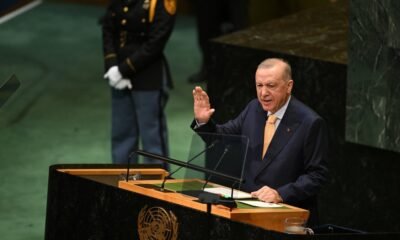
President Recep Tayyip Erdoğan and Foreign Minister Hakan Fidan sought support for Türkiye’s candidacy this week during their diplomatic contacts on the sidelines of the U.N. General Assembly in New York.
In his address at the General Assembly, Erdoğan referred to food waste worldwide. “More than 2 billion metric tons of food are wasted every day. In a world where, on the one hand, metric tons of food are thrown away and, on the other, hundreds of millions of people scavenge for food in the trash, there can be no talk of justice,” he said.
Erdoğan said Türkiye was ready to make every possible contribution, “both to efforts to prevent waste and to ensuring global food security.”
“With this in mind, we have nominated Dr. Mehmet Mehdi Eker for the position of director-general of the Food and Agriculture Organization of the United Nations. I am confident that you will not withhold your support,” he said.
Eker served as the minister of food, agriculture and livestock from 2005 to 2015, making him the longest-serving agriculture minister in the country’s history. He is currently a member of the Presidential Agriculture and Food Policies Council.
Türkiye has been seeking direct engagement with FAO member states eligible to vote in the election, Eker said, adding that he had met representatives of nearly 100 countries since the campaign began.
Türkiye has received written or verbal pledges of support from a significant number of these countries, according to Eker, who said the country would intensify its diplomatic outreach as the election approaches.
“There are 193 U.N. member states. These are the countries that will make the choice at FAO. We are trying to establish face-to-face, one-on-one contact with as many of them as possible,” he said.
Food access as human right
Eker said Türkiye’s approach is based on safeguarding food as a fundamental human right, and said food shortages can lead to population displacement and migration.
“Our approach is based on the principle that the right to access food must be guaranteed,” he noted.
He said global food security faced serious challenges, citing what he described as widespread hunger, inadequate nutrition and obesity.
Eker said the world currently produces enough food to feed a population larger than its 8.3 billion people, yet millions remain food insecure, which he said pointed to problems within the global food system.
“Some 645 million people are going hungry worldwide, while 1.4 billion are obese, and 2.3 billion do not have enough food on their plates,” he said, noting that the world produces enough food for 11 billion people.
“There’s something wrong here – the issue of food security is one of global security, and ensuring global security will be very difficult so long as this is not resolved,” he added.
He also highlighted the importance of food security in conflict zones, saying developments around the Black Sea, the Strait of Hormuz, Bab el-Mandeb and the Gulf of Aden had implications for global food security.
“Food is weaponized against people in Gaza, against children – this brutality, this oppression, must somehow come to an end, and the right to food must not be violated,” he said.
FAO’s role
Eker said FAO had three main areas of responsibility: establishing standards in food and agriculture, providing technical assistance and advice to developing countries and combating global hunger.
The organization develops international food standards through the Codex Alimentarius and establishes standards in areas including plant protection and quarantine. It also maintains a major global network of food, agriculture, livestock and fisheries statistics, Eker said.
He said technical assistance could help developing countries improve agricultural productivity, reduce food losses and strengthen efforts to combat animal diseases that can affect both food supplies and human health.
Eker described the fight against hunger as FAO’s third major area of activity and said effective management of the organization was essential to addressing the issue.
“This is a matter of humanity, the future of humanity – it’s impossible for the world to function and move forward amid such oppression, darkness, and brutality, when food is weaponized against vulnerable populations like children, women, and the elderly, who are dying of hunger,” he noted.
“As Türkiye, we believe the U.N. FAO, like all other U.N. agencies, will be engaged in more effective, efficient and beneficial work for humanity,” he added.
Türkiye’s 1st bid for top post
Eker said FAO was established 81 years ago and that nine different countries had so far produced its directors-general. Türkiye has not previously held the post.
If elected, Eker said, Türkiye’s perspective on food security would be reflected in the organization’s leadership.
“Türkiye’s perspective, approach, understanding of humanity, and vision of civilization would be reflected in the governance of this organization,” he added.
FAO’s current director-general, Qu Dongyu of China, was reelected in 2023 for a second term running through July 31, 2027.
The next director-general is due to be elected at the FAO Conference in Rome in 2027 and will serve a four-year term.
Angola, Italy, Spain, and Ireland put forward their candidates for this position.
U.S. President Donald Trump treated Chinese leader Xi Jinping to pomp and pageantry Thursday, as the leaders of the world’s two superpowers met in Washington, D.C.
Talks on trade, artificial intelligence and the growing strategic rivalry between the countries were all in the spotlight during an elaborate state visit.
Here are the key takeaways from the keenly watched meeting:
Pomp over substance
Trump hailed his “great friendship” with Xi and pulled out all the stops to woo the Chinese leader, greeting him on the runway on his arrival, offering him a rare tour of the presidential helicopter, and gifting him a bald eagle statue.
The pomp, however, masked the lack of diplomatic breakthroughs.
“The pageantry was the point,” according to Ryan Hass at the Brookings Institution.
“When the troop reviews and opening ceremony are taken out of the schedule, the two leaders had less than two hours of direct meetings with each other,” he added.
Those meetings yielded “many new consensuses”, according to Xi – but the only concrete deals announced were a promise to invite 100,000 young Americans to China for exchanges, and lending two pandas to a zoo in Atlanta.
Instead, the meetings were meant to show that the two leaders could “effectively manage U.S.-China relations within tolerable bounds of competition”, Hass said.
Xi once again urged the two sides to avoid the “Thucydides Trap” – the theory that a rising power will come into conflict with an established one – but there was little sign of progress on thorny issues like Taiwan or artificial intelligence.
Trade deal extended, for now
One significant deal was the extension of the countries’ fragile trade truce, but only a short one.
U.S. Treasury Secretary Scott Bessent said the two sides agreed to extend by two months a trade agreement that ended last year’s trade war and was due to expire in November. The extension would give Washington and Beijing “more time to see what we can do on the economic front,” he said.
But rather than locking in a durable agreement, the extension appears to push the central questions – tariffs, Chinese purchases, rare-earth supplies and technology restrictions – into the next round of negotiations.
Bessent said Wednesday that Beijing was meeting its requirement in the earlier agreement to buy 25 million tons of soybeans but was lagging on its pledge to buy $17 billion in other agricultural goods. U.S. officials have said rare-earth deliveries were also falling short, another sign that significant gaps remain.
For companies, the result is a familiar form of instability: tariff rates remain lower for now, but decisions must still be made against a shifting policy backdrop.
“I think the Chinese would have hoped for a longer extension, but they are also realistic”, said Dylan Loh of Singapore’s Nanyang Technological University.
The truce would provide “some calm on the trade front”, he said.
Trump is “trying to stabilize relations for now until the U.S. can basically decrease its vulnerabilities to Beijing,” according to Jared Mondschein, Director of Research at the United States Studies Centre, University of Sydney.
Dress to impress
For Trump, Xi’s White House visit was an opportunity to show off a Washington being remade in his image.
After Xi treated Trump in Beijing to a tour around a Ming dynasty temple and a walled-off garden retreat rarely opened to foreigners, the U.S. president returned the favor with a different kind of spectacle: Troops wearing wigs and tri-corner hats marched in formation and played music in a Rose Garden redesigned to look like a Trump golf club.
Fighter jets and bombers roared overhead during ceremonies staged Wednesday and Thursday, one so loud it caused Trump to flinch.
When the White House press corps was called to cover the two leaders, it wasn’t to hear them talk about the weighty affairs of state. Instead, it was to watch them tour the Marine One helicopter and the recently redesigned South Lawn of the White House, replete with a large helipad emblazoned with the presidential seal.
Speaking to reporters, Trump brushed away questions about their policy discussions.
“He loves good granite,” Trump said of Xi. “Great meeting.”
Xi wants US ‘prudence’ over Taiwan
As expected, Xi pressed Trump on the Taiwan issue, saying, according to China’s official news agency, that Beijing hoped the United States would “handle the Taiwan question with prudence.”
The agency’s English-language service also wrote that Xi hoped the U.S. would oppose Taiwan independence.
That would be a tougher version of Washington’s long-standing formulation that it does not “support” independence. There are no signs that the Trump administration plans to change its wording.
There was no immediate White House readout of the exchange, but U.S. officials have long avoided explicitly stating opposition to Taiwanese independence. Any shift in language would raise questions about Washington’s resolve to defend the island and provoke opposition in Congress.
The island, which China claims and has vowed to bring under its control, relies on the U.S. for its defense.
A $14 billion U.S. arms package for Taiwan has been put on hold and is “under review,” U.S. Secretary of State Marco Rubio said Wednesday.
In May, Trump suggested the sales could be used as a bargaining chip with China.
Trump “has been willing to talk about the levels of arm sales in a way that previous administrations haven’t,” said Rana Mitter, professor of U.S.-Asia relations at the Harvard Kennedy School.
“But I don’t see any sign… there’s going to be a fundamental change in terms of U.S. assurances (to Taiwan),” he said.
Strategic risk
Xi, not for the first time while meeting Trump, invoked the “Thucydides Trap,” an academic theory that competition between a rising power and an established one tends toward war.
While the Chinese leader said the risk “can be overcome,” his reference underscored how concerns about a potential U.S.-China military conflict continue to shadow relations between the world’s two largest powers.
Xi argued that both nations stand to gain from cooperation and lose from confrontation, and he called for regular military dialogue and stronger crisis-prevention mechanisms.
Trump, for his part, drew on the two nations’ shared history to emphasize the potential for cooperation. They could accomplish much by pursuing common interests, he said, invoking their wartime alliance against Japan.
Differences on AI
The two leaders expressed diverging views about artificial intelligence.
Trump, who has declared that AI should be called super intelligence, or SI, has dismissed calls from tech leaders for regulations to “pace the frontier” of the technology.
He said in a social media post that he wants “to leave it exactly where it is” and rely on the U.S. Department of Justice rather than impose any new guardrails. He insisted that China held the same position.
But Xi said Thursday that, as leading nations on AI, China and the U.S. must manage its growth.
“We have both the capability and responsibility to develop and manage AI for good, and ensure that the development of AI is always under human control and serves the well-being of the people,” Xi said.
“There is some broad general agreement on the risks presented by AI, but they diverge on how to manage this”, according to Loh of Nanyang Technological University.
“Deep suspicions and intensifying competition” on AI mean breakthroughs on governing the technology are unlikely, he said.
Some of the biggest names in AI attended Trump’s state dinner at the White House Thursday for Xi, including Alphabet’s Sundar Pichai, OpenAI’s Sam Altman and Nvidia’s Jensen Huang.
Iran
Trump has repeatedly called on China to help extricate the U.S. from its conflict with Iran and reopen the Strait of Hormuz for shipping, calls Beijing has rebuffed.
China has also been accused of helping Iran target U.S. military assets in the Middle East.
On Thursday, Xi told the U.S. president to end the war and come to a negotiated settlement with Tehran as soon as possible, according to a Chinese readout of the talks.
“The idea that China is going to be a big power broker, appear publicly and negotiate solutions – I think that’s really unlikely,” said Harvard’s Mitter.
“I don’t think that China is going to be the magic card that gets the U.S. out of trouble in the region.”
President Recep Tayyip Erdoğan said Thursday that the recent problems involving investment funds posed no risk to Türkiye’s financial system or the wider economy, adding that those responsible will be held accountable.
That marked Erdoğan’s first comments since authorities took steps last week to support financial stability after some investment funds defaulted on redemption requests.
Prosecutors are currently investigating the activity of 131 investment funds held by seven companies holding more than $18 billion in assets.
All of them were placed into liquidation last week by the Capital Markets Board (SPK), which said they handled the money of nearly half a million investors.
Investigations are focused on suspected share price manipulation in thinly traded stocks, with dozens of people, including fund managers and senior executives, arrested or detained.
Judicial proceedings are ongoing, Erdoğan told reporters on the sidelines of the U.N. General Assembly in New York.
He said the problems had emerged in a limited area of the capital markets and involved a certain number of funds.
Erdoğan said the issue did not pose a risk to either the financial system or the Turkish economy, arguing that portraying it as a problem affecting the entire market would be “unfair.”
The necessary steps are being taken in line with capital market principles and the law, while relevant institutions are pursuing the matter, the president noted.
“Whoever is responsible will be held accountable before the law. There should be not the slightest hesitation on this matter,” Erdoğan said.
Justice Minister Akın Gürlek said Wednesday the government’s top priority was to recover the money of investors.
Finance chief to hold meetings
Treasury and Finance Minister Mehmet Şimşek will hold a series of meetings Thursday and Friday to discuss the process of the funds liquidation, Anadolu Agency (AA) said.
The meetings will focus on technical work on the liquidation of the funds and payments to investors, with officials from relevant institutions and organizations also participating, the report said.
It said the main priority of the meetings would be to preserve the rights and interests of investors, to ensure the healthy functioning of markets and to discuss steps that may be taken to support financial stability.
Coordination among various institutions and a technical road map will also be on the agenda, it added.
Erdoğan said legal and administrative measures would be introduced if necessary to prevent similar problems from occurring again.
“We will ensure that whatever measures are needed, including legal and administrative regulations, are implemented to prevent a similar problem from occurring,” he said.
He also stressed the importance of conducting the process transparently and carefully given the structure of capital markets, adding that instructions had been issued accordingly.
The problems began to emerge after the SPK on Aug. 28 issued new guidelines on investment funds, saying they could no longer invest all their assets in one stock but were required to diversify.
The move sought to address concerns that many funds were heavily investing in a small number of obscure or hard-to-sell stocks.
In order to comply, funds began selling stocks, spooking investors who got the jitters and started trying to cash in their investments.
But scandal erupted last week when several companies admitted they were unable to liquidate their assets fast enough, raising liquidity concerns.
“We’ve seen the savings of some citizens.. have been exploited and transferred elsewhere and smuggled abroad. Our goal is now to bring them back and ensure that our citizens get their money,” Gürlek said in a YouTube interview in New York.
Prosecutors have “initiated proceedings against 63 individuals” over allegations of organized crime, fraud, defrauding the state and violations of the capital markets law, he said.
In certain cases, the value of the stocks had been wildly exaggerated, Gürlek said, pointing to one without a listed company headquarters whose “value is currently higher than Turkish Airlines and Aselsan”, Türkiye’s largest defense electronics firm.


-
 Politics2 days ago
Türkiye commemorates Muslim Turks killed in 1821 Tripolitsa massacre
-

 Economy2 days ago
Nearly half million investors affected by Türkiye funds liquidation
-

 Sports2 days ago
Mbappe touts scoring dominance in Ballon d’Or campaign
-
 Politics3 days ago
Greek party leader targets Turks in provocative remarks
-
 Politics3 days ago
Turkish Cypriot leader heads to NY in push for tangible talks
-
 Politics2 days ago
President Erdoğan holds diplomatic blitz on UN sidelines in New York
-
 Sports2 days ago
Infantino’s FIFA reform plan fails to quell leadership concerns
-
 Politics2 days ago
President Erdoğan gives voice to oppressed, pushes global peace efforts