
Politics
Putin praises Russia-Türkiye ties as he hosts FM Fidan in Kazan

Russian President Vladimir Putin underscored the strength of Türkiye-Russia relations and the importance of continued dialogue on regional and international developments as he received Foreign Minister Hakan Fidan in the Russian city of Kazan on Wednesday.
According to diplomatic sources, Fidan was received by Putin during his visit to Russia. Russian Foreign Minister Sergey Lavrov and Kremlin foreign policy adviser Yuri Ushakov also attended the meeting, the Kremlin said.
Speaking at the start of the talks, Putin said relations between Türkiye and Russia continue to develop steadily and have evolved beyond formal diplomatic engagement.
“We are very pleased with how relations between our countries are developing steadily,” Putin said. “Our contacts have gone beyond the official framework and acquired a friendly character. This has largely been possible thanks to the approach demonstrated by President Recep Tayyip Erdoğan.”
Putin also asked Fidan to convey his best wishes to Erdoğan, adding that Russia is always pleased to welcome the Turkish president.
Fidan delivered Erdoğan’s greetings to Putin and emphasized the need for close consultations amid growing international challenges.
“There is a very intensive agenda in our region and around the world,” Fidan said. “Your experience on these matters is extremely important. There are many issues that we need to discuss.”
The meeting comes as Türkiye and Russia remain engaged on a range of issues, including regional security, trade, energy cooperation and diplomatic efforts related to ongoing conflicts.

Turkish Cypriot President Tufan Erhürman and Greek Cypriot leader Nikos Christodoulides are set to meet on Oct. 13 in the United Nations-controlled buffer zone on the divided island of Cyprus, according to reports Wednesday.
The meeting between the leaders of the Turkish Republic of Northern Cyprus (TRNC) and the Greek Cypriot administration is scheduled for 3:30 p.m. local time and is expected to focus on efforts surrounding the Cyprus issue and confidence-building measures.
The two leaders last met on Sept. 17 at the office of the U.N. Good Offices Mission in the buffer zone. Their closed-door talks, which began at 11 a.m., lasted approximately two hours.
Following the meeting, the U.N. said Erhürman and Christodoulides had exchanged views on confidence-building measures, methodology and substantive aspects of the Cyprus issue.
Erhürman said after the talks that the two sides had yet to reach an agreement on confidence-building measures.
“On the remaining substantive issues, the two sides are only at the stage of listening to each other’s thoughts and views. That is the clear picture,” he said, noting that the meeting was “better” than their previous talks but that the sides remained at the stage of listening to each other’s positions on substantive issues.
He also stressed that concrete progress on the island would be necessary before another meeting could be held in an expanded format.
Erhürman and Christodoulides later traveled to New York for the U.N. General Assembly following their Sept. 17 meeting. The two leaders did not hold a bilateral meeting during their time in New York, although talks were held between their respective delegations.
Cyprus has remained divided for more than five decades between the Turkish Cypriot north and the Greek Cypriot south despite a series of diplomatic efforts by the U.N. to achieve a comprehensive settlement. The TRNC was established in 1983 and is recognized only by Türkiye, while the Greek Cypriot administration represents the island internationally and joined the European Union in 2004.
Turkish officials and leaders in Turkish Cyprus have increasingly advocated a two-state solution to the dispute, arguing that decades of United Nations-led negotiations for a federal settlement have failed to produce results.
The upcoming Oct. 13 meeting comes as efforts continue to find common ground between the two sides and determine the next steps in the long-running Cyprus issue.
President Recep Tayyip Erdoğan told Russian President Vladimir Putin on Wednesday that Türkiye remains ready to support efforts to establish direct contacts between Russia and Ukraine, stressing the importance of diplomacy aimed at finding a solution to the war.
Erdoğan and Putin discussed bilateral ties as well as regional and global issues during a phone call, Türkiye’s Directorate of Communications said in a statement.
During the call, Erdoğan emphasized the importance of ongoing efforts to ensure the safety of navigation in the Black Sea.
He said Türkiye was always ready to contribute to initiatives aimed at establishing direct contacts between Moscow and Kyiv and underlined the importance of solution-oriented diplomatic efforts, according to the statement.
The two leaders also discussed Türkiye-Russia relations and other regional and international developments, the directorate said, without providing further details.
Erdoğan also congratulated Putin on his birthday and on his party’s performance in Russia’s Duma elections.
The opposition Republican People’s Party (CHP) has alleged that vehicles, equipment and other assets worth more than TL 250 million (approximately $5.1 million) were reported to have been removed or gone missing from its provincial and district offices during the formation of the New Party (YP).
The alleged losses followed a court ruling declaring the CHP’s leadership election legally invalid, triggering a period of internal turmoil and disputes over party property.
According to findings cited by CHP officials, the vehicles and equipment were allegedly taken from party offices across Türkiye’s 81 provinces, Sabah newspaper reported.
Individual criminal complaints have been filed with prosecutors under the coordination of CHP Deputy Chair Tahsin Tarhan, seeking investigations into the missing assets.
The allegations also involve seven district headquarters previously rented by the CHP. Rental agreements were reportedly changed following arrangements with property owners, allowing the buildings to be transferred to the New Party without the CHP leadership’s knowledge.
The affected districts reportedly include Akyurt and Altındağ in Ankara.
A court ruling in a case concerning alleged irregularities at the CHP’s November 2023 convention declared the congress null and void and reinstated Kemal Kılıçdaroğlu and the previous party administration.
In late July, following escalating tensions within the party, Özel and 90 lawmakers resigned from the CHP and established the New Party.
Meanwhile, several missing CHP vehicles were reportedly located in industrial repair facilities and scrapyards. Party officials alleged that many returned vehicles had been deliberately damaged, potentially requiring millions of liras in repairs.
The whereabouts of office furniture, computers, sound systems and air conditioning units remain unknown.
CHP officials further alleged that equipment belonging to the party had been transferred to newly established New Party offices.
Turkish defense companies showcased advanced underwater systems, sonar technologies and unmanned maritime platforms in the western province of Izmir as part of the Türkiye-hosted Nusret-2026 Invitation Exercise.
The exhibition at the Port of Alsancak brought together 16 defense companies presenting technologies for underwater operations and mine countermeasures to Turkish and foreign military representatives participating in the exercise.
The Nusret-2026 Invitation Exercise is being held from Oct. 6-16 in the Gulf of Izmir and off the coast of Karadeniz Ereğli. Alongside Turkish forces, the exercise includes units from NATO’s Standing Mine Countermeasures Group 2 (SNMCMG2) and the Black Sea Mine Countermeasures Task Group (MCM Black Sea).
Havelsan presented a remotely operated underwater vehicle developed with the company’s own resources that can operate at depths of up to 300 meters (985 feet).
Zekiye Bilinç Serintuna, Havelsan’s underwater systems group leader, said the platform is equipped with sensors and systems enabling navigation and precise positioning. It can be used for military and civilian missions, including search and rescue, mine countermeasures, pipeline monitoring and ship hull inspections.
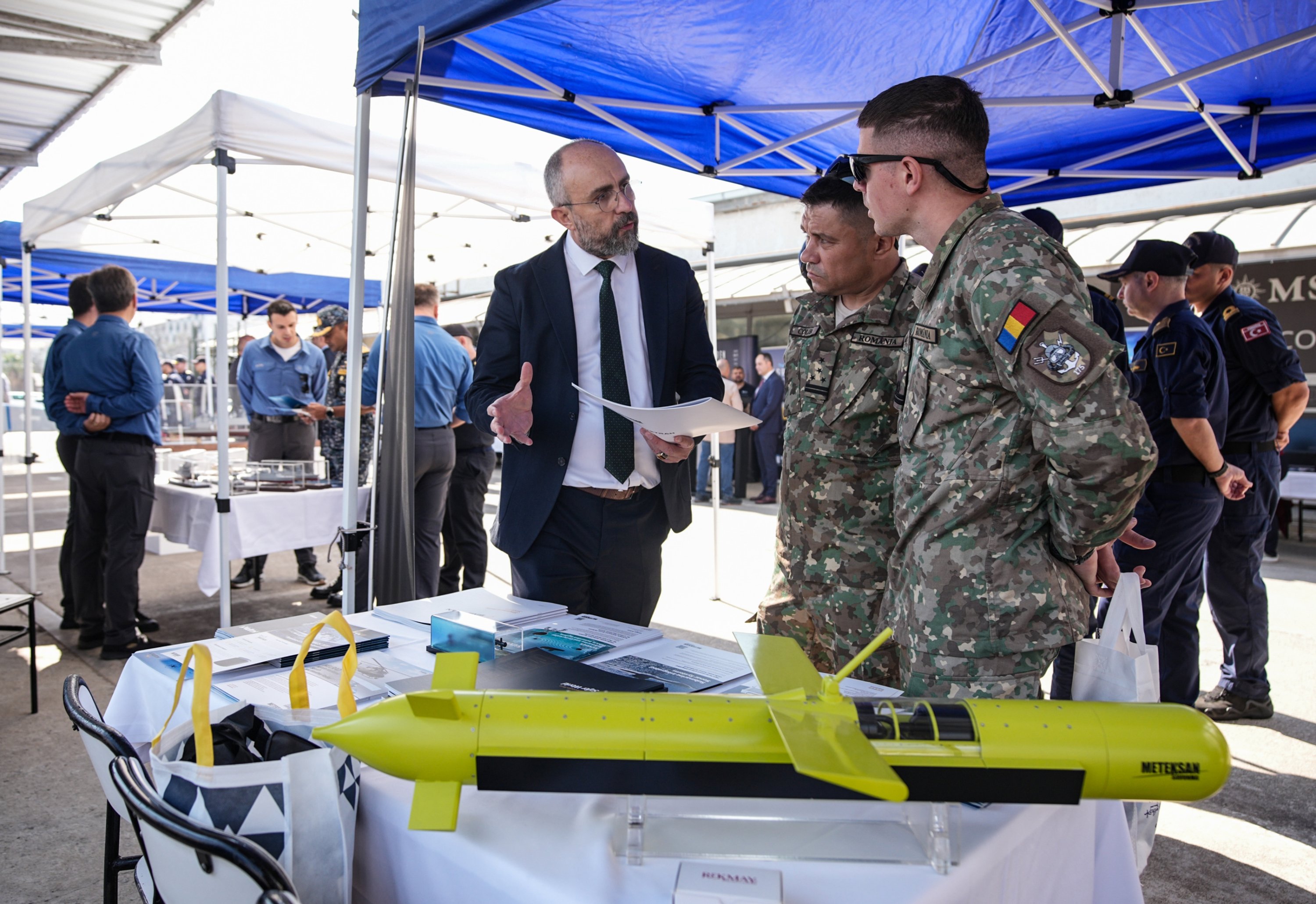
Meteksan Defense also showcased underwater acoustic technologies, including sonar systems developed for ships and submarines.
The company introduced two new products at Nusret-2026: the Submarine and Underwater Vehicle Detection System (SUVDES) and the National Synthetic Aperture Sonar System (MİLSAS).
SUVDES is designed for tasks including harbor security, protection of critical facilities and the detection of unmanned maritime vehicles.
State-owned defense manufacturer MKE, meanwhile, displayed several systems developed for naval warfare.
They included the Denizhan national naval gun, the Pirana kamikaze unmanned surface vehicle and the Malaman smart bottom mine, alongside infantry rifles used by naval forces.
A total of 20 ships, five aircraft and various unmanned systems are taking part in the exercise, which focuses on mine countermeasures and maritime operations.
Interior Minister Mustafa Çiftçi will be in Athens on Thursday. Ministry sources said Wednesday that the purpose of the visit was “cooperation in fighting against transboundary crime, terrorist groups and next-generation criminal gangs.”
He is scheduled to meet Greek Minister for Migration and Asylum Thanos Plevris and Minister for Citizen Protection Michalis Chrisochoidis. Çiftçi’s talks will focus on joint steps in the above-mentioned areas.
The Turkish and Greek officials will discuss extradition of members of criminal gangs and how to enhance cooperation in this area, ministry sources also said.
Çiftçi stepped up Türkiye’s contacts with neighboring countries in the joint fight against transboundary crimes and recently paid visits to Bulgaria and Georgia to this end.
The minister last visited Athens in April for a trilateral meeting with Plevris and Bulgarian Interior Minister Emil Dechev on security-related issues affecting the three neighboring countries.
U.S. Secretary of State Marco Rubio said Wednesday that any confrontation between Türkiye and Greece over the Aegean Sea or the island of Cyprus would benefit neither country nor the U.S., stressing Washington’s commitment to preventing tensions between the two NATO allies.
Speaking in an interview with Greek newspaper Kathimerini during a visit to Athens, Rubio dismissed the prospect of a conflict between Ankara and Athens, describing such a scenario as unthinkable.
“It wouldn’t be good for anybody. It wouldn’t be good for Greece. It wouldn’t be good for Türkiye. It wouldn’t be good for the United States,” Rubio underlined, adding that Washington would not allow such a situation to develop.
Rubio also addressed the proposed Great Sea Interconnector (GSI) electricity project linking Greece, the Greek Cypriot administration and Israel, acknowledging potential obstacles and emphasizing the importance of diplomatic engagement.
He said Washington intended to use diplomatic channels to encourage solutions, arguing that sensitive disagreements were best addressed through private negotiations.
Highlighting Türkiye’s strategic importance, Rubio noted that Ankara had previously hosted negotiations between Russia and Ukraine and maintained cooperation with Washington on several regional issues.
On Türkiye’s efforts to acquire U.S.-made F-35 fighter jets, Rubio reiterated that President Donald Trump supported a potential sale but acknowledged that existing U.S. legislation remained a significant obstacle.
He said restrictions tied to Türkiye’s acquisition of Russian S-400 air defense systems must be resolved before Washington could legally proceed with the transfer.
“The issue is the S-400 system,” Rubio said, adding that the matter remained unresolved despite possible diplomatic solutions.
Türkiye was removed from the multinational F-35 program in 2019 after acquiring Russia’s S-400 air defense system, prompting U.S. sanctions despite Ankara’s role as a production partner in the fighter jet program.
The U.S. and Greece announced $4 billion (TL 196.86 billion) in military sales under the Foreign Military Sales program to support Athens’ long-term defense plans, as the two countries pledged Wednesday to strengthen security and economic cooperation.
The announcement followed the sixth round of the U.S.-Greece Strategic Dialogue in Athens, co-chaired by Rubio and Greek Foreign Minister George Gerapetritis, according to a joint statement released by the U.S. State Department.
Both sides said the sales would bolster Greece’s defense capabilities and improve military interoperability, while also pledging to explore further cooperation between their defense industries, particularly in emerging and innovative technologies.


-
 Politics3 days ago
3 jailed in Türkiye over FETÖ-linked infiltration of MASAK data systems
-
 Politics2 days ago
Türkiye condemns Israel’s deepening incursion into Syria
-
 Economy2 days ago
Over $16B shifted into deposits amid fund exits: Turkish central bank
-

 Economy1 day ago
Inside Türkiye’s plan to repay investors caught up in fund turmoil
-
 Politics2 days ago
Turkish police detain 14 suspects linked to Daesh, al-Qaida
-
 Economy1 day ago
CBRT chief vows cautious stance to preserve disinflation gains
-
 Economy2 days ago
Türkiye sets new record for solar, wind power generation
-
 Politics2 days ago
Mecca Alliance activates collective deterrence over Saudi attacks