
Economy
Slump in auto exports amid tariffs hits Japan’s shipments to US

Japan’s exports dropped in May for the first time in eight months as top automakers like Toyota were hit by sweeping U.S. tariffs – while Tokyo also did not manage to strike a trade deal with Washington this week – which would likely put even more pressure on a fragile economy.
Japan’s Prime Minister Shigeru Ishiba said after the G-7 summit in Canada on Tuesday that his country had not reached a comprehensive tariff agreement with Washington, as some disagreements persisted between the two nations despite several rounds of talks.
Japan and the U.S. “explored the possibility of a deal until the last minute,” he added.
Tokyo is scrambling to find ways to get Washington to exempt Japan’s automakers from 25% automobile industry-specific tariffs, which are hurting the country’s manufacturing sector. Japan also faces a 24% “reciprocal” tariff rate starting on July 9 unless it can negotiate a deal with Washington.
The data on Wednesday showed that Japanese auto exports to the U.S. fell almost a quarter in May as worries over tariffs grow.
Roughly 8% of jobs are tied to the auto industry in Japan, which is home to the world’s top-selling carmaker, Toyota, as well as Honda, Nissan and other giants.
Japan’s automobile sector accounted for about 28% of the total 21 trillion yen ($145 billion) worth of goods the Asian country exported to the U.S. last year.
Total exports down
Its total exports in May dropped 1.7% year-over-year by value to 8.1 trillion yen, government data showed, smaller than a median market forecast for a 3.8% decrease, and following a 2% rise in April.
Exports to the U.S. slumped 11.1% last month from a year earlier, the largest monthly percentage decline since February 2021, dragged down by a 24.7% plunge in automobiles and a 19% fall in auto components, while a stronger yen also helped reduce the value of shipments. Exports to China were down 8.8%.
In terms of volume, however, U.S.-bound automobile exports dipped just 3.9%, indicating that the biggest Japanese exporters were absorbing the tariff costs.
“The value of automobile exports to the U.S. fell, but their volume did not drop that much,” Daiwa Institute of Research economist Koki Akimoto said. “This indicates Japanese automakers are effectively shouldering the tariff costs and not charging customers.”
So far, major Japanese automakers have refrained from price increases in the U.S. to mitigate the tariff costs, except for Subaru and Mitsubishi Motors.
“They are buying time right now to see the course of Japan-U.S. trade negotiations,” Akimoto said. The absence of price hikes could affect their profits, but their fiscal base is generally solid, he added.
While Japanese stocks and the yen showed little reaction to the data, shares of car companies have come under pressure this year due to concerns about the tariff impact.
Automakers and other transport companies are the second-worst performers this year among the Tokyo market’s 33 sector sub-indices, down almost 12%. Only makers of precision equipment have fared worse.
Toyota, the world’s top-selling automaker, has estimated that tariffs likely sliced 180 billion yen from its profit in April and May alone. Honda has said it expects a 650 billion yen hit to its earnings this year from tariffs in the U.S. and elsewhere.
The Japan May trade data provide one of the earliest indications of how U.S. President Donald Trump’s tariffs are impacting countries and the global economy.
China’s data showed this week that the country’s factory output grew 5.8% in May year-over-year, the slowest pace in six months. And its outbound shipments to the U.S. plunged 34.5%, the sharpest drop since February 2020.
The impending tariffs had driven companies in Japan and other major Asian exporters to ramp up shipments earlier this year, inflating levels of U.S.-bound exports during that period.
The Japan data showed imports dropped 7.7% in May from a year earlier, compared with market forecasts for a 6.7% decrease.
As a result, Japan ran a trade deficit of 637.6 billion yen last month, compared with the forecast of a deficit of 892.9 billion yen.
After the G-7 summit in Canada, Ishiba told reporters that U.S. tariffs were “hitting many Japanese companies’ profits.”
The situation “could have a grave impact on both Japan and the U.S. as well as the world economy, directly and indirectly,” he warned.
Drag on GDP
The hit from U.S. tariffs could add more pressure on Japan’s lackluster economy. Subdued private consumption already caused the world’s fourth-largest economy to shrink in January-March, the first contraction in a year.
However, the smaller-than-expected drop in May shipments suggests that Japan’s export driver has not stumbled, slightly raising the chance of the economy avoiding a contraction in the April-June quarter, Yuhi Kawano, economist at Mizuho Securities, wrote in a report.
The tariff woes complicate the Bank of Japan’s (BOJ) task of raising still-low interest rates and reducing a balance sheet that has ballooned to roughly the size of Japan’s economy.
The BOJ kept interest rates steady on Tuesday and decided to decelerate the pace of its balance sheet drawdown next year, signaling its preference to move cautiously in removing remnants of its massive, decadelong stimulus.
According to an estimate by the Japan Research Institute, if all the threatened tariff measures against Japan were to take effect, U.S.-bound exports would fall by 20% to 30%.
Some economists say those duties could shave around one percentage point of the nation’s gross domestic product (GDP).

Paramount inched closer to a blockbuster purchase of Warner Bros., months after the deal was initially floated, in what could be a game-changing moment in the entertainment industry.
California Attorney General Rob Bonta announced a settlement with Paramount in a lawsuit his state led challenging the company’s acquisition of Warner Bros. Discovery on Monday, effectively paving the way for the mega merger to move forward, with some new commitments.
The $81 billion blockbuster deal will bring together two of Hollywood’s oldest studios, key TV networks like CBS and CNN, and streaming platforms HBO Max and Paramount, as well as decades of libraries with titles ranging from “Harry Potter” to “Top Gun.”
But terms of Monday’s agreement include what Bonta called “court-enforceable” requirements for Skydance-owned Paramount to increase domestic production and establish monitoring of editorial independence of the company’s news operations.
The settlement still needs final court approval. Bonta maintained that Monday’s agreement “is not a vote of support for this merger” – but that he was always willing to come to the table and “find a strong solution that protects competition and consumers.”
The coalition of states – including entertainment heavyweights like California and New York – sued to block the $81 billion merger back in July, alleging a Paramount-Warner combo would “extinguish competition” and lead to fewer choices for consumers, particularly movie theatergoers and cable customers across the U.S.
Accompanied by a complaint also filed by the Writers Guild of America, the challenge was headed toward a full antitrust trial set to kick off in March.
Paramount said the allegations were meritless, but previously agreed to delay its transaction well into next year so the case could make its way through court. It then quickly called for a settlement – arguing that it had satisfied all regulatory clearances worldwide, including from the Trump administration’s Justice Department and the states’ challenge was its “final obstacle.”
As reports of the states reaching a settlement with Paramount emerged Monday, critics decried the deal – while warning of what further consolidation could mean in an industry already controlled by just a few major players.
“Today, billionaires have yet again bribed, censored, and bullied their way to the top,” Alvaro Bedoya, senior adviser at the American Economic Liberties Project and former FTC commissioner, said in a statement earlier Monday.
“Layoffs will follow. People from L.A. to Atlanta will lose their jobs, small businesses will lose their contracts, your cable bill and movie ticket will be even more expensive.”
Paramount, which is run by David Ellison, whose ultra-wealthy family has ties to U.S. President Donald Trump, won a bidding war against Netflix in February for control of a stable of assets that includes Warner Bros. Pictures, CNN and the HBO Max streaming service.
The Trump administration approved the deal, one of the largest media mergers in years, in June without demanding a change to its business, before 12 U.S. states sued to block the transaction.
Financing for the deal reportedly includes about $24 billion in equity from the sovereign wealth funds of Saudi Arabia, Qatar and Abu Dhabi. David Ellison’s father, billionaire Oracle founder Larry Ellison, also provided funding and a guarantee.
In their complaint, the 12 states argued the combined company would control roughly 27 percent of wide-release theatrical film distribution and a similar percentage of the basic cable channel industry.
California led the suit, joined by Arizona, Colorado, Connecticut, Massachusetts, Minnesota, Nevada, New Jersey, New Mexico, New York, Oregon and Washington, all Democratic-led.
Türkiye and the United Kingdom are continuing work on the procurement of Eurofighter Typhoon fighter jets, the National Defense Ministry said Monday.
The statement came after a team of experts from the ministry inspected aircraft maintenance facilities at the Royal Air Force’s Coningsby Air Base in the U.K. from Sept. 15-17.
Türkiye earlier this month said its pilots had begun flight training in August as part of the Eurofighter agreement signed with the United Kingdom.
“The work on the Eurofighter Typhoon procurement project being carried out with the United Kingdom continues as part of the modernization efforts of our Air Force,” the ministry said.
It described the visit as a “strategic” step toward planning maintenance and sustainment processes, ensuring compatibility of technical infrastructure and strengthening bilateral cooperation.
The inspection was conducted as Ankara and London continue their work on the Eurofighter Typhoon procurement project, according to the ministry.
The agreement signed in late October last year covers 20 Eurofighter jets that Türkiye will buy from the U.K. The deal is worth about 8 billion pounds ($10.8 billion).
This March, the countries signed a technical and logistical agreement for the maintenance and operation of the warplanes.
Britain, a leading partner in the Eurofighter program, had been Türkiye’s most vocal supporter, and the agreement followed long negotiations to overcome a German objection to the sale.
Türkiye’s interest in the Typhoon was first reported in 2022, as Ankara grew frustrated with prolonged negotiations over the acquisition of F-16 fighter jets from the U.S.
Türkiye is scheduled to receive the first of the batch of Typhoons in 2030. The deal provides the option for the sale of more jets in the future.
In addition, Türkiye also plans to purchase 12 secondhand jets from Qatar and 12 others from Oman.
Meanwhile, Türkiye is developing its own fifth-generation fighter jet. Named Kaan, the stealth fighter is sought to replace the Air Force Command’s aging F-16 fleet, which is planned to be phased out starting in the 2030s.
Türkiye’s manufacturing capacity utilization rate rose in September, while business confidence edged higher, the country’s central bank said Monday.
The unadjusted capacity utilization rate in the manufacturing sector increased 0.7 percentage points from the previous month to 74.2%, the Central Bank of the Republic of Türkiye (CBRT) said.
The seasonally adjusted rate rose 0.6 percentage points to 74.1%.
Among the main industrial groups, the highest utilization rate in September was 74.5% in intermediate goods, down 0.2 percentage points from the previous month.
At the other end, durable consumer goods recorded the lowest rate at 66.4%, a decline of 1.8 percentage points month-over-month.
By sector, the manufacture of wood products posted the highest capacity usage at 83.7%, while the lowest rate, 59.8%, was recorded in the leather industry.
The data was based on responses from 1,982 manufacturing companies participating in the central bank’s business tendency survey.
Business confidence edges higher
Separate data by the CBRT showed the seasonally adjusted Real Sector Confidence Index rose 0.1 percentage points in September to 102.5.
Assessments of the overall business outlook, current total orders, total orders over the past three months and employment expectations for the next three months contributed positively to the index.
Expectations for export orders over the next three months, assessments of finished-goods inventories, fixed-capital investment spending and expected production over the next three months weighed on the index.
The unadjusted Real Sector Confidence Index fell 0.8 percentage points from the previous month to 102.
Mixed signals in orders and production
Companies’ assessments of production volumes over the past three months shifted further toward those reporting an increase.
The balance of responses on domestic orders shifted from a decline toward an increase, while assessments of export orders moved from an increase toward a decline.
Fewer companies said current total orders were below seasonal norms, while more respondents assessed finished-goods inventories as above seasonal norms.
For the next three months, expectations for higher production and export orders weakened, while expectations for an increase in domestic orders strengthened.
Expectations for higher employment over the next three months also strengthened, while expectations for fixed-capital investment over the next 12 months weakened.
Producer price expectations ease
Expectations for higher average unit costs over the next three months strengthened, as did reports of higher costs over the previous three months.
Expectations for higher selling prices over the next three months also increased.
The manufacturing sector’s expectation for annual producer-price inflation over the next 12 months fell 0.2 percentage points from the previous month to 31%.
Meanwhile, the share of respondents who viewed the overall outlook in their industry as worse than the previous month weakened, indicating a less pessimistic assessment of conditions.
Türkiye generated a combined 442.2 terawatt-hours of electricity from solar and wind power between 2015 and 2025, according to data from the Energy and Natural Resources Ministry released Monday.
The output helped avoid $21.5 billion in coal imports and an estimated 354 million metric tons of carbon dioxide emissions, the ministry said.
The release coincided with the World Zero Emissions Day, observed on Sept. 21 since 2008 to raise awareness of the impact of fossil fuels, reduce carbon footprints and promote renewable energy.
Türkiye generated 11,847 gigawatt-hours of electricity from solar and wind in 2015, replacing electricity that would have required around $300 million worth of imported coal and avoiding an estimated 9.5 million tons of carbon dioxide emissions, the ministry said.
Renewable generation increased over the following decade, reducing the potential carbon emissions associated with fossil-fuel-based power generation.
Between 2015 and 2025, the 442.2 TWh generated by solar and wind was equivalent to electricity that would have required $21.5 billion in imported coal or $43.3 billion in imported natural gas, according to the ministry.
If the same amount of electricity had been generated entirely from imported coal, about 354 million tons of carbon dioxide emissions would have been avoided. If it had instead been generated entirely from natural gas, the avoided emissions would have amounted to about 177 million tons.
Energy and Natural Resources Minister Alparslan Bayraktar said Türkiye was continuing to maximize its renewable-energy potential as part of its targets for net-zero emissions by 2053 and greater energy independence.
“Between 2015 and 2025, the 442.2 TWh of electricity we generated from wind and solar prevented carbon emissions of up to 354 million tons,” Bayraktar said in a post on the social media platform X.
He said Türkiye had also avoided tens of billions of dollars in fossil-fuel imports while expanding renewable energy.
Bayraktar said Türkiye had risen to fifth place in Europe and 11th globally in renewable energy by installed capacity and investment, and reiterated the country’s target of reaching 120 gigawatts of renewable capacity by 2035.
The shares of solar and wind power in Türkiye’s electricity generation reached 11.6% and 12.1%, respectively, as of this July.
Solar power’s share of electricity generation rose 28-fold from 0.4% in 2016, while wind power’s share increased from 5.7% to 12.1% over the same period.
The rise in renewable generation was accompanied by a significant expansion in installed capacity.
Türkiye’s total electricity generation capacity reached 126,476 megawatts (MW) at the end of July. Solar accounted for 27,507 MW, or 21.7% of total installed capacity, while wind capacity reached 15,358 MW, representing 12.1%.
Combined solar and wind capacity stood at 42,865 MW, accounting for 33.8% of Türkiye’s total installed electricity capacity.
Solar power generation also reached a new monthly record in July after setting a previous record in June. Solar-generated electricity totaled 5.37 billion kilowatt-hours in July, the highest monthly level on record.
Iranian airlines will have trouble functioning globally in two days under the weight of American sanctions, U.S. Treasury Secretary Scott Bessent warned Monday, as the Trump administration seeks to keep pressure on Tehran.
On Sept. 23, Wednesday, “all the Iranian airlines will be shut down around the world,” Bessent told CNBC in an interview.
“If they land, you cannot provide them with fuel, you cannot provide them with landing services, you cannot sell them tickets, or you will be knocked out of the dollar system,” he added.
The war in Iran started after the United States and İsrael launched joint strikes in late February.
Tehran countered by blocking the Strait of Hormuz, a vital waterway for energy transit, causing global oil prices to surge as the conflict spread in the Middle East.
Earlier this month, the United States imposed sanctions on “all remaining Iranian airlines” that had yet to face such penalties.
The Treasury Department also took aim at targets for supporting Iran’s aviation sector, including firms based outside Iran.
Bessent previously vowed the United States would declare “economic D-Day” on Iran and pledged to choke off Tehran financially.
Bessent’s comments came a day after he met with Chinese Vice Premier He Lifeng for economic talks laying the groundwork for President Donald Trump’s summit this Thursday with Chinese leader Xi Jinping.
China is one of Iran’s top economic partners and diplomatic backers.
Iran’s aviation sector has long grappled with sanctions, which have restricted its ability to acquire aircraft, spare parts and maintenance services.
Advanced Micro Devices (AMD) briefly climbed past $1 trillion in market capitalization for the first time on Monday, marking a milestone for the chipmaker, which joined a small group of competitors with a similar valuation as investors bet on its expanding role in artificial intelligence computing.
The company’s shares were last up 9% at $610, after surging to an all-time high of $613.92, creating a valuation of just over $1 trillion.
The milestone caps a stellar rally for the Santa Clara, California-based AMD, regarded as the closest rival to AI bellwether Nvidia for graphics processing units (GPUs).
It becomes the fourth U.S. chipmaker to top a $1 trillion valuation, after Nvidia, Broadcom and Micron. Nvidia crossed the mark in 2023 and is now the world’s most valuable company, worth more than $5 trillion.
AMD has accelerated its AI product launches and moved beyond selling individual chips to offering complete systems that combine processors, networking gear and related hardware, helping it compete with Nvidia’s products.
The company is also benefiting from rising demand for central processing units used alongside graphics processors in servers handling inference. That has helped AMD take market share from Intel.
Early last month, AMD forecast quarterly revenue above Wall Street estimates, which fell short of lofty investor expectations, sending its stock down over 7% on the day. Since then, it has leaped over 26%.
Most chip stocks surged on Monday, with Intel jumping around 11%, Qualcomm rising 4.1% and the broader chips index gaining 2.6% to a one-month high.


-

 Sports3 days ago
Jordan tops all-time highest-paid athletes list, Ronaldo closes in
-

 Sports3 days ago
Mbappe swaps Nike for On as Swiss brand plots entry into football
-

 Economy15 hours ago
Türkiye extends funds liquidation process, freezes execs’ assets
-

 Sports3 days ago
Infantino invited to CAF strategy conference as FIFA election looms
-

 Economy2 days ago
Türkiye revokes license of Iranian Bank Mellat
-

 Politics2 days ago
Türkiye closely monitoring field as terror-free initiative advances
-
 Politics21 hours ago
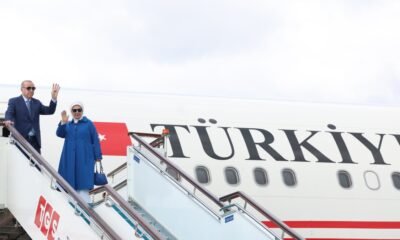
Erdoğan leaves for UN General Assembly with Gaza in mind
-

 Politics12 hours ago
Türkiye rejects disinformation targeting child protection operations