
Economy
Trump imposes 50% tariffs on $20 billion worth of Canadian products

U.S. President Donald Trump announced a 50% tariff on a broad range of Canadian imports on Monday, citing alleged trade discrimination against American-made cars, alcohol and dairy products.
The move could unleash a new wave of economic chaos, with risks of higher inflation and further fraying of relations between two nations that had been closely woven together before Trump’s return to the White House.
The administration official previewing the action said that Canada was one of the few nations, other than China, that retaliated against Trump’s previous tariffs and must be held accountable.
The official insisted on anonymity on a call with reporters to preview the president’s actions and said that Trump signed three proclamations to launch the tariffs under Section 338 of the 1930 Trade Act. Several Democratic lawmakers last year proposed repealing the section because they said Trump could use it to destabilize the economy.
The U.S. Trade Representative’s office said that the tariffs would apply to nearly $20 billion of imports from Canada. That’s about 5.2% of the $382 billion worth of goods that the U.S. imported from Canada in 2025, according to U.S. Census Bureau data.
The new levies would exclude energy products, potash, fish and critical minerals, but they would include goods that had previously been protected from import taxes by the United States-Mexico-Canada Agreement, or USMCA. That 2020 trade pact was not renewed by the U.S., triggering a new set of negotiations that could run until 2036.
The White House said in a fact sheet that the tariffs would go into effect in 30 days, meaning there is time for negotiations, as Trump has not always followed through on his announced tax hikes on imports.
Canadian Prime Minister Mark Carney said in a statement that his government believes in the “benefits of free and fair trade,” having signed “more than 20 new economic and security partnerships.” He said Canada is prepared to negotiate with the Trump administration.
“This trade dispute has raised costs for families, particularly in the U.S.,” Carney said. “Canada stands ready to engage intensively to address outstanding issues with the U.S. to the mutual benefit of our citizens.”
Risk of broader trade war
Still, the tariffs could escalate into a wider trade war as Canada seeks to defend its economy. Ontario Premier Doug Ford saw a possible showdown ahead.
“If these tariffs proceed, Canada should respond tariff for tariff, dollar for dollar,” Ford posted on social media.
Candace Laing, CEO of the Canadian Chamber of Commerce, said the Trump administration’s moves were “regrettable” but the two countries need to use the 30-day window before the tariffs start “to make meaningful progress in advancing formal talks.”
Chris Swonger, CEO of the Distilled Spirits Council of the United States, also called for a deal: “We encourage policymakers on both sides of the border to pursue a negotiated solution that restores market access for U.S. spirits and avoids further harm to the U.S. hospitality sector.”
But the use of a Great Depression-era law to impose the tariffs broadens some of the risks, as those tariffs could be applied to other U.S. trading partners, not just Canada, and inject “massive uncertainty” into the global economy, said Scott Lincicome, vice president of general economics at the Cato Institute, a libertarian think tank.
“We crossed the Rubicon,” Lincicome said. “The invocation of 338 is the nuclear option for Trump tariffs.”
Political challenge for Trump
The new tariffs carry serious political and economic risks for Trump ahead of the November midterm elections for control of Congress. His “Liberation Day” tariffs last year in April provoked a financial market meltdown over concerns about inflation and a recession, prompting him to walk back the rates for a period of negotiation.
The Supreme Court ruled this February that Trump had lacked the legal authority to impose the tariffs by declaring an economic emergency, causing the administration to find alternative ways to raise import taxes based on a series of legal authorities.
Tariffs are taxes on imports, which companies can then pass along to consumers in the form of higher prices. The president maintains that the costs created by tariffs will cause manufacturing to relocate to the U.S., though there is little evidence of that in the economic data.
“These new taxes will raise prices on American families and likely lead to retaliation against the very industries Trump purportedly wants to protect,” said Rep. Suzan DelBene, D-Wash., who is chair of the Democratic Congressional Campaign Committee.
The latest import taxes could worsen Trump’s weak ratings on the economy.
He promised voters when running for the presidency that he would bring prices down, but the annual inflation rate has risen since he became president because the tariffs and the war in Iran are pushing up oil prices.
Trump repeatedly targeted Canada
The Trump administration official said the president had also requested that his aides look into additional tariffs on Canada because its wildfires hurt air quality in the U.S. He had publicly threatened to do so in social media posts.
At the World Cup final on Sunday, Trump watched the game with Carney. The Trump administration official said their time together at the game was not a working visit to discuss trade and tariffs.
Trump claims in the proclamations that Canada discriminates against American autos, alcohol and cheese relative to other nations, but his argument rests in large part on retaliatory actions taken by Canada after the U.S. president imposed tariffs on Canada under the pretext that it should do more to stop fentanyl smuggling.
Trump noted in his auto proclamation that Canada maintained, starting in April 2025, a 25% tariff on the imports of U.S. motor vehicles that did not qualify for preferential treatment under the USMCA.
The White House said that, regarding alcohol, all but two Canadian provinces and territories halted the purchase and retailing of American alcoholic beverages beginning last year, which was also a response to Trump’s tariffs and taunts of making Canada the 51st state.
But Trump has long objected to Canada’s treatment of U.S. cheese, saying in his proclamation that Canada discriminates against the U.S. compared to Europe on dairy products.
Trump and Carney have had a frosty relationship, with Carney, a former central banker, pledging to go “elbows up” for Canada during his election campaign last year.
At the World Economic Forum in Davos, Switzerland, in January, Carney called out Trump – without naming him – by saying that the “most powerful” countries are using the economy to coerce less powerful nations.
Trump responded at the time by saying: “Canada lives because of the United States.”
German factory orders dropped sharply in August, more than forecasted, as large-scale orders for aircraft, ships, trains and military vehicles declined, official data showed Tuesday, underscoring the fragility of a recovery in Europe’s biggest economy.
New orders, a key indicator of future business activity, were down 10.6% from a month earlier due to a drop in large-scale domestic orders, according to provisional data from Destatis.
It was the first decline in four months and more than the 1% decrease forecast by analysts surveyed by the financial data firm FactSet and Reuters.
The long-stagnant German economy has been slowly recovering on the back of massive public spending, with some recent data generally pointing to signs of growing strength.
The economy ministry said August’s order data thus represented a “marked setback.”
The decline was entirely attributable to a 61.5% slump in what the statistics office classifies as “other transport equipment,” a category that more than doubled in July due to an exceptionally high volume of large-scale orders of ships, railway rolling stock and aircraft.
When large-scale orders are excluded, new orders in August were 0.1% lower than in the previous month.
Weak figures likely to drag on Q3 growth
The weak figures suggest industry will weigh on third-quarter economic growth after helping to drive expansion in the first half of 2026, although analysts expect a rebound in the fourth quarter as government contracts pick up.
The German economy grew by 0.3% in the second quarter, prompting the government to raise its full-year forecast to 1.3%.
Much of the momentum seen in German industry so far this year has been driven by defense spending.
“Excluding these highly volatile large orders, bookings in the manufacturing sector have been treading water for months,” said Jupp Zenze, economic expert at the German Chamber of Commerce and Industry.
“Broad-based economic momentum remains absent.”
Economist points to full order books
The three-month comparison, which strips out some of the month-on-month volatility, showed that new orders in the period from June to August were 1.3% higher than in the previous three months.
Based on the figures available so far, the industrial sector likely slowed growth of the German economy in the third quarter, in contrast to the first half of the year, said Commerzbank senior economist Ralph Solveen.
However, Solveen expects this trend to reverse in the fourth quarter, as the government is likely to issue more contracts, which should have a positive long-term impact on sales and production.
“This outlook is also supported by the significant improvement in business sentiment over the past few months,” he said.
After revision of provisional data, new orders in July increased by 3.2% compared with the previous month, up from the previously estimated 2.5%.
According to the latest data from July, the order backlog provided coverage for a record nine months, said Marc Schattenberg, economist at Deutsche Bank.
“The disappointingly weak August figures should be viewed in the context of already very full order books,” Schattenberg said.
Foreign orders were down 5.4% in August on the month, with orders from the euro zone registering a decline of 5.4% and orders from outside the eurozone decreasing by 5.5%. Domestic orders declined by 17.3% on the month.

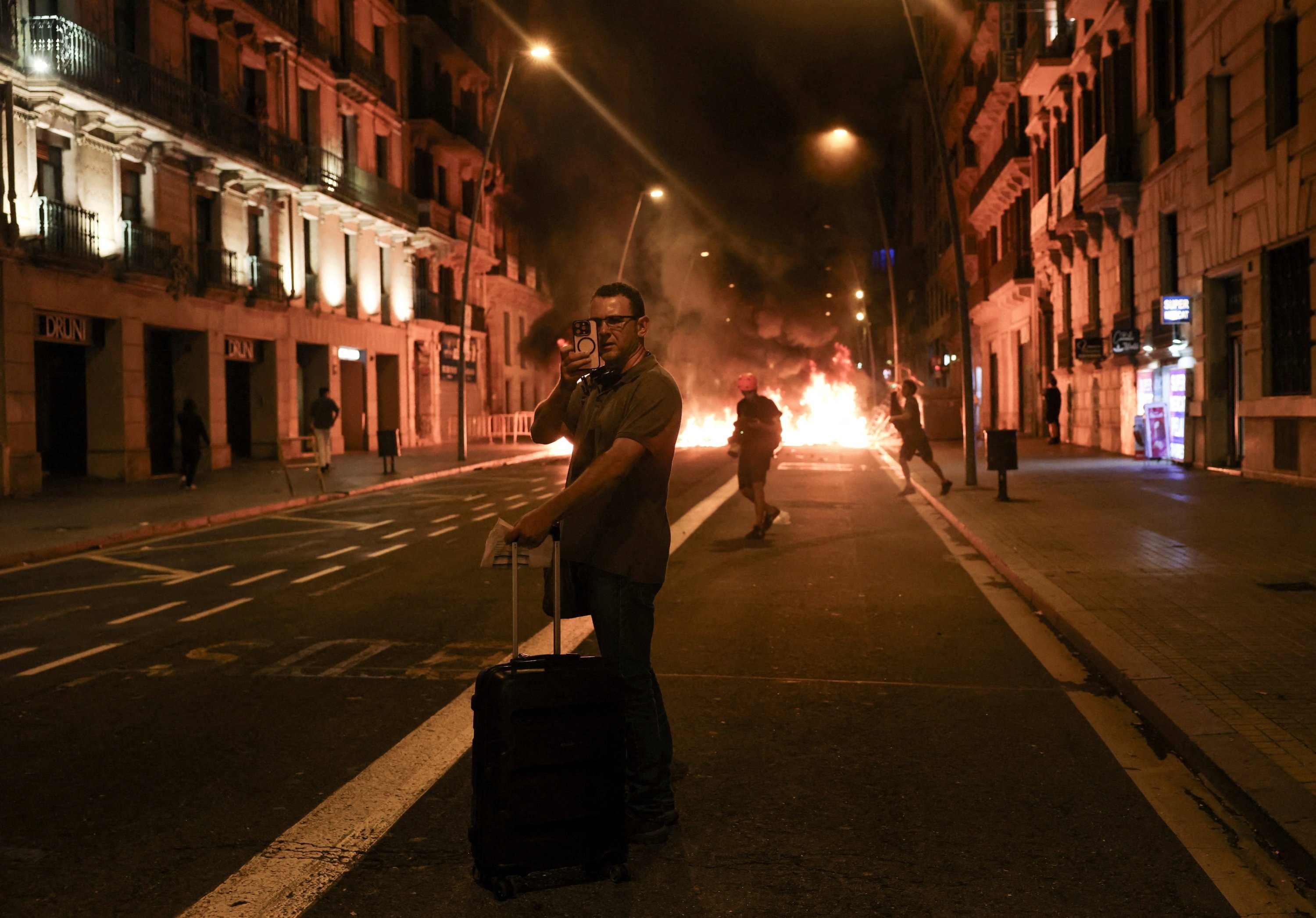
Spain’s government on Tuesday approved emergency measures to address the housing crisis, after an outbreak of violence in the coastal city of Barcelona the previous night that drew tens of thousands of people into the streets.
The Barcelona turmoil late on Monday followed protests across the country over the weekend that demanded measures to resolve a crisis sparked by the eviction of an 87-year-old woman in Madrid, the country’s capital.
In Barcelona, Spain’s second-largest city, a severe weather alert over the weekend had forced organizers to reschedule the protest for Monday. What began as a massive peaceful march turned violent when groups of hundreds of hardcore activists clashed with police, throwing stones and setting fire to trash containers.

Prime Minister Pedro Sanchez’s government approved measures similar to those rejected by Parliament last Friday, which prompted his call for early elections on Nov. 29. The measures will be sent for ratification by an interim legislature, which remains active until the elections.
The smaller, interim legislature – known as “permanent commission” – is composed of 69 members, compared to the 350 that sit in the regular Parliament.
Alejandro Quiroga, professor of political science at Madrid’s Complutense University, said the maneuver of having decrees approved by the interim legislature was constitutional but also a necessary political move by Sanchez.
“I don’t think Sanchez had an alternative,” Quiroga told the Associated Press (AP). “If you are calling early elections so you can keep the public’s focus on housing, you can’t just sit back and do nothing about it. That wouldn’t have been smart.”
The new measures are to extend protection against evictions for vulnerable Spaniards until 2030, regulate room rentals, impose a new tax on seasonal rentals, ban speculative real estate purchases and give tax breaks to landlords, Housing Minister Isabel Rodriguez told reporters last week.
Rising costs and a housing shortage are pricing many Spaniards out of the housing market, despite strong economic growth in Europe’s fourth-largest economy.
The protesters have been demanding stronger protections for tenants, measures to combat fraud and a ban on evictions when alternative housing is unavailable.
Dario Amodei took home $18 million last year as chief executive of Claude AI developer Anthropic, according to the company’s IPO filing, putting his compensation roughly in the middle tier among leading technology executives.
Anthropic is preparing for an initial public offering as early as this fall that could value it at more than $2 trillion, according to its IPO prospectus reported by Reuters. Amodei’s pay last year puts him above CEOs at Alphabet and Amazon, but behind those at Oracle and Nvidia.
Amodei’s pay leans heavily toward stock and other sorts of compensation, suggesting that, like many other tech founders, his yearly salary will account for just a fraction of his wealth.
Amodei and his sister, Anthropic President Daniela Amodei, each had their annual salaries doubled in July to $1.4 million. Stock and options awards made up the bulk of their packages in 2025, with Daniela Amodei receiving a total of $16.4 million last year.
Anthropic’s board this year granted the pair the promise of further equity in the form of restricted stock units, which promise a future payout if certain conditions are met. Some of that is tied to their remaining at the company, and some of it is tied to the IPO.
Chief Financial Officer Krishna Rao earned $720,250 last year. He was granted options to buy 1.4 million shares when he was hired in 2024, and exercised options worth $385,285 in 2025.
Middle of the pack
The rise in U.S. CEO pay in recent years has far outpaced the gains for the average worker, a dynamic critics worry could be exacerbated by AI’s widespread adoption.
S&P 500 CEO average annual compensation rose 21% to $22.8 million last year, and that does not include the extraordinary case of Tesla’s Elon Musk and his $158 billion restricted stock plan, according to the AFL-CIO.
Courtney Yu, director of research for executive compensation data firm Equilar, said Amodei’s $18 million haul “seems on the lower end for a company valued at $2 trillion, but it will be interesting to see how that changes once the company goes public” and his full ownership stake is shown.
With six other co-founders, Amodei may wind up getting a lesser share of the wealth created by the IPO compared with other major tech CEOs, Yu added.
Top executives at AI-focused tech firms earned amounts that varied widely in 2025, based on SEC filings.
At the high end, Oracle co-CEO Clayton Magouyrk earned $627.5 million, while the lowest was the $54,080 paid to Musk as CEO of SpaceX, before it went public. SpaceX has also promised super-voting restricted shares to Musk, already the world’s richest person, if the company’s market value grows to $7.5 trillion and the firm puts 1 million people on Mars.
Other giant companies pay less on a year-by-year basis, with executives benefiting from enormous stock ownership while having only salary and security costs reflected in annual filings.
For instance, Alphabet CEO Sundar Pichai made $10.9 million in 2025, including $8.8 million for personal security “due to Sundar’s significant public profile.” By “compensation actually paid,” Pichai earned $213.9 million last year, which, among other things, reflects the change in value of his unvested shares.
Amazon CEO Andrew Jassy made $2.1 million in 2025, a disclosure said, mainly reflecting travel and security. On an “actually paid” basis, Jassy received $13.2 million.
Living off the stock
Equilar’s Yu said the disclosures show how these executives don’t need to worry about year-by-year pay.
“Founder CEOs typically own enough equity that when the company does well and the stock price increases, they can just live off the wealth of the equity they already own, and typically don’t take in a lot in annual compensation,” Yu said.
Anthropic said in the filing it offered a mix of salary, equity awards, and other benefits. The S-1 statement reported by Reuters does not describe the founders’ share of ownership in the company, which could be worth billions of dollars, depending on the final terms and valuation of the IPO.
The Amodei siblings and their fellow co-founders pledged in the IPO filing to dedicate 80% of their personal Anthropic equity to charitable causes.
Asked about the 80% figure Monday, an Anthropic spokesperson noted an essay Dario Amodei posted earlier this year, where he wrote that wealthy individuals have an obligation to help address problems stemming from AI adoption, and decried that many wealthy people, particularly in the tech industry, “have recently adopted a cynical and nihilistic attitude that philanthropy is inevitably fraudulent or useless.”
German factory orders dropped sharply in August, more than forecasted, official data showed Tuesday, underscoring the fragility of a recovery in Europe’s biggest economy.
New orders, a key indicator of future business activity, were down 10.6% from a month earlier due to a drop in large-scale domestic orders, according to provisional data from Destatis.
It was the first decline in four months and more than the 1% decrease forecast by analysts surveyed by the financial data firm FactSet.
The long-stagnant German economy has been slowly recovering on the back of massive public spending, with some recent data generally pointing to signs of growing strength.
The economy ministry said August’s order data thus represented a “marked setback.”
But it also noted that without the fall in big orders, the situation was virtually unchanged from July.
August’s drop was driven by lower domestic orders. There was a more than 60% decrease in the category that includes military vehicles, aircraft, ships and trains.
Orders in this area have boomed in recent years as Germany spends huge sums on its military to face a hostile Russia and amid worries over U.S. security guarantees to Europe.
The ministry emphasized that the growing importance of public procurement meant that orders were “highly volatile.”
On a less volatile three-month basis, new orders from June to August were 1.3% higher than in the previous three months.
The energy shock from the U.S. war against Iran has added to headwinds for Germany’s recovery, but so far the economy has withstood the fallout better than initially feared.
Leading economic institutes recently doubled their growth forecast for this year to 1.3%.
Fast-food chain McDonald’s has been sued in federal court in Chicago in a proposed nationwide class action alleging that the company illegally coordinates menu prices across its franchises and company-owned restaurants by using an AI-powered pricing system.
The lawsuit, filed on Friday, said McDonald’s violated U.S. antitrust law by conspiring with independent franchisees to fix prices using algorithms trained on nonpublic data.
Reuters reported recently that McDonald’s pricing engine uses machine-learning algorithms to continually analyze data from millions of daily transactions across its nearly 14,000 restaurants.
The lawsuit cited the Reuters article, which said that other fast-food companies are also turning to AI to help with pricing and other operations.
“Independent businesses must set their prices independently,” the lawsuit said.
McDonald’s, in a statement on Monday, called the allegations speculative and uninformed.
“AI does not set the price of a Big Mac or any other menu item,” the company said.
It said franchisees make their own pricing decisions, and that the use of pricing recommendation tools and analytics is widespread across industries.
U.S. plaintiffs have filed a wave of class actions in recent years alleging that companies used algorithms or AI to illegally coordinate prices for hotel rooms, apartment rentals and other purchases.
Lark Turner, a lawyer for the plaintiff, said in a statement that McDonald’s is “leveraging its troves of data and its franchised system to nickel-and-dime consumers down to the last French fry.”
The plaintiff, an Illinois resident, is seeking to represent a class of potentially millions of McDonald’s customers, the lawsuit said.
Some of the world’s most prominent central bankers will attend the Istanbul Economic Forum this week to discuss inflation, monetary policy and the global economic outlook, the forum’s website said.
U.S. Federal Reserve (Fed) Governor Christopher Waller, Bank of England (BoE) Governor Andrew Bailey, Bank for International Settlements (BIS) General Manager Pablo Hernandez de Cos and Banque de France Governor Emmanuel Moulin are among those due to attend the two-day forum on Thursday and Friday.
Other expected attendees include the central bank governors of Greece, the Netherlands, Hungary, Saudi Arabia, Malaysia, Azerbaijan and Kazakhstan, according to the website compiled by the Central Bank of the Republic of Türkiye (CBRT).
In total, 16 central bank governors and eight deputy governors, as well as the finance ministers of Türkiye and Egypt and officials of international financial institutions, are scheduled to join the meeting.
The forum said participants will discuss topics including navigating a fragmenting global economy, monetary policy under uncertainty, debt dynamics, and the implications of artificial intelligence and digital innovation for macroeconomic policy.
The Federal Reserve website included Waller’s planned speech at the conference on its schedule for Thursday.


-

 Economy2 days ago
Revolut: $115 billion fintech taking on Europe’s biggest banks
-

 Economy2 days ago
Global M&A deal rush slowed down in Q3 as borrowing costs bite
-

 Economy22 hours ago
Brazilian assets rally as Flavio Bolsonaro tops first-round vote
-

 Economy1 day ago
Türkiye’s Halkbank after secondary offering amid strong interest: CEO
-

 Politics1 day ago
MP hints at more access for Öcalan amid terror-free Türkiye bid
-

 Economy1 day ago
Türkiye’s inflation drops below 30% for 1st time in nearly 5 years
-

 Economy18 hours ago
Türkiye says Development Road could become $80B ‘energy corridor’
-
 Economy17 hours ago
Top central bankers due in Istanbul to discuss policy challenges