
Economy
THY aims to be 1st Turkish firm among top 100 global brands

Türkiye’s flag carrier Turkish Airlines (THY) aims to become one of the top 100 most valuable brands worldwide, making it the first Turkish firm and potentially the first airline to do so, according to its chief executive.
The carrier aims to prioritize value-driven growth alongside volume-driven growth to reach this goal, CEO Ahmet Olmuştur, who earlier this year assumed the role, told Anadolu Agency (AA).
Building brand value is a unique endeavor for each firm and is seen as a long-term process.
“We’ve created some 122 touchpoints to interact with passengers, starting from visiting our website and continuing with the check-in and boarding at the airport, as well as with in-flight experience, baggage delivery, and other subsequent customer relations processes – these make up integral parts of customer experience and are the most important criteria in our strategy,” he said in the recently published interview.
The carrier held the title of Türkiye’s most valuable brand for nine consecutive years, reaching a record valuation of $2.9 billion last year, and the airline invested in product diversification to elevate its global standing to extend its success at home to the rest of the globe with the upcoming launch of a Premium Economy class.
“We will offer passenger seats with a greater recline angle and more legroom, alongside an enhanced in-flight dining experience and additional benefits through the Miles&Smiles loyalty program,” Olmuştur said, noting that the airline is targeting 2029 for the widespread rollout of the program as efforts are underway to reassess its fleet.
In addition to cabin upgrades to accommodate the new package, Turkish Airlines initiated a tender process in July to acquire regional aircraft, with integration expected to be in the second half of 2028.
“The fleet expansion will allow connecting a daily passenger count of 100-140 to Istanbul and transport our passengers to other destinations in our flight network via the megacity, thereby strengthening the importance of the IGA Istanbul Airport as a leading hub,” he said.
Plans are underway to increase the number of long-range high-capacity aircraft with a focus on models boasting 400 seats.
The carrier already boasts the world’s highest operational efficiency for its Airbus A350 and Boeing 787 Dreamliner fleets in 2025-2026.
One of Turkish Airlines’ Airbus A350s, named TC-LGP, logged an industry-leading average of 17 hours and 20 minutes of daily flight duration last year.
“We aim to ensure the effective use of our aircraft by maintaining the highest standards of safety, maintenance, and operational requirements,” he noted.
Olmuştur stated that route expansion efforts continue to drive the flag carrier’s market share as the airline attracted 1.2 million first-timers over the past year, while its footprint in Asia grew with new flights to Chengdu, China, set to launch on Nov. 11, complementing its existing schedules of 14 weekly flights each to Beijing, Shanghai, and Guangzhou.
He also mentioned that flights to the Belarusian capital of Minsk will resume on Sept. 20.
Meanwhile, Turkish Airlines is also expanding its logistics efforts with redirecting its cargo capacity toward high-demand markets with limited supply to maximize revenue.
“We’re closely monitoring the price balance in the market, allowing us to use our capacity more efficiently and generate further revenues,” he noted.
Olmuştur stated that technological integration remains a priority at Turkish Airlines, with the flag carrier’s TK Assistant, an application powered by artificial intelligence, handling over 2 million passenger inquiries in over 100 languages in its first seven months since rollout.
He mentioned that Turkish Airlines, as the carrier flying to most countries worldwide, aims to capture a broader share of the tourism market with its dedicated platform, Turkish Airlines Holidays, beginning by awarding additional status miles on travel packages starting as of Sept. 1.
These efforts aim to further bolster the Miles&Smiles loyalty program, which recently exceeded 25 million members.
“The program reached a scale that can no longer be described as a simple frequent-flyer program,” he said.
“We gathered at the IGA Istanbul Airport with 100 of our passengers who have flown the most consistently since the program launched and have forged very strong bonds with our brand over the years.”
Olmuştur added that he began his career at a Turkish Airlines call center in 2000, noting that capturing employee insights is one of the brand’s priorities to make continuous improvements.

Focusing on the disinflation process and ensuring price stability alongside sustainable growth remains the top priority, Vice President Cevdet Yılmaz said on Sunday while unveiling the new road map for the Turkish economy, covering the 2027-2029 period.
“The main point is to resolutely continue the disinflation process and permanently establish price stability,” Yılmaz said while presenting the new Medium-Term Program (MTP) for the 2027-2029 period.
Speaking in Ankara, Yılmaz said that the government revised its growth forecast for 2026 to 3.3% from an earlier 3.8% and that it expects inflation to end the year at 28.4%.
“We expect inflation to start declining again in the fourth quarter of 2026 and to reach 28.4% by the end of the year,” he said in a televised address.
Under the new program, inflation is projected to fall to 21% in 2027, 13.5% in 2028 and 9% in 2029, the vice president also said.
Türkiye’s annual inflation rate eased to 31.51% in August from 31.75% in July, according to official data.
Yılmaz said the war in the Middle East had played a key role in the upward revision of the inflation outlook.
“According to our central bank, the direct and indirect effects of the war on inflation have been estimated at approximately 7 percentage points,” he said.
The vice president also said the government had made “significant progress in combating inflation,” which remains the top priority of its economic program.
“Inflation, which had risen to 75.5% in May 2024, has begun to show a clear downward trend as a result of the policies we have implemented,” he said.
Starting his speech, he reflected on the holistic approach and involvement of the ministries when forming the road map, which constitutes the main policy framework, as he shared key targets and forecasts for the upcoming period.
Global risks
“The global economy is going through a new period in which economic, technological and geopolitical developments have become increasingly intertwined, predictability has declined, and risks have reached historically high levels,” said Yılmaz.
“The Turkish economy is, of course, not independent of developments in the world or in our region,” he added.
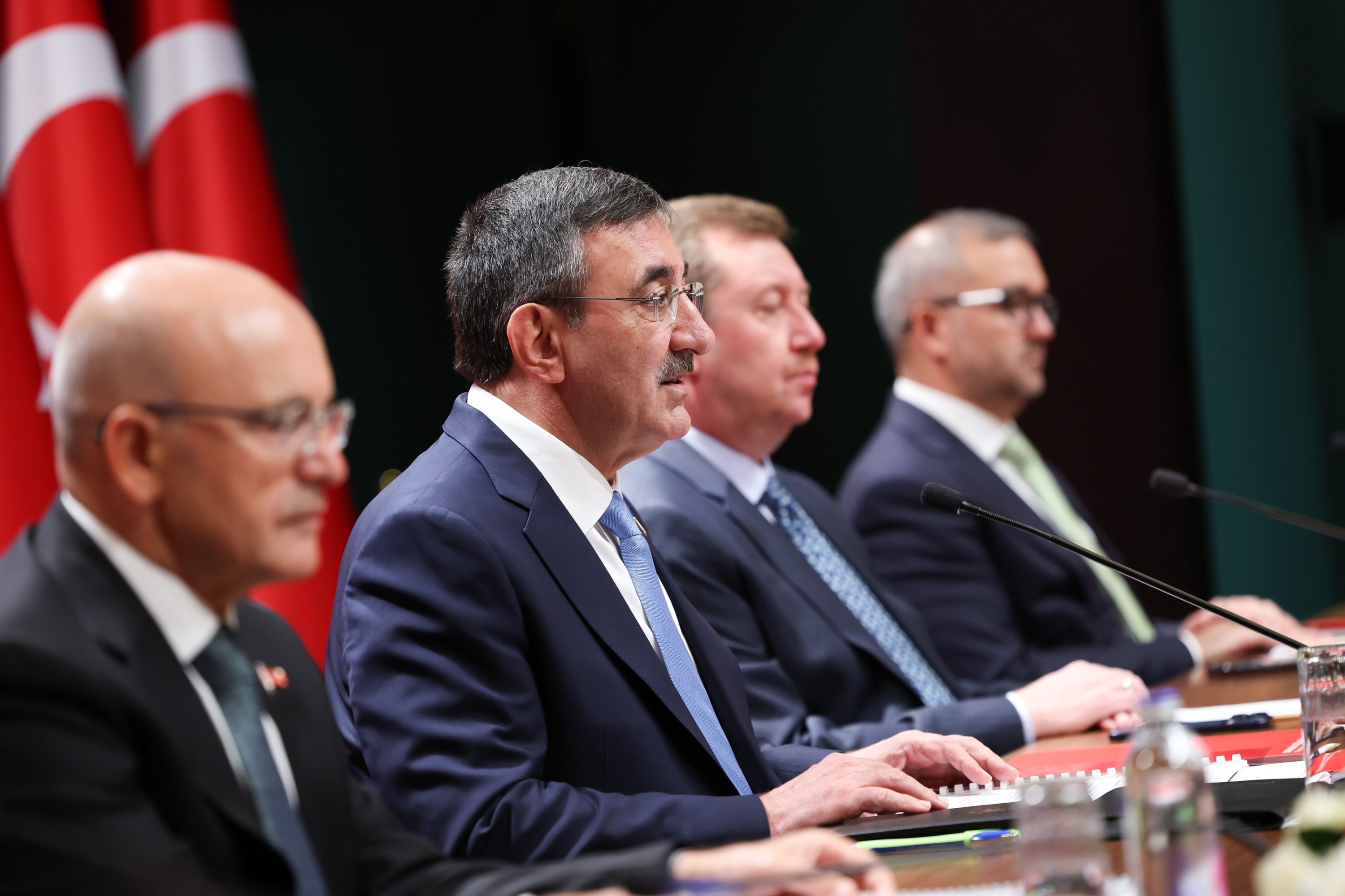
He went on to say that the direct and indirect effects of the war in the region “are being felt across many areas, from energy and commodity prices to global trade, and from the inflation outlook to growth expectations.”
In line with this, he said that the assumptions used last year had been updated in light of developments during the year, particularly due to the war in the region.
Türkiye, as an energy-importing country, has been exposed to the increase in oil and gas prices, which have risen sharply this year following the outbreak of the U.S.-Iran war.
“The global growth forecast, one of the main assumptions in the previous MTP, was revised down from 3.1% to 3%. The growth forecast for our trading partners declined from 2.4% to 1.6%, while growth in the euro area fell from 1.2% to 0.9%,” he said.
Growth at 3.3% this year
Furthermore, he shared the revised figure for the Turkish economic growth this year, suggesting it is expected to come in at 3.3% before recovering next year and in the years after.
“We revised our 2026 growth forecast to 3.3%. Our industrial growth forecast was reduced to 2.3%, while our year-end inflation forecast was raised to 28.4%,” Yılmaz noted.
“Due to the direct impact of higher energy prices on our external balance, our energy import forecast increased from $63 billion to $71 billion, while our forecast for the foreign trade deficit rose from $96 billion to $105 billion,” he also said.
“Accordingly, we also revised our forecast for the current-account deficit as a share of GDP (gross domestic product) to 2.6%,” he further said.
“Our tourism revenue forecast was also revised downward from $68 billion to $65 billion due to the effects of the war,” he added.
Still, Yılmaz said that these revisions “do not represent a change in the direction or main framework of our program.”
He referred to the long-term goal of price stability, which Turkish authorities have been pursuing since the middle of 2023 with the return to more conventional macroeconomic policies.
“Despite this, the Turkish economy continues to produce, grow and create employment,” said the vice president.
He continued by also pointing out that expectations for 2027 point to a renewed recovery in the global outlook and consequently easier conditions for trade and stronger growth for Türkiye as well.
He also said that officials were closely monitoring the risks amid the geopolitical tensions.
“We are closely monitoring these developments and the additional risks they may create, taking measures to limit their effects and conducting our economic policies with an approach that takes different scenarios into account and strengthens resilience against external shocks,” Yılmaz said.
‘Program producing concrete results’
At the same time, he cited the gains of the economic program so far.
“Within the framework of the policies we have implemented, confidence in the Turkish lira has continued to increase,” he suggested.
“The rise in the share of TL deposits in total deposits from 31.6% to 61.5% as of Aug. 28 has been a concrete indication that the policies we have been pursuing are right,” he maintained.
He also recalled that the exit from the KKM scheme, a form of contingent liability, had been completed without disruption and said that despite uncertainties in the global economic outlook and geopolitical risks, “our gross reserves have increased by $89.7 billion to reach $188.2 billion as a result of the policies we have implemented with determination.”
“This strong increase in reserves supports the resilience of our economy against external shocks,” he added.
“Despite geopolitical tensions, our risk premium has also declined significantly, falling from levels in the 700s to below 220 (points),” Yılmaz said.
Similarly, he pointed out that annualized exports have reached $280 billion as of August, while underscoring the improvement in the composition of the exports, with the share of medium- and high-tech exports on the rise.
However, due to rising energy and commodity prices, there has been a “temporary pressure” on the external balance, Yılmaz said.
“The current-account deficit as a share of GDP was 1.8% in June 2024 and 1.6% in June 2025. As of June 2026, this ratio had risen to 2.3%. We calculate that 0.7 percentage points of this increase was attributable to the war,” he maintained.
Growth, unemployment figures
In addition, the vice president shared the expectations for growth and unemployment figures in the new 2027-2029 period.
He said that the growth is expected to rebound to 5% in 2029 after hitting 4.2% in 2027 and 4.6% in 2028, adding that the goal is to have “balanced and sustainable growth.”
He also conveyed the projections of the unemployment rate reaching 8.1% this year before falling to 8% next year, 7.8% in 2028 and 7.6% in 2029.
Yılmaz also stated that they aim to gradually reduce the budget deficit and continued: “Last year, we projected a budget deficit of 3.5% of national income for 2026, and with the measures we have taken, we expect to achieve it at 3.1%.”
Among others, he also said they expected the Turkish economy to reach $1.8 trillion in size by the end of this year for the first time.
The program foresees a national income exceeding $2.2 trillion and per capita national income reaching $25,000 by 2029.
It also aims to create more jobs through economic growth and reach $450 billion in exports when goods and services combined. In terms of employment, the program aims to create approximately 2.1 million additional jobs.
Its other objectives include increasing production capacity and productivity, strengthening the competitiveness of the industry through policies such as green transformation, and supporting high-value-added production and exports.
Yılmaz also wished the program to be auspicious for the country.
The unveiling of the program was attended by other top officials, including Treasury and Finance Minister Mehmet Şimşek and the governor of the Turkish central bank, Fatih Karahan.
A set of recent economic data brought U.S. President Donald Trump and his Republican Party some good and bad news ahead of the midterm elections, with the labor market posting strong growth, but record-high diesel prices likely to add more pressure on the inflation outlook.
Employment in the U.S. grew by 162,000 jobs in August, and the unemployment rate remained steady at 4.1%, the U.S. Bureau of Labor Statistics (BLS) said.
But the price of diesel, used for road hauling, agriculture and construction also hit a new record on Friday.
The cost of a gallon of diesel is up 55% since the Iran war began in late February, according to the AAA motorists’ association.
Stock markets were down on the employment figures, with all eyes on the next interest rate-setting meeting by the Federal Reserve (Fed) later this month.
Strong job growth indicates a healthy labor market, which would allow the central bank to focus on its other mandate: keeping long-term inflation to its 2% target, potentially by hiking interest rates.
The Fed has missed that target for more than five years, with consumer inflation running at 3.3% in July. August data is due this week.
Price rises have been fuelled by Trump’s war on Iran, which has sent energy costs skyrocketing and his signature tariff policies.
Overall inflation hit a three-year high in May, but has dropped since then.
Several Fed policymakers have indicated that they would be open to raising interest rates if August’s data does not show a continuing downward trend.
Three of the committee’s 12 voting members dissented at its last meeting in July, calling for an immediate hike.
Responding to the August jobs data, Trump made a surprising link Friday between the Fed’s setting of interest rates and Washington’s trade ties with other countries.
“Lower the interest rates because the U.S.A. is a much stronger credit than it was just a short time ago!” Trump posted on his Truth Social platform.
“LOWER THE RATE OR I’LL STOP TRADING WITH COUNTRIES WITH WHICH WE HAVE A DEFICIT.”
He also railed against the stock markets being down due to expectations of a Fed rate hike, saying they were living in a “false reality that if things are good, you’ve got to ‘KILL IT’ because of a ‘fear’ of Inflation.”
Later, Trump told reporters that “success does not cause inflation. Stupidity causes inflation.”
He renewed his call for the Fed to lower interest rates, saying the key rate should be between 0.5% and 1%. The rate is currently between 3.5% and 3.75%.
‘Heating back up’
The job report showed that U.S. employment expanded in the restaurant and bar sectors, and jobs in public schools bounced back from a contraction a month earlier.
The strong report also revised up job numbers for June and July by a combined 55,000, indicating the U.S. labor market remains in a state of steady growth.
Average hourly earnings increased by 3.1% year-over-year, still lagging behind inflation, indicating many workers are seeing their salaries contract in real terms.
Diane Swonk, chief economist at KPMG, told Agence France-Presse (AFP) that the August data was “reassuring” but cautioned that “one month does not a trend make.”
“This report does suggest that the labor market is heating back up,” she said.
“The labor market is now stronger, and this is worrisome for the Federal Reserve because now you have demand along with supply shocks.”
Still, strong job growth was “welcome news for workers out there. Welcome news for people trying to make ends meet.”
The health care sector, one of the major drivers of U.S. job growth as the population ages, expanded at a slower pace than its average over the last year.
Kathy Bostjancic, chief economist at Nationwide, said the overall “across-the-board robust gains” were encouraging.
“Today’s report supports our forecast that real GDP growth accelerates to at least three percent in Q3, reflecting a strong labor market, resilient consumer spending, and continued ebullient AI investment,” she said in a note.
The information technology sector lost 23,000 jobs, with analysts saying it is more exposed to AI-related layoffs due to wider adoption of the technology than other industries.
Türkiye revised its growth forecast for 2026 to 3.3% from an earlier 3.8% and it expects inflation at 28.4%, Vice President Cevdet Yılmaz announced while presenting the new 2027-2029 Medium-Term Program (MTP) on Sunday.
“We expect inflation to start declining again in the fourth quarter of 2026 and to reach 28.4% by the end of the year,” Yılmaz said in a televised address.
Under the new program, inflation is projected to fall to 21% in 2027, 13.5% in 2028 and 9% in 2029.
Türkiye’s annual inflation rate eased to 31.51% in August from 31.75% in July, according to official data.
Yılmaz said the war in the Middle East had played a key role in the upward revision of the inflation outlook.
“According to our central bank, the direct and indirect effects of the war on inflation have been estimated at approximately seven percentage points,” he said.
The vice president also said the government had made “significant progress in combating inflation,” which remains the top priority of its economic program.
“Inflation, which had risen to 75.5% in May 2024, has begun to show a clear downward trend as a result of the policies we have implemented,” he said.
The world needs to “rethink” and “redesign” its energy infrastructure in response to the climate crisis, requiring massive financial resources, Turkish Energy and Natural Resources Minister Alparslan Bayraktar said Friday, warning that public funding alone cannot meet the challenge.
Bayraktar’s remarks came on the sidelines of the Climate Finance Summit in Istanbul, organized ahead of this year’s U.N. climate summit, COP31.
At the conference in the southern Antalya province scheduled for November, Türkiye will seek to deliver a historic action plan with concrete solutions to the climate crisis, with a particular focus on financing.
“Floods, droughts, wildfires, and storms around the world are disrupting electricity transmission and distribution. Due to global warming and climate change, we must rethink, redesign, and strengthen our electricity infrastructure,” Bayraktar said Friday.
The infrastructure built today must be designed to withstand the climate conditions of the next 10 years, he said. This, however, will require enormous financial resources, and public funding alone will not be enough, Bayraktar cautioned.
“We need to mobilize private capital, international financial institutions, development banks and long-term institutional investors,” he said. “We need financing mechanisms that reduce risk, lower the cost of capital, and make investments in clean energy and climate-resilient infrastructure commercially viable.”
Access to affordable, long-term climate finance is of vital importance, particularly for developing economies like Türkiye, Bayraktar said, warning that the global energy transition would not succeed if financing remained expensive or inaccessible in countries where energy demand and investment needs were growing fastest.
“An energy transition on an unprecedented scale lies ahead. In Türkiye alone, infrastructure requires at least $80 billion in investment through 2035,” said Bayraktar.
The transformation is not just about the environment, according to the minister. “It is also an agenda for energy security, economic development, and industrial competitiveness,” he said.
The long-established consensus among the world’s scientists is that climate change is real, mostly caused by humans, and getting worse. Its main cause is greenhouse gas emissions from burning fossil fuels like coal, oil and gas, which trap heat in the atmosphere.
Türkiye’s energy transition
According to Bayraktar, Türkiye’s energy transition focuses on three goals simultaneously: securing energy supply, reducing dependence on imported energy and meeting the country’s climate commitments, including its 2053 net-zero emissions target.
None of these objectives can be considered independent from one another, he said. And under today’s conditions, achieving these simultaneously has become more challenging than ever.
Drawing attention to the challenges experienced worldwide in recent years, Bayraktar pointed to serious pressures in the global oil and natural gas markets.
“Energy prices have risen significantly. Natural gas prices in Europe have once again reached their highest levels in recent years,” he said.
This, Bayraktar said, reminds the world once again of a fundamental truth: “Energy security has not fallen off the agenda alongside the energy transition. On the contrary, energy security and the energy transition must move forward hand in hand.”
For Türkiye, the key to this is “electrification,” Bayraktar said.
Renewables, nuclear power
Renewable energy will remain at the center of Türkiye’s energy transition, the minister said, pointing to the country’s potential in solar, wind, hydropower and geothermal resources.
“We are rapidly increasing our installed renewable capacity, while also building an electrical infrastructure capable of integrating much higher volumes of variable renewable generation into the grid,” he noted.
Energy efficiency should also be treated as a strategic energy resource, Bayraktar said.
Türkiye’s 2024-2030 National Energy Efficiency Action Plan envisages more than $20 billion in investment across industry, buildings, transport, agriculture and energy.
Türkiye also plans to prepare a third national energy efficiency action plan with more ambitious targets for the following decade, he added.
Nuclear power, meanwhile, will also be one of the indispensable components of Türkiye’s carbon-free electricity generation portfolio, Bayraktar said.
“In an increasingly electrified economy, we view nuclear energy and renewable energy not as competitors, but as two complementary core components of a safe and clean energy system,” he added.
Grid investment becomes critical
Bayraktar said the transition in transport, along with the growing importance of battery storage, would further increase pressure on electricity infrastructure.
“Focusing only on generation investments is not enough,” he said. Focusing solely on generation investments is not enough. We need very large-scale investments in both transmission and distribution grids. Our electricity grids need to become larger, more powerful, smarter, and more flexible,” he noted.
Bayraktar also highlighted the strategic importance of critical minerals needed for transmission lines and batteries.
“Just as there was a ‘gold rush’ in the 1800s, there is a global race for critical minerals today. Countries that cannot access these minerals will fall behind in many areas, from renewable energy to data centers, and from artificial intelligence to the industries of the future,” he said.
“In short, the extraction of these minerals and the financing of mining projects are of strategic importance,” he noted.
Türkiye’s services exports rose 6.5% in 2025 to a record $124.9 billion (TL 6.05 trillion), exceeding the government’s target and contributing significantly to financing the country’s current account deficit, the Trade Ministry said on Friday.
The figure surpassed the previous year’s $117.3 billion and was also above the $122.6 billion reported earlier in the central bank’s balance of payments data, according to data from the Turkish Statistical Institute (TurkStat).
Services imports increased 9.6% to $61.9 billion from $56.4 billion in 2024, leaving Türkiye with a services trade surplus of $63 billion, up 3.6% from a year earlier.
The result exceeded the government’s 2025 services exports target of $121 billion, the ministry said.
“Türkiye has reached its highest-ever services exports figure and set a new record,” the ministry said in a statement, adding that the country ranked 22nd globally in services exports.
Türkiye’s services exports have expanded significantly over the past two decades. They totaled $14 billion in 2002, accounting for 0.89% of global services exports, compared with $762 million and a 0.19% share in 1980.
Global share rises
Between 2002 and 2025, Türkiye’s services exports grew at an average annual rate of 10%, outpacing the World Bank’s reported 7.5% average annual growth in global services exports.
Türkiye ranked sixth globally among countries with a services trade surplus in 2025, according to the ministry.
Travel services accounted for 48.1% of Türkiye’s total services exports in 2025, broadly unchanged from 48% a year earlier.
Transport services ranked second, although their share fell to 34.1% from 35.1%. Transport exports rose 3.5% to $42.57 billion in 2025 from $41.13 billion a year earlier.
“Other business services” ranked third, accounting for 6.3% of total services exports.
Telecommunications, computer and information services recorded one of the fastest rates of growth, with exports rising 25.3% year-over-year to $6.72 billion.
On the import side, transport accounted for 32% of total services imports in 2025, down from 38.1% in 2024. Other business services increased its share to 16.9% from 16.1%, while travel services accounted for 14.5%.
European Union top market
The European Union was Türkiye’s largest trading bloc for services excluding travel in 2025.
Services exports to EU countries totaled $25.33 billion, while exports to other European countries stood at $9.26 billion.
Imports from the EU reached $24.73 billion, compared with $6.45 billion from other European countries.
EU countries accounted for 37.9% of Türkiye’s total services exports excluding travel and 45.3% of its services imports.
The United States was Türkiye’s largest individual market for services excluding travel, receiving $8.34 billion, or 12.9% of total exports. Germany followed with an 11.5% share, while Britain ranked third with 6.6%.
The three countries together accounted for 31% of Türkiye’s services exports excluding travel.
Ireland was the largest source of services imports, with $6.67 billion, or 12.6% of the total. Britain followed with $4.80 billion, while the United States ranked third with $4.38 billion.
Türkiye has signed a cooperation agreement with the Asian Infrastructure Investment Bank (AIIB) that will support environmental investments, urban infrastructure and climate change efforts, a top official said Friday.
The first phase of the agreement will focus on environmental projects in the Marmara region through an investment package worth around 400 million euros ($465 million), Environment, Urbanization and Climate Change Minister Murat Kurum said.
“We aim to provide significant support for the cleaning of the Marmara Sea and our fight against sea snot through an investment package worth approximately 400 million euros, primarily for advanced biological wastewater treatment facilities,” Kurum noted.
He did not give details of any further phases of the cooperation agreement, nor how much the total investment could amount to.
Türkiye in the past faced a plague of “sea snot,” a thick, slimy layer of organic matter known as marine mucilage, in the Sea of Marmara, posing a threat to marine life and the fishing industry. The inner Sea of Marmara, which connects the Black Sea through the Bosporus to the Aegean Sea through the Dardanelles, lies in the middle of the most industrialized region of Türkiye.
Kurum said increasing wastewater treatment capacity, expanding advanced biological treatment facilities and strengthening environmental infrastructure were among the main efforts of Türkiye’s attempts to address pollution in the sea.
Kurum and AIIB Vice President Ajay Bhushan Pandey signed the cooperation agreement on the sidelines of the Climate Finance Summit in Istanbul, organized ahead of the COP31 U.N. climate conference in November.
Türkiye is one of the AIIB’s largest investment destinations, Pandey noted.


-

 Politics2 days ago
Türkiye detains 10 over support for FETÖ assassination team member
-
 Politics3 days ago
Former minister in hot water over alleged links to Kuriş gang
-

 Refugees2 days ago
2 bodies found on ferry wreckage, North Cypriot leader says
-

 Economy2 days ago
US job market surprises in potential boon to Trump ahead of midterms
-

 Sports3 days ago
Alcaraz calls for breaks as packed tennis calendar fuels injuries
-

 Economy2 days ago
Trump says he’ll stop trading with some nations if Fed doesn’t cut rates
-

 Sports2 days ago
FIFA slams UEFA legal action as ‘smear campaign’ against Infantino
-

 Politics3 days ago
Türkiye seeks extradition of 3 crime suspects from Greece