
Economy
Türkiye to transfer defense tech to civilian sectors under new program

Türkiye plans to encourage the transfer of technologies and capabilities developed by its defense industry to civilian sectors as part of efforts to reduce dependence on foreign suppliers in critical technologies, according to its updated economic road map.
Under the 2027-2029 Medium-Term Program (MTP), the government will also encourage the use of domestic defense-industry capabilities in technology-intensive civilian procurement, with the aim of raising domestic production and supporting higher-value exports.
The plan, unveiled Sunday, seeks to strengthen economic security against global shocks, geopolitical tensions and competitive pressures by improving supply security in strategic sectors including energy, agriculture, food, health care, technology and defense.
Since the early 2000s, Türkiye has injected billions of dollars to transform from a nation heavily reliant on equipment from abroad to one that is a major exporter and where homegrown systems now meet almost all of its defense industry needs.
For much of the past two decades, Ankara has expressed frustration over its Western allies’ failure to provide adequate defense systems against missile threats despite Türkiye being a major NATO member.
Türkiye is currently the world’s 11th-largest defense exporter. Its shipments rose nearly 50% in 2025 to a record of more than $10 billion. Annualized sales reached $11.2 billion as of this July.
The new program envisages the development of domestic production and innovation capacity for critical products, technologies and services, while supply chains are planned to be diversified and strategic partnerships with reliable partners strengthened.
The government also aims to improve Türkiye’s resilience to multiple shocks stemming from demographic change, natural disasters, geopolitical developments and global supply disruptions.
Semiconductor, AI capacity
Domestic research and development, production and innovation capabilities will be expanded in strategic sectors including defense, health care, semiconductors and artificial intelligence.
Technologies developed in these fields will be supported in their transfer to the broader economy and civilian applications.
The interaction between defense technologies and civilian applications will be increased, while public procurement of technology-intensive civilian products will be encouraged to draw on the capabilities of Türkiye’s domestic defense industry.
The government expects this approach to increase domestic content in these sectors and support higher-value-added exports.
The wider adoption of agile manufacturing methods will also expand the potential applications of defense-industry products and increase the domestic contribution rate.
Action plans will be prepared to support technology development and domestic production in critical areas needed to strengthen supply security in manufacturing, energy, agriculture, health care and transport.
Health care seen as key area
Health care is expected to be one of the main civilian sectors to benefit from technologies developed by Türkiye’s defense industry.
The government will support R&D and product-development activities for vaccines, medicines, medical devices, diagnostic kits, biotechnology products and AI-based health care technologies needed by the national health care system.
The initiatives are intended to strengthen domestic production capacity in the health care sector.
Türkiye also plans to establish modern facilities capable of producing semiconductor chips used in identity documents, passports and industrial applications.
Capabilities in semiconductor R&D, design, production and commercialization will be developed, while processes will be established to prepare data held by public institutions in standardized formats suitable for use in AI applications.
Partnerships with friendly countries
Vice President Cevdet Yılmaz said the government also planned to establish product-based platforms with friendly countries for joint development and marketing.
“We want to transfer the technologies and capabilities we have acquired in the defense industry to civilian industries,” Yılmaz said.
He said public procurement would play an important role in this process and stressed the need to develop other critical technologies domestically to strengthen Türkiye’s economic and technological security.
“We are not looking at this only from Türkiye’s perspective. We need to move forward by producing through joint platforms with friendly and brotherly countries,” Yılmaz said.
Yılmaz cited the multinational industrial structure behind the U.S.-led F-35 fighter jet program as an example, saying Türkiye would seek to establish similar platforms with friendly countries on a product-by-product basis, both for development and marketing.

A key interest rate policy decision in the U.S., along an update on inflation and its impact on consumer confidence and economic growth data will fill a busy calendar this week as more large companies are also due to report their quarterly earnings.
They all arrive just weeks before the Nov. 3 midterm elections that will determine the future makeup of Congress as the U.S. economy grapples with constantly shifting global trade conflicts and a global oil shortage brought on by the U.S. war with Iran.
Inflation is stubbornly high, consumers are losing confidence and the resilient jobs market is showing more signs of stress.
Here’s a look at some of the key reports coming in the week ahead.
Americans are losing confidence in the economy as rising prices for everything from gas to groceries guts budgets. The latest consumer confidence survey from business group The Conference Board on Tuesday is expected to show that consumer confidence kept shrinking in October.
The last report showed that confidence plunged in September to the lowest level in more than a decade. The October report is expected to show confidence kept weakening. Consumer confidence is down sharply from two years ago, according to the survey.
In that time, the U.S. has waged a wide-ranging trade war with much of the world, including its neighbors and closest trading partners.
The uncertainty around the sudden shifts in tariffs left businesses and consumers wary about planning ahead over worries about higher costs.
Meanwhile, the U.S. war with Iran that started in early 2026 slashed global oil supplies and added more fuel to rising prices.
The Federal Reserve (Fed) will close out a two-day meeting on Wednesday and is expected to hold its benchmark interest rate steady following a hike at its September meeting.
The central bank has been signaling that it is still worried about inflation and that it may have to continue raising rates to help tame rising costs. Wall Street still expects that one more rate hike is coming at the Fed’s meeting in December.
Higher interest rates make borrowing more costly, which in turn can slow economic growth and cool stubbornly hot inflation. The Fed has to balance taming inflation with supporting the jobs market. Higher interest rates and slower economic growth could dampen rising inflation, but they could also hurt job growth at a time when the somewhat resilient employment market is showing signs of stress.
The U.S. Department of Commerce on Thursday will release its initial report on economic growth during the third quarter and economists expect a sluggish result. Economists are forecasting that gross domestic product (GDP), which is the nation’s output of goods and services, rose 1.7% from July through September. It’s the first of three reports for third-quarter GDP and can be revised higher or lower.
The forecast for the initial assessment marks an easing from 2.2% growth during the second quarter.
GDP growth has been slowing since the first quarter under pressure from higher oil prices fueling already stubbornly high inflation.
Yet, growth has been bolstered by a strong stock market and businesses investing in artificial intelligence technology. Households, though, have been struggling with higher costs on everything from gas to groceries eating up more of their budgets at the same time that average wages for workers stagnate.
The latest inflation update is expected to show that prices on everything from gasoline to clothing and groceries marched higher at a faster rate in September. The U.S. will release the personal consumption expenditures report (PCE) on Thursday and economists expect that inflation jumped at a 3.7% rate, up from a 3.4% rate in August.
The PCE is the preferred measure of inflation used by the Fed, which wants to bring inflation down to its target rate of 2%. Several other measures of inflation have also moved stubbornly above a 3%.
Inflation has been rising at an even sharper rate since the U.S. war with Iran started in February, essentially shutting down the vital Strait of Hormuz and stifling the global oil supply.
That has prompted a surge in gasoline prices that have been a direct hit to household budgets. Higher diesel fuel costs raised the cost of shipping and warehousing goods, which businesses typically pass along to consumers.
The latest updates on retail sales show that household spending remains strong, on the surface. Much of that spending, though, is the result of paying higher costs , especially for gasoline.
Investors have another busy week of earnings ahead, with reports from big names that could provide more insight on plans for AI spending and how inflation is influencing profits.
The most closely-watched reports this week are likely to be the big technology or technology-related companies that have seen their stock values surge as they heavily invest in artificial-intelligence technology with hopes for a big benefit.
Google’s parent company, Alphabet, reports its results on Wednesday, with Intel and Amazon reporting their latest results on Thursday.
Analysts expect all three companies to report profit gains as Wall Street tries to determine whether their big AI investments will translate into future growth and whether their outsized stock values are justified.
A wide range of other companies will report results this week, shedding more light on inflation’s impact across industries. Shipping company UPS and beverage giant Coca-Cola report results on Tuesday. Starbucks reports its results on Thursday, while oil giants ExxonMobil and Chevron report their results on Friday.
Togg, Türkiye’s domestically developed electric vehicle brand, unveiled on Friday a new special edition of its T10F electric fastback, featuring amber-inspired design details and seven exterior color options.
The T10F 4More Kehribar edition takes its name from kehribar, the Turkish word for amber, a natural resin that fossilizes over millions of years. The series draws on amber’s warm tones and changing reflections to highlight the car’s sporty design, the company said.
The seven exterior colors are Ayder, Seyhan, Urla, Kula, Oltu, Gemlik and Mardin, names associated with locations across Türkiye. The colors are designed to create different visual effects depending on the lighting and viewing angle.
Amber-colored accents appear on several exterior elements, including the wheels, front grille, logo, side mirrors and window surrounds. Inside, seats made with Artisyn fabric, embossed patterns and specially designed decorative surfaces carry the color and material theme into the cabin.
The new edition joins Togg’s special-series lineup following the Obsidian edition, which drew inspiration from the deep black tones of obsidian, a naturally occurring volcanic glass.
The 4More goes for a high-performance, dual-motor, all-wheel-drive (AWD) product line for the carmaker’s models.
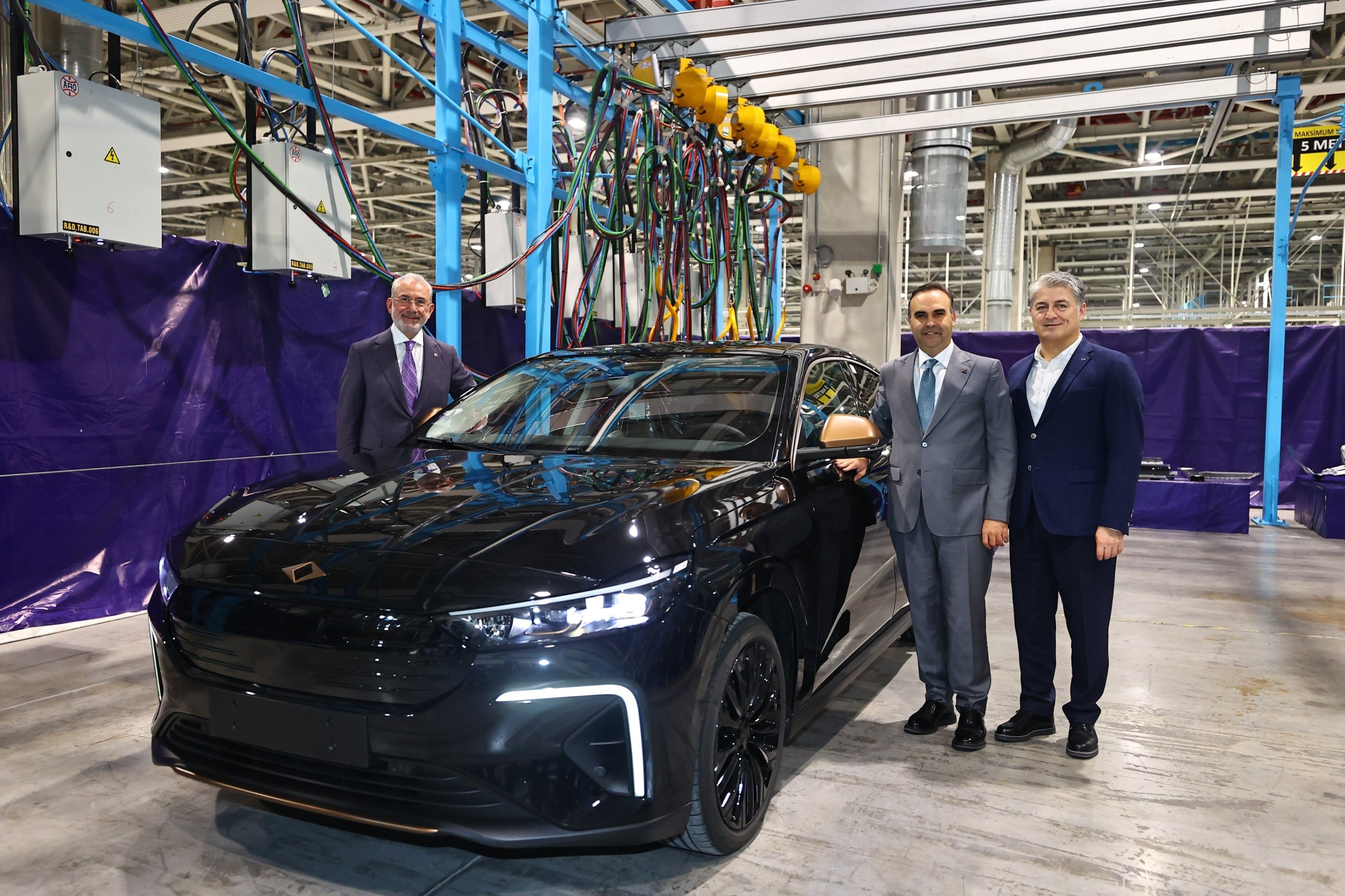
Industry and Technology Minister Mehmet Fatih Kacır on Friday visited Togg’s campus in the northwestern Bursa province to review work on the new model and the T6X, a low-cost B-SUV scheduled to go on sale in 2027.
In a post on the Turkish social media platform NSosyal, Kacır described Togg’s facility as the country’s most digitally advanced automotive production plant, with an average of one industrial robot for every 10 employees.
He also said the plant had a production rate of 375 vehicles per day, highlighting the company’s manufacturing capacity as it continues to develop its model lineup.
Togg was founded eight years ago after President Recep Tayyip Erdoğan called for the production of a fully locally funded passenger car.
The company is currently manufacturing the T10X SUV and the T10F fastback, launched last year.
Togg sold 39,020 vehicles domestically last year, and its sales in the first nine months of this year rose over 60% year-over-year to 37,426 units, data from the Automotive Distributors and Mobility Association (ODMD) shows.
U.S. President Donald Trump is expected to lift 50% tariffs on select Canadian agricultural and forestry products in a move intended to bolster Republican Sen. Susan Collins’ reelection bid in Maine ahead of November’s midterm elections, The Wall Street Journal reported Friday.
Citing people familiar with the planned action, the report said the tariff changes could be announced as early as Friday, although the scope and timing remain subject to change.
The potential move comes after Collins, a moderate Republican facing a competitive reelection race, sought relief from tariffs that have affected Maine industries and consumers. Maine has extensive economic ties with Canada, making cross-border trade a significant issue in the state’s Senate contest.
Collins’ Democratic challenger, Troy Jackson, has made Trump’s trade policies toward Canada a central theme of his campaign. The two candidates are neck-and-neck in polls ahead of Election Day.
A White House official cautioned against treating preliminary reports as confirmation of an impending policy change. “Any tariff announcements would come directly from the administration and any preliminary reporting is speculation,” the official said, according to the Journal.
Canada imposed retaliatory tariffs on the U.S. after Trump’s announcement last month, following the breakdown of trade talks between Washington and Ottawa.
Canada plans to use a government agency in Türkiye that manages the country’s defense industry and the supply of military technology as a model as it works to build up its own domestic arms sector, a report said Friday.
The Presidency of Defense Industries (SSB) serves as the primary defense procurement authority to fulfill the technological needs of Turkish security forces utilizing domestic resources.
The report comes amid Prime Minister Mark Carney’s visit to Türkiye, the first bilateral visit by a Canadian leader, as Ottawa seeks new global trade partners to reduce reliance on the United States.
NATO allies upgraded their relations to a “strategic partnership” on Thursday following talks between Carney and President Recep Tayyip Erdoğan in Ankara, focusing on trade and investment, defense, security and energy.
In Istanbul on Friday, Carney said Ottawa is “in need of Turkish expertise” to strengthen its defenses and reduce reliance on foreign military systems. He said Canada was interested in both Turkish military technology and joint industrial partnerships.
Türkiye has agreed to join Canada’s Defense Security and Resilience Bank as one of 10 founding member nations of Carney’s multilateral “middle powers” bank.
The bank’s purpose is to bolster the defense of like-minded allied nations by raising up to 100 billion pounds ($134 billion) in cheap financing.
‘Lot to learn’
Carney’s government wants to bring about strategic cooperation between Canadian and Turkish companies in production, innovation and technology transfer, Anadolu Agency (AA) said on Friday, citing defense industry sources. They said he drew particular attention to Türkiye’s expertise in space and aviation.
During the visit, Carney stressed Türkiye produces around 80% of its own defense needs domestically, which he said is not the case in Canada. “We have a lot to learn,” he noted.
He added that Canada is in a position where it needs Türkiye’s defense industry expertise more and described reaching a local-content rate above 80% as a desirable policy goal for his government, the report said.
In an earlier interview, Carney said Canada intends both to run joint defense projects with Türkiye and to buy Turkish products. He pointed to Türkiye’s innovation and technology base, especially in unmanned systems.
What SSB does
The SSB organizes nearly all areas of Türkiye’s defense industry, including localization, production, innovation, procurement, regulation, public-private cooperation and corporate financing.
It centralizes coordination between the armed forces and public and private companies, which allows quick decisions and rapid delivery of requirements. It is said to be a structure with no equal in the world.
The agency supports national design and domestic production, introduces rules to raise firms’ export earnings, and aims to phase out dependence on foreign suppliers for critical systems. It oversees an ecosystem of more than 4,500 companies, guided by technology-acquisition obligations and capability-building policies.
Poland’s deputy prime minister and defense minister, Wladyslaw Kosiniak-Kamysz, has also praised the agency. He said earlier that Poland wanted to adopt a similar model, because the SSB not only buys and produces for its own needs but also exports and promotes exports.
Part of push to cut reliance on Washington
Canada’s interest fits Carney’s strategy of reducing dependence on the United States for security and supplies.
Canada’s government set up a Defense Investment Agency last year to cut bureaucratic delays in defense procurement. It also announced a goal of raising the domestic industry’s share of defense spending to 70% over the next 10 years.
The two countries signed a Defense Sector Partnerships memorandum of understanding on Thursday. SSB head Haluk Görgün said it reflects a commitment to expand cooperation between two NATO allies.
On Friday, Carney met senior executives of Aselsan, known for electro-optical, radar and avionics systems, and Baykar, known for unmanned aerial systems and autonomous software.
Türkiye aims to see 100,000 startups founded by 2030 and to raise the combined valuation of its “Turcorns,” the country’s billion-dollar startups, to $100 billion, Industry and Technology Minister Mehmet Fatih Kacır said on Friday.
“We aim to have 100,000 startups established in Türkiye by 2030 and to raise the total valuation of our Turcorns to $100 billion,” Kacır told the GO! GLOBAL Türkiye Summit 2026.
The event was organized by the Türkiye-U.S. Business Council’s Digital Working Group at the Foreign Economic Relations Board (DEIK) with Endeavor Türkiye. It focused on Türkiye’s technology entrepreneurship ecosystem, global investment opportunities and goals in advanced technology.
Kacır said Türkiye is working to become a global center for technology, entrepreneurship and investment. He said annual research and development spending has risen over the past 20 years from $1.2 billion to about $20 billion, and R&D’s share of national income from 0.5% to 1.46%.
He said advances in artificial intelligence, biotechnology, semiconductors and quantum technologies are reshaping global competition, value chains and traditional sources of competitive advantage.
Kacır said more than 13,000 technology companies operate in Türkiye’s 115 technology parks, and thousands of researchers and engineers work in more than 1,700 R&D and design centers. He added that Türkiye is the world’s 11th-largest defense exporter.
Startup support, data centers
Kacır pointed to Togg, Türkiye’s national electric carmaker, as a concrete example of this vision. He said more than 120,000 Togg vehicles have been put on the road so far.
He said the BiGG program is Türkiye’s largest public support mechanism for pre-seed and seed-stage technology startups, and has helped set up about 2,700 technology ventures.
Kacır said artificial intelligence is among the government’s highest priorities, and that Türkiye wants to be a country that develops AI technologies and exports them to global markets.
The Türkiye AI Action Plan has 16 priority actions, he said. Within two years, the government aims to train 10,000 advanced AI specialists and 100,000 AI application professionals, and to give AI literacy training to 5 million citizens.
On data centers, he said the goal is to raise installed capacity to at least 1 gigawatt by 2030, which would require mobilising at least $10 billion of investment.
He said $3 billion in public support has been set aside for data center and AI investments under HIT-30, the government’s high-technology investment program.
Kacır said Türkiye offers global investors its strategic location, growth, large domestic market and skilled workforce. The economy has grown by more than 5% a year on average over the past 20 years, he said, and the country has more than 86 million people and about 23 million primary, secondary and university students.
He said Türkiye added about 8 gigawatts of electricity generation capacity last year, and aims to add 8 to 10 gigawatts of renewable capacity each year for the next decade.
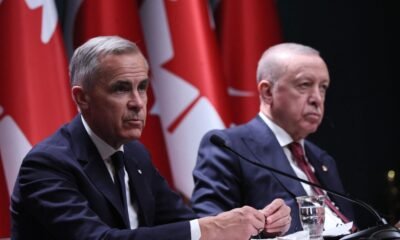
Canadian engineering company AtkinsRealis is in the running to help build Türkiye’s third nuclear power plant, Prime Minister Mark Carney said Friday.
NATO allies Canada and Türkiye upgraded their relations to a “strategic partnership” during the first bilateral visit by a Canadian prime minister on Thursday, as Carney seeks new global trade partners to reduce reliance on the U.S.
The new partnership signed in Ankara following talks between Carney and President Recep Tayyip Erdoğan focuses on trade and investment, defense, security and energy. It aims to create jobs and opportunities for Canadian and Turkish companies to do more business together.
Carney arrived in Istanbul on Friday to meet with Turkish business leaders in strategic sectors such as energy, aerospace and critical minerals.
Canada and Türkiye announced a partnership agreement in the defense industry and have also identified potential for cooperation in nuclear energy.
Asked about talks on Canadian involvement in Türkiye’s planned third nuclear power plant, over which Ankara has also held talks with South Korea, Russia, China and Japan, Carney said the decision would ultimately be made by the Turkish government, but he believed Canada had better odds now.
“If you would have asked us a year ago how we would have pegged the chances, they would have been very low. Now there are good chances. There’s real competition, of course,” Carney told reporters in Istanbul, adding that there may be a decision on the issue before the end of the year.
He said the strength of Canada’s CANDU technology, partnership with some Turkish businesses, including on the construction side, and the ability to build out elements of the supply chain make it “quite a compelling proposition.”
Rosatom, Russia’s state nuclear energy company, is building Türkiye’s first nuclear power station at Akkuyu in the Mediterranean province of Mersin under a $20 billion accord from 2010. It said last week that it expected a year-end nuclear startup at the site.
Türkiye plans to build a second nuclear power plant in the Black Sea region of Sinop, with the third planned in the northwestern region of Thrace.
Reports before Carney’s visit said allies would discuss potential purchases by Türkiye of liquefied natural gas (LNG) from Canada, as well as critical minerals.
On Thursday, they said they had agreed to significantly increase collaboration across the energy sector, including in LNG, civil nuclear energy and renewable energy.
Turkish expertise in defense
Carney meanwhile also said Friday that Ottawa is “in need of Turkish expertise” to strengthen its defenses and reduce reliance on foreign military systems.
He said Canada was interested in both Turkish military technology and joint industrial partnerships, with an emphasis on developing capabilities together.
“I would lean toward the partnership end of the spectrum, where we’re providing complementary technology and we’re building up together,” Carney said.
He was more direct when asked whether Canadian companies could benefit from closer ties with Türkiye’s established defense industry, particularly its expertise in drones and autonomous systems.
“Candidly, we’re in a position where we’re more in need of Turkish expertise in terms of reinforcing what we need to do to protect Canadians and to serve as a full NATO ally at this stage,” he said.
Deal to strengthen export credit cooperation
Separately, Türkiye and Canada signed a memorandum of understanding to strengthen export credit cooperation and support joint projects in third-country markets, Trade Minister Ömer Bolat said Friday.
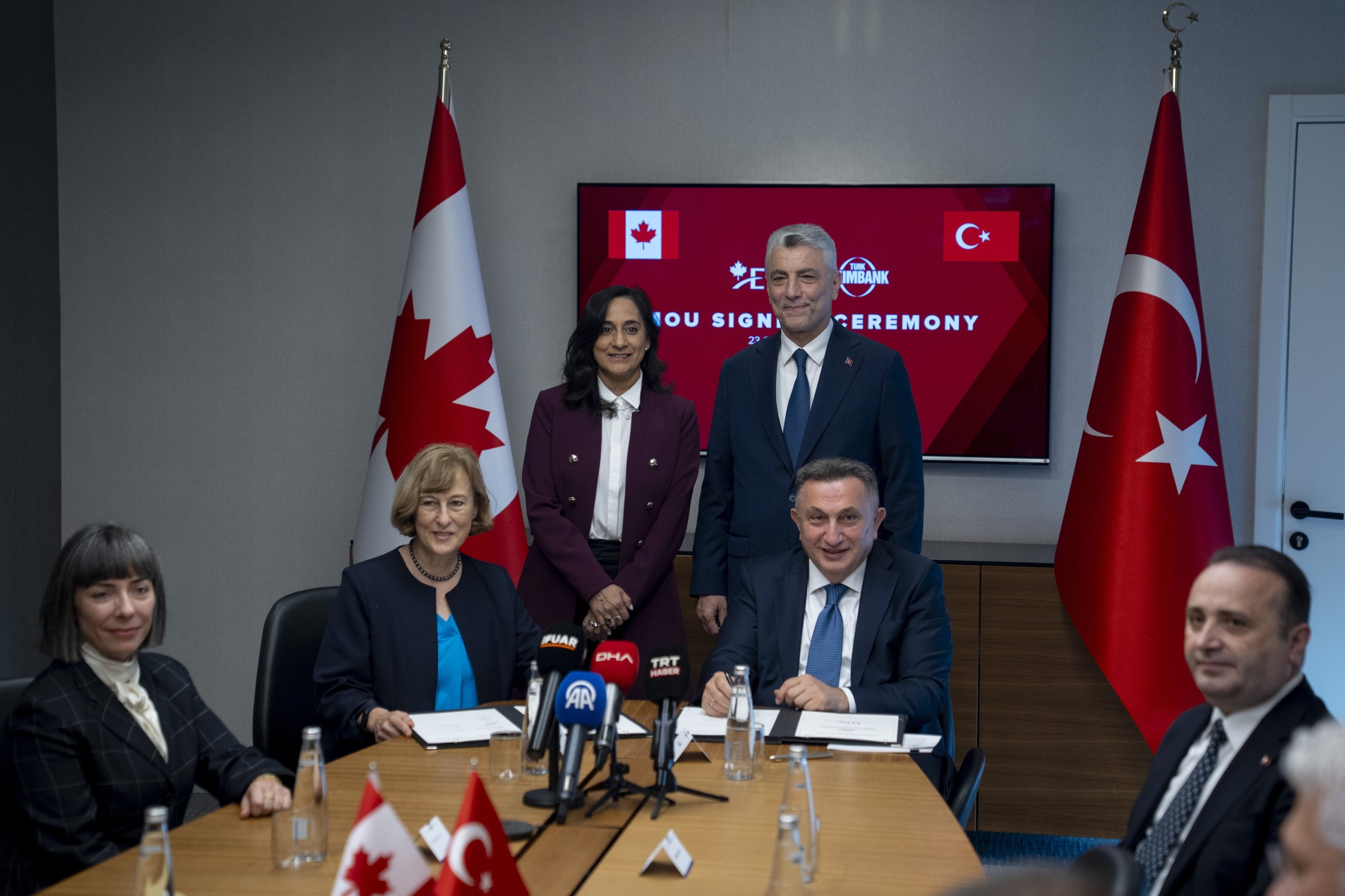
The agreement between Türk Eximbank and Export Development Canada (EDC) followed Bolat’s meeting with Canadian Foreign Minister Anita Anand in Istanbul.
In a statement on Turkish social media platform NSosyal, Bolat said the two discussed expanding bilateral trade and economic relations, alongside negotiations on a Türkiye-Canada free trade agreement.
Canadian and Turkish negotiators will kick off the first round of free trade talks next month in Ankara.
The memorandum aims to support Turkish and Canadian companies in developing joint projects in third-country markets, particularly in Africa, the Middle East, North Africa and Central Asia.
“We will continue our efforts to deepen trade and economic cooperation between our two countries and create new opportunities for our companies,” Bolat said.


-
 Economy2 days ago
Canada eyes Türkiye’s defense agency as model for domestic arms sector
-

 Sports3 days ago
Turkish clubs enjoy encouraging European week with 2 wins, 2 draws
-
 Politics1 day ago
Türkiye rules out fight against Houthis under Saudi defense pact: Güler
-

 Economy3 days ago
Apple’s foldable iPhone hits stores with $2,000 price tag, scarce supply
-
 Economy3 days ago
Canada’s AtkinsRealis contender to build Türkiye nuclear plant: Carney
-
 Politics2 days ago
Türkiye convenes 8 nations for first-ever R4+E3 meeting in Istanbul
-
 Politics3 days ago
Turkish Cypriot leader urges rotating presidency deal to resume talks
-

 Politics2 days ago
Main opposition leader threatens attack on Türkiye’s A Haber