
Politics
Government ally Bahçeli urges Erdoğan to run again in 2028

Nationalist Movement Party (MHP) leader Devlet Bahçeli addressed his supporters at a parliamentary group meeting on Tuesday. Among other things, Bahçeli’s speech focused on the political future of President Recep Tayyip Erdoğan. Erdoğan will be eligible to run for the presidency in the 2028 election, but this will require Parliament to approve the renewal of the election. Bahçeli pointed to this fact and threw his full support behind another term for Erdoğan.
“If our president finds it suitable and Parliament demonstrates its constitutional will, the People’s Alliance (of the MHP and Erdoğan’s Justice and Development Party (AK Party)) wants to have him as its candidate,” he said.
“Maintaining the momentum Türkiye has achieved will be possible if President Recep Tayyip Erdoğan runs for office once again and is elected president for a third term. The third term will coincide with many significant developments in Türkiye, the region and the world, and, above all, it will require the resolve and experience to navigate this challenging period. That experience lies with Erdoğan through the executive presidential system and the institutional structure of the People’s Alliance,” Bahçeli said.
It has been 12 years since Erdoğan became Türkiye’s first president elected directly by popular vote, a period that has seen the country overhaul its system of government and expand its diplomatic and defense footprint.
“At a time when the world is going through a chaotic period, amid an environment of uncertainty in our region and as historic steps are being taken toward a ‘terror-free Türkiye’ and a terror-free region, Türkiye needs to not change course or abandon its goals, but to fully maintain its existing capabilities and resources both systemically and institutionally,” Bahçeli said, referring to the process for the dissolution of the PKK terrorist group that the MHP leader spearheaded.
“Considering the responsibility our president has assumed to date, the leadership he has demonstrated and the strategic capacity he has brought to Türkiye, it would be in the interests of Türkiye and our region for him to serve another term as president. There is more than sufficient legal, political and social ground to make this possible,” Bahçeli stated.
Erdoğan’s chief adviser Mehmet Uçum, who also serves as deputy chair of the Presidency’s Legal Policies Board, clarified a debate over the date of the next elections last month. Uçum told journalists that the elections will most likely be held on April 16, 2028, the same date as a referendum held in 2017 on the switch to an executive presidential system. He also underlined that this would be the last election Erdoğan would be eligible to run in.
Uçum said the elections may be held on that date if Parliament approves the renewal of the elections, something that would require the support of 360 lawmakers. He said the possibility of an election in the last quarter of 2027 was “low” amid calls from the opposition for an early election.
Under Turkish law, an election would normally be held in May 2028. However, the Constitution allows Parliament to trigger an early election if such a move has the support of 360 of the Turkish Parliament’s 600 lawmakers, which would open the way for Erdoğan to seek another term. The People’s Alliance has 326 seats in total.
The government has repeatedly insisted that elections will be held on schedule. Erdoğan, who was elected prime minister in 2003, was elected president in 2014 after serving three terms as premier.
Bahçeli recalled Article 116 of the Constitution, which stipulates that, “If the Grand National Assembly of Türkiye decides to renew elections during the president’s second term, the president may run for office once more,” saying the provision allows for a third presidential candidacy if Parliament decides, by a qualified majority, to renew the elections.
“For President Recep Tayyip Erdoğan to be able to run for office again, the Grand National Assembly of Türkiye should, at an appropriate time and with the broadest possible consensus, decide to renew the elections. If the renewed elections are held in 2028 within the framework of Parliament’s decision, this will not undermine stability or predictability, and the system will have been operated in accordance with its spirit. With the emergence of such a political will, unnecessary debates will come to an end, uncertainties will disappear, economic confidence will increase, and our country will be able to continue full steam ahead on its path as it takes historic steps. The instability that Türkiye’s adversaries expect and hope for will not materialize, and the calculations of those who invest in uncertainty, chaos and turmoil will be thwarted.
“It should also be underlined here that our issue is not the political careers of individuals, but the continuity of the state, political stability and, ultimately, the construction and revitalization of a leading Türkiye,” Bahçeli said.
Emphasizing that the MHP views 2028 not merely as an election year but as the beginning of a period in which major reforms will be implemented in Türkiye, Bahçeli said efforts aimed at diverting attention from these goals should come to an end.
“Candidacy must be clarified, and the realities of the world must be confronted under conditions of ruthless competition. Alongside the president, the parliamentary majority must undoubtedly also belong to the People’s Alliance, while the Nationalist Movement Party must definitely increase its strength of representation in the legislature to ensure that the checks and balances mechanism functions more effectively. Because if the MHP is strong, Türkiye will be secure. If the MHP is strong, our national unity and fraternity will be strengthened, and our people will find peace,” he said.
Bahçeli said his party’s legislative objectives were clear.
“First is representational strength. Within this framework, our goal is to increase our vote share, raise the number of our lawmakers and become Türkiye’s leading party. Second is institutional strength. Within the institutional structure of the legislature, our goal is to assume more positions in its governing bodies and become more effective. Third is political strength. In this way, we aim to become more effective and decisive in legislative activities and policymaking, and to implement our party’s strategic objectives and economic and social policy priorities,” he said.
“Within this framework, I express the political formula for the next five-year period, which will witness Türkiye’s rise, as follows: Erdoğan in the executive, MHP in the legislature, the People’s Alliance in Türkiye, and the ‘Century of Türkiye’ in the world. This formula expresses our strategy that the legislature, like the executive, must be strong, while also being able to exercise oversight, produce policies and play a decisive role, as well as our determination to become a global power.”
Bahçeli, who traditionally wears a different ring at every parliamentary group speech, was seen wearing one featuring the crescent and star symbols of the Turkish flag and the immortal verses of Turkish folk singer Neşet Ertaş: “You have been my hidden, you are my outward, you have been my first, you are my last,” words derived from esoteric expressions linked to Islam.
Nationalist Movement Party (MHP) Chairperson Devlet Bahçeli on Tuesday highlighted the progress made under the terror-free Türkiye initiative, saying the withdrawal of the terrorist group from several areas in the region marked an important step toward lasting peace and regional stability.
Speaking at his party’s parliamentary group meeting in Ankara, Bahçeli said recent developments had produced significant results for both Türkiye and the wider region, emphasizing that verifying the withdrawals was essential to establishing a solid foundation for the future.
“Every stage we pass brings us closer to our goal, and signs of a hopeful future for the entire region are becoming increasingly evident,” he said.
Turkish security sources announced on Monday that the terrorist group PKK abandoned 14 more “areas of accommodation” in Iraq’s north, in a sign of progress in the terror-free Türkiye initiative. The areas were located in the Hakurk region. Last month, sources confirmed that the group left its hideouts in several areas in northern Iraq.
Bahçeli outlined two key stages of the terror-free Türkiye initiative, identifying the first as strengthening national unity and domestic solidarity and the second as establishing a terror-free region.
He argued that establishing peace, stability and fraternity across the region would help break the cycle of instability that has persisted for decades in the Middle East.
The MHP leader emphasized that the initiative was a state policy aimed at safeguarding national interests, strengthening social cohesion and consolidating fraternity between Turks and Kurds.
Recent developments, he said, had demonstrated that terrorism had been used as a tool to sow discord between the two communities.
Bahçeli also criticized opponents of the initiative, accusing them of serving imperialist interests and undermining efforts to strengthen Turkish-Kurdish unity.
Stressing that the initiative was being pursued within the framework of law, ethics and democratic politics, Bahçeli said reconciliation and social integration remained central to the process.
“We advocate reconciliation rather than conflict, integration rather than division, and peace rather than confrontation,” he said, expressing confidence in Türkiye’s collective determination to build its future.
He described the initiative as a guarantee for a future based on collective wisdom, social consensus and sincere efforts, free from external impositions and aimed at strengthening centuries-old bonds of fraternity.
Turning to developments in the Middle East, Bahçeli warned that the region was undergoing another period of instability and uncertainty.
He argued that Türkiye, drawing on its historical experience, state tradition and regional knowledge, was uniquely positioned to contribute to the establishment of a stable regional order.
Bahçeli also linked the initiative to the broader vision of the Century of Türkiye, saying domestic peace and regional stability were essential to achieving the country’s long-term objectives.
He called on political institutions to assume greater responsibility in promoting peace, strengthening national solidarity and protecting the country’s interests amid rapidly changing global and regional dynamics.
Reiterating his opposition to ethnic divisions, Bahçeli stressed that Türkiye would not allow itself to become trapped in a cycle of internal conflict.

Turkish authorities detained 20 suspects on Tuesday as part of an investigation into the Gülenist Terror Group’s (FETÖ) alleged efforts to infiltrate the Justice Ministry by placing its members in ministry positions.
The Ankara Chief Public Prosecutor’s Office said in a statement that the investigation was conducted by the police’s Anti-Smuggling and Organized Crime Department (KOM) in coordination with Ankara police units responsible for combating crimes against national security.
As part of the investigation, prosecutors issued detention warrants for 20 suspects identified based on information obtained from a confidential witness code-named “Albatros.”
All 20 suspects were detained in simultaneous operations across three provinces, coordinated from the capital Ankara.
The prosecutor’s office said the investigation was continuing on multiple fronts.
Justice Minister Akın Gürlek previously stated that a total of 1,065 operations were carried out against FETÖ by security forces in the first six months of 2026 and 2,451 suspects were detained. He stated that since FETÖ was designated as a terrorist threat shortly after its first coup attempts in 2013, authorities launched criminal proceedings against 720,338 people and 636,934 among them were either convicted or acquitted.
Some 127,102 suspects, among them were convicted of various crimes, according to minister. He noted that investigations and trials were still underway for another 83,404 suspects in investigations focused on FETÖ.
Türkiye has targeted its active members and sleeper cells nonstop, and its influence has been much reduced since 2016. However, the group maintains a vast network, including infiltrators suspected to still be operating within Turkish institutions.
Five soldiers were killed after a Turkish Air Force AS-532 helicopter crashed during a training flight after taking off from the central province of Eskişehir, the Defense Ministry said Tuesday.
“Five of our heroic comrades-in-arms serving aboard an Air Force helicopter that crashed during a training flight in Eskişehir have been martyred. May Allah have mercy on our martyrs. We extend our condolences and wish patience and strength to their grieving families, the Turkish Armed Forces and our noble nation,” the statement said.
Emergency crews continued operations at the site of a military helicopter crash in the Tepebaşı district of central Türkiye’s Eskişehir province.
The helicopter went down for reasons yet to be determined in a rural area near the Yörükakçayır neighborhood, approximately 25 kilometers (15.5 miles) from the city center, according to initial reports.
Firefighters from the Eskişehir Metropolitan Municipality and teams from the Disaster and Emergency Management Authority (AFAD) were dispatched to the scene following reports of the crash.
Firefighters began cooling operations on the wreckage upon arrival, while another helicopter was seen conducting patrol flights over the crash site.
Security measures and on-site investigations remain underway.
Twenty-one of 28 wanted suspects were detained Tuesday in a new round of operations against the criminal gang led by Alihan Kuriş, the self-styled leader of the Süleymancılar movement.
The “Süleymancılar” originated as a religious movement named after the 20th-century Islamic scholar Süleyman Hilmi Tunahan, Kuriş’s great-grandfather. Authorities say the investigation is not directed against the religious movement and instead focuses on alleged financial wrongdoing by Kuriş and other figures in the group, which prosecutors have named the “Alihan Kuriş criminal syndicate.” Initially operating through informal religious instruction in homes and mosques, the group later expanded across Türkiye through Quran courses and student dormitories, largely financed by membership contributions and donations. Over time, its activities expanded into commercial sectors including food, health care, tourism, textiles, construction and real estate. Kuriş and people in his close circle were arrested last August in the first wave of operations against the criminal group.
A statement by the chief prosecutor’s office in Ankara said that detention warrants were issued for suspects accused of running a criminal organization, membership in a criminal organization, defrauding public institutions and violating tax laws. Operations were carried out in 29 locations in eight provinces. More operations are underway to capture seven suspects at large.
Armenian Prime Minister Nikol Pashinyan put his political career at stake as he announced a draft proposal for a new constitution. Pashinyan offered to resign if people vote against the draft that will pave the way for signing a formal peace agreement with Azerbaijan. The proposal made public on Monday is also of interest to Azerbaijan’s close ally Türkiye, which cut off ties with Armenia in the post-Soviet era, when the latter occupied Azerbaijan’s territories.
Armenia and Azerbaijan already reached a US-brokered peace agreement last August, a few years after Azerbaijan succeeded in retaking occupied Karabakh from Armenia. Since then, they have begun to rebuild trade links and say they are at a state of “real peace”.
But for Azerbaijan, a central sticking point to signing a formal deal has been the preamble of Armenia’s constitution, which contains a reference to another Soviet-era document calling for the so-called reunification of Armenia and Karabakh, then an autonomous region in Soviet Azerbaijan. The proposed new constitution rewrites the preamble and removes the reference to which Baku has objected.
Pashinyan, who won reelection in June, has faced a wave of criticism from the opposition and some sections of the public. They accuse him of capitulating to Azerbaijan, particularly since the 2023 war, when Baku retook Karabakh in a lightning offensive. The prime minister is now under pressure to convince at least six opposition legislators to join his ruling Civil Contract party, which lacks a constitutional majority, to call for a constitutional referendum. The new charter will also undergo a public debate. Armenia’s opposition parties have already said they will not support Pashinyan’s initiative.
He was, however, confident of success, as he addressed the public through a live broadcast on Monday.
“I put all my political, human and moral credibility into this issue and say that after the adoption of the new Constitution, we will not only sign and ratify the peace agreement with Azerbaijan, but we will also have institutional, lasting and irreversible peace,” he said.
Pashinyan announced that he would resign if the new constitution is not adopted, if people vote against it in a referendum. He also pledged that he would not run again in the next election if the constitution is approved.
The Armenian premier has recently met Azerbaijani President Ilham Aliyev on the sidelines of the European Political Community summit in Dublin. The sides have stated that the discussions built on the outcomes of an August 2025 peace summit, where Baku and Yerevan signed a joint declaration and initialed a peace agreement. The leaders reviewed progress on the Trump Route for International Peace and Prosperity (TRIPP) project, including the planning and design of its railway and highway components and prospects for transit connectivity. They also welcomed the transit of goods to and from Armenia through Azerbaijan as a “positive development,” noting that 105,000 tonnes of cargo had been transported to Armenia via Azerbaijani territory since November 2025.
Türkiye also stands to benefit from improved connectivity as it shares a roughly 300-kilometer (186-mile) border with Armenia. Ankara closed its border and cut ties with Armenia in 1993 in support of Azerbaijan during the First Karabakh War. More than three decades later, a normalization process launched by the two neighboring countries in 2022 has revived old memories and new calculations on both sides.
Since then, Türkiye has cleared the way for direct trade, allowing goods to list Armenia as their destination or origin. The two countries’ leaders have also met several times, most recently at the COP31 UN climate summit last week. Although Turkish officials say preparations to reopen road and railroad crossings are complete, Ankara maintains that the border’s reopening hinges on a final peace agreement between Armenia and Azerbaijan, a condition it has long attached to normalization with Yerevan.
Commenting on the matter, Azerbaijan’s Foreign Minister Jeyhun Bayramov said it was “a positive development.” Speaking during a joint news conference with visiting Italian Foreign Minister Antonio Tajani in Baku on Monday, Bayramov said Azerbaijan was ready to sign the peace agreement with Armenia on the condition of the removal of territorial claims from Armenia’s Constitution. “This is an internal matter for Armenia. Only matter relevant to us is not having such claims in the new constitution,” he said.
In parallel with the presentation of the draft constitution, U.S. President Donald Trump and Pashinyan on Monday announced the launch of the Trump Route for International Peace and Prosperity (TRIPP), a transport and infrastructure project aimed at connecting mainland Azerbaijan with its Nakhchivan exclave through Armenian territory.
In separate video messages, Pashinyan said preparatory construction work had begun in Armenia’s southern Syunik province, describing the initiative as the country’s largest economic project since independence. “We are launching work on the largest economic project in Armenia since independence,” he said.
Syunik Governor Robert Ghukasyan confirmed that work had begun at several locations in the Meghri area, adding that major construction would follow the preparatory phase.
Trump congratulated Pashinyan on the project’s launch, praising his efforts toward peace with Azerbaijan.
He also announced the launch of the TRIPP Development Company, saying the U.S.-Armenia partnership would establish new trade routes for goods, energy and travel across the region.
Trump thanked Pashinyan and Azerbaijani President Ilham Aliyev for their cooperation and invited the Armenian premier to visit the White House next year.
Pashinyan said the project would strengthen regional connectivity, boost Armenia’s access to international markets and attract investment, particularly benefiting the Syunik region.
He added that TRIPP would give fresh momentum to the Trans-Caspian trade route and East-West connectivity while respecting the sovereignty, territorial integrity and jurisdiction of participating countries.
The project stems from the 2025 joint declaration signed in Washington by Pashinyan and Aliyev in Trump’s presence.
Turkish security sources announced on Monday that the terrorist group PKK abandoned 14 more “areas of accommodation” in Iraq’s north, in a sign of progress in the terror-free Türkiye initiative. The areas were located in the Hakurk region. Last month, sources confirmed that the group left its hideouts in several areas in northern Iraq.
Türkiye monitors the terrorist group’s dissolution as part of the initiative, which was first proposed by government ally Nationalist Movement Party (MHP) leader Devlet Bahçeli in 2024. PKK announced it started disarmament in 2025 and held a symbolic ceremony in northern Iraq, where the group’s members burned weapons.
For decades, the PKK remained the main security threat for Türkiye, and its violent campaign is blamed for the deaths of thousands of people and immense economic losses, especially in southeastern Türkiye. Apart from small nationalist parties, almost all political parties openly supported the initiative, something rare in polarized Turkish politics.
According to the sources, significant steps continue to be taken as part of a process aimed at strengthening national solidarity and social integration, ensuring regional security, stability and long-term peace.
As part of ongoing efforts to vacate shelters posing a potential conflict risk to Türkiye’s security, the PKK previously vacated the Hebat, Yajk, Sabri and Sason areas in northern Iraq’s Metina and Baze regions on Oct. 8, 2026, sources said.
Following those withdrawals, another 14 shelters in Hakurk were vacated on Nov. 18.
Türkiye’s National Defense Ministry announced that caves and shelters in these areas would be rendered unusable.
Security sources said the developments on the ground demonstrate progress toward completing disarmament, one of the first and most important stages of the process. They also highlighted the contribution of these developments to the national security and political stability of countries in the region. The sources described the latest withdrawals as concrete and verifiable developments reflecting the determination to successfully complete the process. They emphasized that the developments also indicate that several critical milestones have already been achieved through a realistic and carefully managed approach.
According to the sources, each positive development monitored by the National Solidarity and Social Integration Coordination Board and its subcommittees brings the process closer to facilitating the reintegration into society of individuals who return to Türkiye under conditions established by law. The board began operating under the Law on Strengthening National Solidarity and Social Integration. The sources said the social integration process, based on democracy, inclusiveness and reconciliation, would help reintegrate previously underutilized human potential into society.
They added that the process could also allow substantial economic resources previously allocated to other areas to be redirected toward Türkiye’s prosperity and future development.
The initiative, to a degree, is linked to Abdullah Öcalan, the jailed ringleader of the PKK, who was sentenced to life after his capture in Kenya more than two decades ago. Bahçeli has called upon Öcalan to urge his group to lay down arms and Öcalan responded positively a few months later, effectively paving the way for full dissolution of the group. In parallel with the initiative, Öcalan has been allowed to have more visitors, particularly a delegation from the Peoples’ Equality and Democracy Party (DEM), which has close ties with the PKK. The delegation visited Öcalan quite a few times since 2024 and their last visit on Sunday was followed by a statement on Monday that contained messages from the terrorist leader. The statement published on DEM’s website said the delegation “observed” that Öcalan was resettled in a newly constructed facility in the Imrali island prison where he was incarcerated. The PKK ringleader has been in relative isolation at the prison for years before authorities allowed the transfer of a few inmates to the island in the Sea of Marmara. As the terror-free Türkiye initiative advanced, Bahçeli suggested an expanded role for Öcalan as a “coordinator” and giving him more public access, particularly to facilitate his communication with the outside world. The DEM said Öcalan’s prison conditions have been improved, but he should be granted “communication instruments so that he can personally convey his contribution to historic unity of Turks and Kurds and peace directly to the media and the public.”
DEM also released statements of Öcalan in which the PKK leader said the initiative was “strongly feasible” and that they were at the threshold of a turning point “in the history of the Republic.” Öcalan warned that the politics in Türkiye should not fall victim to “agitation, provocation” that could harm the initiative. Öcalan said the initiative was being handled meticulously and had a strong “transformation” potential for the country and the region. He said that it was because of this potential that different circles would attempt to undermine it. “The most effective measure to disrupt those is reinforcing the process with democratic law and free politics,” he said, referring to his earlier statements about PKK’s switch to what he called “democratic struggle.” “A historic initiative to resolve this issue is for the benefit of every political and social group in Türkiye and is against the interests of racist minds,” Öcalan was quoted in DEM’s statement.


-
 Economy2 days ago
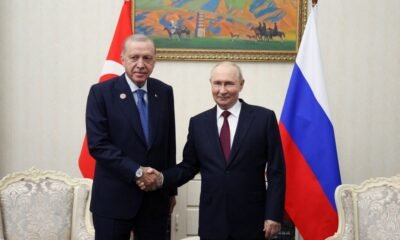
Türkiye, Russia to weigh new trade, energy cooperation deals
-
 Economy3 days ago
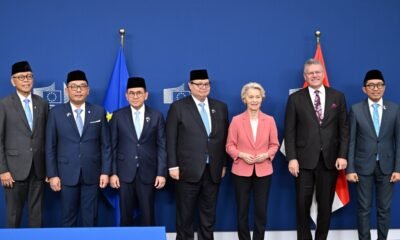
EU, Indonesia sign landmark trade deal after 10 years of talks
-
 Economy1 day ago
US expands Iran sanctions, targets ‘shadow-banking’ networks
-
 Economy1 day ago
Türkiye’s central bank says could opt for tax measures to support lira
-
 Economy2 days ago
Home sales to foreigners in Türkiye hit 2026 high
-

 Sports2 days ago
Vlahovic, Trossard lift Beşiktaş past Konyaspor in 6-goal thriller
-

 Politics2 days ago
20 detained in corruption probe into Turkish municipality
-

 Sports3 days ago
Greenwood saves Fener blushes as Galatasaray tighten grip on top