
Economy
China on course for record trade surplus, likely irking US, EU

China’s exports surged again sharply in September, official data showed Wednesday, putting it on course for another record annual trade surplus and likely more tensions with the European Union and the U.S.
The world’s second-largest economy recorded a $133.5 billion trade surplus in September, the most since January 2025, driven by exports surging 36.3% year-over-year, according to China’s customs administration.
Imports also grew 31%, but China’s cumulative trade gap through the end of September still reached $938.1 billion, putting it on course to break the record $1.2-trillion total recorded last year.
The data came days after the EU trade chief Maros Sefcovic held talks in Beijing aimed at reducing what he called an “unsustainable” gap between imports and exports of around 1 billion euros a day.
Shipments to the 27-nation bloc rose 25.3% in September, while imports were flat, pushing China’s trade surplus with the bloc to new heights.
“China’s trade surplus with the EU and the U.K. also reached a new high, which will likely add to trade tensions,” said Nguyen Hoang Nam, a China economist at Capital Economics.
Talks last week between Sefcovic and Chinese counterpart Wang Wentao ended with an agreement to limit exports of Chinese hybrid vehicles to Europe.
Sefcovic told reporters Friday that this was a “first step” toward rebalancing trade with China, which the EU accuses of using subsidies and unfair trade practices to outcompete European firms.
“Brussels is considering expanding restrictions to more strategic sectors, though we estimate that the impact of this on China’s economy would be small,” Nguyen wrote.
Shipments to the U.S. rose 39.6% in September, up from a low base last year when trade cratered after Beijing and Washington slapped punitive tariffs on each other’s goods.
Chinese President Xi Jinping met with Donald Trump last month in Washington, where the two sides vowed to extend a trade truce they agreed in October 2025 and to explore tariff cuts on $30 billion of goods on each side.
AI demand
Imports and exports both grew faster than the 25% and 25.7% increases predicted by a Bloomberg survey of analysts, driven by demand in China and abroad for AI-related products like semiconductors and computing equipment.
But growth was mainly caused by price increases for many of these products.
September’s exports of integrated circuits, for example, rose just 1% in volume but by 136% in dollar terms.
Vehicle export volumes, however, soared 56.3% compared with September last year, hinting at strong foreign demand for Chinese electric vehicles.
With domestic demand weak by comparison, as retail sales grew just 0.4% year-over-year in August, Beijing has relied on exports to meet its annual economic growth target of 4.5% to 5%.
On Tuesday, the IMF downgraded its growth forecast for China to 4.5%, slowing to 4% in 2027.

Outflows from investment funds caught up in last month’s turmoil have not significantly weakened Turkish residents’ preference for lira-denominated assets, the chief of the country’s central bank said Wednesday.
Central Bank of the Republic of Türkiye (CBRT) Governor Fatih Karahan said proactive measures had limited potential spillovers from funds subject to trading restrictions, while tight monetary policy supported demand for the lira.
The crisis began after several funds said they could not meet investors’ redemption requests during a market sell-off. That prompted a wide investigation into suspected price manipulation in a number of thinly traded stocks.
The Capital Markets Board (SPK) suspended trading in 131 funds run by seven asset management companies and placed them into liquidation, affecting nearly half a million investors.
Last week, Karahan said a significant part of the outflows from funds had moved into bank deposits, which he said had increased by TL 800 billion ($16.2 billion) during the period.
“Fund outflows have not materially weakened residents’ preferences for lira assets,” Karahan said on Wednesday during the International Monetary Fund and World Bank annual meetings in Bangkok.
“Residents’ preference for Turkish lira remains robust overall.”
Karahan reiterated that the bank would maintain its tight policy stance until price stability is achieved, supporting disinflation through demand, exchange rate and expectations channels.
He said interest rate decisions would take into account actual and expected inflation, alongside its underlying trend, to ensure the degree of tightness needed for a disinflation path consistent with the bank’s interim targets.
Decisions would remain cautious and be taken on a meeting-by-meeting basis, he added, with further tightening if the inflation outlook deviated significantly from those targets.
Underlying inflation moderates
Karahan said supply-side pressures had slowed disinflation, with energy prices exerting a major influence this year. Nevertheless, underlying inflation was moderating as weaker demand cushioned inflationary pressures.
Türkiye’s annual inflation dipped below 30% for the first time in almost five years in September. Consumer price growth eased more than expected to 29.73% from 31.51% in August.
That marked the fourth consecutive month of decline, after the downward trend that started in mid-2024 stalled earlier this year following a sharp rise in energy prices caused by the Iran war.
Monthly price growth also came in below expectations at 1.84%, the same as in August.
Some analysts said the September reading raises the prospect of an interest rate cut at the Oct. 22 meeting.
The bank has kept its benchmark one-week repo rate at 37% this year, as it monitored the inflation impact of the Iran war.
Rent inflation has been easing, with leading indicators pointing to further moderation. However, increases in transportation and communication prices partly offset declines in rent and education inflation.
Karahan said inflation expectations warranted continued caution, while high-frequency indicators confirmed weak domestic demand in the third quarter. Macroprudential policies also supported slower credit growth.
Despite weaker external demand prospects for 2026, Karahan said the trade deficit remained moderate and tourism revenues were close to last year’s levels, helping contain the current account deficit.
Türkiye’s sliding-scale fuel tax mechanism had restrained fuel price increases, he said, adding that gold price fluctuations amplified volatility in reserve buffers.
Bank of America has been hit with a $1.2 billion fine for allegedly violating anti-money laundering and sanctions laws, the U.S. Treasury Department said Tuesday.
The fines on America’s second-biggest bank amount to the third-largest in the department’s history.
The Treasury Department said the fine is due to the bank’s failure to report more than $5 billion in suspicious activity to the government, including $1 billion that posed national security-related and other priority illicit finance risks.
“Financial institutions are on the front lines of protecting our economic and national security,” Treasury Secretary Scott Bessent said in a statement. “When a bank of this size fails to meet its anti-money laundering and sanctions obligations, the consequences extend far beyond its own walls, exposing the entire U.S. financial system to significant illicit finance risks,” he noted.
“Today’s actions send a clear message that even the biggest financial institutions are not above the law.”
Treasury said Bank of America also reached an $11.6 million settlement with the department’s Office of Foreign Assets Control over “apparent violations of numerous sanctions programs, including on Iran, Russia, narcotics, and global terrorism.”
In a statement, Treasury said its Financial Crimes Enforcement Network (FinCEN) assessed the $1.2 billion penalty for Bank of America’s “failure to mitigate and report priority national security risks, including Chinese Money Laundering Networks and illicit finance along the southwest border.”
The penalty includes $750 million that will go to the U.S. Office of the Comptroller of the Currency, the largest fine ever imposed by that federal bank regulatory agency.
Treasury said that Bank of America “admits that it willfully violated” the 1970 Bank Secrecy Act, which requires banks to help the government detect and prevent money laundering.
“Financial crime compliance is serious, and we are responsible for getting it right,” said a Bank of America spokesperson in a statement. “We worked with regulators to reach these penalty resolutions stemming from violations cited in the previously reported 2024 (Comptroller of the Currency) Consent Order and FinCEN’s investigation.”
“We have invested billions of dollars in technology and dedicated thousands of employees to combat financial crime, and our team is far along with and committed to completing the work required to address the issues raised by our regulators,” the statement said.
The spokesperson added that the bank’s third-quarter results due for release on Wednesday would include a non-tax-deductible charge of $1.2 billion, which will reduce quarterly net income by approximately 17 cents a share.
Analysts have estimated adjusted EPS of $1.10, according to mean estimates compiled by LSEG, but that excludes one-offs like this fine.
Shares were down 2.7% in after-hours trading after closing the day down 1.1%.
The penalty is likely to add to negative investor sentiment and raise concerns about higher expenses and whether Bank of America can maintain its roughly $6 billion quarterly share buyback pace, UBS analyst Erika Najarian said in a note.
With earnings due on Wednesday, “we think shares likely underperforming at open,” she said.
She noted there was no asset cap, a regulatory penalty that would limit how large the bank could grow.
The fine comes days after American Express was also hit with a $350 million penalty for similar anti-money laundering shortcomings.
The latest action is the third-largest penalty ever issued by the Treasury Department, behind a roughly $4 billion settlement in 2023 with Binance, the world’s largest cryptocurrency exchange, and an approximately $3 billion settlement with Canada-based TD Bank the following year. Both those historic actions happened as part of the Biden administration’s focus on anti-money laundering and efforts to promote compliance with the then-emerging virtual currency industry.
Months later, Binance founder and CEO Changpeng Zhao, was sentenced to four months in prison over charges that he looked the other way as criminals used his platform to move money connected to child sex abuse, drug trafficking and terrorism.
Türkiye said on Tuesday it plans to complete the liquidation of about half of the investment funds caught up in last month’s market turmoil by the end of this week.
The crisis began after several funds said they could not meet investors’ redemption requests during a market sell-off. That prompted a wide investigation into suspected price manipulation in a number of thinly traded stocks.
The Capital Markets Board (SPK) suspended trading in 131 funds run by seven asset management companies and placed them into liquidation, affecting nearly half a million investors.
Seventeen funds run by three of the companies, A1 Capital, Bulls and Pardus, were settled last week, with a total of TL 6.4 billion (nearly $130 million) paid back to 43,643 investors, the Communications Directorate said.
The statement came following a meeting of the Fund Coordination Board, set up to oversee the liquidation process.
The three companies have 49 other funds holding a total of TL 34.1 billion lira, and the board aims to finish liquidating them this week, the directorate said.
If it does, all 66 funds run by the three companies will have been settled. They cover 45,745 people and TL 40.5 billion lira, in cash and in kind.
The statement said a bill meant to make the liquidation fair, transparent and effective, and to give payments a legal footing, was submitted to parliament on Friday. It is expected to be discussed on Wednesday at Parliament’s Planning and Budget Committee. The bill gives priority to money market funds and small investors.
Once it becomes law, the aim is to complete interim payments quickly for the other 65 funds still in liquidation, the statement said. These belong to the four remaining companies, Tera, Pusula, Hedef and Atlas, which are due to go through the extraordinary liquidation process set out in the bill.
Vice President Cevdet Yilmaz, who chairs the board, has said the bill would provide for interim payments of up to TL 1 million of principal and that fewer than 100,000 investors would be waiting once it passes.
Prosecutors have arrested more than 80 people in a related investigation into suspected market manipulation.
The EU sought Tuesday to downplay its reliance on Russian fossil fuel imports after Moscow boasted of its sales, seizing upon the controversy sparked by a U.S. decision to buy Russian diesel.
Russia said on Monday it had sold European countries more than $320 billion worth of hydrocarbons since 2022, despite sanctions imposed over the war in Ukraine.
European countries purchased $21.3 billion worth of Russian hydrocarbons in the first nine months of 2026 alone, Russian Deputy Prime Minister in charge of energy Alexander Novak said on television.
“In other words, despite sanctions-related restrictions, we continue to supply energy resources in certain areas for which exemptions have been granted,” Novak added.
He said Russian oil exports may reach their pre-war levels by the end of the year.
The European Commission responded by providing a lower figure – $209 billion since the invasion of Ukraine in February 2022 – and stressing that the 27-nation bloc was working toward ending all Russian gas imports by the end of 2027.
“We are in this for the long term and that trend is very clear,” commission spokesperson Anna-Kaisa Itkonen told a press conference in Brussels.
Moscow pointed to its European sales after some European countries criticized a deal allowing the United States to import Russian diesel.
The rebuke did not go down well in Washington, where the administration of U.S. President Donald Trump is seeking to bring down soaring fuel prices ahead of key midterm elections in November.
“The European Union paid Russia 250 Billion Dollars for Energy, and the Fake News Media doesn’t want to get near that story. I made the right choice for the American People – ALWAYS, AMERICA FIRST!,” Trump posted on Truth Social on Monday.
U.S. Treasury Secretary Scott Bessent on Sunday accused European nations of “hypocrisy,” as they “continue to finance Vladimir Putin” while criticizing the diesel agreement.
The European Union has taken significant steps to reduce its longstanding dependence on Russian pipeline gas and sap Moscow’s war chest since 2022.
Overall Russian gas imports, which represented 45% of the total in 2021, are down to 12%, Itkonen noted.
However, the bloc has increasingly turned to LNG shipped by sea, unloaded at ports, regasified and fed into the European network.
After the United States, which supplies about 60% of the EU’s LNG imports, Russia remains the bloc’s second-largest LNG supplier, accounting for around 17% of imports in 2026.
Several landlocked EU countries, including Slovakia and Hungary, also benefit from exemptions allowing them to purchase Russian oil transported via pipeline.
Swedish Foreign Minister Maria Malmer Stenergard pointed to the figure cited by Russia on Monday, lamenting it was higher than the 218.7 billion euros ($244 billion) the bloc has sent in support to Ukraine since the beginning of the war.
“We have imported a higher amount to the EU countries than we have given support to Ukraine,” Malmer Stenergard said. “If we would use the frozen assets, we would almost double the total support that we have given to Ukraine,” she added, referring to Russian sovereign funds held by the bloc.
“That would be a game-changer, and a game-changer is exactly what Ukraine needs.”
The International Monetary Fund (IMF) lowered on Tuesday its growth projection for the Turkish economy for this year, while keeping the outlook for the next year unchanged.
The IMF published its World Economic Outlook as part of the 2026 Annual Meetings of the IMF and the World Bank, held this week in Bangkok.
The fund said it expects Turkish gross domestic product (GDP) to grow 2.7%, down from 2.9% projection it shared in July. In 2027, the economy is expected to expand at 3.6%.
The fund also said it expects Türkiye’s annual consumer inflation at 31.2% in 2026 and 26.5% next year.
Türkiye’s annual inflation dropped below 30% for the first time in nearly five years as consumer price growth eased more than expected to 29.73% in September, according to official data.
For the global economy, the monetary body lifted the outlook by 0.1 percentage points to 3.1% this year. However, it cited disruptions caused by conflicts and the AI’s transformative role.
Business leaders and diplomats used a summit in Brussels on Tuesday to push for closer economic ties between Türkiye and the European Union, again calling for a modernized customs union, a place in the bloc’s industrial supply chains and a clearer accession perspective.
Belgium’s foreign minister also voiced support for updating the over 30-year-old trade agreement.
Speaking at the EU-Türkiye Business Summit, executives and officials argued that deeply integrated economies need a political and institutional framework that reflects their commercial reality.
Foreign Economic Relations (DEIK) President Nail Olpak quoted Jean Monnet’s line that Europe will be forged in crises and will be the sum of the solutions adopted for those crises.
“We are living in such a time. And I believe deeper integration with Türkiye is one of the answers Europe needs today,” Olpak said.
Priorities
He set out three priorities for the partnership.
The first is modernizing the customs union, which he said has been the backbone of economic ties for more than three decades but no longer meets current needs. “In a world that has changed this fast, we’re missing too many opportunities together,” said Olpak. An update would open up cooperation in services, e-commerce, public procurement and agriculture.
The second is recognizing Türkiye’s place in European industry. Olpak referred to the European Union’s proposed “Made in EU” rules, or how he reframed it, “Made with EU,” saying Türkiye has been part of the continent’s supply and value chains for over 30 years. Treating Turkish-made products as part of Europe’s industrial ecosystem “without new quotas or barriers,” he argued, is critical to Europe’s own resilience and competitiveness.
The third is connectivity. Citing the war in Ukraine and instability in the Middle East, he said the Middle Corridor, which links Europe with Central Asia via Türkiye and the South Caucasus, should remain a shared strategic priority. He also pointed to emerging north-south links connecting Europe and Türkiye with Iraq and the Gulf. He said geopolitical shocks “showed why we need reliable links for transport, energy and data.”
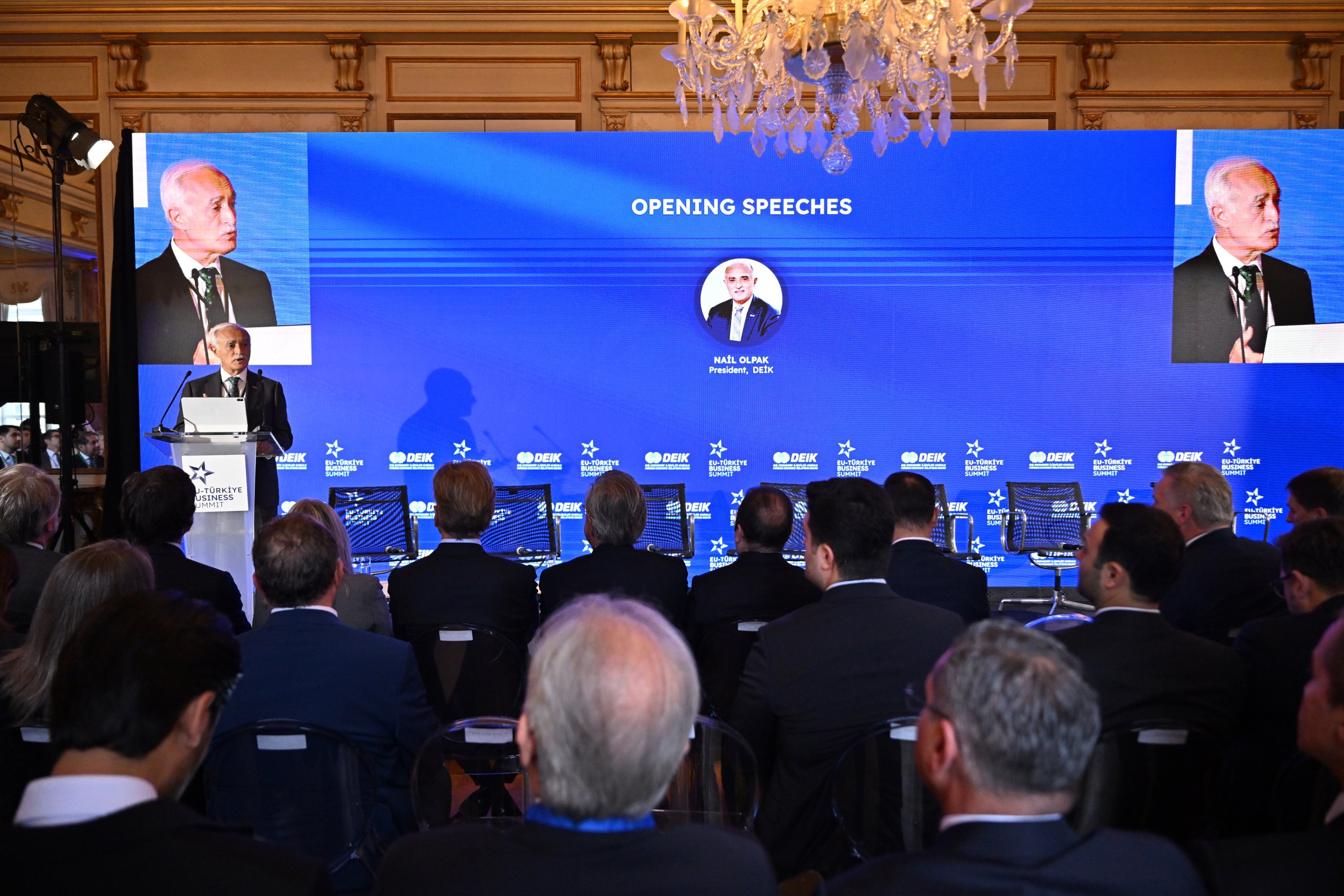
Tying the themes together, Olpak spoke of “competition on trust,” saying trust is built through performance rather than words and that Türkiye has proven itself a dependable partner through every crisis.
Türkiye’s European journey began more than 60 years ago, he noted, and full membership remains its goal. “After so many years, we need fresh momentum,” Olpak said.
Call for clear membership signal
Mehmet Ali Yalçındağ, coordinator chair of the DEIK Türkiye-EU Business Councils, said a “clear and credible reaffirmation” of Türkiye’s membership perspective would give the relationship direction, encourage reform and strengthen confidence in Europe’s ability to act with purpose.
He noted that the heads of DEIK’s 26 business councils with EU member states wrote earlier this year to the leaders of the European institutions, asking for renewed momentum in the accession process. He also welcomed European Commission President Ursula von der Leyen’s recent State of the Union address, which he said put competitiveness, security, affordable energy, AI and democratic resilience at the center.
Europe “will not become more competitive by excluding Türkiye from the economic space where our businesses already work together,” Yalçındağ said, adding that it grows stronger by building on its value chains rather than drawing new boundaries through them.
He urged both sides to move beyond arguments repeated for too long, saying caution has at times replaced initiative, to the benefit of competitors. Political dialogue, credible conditionality and practical cooperation can advance together, he said, without every disagreement being resolved first.
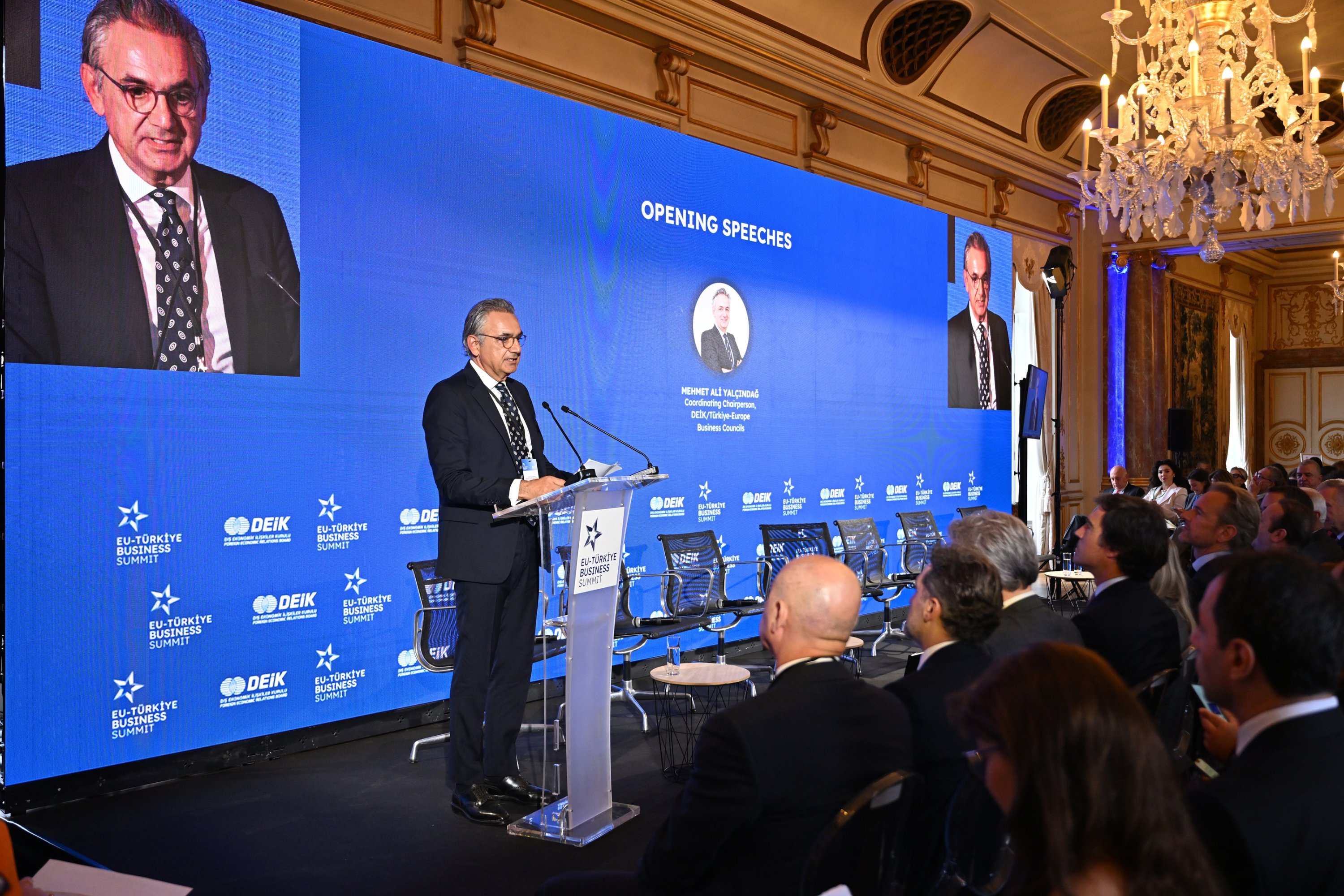
A clear commitment to Türkiye’s European future, he added, could help open the way to a modernized customs union, easier business mobility and visas, and closer cooperation on technology, energy, transport, defense and the green transition. He closed by urging both sides to act without adding “another ‘yes, but'” to a relationship already burdened by too many.
Industrial Accelerator Act in focus
“Türkiye and the EU need each other more than ever,” said Ambassador Yaprak Balkan, Türkiye’s permanent delegate to the EU, speaking at a summit session titled “Made in Europe or Made with Europe? The Industrial Accelerator Act Revisited.”
She said Türkiye shares the EU’s goals of building more resilient industry and speeding up decarbonization, but that neither side should weaken the value chains that make both more competitive.
Balkan said much of her team’s recent work has centered on the “Made in Europe” approach, which would prioritize European-made products in public procurement and subsidies under the proposed act, and that they have been working day and night to persuade partners with facts and scientific data.
Her central argument was legal. Decision 1/95 of the Association Council, which established the customs union, provides for removing duties and non-tariff barriers on industrial goods. If the act takes shape in the way Ankara fears, she said, it could contradict existing commitments.
Türkiye’s unique relationship with the EU through the customs union must be fully reflected in the legislation, Balkan said, and if it defines which partners are covered, Türkiye must be included from the outset. Where origin requirements are met, vehicles made in Türkiye should receive equivalent treatment.
Bilateral trade between Türkiye and the EU reached a record of about 207 billion euros last year. Automotive trade alone totaled 54 billion euros, roughly a quarter of the total, making Türkiye the third-largest export market for the EU automotive industry.
About 70% of vehicle production in Türkiye rests on direct or joint investments by major European manufacturers, Balkan said, and more than half of the parts and components in a car made there are imported from the EU.
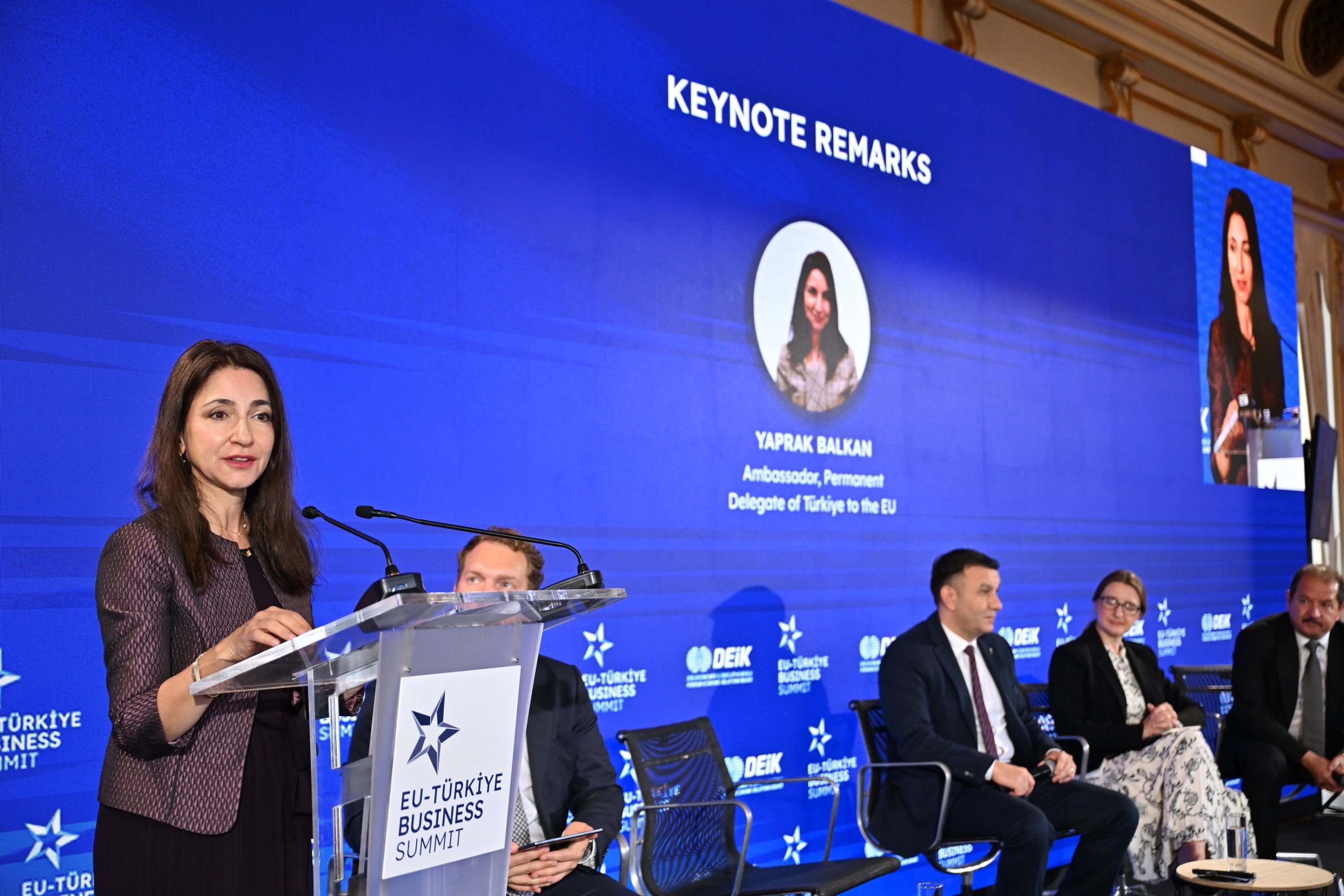
She dismissed claims that third-country goods would enter the EU through Türkiye as an “urban myth,” saying Türkiye will not become a back door for circumventing the rules and that Turkish industry also suffers from unfair competition and overcapacity.
On public procurement, Balkan said a law passed in Türkiye in July contributes to the process toward an agreement with the EU, that Ankara wants negotiations to start as soon as possible, and that reciprocity will be ensured. She added that senior executives of European carmakers have themselves lobbied for Türkiye’s inclusion.
Future cooperation, she said, should focus on joint research, advanced manufacturing, cleaner materials, batteries, circularity and skills. “Inward-looking attitudes and protectionism cannot be the solution,” she said.
Belgium: Türkiye can help reduce Europe’s dependencies
Belgian Foreign Minister Maxime Prevot also addressed the summit, saying Türkiye has an important role in helping Europe reduce its strategic dependencies, particularly in key industrial sectors.
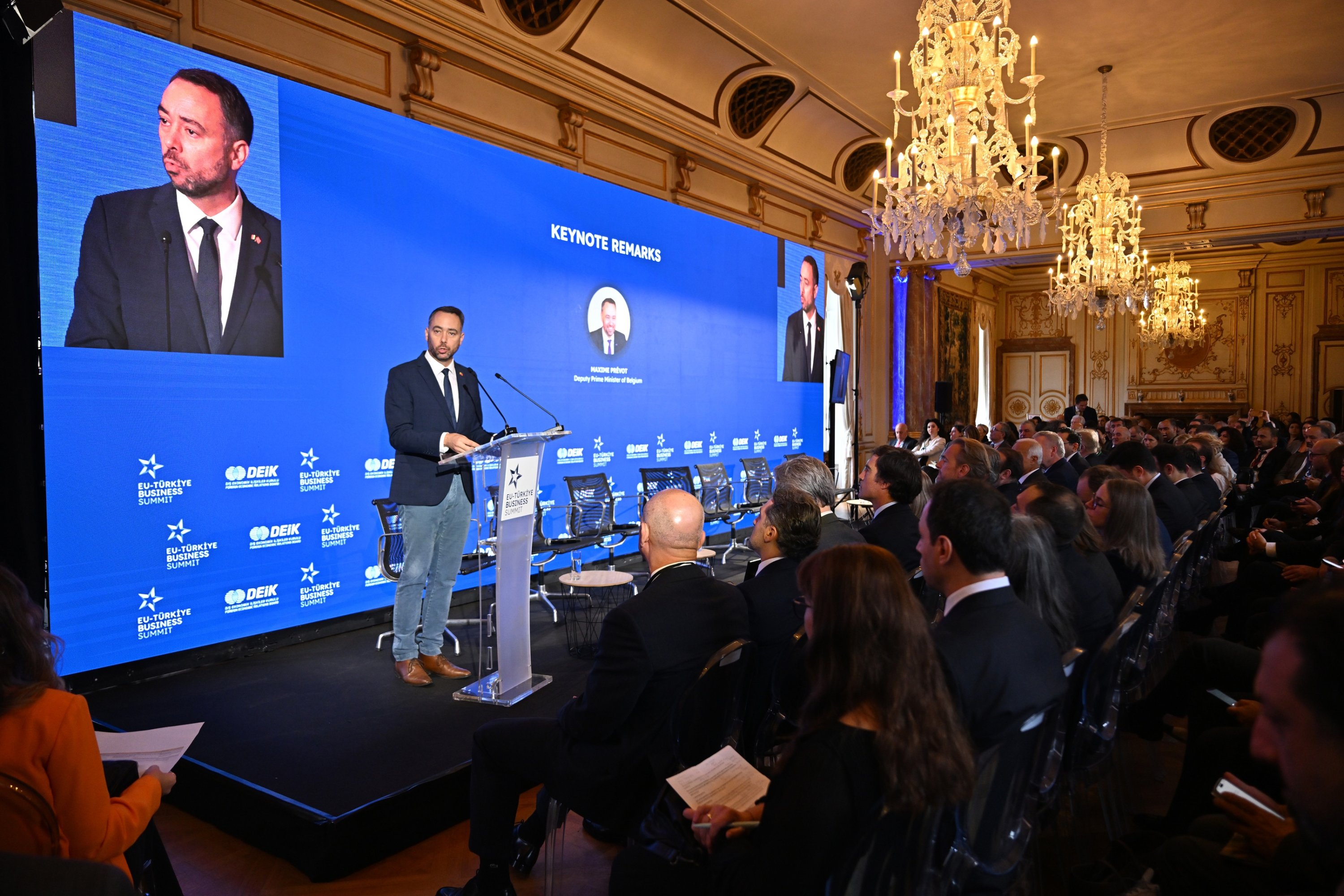
He said shifting global dynamics, the war in Ukraine and supply chain disruptions had made Europe increasingly aware of its economic vulnerabilities.
“Türkiye has an important role to play, not only as an industrial market but also as a gateway to markets in the wider region,” he said, stressing its manufacturing capacity, industrial expertise and links to neighboring markets.
European companies are increasingly seeking reliable partners closer to home as they reconsider where to manufacture and store their goods, Prevot said, and Europe should make the most of Türkiye’s proximity, especially in sectors where it needs to cut strategic dependencies.
He described Türkiye as a NATO ally, an EU candidate country and a major industrial economy connecting Europe, Asia and the Middle East, whose capabilities could make European supply chains more resilient. He called for stronger cooperation between Brussels and Ankara in economic security, defense, innovation, clean energy and digital technologies.
“Our economic relationship should no longer be limited to buying and selling goods. We should also be developing, producing, and investing together,” he said.
Prevot also backed modernizing the customs union, which he said has served both economies for around 30 years but needs to reflect changing global economic conditions.


-
 Economy3 days ago
Can diesel prices fall after Trump-Russia deal?
-
 Politics3 days ago
Türkiye-France defense cooperation spark concern in Greek media
-
 Politics3 days ago
Türkiye presses Greece to hand over FETÖ members, crime bosses
-

 Economy2 days ago
Top oil execs drop from major event schedule after Riyadh attacks
-

 Economy2 days ago
Türkiye says 17 funds settled, eyes Atlas deal this week
-

 Sports3 days ago
Bezzecchi wins Indonesian GP to hand Martin championship lead
-
 Economy2 days ago
AI ‘slow-moving tsunami’ but holds global growth, IMF chief says
-
 Politics2 days ago
Troubled funds, terror-free Türkiye on the agenda as the Cabinet meets