
Politics
Türkiye awaits Saudi needs, Parliament approval for military assistance

Türkiye’s Defense Ministry said Thursday that any deployment of Turkish troops or military capabilities to Saudi Arabia under the Mecca Joint Defense Alliance would require parliamentary approval, while confirming that talks with Washington continue over the delivery of six F-35 fighter jets and the lifting of U.S. sanctions.
The ministry addressed these issues following its weekly press briefing in Ankara, where spokesperson Rear Adm. Zeki Aktürk provided updates on regional security, counterterrorism operations and Türkiye’s international military commitments.
Responding to questions about potential Turkish military contributions to Saudi Arabia under the Mecca alliance, the ministry said any deployment would be carried out in accordance with the Constitution and relevant legislation.
“The agreement must be approved by the Turkish Parliament, and the necessary authorization procedures for deploying the Turkish Armed Forces abroad must be completed,” the ministry emphasized.
The Mecca agreement, signed in Mecca on Aug. 7 by Erdoğan, Saudi Crown Prince Mohammed bin Salman and Pakistani Prime Minister Shahbaz Sharif, establishes a collective defense framework among the three countries. Under the pact, an armed attack against any one of the three countries is considered an attack against all of them. The agreement also calls for broader defense cooperation and collective deterrence.
The scope of Türkiye’s potential contribution would depend on Saudi Arabia’s needs and requests, developments on the ground and operational requirements, it added. Final arrangements would be determined through assessments by relevant authorities and mutual agreement between the two countries.
Saudi Arabia has faced widening Houthi strikes over the past week, including an attack on King Khalid International Airport in Riyadh Saturday that killed 13 people.
F-35 talks, US sanctions
The ministry also confirmed that discussions with U.S. officials were continuing over the delivery of six F-35 fighter jets manufactured for Türkiye.
Ankara reiterated its demand for the removal of sanctions imposed under the Countering America’s Adversaries Through Sanctions Act (CAATSA), along with all direct and indirect restrictions targeting its defense industry.
“Our expectation is that CAATSA sanctions, which are incompatible with the spirit of alliance, and all restrictions on our defense industry will be lifted,” said the ministry.
In 2020, Washington imposed Countering America’s Adversaries Through Sanctions Act (CAATSA) sanctions on fellow NATO member Türkiye over its acquisition of Russian S-400 systems. It also removed Ankara from the F-35 fighter jet program, a move Türkiye called unjust and illegal.
The ministry expressed hope that the process would reach a positive conclusion in line with allied relations and mutual interests.
Regional tensions, Israel
Addressing developments in the Middle East, Rear Adm. Aktürk criticized Israel’s continued military operations and rhetoric, accusing it of undermining regional security and stability since October 2023.
He urged the international community to adopt a firmer stance against Israeli attacks, citing mounting Palestinian casualties and displacement.
The ministry also condemned Houthi attacks targeting King Khalid International Airport in Riyadh, expressing condolences for those killed and wishing the injured a speedy recovery.
It warned that attacks against civilian infrastructure and noncombatants violated international humanitarian law and risked further escalating regional tensions.
NATO commitments
On international military commitments, Aktürk confirmed that Türkiye handed over command of NATO’s Kosovo Force (KFOR) to Italy on Oct. 14, following a yearlong mission that began in October 2025.
The handover ceremony was attended by Turkish Chief of General Staff Gen. Selçuk Bayraktaroğlu.
Aktürk reaffirmed Türkiye’s commitment to NATO and Euro-Atlantic security, saying Ankara would continue contributing to regional stability.
He also announced that Defense Minister Yaşar Güler was scheduled to meet Polish Chief of General Staff Gen. Wieslaw Kukula on Thursday.
Turning to counterterrorism and border security, Aktürk said two PKK terrorists surrendered over the past week, while security forces apprehended 477 people attempting illegal border crossings.
Since Jan. 1, Turkish authorities have detained 13,843 people attempting to cross the country’s borders illegally and prevented another 54,851 from entering, including 981 during the past week.

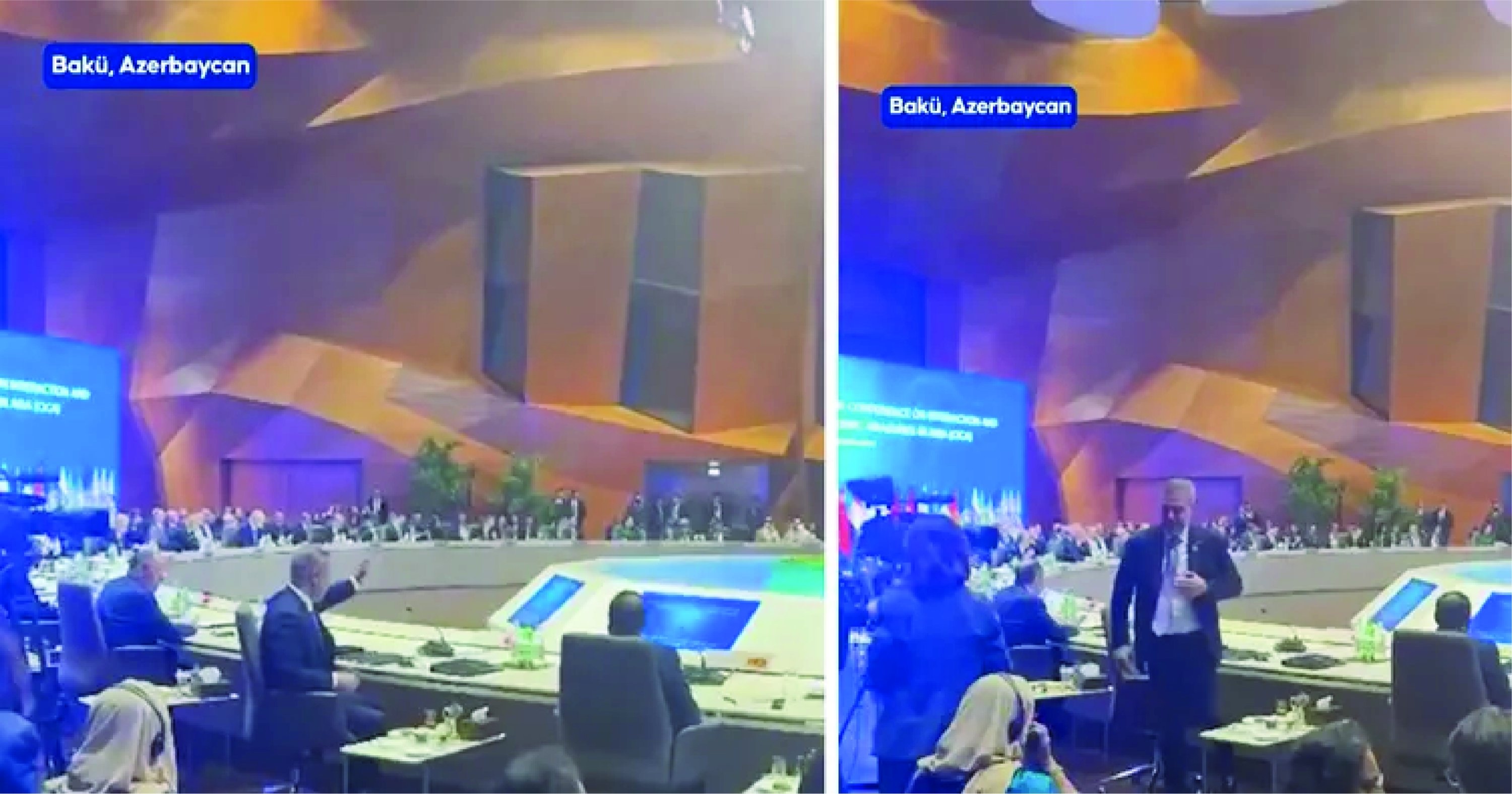
Foreign Minister Hakan Fidan protested Israeli President Isaac Herzog’s speech in Baku, Azerbaijan, on Thursday by walking out of the venue as Herzog began speaking.
Fidan is representing Türkiye at the seventh summit of the Conference on Interaction and Confidence Building Measures in Asia (CICA), which kicked off in Azerbaijan and is also attended by heads of state and government, as well as ministers. He was among representatives of more than 10 countries who left the hall when Herzog took the floor. Earlier, Fidan was welcomed by Azerbaijani President Ilham Aliyev and met with Russian Foreign Minister Sergey Lavrov.
Türkiye and Israel had been working to improve their relations before the latest round of the Israeli-Palestinian conflict began in 2023. Since then, Türkiye has been one of the most vocal critics of the Netanyahu administration over the genocide in Gaza and has severed all ties with Israel. Türkiye has also criticized the international community for its inaction over war crimes committed by the Israeli administration against Palestinians.
Pressure from Türkiye and several other countries has fueled growing opposition to Israel’s actions and further isolated Benjamin Netanyahu on the international stage. This diplomatic isolation was evident during last month’s U.N. General Assembly in New York, as scores of delegates walked out when the Israeli prime minister took the podium.
Later, addressing the summit, Fidan’s speech was a scathing critique of Israel. Pointing out member states’ commitments to peace and mutual trust, Fidan said this should apply to all members. “Israel is a member of the CICA. While it violates the basic rights of the Palestinian people with its policy of systemic pressure, we cannot fulfill our own commitment. We have to demonstrate a decisive stand to support the rights of Palestine, another member, against the ongoing oppression and severe violations,” he said.
The minister noted that the issue can be permanently resolved by the establishment of an independent and sovereign State of Palestine with East Jerusalem serving as its capital and based on the 1967 borders.
“The CICA is a valuable platform for bridging different priorities and deepening mutual understanding. This summit should clearly define the path to a more efficient CICA to ensure continent-wide sustainable peace and increased prosperity. We are determined to work to achieve these goals,” he said.
Armenian Prime Minister Nikol Pashinyan said yesterday he aims to sign and ratify a peace treaty with Azerbaijan before 2031, as the two South Caucasus neighbors seek to normalize relations following decades of conflict over the Karabakh region.
Speaking at a televised Cabinet meeting, Pashinyan described the signing of a peace agreement with Baku as one of his government’s top priorities and said he had established a specific timeline for completing the process.
“Signing a peace treaty with Azerbaijan is one of the most important issues for the government and for me personally,” Pashinyan said.
“I have set myself a task, a specific timetable to resolve the issue before 2031,” he added, expressing confidence that the goal was achievable.
“I see such a possibility. Otherwise I would not raise this issue.”
Armenia and Azerbaijan have fought two wars over Karabakh, an internationally recognized part of Azerbaijan that was previously home to Armenian separatists.
Azerbaijan regained full control of the region following a military offensive in September 2023.
The two countries took a significant step toward reconciliation in August 2025 when Pashinyan and Azerbaijani President Ilham Aliyev initialed a peace agreement during a White House summit hosted by U.S. President Donald Trump.
However, the agreement has yet to be formally signed or ratified, with disagreements over Armenia’s Constitution remaining a major obstacle.
Baku has demanded constitutional amendments, arguing that references to Armenia’s declaration of independence, which calls for unification with Karabakh, amount to territorial claims against Azerbaijan.
Any constitutional changes would require approval through a nationwide referendum in Armenia.
Yerevan has rejected Azerbaijan’s interpretation, maintaining that the agreed peace treaty already addresses concerns over territorial claims and provides sufficient guarantees for both countries.
The draft agreement commits Armenia and Azerbaijan to recognizing each other’s sovereignty and territorial integrity, renouncing territorial claims and establishing formal diplomatic relations.
Mehmet Uçum, chief presidential adviser and deputy chair of the Turkish Presidency’s Legal Policies Board, told journalists on Thursday that Oct. 1 was the “starting date of the process for drafting the new constitution.”
He was referring to the day when President Recep Tayyip Erdoğan made a speech for the inauguration of the new legislative year at the Turkish Parliament.
Erdoğan has called political parties to set aside differences for what he called a “grand Türkiye consensus” and devoted a large part of his speech to the need for a new constitution.
Uçum joined a meeting of the Legal Policies Board with Justice Minister Akın Gürlek on Wednesday in Ankara and told journalists that the meeting’s agenda was the new constitution. He noted that the work was underway on the perspective, basis and principles.
He noted that the need for a new constitution cannot be assessed solely in terms of politicians’ expectations, stressing that the demands and needs of the public must be taken as the basis.
Recalling that calls for a change have been on Türkiye’s agenda for many years, Uçum said the need for a new and civilian constitution had been debated since 1987. Political parties had also pledged to introduce a new constitution in previous elections, he said, adding that the country was now entering a period in which specific issues would be discussed.
Uçum said the remaining period could be used to develop the intellectual groundwork, adding that drafting one after the 2028 elections, during the 29th parliamentary term, could become a realistic goal. Emphasizing that drafting a new one and amending the existing one are two different processes, Uçum said the procedures currently in place for constitutional amendments could not be directly applied to the drafting of an entirely new constitution.
Under the current system, constitutional amendments require the approval of at least 360 lawmakers, while a referendum is optional when an amendment receives 400 or more votes, Uçum recalled. However, he said, a new constitution would require public approval.
“Regardless of numerical legitimacy, even if 550 to 600 lawmakers approve it, a new constitution cannot enter into force without a referendum. It must receive final approval from the public,” Uçum said.
Since the founding of the Republic of Türkiye, constitutional design has served as the backbone of the country’s legal system. The current Constitution, adopted in 1982, has been repeatedly amended over the decades, most notably in 2017, when a national referendum paved the way for the country’s transition from a parliamentary model to an executive presidential system.
Despite numerous amendments over the decades, replacing the 1982 Constitution with a new, civilian-drafted charter remains a prominent issue in Türkiye’s political debate.
Erdoğan and Parliament Speaker Numan Kurtulmuş have repeatedly advocated for a new civilian constitution, arguing that the existing charter retains the legacy of the military rule under which it was drafted despite extensive subsequent amendments.
Kurtulmuş said in August 2026 that Türkiye’s political climate and level of dialogue had matured sufficiently for work toward a new civilian constitution, describing such a charter as a longstanding objective.
Stressing that the process of a draft should begin with the will of the people and conclude with that same will, Uçum said a constitution adopted through broad social consensus could also secure strong support in a public referendum.
Responding to journalists’ questions about whether the drafting process had begun on an article-by-article basis, Uçum said numerous constitutional drafts had been prepared in Türkiye over the years.
Uçum said the Legal Policies Board had no direct mandate to draft a constitutional text, but could contribute ideas to the constitutional discussions. Rather than presenting a draft proposal at the outset, he said a more appropriate approach would be to first discuss the fundamental principles of the new constitution and establish common intellectual ground. Pointing to differing political views on the system of government, Uçum highlighted disagreements between parties advocating the continuation and further development of the executive presidency system in which the president is elected by the public and has authority to issue decrees unilaterally in a number of fields, and those calling for a return to the parliamentary system.
Noting that a semi-presidential model had also been raised as an option, Uçum said, “If you want to draft the new constitution through a grand Türkiye consensus, you first need to reach an agreement on the model of government.” Uçum also said consensus was needed on the vision for the country’s future that the new constitution would embody.
Foreign ministers from 19 countries, including Türkiye, Saudi Arabia and Qatar, condemned on Friday Colombia’s decision to relocate its embassy in Israel from Tel Aviv to Jerusalem, calling the move a violation of international law and a setback to efforts toward a two-state solution.
In a joint statement, the foreign ministers strongly rejected the opening of Colombia’s Embassy in Jerusalem, saying the decision contradicts relevant United Nations Security Council resolutions and undermines international efforts to establish a just and lasting peace between Israelis and Palestinians.
The statement was issued by the foreign ministers of Türkiye, Algeria, Djibouti, Indonesia, Palestine, Qatar, Kuwait, Lebanon, Libya, Malaysia, Egypt, Pakistan, Somalia, Sudan, Syria, Saudi Arabia, Oman, Jordan and Yemen.
Colombia relocated its embassy from Tel Aviv to Jerusalem after 46 years, with Israeli Foreign Minister Gideon Saar and his Colombian counterpart, Omar Bula Escobar, attending the inauguration ceremony.
Israel occupied East Jerusalem during the 1967 Middle East war and unilaterally declared the entire city its capital in 1980, a move that has not gained broad international recognition.
The ministers reaffirmed that any measures or decisions aimed at altering the legal or historical status of occupied Jerusalem, or recognizing the city as Israel’s capital, are null and void and carry no legal effect.
They cited U.N. Security Council Resolutions 476 and 478, adopted in 1980, which reject attempts to change Jerusalem’s status and call on countries to withdraw diplomatic missions from the city.
The ministers urged Colombia to reconsider and reverse its decision, comply with its obligations under international law and refrain from actions that could undermine the legitimate rights of the Palestinian people.
They also reiterated their support for the establishment of an independent, sovereign Palestinian state with East Jerusalem as its capital.
Most countries continue to maintain their diplomatic missions in Tel Aviv, reflecting the international position that Jerusalem’s final status should be determined through negotiations.
The U.S., Guatemala, Honduras, Kosovo, Paraguay, Papua New Guinea and Fiji are among those maintaining embassies in Jerusalem.
Colombia shifts Israel policy
Colombian President Abelardo de la Espriella restored diplomatic relations with Israel after his predecessor, Gustavo Petro, severed ties in May 2024 over Israel’s military offensive in Gaza.
Since taking office in August, Espriella has reinstated a free trade agreement with Israel and reopened Colombia’s Embassy, relocating it from Tel Aviv to Jerusalem. Colombian Foreign Minister Omar Bula Escobar attended the inauguration ceremony alongside Israeli Foreign Minister Gideon Saar.
Saar welcomed the diplomatic shift, saying the new Colombian administration had reversed much of the damage to bilateral relations under Petro in just two months.
Petro had been a vocal critic of Israeli Prime Minister Benjamin Netanyahu, withdrawing Colombia’s ambassador and closing its embassy in Tel Aviv.
Since October 2023, more than 74,000 Palestinians have been killed and over 175,000 injured in Gaza in the Israeli genocide since October 2023, while around 90% of the enclave’s infrastructure has been damaged or destroyed.
Israeli army raids and attacks by occupiers against Palestinians and their property have intensified in the occupied West Bank, including East Jerusalem, since the start of Israel’s genocide against the Gaza Strip in October 2023.
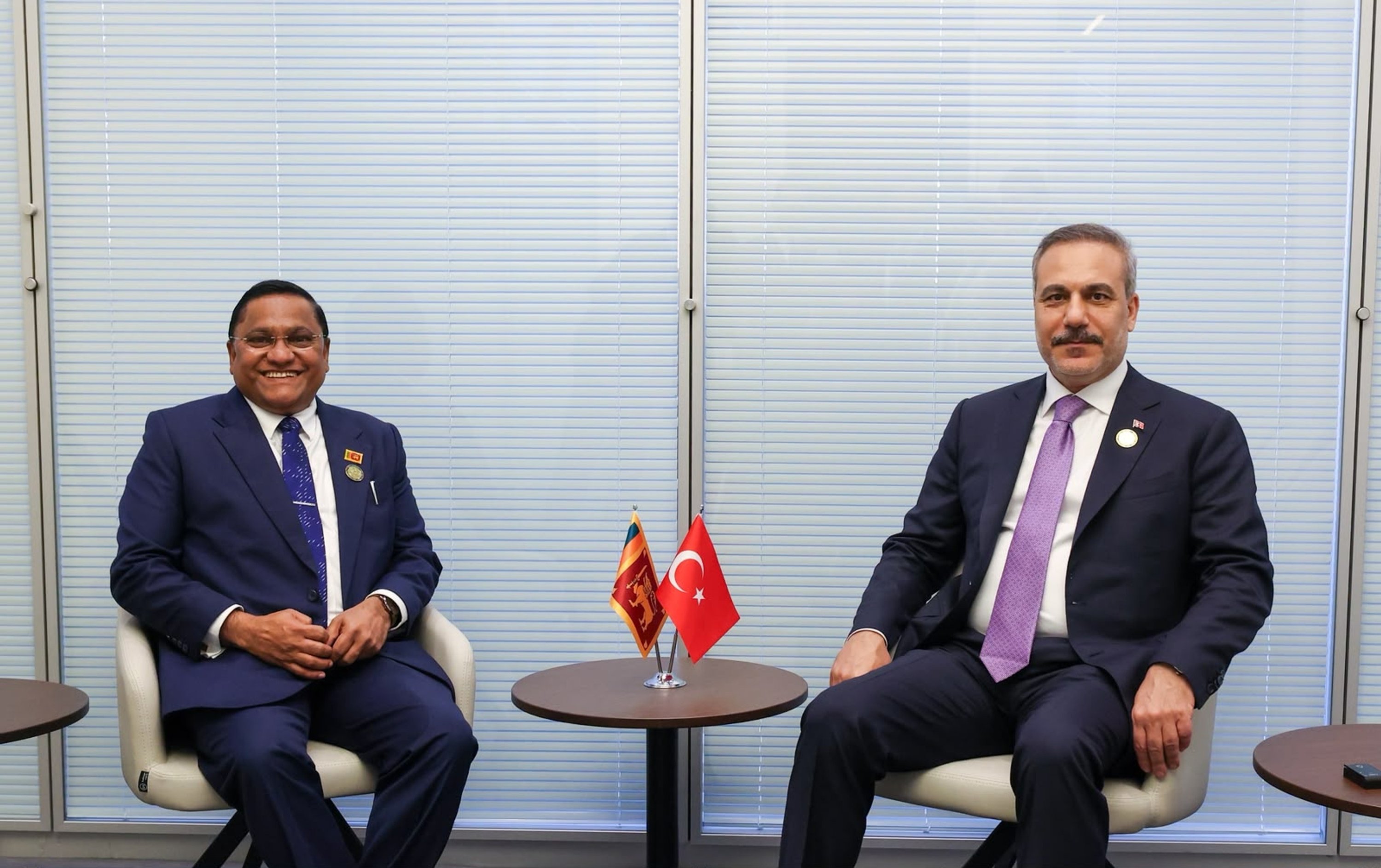
Foreign Minister Hakan Fidan held separate talks with his Azerbaijani and Sri Lankan counterparts on the sidelines of the seventh summit of the Conference on Interaction and Confidence Building Measures in Asia (CICA) in Azerbaijan’s capital, Baku.
Fidan met with Azerbaijani Foreign Minister Jeyhun Bayramov as part of the summit, Turkish diplomatic sources said.
The Turkish foreign minister also held a separate meeting with Sri Lankan Foreign Minister Vijitha Herath during the gathering.
Meanwhile, speaking to reporters after the summit, Fidan stressed that the strategic nature of Türkiye-Azerbaijan relations transcends any differences between the two countries, warning against attempts to undermine their longstanding ties through misinformation.
Fidan said the principle of “one nation, two states” remained central to bilateral relations, emphasizing that the bond between President Recep Tayyip Erdoğan and Azerbaijani President Ilham Aliyev had been tested during wars and crises.
“Regardless of the circumstances, the strategic nature of Türkiye-Azerbaijan relations stands above all other issues,” Fidan said, adding that occasional differences in perspectives were natural and should be resolved through dialogue rather than social media campaigns.
He also warned that misinformation and artificially inflated disputes could damage public perceptions of bilateral ties, stressing that Ankara and Baku remained committed to preserving their strategic partnership.
Turning to the Russia-Ukraine war, Fidan said Türkiye continued diplomatic efforts to prevent the conflict from further threatening security and commercial shipping in the Black Sea.
He said Ankara had presented proposals to both Moscow and Kyiv aimed at safeguarding maritime navigation and had discussed the issue with Russian Foreign Minister Sergey Lavrov.
Fidan warned that disruptions to Black Sea shipping were affecting global food and energy markets, particularly wheat supplies to African countries, while restrictions in the Strait of Hormuz and Bab el-Mandeb were adding pressure to international trade.
“Maritime safety in the Black Sea is critically important,” he said, stressing that Türkiye would continue working toward a solution to protect trade routes and ease the economic impact on developing countries.
Cambodian Prime Minister Hun Manet will pay an official visit to Türkiye on Oct. 15-16 at the invitation of President Recep Tayyip Erdoğan, Türkiye’s Directorate of Communications announced Thursday.
Burhanettin Duran, head of the Directorate of Communications, said in a statement shared on the Turkish social media platform NSosyal that the visit would focus on strengthening bilateral relations and exploring new opportunities for cooperation.
Erdoğan and Manet are scheduled to hold talks in Istanbul on Friday, Oct. 16, during which the two leaders will review Türkiye-Cambodia relations in all areas and discuss potential steps to deepen cooperation.
The discussions are also expected to cover regional and global developments, with the two sides exchanging views on issues of mutual interest, Duran said.
The visit comes as Ankara seeks to strengthen diplomatic engagement and expand cooperation with countries across Southeast Asia.
Türkiye is expected to expand cooperation with the Association of Southeast Asian Nations (ASEAN) in trade, economic relations, the defense industry and energy after recently becoming a “dialogue partner” of the regional bloc.


-
 Economy3 days ago
Türkiye aims to finish liquidating half of troubled funds this week
-

 Sports2 days ago
Galatasaray’s Champions League woes deepen after 4-1 loss to Barca
-
 Politics2 days ago
FM Fidan, Iran FM discuss regional tensions, efforts to end conflicts
-

 Sports2 days ago
Beşiktaş battle struggling Hoffenheim in Europa League matchup
-
 Politics23 hours ago
Turkish opposition CHP moves to sue former leader Özel over forgery
-

 Sports2 days ago
Trabzonspor aim winning start against KuPS in Conference League
-

 Sports3 days ago
Barcelona beat Galatasaray 4-1 in Champions League
-
 Economy2 days ago
Turkish lira preference remains strong despite fund outflows: CBRT