
Economy
Indonesian stocks rise after measures to address recent rout

Indonesian stocks climbed on Tuesday, recuperating slightly as authorities in Jakarta introduced measures, including to restrict selling after a record two-day $82 billion rout sparked by index provider MSCI’s warning of possible removal from its global indexes.
Jakarta’s benchmark index rose 4% on Tuesday, after hitting a six-year low in the previous session as the world’s worst-performing stock market this year dropped 14.8% over Friday and Monday. Still, the index is down about 40% this year.
MSCI on Friday said it was considering shifting Indonesia to “standalone” instead of “emerging markets” status, a more-severe-than-expected downgrade that shocked investors and officials and fueled fears of a sell-off by passive funds that track global indexes.
The index provider’s latest warning stemmed from concerns that Indonesia had yet to improve ownership transparency or clamp down on coordinated trading and was much worse than the January threat of a downgrade to “frontier” market status.
Relegation to “standalone” would be a devastating blow to Indonesia as Southeast Asia’s biggest economy grapples with eroding investor confidence over its fiscal health and central bank independence under President Prabowo Subianto.
After an online meeting with MSCI on Monday, the Indonesia Stock Exchange said it would exclude from its benchmark index any stocks with a high concentration of ownership by any person or entity.
“We are doing what is best for our market,” IDX President Director Jeffrey Hendrik said, adding the exclusion would provide a more accurate picture of the index’s movements. He said the affected stocks account for roughly 18% of the total index weight.
Gary Tan, portfolio manager at Allspring Global Investments, said excluding tightly held stocks should help address some investability concerns, but implementation would be key, given the potential for domestic pushback.
“From here, we think the bigger incremental risk to flows is likely to come from active rather than passive funds,” he said.
Jakarta aims to calm nerves with market measures
To slow the heavy selling on the market, the stock exchange this week halved the daily down limit on stock prices to 7% from 15%, while setting a 1 rupiah down limit on shares priced at 14 rupiah or less.
Also on Monday, Prabowo held talks with finance chiefs, including the head of the Financial Services Authority (OJK), the finance minister and the Bank Indonesia (BI) governor.
After the meeting, OJK chief Friderica Widyasari Dewi said the regulator would continue to advance Indonesia’s capital market reforms, particularly regarding transparency, liquidity, and law enforcement against various forms of violations.
“A particularly important special message is how we must continuously enforce regulations against those who have committed violations related to coordinated trading and other similar practices,” Friderica said.
Market watchers said the stock exchange had taken a constructive step in eliminating stocks with highly concentrated ownership from the benchmark index, but that would not automatically eliminate investors’ exposure to those companies either directly or through products such as mutual funds.
“We must ensure that even if a stock is delisted from the Jakarta Composite Index, concentration risk does not continue to accumulate within products purchased by the public,” said Liza Camelia Suryanata, head of research at stockbroker Kiwoom Sekuritas Indonesia.
Eyes on central bank
MSCI’s warning has weighed on the rupiah, which strengthened slightly to 18,000 per U.S. dollar on Tuesday but remained close to the record low of 18,190 hit in June ahead of a policy decision from Indonesia’s central bank.
BI is expected to hold rates steady on Wednesday, although some economists have raised the prospect of a rate hike to defend the currency, which is down 7% this year, making it the worst-performing currency in the region.
George Xu, a director in Fitch Ratings’ sovereigns team, said the latest concerns and substantial market sell-off reinforced the risks the rating agency identified when it revised the outlook on Indonesia to negative in March.
“From sovereign rating perspective, we do not anticipate the consultation announcement itself to have material immediate credit implications,” he said, but added that external pressure could raise the government’s borrowing costs and erode external buffers.

The U.S. government on Monday instructed its civilian agencies to remove DeepSeek products and third-party services using the Chinese AI model from their IT systems, drawing opposition from Beijing, which said Washington “overstretched” the concept of national security.
China and the United States are locked in a race for dominance in the fast-moving artificial intelligence sector, trading accusations of stealing AI technologies and jeopardizing security in recent months.
The U.S. Department of Homeland Security on Monday banned products developed by DeepSeek – and tools created using DeepSeek by third parties – saying they risked sharing sensitive data with China.
Beijing’s Foreign Ministry opposed the ban on Tuesday, vowing to resolutely safeguard the legitimate rights and interests of Chinese businesses.
“China has consistently opposed the overstretching of the concept of national security and the politicisation of issues related to science, technology, and trade,” ministry spokesperson Mao Ning told a news conference.
The Department of Homeland Security can issue directions to civilian agencies, but not the military or intelligence services.
Its statement on Monday said that “DeepSeek’s models present multiple threat vectors” and must be removed from IT devices.
Use of DeepSeek AI tools “may result in the transfer of sensitive data to (China) if used by U.S. government employees or vendors,” the department warned.
Its servers are located in China, where the legal system permits the government “extensive authority” to access private company infrastructure, it claimed.
DeepSeek, one of China’s top AI labs, shook up the industry in January 2025 with a low-cost, high-performance chatbot, challenging assumptions of U.S. dominance.
The firm released a long-awaited new model, V4, in April and this month updated a faster, more lightweight version of V4.
The United States has accused DeepSeek and other top Chinese AI firms of systematically stealing the capabilities of cutting-edge models developed by American rivals.
Despite their fierce competition in the field, China and the United States in September agreed to set up a “communication channel” for AI incidents.
The topic is expected to arise again when the countries’ leaders meet next month at a summit in the Chinese city of Shenzhen.
Saudi Arabia has decided to move the hosting of its flagship investment conference to next year, organizers confirmed on Monday, following recent deadly attacks by Houthis on the kingdom, as the Middle East conflict widens, posing fresh challenges for businesses in the region.
The Future Investment Initiative (FII) was planned for Oct. 26 to 29, but will now take place in 2027, with a new date to be announced “very soon,” the organizers said.
Reuters reported earlier Monday that the in-person event had been scrapped and organizers were weighing postponing the event.
The conference, set for its 10th edition, has become a must-attend event for some of the world’s top financiers.
Informally dubbed “Davos in the Desert,” in a nod to the World Economic Forum’s (WEF) annual meeting in Switzerland, the state-backed annual event has showcased the kingdom’s ambitious investment plans in a bid to attract billions of dollars needed to fund its economic transformation away from hydrocarbons towards tourism, sports and technology.
Expected speakers for this year’s event included Goldman Sachs CEO and Chairman David Solomon, Standard Chartered CEO Bill Winters and Citi’s CEO Jane Fraser, according to a draft program.
The U.S.-Israeli war with Iran this year has disrupted the Gulf’s busy calendar of events, with several conferences canceled, postponed, or retooled in the UAE and Qatar in the first part of the year, when the countries bore the brunt of the attacks while Saudi Arabia suffered fewer hits.
The kingdom in recent weeks has faced an escalating war with Yemen’s Iran-aligned Houthis, which have struck military, energy and civilian infrastructure across the country, including the state oil company Aramco’s headquarters and Riyadh’s international airport, where strikes killed at least 18 people and hundreds were wounded this month.
FII said it wanted to ensure the event delivered “the full scale, extraordinary quality, and unforgettable impact that our community has come to expect.”
Reuters reported last week that the FII organizers considered a hybrid format, allowing executives to tune in remotely.
Semafor reported on Monday that big banks and private-equity firms have privately relayed safety concerns about attending the event to Saudi Arabia’s Public Investment Fund (PIF) Governor Yasir Al-Rumayyan, adding that CEOs feel pressure to attend the four-day event.
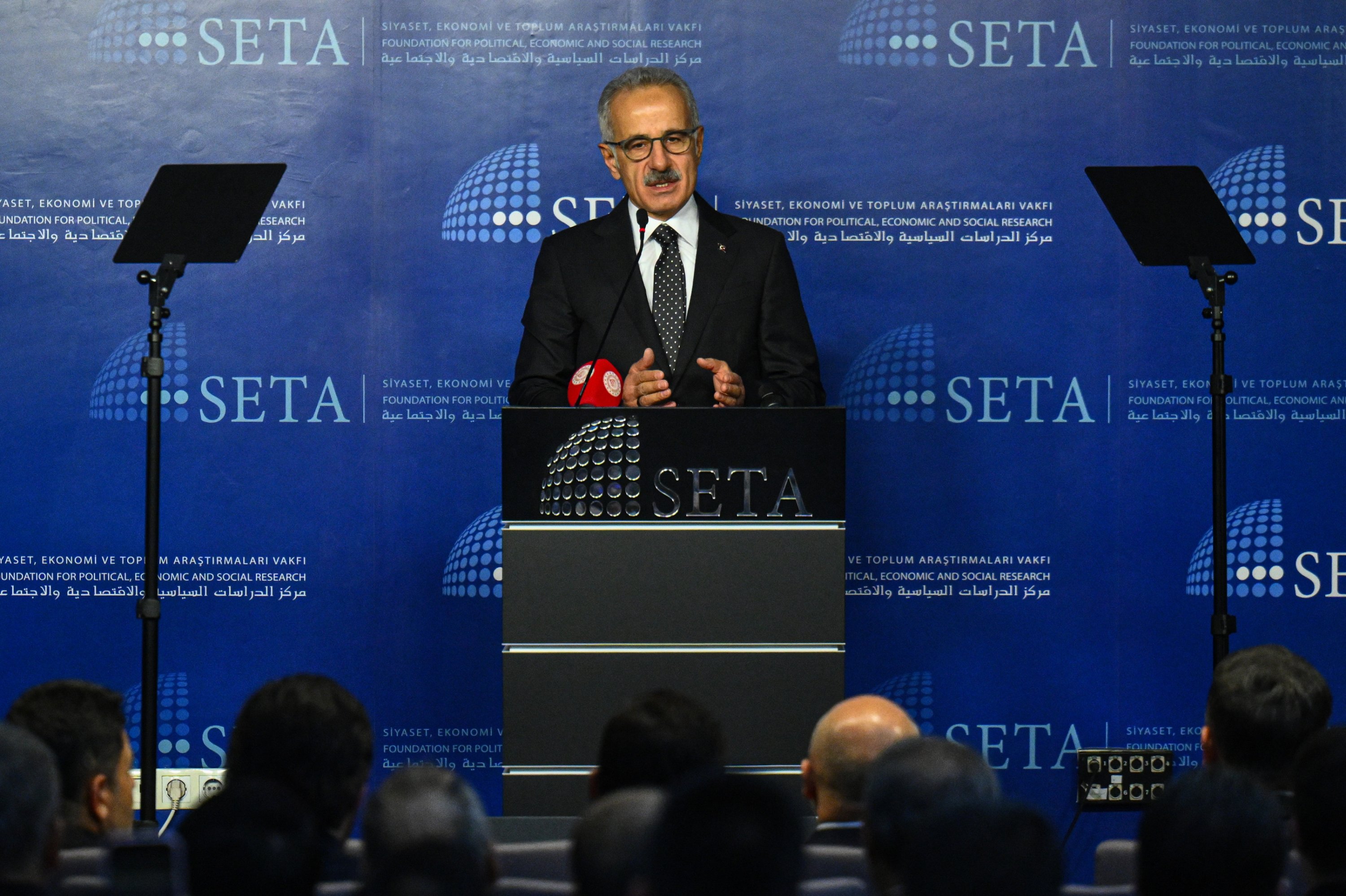
Türkiye expects the Development Road, a planned trade corridor linking the Persian Gulf to Europe through Iraq, to add about $55 billion to its economy over 10 years once completed, a senior official said Monday.
The project should also create jobs for roughly 70,000 people a year, Transport and Infrastructure Minister Abdulkadir Uraloğlu said.
Uraloğlu was speaking in Ankara at a conference on changing global transport geopolitics and the Development Road project.
Cargo leaving Iraq’s Faw Port, on the Gulf coast in Iraq’s far south, would travel about 1,200 kilometers (745.65 miles) by rail to Ovaköy, a crossing on the Türkiye-Iraq border in southeastern Türkiye. From there, it would continue across Türkiye toward Europe. The initiative was unveiled in May 2023 and is estimated to cost $20 billion.
Jobs from logistics, production hubs
Uraloğlu said the jobs would come from production and logistics centers built along the route.
The project also includes energy transmission lines and fiber optic infrastructure alongside the rail and road links, and officials hope it will further deepen economic ties between Türkiye and Iraq.
He also said transit from the Gulf to Europe along the route would fall to about 25 days.
That compares with 45 days around the Cape of Good Hope, off Africa’s southwestern coast, and 35 days via the Southern Corridor.
Lower logistics costs, Uraloğlu added, would make Turkish exporters more competitive and strengthen Türkiye’s position in global trade.
Officials have repeatedly tied the project to instability around the Strait of Hormuz.
The strait is the narrow waterway at the mouth of the Persian Gulf through which much of the world’s oil was shipped before the Iran war started.
Uraloğlu had said that had the Development Road been completed, the world’s energy supply would have been far less affected, and that the project would be started quickly after the war ends.
Transit push
The Development Road forms part of Türkiye’s wider push to become a transit hub between Asia and Europe. It complements the Middle Corridor, the route across Central Asia and the Caucasus, and Ankara has described both as central to Türkiye’s strategy.
Earlier this month, Türkiye opened the Çerkezköy-Kapıkule section, the longest part of the Halkalı-Kapıkule high-speed rail line, extending the network to the Bulgarian border.
The line is 229 kilometers long. It begins on Istanbul’s western edge and ends at Türkiye’s main rail and road border crossing with Bulgaria, at Kapıkule near the northwestern city of Edirne.
President Recep Tayyip Erdoğan said the line is a key component of the 2,094-kilometer Turkish section of the Development Road. The line extends the European end of the same network.
Türkiye’s top economic officials on Monday discussed, among others, the winding down of investment funds caught up in last month’s turmoil.
A statement after the meeting of the Economic Coordination Board (EKK) said payments to investors in the funds should start soon after Parliament passes a liquidation bill, which is due to be debated this week.
The board, chaired by Vice President Cevdet Yılmaz, also reviewed education and labor-market policy and revisions to balance of payments statistics.
The Fund Coordination Board said Sunday that authorities have settled about half of the funds ordered to be wound down. All 66 funds run by A1 Capital, Bulls and Pardus have been settled, covering more than 45,000 people and TL 40.8 billion ($823.37 million) in cash and in kind.
The goal this week, the board said, is to pay the largest number of participants, primarily those in money market funds. The remaining funds belong to Tera, Pusula, Hedef and Atlas.
The bill governing liquidation of the troubled funds has been submitted to Parliament and approved by its Planning and Budget Committee, the EKK said. Interim payments are expected to begin as soon as possible once it enters into force.
The crisis erupted last month after several funds said they could not meet investors’ redemption requests during a market sell-off, prompting a wide investigation into suspected price manipulation in thinly traded stocks.
The Capital Markets Board (SPK) suspended trading in 131 funds run by seven asset management companies, affecting nearly half a million investors.
Prosecutors have issued asset freezes and travel bans and have arrested more than 80 people, including the top executives of the asset management companies.
Economic outlook
The EKK said Türkiye’s strong macroeconomic fundamentals and firmly applied policies should keep the impact of recent developments on the financial system and the real economy limited. The measures taken are meant to make capital markets more reliable and efficient, it said.
The statement described the global economy as passing through a period of multiple shocks, with uncertainty and risk at historically high levels. Supply shocks and supply chain disruptions driven by the Iran war are weighing on the global outlook, it said, making economic resilience and stability more important.
Türkiye’s economic program has made growth more balanced, lowered unemployment and inflation, strengthened financial stability and established fiscal discipline, according to the statement. The government’s aim now is to protect those gains while raising production capacity, productivity and competitiveness.
Education, jobs
The board named raising the quantity and quality of education, and linking education more closely to employment, as priorities, noting that education has had the largest share of the budget for years.
It said green, digital and demographic change are reshaping labor-market needs, so education and employment policies must keep pace with technology and sector needs.
The government wants to increase the supply of skilled workers where they are needed, support productivity and encourage groups that struggle to enter the labor force, especially young people and women, to find work.
Balance of payments
The board also assessed how revisions to balance of payments statistics affect the “net errors and omissions” line, which captures transactions the statistics do not record.
The EKK includes the ministers of finance, trade, labor, energy, industry and agriculture, along with senior officials from other key economic institutions, including the central bank.
Insurance companies have set aside nearly TL 2 billion (about $40.4 million) as of Monday to cover damage from last week’s record rainfall and flooding in Istanbul and five other provinces, according to the Insurance Association of Türkiye.
The amount is an estimate of what insurers expect to owe on filed claims, and only a small fraction has been paid so far.
The historic rainfall, which officials said was the heaviest since records began in 1942, caused chaos and flash flooding, with footage showing cars and people being dragged away by the fast-flowing waters.
Six died in Istanbul, while the bodies of two more people from the neighboring Kocaeli province were washed up on the southeastern outskirts of the megacity, Istanbul governor Davut Gül told reporters on Monday.
So far, authorities have received nearly 20,000 reports about property damage as a result of the torrential rainfall and the resulting floods, Gül said.
“We experienced a disaster that generated around 19,300 reports, each with different types of problems. At this point, it has been determined that around 2,000 homes and about 900 businesses … have suffered serious damage,” he said.
On Friday, the authorities paid out TL 10,000 to 5,200 affected residents and were to pay out the same amount to another 2,500 people on Monday, he said.
The amounts insurers estimate they will owe on filed claims as of Monday stood at over TL 1.9 billion across 2,379 damage files under flood and inundation coverage in fire and motor policies, a report by Anadolu Agency (AA) said.
The affected provinces are Istanbul, Kocaeli, Yalova, Bursa and Sakarya in northwestern Türkiye’s Marmara region, and Antalya on the Mediterranean coast in the south. Kocaeli lies just east of Istanbul, and Sakarya lies further east.
In the fire branch, which covers fire, natural disaster and home insurance, insurers reserved nearly TL 1.56 billion for 1,638 files. In the motor own-damage branch, they reserved TL 345.75 million for 741 files.
Istanbul has the largest share in both. In fire insurance, reserves for Istanbul reached about TL 1.39 billion and for Kocaeli about TL 164 million. In motor insurance, Istanbul’s reserves were about TL 312 million.
Insurers have paid 13 claims totaling TL 389,535 in the fire branch. No payments have been made yet in the motor branch.
Policyholders have filed 2,453 damage notifications in all: 1,703 in the fire branch and 750 in the motor branch.
In fire insurance, Istanbul has 1,486 notifications, of which 12 files have received payments totaling TL 382,886. By segment, residential policyholders filed 821 notifications and 11 were paid, totaling TL 378,263. Commercial policyholders filed 563 and one was paid, totaling TL 4,623. The 102 industrial notifications have received no payments yet.
Kocaeli has 179 fire notifications, with one payment of TL 6,649 on a residential claim. Yalova filed 18, Antalya 14 and Bursa six.
In motor insurance, Istanbul has 670 notifications, Kocaeli and Antalya 35 each, Sakarya nine and Yalova one. Bursa has none.
Paris and Milan stocks spearheaded a decline in European markets on Monday, as intensifying violence in France and street clashes in Italy’s financial hub heightened concerns about mounting debt levels.
Most sectors were dragged lower, while there was renewed selling of bonds and the euro.
However, tech stocks led a rebound on Wall Street on Monday, with the Nasdaq Composite climbing 1.0% as trading got underway in New York.
“There was no mistaking that last week was a tough week for the semiconductor and AI trade,” said Briefing.com analyst Patrick O’Hare.
Concerns about rising investment costs and whether the vast sums pumped into the sector would see a return dominated sentiment, with investors dumping the stocks and bonds of a company providing computing power for AI firms.
“Staying true to form, though, there is a buy-the-dip bid in those stocks this morning,” O’Hare added.
Whether that rebound continues may depend on tech firm earnings and their message about AI investment as more companies report their third-quarter earnings this week.
“Earnings this week will be crucial to broader risk sentiment. In particular, (Facebook parent) Meta is in focus as the first of the five major hyperscalers to report,” said Saxo UK investor strategist Neil Wilson.
‘Worst of it’
In Europe, Paris stocks dropped 1.7% and Milan fell 1.8% in afternoon trading.
“European shares were broadly weaker, but France and Italy are getting the worst of it,” noted Saxo’s Wilson.
France’s President Emmanuel Macron on Sunday slammed the “unbridled” violence that erupted alongside cost-of-living demonstrations across the country, as police battled protesters and looters in new clashes in Paris.
Nearly 2,400 people were arrested Saturday in unrest that represented some of the worst urban violence in France in years, with almost 1,000 police injured, the interior ministry said.
It comes as the country’s lawmakers wrangle over a 2027 budget plan that calls for billions of euros in spending cuts but which keeps France’s debt levels extremely high.
In Italy, Prime Minister Giorgia Meloni was holding a security meeting Monday to address the Milan violence, which resembled some scenes of chaos and looting in Paris.
Oil prices pulled back Monday on signs that supplies continued to leave the Middle East despite Iran’s chokehold on the Strait of Hormuz and ongoing attacks by Yemen’s Houthis on key Saudi Arabian crude sites.
U.S. President Donald Trump’s decision to waive a new package of energy sanctions on Russia also weighed on oil futures, according to analysts.
Jakarta’s stock market sank over 5% on Monday, extending Friday’s plunge of more than 11%, to close at its lowest level in six years.
It came after index compiler MSCI said it was “no longer appropriate” to maintain the country’s emerging-market status, fuelling fears of an exodus of foreign investment.


-
 Politics2 days ago
Turkish Embassy rejects reports of FM Fidan’s ‘secret talks’ in Baku
-
 Economy2 days ago
US consumers withstand rising prices, but for how long?
-
 Politics3 days ago
Turkish military flexes combat capabilities in Northern Cyprus drill
-
 Economy2 days ago
Türkiye foresees spending over $20B on transportation next year
-

 Politics3 days ago
Türkiye plans time limits on alimony under judicial reform package
-
 Politics3 days ago
Sudan values Türkiye’s support as Ankara pledges continued backing
-
 Politics3 days ago
FM Fidan holds talks with OIC counterparts in Iraq
-
 Politics2 days ago
Turkish FM heads to Baghdad for OIC talks on Gaza, regional tensions