
Politics
Azerbaijan celebrates restoration of independence 35 years ago

After decades of Soviet rule, Azerbaijan regained its independence on Oct. 18, 1991. Today, it is marked as a day of restoration of independence, in reference to short-lived independence in 1918, before the Soviet occupation.
The Turkish Foreign Ministry and officials extended congratulations to “brotherly” Azerbaijan on the anniversary. President Recep Tayyip Erdoğan said in a social media post on Sunday that he sent his heartfelt congratulations to “friend and brother” Azerbaijan on its day of restoration of independence. “I extend my greetings to president, my qardaş (brother) Ilham Aliyev and my brothers and sisters in Azerbaijan who are united with us in joy and grief,” Erdoğan stated.
Türkiye was the first country to recognize Azerbaijan’s independence. The late President Heydar Aliyev’s words, “One nation, two states,” used to describe Türkiye and Azerbaijan, became a fundamental principle guiding relations between the two countries.
Building their relations on a strategic alliance, Türkiye and Azerbaijan have undertaken projects such as the Baku-Tbilisi-Ceyhan oil pipeline, the Trans-Anatolian Natural Gas Pipeline (TANAP) and the Baku-Tbilisi-Kars railway.
During the Second Karabakh War, Türkiye and the Turkish people provided political and moral support to Azerbaijan. President Recep Tayyip Erdoğan’s statement that “Azerbaijan is not alone” prevented third powers from intervening in Azerbaijan’s military operation.
Erdoğan and Aliyev elevated relations between the two countries to a higher level by signing the Shusha Declaration on June 15, 2021.
Azerbaijan declared its independence on May 28, 1918, through the National Council, headed by Mahammad Amin Rasulzadeh. After a brief two-year period of independence, the country was occupied by the Soviet Union. It reemerged as an independent state on the world stage on Oct. 18, 1991.
The massacre carried out by the Soviet Union’s army in Baku and other Azerbaijani cities on Jan. 20, 1990, in which women and children were killed indiscriminately, completely shattered the Azerbaijani people’s trust in Soviet rule and accelerated the process leading to the country’s independence.
On Aug. 30, 1991, the Supreme Council of Azerbaijan, which functioned as the country’s parliament at the time, adopted a declaration calling for independence. In September 1991, sessions were held to discuss Azerbaijan’s withdrawal from the Soviet Union and the declaration of independence. On Oct. 18, 1991, the Supreme Council adopted, by a majority vote, the Constitutional Act on the State Independence of the Republic of Azerbaijan. The document described the Soviets as occupiers and declared Azerbaijan the successor to the republic established in 1918.
The Supreme Council’s decision was put to a referendum on Dec. 29, 1991. Nearly the entire population voted in favor of independence.
Over the past 35 years, Azerbaijan has developed its economy and strengthened its military. By elevating relations with Türkiye to the level of strategic cooperation and implementing energy and transportation projects, the country has emerged as a regional actor.
In the early years of its independence, Azerbaijan faced territorial claims and attacks by Armenia. Taking advantage of political infighting in Azerbaijan, Armenia occupied Karabakh and surrounding districts between 1991 and 1993. As a result of the occupation, approximately 1 million Azerbaijanis were forced to leave their homes.
Azerbaijan negotiated with Armenia for years through the Organization for Security and Co-operation in Europe (OSCE) Minsk Group, co-chaired by Russia, the United States and France, in an effort to resolve the conflict peacefully. After the negotiations failed to produce results and the Armenian Army intensified its attacks on civilian settlements, Azerbaijan moved to exercise its rights under international law.
After Armenian forces opened fire on Azerbaijani civilian settlements, Azerbaijan launched a counteroffensive on Sept. 27, 2020. The operation, which soon became known as the “Patriotic War,” enabled the Azerbaijani army to liberate its territories and end the Azerbaijani people’s 30-year-long longing to return home.
The Second Karabakh War, which Azerbaijanis call the “Patriotic War,” lasted 44 days and ended on Nov. 10, 2020, when Armenia signed a statement acknowledging its defeat.
In 44 days, the Azerbaijani army liberated five cities, four towns and 286 villages from occupation. Under the terms of the signed statement, the Armenian Army was required to withdraw from the districts of Kalbajar, Lachin and Aghdam.
In September 2023, the Azerbaijani army launched an anti-terrorism operation in the Karabakh region, ending the presence of illegal armed groups on Azerbaijani territory. Azerbaijan thus fully restored its territorial integrity and established its sovereignty across the entire country.
Following these developments, peace talks gained renewed momentum. At a summit in Washington, the parties initialed the text of a peace agreement, marking a significant step toward lasting peace.
The foundations of Azerbaijan’s economic development were laid when the late Heydar Aliyev, the country’s former president and National Leader, signed the “Contract of the Century” with 11 companies from seven countries. The agreement provided for the development of the Azeri-Chirag-Gunashli (ACG) oil field, the country’s largest, and the export of its oil to global markets.
Azerbaijan cooperated with Türkiye and Georgia to transport its oil, leading to the construction of the Baku-Tbilisi-Ceyhan (BTC) pipeline.
While Azerbaijan’s oil production had fallen to almost negligible levels in the early 1990s, the country now sells oil and petroleum products to more than 30 countries.
Under President Ilham Aliyev, Azerbaijan also made major advances in the natural gas sector. The Southern Gas Corridor was built to transport natural gas extracted from the Shah Deniz 2 field to Türkiye and Europe. The corridor consists of the South Caucasus Pipeline, the Trans-Anatolian Natural Gas Pipeline (TANAP) and the Trans Adriatic Pipeline (TAP). Azerbaijan now exports natural gas to 16 countries.
Since gaining independence, Azerbaijan has established good relations with nearly all neighboring and nearby countries, with the exception of Armenia, and has played an active role in international organizations such as the Organization of Turkic States (OTS), the Commonwealth of Independent States, the Organisation of Islamic Cooperation (OIC), the Non-Aligned Movement, the Economic Cooperation Organization and the OSCE.
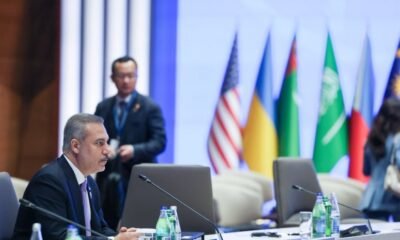
Türkiye was represented by Foreign Minister Hakan Fidan as the 52nd Session of Organization of Islamic Cooperation (OIC) Council of Foreign Ministers gathered in Baghdad over the weekend.
Fidan said in a social media post on Saturday that they emphasized solidarity and joint action on challenges facing the Islamic world, particularly Palestine, at the meeting.
Türkiye handed over the OIC chairmanship to Iraq at the meeting, which was held under the theme “Dialogue and Solidarity: Two Essential Pillars for Promoting Peace and Sustainable Development.” Türkiye has held the rotating chairpersonship since June 2025.
At the meeting, OIC Secretary-General Ismail Ould Cheikh Ahmed strongly condemned recent attacks on Saudi Arabia, saying they constitute a “blatant violation” of the kingdom’s sovereignty and threaten the safety of Islamic holy sites and regional stability.
The Yemeni Houthi group has recently targeted energy and aviation sites in Saudi Arabia. Yemen has been engulfed in conflict since the Houthis seized Sanaa and several provinces in 2014, prompting a Saudi-led coalition to intervene the following year in support of the internationally recognized government. The latest fighting began in July and a 2022 truce broke down.
The OIC chief said safeguarding the sovereignty and territorial integrity of member states is a shared responsibility and called for prioritizing dialogue and political solutions to consolidate peace and stability.
He also pledged to strengthen the OIC’s role in preventing and resolving conflicts by promoting preventive diplomacy and activating the organization’s mediation mechanisms.
The minister said he held meetings with Iraqi President Nizar Amedi, Prime Minister Ali al-Zaidi and Parliament Speaker Heibet Halbusi. He also met with Iraq’s Supreme Judicial Council President Faiq Zaidan, Foreign Minister Fuad Hussein, Popular Mobilization Forces Commission Chair Falih al-Fayyad and National Security Adviser Qasim al-Abboudi.
His meetings also included Iraqi Turkmen Front President and Kirkuk Governor Muhammed Seman Agha.
Fidan said the discussions covered bilateral relations in all their dimensions, including steps to deepen cooperation between Türkiye and Iraq in trade, energy and security. He also thanked Iraqi officials for their hospitality. Fidan said he also met with Egyptian Foreign Minister Badr Abdelatty and Iranian Foreign Minister Abbas Araghchi to assess progress in efforts to resolve ongoing regional conflicts.
“As Türkiye, we will resolutely continue our efforts to strengthen solidarity in the Islamic world, defend the rights of the oppressed, and make constructive contributions to peace and prosperity in our region,” he said.
Ties with Iraq
Fidan also spoke to reporters about his talks with Iraqi officials. He praised Iraqi Prime Minister Ali al-Zaidi’s “strong vision” for strengthening bilateral relations following talks in Baghdad on Saturday.
“Mr. al-Zaidi has a very strong vision for advancing relations with Türkiye. We are also seeing the positive and constructive impact of this vision in Iraq’s policies,” Fidan said.
Fidan said al-Zaidi has demonstrated a strong commitment to improving bilateral relations and taking practical steps to address Iraq’s challenges.
He said discussions with Iraqi officials covered energy, connectivity, the Development Road Project, security and defense cooperation, counterterrorism and the situation in Sinjar. Fidan reaffirmed Türkiye’s support for the Iraqi government’s constructive policies and said both sides shared a vision of taking bilateral relations to an unprecedented level.
He added that Ankara would contribute to overcoming difficulties stemming from recent history that had particularly affected Iraqi society.
“Hopefully, other problems in the region will also be resolved through dialogue and peaceful means in the near future, creating a more favorable environment for Iraq and helping the region evolve toward a more peaceful atmosphere,” he said.
Fidan also met with Iraqi President Nizar Amedi, conveyed President Recep Tayyip Erdoğan’s greetings and congratulated Amedi on assuming office.
“This was our first face-to-face meeting since he assumed his new position. He was a statesman we already knew,” Fidan said.
Fidan said he discussed Iraq’s political situation and regional developments with Iraqi Foreign Minister Fuad Hussein. He also met with Popular Mobilization Forces Commission Chairperson Falih al-Fayyad, with whom he said he had maintained ties since his years at Türkiye’s National Intelligence Organization. Their discussions covered the Popular Mobilization Forces, regional developments, steps taken toward disarming certain armed groups in Iraq and bilateral security cooperation, Fidan said. He also conveyed Erdoğan’s greetings to Iraqi Parliament Speaker Haibat al-Halbusi and discussed parliamentary matters. Fidan said talks with Iraqi National Security Adviser Qasim al-Abboudi focused on security cooperation and its regional implications.

The presidency of the Turkish Republic of Northern Cyprus (TRNC) announced on Sunday that U.N. Secretary-General Antonio Guterres replied to a letter written by TRNC President Tufan Erhürman and branded moves by Greek Cypriots as “discouraging.”
Erhürman sent a letter to Guterres in August, complaining that the Greek Cypriot administration sought to ban cultural and sports events such as music festivals and a football camp by Spanish club Barcelona on the Turkish side of the divided island.
A statement by the presidency said that Guterres lamented the fact that these may prevent building confidence between two sides on the island.
Cyprus has remained divided for more than five decades between the Turkish Cypriot north and the Greek Cypriot south despite a series of diplomatic efforts by the U.N. to achieve a comprehensive settlement. The TRNC was established in 1983 and is recognized only by Türkiye, while the Greek Cypriot administration represents the island internationally and joined the European Union in 2004.
Turkish officials and leaders in Turkish Cyprus have increasingly advocated a two-state solution to the dispute, arguing that decades of United Nations-led negotiations for a federal settlement have failed to produce results.
In his letter, Guterres drew attention to the need to continue cooperation and confidence building between the two sides, noting that they were necessary to launch the process for a lasting solution. Underlining the importance of implementing confidence-building measures as a priority, Guterres said he had instructed his personal envoy to continue working with both sides on the implementation of these initiatives, according to a statement by the TRNC presidency. He also said he had requested that all relevant actors be reminded that actions undermining efforts to build trust, including the cancellation of events, ran counter to joint efforts. At the end of his letter, the U.N. secretary-general reaffirmed his commitment to supporting efforts to find a solution to the Cyprus issue.
A similar message was conveyed in a response dated Oct. 6, 2026, to a letter Erhürman had sent to the European Commission on Aug. 28, 2026, on the same issue. The commission stressed the importance of building trust between Turkish Cypriots and Greek Cypriots and fostering a positive atmosphere. Quoting the 2004 European Union Council decision on ending the isolation of Turkish Cypriots, it highlighted the goals of building bridges between Turkish Cypriots and the EU, promoting dialogue and fostering closer ties. The European Commission also said that civil society and private organizations contributing to the socioeconomic development of Turkish Cypriots, particularly young people, were in line with the goal of establishing closer relations between Turkish Cypriots and the EU.
Gendarmerie forces in the southern Turkish province of Adana launched anti-corruption raids early Monday in the district of Çukurova. Mayor Emrah Kozay and former Mayor Soner Çetin, four deputy mayors and the manager of a municipal subsidiary were among 44 suspects detained in the operation. Çetin currently serves as deputy secretary-general of the opposition Republican People’s Party (CHP), while Kozay won the 2024 municipal election in the district as the candidate of the same party.
Security forces raided several locations to apprehend the suspects and searched the municipal building. Seven suspects remain at large.
Media outlets reported that the detentions stem from an investigation into allegations of irregularities in public tenders organized by the municipality in previous years, as well as procurement for public services. The suspects are accused of taking bribes from contractors in exchange for approving funds allocated for payments for services rendered. Authorities say some municipal staff were also “ghost employees” who received salaries without performing any work for the municipality. Top municipal bureaucrats are accused of running a criminal organization and committing bribery, fraud and tender-rigging.
Authorities stated that the investigation originated from tip-offs about alleged irregularities in tenders and procurement between 2024 and 2026. Expert reports on the tenders and procurement provided evidence of alleged wrongdoing.
A crackdown on municipalities where mayors are suspected of corruption began a few years ago in Istanbul and soon spread across the country. Most of those arrested or detained on corruption charges are affiliated with the opposition Republican People’s Party (CHP). Perhaps the most notable among them is Ekrem Imamoğlu, mayor of Türkiye’s most populous city, Istanbul. Imamoğlu was arrested last year.
President Recep Tayyip Erdoğan will be quite occupied this week with a busy schedule, including meetings with his Justice and Development Party (AK Party), an address at Parliament, and a rare visit by Canadian premier Mark Carney.
Erdoğan will convene the AK Party’s Central Decision and Executive Board (MKYK) on Tuesday. On Wednesday, he will address lawmakers at the party’s parliamentary group meeting at Parliament, for the first time in 119 days after a long summer recess. On Thursday, he will receive Canadian Prime Minister Mark Carney.
The MKYK meeting is expected to focus on current developments, particularly the investment fund crisis and the Terror-Free Türkiye initiative. Discussions with senior party officials are also expected to cover major domestic issues alongside the political agenda.
His speech at the AK Party parliamentary group meeting is expected to deliver key messages on domestic and foreign policy developments, as well as touch on the Terror-Free Türkiye initiative and other current political issues.
Another key item on Erdoğan’s weekly agenda will be his meeting with Canadian Prime Minister Mark Carney, scheduled for Thursday. The meeting is considered important for bilateral relations. Carney’s visit also stands out as the first bilateral visit to Türkiye by a Canadian prime minister.
Istanbul police captured three fugitive members of the Gülenist Terror Group (FETÖ), including one who had been on the run for a decade, authorities announced Sunday.
Police identified the suspects as Mehmet Yılmaz, Abdullah Ilık and Serdar Uluocak. Yılmaz was wanted for membership in a terrorist group and was a user of ByLock, an encrypted messaging app developed and exclusively used by FETÖ members. He worked as an editor, reporter and editor-in-chief at publications controlled by FETÖ, including the now-defunct newspaper Zaman. Yılmaz was captured in a “gaybubet evi” (house of absence), a term used for safe houses operated by FETÖ.
Ilık was a high-level member of FETÖ and was in charge of secret prep schools operated by the group. He had been on the run for the past three years after a court sentenced him to more than six years in prison. Uluocak was a police officer linked to FETÖ.
FETÖ has faced increased scrutiny following the coup attempt that killed 251 people and injured nearly 2,200 others. Tens of thousands of people were detained, arrested or dismissed from public sector jobs following the attempt under a state of emergency.
The terrorist group faces operations almost daily as investigators continue to unravel its extensive network of infiltrators. However, an unknown number of FETÖ members, mostly high-ranking figures, fled Türkiye when the coup attempt was thwarted.
In addition to Iraq’s Turkmen community, Mohammed Samaan Agha’s appointment as a state minister in Iraq was also welcomed in Türkiye.
The minister, who also happens to be the leader of the Iraqi Turkmen Front (ITC) and serves as governor of Kirkuk, promised to work “for the benefit of Iraq and Türkiye” in remarks to Turkish journalists on Sunday in Baghdad.
He met Foreign Minister Hakan Fidan on Saturday as the latter was in Baghdad to attend a meeting of the Organisation of Islamic Cooperation (OIC).
Fidan congratulated him on his appointment as minister and told journalists that Türkiye had long monitored the challenges facing Iraq’s Turkmen community. He said addressing those challenges required progress on Iraq’s broader political and social problems.
”They are loyal citizens of Iraq. They are also highly conscious of preserving their own identity, which is precisely what we want,” Fidan said.
He stressed that the Turkmen community had consistently played a constructive role in Iraqi society and politics. “Türkiye and Iraq are brotherly countries, extensions of one another geographically, culturally and historically,” Fidan said. He called for a more institutionalized framework for bilateral cooperation that would serve both countries’ interests.
Agha was elected governor of Iraq’s Kirkuk province in April by the Kirkuk Provincial Council, becoming the first governor of Turkmen origin in more than a century. Turkmens are a Turkic-speaking minority whose total population is estimated at around 3 million. Agha visited Türkiye on an official trip following his election.
The new minister told reporters that, as a minister of Turkmen origin, he would work on issues in the interests of the people of both countries.
Commenting on his meeting with Fidan, Agha highlighted the historical, geographical, religious and cultural ties between the two countries.
Noting that Türkiye and Iraq shared many common issues, Saman Agha said: “We discussed all issues of mutual concern to the two countries, particularly security, trade, oil exports, energy, water and the fight against terrorism. In the coming period, as a Turkmen minister, we will do our best to carry out work in these areas that will benefit both countries and their peoples. We have initiated this process. God willing, we will make very good progress.”
Stating that regional tensions were negatively affecting the Iraqi economy, he said developments around the Strait of Hormuz and tensions between Iran, Israel and the United States had seriously harmed Iraq’s oil exports.
Emphasizing that Türkiye was an important neighbor and economic partner for Iraq, Agha said the Development Road Project should be accelerated.
“The faster the Development Road Project is carried out and implemented, the more beneficial it will be for Iraq. Türkiye will also benefit from it, but Iraq’s gains will be greater because this project will connect the East with the Western world,” he said.
Unveiled in May 2023, the Development Road Project is a $20 billion regional infrastructure initiative designed to facilitate the transport of goods from the Gulf to Europe via the Grand Faw Port in Basra, southern Iraq. The port would be linked to Türkiye and subsequently to Europe through an extensive network of railways and highways.
In April 2024, Türkiye, Iraq, the United Arab Emirates (UAE) and Qatar signed a memorandum of understanding (MoU) on joint cooperation on the project.
Noting that the issue of water was becoming increasingly important as winter approached, Agha said water and security had also been discussed during talks between Türkiye and Iraq.
Recalling that Iraqi Prime Minister Ali al-Zaidi had also recently raised security concerns, the minister stressed the importance of strengthening cooperation between the two countries in these areas.
“I believe that relations between Iraq and Türkiye will become much stronger in the coming period,” he said.
Commenting on the Iraqi Turkmen Front’s political goals and the representation of Turkmens in the new government, Agha said they attached importance to maintaining good relations with the country’s different social groups.
“First and foremost, we trust in God. Then, we trust in the votes of our people and the support they have given us and the Iraqi Turkmen Front. At a very critical and difficult time for Iraq, we have established very good relations with our Shiite, Sunni and Kurdish brothers. We maintain sound and sincere relations with everyone,” the Turkmen minister said.
Recalling the agreement on rotating the governorship of Kirkuk among Turkmens, Kurds and Arabs, Agha said it was also significant that Turkmens had subsequently secured representation at the ministerial level in the government.
Emphasizing that all social groups in Iraq should be represented in the country’s administration, he said: “I think everyone in Iraq has now come to the conclusion that, alongside Shiites, Kurds and Sunnis, Turkmens and Christians must also be represented. This would allow all segments of Iraqi society to feel that they are represented in the government Cabinet.”


-

 Economy3 days ago
Türkiye to account for 20% of Europe-CIS aircraft demand: Airbus
-
 Politics2 days ago
Turkish military flexes combat capabilities in Northern Cyprus drill
-
 Economy1 day ago
US consumers withstand rising prices, but for how long?
-
 Economy3 days ago
Türkiye’s 1st Akkuyu reactor set for initial startup by year-end
-

 Economy3 days ago
Tesla unveils ‘flying’ car, but don’t expect to drive it anytime soon
-
 Politics24 hours ago
Turkish Embassy rejects reports of FM Fidan’s ‘secret talks’ in Baku
-
 Politics3 days ago
Turkish FM walks out as Israel’s Herzog takes floor at CICA summit
-

 Politics2 days ago
Türkiye plans time limits on alimony under judicial reform package