
Economy
Lindt sacks CEO as Swiss chocolate maker grapples with weak sales

Swiss chocolate maker Lindt & Sprüngli announced Monday it was parting ways with chief executive Adalbert Lechner after issuing two revenue warnings within a year.
The board of directors said new leadership was needed to put the company, known for its Lindor chocolate truffles and chocolate Easter bunnies, back on a path to sustained growth.
“The Board of Directors has concluded that Lindt & Sprüngli requires new operational leadership to return to consistent, strong growth and to capture opportunities in all its markets globally,” the company said in a statement.
Former chief executive Dieter Weisskopf, 71, will take over as interim CEO with immediate effect, the company said in a statement from its headquarters in Kilchberg, Switzerland.
Weisskopf, who is also vice chair of the board of directors, previously served as the company’s chief financial officer for many years and led the group until 2022.
A permanent successor is expected to be appointed in the second quarter of 2027.
Lechner, 65, had worked for Lindt for 33 years and took over as chief executive in early 2022. The company provided no further details about the circumstances of his departure.
Executive chair Ernst Tanner thanked Lechner for his contribution to the company and expressed confidence in its future.
“Our brands and market positions are strong, and our focus continues to be on delivering exceptional products and experiences for our consumers and on profitable growth for our shareholders,” Tanner said.
Lindt & Sprüngli has been struggling with declining sales volumes for months after sharply raising prices in response to soaring cocoa costs.
The company increased prices by an average of 11.8% in the first half of 2026, while the volume of products sold fell significantly.
In July, Lindt reported slightly higher first-half earnings but said its performance had been affected by higher prices, geopolitical tensions, market volatility and inflation.
Consumers in Germany, Switzerland and Britain proved more sensitive to the higher prices than expected, prompting Lindt to begin cutting prices on selected products over the summer. The company has also introduced smaller packaging.
In late September, Lindt lowered its sales forecast for the second time this year. It now expects organic sales growth of just 0% to 2% in 2026, down from its original forecast of 6% to 8%.
In addition to higher prices, summer heat in Europe weighed on business. The revised outlook triggered a sharp fall in the company’s share price.
Weisskopf will now focus on restoring growth in Europe, while increasing investment in the company’s brands and improving profitability. Business in North America and Asia has been performing significantly better.
Lindt is also replacing the head of its German operations.
Michal Spiller is leaving the company after 23 years and will be succeeded by Ali Kulein, who currently heads Lindt’s Austrian business.

Türkiye will continue its efforts to have its automotive industry covered by the European Union’s draft Industrial Accelerator Act (IAA), Trade Minister Ömer Bolat said Monday after a meeting with sector representatives.
The Trade Ministry said in a statement that the “Made in Europe” policy in the draft should take account of the deep industrial integration between Türkiye and the EU.
The bloc says the proposed rules are designed to strengthen its industrial base by encouraging more manufacturing and sourcing within Europe. The measures would also push foreign manufacturers seeking access to the EU market to produce more goods locally and rely on European suppliers.
But “Made in Europe” has sparked a political dispute over which countries should be covered by the rules.
In its current form, the proposal excludes non-EU countries such as Türkiye, Britain and Morocco, where vehicle production and supplier networks are deeply integrated with Europe’s automotive industry.
Automakers with operations in those countries, along with local industry groups, argue that limiting the definition of Europe to the EU would damage supply chains that have developed across the wider region.
Bolat last week held a series of high-level talks in Brussels, where he said Ankara had worked intensively for the past year on the legislation. He said the European Commission had put forward the proposal, and that the European Parliament and EU Council would still decide on it.
Monday’s meeting in Ankara included officials from ministries and institutions with the heads and senior management of the Türkiye Exporters Assembly (TIM), the Automotive Exporters’ Association (OIB), the Automotive Industry Association (OSD) and the Automotive Suppliers Association (TAYSAD).
Türkiye’s automotive industry supports 250,000 EU jobs, according to OIB.
Concerns being conveyed
Monday’s statement said Türkiye’s priority is for the “Made in EU” policy foreseen in the draft law to respect the strong economic integration built on the customs union, as well as shared production and supply chains.
It said Turkish officials have held numerous contacts with EU institutions, member states and EU industry representatives since the start of the process, and have conveyed Türkiye’s views, expectations and sensitivities at every level.
The private sector is also making many approaches to its counterparts, the statement said, and all work is being carried out in full coordination. Participants agreed to keep pressing for the final text to reflect Türkiye’s position, both in member states’ positions and in the work of the European Council, Parliament and Commission.
Automotive at heart of integration
The ministry said the automotive sector is one of the most successful areas of the integration created by the customs union, which took effect in early 1996, and forms the backbone of industrial integration between the two sides.
It said any approach must take into account the economic integration created by the customs union, together with joint production, investment and supply networks.
It argued that a law meant to boost the competitiveness of European industry should not hurt investment and existing production networks of European manufacturers themselves. This point, the ministry said, has been the central message of nearly a year of trade diplomacy with all stakeholders in the EU, including member states, officials of the European Parliament, the Council of Ministers and the Commission, and private sector groups.
The ministry said European carmakers and industry representatives are also telling EU decision-makers how strategically important Turkish production and investment are to Europe’s automotive ecosystem, in order to avoid disrupting current production and supply chains.
“All of our work aims to develop our joint production capacity and global competitiveness together with the EU, instead of measures that narrow mutual market access,” the statement said. It said Türkiye wants the EU to adopt an inclusive approach that reflects the legal and economic realities of the customs union, and will continue its contacts with EU institutions, member states and the private sector at every level.
Vice President Cevdet Yılmaz said on Tuesday that Türkiye’s capital markets would emerge stronger once the problems in certain investment funds are resolved, cautioning against creating the impression that the whole market is under suspicion.
“Capital markets are extremely important and valuable in our development process,” Yılmaz said in a statement on the social media platform X. “With the overcoming of the problems that have recently emerged in certain funds, our capital markets will continue on their way more strongly.”
The fund scandal hit the headlines just over a month ago, prompting prosecutors to open an investigation into allegations of widespread market manipulation.
It began when several investment funds were unable to satisfy redemption demands, with regulators placing seven firms into liquidation that manage 131 investment funds. Some 455,000 individual investors have been affected.
Yılmaz, who chairs the Fund Coordination Board overseeing the liquidations, said the body is working intensively. He said administrative and judicial measures are being carried out with determination and in coordination.
So far, 85 people have been arrested in connection with the affair, according to the Justice Ministry.
Funds under ordinary liquidation have begun paying investors, while a bill setting rules for extraordinary liquidation is before Parliament and is due to be debated this week.
Ordinary liquidations are proceeding quickly and the legal provisions for extraordinary liquidation are on Parliament’s agenda, Yılmaz said. He added that efforts are underway to bring unjust and excessive gains back into the system and use them to pay investors.
Distorting measures harms investors
Yılmaz said it is wrong to distort the measures taken against abusers and manipulators in a way that casts suspicion on all capital markets and on healthy funds.
President Recep Tayyip Erdoğan said this week that turning the problem in 4.6% of funds into an attack on all capital markets would undermine the economy.
He recalled that about 10 months ago he had objected to the perception that certain rules adopted for some abused funds applied to the whole market, and had stressed the importance of sound economic communication.
He said he holds the same view today. The perception that measures against troubled funds target the funds that “operate in compliance with the rules and account for more than 90% of the market, is causing harm to the system and to investors.”
Yılmaz said the government is acting like someone removing diseased structures without harming the body. “Whenever there is a concrete problem, it is essential that the relevant authorities address that problem or the problematic funds.”
Investing not crime
Yılmaz stressed that investing in funds, shares or other capital market instruments is not a crime, but a policy supported in all of the government’s plans and programs. But unlawful transactions, disrupting the market, fraud and manipulation are crimes, he said.
Failing to make this distinction clearly would hurt both investors and the economy, he said, adding that anyone who has acted or acts unlawfully must face the consequences.
“It is the shared responsibility of all of us, particularly independent regulatory and supervisory authorities, to protect employees who comply with the rules, the system as a whole, and the rights of investors,” Yılmaz wrote.
Türkiye aims to rank as the world’s sixth-highest-earning country in the tourism sector, with a new budget of $244.5 million under the 2027 central government budget draft.
The funding, increased from $188.4 million this year, aligns with Ankara’s Medium-Term Program (MTP) and its tourism revenue targets of $70 billion in 2027, $73.5 billion in 2028 and $78.5 billion in 2029, according to a report on Tuesday.
Türkiye posted a record performance last year, generating $65.2 billion in tourism revenue, but the initial 2026 revenue target of $68 billion was revised downward to $65 billion due to ongoing conflicts between Russia and Ukraine, as well as the tensions in the Middle East.
The country is expected to improve its position in global tourism revenue rankings from a projected seventh place this year to sixth in 2027 as revenues increase, according to global tourism revenue data from the World Tourism Organization.
If the country achieves its $70 billion target next year and moves up in global revenue rankings, subsequent projections place Türkiye in fifth place by 2028.
Türkiye rose from 15th to seventh place in global tourism revenue, while climbing from eighth to fourth place in total tourist arrivals since 2017.
The country is expected to maintain its fourth-place ranking in total tourist arrivals throughout 2027-2029, while aiming to improve its standing in the World Economic Forum’s (WEF) Travel and Tourism Development Index (TTDI), moving up to 35th place from its projected 36th-place finish last year.
Ankara aims for 34th place in 2028 and 33rd by 2029, further cementing the country’s status as a top global travel destination.
The liquidation of the Turkish funds caught up in last month’s turmoil is proceeding at the planned pace, but the final wind-down will take more time, Treasury and Finance Minister Mehmet Şimşek said Tuesday.
Investors in the funds still to be settled are expected to receive interim payments of up to TL 1 million once a liquidation bill now before Parliament becomes law, Şimşek told private broadcaster Habertürk.
He added that people who made real gains of TL 10 million or more from market-disrupting activity will be asked to return the money voluntarily, and will face legal action if they do not.
The scandal broke just over a month ago, when several investment funds said they were unable to satisfy redemption demands, prompting prosecutors to open an investigation into allegations of widespread market manipulation.
Regulators placed seven firms managing 131 funds into liquidation, affecting nearly half a million individual investors. The Justice Ministry says 85 people have been arrested.
Liquidation progress
“The liquidation process is going at the speed and within the framework we foresaw,” Şimşek said. “An interim payment has been planned in liquidation, because final liquidation will take time.”
Liquidation is split into ordinary and extraordinary procedures, with ordinary liquidation applying to firms whose finances are relatively manageable. The 66 funds run by A1 Capital, Bulls and Pardus have been wound down this way, completing three of the seven companies, Şimşek said.
A total of TL 40.8 billion has been paid to 45,747 accounts.
Hedef Portföy, which has 31 funds including four money market funds, will also go through ordinary liquidation, bringing the total to four of the seven companies, the minister noted, adding that the process would probably finish by the weekend.
Atlas Portföy’s owners are in talks with the liquidating institution and have shown willingness to put resources back, he said. The remaining firms are Tera and Pusula. Only two funds still involve a complicated process, he said, without naming them.
Investors in equity funds have received about 58% of what they had invested as of Sept. 17, Şimşek said, while those in money market funds earned a 1.43% return.
Recovering gains
Once the bill that is due to be debated at Parliament this week becomes law, payments of up to TL 1 million will be made quickly, depending on the resources in each fund, the minister said.
Small investors and money market funds will be paid first, covering a further 390,000 accounts and putting a large part of the process behind, he said.
The Savings Deposit Insurance Fund (TMSF), the Justice Ministry and the Central Registry Agency (MKK) are working together and have identified people who profited from market-disrupting activity, Şimşek said.
In the first stage, those with real gains of TL 10 million or more will be approached. If they do not return the money voluntarily, the Justice Ministry will begin legal proceedings.
Authorities also aim to recover assets that were transferred unlawfully to people and companies that benefited from the funds, in case the funds themselves lack enough money, he said. The personal assets of people who acted together will also be pursued.
Limited risk to banks, economy
The risks from the troubled funds have been contained and do not threaten the wider economy, Şimşek said. The problem area has been “quarantined” and direct effects limited, though some indirect effects are possible. “I am not underestimating indirect effects,” he said.
The risk of contagion to banks is very low, he said. Banks’ direct exposure to the risky funds is TL 1.3 billion, against total banking sector assets of about TL 56 trillion, and risky assets make up about 0.09% of the real sector’s total assets, he noted.
Outflows from the funds have largely stopped, Şimşek said. Net outflows total TL 647 billion, about half from foreign investors. Şimşek said most of the money has moved into bank deposits, which have risen by TL 685 billion since Sept. 17.
More regulation planned
The Fund Guide issued in late August was an important step that raised transparency and closed most gaps, but it is “not enough,” Şimşek said.
Further rules are being studied. The minister said sanctions against market manipulation and coordinated trading will be raised significantly, and supervisory institutions will be strengthened. “If necessary, we will transfer some of our tax inspectors to these institutions by law,” he said, adding that the government will also fill any gaps in legislation.
Measures under consideration include independent verification of reported free-float ratios and whether funds sold to retail investors should be open to the electronic fund trading platform TEFAS. Work on permanent reforms was drafted earlier, but the priority is to finish the liquidation first, Şimşek said. The government will consult the industry and weigh the risk of over-regulation.
Şimşek said opening hedge funds to TEFAS in 2019 was a decisive factor in the current problems and that they would not have arisen otherwise.
Türkiye’s $1.8 trillion economy cannot be financed by banks alone, he noted, and at least 30%-40% of financing should come from capital markets, which he said will emerge from this episode healthier. “This area is too valuable to be left to the greedy and the fraudsters,” he said.
The tractors entering Gela, a town on Europe’s southernmost edge, fly the Sicilian flag, decorated with Medusa, three bent legs and ears of wheat – a symbol of the island’s long-standing role as a breadbasket dating back to Roman times.
But the farmers are not bringing in a harvest. They are protesting.
As soaring fuel prices squeeze household budgets and businesses across Europe, cost-of-living pressures are driving unrest and giving fresh momentum to far-right parties ahead of elections next year in countries including France, Italy and Poland.
Parties once considered fringe had already been gaining ground, with voters from motorists in rural France to young men in Germany’s former Communist east looking for alternatives.
The U.S.-Iran war, which erupted in February and sent energy prices sharply higher, has compounded the challenge for governments already struggling to contain inflation, support growth and rein in spending.
The discontent has spilled onto the streets.
In France, demonstrations that began over deteriorating school facilities in Paris’ northern suburbs have morphed into some of the country’s worst unrest in decades, with shops looted, buildings torched and a 19th-century town hall in Limoges set on fire.
“Why am I here? Well, quite simply, I find the current cost of living truly terrifying,” said Quentin Leviloux, a 21-year-old protester in Nantes.
“Just think of people who earn barely the minimum wage, when you look at the cost of food, fuel, and everything else. It’s terrifying how incredibly expensive things have become.”
The European Commission estimates the Iran conflict has cost Europe roughly 100 billion euros ($112 billion) through disrupted trade and energy markets. Gas prices have jumped about 140% and diesel prices have doubled.
In a weekend address, French President Emmanuel Macron acknowledged the “legitimate demands” of protesters angered by rising living and fuel costs, while condemning those responsible for violence and looting.
“We must never confuse them with those who destroyed, vandalized and looted,” he said.
Protests erupt across Europe
Violence has also erupted elsewhere. In the wealthy northern Italian city of Milan, police clashed on Sunday with protesters hurling stones and looting stores during demonstrations over poor public services and rising living costs.
In Gela, on Sicily’s southern coast, farmers say fuel costs have made operating machinery prohibitively expensive. “We cultivate the land, we harvest debts,” said one banner.
“We are completely at a standstill,” said Arcangelo Gambino, a farmers’ representative in Caltanissetta province. “The (fuel) cost has more than doubled.”
Roadblocks by truckers, farmers and steelworkers have disrupted transport across parts of southern Italy, contributing to local fuel shortages and concerns over supermarket supplies.
Tens of thousands marched through Lisbon on Saturday over low wages, housing costs and the rising cost of living, increasing pressure on Portugal’s centre-right government.
In Spain, the eviction of an 87-year-old woman from her home sparked nationwide demonstrations over housing shortages and soaring rents, helping trigger a snap election next month.
Belgium has also seen demonstrations, while large rallies in Albania have been driven by anger over perceived government corruption, a lack of jobs and poor education standards.
The protests reflect broader economic anxieties that are increasingly shaping politics across the continent.
Concerns about purchasing power have become “a major driver of populist politics” across Europe, said Gilles Ivaldi, a political scientist at Sciences Po.
Politicians on both the hard right and hard left have increasingly argued that restoring energy ties with Russia would help lower costs, challenging Europe’s mainstream consensus on support for Ukraine.
Le Pen makes fuel prices campaign issue
The latest energy shock comes after years of economic strain following the COVID-19 pandemic and the fallout from Russia’s 2022 invasion of Ukraine.
In France, rising energy costs have provided an explosive backdrop to next April’s presidential election. Macron’s government is struggling with a ballooning budget deficit and pressure from bond markets.
Frontrunner Marine Le Pen of the far-right National Rally (RN) and hard-left veteran Jean-Luc Melenchon, have both made fuel prices central planks in their campaigns.
“Rising fuel prices are clearly an issue that boosts Marine Le Pen,” said Ivaldi. “I think this is an issue she has owned for quite some time.”
Since the Iran war began, Le Pen’s ratings have improved while Macron’s have slipped, according to polling by Elabe.
Le Pen’s proposal to sharply cut value-added tax on fuel has attracted broad public support. Analysts say the issue resonates strongly with her core voters in rural and semi-rural areas where car travel is often essential.
Calls to restore Russia ties
In neighboring Germany, the Alternative for Germany (AfD) is leading national opinion polls after strong gains in local elections. The cost of living topped Germans’ concerns for a fifth straight year in a survey published this month.
German inflation spiked to nearly a three-year high in September, with energy price inflation rising to 14.9%, handing ammunition to the AfD to attack Chancellor Friedrich Merz.
The AfD is pushing to restore energy ties with Russia, arguing that Berlin’s support for Ukraine is needlessly self-sabotaging at a time when Europe’s largest economy and many of its energy-hungry companies are struggling.
Past experience indicates a link between high energy prices and voter turnout for the AfD, said Jan Steckel, professor for the political economy of climate change at the Technical University of Munich.
“Populist parties often frame energy costs as avoidable and attribute them to government policy choices … rather than to the underlying geopolitical shocks that drive them,” he said.
“These geopolitical shocks are … much more difficult to explain. And I think this is why incumbent parties often struggle.”
The argument is gaining traction elsewhere.
In Italy, Prime Minister Giorgia Meloni faces growing competition from National Future, a new far-right party led by former army Gen. Roberto Vannacci that advocates restoring gas links with Russia.
In Poland, one of Ukraine’s staunchest supporters, concern over energy bills is helping boost support for the far-right Confederation of the Polish Crown. Its leader, Grzegorz Braun, has called for a return to buying Russian oil and gas, making the case alongside AfD politicians in Lubmin, where the damaged Nord Stream pipelines land in Germany.
“I love the smell of Russian gas in the morning,” he said.
A photo of a home-cooked lunch almost exposed Coco Li’s secret.
The 32-year-old, a former employee of a Chinese state-owned property firm, had been about to share it in her family group chat before catching herself. Her mother might ask why she wasn’t at work.
Li is one of many unemployed Chinese hiding their joblessness from relatives, wary of the concern and pressure that often follow in a labor market where finding work has become increasingly difficult.
“She would fall into an endless cycle of anxiety and eventually pass that anxiety on to me,” said Li, who quit more than six months ago, citing high workload and little recognition. Her mother’s concern “couldn’t really solve my problem,” she added.
Pretending to be employed may ease social tensions
The scale of online engagement suggests pretending to have a job is widespread.
Posts advising where to spend the day, how to dodge relatives’ questions about work, and chronicling the experiences of pretend-workers have drawn more than 70 million views on the Instagram-like RedNote app and 610 million views on Douyin, China’s TikTok. On X-like Weibo, related hashtags have drawn up to 320 million views.
Analysts say the phenomenon is a stark reflection of a weakening job market in an economy increasingly reliant on roaring exports. As Monday’s third quarter data showed, manufacturers are battling fierce competition by slashing prices and payrolls while piling heavier workloads onto remaining staff.
A prolonged property market crisis and tight local government finances have also hurt jobs and incomes, along with automation and rapid AI adoption.
Diana Fu, an associate professor of Chinese politics at Cornell University, says pretending to go to work allows people to save face and potentially defuse collective discontent.
This helps preserve social stability as Beijing pushes ahead with automation and its tech race against the U.S., she said.
“Pretend-workers are helping the Chinese government to stave off the hard choice between leaping ahead in automation and protecting job security, which is so essential to the social contract,” she said.
Parks, malls, libraries
Most social media posts share tips on how to spend the day away from home, drifting through parks, libraries, cafes and shopping malls, in scenes reminiscent of salarymen who hid their joblessness in South Korea and Japan during the Asian financial crisis in the 1990s.
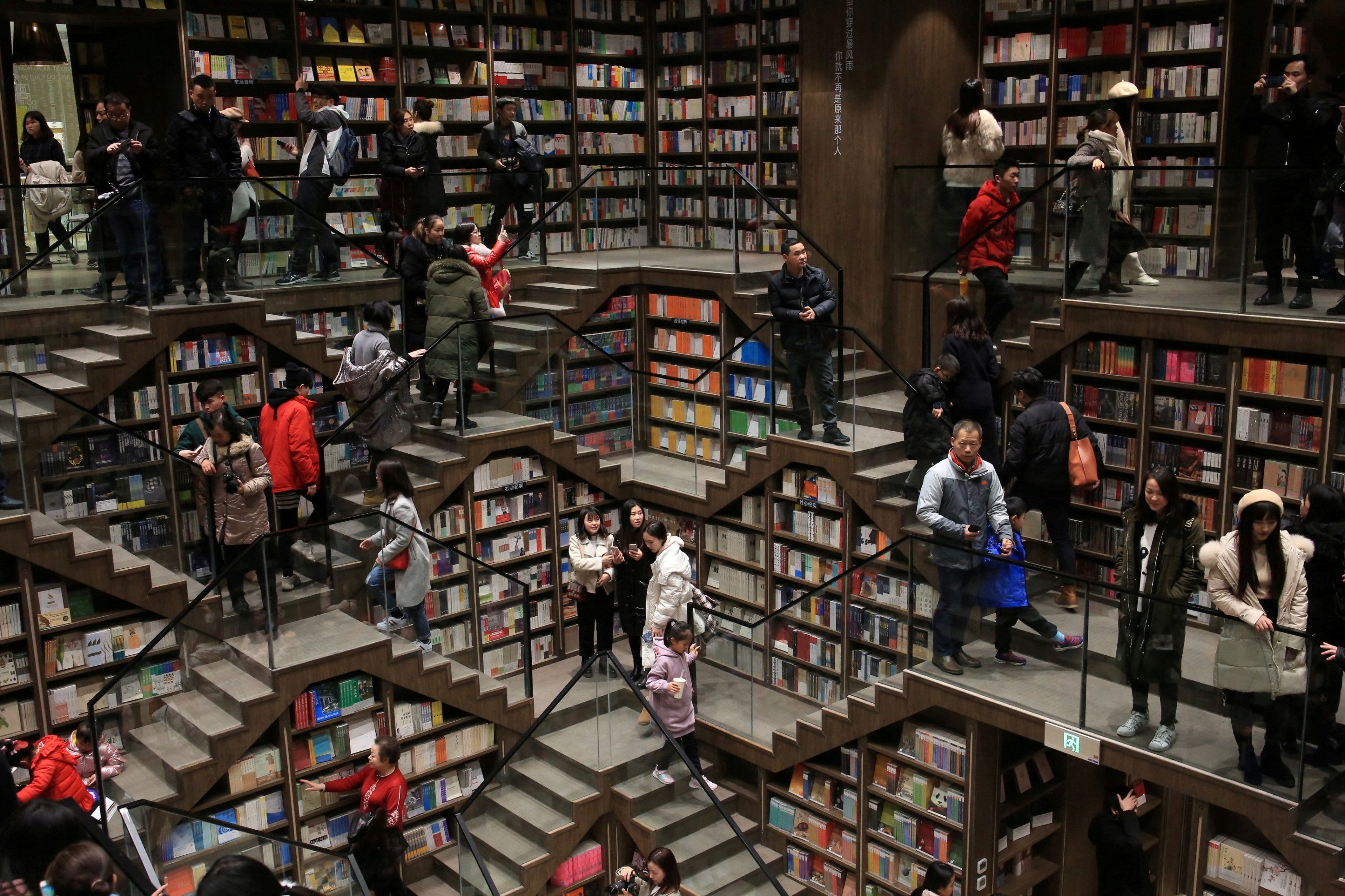
Li follows similar routines when her parents visit.
“I never would have believed the library would be completely full on a weekday,” said Zhang, 36, a visual effects producer who lost her job in AI-driven redundancies in August. She gave only her surname.
In other posts, users wonder if the people around them are in a similar predicament, or – echoing Li – explain why they hide and how it makes them feel.
Some posts are daily journals. In one titled “Day 30 of unemployment: a month pretending to work,” a user recounts 80 failed job applications.
Susan Sun, 28, has concealed her layoff from an internet company since late last year. The balancing act became more complicated in May when her mother and stepfather moved in with her in the megacity of Chongqing from their smaller hometown to look for work.
This forces her to leave home before 9 a.m. and return after 6 p.m.
Sun lives on 1,864 yuan ($278) per month in unemployment benefits and what remains of her severance package. She says she is happy living on little and not working. Her only pressure comes from her parents.
“They pass their anxiety on to me, through subtle, insistent expressions and tone of voice,” she said, especially when they advise her to save money because “the economy is bad.”
Yige Dong, an assistant professor of sociology at the University at Buffalo, says China’s relatively thin social safety net, compared with those in Japan and South Korea during the 1990s, could eventually make it harder for the unemployed to keep up the pretence.
At some point, “individuals would probably be more concerned with pooling resources from all available sources, including borrowing from family members and relatives,” Dong said.


-
 Economy2 days ago
US consumers withstand rising prices, but for how long?
-
 Politics2 days ago
Turkish Embassy rejects reports of FM Fidan’s ‘secret talks’ in Baku
-
 Economy2 days ago
Türkiye foresees spending over $20B on transportation next year
-
 Politics3 days ago
FM Fidan holds talks with OIC counterparts in Iraq
-

 Sports1 day ago
Fenerbahçe seek Champions League reset against Slavia Prague
-
 Politics2 days ago
Turkish FM heads to Baghdad for OIC talks on Gaza, regional tensions
-
 Politics2 days ago
Erdoğan touts Osman Gazi as Türkiye aims to double gas flow by 2027
-
 Politics1 day ago
Busy week awaits Erdoğan with key speech, Carney visit