
Economy
Euro’s ‘global moment’ risks slipping away amid political division

As alarm over U.S. President Donald Trump’s trade policy was pushing the dollar toward multi-year lows, European Central Bank chief Christine Lagarde in late May asked Europe’s leaders to put their money – or rather, their currency – where their mouths were.
Her argument, outlined in a speech in Berlin, was simple: alarm over Trump’s assault on the economic status quo was a chance for Europe to advance its goal of boosting the influence of its single currency.
Building on proposals last year by her predecessor Mario Draghi for sweeping reforms to Europe’s financial system, Lagarde coined a phrase to define the opportunity: the “global euro moment.”
Her rationale was simple, a source familiar with her thinking told Reuters. Convinced this could be a defining moment for Europe, Lagarde – a former French finance minister – was disappointed by the lack of political leadership. She thought at least one voice should fill the void.
Four months on – and a year since Draghi’s report – Lagarde’s calls to bolster the foundations of the single currency are being drowned out by national divisions and other priorities such as the Ukraine war, dealing with Trump, and coping with home-grown political turmoil.
A sense of policy inertia is the main takeaway from Reuters’ interviews with more than a dozen eurozone officials and central bankers, senior private bankers and veteran Brussels-watchers with a close view – often in the room – of discussions. Lagarde herself declined to comment.
Measures that would have strengthened the euro’s appeal for investors have fallen by the wayside, the sources said.
Proposals to jointly issue debt in euros to fund Europe’s defense encountered resistance from Berlin and Paris. Smaller nations with big financial sectors opposed centralizing supervisory powers in EU bodies. And plans to create a digital version of the euro have yet to take on a clear shape.
“Fundamentally, the EU struggles to concentrate on many crises at the same time,” Enrico Letta, the Italian ex-prime minister who last year presented his own report on reforms needed for the region’s single market, told Reuters.
“I see a Europe divided”.
‘Dollar is king’
The euro in the pockets of 350 million Europeans from Dublin to Lefkoşa (Nicosia) is among the EU’s most tangible achievements. Nearly wrecked by a sovereign debt crisis 15 years ago, it’s the fruit of a three-decade process of banking and monetary reforms that remains a work in progress.
But the dollar remains dominant globally. It accounts for three-fifths of central bank reserves and is the main transaction currency for commodities such as oil. Its status gives the U.S. government access to a ready pool of lenders and helps it wield outsized financial clout. As Trump said in July: “Dollar is king and we’re going to keep it that way.”
Yet the euro can claim to be the world’s second-most-favored currency. It accounts for some 20% of global central bank reserves and a similar amount of trade invoicing. Aside from the 20 eurozone countries, 60 nations or territories have directly or indirectly pegged their currencies to it.
The euro has risen around 13% against the dollar this year, taking it to a four-year high, with the investor consensus that further gains are likely as the U.S. Federal Reserve (Fed) embarks on a cycle of cutting its benchmark rate.
With the free trade era giving way to protectionism and growing economic tensions under Trump, European leaders acknowledge that bolstering the euro’s global status would help shield their export-driven economies.
The argument is that a greater presence of the euro in trade and global reserves would help insulate the area from swings in exchange rates and capital flows – even economic sanctions, if tensions worsen.
But European capitals are baulking at three steps that would underpin that goal: creating a big enough stock of safe euro assets for investors; making institutional changes to complete Europe’s economic and monetary union; and responding to the rising challenge of digital currencies.
More ‘safe’ assets needed
Step one remains among the most contentious – particularly for Europe’s largest economy, Germany.
At the equivalent of $13 trillion, the stock of outstanding euro area bonds issued by governments is dwarfed by the $30 trillion U.S. Treasury market. And while most investors regard the $2.3 trillion of German government paper as a safe bet, fewer would say the same of Italian bonds or politically troubled France’s.
“The EU doesn’t have a deep enough capital market,” Alfred Kammer, head of the International Monetary Fund’s (IMF) European department, told Reuters. “It’s fragmented along national lines and lacks a truly large, liquid safe asset.”
For some, this is where new types of debt secured by a collective guarantee of the 20 euro-area countries should come in.
As far back as 2010, one proposal to help Europe emerge from its sovereign debt crisis envisaged countries pooling up to 60% GDP of their national debt into synthetic “blue bonds” enjoying joint liability. Any national debt beyond that – dubbed “red” debt – would remain the liability of the EU member state alone.
Such ideas have hit the same roadblock: reluctance by frugal northern nations such as Germany or the Netherlands to share liability with southern European countries they see as spendthrift.
It took the COVID-19 pandemic for capitals in 2020 to agree for the first time to share debt in the shape of the 800-billion-euro Next Generation EU (NGEU) recovery fund: a one-off stimulus package some hoped would set a precedent.
Then, five years later, Trump’s questioning of NATO spurred hope for further action. Europe’s rush to upgrade its military muscle needed huge funding for the shared goal of European security – a move that could generate hundreds of billions in euro-denominated joint debt.
“Defense creates an opportunity for creating another safe asset that could bolster Europe’s financial architecture,” Olli Rehn, Finnish central bank chief and ECB rate-setter, said.
While defense bonds’ time may yet come, it’s not today.
After winning power in February this year, German Chancellor Friedrich Merz took a different tack: loosening Germany’s sacrosanct “debt brake.” That paves the way for major spending on defense and infrastructure, but all of it will remain firmly under Berlin’s control.
By the time EU finance ministers met in Warsaw in April to discuss a proposal to borrow jointly to fund arms procurement, the writing was on the wall.
“There was support from a number of member states, but Germany and France were not convinced,” said one participant, characterizing German arguments as being about money and French ones as related to national defense sovereignty.
Asked for comment on his stance at that meeting, Germany’s then-finance minister Joerg Kukies said Berlin was not categorically against joint debt for defense.
“We didn’t say no. We just said there has to be a specific project to be financed,” Kukies, who left office in May, told Reuters. “Then we can talk about the financing.”
French Finance Minister Eric Lombard did not respond to a request for comment. A finance ministry source said France was not against common schemes in principle but did not see them as a priority. “Right now, the important thing is to build up capacity and capability,” the source said.
It was no surprise when, at NATO’s June 25 summit, European capitals chose to keep defense fund-raising largely within national budgets that would be loosened to allow higher spending. A new EU loan program would act as a top-up.
Capital union qualms
A second stumbling block is the fragmentation of Europe’s capital and banking markets across 20-plus national jurisdictions – which then-European Commission President Jean-Claude Juncker had set as a priority to solve back in 2014.
A capital markets union would align national rules on bankruptcies, public offerings and tax treatment of capital gains, debt and equity, making it easier for investors to put money into assets in the currency zone.
But years of patchy progress on the project, recently rebranded as the Savings and Investments Union, underline how wary EU capitals and many bankers are of any move that would shift decision-making to EU agencies.
Take the idea of creating a European version of the U.S. Securities and Exchange Commission(SEC) with a mandate to monitor risks across the EU – something Lagarde suggested could be achieved by extending the powers of the European Securities and Markets Authority (ESMA), an EU body based in Paris.
When European leaders met in April last year to advance such plans, France and Germany pushed for joint financial supervision. But it was smaller states – among them Luxembourg, Malta and Ireland – that blocked.
In a speech later that year, Lagarde suggested a European SEC could “be organized as a network of offices in the member states” – an idea some agree had a better chance of sticking.
“You could, for example, reassure Luxembourg regional asset managers they will be treated by the Luxembourg office,” said Nicolas Veron, senior fellow at EU think tank Bruegel and author of a blueprint on how ESMA could be expanded into a network of national offices.
When EU leaders met in June, they agreed on the need for “advancing decisively” on efforts to raise the euro’s profile as a reserve and transaction currency.
Steps due by year-end include promoting financial literacy among Europeans and making it easier for them to invest in securities markets. But the bigger goal of centralizing markets and securities supervision faces headwinds, at least for now.
“My impression is that the tougher topic – that of giving more powers to ESMA – will likely be left till further down the line,” Letta told Reuters.
Euro goes digital: But when?
The euro’s jostling for global influence has been conducted as a fiat money backed by the might of the ECB. But the rise of crypto and the U.S. foray into stablecoins – digital money pegged to the dollar – is opening up a new front.
Here too, Europe faces obstacles.
A Commission proposal for legislation on a digital euro has sat idle for over two years, despite the ECB holding 14 hearings on the project in the European Parliament and Lagarde pleading for its approval.
Banks and lawmakers worry it will drain bank deposits and involve heavy set-up costs without achieving a clear purpose, arguing it is variously portrayed as a defence against the rise of cryptos or as a new tool for digital finance.
“The digital euro is presented as a Swiss Army knife, but lacks precision for any specific problem,” Fernando Navarrete, the Spanish lawmaker and ex-central banker who is parliament’s rapporteur on the legislation, wrote in a commentary this month.
After EU finance ministers managed last week to agree on a road map for its launch, the earliest timeline for its approval is mid-2026. And even then, it will need a further two and a half to three years to build the technology.
According to three participants at the Copenhagen meeting where the road map was agreed, Lagarde voiced disappointment at how slow the process had been and the fact that it would not be in place by the end of her term in 2027.
Yuan challenger
Amid entrenched resistance to the reforms required, no one sees the euro rivalling the dollar’s dominance soon – the question is more whether it can strengthen its claim to be the global number two.
Some suggest Europe need not do anything to enhance the euro’s appeal other than emphasize its respect for the rule of law and the independence of its central bank.
A survey of 75 central banks published in May by the Official Monetary and Financial Institutions Forum (OMFIF) showed 16% saying they plan to increase euro holdings over the next 12-24 months.
But the same survey concluded that the main beneficiary of moves to diversify out of the dollar was not a currency but gold. And, in the long term, China’s yuan was favored by more central banks.
“We believe that diversification to manage the foreign exchange is very important,” Central Bank of Mongolia board member Enke Enkhjargal Danzanbaljir told business and finance chiefs in France in July, praising China’s offer of standby currency swaps to other central banks.
“The ECB must create tools, swap arrangements for central banks like us in Asia, then it would be easy to invest more in Europe,” she said.
The ECB has liquidity lines with 16 central banks in mostly Western countries, in some cases for unlimited funding.
Three sources close to Lagarde’s thinking said she was determined to maintain her push.
In a Sept. 15 speech in Paris, Lagarde urged the region to address “chinks in the armor” of its geo-economic standing, concluding: “Europe is working on this, albeit possibly too laboriously and too slowly.”
Business leaders and diplomats used a summit in Brussels on Tuesday to push for closer economic ties between Türkiye and the European Union, again calling for a modernized customs union, a place in the bloc’s industrial supply chains and a clearer accession perspective.
Belgium’s foreign minister also voiced support for updating the over 30-year-old trade agreement.
Speaking at the EU-Türkiye Business Summit, executives and officials argued that deeply integrated economies need a political and institutional framework that reflects their commercial reality.
Foreign Economic Relations (DEIK) President Nail Olpak quoted Jean Monnet’s line that Europe will be forged in crises and will be the sum of the solutions adopted for those crises.
“We are living in such a time. And I believe deeper integration with Türkiye is one of the answers Europe needs today,” Olpak said.
Priorities
He set out three priorities for the partnership.
The first is modernizing the customs union, which he said has been the backbone of economic ties for more than three decades but no longer meets current needs. “In a world that has changed this fast, we’re missing too many opportunities together,” said Olpak. An update would open up cooperation in services, e-commerce, public procurement and agriculture.
The second is recognizing Türkiye’s place in European industry. Olpak referred to the European Union’s proposed “Made in EU” rules, or how he reframed it, “Made with EU,” saying Türkiye has been part of the continent’s supply and value chains for over 30 years. Treating Turkish-made products as part of Europe’s industrial ecosystem “without new quotas or barriers,” he argued, is critical to Europe’s own resilience and competitiveness.
The third is connectivity. Citing the war in Ukraine and instability in the Middle East, he said the Middle Corridor, which links Europe with Central Asia via Türkiye and the South Caucasus, should remain a shared strategic priority. He also pointed to emerging north-south links connecting Europe and Türkiye with Iraq and the Gulf. He said geopolitical shocks “showed why we need reliable links for transport, energy and data.”
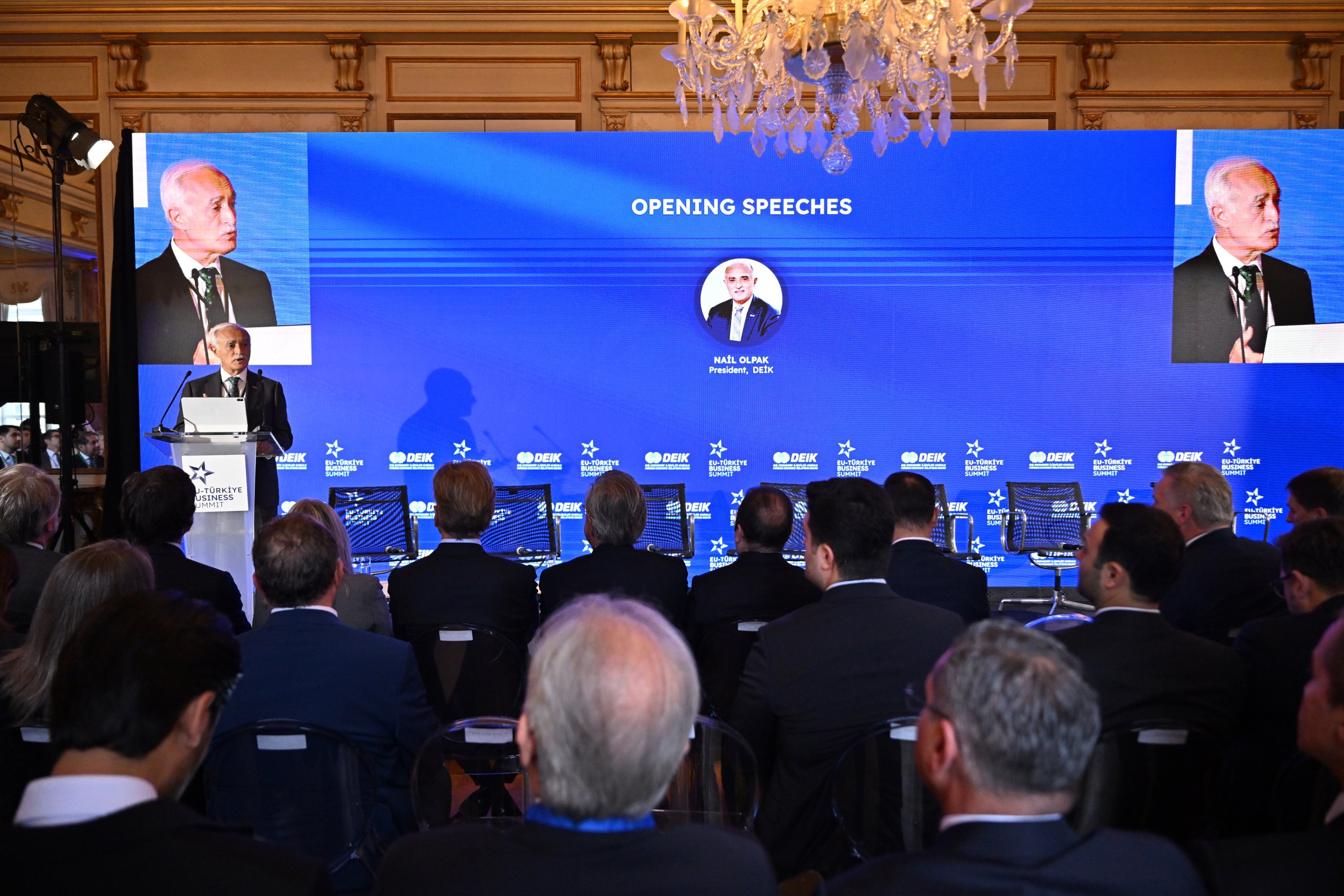
Tying the themes together, Olpak spoke of “competition on trust,” saying trust is built through performance rather than words and that Türkiye has proven itself a dependable partner through every crisis.
Türkiye’s European journey began more than 60 years ago, he noted, and full membership remains its goal. “After so many years, we need fresh momentum,” Olpak said.
Call for clear membership signal
Mehmet Ali Yalçındağ, coordinator chair of the DEIK Türkiye-EU Business Councils, said a “clear and credible reaffirmation” of Türkiye’s membership perspective would give the relationship direction, encourage reform and strengthen confidence in Europe’s ability to act with purpose.
He noted that the heads of DEIK’s 26 business councils with EU member states wrote earlier this year to the leaders of the European institutions, asking for renewed momentum in the accession process. He also welcomed European Commission President Ursula von der Leyen’s recent State of the Union address, which he said put competitiveness, security, affordable energy, AI and democratic resilience at the center.
Europe “will not become more competitive by excluding Türkiye from the economic space where our businesses already work together,” Yalçındağ said, adding that it grows stronger by building on its value chains rather than drawing new boundaries through them.
He urged both sides to move beyond arguments repeated for too long, saying caution has at times replaced initiative, to the benefit of competitors. Political dialogue, credible conditionality and practical cooperation can advance together, he said, without every disagreement being resolved first.
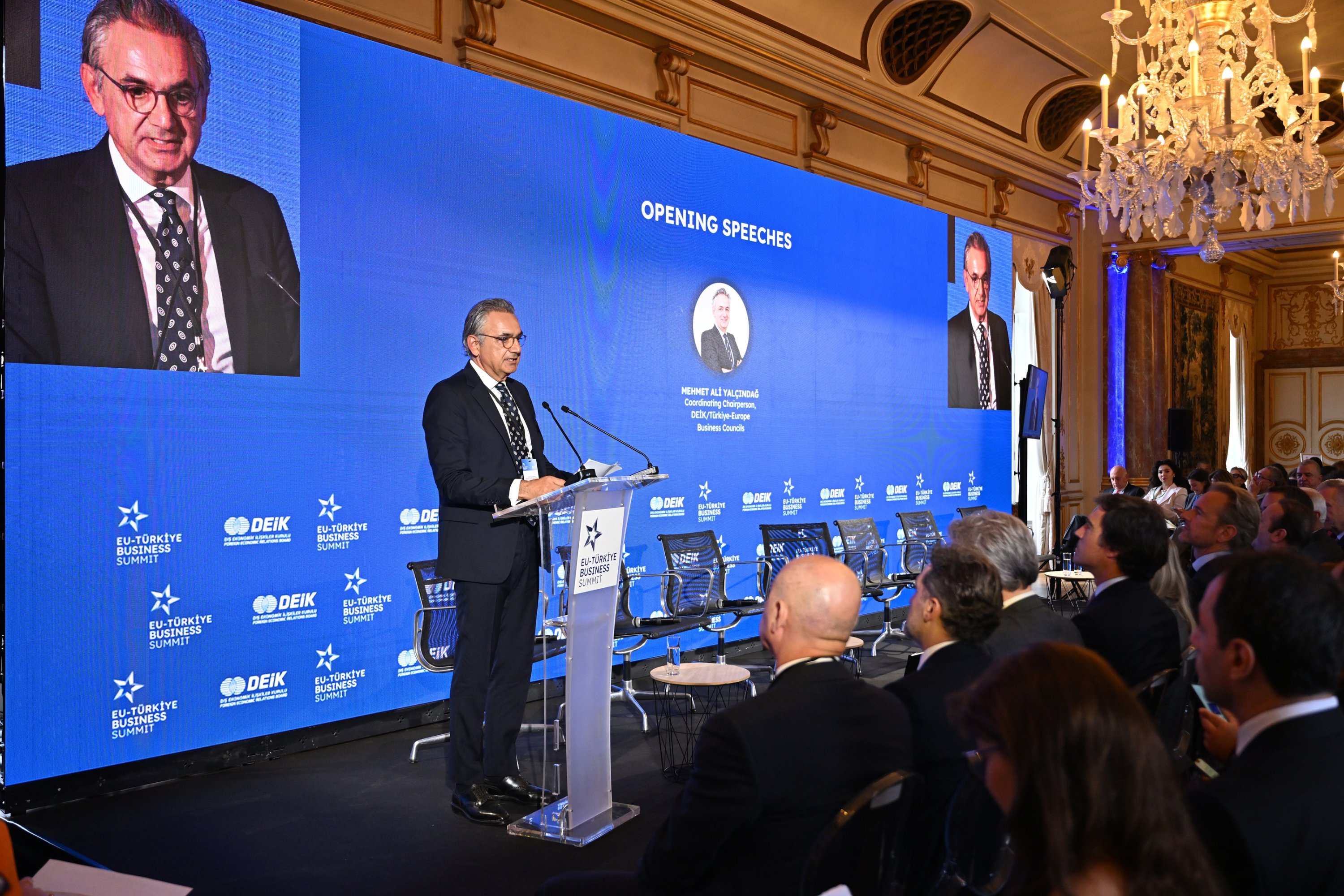
A clear commitment to Türkiye’s European future, he added, could help open the way to a modernized customs union, easier business mobility and visas, and closer cooperation on technology, energy, transport, defense and the green transition. He closed by urging both sides to act without adding “another ‘yes, but'” to a relationship already burdened by too many.
Industrial Accelerator Act in focus
“Türkiye and the EU need each other more than ever,” said Ambassador Yaprak Balkan, Türkiye’s permanent delegate to the EU, speaking at a summit session titled “Made in Europe or Made with Europe? The Industrial Accelerator Act Revisited.”
She said Türkiye shares the EU’s goals of building more resilient industry and speeding up decarbonization, but that neither side should weaken the value chains that make both more competitive.
Balkan said much of her team’s recent work has centered on the “Made in Europe” approach, which would prioritize European-made products in public procurement and subsidies under the proposed act, and that they have been working day and night to persuade partners with facts and scientific data.
Her central argument was legal. Decision 1/95 of the Association Council, which established the customs union, provides for removing duties and non-tariff barriers on industrial goods. If the act takes shape in the way Ankara fears, she said, it could contradict existing commitments.
Türkiye’s unique relationship with the EU through the customs union must be fully reflected in the legislation, Balkan said, and if it defines which partners are covered, Türkiye must be included from the outset. Where origin requirements are met, vehicles made in Türkiye should receive equivalent treatment.
Bilateral trade between Türkiye and the EU reached a record of about 207 billion euros last year. Automotive trade alone totaled 54 billion euros, roughly a quarter of the total, making Türkiye the third-largest export market for the EU automotive industry.
About 70% of vehicle production in Türkiye rests on direct or joint investments by major European manufacturers, Balkan said, and more than half of the parts and components in a car made there are imported from the EU.
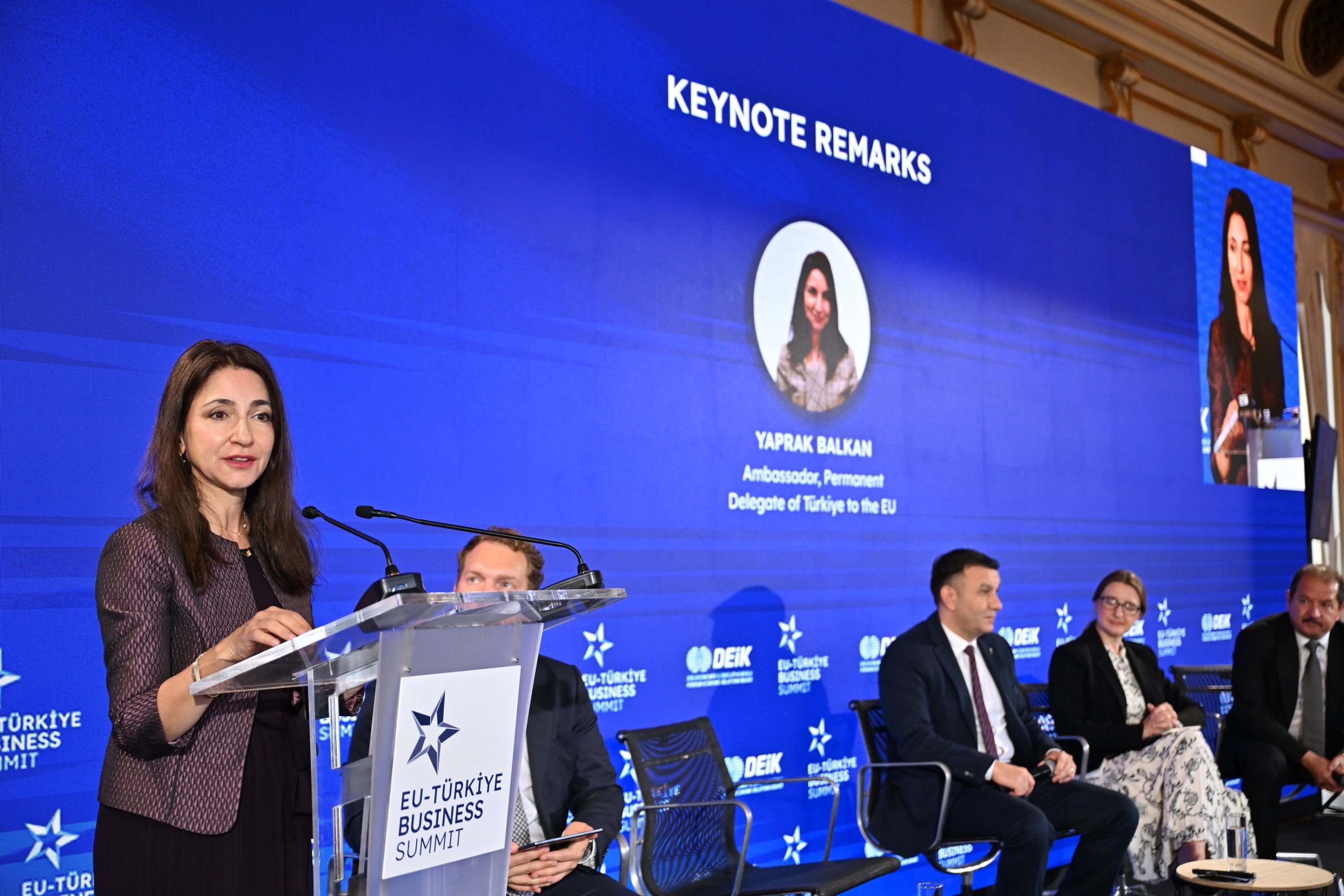
She dismissed claims that third-country goods would enter the EU through Türkiye as an “urban myth,” saying Türkiye will not become a back door for circumventing the rules and that Turkish industry also suffers from unfair competition and overcapacity.
On public procurement, Balkan said a law passed in Türkiye in July contributes to the process toward an agreement with the EU, that Ankara wants negotiations to start as soon as possible, and that reciprocity will be ensured. She added that senior executives of European carmakers have themselves lobbied for Türkiye’s inclusion.
Future cooperation, she said, should focus on joint research, advanced manufacturing, cleaner materials, batteries, circularity and skills. “Inward-looking attitudes and protectionism cannot be the solution,” she said.
Belgium: Türkiye can help reduce Europe’s dependencies
Belgian Foreign Minister Maxime Prevot also addressed the summit, saying Türkiye has an important role in helping Europe reduce its strategic dependencies, particularly in key industrial sectors.
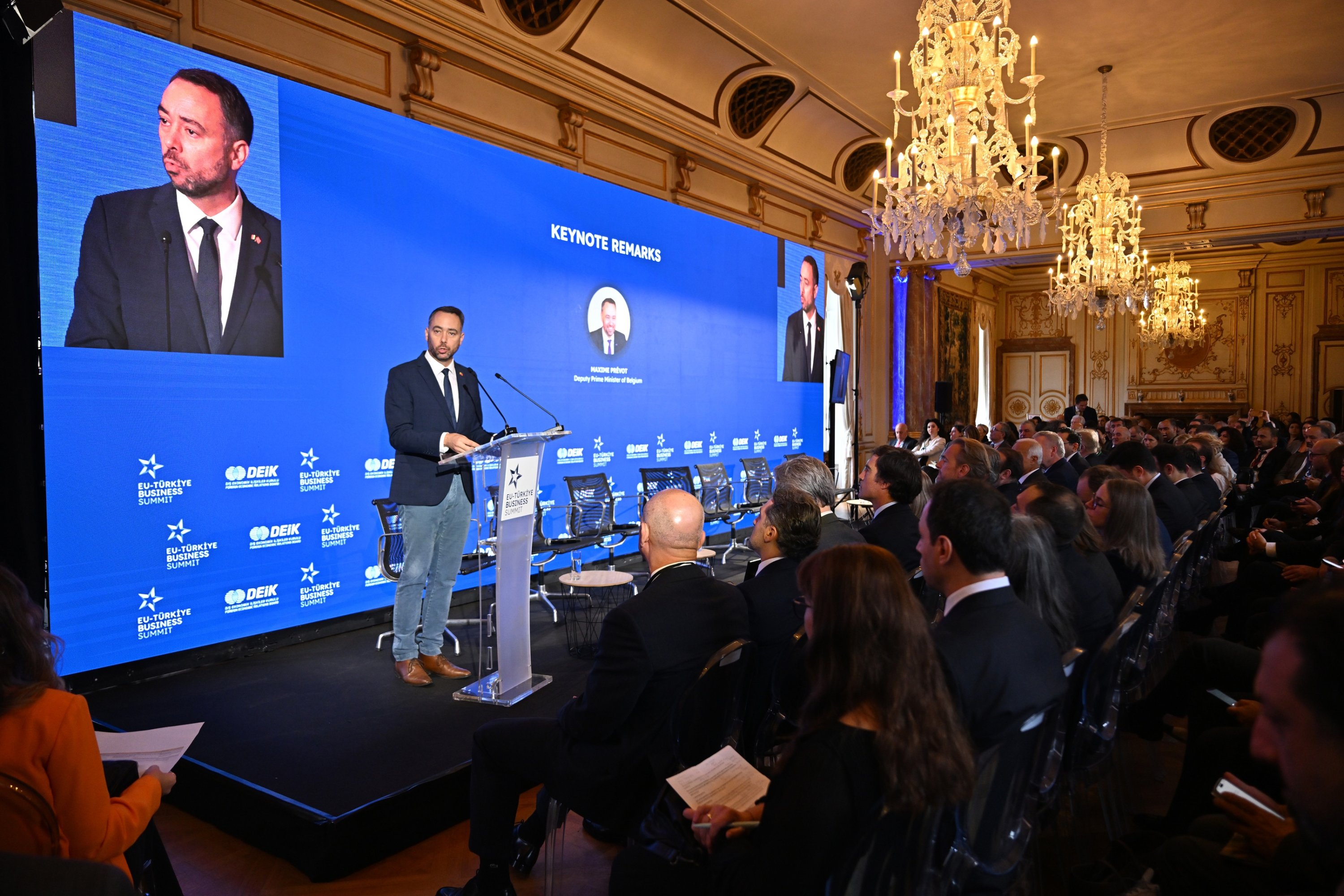
He said shifting global dynamics, the war in Ukraine and supply chain disruptions had made Europe increasingly aware of its economic vulnerabilities.
“Türkiye has an important role to play, not only as an industrial market but also as a gateway to markets in the wider region,” he said, stressing its manufacturing capacity, industrial expertise and links to neighboring markets.
European companies are increasingly seeking reliable partners closer to home as they reconsider where to manufacture and store their goods, Prevot said, and Europe should make the most of Türkiye’s proximity, especially in sectors where it needs to cut strategic dependencies.
He described Türkiye as a NATO ally, an EU candidate country and a major industrial economy connecting Europe, Asia and the Middle East, whose capabilities could make European supply chains more resilient. He called for stronger cooperation between Brussels and Ankara in economic security, defense, innovation, clean energy and digital technologies.
“Our economic relationship should no longer be limited to buying and selling goods. We should also be developing, producing, and investing together,” he said.
Prevot also backed modernizing the customs union, which he said has served both economies for around 30 years but needs to reflect changing global economic conditions.
Türkiye logged a current account surplus of $4.05 billion (TL 199.94 billion) in August, official data shared by the country’s central bank showed Tuesday.
Excluding gold and energy, the current account indicated a net surplus of $8.2 billion during the month, the Central Bank of the Republic of Türkiye (CBRT) said in its balance of payments data.
The surplus narrowed from $4.62 billion a year earlier as the goods deficit widened, while the services surplus increased.
The reading marked the second consecutive month in which the current account posted a surplus. Prior to that, the balance last posted a surplus in October 2025, when it stood at $477 million.
The country’s goods deficit reached nearly $3.75 billion in August, up from $2.8 billion a year earlier, the bank stated.
Meanwhile, the services surplus increased to $9.71 billion from $9.34 billion over the same period.
Travel revenues reached $7.28 billion, and transportation revenues reached $3.26 billion.
The primary income deficit edged down to $1.89 billion from $1.9 billion, while the secondary income deficit fell to $18 million from $21 million.
Direct investment saw a net inflow of $141 million in August, as nonresidents recorded a net inflow of $719 million.
Portfolio investment recorded a net outflow of $1 billion in August.
The country’s official reserves increased by $7.14 billion during the same period.
In the first eight months of 2026, Türkiye’s current account deficit widened to $31.5 billion from $19.67 billion in the corresponding period a year earlier.
The 12-month rolling deficit stood at $42.1 billion as of August, according to central bank data.

The International Monetary Fund (IMF) revised slightly upward its outlook for the world economy growth for this year, while also warning of growing risks from rising debt, including borrowing related to artificial intelligence.
The IMF says it expects the global economy to grow at a 3.1% pace this year.
That’s up from its July forecast for 3.0% growth and well below the 3.5% expansion in 2025. Growth in 2027 should rebound to 3.4%, it said in its latest Economic Outlook.
The report, released as world economic and financial leaders gather in Bangkok for the fall meetings of the IMF and World Bank, predicts that growth in the U.S. will remain steady at 2.3% in 2026 and 2027.
Collectively, advanced economies will grow 2.1% this year, up from 2.0% in 2025. But growth is forecast to slow to 1.9% next year, it said.
The forecasts are based on a nearly 41% increase in oil prices this year, at an average of $96 a barrel. Global inflation is foreseen at 4.7% in 2026 and falling to 4.1% next year.
They also are based on the assumption that shipments of oil and gas through the Strait of Hormuz will resume by March, and that the boom in AI demand will moderate.
The boom in artificial intelligence is offsetting damage from sharply higher prices for oil and gas, IMF economists say, but it also carries risks.
Its benefits are not shared equally: the U.S. and China account for more than three-quarters of net demand for imports of computer chips and other AI-related equipment, the report said.
“The outlook is highly uneven,” Silvana Tenreyro, the IMF’s director of research, told reporters in Bangkok.
Growth is increasingly concentrated, with 32 countries accounting for 95% of global growth, the report said. That compares with 54 countries as of April.
“The global economy is not simply slowing or accelerating; rather, growth is being reallocated across countries according to their exposure to the war-induced supply shock and AI-related demand strength,” it says.
Athanasios Vamvakidis, deputy director at the IMF’s Monetary and Capital Markets Department, said an AI-related correction in stock markets is just one of the risks. Rising bond yields are another evolving problem, along with cyberthreats that could disrupt financial systems, he said.
AI’s effects on employment are another key focus of the meetings in Bangkok, which IMF Managing Director Kristalina Georgieva described during an event Monday as “a slow moving tsunami, but a tsunami nonetheless.”
“The impact over time on jobs globally we estimate to be around 40% – jobs either augmented or downgraded or eliminated. And we are already seeing some of this impact,” she said.
Last week, the IMF chief urged countries both rich and poor to do a better job of improving their national finances, urging policymakers to do more to tame mounting levels of debt.
That’s especially true at a time of high borrowing costs, Tenreyro said.
Countries that are somewhat insulated from the energy shocks of the Iran war and that are benefiting from rapid adoption of AI are managing to keep growth on track.
Middle East contraction
But developing economies and emerging markets more vulnerable to higher costs for oil and gas will see growth slow to 3.7% this year from 4.5% in 2025, the report says. It forecasts they will regain momentum next year, expanding at a 4.4% annual pace.
The situation is much worse in the Middle East and Central Asia, where those regions’ economies are expected to contract this year before recovering to a 6.3% rate of growth in 2027.
The 21 European countries that share the euro currency are expected to grow by 1.1% this year and 1.2% in 2027.
China, the world’s No. 2 economy, is expected to expand 4.5% this year, down from 5% in 2025, in line with the government’s official target.
India is once again forecast to be the world’s fastest-growing major economy, advancing at a 7% clip, down from a sizzling 7.7% last year.
The IMF is a 191-nation lending organization that works to promote economic growth and financial stability and to reduce global poverty. At the meetings in Bangkok, finance ministers and central bank governors will assess the state of the world economy and discuss strategies to support financial stability and sustained growth.
China’s deal to curb hybrid vehicle exports to the European Union is set to deal a fresh blow to electric vehicle makers that ramped up shipments exempt from the bloc’s tariffs on Chinese-made EVs as sales growth slows at home.
Beijing’s exports of hybrids to the EU’s 27 member states tripled to $7.5 billion in the first half of this year from $2.5 billion a year earlier, according to Chinese customs data. The figure was nearly nine times the $845 million exported in all of 2021.
Since the EU imposed additional tariffs on Chinese-made EVs in 2024, automakers have increasingly turned to plug-in hybrids, which are exempt from the extra duties. Weak charging infrastructure in parts of Europe has also supported demand for plug-in hybrids, which are marketed for their long range and strong fuel economy.
SAIC, BYD and Chery accounted for more than 90% of Chinese hybrid sales volume in the EU, while hybrids represented more than half of their European sales, according to Jefferies.
“It’s making life a bit more difficult for the Chinese, but…that’s not going to stop them as it happened to the electric cars,” said Felipe Munoz of Car Industry Analysis.
“Europe is going to a point where they will need to decide whether they’re doing what the U.S. is doing or just let the whole industry be bought by the Chinese.”
Deal preferable to trade war
Chinese brands captured a record 15% share of Europe’s EV market in the second quarter, up from 9.5% in the first quarter of 2024, while Chinese plug-in hybrids accounted for more than a quarter of the segment, rising sharply from just 1.7% at the beginning of 2024, according to Schmidt Automotive Research.
While European Trade Commissioner Maros Sefcovic said on Friday the agreement would cut the imports of “several million cars over four years,” Brussels and Beijing have yet to disclose how the arrangement will be implemented.
China’s Commerce Ministry said on Monday that the arrangement would allow continued export growth and guarantee China a quota no smaller than that granted to any other source of imports.
Renault CEO Francois Provost said on Monday the surge in Chinese hybrid imports was unsustainable for Europe, but added the agreement was preferable to a trade war and underscored the need to manage trade relations “sensibly.”
Investors largely viewed the agreement as a de-escalation of trade tensions and a sign that tariffs on Chinese hybrids may be off the table for now. Shares in BYD fell 1.8%, while Chery and SAIC rose 1.4% and 0.5%, respectively.
“Overall, we believe it is a risk-relief rally story…as the implementation rules, volume caps, price floors, carve-outs are still pending technical negotiation,” Citi analysts said.
‘Tariff risk off, quota risk on’
The rapid growth of Chinese hybrid sales has increasingly challenged European manufacturers, including Volkswagen, long the region’s leading plug-in hybrid seller, said Li Yanwei, an analyst at the China Automobile Dealers Association.
BYD, China’s largest hybrid vehicle exporter to Europe, sold more plug-in hybrids than fully electric models in the first eight months of the year, with its Seal U SUV its best-selling model, according to data compiled by Li.
Together with Chery, SAIC and Geely, the company has narrowed the gap with Volkswagen, which still commanded a 31.8% share of the EU plug-in hybrid market.
“Let’s see if China honors the agreement or finds workarounds, or temporary tariff exemptions,” said Michael Dunne, a consultant who closely follows the Chinese automotive industry.
Analysts said the deal could ultimately accelerate Chinese automakers’ push to build vehicles in Europe, even if some manufacturers attempt to frontload exports before any quota system takes effect.
“I would expect this to strengthen the incentive for Chinese automakers to manufacture in Europe,” said Bill Russo, founder of Shanghai-based consultancy Automobility.
“If access through imports becomes more constrained, investing closer to the customer becomes more attractive. But localization requires capital…smaller players may reconsider their European ambitions.”
Jefferies analysts said the deal signaled “tariff risk off, quota risk on,” potentially pushing Chinese automakers toward higher-priced models, increasing pressure on German premium brands and accelerating plans to build more vehicles in Europe.
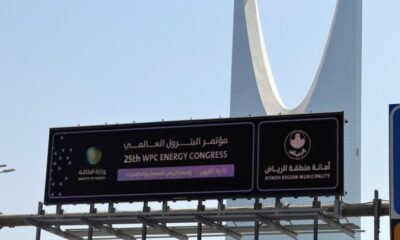
Several top energy executives have been dropped from the schedule of a major summit in Riyadh, as Saudi authorities pressed ahead with the event Monday despite deadly attacks on the capital claimed by Yemen’s Iran-aligned Houthis.
The chief executives of ExxonMobil, TotalEnergies, Shell, Chevron and BP had all been expected at the event, which began on Sunday, but were no longer on the agenda that conference organizers released early Monday.
“To everyone who traveled to Riyadh, thank you,” said Saudi Energy Minister Prince Abdulaziz bin Salman, who opened Monday’s session of the gathering for energy policy and industry.
“You know this country is safe and that we hold your protection at whole heart…Our gathering here does not mean the risk is gone.”
Prince Abdulaziz said the events of recent weeks were serious and that the kingdom’s response must be “equally serious.”
The WPC Energy Congress was originally scheduled for April of this year, but was postponed after the U.S. and Israeli war on Iran began in late February. Saudi Arabia was named host in October 2022, the first time the event, first held in Britain in 1933, has been held in the kingdom.
Chief executives of major energy companies are a regular fixture at WPC Energy events and had been scheduled to speak on stage this week about global oil and gas markets, energy security and the energy transition.
A BP spokesperson said the company had “made every effort to participate” in the conference. “Unfortunately, due to travel disruption we are unable to be there in person. We greatly value our long-standing partnerships across the region.”
The WPC Energy Congress is taking place this week at a conference center some 10 kilometers (6 miles) from Riyadh’s international airport, which has been attacked four times in the last week.
One person was killed and nearly a dozen hurt in a new attack on the airport on Sunday evening, Saudi authorities reported, a day after a strike claimed by Houthis killed 13 people and wounded more than 300, the deadliest attack in the kingdom in more than a decade.
Major French supermarket chains Intermarche and Cooperative U were hit by a cyberattack that caused their refrigerators to defrost, the companies said Monday.
Some 150-200 Intermarche shops were targeted, along with almost 100 Cooperative U outlets, in the attack, the two retailers told Agence France-Presse (AFP).
Paris prosecutors confirmed the attack, which reportedly also hit other major chains, and also indicated it had prompted outbreaks of fire.
BFM TV said France’s largest supermarket chain E. Leclerc was also affected, with hackers “managing to remotely trigger the forced defrosting of the refrigeration systems in numerous stores.” E. Leclerc did not immediately confirm the information.
Those branches that were affected will have to “throw away all of the products” that are fresh and frozen, Intermarche told AFP.
Specialist French retail sector news website jebosseengrandedistribution.fr said other retail giants Carrefour Market and Monoprix were affected, but the companies have yet to confirm this.
‘Unprecedented’
The chief executive of Cooperative U, Dominique Schelcher, described the attack as “unprecedented” and confirmed the cyberattack had affected refrigeration systems since Sunday night.
“Targeting equipment essential to the preservation of fresh products and to the food supply of the French people is extremely serious and is unprecedented. It is unacceptable,” he wrote on the social media platform X.
He added that the company’s teams are “fully mobilized” to restore the situation as quickly as possible.
“An investigation will be necessary to shed full light on this attack,” he added.
The office of the Paris prosecutor confirmed to AFP that an investigation has been opened into “the large-scale cyberattack affecting the refrigerators of several major food retail chains across France.”
The probe will help “identify the victims and establish the link with the damage they reported in terms of foodstuff losses and the outbreak of fires,” the prosecutor’s office said.
Intermarche condemned the food waste and financial losses resulting from the attack, without providing figures, and warned there could be issues with insurance policies which do not “cover this type” of in-store incident.
BFM TV said temperatures were “altered remotely, resulting in the destruction of stocks of fresh and frozen products.”
The incident comes against the background of growing concern over the potential havoc that can be caused in Europe in all sectors by cyberattacks by malicious actors.
President Emmanuel Macron, a strong supporter of Ukraine in its fight against the Russian invasion, last month ordered measures to protect France’s critical infrastructure from Russian “hybrid attacks.”


-
 Economy2 days ago
Can diesel prices fall after Trump-Russia deal?
-
 Politics2 days ago
Türkiye-France defense cooperation spark concern in Greek media
-
 Politics2 days ago
Türkiye presses Greece to hand over FETÖ members, crime bosses
-
 Economy1 day ago
Top oil execs drop from major event schedule after Riyadh attacks
-
 Economy2 days ago
Tehran’s once-bustling bazaar struggles as war dampens demand
-

 Sports2 days ago
Bezzecchi wins Indonesian GP to hand Martin championship lead
-

 Economy1 day ago
Türkiye says 17 funds settled, eyes Atlas deal this week
-
 Sports2 days ago
Deadly Houthi strike on Riyadh airport draws int’l condemnation