
Politics
Cyprus split, Turks united on anniversary of peace operation

The Turkish Republic of Northern Cyprus (TRNC) on Sunday marked the anniversary of the July 20, 1974 Cyprus Peace Operation by Türkiye, a turning point in the history of the Mediterranean island, which is divided between Greek and Turkish Cypriots.
The operation was a display of Türkiye’s unwavering support for the community whose future state is fully recognized only by Ankara. President Recep Tayyip Erdoğan was scheduled to fly to the TRNC to attend ceremonies marking the anniversary.
The operation helped Turkish Cypriots stave off a grim future and paved the way for the establishment of their state in its current form. Fifty-one years on, the operation is an occasion celebrated through military parades and ceremonies and dedicated to those who died in atrocities committed by Greek Cypriot gangs.
Along with attending anniversary ceremonies, Erdoğan is expected to showcase Türkiye’s concrete steps to support the TRNC, including a groundbreaking ceremony for a new hospital supported by the Turkish Ministry of Health and the inauguration of new roads in the city.
The anniversary comes a few days after TRNC President Ersin Tatar and Greek Cypriot leader Nikos Christodoulides met in New York at U.N. headquarters for informal talks on the future of the divided island. They were accompanied by U.N. Secretary-General Antonio Guterres and representatives of the guarantor powers, Türkiye, Greece and the United Kingdom. Talks, held for the second time this year, did not yield any concrete results, but the two sides agreed on confidence-building measures.
Greek Cypriots advocate for the reunification of the island with a bi-communal administrative system, while the TRNC insists on a two-state solution where it will be recognized as a sovereign state.
In the second half of the 20th century, Cyprus was the scene of Greek efforts to erase Turkish Cypriot existence on the island. Fearing a Greek Cypriot plot to unite with Greece, which would ultimately put Turkish Cypriots under the control of Greek Cypriot dominance, Türkiye launched the Cyprus Peace Operation in the summer of 1974.
Cyprus was once an Ottoman island before it was handed over to a British mandate in 1923. Greek Cypriots, encouraged by the Greek uprising against Ottoman rule in 1821, have long aspired for reunification with Greece. In 1955, they took the first steps to achieve this by the establishment of the terrorist group EOKA. EOKA’s campaign of violence targeted Turkish Cypriots, as well as Greek Cypriots opposing their goal of reunification. Turkish Cypriots took up arms in 1958, establishing a resistance organization known as the Turkish Resistance Organization (TMT). Rising tensions on the island appeared to die down in 1960 with the establishment of the Republic of Cyprus. Yet, three years later, Greek Cypriots moved to amend the constitution to deprive Turkish Cypriots of their rights. Armed attacks against the Turkish Cypriot community exacerbated tensions again, effectively putting an end to the bi-national republic. Assaults on Turkish Cypriots in 1963 evolved into an all-out attack by Greek Cypriot forces on Erenköy, a line of resistance by Turkish Cypriots, in 1964. The civilian population was bombed by Greek warplanes, prompting Türkiye to launch a limited air offensive to stave off Greek attacks.
Ten years later, Türkiye took the initiative for a lasting solution to attacks targeting Turkish Cypriots and launched the Cyprus Peace Operation. The operation led to a cease-fire two days later, but ongoing hostilities prompted Türkiye to launch the second stage of the operation on Aug. 14, 1974. The operations cost the lives of 498 Turkish soldiers and 786 Turkish Cypriot “mücahits,” members of paramilitary groups resisting Greek Cypriot attacks. The operation ensured a cessation of attacks by Greek Cypriots, and one year later, Turkish Cypriots declared the Turkish Federated State of Cyprus, under the leadership of Rauf Denktaş, a co-founder of TMT. The state renamed the TRNC in 1983.
The TRNC, however, faced major setbacks as it was not recognized globally and faced economic and political embargoes. It also sought to reconcile with Greek Cypriots, and the two sides agreed upon a series of talks in the early 2000s. Yet, after the Greek Cypriot administration was admitted to the European Union in 2004, efforts collapsed. The last round of concrete talks to end the division failed in 2017.
Under the leadership of President Erdoğan, Türkiye continues to implement policies that provide full support to Turkish Cypriots, although at times it has fallen out with Turkish Cypriot administrations, which have warmed up to the idea of a bi-communal federation. Under Tatar, who came to power in 2020, the TRNC realigned with Ankara and adopted a no-concession policy in talks over the island’s status.
The TRNC will continue to build its future, Tatar said on Friday after the informal talks in New York, underlining that “there are two states” on the Eastern Mediterranean island.
“The existence of these two states has been a reality for 62 years. A solution based on the sovereignty of both peoples in Cyprus is possible,” Tatar told reporters. Tatar said progress could be achieved in Cyprus “through cooperation between the two separate states. We are not avoiding dialogue, but we insist on sovereign equality.”
He noted that the informal meeting did not constitute official negotiations, nor did it indicate a move in that direction, adding that their presence in New York was for cooperation, rather than formal talks. Tatar criticized the EU for appointing a special envoy on Cyprus without consulting the Turkish Cypriot side. He said the bloc holds a biased stance and reaffirmed that Turkish Cypriots would only accept EU involvement if their sovereignty is recognized. “Otherwise, such representation is unacceptable,” he said.
He added that they had met their obligations regarding matters related to the cooperation agreed upon in Geneva (during a meeting last March) and New York with the Greek Cypriot administration, but said no consensus was reached on opening new border crossings due to the Greek Cypriot side’s stance.
Tatar described the Greek Cypriot side’s legal actions against individuals investing in properties in the TRNC as a violation of international law and human rights, calling it an attack that is incompatible with goodwill. He also emphasized that all negotiation processes were being conducted in consultation with Türkiye. Since last year, the Greek Cypriot administration has been pursuing legal action and arrests targeting individuals who purchased property in the TRNC. TRNC officials argue that the true aim behind these actions is to undermine the construction sector and the broader economy. On Sunday, four individuals identified as citizens of the Greek Cypriot administration were detained by police while conducting land surveys and assessments in the TRNC, according to security sources. The suspects were caught by security forces near the town of Iskele while surveying land, police sources said. The suspects were allegedly collecting documents and conducting assessments as part of the Greek Cypriot administration’s ongoing efforts to identify and prosecute those acquiring property in the TRNC. The four detainees are expected to appear in court, while authorities investigate their possible ties to the Greek Cypriot administration’s intelligence agency and determine who may have directed their actions.
Taking root
Today, the peace operation is a source of pride for Turkish Cypriots, while Greek Cypriots mark the same day as a day of mourning for those killed in clashes with Turkish and Turkish Cypriot forces. Greek Cypriot President Christoulides said in a ceremony on Sunday that they would “never yield an inch of land,” while he described the ceremonies in the TRNC as “shameful.”
TRNC Parliament Speaker Ziya Öztürkler said that Greek Cypriots never gave up the idea of annexation with Greece and through the Peace Operation, Turkish Cypriots started taking root in the island. The day is officially known as July 20 Peace and Freedom Day in the TRNC. Öztürkler told Anadolu Agency (AA) on Sunday that the TRNC has made significant progress since the operation, particularly in establishing institutions for infrastructure, education and health care, as well as in “standing for our lands.”
“The flags of the TRNC and the mainland Republic of Türkiye will fly together forever here,” Öztürkler said.
The speaker noted that, thanks to the efforts of Erdoğan, Turkish Vice President Cevdet Yılmaz and Parliament Speaker Numan Kurtulmuş, the TRNC had raised its profile internationally and particularly enhanced relations with the Turkic states.
“The peace operation means independence and freedom for Turkish Cypriots. This is the anniversary of a day where Turkish Cypriots built a freedom epic together with their homeland, Türkiye,” he said. Öztürkler said they fondly remembered the Turkish politicians behind the operation, including then-Prime Minister Bülent Ecevit and Deputy Prime Minister Necmettin Erbakan.
Before his flight to the TRNC, President Erdoğan issued a message on his social media account to celebrate the anniversary and said he wholeheartedly congratulated the Turkish Cypriot people.
“On the 51st anniversary of the Cyprus Peace Operation, I remember with respect our martyrs who gave their lives for the Turkish Cypriot people’s struggle for existence, and I offer my gratitude to our heroic veterans,” Erdoğan said.
One of those veterans is a 75-year-old Cuma Erdem. Erdem was a conscript in the southern Turkish province of Kahramanmaraş when he was deployed to Cyprus for both stages of the operation. He and others boarded a passenger ship to reach the island in the 1974 summer. The ship was among 33 others carrying Turkish troops and came under Greek Cypriot fire when they approached the coast. Erdem and fellow troops crossed the Beşparmak mountains to reach Lefkoşa, with sporadic clashes with Greek Cypriot forces. Along the way, he witnessed fellow troops mowed down by gunfire, and his unit persisted in its march. “On the other side, Greek Cypriot troops started running when we advanced further,” he told AA on Sunday. “We came across Greek Cypriot soldiers tied to their machine guns by their commanders so that they would not flee,” he recounted.
In the second operation, Erdem says he witnessed the aftermath of atrocities committed by Greek Cypriots. He recalls raids by Greek Cypriots on Turkish Cypriot villages, Muratağa, Sandallar and Atlılar. “We heard that they were indiscriminately killing people in an execution style. In one village, we discovered a fresh trail of blood and followed it. We found half-buried bodies of martyrs there. I still remember those moments,” Erdem said.
Cevdet Kürtdur was deployed in a tank unit during the operation. He survived attacks by Greek Cypriots but still bears their scars, including a partial hearing loss. Kürtdur, who was injured when gunfire hit his tank, says he was “honored” to be a veteran. “If they call me again (for deployment), I would go,” he proudly says.
Hasan Aslan, a Turkish army veteran, experiences a mix of joy and grief while remembering the peace operation. Seventy-one-year-old Aslan was among 128 soldiers taking on a well-armed Greek Cypriot regiment. “When the dawn broke on July 20, Turkish reconnaissance planes hovered above us, and then came a barrage of bullets. At one point, we ran out of ammo, and then, paratroopers came to our aid,” Aslan told AA.
One of those paratroopers who landed in the spot he was deployed turned out to be a compatriot. “Bullets were grazing us, but I remember hugging him when I found out that he was from a village neighboring mine in Türkiye. I asked him about the situation in Türkiye, and he told me that people were mobilized and donating to the Turkish army.”
“I am happy to make a small contribution to Cyprus. We showed the world that Turkish Cypriots had the right to exist, and eventually, they managed to establish the TRNC,” he said.
Türkiye’s Underwater Defense Command (SAS) is training its personnel to respond to threats ranging from drifting sea mines and unexploded ordnance to improvised explosive devices and unmanned maritime systems, as the naval unit maintains operations aimed at securing the country’s waters.
The unit, part of the Turkish Naval Forces Command, carries out explosive ordnance disposal, underwater operations and other specialized missions at sea and on land. Its personnel have also taken part in counterterrorism operations when assigned, according to SAS commander Navy Capt. Dr. D. Ilhan Sayıcı.
“These missions require many years of training and experience,” Sayıcı said. “Procedures must be followed completely during a mission because there is no margin for error. For us, the first mistake is the last.”
Established in 1964, the command has participated in operations ranging from the 1974 Cyprus Peace Operation to more recent counterterrorism missions, Sayıcı noted.
One of its main areas of expertise is neutralizing explosive threats, including naval mines, unexploded ordnance, improvised explosive devices and suspicious underwater objects.
SAS teams have also been tasked with responding to drifting mines and other potential threats in the Black Sea, where mines have posed risks to maritime traffic.
He said the unit’s objective is to protect maritime transportation, respond rapidly to potential threats and safeguard Türkiye’s maritime interests.
Becoming a SAS commando requires about a year of intensive training, with officers and noncommissioned officers joining on a voluntary basis.
Candidates are evaluated not only on physical fitness but also on psychological resilience, technical knowledge, leadership and their ability to make decisions under intense pressure, Sayıcı said.
The unit regularly conducts shooting, diving, demolition, helicopter and field exercises to maintain operational readiness.
A SAS officer identified as Lt. B. described one of the unit’s procedures, known as the Tactical Claw Operation, which is designed to neutralize drifting naval mines and unmanned aerial or maritime vehicles.
Under the procedure, SAS personnel are transported to the area by helicopter before entering the water and placing explosives on the target. They then withdraw to a safe area by boat or helicopter before remotely detonating the device, the officer said.
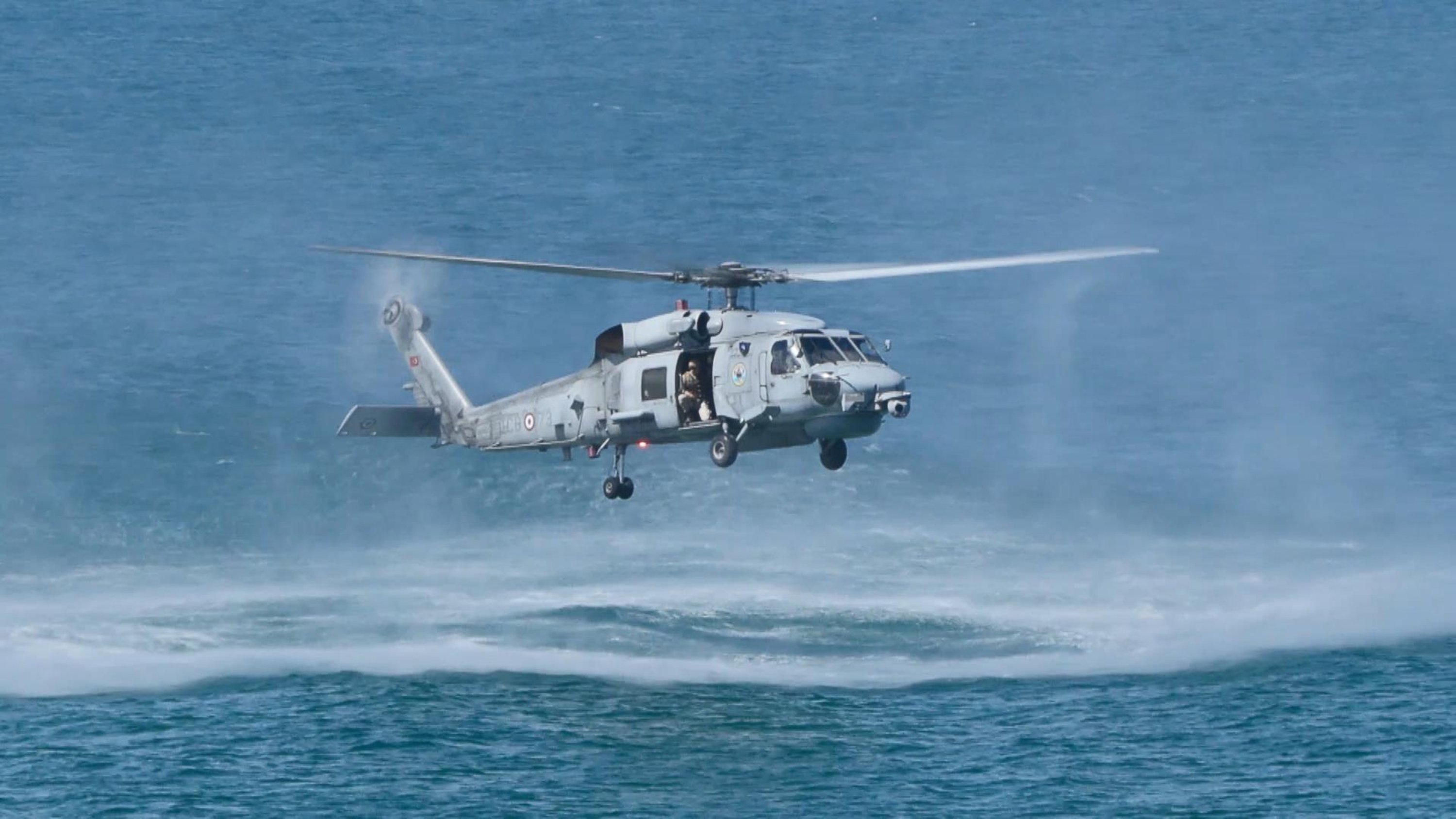
SAS teams have intervened against more than 300 suspicious objects, including mines and unmanned aerial and maritime vehicles, according to the unit.
Its personnel have also served in counterterrorism operations inside Türkiye and across the border, including operations Euphrates Shield, Olive Branch, Peace Spring and the Claw series, Lt. B. said.
The unit has also carried out missions in Libya, Afghanistan, Azerbaijan, Bosnia-Herzegovina and Albania.
During a recent training exercise, SAS commandos practiced clearing a booby-trapped building, rescuing a hostage and neutralizing an improvised explosive device. Another explosive device detected in the field was targeted using sniper and rocket fire.
Another SAS officer, identified as Lt. S., said fewer than 30% of candidates have completed the approximately yearlong training course in previous years.
The officer said personnel undergo regular physical conditioning on land and at sea alongside specialized operational training.
“The physical and mental endurance required by our work can only be developed through continuous and disciplined training,” he emphasized, adding that exercises also focus on patience, composure, attention and decision-making.
Lt. B. said teamwork remains central to the unit’s approach, particularly during missions involving explosives.
“There is no room for fear, hesitation or mistakes in our understanding of duty,” he said. “We remind ourselves that we do not have the luxury of making a mistake.”

U.S. President Donald Trump voiced strong support for Türkiye and President Recep Tayyip Erdoğan on Friday when asked about delays in lifting CAATSA sanctions that led to Ankara’s removal from the F-35 fighter jet program.
Noting that he loves Türkiye, Trump said he talks to President Erdoğan all the time.
“He is a friend of mine, as you know. And I’ll always make him happy,” Trump told reporters as he left the White House for Alabama, where he was due to attend a Republican Party campaign event.
Trump had announced during the NATO leaders’ summit in Ankara in July that sanctions on Türkiye would be lifted, saying Washington did not want to impose sanctions on its friends.
The U.S. imposed sanctions under the Countering America’s Adversaries Through Sanctions Act (CAATSA) in 2020 after Türkiye purchased the Russian-made S-400 air defense system.
Ankara turned to the S-400 after its efforts to purchase the U.S.-made Patriot air defense system failed to produce a deal. Türkiye was subsequently removed from the F-35 fighter jet program.
Türkiye will open a Turkish school with capacity for about 1,000 students in the Syrian capital Damascus on Oct. 4 as Ankara and Damascus expand cooperation, the Turkish Education Ministry said.
The Damascus International Recep Tayyip Erdoğan Turkish School, named after Türkiye’s president, will open in the Artuz area of the Syrian capital and will begin providing education during the 2026-2027 academic year.
The school will operate under Türkiye’s Education Ministry and include kindergarten, primary, middle and high school levels, the ministry said in a statement on Friday.
The ministry said the school was established as part of growing education cooperation and coordination between Türkiye and Syria, including efforts aimed at expanding access to education for Syrian children and young people.
The facility has 36 classrooms and will accommodate about 1,000 students.
A delegation from the Turkish Education Ministry is expected to attend the opening ceremony and the school’s first class.
Ankara said the project was also intended to support children from families returning to Syria and help them adapt to education following their return.
The ministry described the school as part of broader efforts to strengthen educational links between the two countries, which share longstanding historical, cultural and social ties.
Türkiye has expanded its education-related activities in Syria as Ankara and Damascus have sought closer cooperation in several areas.
Turkish education officials have held a series of meetings and visits in Syria in recent months. Türkiye’s education office in Damascus said officials inspected the new school’s campus in September ahead of its planned opening.
The Education Ministry said it expects the school to provide students in Syria with access to Türkiye’s educational system while contributing to closer ties between the two countries.
The opening comes as Türkiye and Syria increase coordination on education following years of conflict that severely disrupted Syria’s education system and displaced millions of people.
Turkish officials have said supporting education and facilitating the adaptation of returning families are among the objectives of Ankara’s cooperation with Syrian authorities.
On Aug. 6, officials from Türkiye’s Council of Higher Education (YÖK) and Syria’s Ministry of Higher Education and Scientific Research also signed a memorandum of understanding to advance educational cooperation between the two countries.
Under the memorandum, the two parties will continue work on the legal framework, governance structure, academic organization, student admission procedures, quality assurance mechanisms and administrative regulations for the planned Syria-Türkiye University in Damascus.
Damaged vessels from the Global Sumud Flotilla are being repaired in Türkiye’s Antalya after an Israeli attack in international waters, with volunteers working to prepare the ships for another voyage toward Gaza.
Some of the vessels were left with damaged engines, broken masts and torn sails after the attack. They were later brought to Antalya, where local and international volunteers are carrying out repairs at a shipyard.
Two vessels have already been repaired and sent to Italy as part of preparations for another Gaza-bound mission, said Sümeyra Akdeniz Ordu, a board member of the Global Sumud Flotilla.
“We are trying to recover the ships drifting at sea one by one. We are carrying out a rescue mission,” Ordu told Anadolu Agency (AA). “We are repairing these ships so they can sail to Gaza again.”
Fourteen flotilla vessels are currently in Antalya, Ordu said, adding that volunteers from different countries were helping coordinate and repair the ships.
She said each vessel had a special significance for the activists and that they were treating the ships “like their own children” as they worked to restore them.
The damage was extensive, Ordu said, describing broken masts, damaged engines and cut hoses. She also said the sails had been torn with knives.
“The mast was broken, surface cleaner and coffee had been poured into the engines, and the hoses on each ship had been cut one by one,” she said. “They caused this damage by ramming them with larger ships.”
The repairs have been difficult because of the extent of the damage, but volunteers have continued working, Ordu said.
Türkiye has provided a safe port for the repair effort, she added.
Ordu said the activists remained determined to continue their efforts despite the damage to the vessels.
“If the enemy does not give up, we cannot give up,” she said. “We are trying to be a voice here for our Palestinian friends.”
She said the damage to the vessels showed what she described as the violence and hostility directed at the flotilla.
“We, too, insist on continuing every form of resistance,” Ordu said.
Türkiye condemned a drone attack on a power distribution station in the Saudi city of Medina that supplies electricity to the Prophet’s Mosque, reiterating its support for Saudi Arabia amid renewed regional tensions.
Ömer Çelik, spokesperson for Türkiye’s ruling Justice and Development Party (AK Party), condemned the attack on Friday, saying targeting infrastructure serving the Prophet’s Mosque was unacceptable.
“Attacks targeting our sacred values are illegitimate acts directed against all Muslims,” Çelik said in a social media post, adding that Türkiye strongly supported Saudi Arabia’s security and stability.
The targeted facility supplies electricity to the Prophet’s Mosque, Islam’s second-holiest site. The attack put one transformer out of service but did not affect the electricity network.
Türkiye’s Foreign Ministry also strongly condemned the attack, saying strikes targeting civilian infrastructure and threatening Saudi Arabia’s sovereignty and security should “cease immediately and unconditionally.”
The ministry reiterated Türkiye’s support for Saudi Arabia and called on parties to avoid steps that could further escalate tensions in the region.
“We reaffirm our strong support for Saudi Arabia and emphasize the need to avoid any steps that would further escalate tensions in the region,” the statement said.
Presidential Communications Director Burhanettin Duran on Friday separately condemned the strike and said Türkiye would continue to stand by Saudi Arabia.
The Saudi-led coalition said an investigation and examination of drone wreckage indicated Houthi involvement in the Sept. 29 attack.
Coalition spokesperson Maj. Gen. Turki Al Maliki said the targeted facility supplies electricity to the Prophet’s Mosque, one of Islam’s holiest sites.
Saudi Arabia said two weeks ago it had intercepted and destroyed a Houthi drone south of Mecca before it entered restricted airspace over the Muslim holy city. The coalition described that incident as the second Houthi attempt to target Mecca since 2017.
Earlier on Thursday, the Organisation of Islamic Cooperation (OIC) and several Arab countries, including the United Arab Emirates (UAE), Jordan, Kuwait and Bahrain, also condemned the attack on Medina.
The OIC described the targeting of vital infrastructure and facilities as “a dangerous escalation and a blatant violation of the sanctity of holy sites,” as well as international and humanitarian laws and norms.
Bashiqa-Zilkan, a key Turkish base in Iraq, will soon be handed over to Iraqi authorities while Turkish troops are expected to withdraw from the country. The development, which comes amid the withdrawal of U.S. forces from the country, which remained there as part of an anti-Daesh coalition, signals the start of a new era for Iraq and Türkiye. The Ministry of National Defense said in a statement on Thursday that the handover of the base did not mean an end to cooperation with Iraq and, on the contrary, Türkiye would continue supporting Iraq’s security and stability.
Türkiye and Iraq agreed earlier this month to deepen security cooperation, restore full Iraqi state authority in Sinjar and begin the gradual handover of the Bashiqa-Zilkan military base to Baghdad under an agreed timetable.
President Recep Tayyip Erdoğan and Iraqi Prime Minister Ali al-Zaidi announced the steps in a joint statement following talks in New York on the sidelines of the 81st United Nations General Assembly.
The ministry said Türkiye welcomed steps to ensure state authority in Sinjar. The base was set up in 2015 to help Iraq fight against Daesh and later maintained its presence when the terrorist group PKK sought to replace Daesh following the liberation of Sinjar.
“These steps will contribute to normalization of the region, establishing an environment of security and stability and a terror-free region,” the ministry said, using an expression referring to Ankara’s “terror-free Türkiye” initiative, which aims to disarm the PKK.
The statement also said it was decided to gradually hand over the compound to the central government in Baghdad, “based on improvement of security in Sinjar.”
“Our country, as it did in the past, stands with our neighbor Iraq in terms of maintaining an environment of security and stability. Throughout future contacts, we are planning to take steps that will further advance military and security cooperation. We will continue supporting Iraq’s armed forces in increasing military capacity, sharing know-how in counterterrorism and in the fields of military training and defense industry cooperation, based on bilateral agreements,” the ministry stated.
Ayhan Sarı, an assistant professor at the Turkish-German University and a security and foreign policy expert at the Turkish Research Foundation (TAV), noted that Türkiye’s withdrawal was linked to ending the PKK’s presence in Sinjar and the re-establishment of Baghdad’s authority there.
Sarı told Daily Sabah that Türkiye has been in Iraq as an exercise of its right to self-defense under international law, particularly Article 51 of the United Nations Charter, which recognizes the right to individual and collective self-defense against armed attacks. “Türkiye’s presence in Iraq has been due to the PKK threat in the north. (The dissolution) of the PKK will remove the need to remain in Iraq,” Sarı said.
He noted that the PKK and other terrorist groups had, for years, filled the power vacuum that emerged in Iraq’s northern region following the beginning of the Iraq War.
“Iraq’s central government claims it can find a solution to this vacuum through recent steps and establish full authority within its borders after the U.S. withdrawal,” Sarı said.
A U.S.-led coalition deployed in Iraq more than a decade ago against Daesh formally concluded its mission on Wednesday. Daesh was largely expelled from Iraq and Syria, also thanks to Türkiye’s cross-border operations in Assad-era Syria, but U.S. forces remained. Washington and Baghdad reached an agreement two years ago to wind down the mission.
Sarı said it was only natural that Türkiye was supportive of Iraq’s steps to ensure security on its own, since Ankara was committed to developing good relations with its neighbors and centered its foreign policy on peace and stability.
“As it did in Syria, Türkiye sides with central authority, stability and security in Iraq. Türkiye will support this move and will do whatever it can to ensure that this mission succeeds in maintaining stability and security, based on its neighborly relations,” he said.
Sarı added that Iraq’s efforts were compatible with Türkiye’s foreign policy and plans. “Iraq’s success will also mean the complete expulsion of the PKK from that country. This expulsion, removal of this malignant tumor between Türkiye and Iraq, will certainly add momentum to Turkish-Iraqi relations,” he also stated.


-
 Politics3 days ago
Turkish defense chief attends major joint military drills in Azerbaijan
-
 Economy2 days ago
Türkiye moves to finalize capital markets law changes after fund turmoil
-
 Politics2 days ago
Erdoğan calls for ‘grand consensus’ amid terror-free Türkiye success
-
 Economy3 days ago
Şimşek tells investors Türkiye has avoided systemic risk in fund turmoil
-

 Economy3 days ago
US tells European allies to release diesel stocks ‘immediately’
-
 Economy3 days ago
Turkish manufacturing activity eases again amid Mideast war impact
-

 Economy3 days ago
9 video game companies probed by EU over virtual currencies
-
 Politics3 days ago
Izmir mayor meets Erdoğan amid rumors of AK Party switch