
Politics
D-8 seeks to turn growing economic weight into deeper trade ties

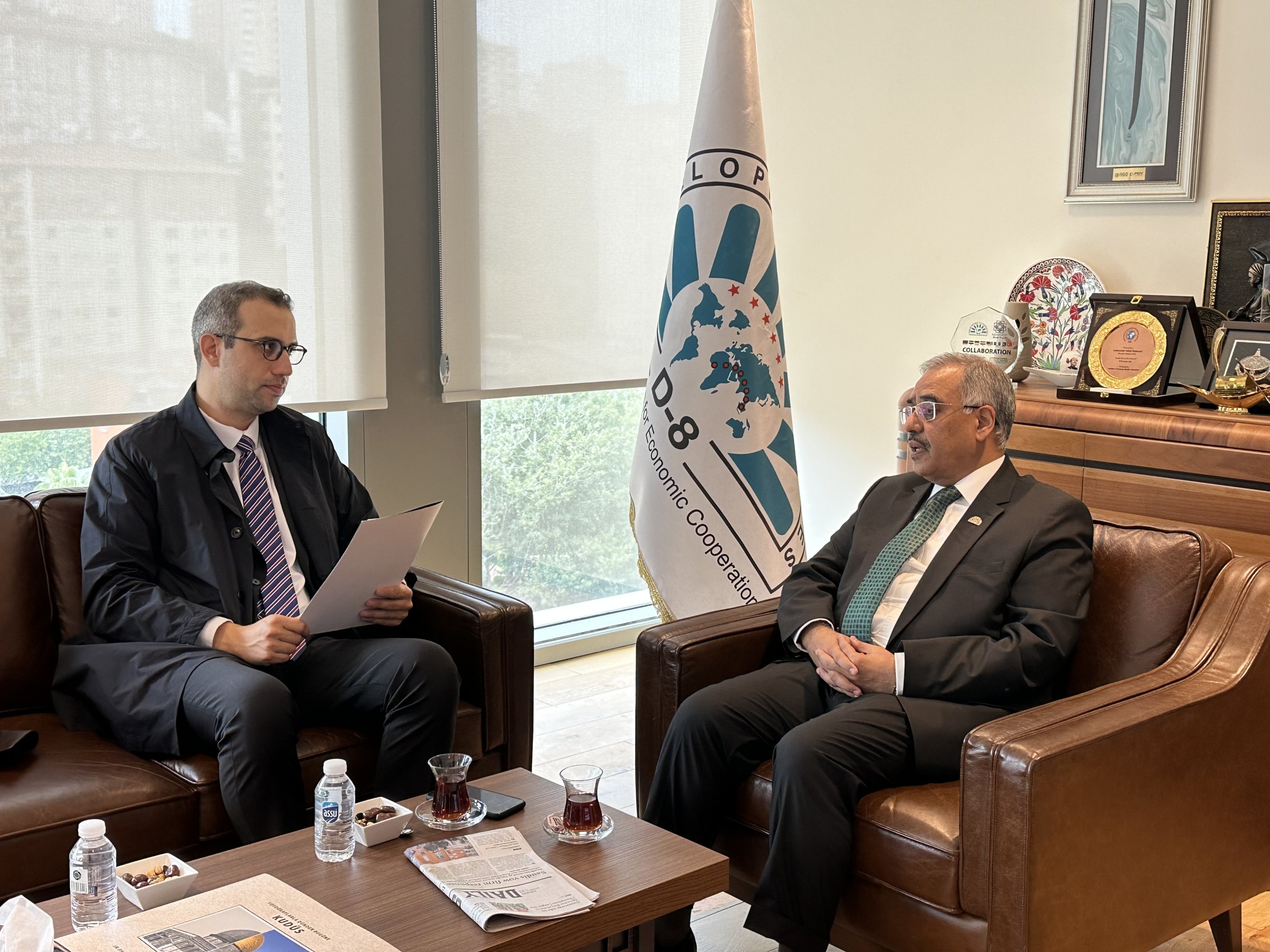
Nearly three decades after eight developing countries came together in Istanbul with ambitions of reshaping economic cooperation among Muslim-majority nations, the D-8 Organization for Economic Cooperation is seeking to turn its members’ growing economic weight into stronger commercial ties and a more influential international voice.
The challenge is not a lack of scale. The nine-member organization now represents about 1.3 billion people and a combined gross domestic product (GDP) of over $5.2 trillion, according to its secretary-general, Sohail Mahmood. Trade among its members has also increased substantially since the organization was established in 1997.
Yet intra-D-8 trade remains a relatively small share of the members’ overall commerce, exposing a gap between the group’s collective economic potential and the degree to which its economies trade with one another.
The organization has set a target of raising trade among its members to $500 billion by 2030, from approximately $170 billion today. Achieving that goal, the secretary-general said in a recent interview with Daily Sabah, will require more effective implementation of existing trade-facilitating arrangements, closer private-sector engagement, and facilitation of the movement of goods and businesspeople.
At a time of geopolitical tensions, shifting economic power and mounting pressure on multilateral institutions, he argued, the case for cooperation among developing economies has become more compelling.
“The more the capacities of member states grow, the more they align themselves economically and integrate deeply, I think their capacity to influence global outcomes will be much greater,” he said.
The statement reflects a central premise of the D-8: that economic integration can provide its members with a stronger foundation for political coordination and a greater role in international affairs. Whether the organization can translate that premise into measurable results will help define its next phase.
From collectivity to practicality
Founded in Istanbul in 1997 under the vision of then-Turkish Prime Minister Necmettin Erbakan, the D-8 brought together Bangladesh, Egypt, Indonesia, Iran, Malaysia, Nigeria, Pakistan and Türkiye. Azerbaijan became its ninth member following a decision taken in Cairo in December 2024.
The organization was conceived as a platform for major developing economies to pool their resources, draw on their complementary strengths and pursue sustainable development. Its name was modeled on the Group of Eight, then a gathering of major industrialized economies.
The group has since grown considerably in demographic and economic terms. Its combined GDP has risen from an estimated $750 billion to $800 billion at its founding to more than $5.2 trillion, while its population has increased from around 700 million to 1.3 billion, according to Mahmood.
But aggregate growth does not automatically translate into economic integration.
Trade among D-8 members has historically accounted for roughly 6%-7% of their total trade, the secretary-general said. The organization wants to increase that proportion to at least 10%, a shift that would require businesses to find more opportunities within the bloc and governments to make cross-border commerce easier.
A preferential trade agreement that entered into force in 2011 is one existing instrument the organization wants its members to implement more fully. D-8 ministers have also called for work on a more comprehensive economic partnership framework to expand trade.
The organization is seeking to strengthen the role of the private sector as well. Plans include establishing a permanent secretariat of the D-8 Chamber of Commerce and Industry in Istanbul under the guidance of Türkiye’s Union of Chambers and Commodity Exchanges, known as TOBB.
The proposed body would give business communities across the member countries a more dynamic and sustained channel for cooperation. The secretary-general also pointed to customs coordination and visa facilitation as areas where improvements could help businesses operate across national borders.
These efforts address a practical question facing the organization: how to make membership translate into opportunities that companies can use, rather than relying primarily on political commitments and summit declarations.
The $500 billion trade target gives that challenge a measurable dimension. Reaching it by 2030 would require a substantial expansion of commerce among countries whose economies differ in size, industrial capacity and geographic position.
Türkiye’s role in the next phase
For Türkiye, the organization’s founding member and host of its secretariat in Istanbul, the D-8 offers a platform that connects its regional relationships with broader economic partnerships across Asia, Africa and the Middle East.
The secretary-general described Türkiye’s contribution as extending beyond its historical role. He cited the country’s industrial and technological capabilities, extensive diplomatic network, geographic position and international partnerships as assets that other members could draw on.
Türkiye hosted the organization’s inaugural summit in 1997 and its ninth summit in 2017, when leaders adopted the Istanbul Declaration and a plan of action covering several areas of cooperation. Its leadership, government and Foreign Ministry continue to support the secretariat, he said.
He also pointed to Türkiye’s diplomatic engagement and its role in international initiatives as potential sources of influence for the wider group.
The country’s upcoming climate diplomacy is one example. Türkiye is preparing to host the U.N. climate conference COP31 in Antalya in November, while D-8 members have begun coordinating their positions on environmental issues through a dedicated ministerial process.
In July, Türkiye hosted the organization’s first environment ministers’ meeting in Istanbul. Participants discussed climate adaptation, climate finance, climate justice, loss and damage, and zero waste, according to the secretary-general.
Such coordination could give members a forum to exchange experiences and identify common priorities ahead of international negotiations. Its longer-term significance, however, will depend on whether shared positions lead to sustained cooperation beyond individual meetings.
Technology offers another avenue. The secretary-general cited Türkiye’s industrial development and emerging technology capabilities, including artificial intelligence, as areas from which D-8 members could benefit.
The organization is also preparing for Türkiye to host its next health ministers’ meeting and an industry ministers’ meeting in 2027.
Türkiye’s central role gives the organization an established institutional base and access to a broad diplomatic network. At the same time, the D-8’s ability to expand its influence will depend on participation and follow-through across all its members, rather than the contribution of any single country.
Beyond trade and diplomacy
The organization’s agenda is also extending into areas that connect governments and economies with their populations, particularly education, youth engagement and tourism.
The secretary-general said the D-8’s Network of Pioneers of Research and Innovation, based in Islamabad, includes 29 universities from member countries. The network aims to facilitate academic exchanges, cooperation in science and technology, and institutional partnerships.
The organization has also signed a memorandum of understanding (MoU) with the Organization of Islamic Cooperation’s (OIC) Standing Committee on Scientific and Technological Cooperation, known as Comstech. The agreement is intended to expand opportunities for knowledge sharing, training and capacity building.
Youth engagement is another priority. The organization is working on a plan of action intended to promote innovation partnerships, leadership and entrepreneurship among young people.
For a group representing 1.3 billion people, the secretary-general said, young people are an important resource not only for national economies but also for international cooperation and closer ties among societies.
Tourism is being used to pursue a similar objective. Through its D-8 City of the Year initiative, the organization seeks to encourage cultural exchange and cooperation among cities in member countries. Antalya was selected for 2025, followed by Aswan, Egypt, for 2026, while a selection process for the 2027 city is underway.
These initiatives reflect a broader effort to give the organization a presence beyond intergovernmental negotiations. Educational networks, tourism and cultural exchange can create connections that persist even when political priorities vary.
The secretary-general said the organization wants to develop a distinct D-8 identity based on its members’ cultural affinities and shared historical and civilizational heritage.
Expanding agenda, targets to meet
Azerbaijan’s accession has added a new dimension to the group’s expansion. The country is expected to host three D-8 centers in Baku focused on energy and climate, transportation, and media cooperation.
The organization is also open to wider engagement through dialogue partnerships and observer status, the secretary-general said, citing interest from additional countries, regions and organizations.
Alongside expansion, the D-8 is broadening its work in areas including energy security, small and medium-sized enterprises, technological innovation, digital transformation and climate action. It is also working toward a framework for cooperation on artificial intelligence.
The expanded agenda offers opportunities to connect traditional sectors such as agriculture, industry, trade and investment with emerging economic priorities.
The secretary-general maintained that stronger political support from member states and a more action-oriented approach were helping the organization make progress.
He said member states envision an organization that is institutionally stronger, more economically integrated, more technologically advanced and more influential internationally.
Its message, he added, is one of “shared prosperity through collective action.”
Estonian Foreign Minister Margus Tsahkna hailed Türkiye’s contribution to the defense of the Baltic states, as he met with newly appointed Turkish Ambassador Yonca Özçeri on Tuesday.
“The Turkish Air Force is currently contributing to the defence of the Baltic States from Ämari Air Base, and just last week we marked the 35th anniversary of the restoration of diplomatic relations between Estonia and Türkiye,” Tshakna said on X.
He continued by saying that it was a pleasure to meet with the Turkish ambassador, ” to discuss how we can further strengthen the friendship and deepen cooperation between our countries.”
Türkiye and Estonia established ties through a friendship and cooperation treaty signed in 1924 and restored diplomatic relations in 1991 following Estonia’s independence from the Soviet Union. The two NATO allies maintain close cooperation in international organizations, while bilateral trade reached $606 million in 2025, according to the Turkish Foreign Ministry.

President Recep Tayyip Erdoğan and French President Emmanuel Macron discussed bilateral relations, regional and global developments, and the selection of the next United Nations secretary-general during a phone call, according to a statement released Tuesday.
During the conversation, Erdoğan stressed that the next U.N. chief should possess the vision and experience needed to restore the organization’s role as a hub for multilateral diplomacy and effectively implement necessary reforms.
The two leaders also reviewed the process of appointing a successor to the current U.N. secretary-general.
Erdoğan invited Macron to attend the COP31 Leaders Summit, which Türkiye is set to host.
Macron, meanwhile, extended his congratulations to Erdoğan on the occasion of Türkiye’s Republic Day, celebrated annually on Oct. 29.
Egypt discussed regional de-escalation efforts with Saudi Arabia and the United Arab Emirates (UAE), emphasizing coordination through a four-way ministerial mechanism involving Türkiye and Pakistan, according to the Egyptian Foreign Ministry.
Foreign Minister Badr Abdelatty held separate phone calls Tuesday with his Saudi counterpart, Faisal bin Farhan, and UAE Foreign Minister Abdullah bin Zayed, the ministry said in two separate statements Wednesday.
During his call with bin Farhan, Abdelatty discussed regional developments and “efforts to contain the current crisis amid growing risks of escalation,” stressing the need to “advance political and peaceful solutions through dialogue.”
The two foreign ministers agreed to “continue close consultations and coordination bilaterally and through a four-way ministerial mechanism that also includes Türkiye and Pakistan.”
The mechanism brings together Egypt, Pakistan, Türkiye and Saudi Arabia to strengthen consultation and coordination on de-escalation and support political solutions to regional crises.
The foreign ministers of the four countries met last month on the sidelines of the 81st session of the United Nations General Assembly to discuss regional and international developments, according to a joint statement released after the meeting.
The ministers stressed the need for closer consultation and coordination among their governments to promote peace, security and economic stability across the Middle East and the broader region.
The call came a day after Egypt’s Parliament approved, by a two-thirds majority, a mandate for President Abdel-Fattah el-Sissi to take necessary measures to support Saudi Arabia and defend its territory, sovereignty and holy sites, in coordination with the kingdom.
It also comes amid ongoing military escalation between Saudi Arabia and Yemen’s Houthi group since July, including Houthi attacks on civil aviation facilities and energy infrastructure in the kingdom.
Saudi Arabia has led a coalition since March 2015 in support of Yemen’s internationally recognized government against the Houthis, who have controlled Sanaa and several provinces since September 2014.
In a separate statement, the Egyptian Foreign Ministry said Abdelatty and his Emirati counterpart discussed the latest regional developments, particularly growing indications of possible escalation in the coming period.
Abdelatty stressed the need for regional countries to “unite their efforts to reach peaceful solutions and return all parties to a peaceful political track to prevent the region from sliding into a more dangerous phase of the current crisis.”
The call came as mediation efforts continue to contain tensions between Washington and Tehran amid ongoing disagreements over the conditions for reopening the Strait of Hormuz.
On Feb. 28, the U.S. and Israel launched a war against Iran, which responded with attacks on Israel and US military facilities in Arab countries.
On June 18, Washington and Tehran signed a memorandum of understanding and began negotiations that later collapsed over disagreements, including maritime navigation through the Strait of Hormuz, a strategic passage for global energy and goods supplies.
President Recep Tayyip Erdoğan met with Nationalist Movement Party (MHP) Chairperson Devlet Bahçeli at the Presidential Complex in Ankara on Tuesday, with discussions expected to focus on key domestic and regional developments.
The meeting began at 2 p.m. local time, according to Presidential Communications Director Burhanettin Duran.
The leaders were expected to discuss recent developments in Türkiye’s “terror-free Türkiye” initiative, aimed at ending decades of terrorism, alongside ongoing efforts to draft a new constitution.
The initiative began in 2024 after a landmark speech by Bahçeli, which urged the jailed ringleader of the PKK, Abdullah Öcalan, to call on the PKK to lay down arms. Öcalan responded in February 2025 and made the historic call to the group that has killed tens of thousands of people across Türkiye since the 1980s. Since then, a disarmament process has been underway, while Türkiye plans to introduce new laws and regulations to accommodate it, namely by offering leniency to PKK members not involved in acts of terrorism.
Regional issues, including the Türkiye-Libya maritime boundary agreement, recently approved by Libyan House of Representatives, were also expected to feature on the agenda.
The talks could also address the Mecca motion expected to reach Parliament and the Badr Memorandum.
Erdoğan had previously signaled that he could meet Bahçeli in the near future.
The meeting marked their fourth encounter this year, following previous talks on Jan. 21, April 30 and Aug. 26.
Türkiye unveiled a new digital sovereignty strategy Tuesday aimed at strengthening cybersecurity, reducing reliance on foreign technologies and protecting critical infrastructure, as President Recep Tayyip Erdoğan chaired a high-level meeting on emerging cyber threats and artificial intelligence risks.
The strategy was presented during the second meeting of the Cybersecurity Board at the Presidential Complex in Ankara, according to a statement from the Presidency’s Directorate of Communications.
Officials reviewed the impact of global and regional geopolitical developments on cybersecurity, recent international cyber incidents and the evolving nature of digital threats.
The board also examined how advances in artificial intelligence are reshaping the scale, speed and sophistication of cyberattacks.
Particular attention was given to algorithmic manipulation and cognitive influence operations conducted through digital platforms, including their potential implications for national security and societal resilience.
The statement emphasized that digital sovereignty has become a strategic priority for Türkiye’s national security and development policies, alongside technological independence, protection of critical infrastructure and stronger cyber deterrence capabilities.
The newly developed Digital Sovereignty Strategy seeks to enhance Türkiye’s control over its digital infrastructure, reduce dependence on foreign suppliers in critical technologies and expand domestic technological capabilities.
Authorities agreed that relevant institutions would implement decisions aligned with the strategy’s objectives, monitor progress and regularly assess results.
The board also called for closer coordination among government agencies, improved joint risk assessment capabilities and more consistent implementation of cybersecurity measures across sectors.
Given the ability of cyber threats to spread rapidly and disrupt multiple industries simultaneously, officials reaffirmed their commitment to strengthening cooperation among public institutions, private companies and academia.
Meanwhile, Interior Minister Mustafa Çiftçi, who attended the meeting, said Türkiye was determined to protect its digital domain with the same resolve it applies to safeguarding its physical borders.
“Digital sovereignty is an integral part of our national security,” Çiftçi said in a statement shared on social media.
He said the meeting addressed global cyber threats, emerging risks associated with artificial intelligence and the national security implications of algorithmic manipulation and influence operations.
Çiftçi also emphasized the importance of strengthening domestic technological capabilities and building a comprehensive cybersecurity framework through cooperation between government, industry and academic institutions.
“We will protect not only our physical borders but also our cyber homeland and strengthen our digital sovereignty with the same determination and resolve,” he said.
“Someone whom the public can trust, who can address their needs, and who is knowledgeable and experienced.” This is how the opposition Republican People’s Party (CHP) general coordinator Gürsel Tekin described the party’s presidential candidate. “We have someone in mind, and our chairperson will announce it when the time comes,” he told journalists on Monday in Ankara in response to a question about whether the CHP would nominate a candidate in the next general election.
Was it Kemal Kılıçdaroğlu, the party’s chair? Tekin did not answer the question, saying only that they had plenty of names in mind and that these would be discussed among party members before the next election.
The next election is scheduled for 2028, although the ruling Justice and Development Party (AK Party) has signaled that it could be brought forward so that incumbent President Recep Tayyip Erdoğan can run again. The CHP has voiced support for holding early elections under those circumstances.
Erdoğan’s most serious rival is expected to be the candidate of the main opposition New Party (YP). The CHP, meanwhile, secured its highest vote share in decades under Kılıçdaroğlu’s leadership in 2023, when he ran as the candidate of a six-party opposition alliance. His defeat to Erdoğan in the presidential runoff paved the way for his ouster as CHP leader. In an intraparty vote in November 2023, he lost to Özgür Özel, who is now chairperson of the YP. Kılıçdaroğlu returned to his post in May after a court ruled that Özel’s victory was questionable amid allegations of vote-buying. Özel initially appealed the ruling before founding the YP in July.
The CHP also plans to hold a congress soon to elect its leadership again. Kılıçdaroğlu has been vague about whether he intends to run, but Tekin said he was “perfectly eligible.”
“Mr. Kılıçdaroğlu has to lead the party before it reaches safe harbor,” Tekin said, referring to the turmoil within the party, where most members and lawmakers have switched to the YP.


-
 Politics2 days ago
France reportedly mulls postponing Med grid after Türkiye-Libya deal
-
 Politics2 days ago
Yemen hails strong ties with Türkiye, its role in region
-

 Economy2 days ago
Ready for French test?: 5 questions for European Central Bank
-
 Politics2 days ago
Turkish opposition parties’ cash row grows
-
 Politics2 days ago
Turkish Parliament set to debate Mecca deal bill
-
 Economy2 days ago
Türkiye begins production of $300M K9 light commercial vehicle project
-

 Sports2 days ago
Football-mad Türkiye in love with Salah after Trabzonspor heroics
-
 Politics2 days ago
Uzbek leader instrumental in new era of cooperation in Central Asia