
Economy
Erdoğan heralds new era as Türkiye launches 5G services

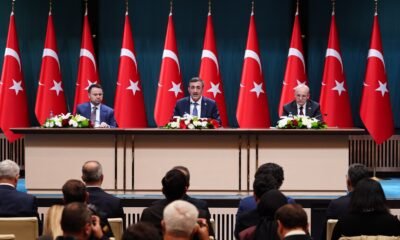
Türkiye officially launched 5G technology on Tuesday in what President Recep Tayyip Erdoğan said will mark the beginning of a new era not only in communications but in all other industries.
Commercial 5G services are scheduled to begin as of Wednesday and are expected to cover the whole country within about two years, according to officials.
Speaking at a launching ceremony, Erdoğan said the next-generation services would strengthen Türkiye’s competitiveness, improve productivity in communications, technology, energy and manufacturing and reinforce the country’s digital independence.
He said it would open a new chapter across transportation, health care, agriculture, manufacturing, the economy and education.
The technology is expected to enable users to experience significantly higher speeds and lower latency across all forms of internet use, supporting wider adoption of advanced digital services.
Erdoğan said sovereignty in today’s world is no longer limited to geography and physical borders, arguing that technological capability, cybersecurity and control over data have become central to national strength.
“In today’s data age, political stability, economic independence, military deterrence and digital sovereignty are inseparable,” he said.
He argued that countries seeking influence and credibility in an increasingly competitive global environment must invest in cyber technologies, cybersecurity measures and digital infrastructure.
Erdoğan said the collection, processing and protection of data now play a critical role in national security, particularly amid recent conflicts in places such as Gaza, Lebanon and Iran.
“The wars and conflicts occurring in our immediate vicinity, particularly in Lebanon, Gaza and Iran recently, have once again demonstrated the importance of cybersecurity,” he noted.
“If you want to be strong, deterrent, and respected on the global stage, you must accelerate your efforts in cyberspace and take the necessary cybersecurity measures.”
Cybersecurity seen as part of national defense
The president said 5G should be viewed not only as a communications technology but also as part of a broader digital sovereignty and national security strategy that includes data centers, cloud infrastructure, artificial intelligence and cybersecurity capacity.
“If you can protect your borders and airspace but cannot protect your cyber homeland and the data that is an inseparable part of it, then you have a serious weakness in your sovereignty,” Erdoğan said.
He said the government has spent the last 23 years building the foundations for this transition through investments in digital infrastructure and cybersecurity.
Türkiye’s fiber optic network has expanded from 81,000 kilometers in 2002 to 657,000 kilometers (408,240 miles) as of the third quarter of 2025, Erdoğan said.
During the same period, the number of broadband subscribers rose from 3,000 to 98 million, while mobile phone subscribers increased from 23 million to nearly 100 million.
Mobile use and cybersecurity efforts expand
Erdoğan said more than 55 million people in Türkiye currently use secure internet services, while total monthly voice traffic through mobile and fixed-line networks has reached 82 billion minutes.
Türkiye ranks first in Europe with an average monthly mobile usage time of 494 minutes, he added.
The 5G will be rolled out in all 81 provincial centers initially before becoming available across the country within two years, said Erdoğan.
The president also highlighted the work of the Cybersecurity Directorate, established last year to protect communications systems, critical infrastructure and national networks from cyber threats.
He said law enforcement, intelligence agencies and other public institutions are also developing contingency plans and response mechanisms against potential cyber risks.
Erdoğan added that the government is closely monitoring debates over foreign-owned messaging and calling applications, particularly since the conflict in Gaza, and will gradually introduce additional measures to strengthen the security of data belonging to state institutions.
Digital transformation
Also addressing the ceremony, Abdulkadir Uraloğlu, the transport and infrastructure minister, echoed the president’s view that 5G would transform Türkiye’s economy, industry, healthcare, transportation and agriculture.
Noting that information technology, artificial intelligence, cybersecurity, and high-speed connectivity play a vital role in countries’ economic development, competitiveness and national security, Uraloğlu said: “As Türkiye, we have taken decisive steps over the past quarter-century by making unique infrastructure investments.”
He stressed that more inclusive, fast and resilient communication systems need higher digitalization capacity.
The minister stated that 5G is not just about faster internet, but is also the key to a smarter, safer and more efficient future.
Noting that 5G, with data transfer speeds 10 times faster than the currently used 4.5G, ultra-low latency and the capacity for massive device connectivity, will position Türkiye at the center of digital transformation, he stated: “With this technology, we are providing a new infrastructure that will transform every aspect of life.
“In transportation, road safety will improve with fully autonomous driving and smart transportation systems, and traffic will become more efficiently manageable.”
He noted that production processes will be optimized through smart factories, autonomous robots and real-time data analysis in the industry field.
In smart cities, innovative solutions will emerge in every area, from energy management to parking systems, he said, adding that students will have access to world-class education through high-resolution and augmented reality-supported content.
Households’ demand for Turkish lira remains strong, the governor of the country’s central bank said, according to a transcript of an interview published on Sunday, pointing also to the importance of the demand for currency for the reserve outlook.
“The latest data show us that demand for the Turkish lira continues in a stable and strong manner,” the Central Bank of the Republic of Türkiye (CBRT) Governor Fatih Karahan said in an interview with Anadolu Agency (AA) published on Sunday.
“To prevent global volatility from affecting demand for the Turkish lira, we proactively took steps last week to support demand for the currency,” he added.
Household demand for the currency is particularly important for the country’s reserve outlook, he also said.
Noting that the underlying trend in inflation continued to decline, Karahan said the current account balance had also deteriorated only slightly despite the adverse effects of the war.
“Therefore, we can say very clearly that our macroeconomic fundamentals are strong,” he said.
Karahan also acknowledged that reserves had declined recently, adding: “When we examine the sources of this decline, we see that falling gold prices and global portfolio movements have played a role. In addition, companies have had some demand for foreign currency.”
On Thursday, the bank said it suspended its one-week repo auctions temporarily in a move expected to push overnight interest rates toward the 39% overnight lending rate. The repo move effectively shifts funding costs above the central bank’s 36% policy rate.
In another step aimed at supporting lira demand, the CBRT also said overnight it had raised the remuneration rate it pays on required reserves for deposits to 90% of the weighted average funding cost from 86%.
Karahan’s latest remarks came during a visit to London, where he also delivered a presentation on the macroeconomic outlook and monetary policy.
According to the presentation shared by the CBRT on Sunday, the governor highlighted that the disinflation process has slowed down and that energy prices had a major impact on inflation in 2026.
However, he also cited that disinflation continues in the services sector and that the deceleration trend in rent inflation is becoming more pronounced. He also reiterated that the underlying trend of inflation has declined.

U.S. consumers spent a record high $13.1 billion online on Black Friday sales and fewer people shopped in person on the single busiest day for stores each year, according to preliminary figures released Saturday.
Excluding purchases of gasoline and automobiles, retail sales both in stores and online were up 5.8% compared with last year’s Black Friday, according to Mastercard SpendingPulse, which tracks all payment forms including cash.
Adobe Analytics, which tracks e-commerce, said the day’s online sales total of $13.1 billion exceeded its forecast and was up 11% from a year ago.
Higher prices, which Americans have expressed frustration with as the Iran war affects gasoline and some consumer goods, did not account for all the sales growth. According to Salesforce, the volume of Black Friday orders increased 5% year-over-year.
Shoppers eager to score digital deals were not limited to the U.S. Global online sales reached a record $82.7 billion Friday, also 5% more than last year’s apex of advertised holiday discounts, Salesforce said.
The company said the global figure included $19.1 billion in U.S. sales.
Adobe and Salesforce use different data, which could account for the disparity in their online sales figures. Salesforce’s total was based on global shopping data from more than 1.5 billion consumers, and Adobe relies on data covering more than 1 trillion visits to U.S. retail sites.
Physical stores still account for the majority of all Black Friday sales, but they saw fewer visitors this year. RetailNext, which measures real-time store foot traffic, said initial data showed customer counts down 2.9% compared with 2025.
Black Friday foot traffic has fallen in recent years as U.S. consumers get in the habit of e-shopping. Bad weather across the country may also have contributed this year.
Another factor could have been households feeling the squeeze on essentials like gas, groceries and rent, which “changes how they plan every shopping trip,” said Joe Shasteen, RetailNext’s global manager of advanced analytics.
Sensormatic Solutions, which also tracks store traffic, said its data found retail foot traffic down 4.2% from the previous Black Friday but up 250% compared with the Friday a week earlier.
Mastercard SpendingPulse found that in-store spending rose 3.8%, which it said was the most since 2022.
Michelle Meyer, chief economist at the Mastercard Economics Institute, said it expects half of this year’s predicted growth in holiday season sales to be due to inflation.
While retailers promote Thanksgiving week through the following Monday for holiday shopping, practical purchases also drove Black Friday spending, Adobe said.
Gaming and electronics purchases, including consoles, video games, smartphones, headphones and smart glasses, were among hot sellers, but online shoppers also used discounts to stock up on essentials such as clothing, baby products, pet supplies and household cleaning items, according to Adobe’s analysis.
But technology was the hottest category overall, according to Mastercard SpendingPulse, with spending on electronics and software up nearly 8% from 2025.
Türkiye’s economic agenda is heading into a busy final month of the year, with attention focused on the 2027 budget, minimum wage negotiations and efforts to improve pension benefits.
December will also feature the release of key data, including inflation and growth.
The Turkish Statistical Institute (TurkStat) is set to release economic growth figures for the third quarter of the year, covering the July-September period, on Dec. 1.
In the second quarter, Türkiye’s gross domestic product (GDP) grew 2.3% year-over-year and 1.1% on a quarterly basis, according to TurkStat.
Meanwhile, Trade Minister Ömer Bolat is expected to announce November foreign trade figures on Dec. 3. Speaking at a recent gathering with craftspeople and tradespeople, Bolat indicated that November export figures were strong, recalling that many monthly records have been broken in recent months.
Exports amounted to $25.9 billion in October, up 8.1% year-over-year, according to preliminary trade data shared by Bolat and Türkiye Exporters Assembly (TIM).
At the same time, inflation data for November is also expected to be released on Dec. 3
Inflation stood at 2.58% month-over-month and 29.77% year-over-year in October. The domestic producer price index (PPI) also rose by 1.65% monthly and 27.41% annually in October.
Among others, TurkStat is also set to release the GDP by provinces and construction cost index for October on Dec. 9, while industrial production figures will follow on Dec. 10.
Markets to focus on interest rate decision
Just a week after the release of inflation data, the Monetary Policy Committee (MPC) of the Turkish central bank will meet on Dec. 10, with markets closely monitoring its decision.
At its October meeting, the committee cut its benchmark one-week repo rate by 100 basis points to 36% after months of a more cautious approach. The institutions are split about the expectations for the year’s last meeting, while energy prices and the inflation reading are expected to influence the decision of the policymakers.
The governor of the Central Bank of the Republic of Türkiye (CBRT), Fatih Karahan, in a new presentation to investors has signaled that the disinflation process “has slowed due to supply-side pressures” but also said that demand conditions “support disinflation in core goods despite strong headwinds.”
The central bank will also release October balance of payments statistics on Dec. 11.
Türkiye recorded a current account surplus of $2.72 billion in September, while the current account balance excluding gold and energy posted a surplus of $7.34 billion.
Budget marathon to continue
The last month of the year will also see final talks on the central budget for the next year and the highly followed discussions on the increase to the minimum wage in the country.
The budget marathon, which has been completed at the Parliament’s Planning and Budget Commission, will move to the General Assembly in December. Budget deliberations are scheduled to begin on Dec. 7 and continue through Dec. 20.
Discussions on the budgets of public institutions will be completed in nine rounds. Following the conclusion of these rounds, the articles of the budget proposal will be put to a vote.
Pensions regulation, minimum wage hike
In the final month of the year, millions of pensioners will also be closely watching for a regulation expected to be submitted to Parliament.
“With the support of our esteemed Parliament, we will implement an improvement covering all of our more than 17 million pensioners before the beginning of the new year,” President Recep Tayyip Erdoğan said earlier in November.
Vice President Cevdet Yılmaz also stated that the increase in pension payments would exceed the inflation rate.
Treasury and Finance Minister Mehmet Şimşek also noted that the government plans to introduce improvements in payments for pensioners in line with the budget.
“Technical studies on how this improvement will be implemented will most likely be completed during December,” he said, noting also that payments would vary according to age and the number of premium payment days.
Meanwhile, workers and employers will turn their attention to the Minimum Wage Determination Commission in December.
The commission will discuss the minimum wage to be implemented in 2027, also concerning millions of workers in the country.
Türkiye’s minimum wage increased by about 27% for 2026, with the amount set at TL 28,075 ($553).
Rising energy prices and renewed inflationary pressures have dashed expectations of further interest rate cuts, prompting instead major central banks around the world to reconsider monetary tightening amid tensions in the Middle East.
Since the start of the U.S. and Israeli strikes on Iran and the subsequent disruption of shipments through the Strait of Hormuz, oil and gas prices have been extremely volatile, adding to worries for consumers, but also complicating the central banks’ task of reining in soaring prices.
Brent crude prices have climbed above $110 a barrel in October before easing to $90 by late November, still 45% higher year-over-year.
On the other hand, the Dutch Title Transfer Facility (TTF), which serves as Europe’s primary wholesale natural gas price benchmark, topped 100 euros ($109) per megawatt-hour (MWh) in late October, marking its highest since December 2022, before stabilizing around 86 euros. The prices remain up close to 190% on a yearly basis, according to Trading Economics data.
All this led to a surge in consumer prices in different regions, including advanced economies in Europe and the U.S.
Annual eurozone inflation rose to 4% in October on energy-driven price pressures, while inflation in the U.K. and the U.S. also exceeded estimates.
The Bank of England (BoE) raised rates 25 basis points to 4% in early November, while markets price a 90% chance of a December Federal Reserve (Fed) hike alongside a year-end European Central Bank (ECB) increase.
On Wednesday, the data showed that the Fed’s preferred inflation gauge came in at a three-year high in October, with a rise in energy prices accompanied by an increase in nondurable goods inflation.
The Personal Consumption Expenditures (PCE) price index rose by 3.8% year-over-year in October, the data showed, matching a three-year high set in May.
Major institutions, including the European Commission in its autumn 2026 forecast and S&P Global, warned that monetary tightening is adding downside risks to global growth in 2027.
Further hikes likely
In its November review, the ECB said higher energy costs are fueling inflation and driving global tightening as markets price in further rate increases.
German Bundesbank President Joachim Nagel echoed the hawkish tone, saying eurozone inflation near 4% reflects energy costs and signaling further tightening may be needed to reach the bank’s medium-term target.
Minutes from the Fed’s late-October Federal Open Market Committee (FOMC) meeting showed a broad majority backing a rate hike in coming months, with a larger-than-25-basis-point hike still on the table for December if inflation worsens.
JPMorgan Private Bank’s 2027 outlook said energy disruptions and higher oil prices have made inflation persistent, with 17 of 37 major central banks tracked resuming rate hikes as global bond yields hit multi-decade highs.
Morgan Stanley’s 2027 global economic outlook warned that escalating Gulf tensions could trigger another wave of energy price hikes, raising U.S. and European recession risks if higher costs become embedded in core inflation.
BlackRock Investment Institute said the U.S. is better shielded as an energy exporter, yet still expects 25-basis-point Fed hikes in December and the first half of 2027, alongside a December ECB increase.
Analysts at ING Think and KPMG International said elevated diesel, jet fuel, and natural gas prices continue feeding core inflation despite a partial normalization in crude flows.
In a separate central bank road map, ING Think economists projected a final December Fed hike after October’s pause amid solid growth and low unemployment, followed by an extended hold through 2027.
ING economists said further Fed hikes would neither ease geopolitical tensions nor slow technology investments.
They described a December ECB hike as nearly certain, noting that the bank’s subsequent path will depend on the Middle East conflict’s duration and inflation pass-through.
Falling energy prices could allow the ECB to consider cutting rates in late 2027, ING added.
The BoE is expected to hike again in February 2027, or as early as December if the energy crisis deepens.
ING also expects the Bank of Japan to raise its policy rate to 1.75% via 25-basis-point increases in December and March 2027 after hitting its 2% inflation target in October.
In contrast, the People’s Bank of China (PBOC) is expected to ease policy amid weak domestic demand and low inflation, cutting rates by 10 basis points in mid-2027.
Türkiye and Russia reaffirmed on Friday their commitment to raise annual bilateral trade to $100 billion (TL 5.08 trillion), as senior officials signed a joint economic declaration in Istanbul.
Speaking at the meeting of the Turkish-Russian Intergovernmental Commission on Trade and Economic Cooperation, Trade Minister Ömer Bolat said delegations held comprehensive talks covering trade, transportation, energy and tourism.
Following the talks, Bolat and Russian Deputy Prime Minister Alexander Novak signed the joint declaration of the 20th commission meeting.
Noting that bilateral trade currently stands at $50 billion, Bolat said both sides remain committed to doubling that figure.
“Türkiye and Russia-two neighboring, friendly nations and key trading partners-will continue to advance our economic relations with growing momentum through 2027,” he added.
Novak said regular dialogue between the two governments continues to guide efforts toward the $100 billion annual trade goal.
He noted that bilateral trade has exceeded $50 billion in recent years, with Türkiye ranking second among Russia’s trading partners last year and fourth in the first nine months of 2026.
In the agro-industrial sector, mutual trade grew 12% over the first nine months of the year while Russian exports rose 17%, with Türkiye remaining the top buyer of Russian grain.
He also highlighted the opening on Thursday of Türkiye’s first maleic anhydride plant in Kocaeli’s GEBKIM industrial zone, enabling domestic paint, varnish and construction manufacturers to source the raw material locally.
On energy, Novak said Russia remains a reliable supplier of gas, oil, and petroleum products, noting that the Blue Stream and TurkStream pipelines continue operating uninterruptedly.
He added that work is underway on all four units of the Akkuyu Nuclear Power Plant, with main efforts focused on preparing the launch of the first unit.
In tourism and transport, Novak said Russian airlines carried over 6.5 million passengers between the two countries last year, while nearly 7 million Russian tourists visited Türkiye, ranking Russia first.
He also pointed to growing cooperation potential in healthcare, pharmaceuticals, digital technologies, logistics and e-commerce, alongside academic, sports and cultural exchanges.
Domestic investors’ interest in Turkish lira-denominated investment instruments has continued despite geopolitical uncertainty and the fund market turmoil.
That’s according to the Central Bank of the Republic of Türkiye’s biennial Financial Stability Report on Friday that came just a day after the monetary authority announced measures aimed at supporting the lira demand.
Authorities have been seeking to contain the fallout from the September investment funds crisis, which prompted outflows but which officials said mainly moved into bank deposits.
Treasury and Finance Minister Mehmet Şimşek said on Thursday the central bank and government would not hesitate to use various instruments to preserve the attractiveness of the lira, while CBRT Governor Fatih Karahan said earlier this week the bank would take a proactive, flexible and controlled approach to reserve and liquidity management.
The scandal centers on groups of funds that poured money into thinly traded stocks, swelling the value of their assets to more than $20 billion and generating extraordinary returns before they became unable to meet withdrawal demands.
Regulators responded by ordering the liquidation of 131 funds managed by seven asset management companies, and authorities have arrested dozens of people since mid-September on allegations of market manipulation, fraud and bribery.
The central bank’s report said the funds ordered liquidated in September have a low share of the market. The affected funds, which held money from nearly half a million investors, accounted for 4.6% of all investment funds in Türkiye and 7.7% of total portfolio value, Vice President Cevdet Yılmaz said on Thursday. He added that their combined value equaled 2.4% of household financial assets.
Outflows from money market funds were met with liquidity measures and have slowed since October, the CBRT said. Measures supporting financial stability were taken to limit contagion risks, and outflows from funds went mainly into lira instruments, it added.
Liquidity tightening
On Thursday, the bank said it suspended its one-week repo auctions temporarily in a move expected to push overnight interest rates toward the 39% overnight lending rate.
In another step aimed at supporting lira demand, the CBRT also said overnight it had raised the remuneration rate it pays on required reserves for deposits to 90% of the weighted average funding cost from 86%.
The lira was slightly weaker on Friday, trading at 50.7875 against the dollar. It has weakened around 2% over the past month.
Türkiye’s main banking index was down 5.2% on Friday.
The repo move effectively shifts funding costs above the central bank’s 36% policy rate. The overnight reference rate TLREF had risen to 37.87% on Thursday from 35.95% previously.
Friday’s report said outflows from money market and similar funds that are still trading were absorbed smoothly, thanks to those funds’ liquid structure and the central bank’s liquidity measures.
Some corporate bond redemptions have gone into default because of the fund developments, mostly from companies linked to the liquidated funds, but this has not spread across the market, the bank said. Steps such as raising credit growth limits and exempting bond redemptions through year-end from that limit have reduced rollover risk, it said.
Strong banking liquidity, capital buffers
The CBRT said the banking sector keeps strong liquidity and capital buffers, and that credit growth has slowed under tight monetary policy.
The report said banks’ access to global markets has stayed strong despite geopolitical uncertainty, and their liquidity buffers are above historical levels. External debt rollover ratios above 100% confirm their strength in borrowing abroad, it said.
Banks have enough liquidity to cover short-term foreign currency debt, and the gap between the maturities of assets and liabilities has narrowed, according to the report. The sector’s net foreign currency position remains in surplus within legal limits.
Banking sector profitability, which fell in the first half of the year, held steady in the third quarter as funding costs fell, the report said. The central bank’s rate cuts widened the gap between rates on existing loans and deposits because of differences in duration, which boosted the contribution of net interest margins to profit. The capital adequacy ratio stayed flat.
The report said asset quality has deteriorated only slightly, though a negative divergence in consumer loans continues.
Credit growth
Credit growth has slowed in line with the tight policy stance and macroprudential rules, the report said. Growth in commercial loans has shifted toward the lira because of strict limits on foreign currency loans.
The slowdown in consumer loans became clear in the second half of the year. Weaker credit demand and higher credit risk have slowed supply, so growth limits bind less, the report said. Loan rates are moving in line with the weighted average funding cost, and credit conditions remain tight.
The real sector’s foreign currency open position has grown, it said, but foreign currency debt is concentrated in large exporters and firms holding foreign currency assets, which limits exchange rate risk.
Global conditions
The central bank said global uncertainty and tight financial conditions have caused volatility in capital flows to emerging markets.
The report said global financial conditions have tightened as expectations of interest rate rises by advanced economies’ central banks have strengthened and long-term bond yields have stayed high. It pointed to energy market uncertainty, higher inflation expectations, high public debt and financing needs from artificial intelligence investment as pushing up advanced-economy government bond yields.
It listed contagion risks from non-bank financial institutions and cybersecurity risks that grow with the spread of artificial intelligence as current threats to global financial stability.
The central bank said it will closely monitor financial stability risks. It said it will manage domestic and foreign risks by using liquidity management and macroprudential tools proactively.


-
 Economy3 days ago
CBRT pauses 1-week repo auctions, raises lira reserve remuneration
-
 Economy2 days ago
Türkiye, Russia extend gas supply contract, sign LNG supply deal
-

 Economy2 days ago
US reportedly pushed Venezuela, Iraq to consider leaving OPEC
-
 Politics2 days ago
Türkiye elections due in 2028, could be held 1-2 months early: VP
-

 Sports3 days ago
Turkish clubs unite behind Beşiktaş after Georgian police violence
-

 Sports3 days ago
Georgian police target Beşiktaş fans for waving Palestinian flags
-
 Politics3 days ago
Experts say Türkiye-Qatar deal will strengthen Gulf security
-
 Economy3 days ago
Türkiye moves toward final phase in fund liquidations, VP says