
Politics
Erdoğan, Kazakhstan’s Tokayev hold high-level talks in Ankara

President Recep Tayyip Erdoğan and his Kazakh counterpart Kassym-Jomart Tokayev held high-level talks in Ankara, bringing together senior officials from both countries for discussions behind closed doors at the Presidential Complex.
Erdoğan and Tokayev chaired an interdelegation meeting following their one-on-one talks at the Presidential Complex.
The Turkish delegation included Foreign Minister Hakan Fidan, Energy and Natural Resources Minister Alparslan Bayraktar, Culture and Tourism Minister Mehmet Nuri Ersoy, Trade Minister Ömer Bolat, and Transport and Infrastructure Minister Abdulkadir Uraloğlu.
Also attending were Presidential Communications Director Burhanettin Duran, National Intelligence Organization (MIT) chief Ibrahim Kalın, Presidential Chief of Staff Hasan Doğan, Defense Industries Presidency head Haluk Görgün, and presidential chief adviser on foreign policy and security Akif Çağatay Kılıç.
Türkiye Wealth Fund CEO Salim Arda Ermut, ruling Justice and Development Party (AK Party) Deputy Chair Kürşad Zorlu, who oversees relations with Turkic states, and Türkiye’s Ambassador to Astana Mustafa Kapucu were also present.
Earlier, Erdoğan welcomed Tokayev in an official ceremony.
The ceremony featured a rifle drill by the Presidential Guard Regiment and a 21-gun salute, with flags representing 16 historic Turkic states displayed alongside ceremonial troops.
Tokayev greeted the guard of honor in Turkish, saying, “Merhaba asker” (“Hello, soldiers”).
The presidents then shook hands and posed for photographs in front of the Turkish and Kazakh flags before proceeding to their private meeting.
Türkiye and Kazakhstan maintain close political, economic and cultural ties rooted in shared historical and linguistic heritage. Türkiye was the first country to recognize Kazakhstan’s independence in 1991, and the two nations elevated their relations to an enhanced strategic partnership in 2022. Both are members of the Organization of Turkic States (OTS), with cooperation spanning trade, energy, transportation, defense and education.

Türkiye’s Foreign Ministry extended condolences to Spain over the tragic train accident that killed dozens of people near the city of Toledo on Wednesday.
In a statement, the ministry said Türkiye was deeply saddened by the loss of life resulting from the train accident.
“We extend our condolences to the families of those who lost their lives and to the people of Spain, and wish the injured a speedy recovery,” the ministry said, adding that no Turkish citizens have lost their lives in the accident.
The Turkish Embassy in Madrid is closely following the developments regarding the accident, the ministry added.
President Recep Tayyip Erdoğan also expressed solidarity with Spain following the collision of two high-speed trains. In a social media post, Erdoğan extended his sympathies to those affected by the crash, saying: “On behalf of my country and nation, I sincerely share the grief of those who lost loved ones and convey Türkiye’s message of unity and solidarity to the people and government of Spain.”
Meanwhile, Foreign Minister Hakan Fidan held a phone call with his Spanish counterpart, Jose Manuel Albares, to convey Türkiye’s condolences over the deadly train crash near Toledo, diplomatic sources said. Fidan expressed the Turkish people’s deep sorrow over the tragedy and extended condolences to the families of the victims. The two ministers also discussed recent developments in the Middle East.
At least 64 people were killed Wednesday when a high-speed train slammed into the rear of another train in central Spain, derailing two carriages and leaving wreckage scattered across a field as emergency crews raced to rescue survivors. The cause of the collision was not immediately known.
President Recep Tayyip Erdoğan told U.S. President Donald Trump that Türkiye was working toward a diplomatic resolution to tensions in the Strait of Hormuz and Yemen during a phone call Wednesday, as Ankara closely monitors developments in the region, the Communications Directorate said.
Erdoğan said Türkiye was closely following developments in the Strait of Hormuz and Yemen as part of the Mecca Joint Defense Alliance and was striving to resolve the tensions through diplomatic means.
Turning to the Russia-Ukraine war, Erdoğan reaffirmed Türkiye’s readiness to support efforts to revive negotiations between Moscow and Kyiv, emphasizing Ankara’s commitment to ending the conflict through diplomacy.
The Turkish president also underscored the importance of strengthening ties with Washington, saying Türkiye would continue working to deepen bilateral relations and accelerate cooperation across all sectors ahead of the 100th anniversary of the establishment of diplomatic relations between the two countries next year.
Meanwhile, Trump congratulated Erdoğan and the Turkish people on Republic Day, which Türkiye celebrates on Oct. 29, and conveyed his wishes for a successful summit of the Organization of Turkic States (OTS).
Türkiye has sought to position itself as a diplomatic mediator in regional and international conflicts, maintaining communication with rival parties and advocating negotiated solutions. Ankara previously hosted talks between Russia and Ukraine and helped broker the Black Sea grain deal in 2022 alongside the United Nations. In the Middle East, Türkiye has backed diplomatic efforts to ease tensions, calling for dialogue and regional stability amid disputes affecting Yemen and the strategically vital Strait of Hormuz.
A senior Turkish official who preferred to remain anonymous told Agence France-Presse (AFP) that Türkiye hosted talks between Libya’s eastern and western administrations last week with an ultimate goal of reunifying them, confirming media reports about the talks that took place last Friday but adding that no agreement has emerged.
“Discussions have so far focused primarily on military unification, while political unity is expected to be addressed at a later stage,” the official said on Wednesday.
The talks, which took place in the capital Ankara, were attended by military officials from Libya’s eastern and western administrations as well as diplomats, the source said, adding that Türkiye was acting as a mediator between the two sides.
Beset by instability since the 2011 overthrow of Moammar Gadhafi, Libya is divided between a U.N.-recognized government in Tripoli and a rival administration in the east backed by military commander Gen. Khalifa Haftar.
Türkiye strongly backed the Tripoli-based government during Libya’s years of conflict, but ties with eastern authorities have warmed significantly in recent years after a long period of hostility.
Ankara is one of the rare countries involved in Libya that maintains ties with both sides.
On Friday, Turkish Foreign Minister Hakan Fidan said the time had come to reunify Libya’s rival eastern and western administrations, hinting that an announcement could come soon after he hosted a meeting of top European diplomats and regional powers in Istanbul. “We have now reached a stage where the conditions are ripe to permanently secure the reunification of the east and the west,” Fidan told journalists.
“One of the most important pillars of national unification is how the military units currently controlled separately by both sides will be brought together under a single umbrella,” he added. “God willing, you will soon hear very good news about this from Türkiye.”
Last week, Libya’s eastern-based Parliament approved a maritime demarcation deal with Türkiye, years after rejecting it when it was first signed. The vote comes as Washington and the United Nations are also pushing for the reunification of the oil-rich country.
New Party (YP) lawmaker Mustafa Sarıgül, a staple of Turkish politics since the 1990s, is facing new allegations in a probe into the businesses of his two sons.
The probe focuses on money laundering accusations that landed Ömer and Emir Sarıgül in custody earlier this month, and statements from a former accountant of the family spell more trouble for the lawmaker. Oktay Özkan collaborated with authorities and exposed the lawmaker’s secret partnership with a luxury hotel in Antalya’s golfing resort Belek. Özkan detailed how he carried bags of cash delivered by the hotel’s other partner, Temel Aygün, to Sarıgül’s residence repeatedly.
Sarıgül’s name came up in the investigation, which was launched upon complaints by two German businesspeople who claimed the lawmaker and his sons defrauded them with the promise of a joint investment. Digging deeper, investigators uncovered an alleged network of money laundering that also involved a prominent business dynasty Sarıgül’s elder son was once married into.
Özkan’s statements, however, focus on Sarıgül’s tenure as mayor of Istanbul’s upscale Şişli district between 1999 and 2014. He said that Sarıgül had a 48% stake at Titanic Hotel in Belek he purchased with bribes he accumulated while serving as mayor.
Özkan, who said he had known Sarıgül for approximately 30 years and had worked for him for a time as a self-employed accountant, explained that Sarıgül had introduced him to Temel Aygün, a partner in Titanic Hotels. He said he had acted as a courier and intermediary in paperwork and money transfers between the two because they had jointly opened the Titanic Hotel in Antalya.
Detailing the money transfers one by one during his questioning by prosecutors, Özkan said: “Since Temel Aygün and Mustafa Sarıgül were partners, I was in contact with them regarding the preparation of documents and their financial dealings. At the time, Temel Aygün would hand me the money in a package, and I would take it without counting it to Mustafa Sarıgül’s home and deliver it to him.”
Responding to prosecutors’ questions about when and how many times the money had been delivered, Özkan said the last transfer had taken place four to five months earlier. “I believe that four to five months ago, I went to Temel Aygün’s hotel in Taksim, collected a sealed bag of money about the size of a chocolate box, took it to Mustafa Sarıgül’s apartment and handed it over to him,” he said.
“This money was related to their partnership in the Titanic Hotel. Since both sides trusted me, I would handle the transfers between them. They would discuss the matter among themselves, determine the amounts and reach an agreement. I did not receive any payment for making these deliveries,” he said.
Allegations concerning a partnership in the Titanic Deluxe Hotel in Belek, Antalya, whose investment cost was reported to be 150 million euros ($166.84 million) and had been mentioned in the testimony of a secret witness in the probe identified as “A3M2LK48,” gained further official weight following Oktay Özkan’s questioning by prosecutors.
Sarıgül alternated between business and politics throughout his career and made a name for himself as Türkiye’s youngest lawmaker in the 1987 elections. He rose to further prominence as mayor of Şişli, an upscale Istanbul district, from 1999 to 2014. After a brief stint leading a political movement, he rejoined the opposition Republican People’s Party (CHP) in 2013, years after unsuccessfully challenging CHP leader Deniz Baykal in intra-party elections. Baykal stepped down in 2010 following a separate sex video scandal.
Sarıgül left the CHP again and established a new party in 2020. He returned to the party ahead of the 2023 general elections and was elected to represent his hometown of Erzincan in Parliament. He joined the YP after it was founded last July by former CHP Chair Özgür Özel. His latest stint in the CHP made him familiar to younger generations, as Sarıgül once again shot to fame with bizarre social media videos in which he is often seen slapping nearby objects and people in alternating fits of excitement and anger.
Türkiye’s main opposition New Party (YP) will hold primary elections on Nov. 8, the first since its founding in July, with its founder, Özgür Özel, expected to be the unchallenged candidate.
The vote will be another test of Özel’s pledge to promote “direct democracy” following earlier intraparty elections. Those who register as YP members by Nov. 5 will be eligible to vote in the primaries.
The primaries are part of the party’s convention process, launched in August, which saw ordinary members vote for district and provincial branch chairs in the first stage, followed by delegates elected by members voting to choose the chairs in the second stage.
The Nov. 8 vote will be followed by the party’s first ordinary congress, scheduled for Nov. 14-15.
The party’s deputy chair and spokesperson, Zeynel Emre, told journalists on Wednesday that the November convention would be held at a sports hall in the capital. “Under New Party rule, we will work for the democratization of the Political Parties Law,” he said at a news conference.
Özel founded YP in July after being ousted from the Republican People’s Party (CHP) over allegations of vote-buying in a 2023 election in which he was elected to the CHP’s top post.
YP is confident of winning the next presidential election, having reduced the CHP to a shadow of its former self by attracting 91 lawmakers from Türkiye’s oldest party. Its presidential candidate, Ekrem Imamoğlu, however, remains jailed on corruption charges.
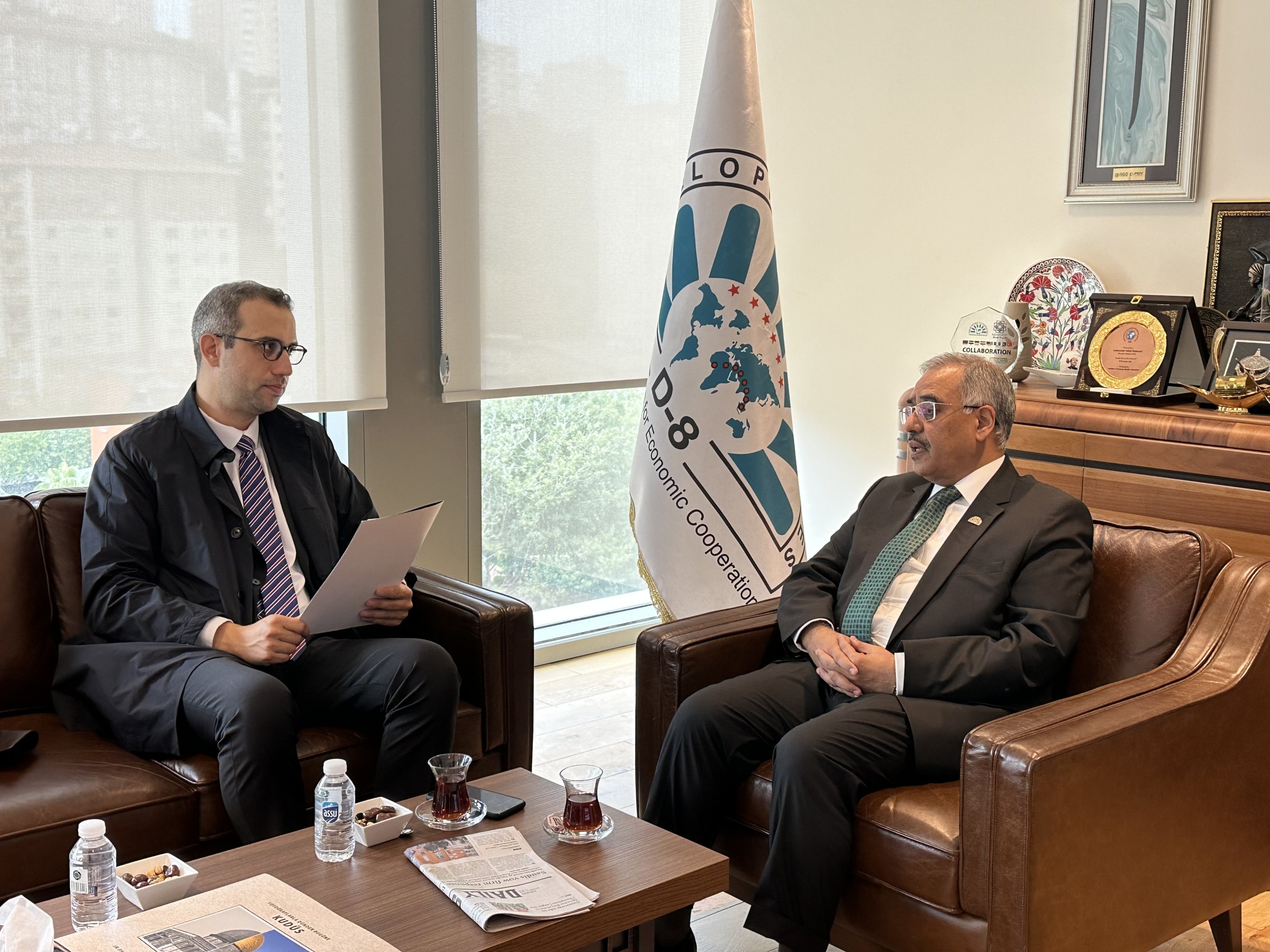
Nearly three decades after eight developing countries came together in Istanbul with ambitions of reshaping economic cooperation among Muslim-majority nations, the D-8 Organization for Economic Cooperation is seeking to turn its members’ growing economic weight into stronger commercial ties and a more influential international voice.
The challenge is not a lack of scale. The nine-member organization now represents about 1.3 billion people and a combined gross domestic product (GDP) of over $5.2 trillion, according to its secretary-general, Sohail Mahmood. Trade among its members has also increased substantially since the organization was established in 1997.
Yet intra-D-8 trade remains a relatively small share of the members’ overall commerce, exposing a gap between the group’s collective economic potential and the degree to which its economies trade with one another.
The organization has set a target of raising trade among its members to $500 billion by 2030, from approximately $170 billion today. Achieving that goal, the secretary-general said in a recent interview with Daily Sabah, will require more effective implementation of existing trade-facilitating arrangements, closer private-sector engagement, and facilitation of the movement of goods and businesspeople.
At a time of geopolitical tensions, shifting economic power and mounting pressure on multilateral institutions, he argued, the case for cooperation among developing economies has become more compelling.
“The more the capacities of member states grow, the more they align themselves economically and integrate deeply, I think their capacity to influence global outcomes will be much greater,” he said.
The statement reflects a central premise of the D-8: that economic integration can provide its members with a stronger foundation for political coordination and a greater role in international affairs. Whether the organization can translate that premise into measurable results will help define its next phase.
From collectivity to practicality
Founded in Istanbul in 1997 under the vision of then-Turkish Prime Minister Necmettin Erbakan, the D-8 brought together Bangladesh, Egypt, Indonesia, Iran, Malaysia, Nigeria, Pakistan and Türkiye. Azerbaijan became its ninth member following a decision taken in Cairo in December 2024.
The organization was conceived as a platform for major developing economies to pool their resources, draw on their complementary strengths and pursue sustainable development. Its name was modeled on the Group of Eight, then a gathering of major industrialized economies.
The group has since grown considerably in demographic and economic terms. Its combined GDP has risen from an estimated $750 billion to $800 billion at its founding to more than $5.2 trillion, while its population has increased from around 700 million to 1.3 billion, according to Mahmood.
But aggregate growth does not automatically translate into economic integration.
Trade among D-8 members has historically accounted for roughly 6%-7% of their total trade, the secretary-general said. The organization wants to increase that proportion to at least 10%, a shift that would require businesses to find more opportunities within the bloc and governments to make cross-border commerce easier.
A preferential trade agreement that entered into force in 2011 is one existing instrument the organization wants its members to implement more fully. D-8 ministers have also called for work on a more comprehensive economic partnership framework to expand trade.
The organization is seeking to strengthen the role of the private sector as well. Plans include establishing a permanent secretariat of the D-8 Chamber of Commerce and Industry in Istanbul under the guidance of Türkiye’s Union of Chambers and Commodity Exchanges, known as TOBB.
The proposed body would give business communities across the member countries a more dynamic and sustained channel for cooperation. The secretary-general also pointed to customs coordination and visa facilitation as areas where improvements could help businesses operate across national borders.
These efforts address a practical question facing the organization: how to make membership translate into opportunities that companies can use, rather than relying primarily on political commitments and summit declarations.
The $500 billion trade target gives that challenge a measurable dimension. Reaching it by 2030 would require a substantial expansion of commerce among countries whose economies differ in size, industrial capacity and geographic position.
Türkiye’s role in the next phase
For Türkiye, the organization’s founding member and host of its secretariat in Istanbul, the D-8 offers a platform that connects its regional relationships with broader economic partnerships across Asia, Africa and the Middle East.
The secretary-general described Türkiye’s contribution as extending beyond its historical role. He cited the country’s industrial and technological capabilities, extensive diplomatic network, geographic position and international partnerships as assets that other members could draw on.
Türkiye hosted the organization’s inaugural summit in 1997 and its ninth summit in 2017, when leaders adopted the Istanbul Declaration and a plan of action covering several areas of cooperation. Its leadership, government and Foreign Ministry continue to support the secretariat, he said.
He also pointed to Türkiye’s diplomatic engagement and its role in international initiatives as potential sources of influence for the wider group.
The country’s upcoming climate diplomacy is one example. Türkiye is preparing to host the U.N. climate conference COP31 in Antalya in November, while D-8 members have begun coordinating their positions on environmental issues through a dedicated ministerial process.
In July, Türkiye hosted the organization’s first environment ministers’ meeting in Istanbul. Participants discussed climate adaptation, climate finance, climate justice, loss and damage, and zero waste, according to the secretary-general.
Such coordination could give members a forum to exchange experiences and identify common priorities ahead of international negotiations. Its longer-term significance, however, will depend on whether shared positions lead to sustained cooperation beyond individual meetings.
Technology offers another avenue. The secretary-general cited Türkiye’s industrial development and emerging technology capabilities, including artificial intelligence, as areas from which D-8 members could benefit.
The organization is also preparing for Türkiye to host its next health ministers’ meeting and an industry ministers’ meeting in 2027.
Türkiye’s central role gives the organization an established institutional base and access to a broad diplomatic network. At the same time, the D-8’s ability to expand its influence will depend on participation and follow-through across all its members, rather than the contribution of any single country.
Beyond trade and diplomacy
The organization’s agenda is also extending into areas that connect governments and economies with their populations, particularly education, youth engagement and tourism.
The secretary-general said the D-8’s Network of Pioneers of Research and Innovation, based in Islamabad, includes 29 universities from member countries. The network aims to facilitate academic exchanges, cooperation in science and technology, and institutional partnerships.
The organization has also signed a memorandum of understanding (MoU) with the Organization of Islamic Cooperation’s (OIC) Standing Committee on Scientific and Technological Cooperation, known as Comstech. The agreement is intended to expand opportunities for knowledge sharing, training and capacity building.
Youth engagement is another priority. The organization is working on a plan of action intended to promote innovation partnerships, leadership and entrepreneurship among young people.
For a group representing 1.3 billion people, the secretary-general said, young people are an important resource not only for national economies but also for international cooperation and closer ties among societies.
Tourism is being used to pursue a similar objective. Through its D-8 City of the Year initiative, the organization seeks to encourage cultural exchange and cooperation among cities in member countries. Antalya was selected for 2025, followed by Aswan, Egypt, for 2026, while a selection process for the 2027 city is underway.
These initiatives reflect a broader effort to give the organization a presence beyond intergovernmental negotiations. Educational networks, tourism and cultural exchange can create connections that persist even when political priorities vary.
The secretary-general said the organization wants to develop a distinct D-8 identity based on its members’ cultural affinities and shared historical and civilizational heritage.
Expanding agenda, targets to meet
Azerbaijan’s accession has added a new dimension to the group’s expansion. The country is expected to host three D-8 centers in Baku focused on energy and climate, transportation, and media cooperation.
The organization is also open to wider engagement through dialogue partnerships and observer status, the secretary-general said, citing interest from additional countries, regions and organizations.
Alongside expansion, the D-8 is broadening its work in areas including energy security, small and medium-sized enterprises, technological innovation, digital transformation and climate action. It is also working toward a framework for cooperation on artificial intelligence.
The expanded agenda offers opportunities to connect traditional sectors such as agriculture, industry, trade and investment with emerging economic priorities.
The secretary-general maintained that stronger political support from member states and a more action-oriented approach were helping the organization make progress.
He said member states envision an organization that is institutionally stronger, more economically integrated, more technologically advanced and more influential internationally.
Its message, he added, is one of “shared prosperity through collective action.”


-
 Politics3 days ago
Yemen hails strong ties with Türkiye, its role in region
-
 Economy3 days ago
Türkiye begins production of $300M K9 light commercial vehicle project
-
 Economy2 days ago
Canada, UAE sign major trade deal amid tensions with US
-
 Politics1 day ago
Turkish opposition CHP confirms it will field candidate in next election
-
 Politics2 days ago
Mecca Defense Alliance reps meet in Iran for regional coordination
-
 Sports3 days ago
Football-mad Türkiye in love with Salah after Trabzonspor heroics
-

 Economy2 days ago
French consumer sentiment hits 2013 low amid protests
-
 Politics3 days ago
Uzbek leader instrumental in new era of cooperation in Central Asia