
Economy
Europe turns to tax breaks, subsidies to tackle record-high fuel prices

Wars in the Middle East and Ukraine, which are not showing signs of a near end, are driving governments across Europe to craft subsidies, taxes and policy revisions to protect their economies, companies and increasingly aggrieved citizens from record gasoline and diesel prices.
Countries around the world have intervened to limit the economic impact of diminished energy supplies and soaring fuel prices since the start of the Iran war, according to the Organisation for Economic Co-operation and Development (OECD).
Seven of the 10 nations working most actively to contain the economic damage are in the European Union, the OECD said in a recent report.
Lithuania cut train ticket prices in half. Greece is taxing gambling more to fund public relief efforts. Italy delayed the scheduled demolition of coal-fired power plants and slashed the required paperwork for oil and natural gas projects. The Netherlands increased funding for a program that provides free energy-saving services in homes. And Poland has proposed heavily taxing the record profits of certain fuel producers and sellers.
Highly relying on gas imports
Before the U.S. and Israel attacked Iran, Russia’s war in Ukraine disrupted global energy supplies and caused turmoil in Europe. The EU imports nearly all of the oil it uses and 85% of its natural gas.
Overall, imports supply 57% of the bloc’s energy needs, with much of its domestically produced energy coming from renewable and nuclear sources, according to the EU’s statistical office.
Europeans are becoming more incensed as pump prices surpass the equivalent of $12 a gallon in some countries. EU citizens are spending an extra 203 million euros ($231 million) a day just for diesel fuel, according to the European advocacy organization Transport & Environment.
“It’s a cruel irony that the U.S. is the least vulnerable to a crisis of its own making, while Europe’s economy again takes the hit,” Antony Froggatt, an analyst at the organization, said.
Some European governments are spending billions to help their countries weather the current energy crisis.
EU leaders in Brussels gave member nations temporary discretion to provide state aid to households and energy-intensive industries like agriculture, transportation and fishing. They also offered limited leeway from EU spending rules for investments that strengthen energy security and reduce the bloc’s long-term reliance on imported oil and natural gas.
“The pressures from higher energy prices and borrowing costs are biting for people and for businesses,” European Commission President Ursula von der Leyen said in her annual State of the European Union address earlier this month.
“We need to double down on our affordable, homegrown, clean energy, be it renewables and nuclear, or biomethane and others,” to “give us independence and drive down energy prices.”
France has adopted an expanding array of targeted measures to cushion consumers and fuel-intensive businesses from higher prices.
The French government on Tuesday announced a 450 million euro package to expand its relief measures. It broadened means-tested aid for people who drive more than 30 kilometers (18 miles) round trip to work or more than 8,000 kilometers annually for professional purposes. The expansion makes 5.5 million workers eligible for 100 euro payments to defray fuel costs through the end of the year, the government said.
The new package also extended fuel subsidies for farmers, fishermen and construction companies until the end of the year, and will make energy vouchers of 48 euros to 277 euros available three months early to help 5.8 million families pay their winter energy bills.
French President Emmanuel Macron has asked von der Leyen to promote a relaxation of EU fuel quality regulations on density, sulfur content and other criteria to help increase diesel and kerosene production in Europe. The EU took a similar step during the COVID-19 pandemic.
In a letter to the EU executive seen by The Associated Press (AP), Macron warned that the global oil market would soon see “strong increases in prices” if the Strait of Hormuz off Iran’s coast did not reopen to tanker traffic and Saudi Arabia’s East-West pipeline to the Red Sea was not repaired.
He also called for raising the EU limit on conventional biodiesel content in standard diesel fuel from 7% to 10%.
On Thursday, Macron said in an interview with French broadcasters that he would deploy French troops, radars and defensive systems to Saudi Arabia to help protect energy infrastructure from attacks by Iran-backed Houthi rebels who have seized new territory near the Bab al-Mandab, a key chokepoint in the global economy.
“We are putting ourselves in a position to protect this site because a few weeks ago, more than 5 million barrels came out of this site every day,” he said, referring to an export terminal in Yanbu on the Red Sea for the Saudi East-West pipeline.
Relief measures
A two-month round of fuel tax cuts in Germany expired at the end of June. The government agreed to renew the tax cuts, which will lower gasoline and diesel prices by 17 cents per liter, from Oct. 1 until the end of the year. The German government said the new reduction will cost 2.5 billion euros.
The government also said it would hold talks with the oil industry about introducing a fuel price cap by Jan. 1. Neighboring Belgium and Luxembourg have had similar price caps in place for decades.
Spain’s government also extended gasoline and diesel tax cuts it introduced in March as part of a 5 billion euro package to counter the effects of the Iran war on local energy prices.
The tax break amounted to 5 cents per liter this month. An automatic mechanism would increase it to 20 cents per liter if fuel-price inflation exceeds 15% year-on-year.
The government also extended fuel subsidies for transportation companies, farmers, livestock producers and fishermen.
Stockpiles use
Alongside national relief programs, EU nations have tapped their strategic reserves as part of an agreement by the International Energy Agency (IEA) 32-member countries to make 400 million barrels of oil from their emergency stockpiles available to the market. Macron said Thursday he would rally G-7 nations to release more fuel, too.
The EU has worked to reduce its reliance on energy imported from Russia through renewable energy production and converting systems and industries to run on electricity instead of fossil fuels.
Von der Leyen said greater electrification could reduce the EU’s annual bill for imported oil, gas and other fossil fuels by 260 billion euros ($296.6 billion) by 2040.
As the EU tried to wean itself off Russian energy, it became more dependent on the United States. Von der Leyen personally struck a deal with U.S. President Donald Trump last year that included a commitment for the EU to buy $750 billion worth of American energy over three years.
The Iran war has made the relationship both more vital and more complicated for the EU, which has increasingly turned to the U.S. for diesel.
The support Trump expressed this week for banning diesel exports to drive down U.S. prices worries the bloc, which would have to find alternative sources of the fuel.
Brussels is lobbying Washington to drop the idea of suspending overseas diesel sales.
“We believe this is a bad idea,” European Commission spokesperson Olof Gill said Thursday.
“EU-U.S. cooperation in the field of energy is strong, stable and mutually beneficial. Any disruption would risk negatively impacting both sides.”
Another suspect was detained in a widening probe into an alleged investment fund scheme that impacted the Turkish capital market and stocks in recent weeks, a report indicated on Sunday.
As part of the investigation, Erdin Özel, the chairperson of the board of Tera Portföy, for whom an arrest warrant had been issued, was taken into custody, an Anadolu Agency (AA) report said.
Investigations into transactions carried out in the capital markets are continuing under the Istanbul Chief Public Prosecutor’s Office’s Bureau for the Investigation of Terrorist Financing and Money-Laundering Crimes, the report added.
Prosecutors have been analyzing the operations of 131 investment funds held by seven companies as part of the investigation launched earlier this month on suspected share price manipulation in thinly traded stocks, which has led to investor withdrawals and a slump in the benchmark stock index.
Authorities took a series of steps to support financial stability, reiterating that the risk is tied to a specific segment of the market and that there is “no structural problem” in the markets.
An arrest warrant had also previously been issued for Emir Münir Sarpyener, CEO of Tera Yatırım, the AA report said.
In a letter sent by the Istanbul Chief Public Prosecutor’s Office to the Financial Crimes Investigation Board (MASAK) on Sept. 17, the office requested financial data concerning the executives of Pusula Finans Holding Inc., Tera Yatırım Menkul Değerler Inc., Hedef Holding Inc. and Bulls Yatırım Menkul Değerler Inc., as well as their subsidiaries.
The prosecutor’s office requested that the full identification details of all company executives be established and that raw data concerning their transfers of money and crypto assets abroad from 2024 to the present, as well as all incoming and outgoing financial transactions, be sent to the Chief Prosecutor’s Office.
As part of the investigation, a number of top executives have been arrested so far.
Meanwhile, Fatma Betül Sayan Kaya, a former minister and Justice and Development Party (AK Party) deputy chair, announced late Saturday in a social media post that she has requested to be relieved of all her duties within the party, citing a recent issue and “various claims” concerning her.
Her resignation came amid speculation over alleged links to the fund withdrawals investigation, which emerged earlier this month.
On Sunday, AK Party spokesperson Ömer Çelik said that “every aspect and detail of the issue referred to as the ‘fund crisis’ has been meticulously monitored and evaluated,” reiterating President Recep Tayyip Erdoğan’s statement that “anyone found responsible will be held accountable.”
“Nothing will remain in the dark, and the necessary actions will be taken. If there is an allegation, it will be investigated,” Çelik wrote in a statement on Turkish social media platform NSosyal.
“All irregularities will be brought to light. Those who have committed wrongdoing will be held accountable before the law,” he added.

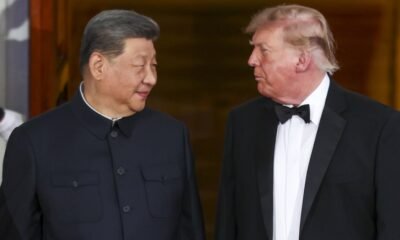
The U.S. and China have agreed to reduce tariffs on $30 billion in goods and to start a dialogue on artificial intelligence, according to both countries following Chinese President Xi Jinping’s visit to Washington.
The tariff reductions would apply to U.S. exports such as agricultural goods, wood and cosmetics, as well as U.S. imports including small appliances, toys and decorations, a White House statement said on Friday.
“The two countries reached consensus on recommendations for more favorable tariff treatment for $30 billion of non-sensitive goods in each direction,” the White House said.
The three-day summit between Xi and U.S. President Donald Trump, which ended on Friday, showcased personal diplomacy rather than big public breakthroughs. Xi has since landed in Beijing, Chinese state news agency Xinhua reported on Saturday.
The two sides also agreed to set up a trade council and extend the outcomes of earlier talks in Kuala Lumpur, the Chinese Foreign Ministry said.
The agreement follows a move by the world’s two largest economies to extend by two months a trade truce that had been due to expire on Nov. 10, allowing more time to work on a potentially bigger trade deal, U.S. Treasury Secretary Scott Bessent said on Wednesday.
“This historic visit enriched the constructive and stable China-U.S. relationship, upheld the overall stability of bilateral ties, opened a new chapter in China-U.S. relations, and will have a far-reaching impact on world peace and development,” Chinese Foreign Minister Wang Yi said in a statement.
Dialogue on AI
On artificial intelligence, the two sides agreed to hold a dialogue on the technology’s risks and benefits, with the next round of discussions set for November, and to set up a communication channel for AI-related incidents, the Chinese Foreign Ministry and the White House said.
The White House said that the leaders had agreed to use the term “super intelligence” in place of “artificial intelligence.”
In a separate statement, the Chinese ministry said that Beijing valued Washington’s use of the new term.
As AI technology continues to advance, the two sides should step up exchanges and work toward consensus in line with new developments, it said.
The two sides also agreed to support each other in hosting the Asia-Pacific Economic Cooperation (APEC) leaders’ meeting and the G-20 summit, with both leaders planning to attend the gatherings hosted by the other.
On foreign policy, the leaders agreed that Iran should fulfil its commitment not to develop nuclear weapons, and that no country or entity should impose transit tolls on international waterways, both countries said.
President Recep Tayyip Erdoğan highlighted Türkiye’s growing export base and continued economic expansion Saturday while praising the international reach of the MÜSİAD EXPO trade fair and warning that rapid advances in artificial intelligence must remain grounded in human values.
Speaking at the closing ceremony of the 21st MÜSİAD EXPO International Trade Fair and 29th International Business Forum in Istanbul, Erdoğan said the number of Turkish companies exporting goods had risen sharply over the past two decades.
“In 2002, the number of our companies exporting was only 33,000. In 2025, exactly 168,000 of our companies carried out exports,” Erdoğan said.
The four-day MÜSİAD EXPO, which opened Wednesday at the Istanbul Expo Center, brought together Turkish manufacturers, exporters, investors and international buyers across sectors including construction, machinery, energy, food, agriculture, health, textiles and automotive.
Türkiye’s global trade reach
More than 300 companies participated, while organizers expected more than 50,000 professional visitors from 114 countries and more than 400 international buying delegations from over 70 countries.
Erdoğan said he was pleased that the event had developed beyond a traditional trade fair into a platform for international commerce, investment and business diplomacy.
He praised MÜSİAD, the Independent Industrialists and Businessmen’s Association, for bringing Türkiye’s production and commercial capacity together with international markets.
Erdoğan said the organization has more than 14,000 members in Türkiye and abroad, represents 60,000 businesses and employs about 3 million people, while maintaining branches and representatives in 84 countries.
MÜSİAD organizers have described the expo as a major platform for establishing international business connections and expanding Turkish companies’ access to new markets. The association says the event is held every two years and is designed to connect investors, industrialists, entrepreneurs and international buyers.
Erdoğan warns AI must keep a human touch
The concurrent 29th International Business Forum focused on artificial intelligence and its impact on people, knowledge and the business world. Its theme was “The Transformation of Humanity and the Business World in the Age of Artificial Intelligence.”
Erdoğan described artificial intelligence as one of the major technological turning points in modern history, saying its effects were already being felt across health care, education, transportation, agriculture and the economy.
He said increasingly sophisticated AI models and robotics were changing production and consumption while creating new opportunities for entrepreneurs, manufacturers and investors.
But Erdoğan warned against developing the technology without sufficient attention to the human element.
“If you do not give the necessary importance to the human factor while developing artificial intelligence, you may encounter results that are the exact opposite of what you desire,” he said.
He argued that technological progress should not come at the expense of human values, social responsibility and business ethics, urging governments, companies, academics and civil society to consider the broader consequences of AI-driven change.
Erdoğan touts economic growth and exports
Erdoğan also pointed to Türkiye’s recent economic performance, saying the country had remained on a path of stability and that its economy had expanded for 24 consecutive quarters.
“Türkiye’s economy has experienced uninterrupted growth for the last 24 quarters. We are currently the 16th-largest economy in the world and the sixth-largest in Europe,” he said.
He added that per capita national income reached $18,103 in 2025. The figure has also been cited by Trade Minister Ömer Bolat based on official economic data.
Erdoğan said the government would continue pursuing sustainable and balanced growth under the new Medium-Term Program announced 20 days earlier.
He also highlighted the expansion of Türkiye’s export base, presenting the increase in the number of exporting companies as evidence of the country’s growing participation in global trade.
Support for Gaza
The president then turned to the war in Gaza and Türkiye’s position on the conflict, saying Ankara would continue speaking out for Palestinians and calling for accountability over alleged war crimes.
“Palestinian people are not alone or abandoned. Our brothers and sisters in Gaza are not alone in their search for rights and justice,” Erdoğan said.
He said Türkiye would continue to stand with what he described as oppressed people and argued that those responsible for genocide must face legal and historical accountability.
“If those who commit genocide are not brought to justice, if they are not held accountable before the law and history, the same brutality will happen again,” Erdoğan said.
He also criticized Israel in forceful terms, saying Türkiye would continue opposing what he called the policies of an occupying power and standing with Palestinians.
“Those who think themselves chosen and are occupying will have their masks removed,” Erdoğan said. “I want it to be known that, whatever the cost, we will stand against the oppressor and alongside the oppressed.”
Erdoğan further said war crimes suspects should face courts rather than international political platforms.
“The place for war criminals is not the U.N. podium, but courtrooms where they will answer for the killings they committed and the blood they shed,” he said.
The president said Türkiye’s stance on Gaza had also encouraged other countries to speak more openly on the issue.
“Türkiye, with its conscientious, honorable, moral and courageous stance, has both given hope to the oppressed and encouraged other countries,” he said.
The closing ceremony brought the 2026 MÜSİAD EXPO to an end after four days of trade meetings, panels, diplomatic engagements and business negotiations.
Organizers said the event was designed not only to showcase Turkish products but also to turn international contacts into longer-term commercial partnerships.
The number of suspects arrested in a spiraling investigation into an investment fund scam in Türkiye has reached 45, officials said Friday.
Prosecutors are parsing the operations of 131 investment funds held by seven companies, whose assets are reportedly worth more than $18 billion.
Authorities took steps last week to support financial stability, with investigations focused on suspected share price manipulation in thinly traded stocks.
Justice Minister Akın Gürlek said Friday that prosecutors were investigating 76 suspects, of whom “45 have been arrested,” he posted on the social media platform X.
Among the arrested is Erkan Kilimci, a former deputy governor of Türkiye’s central bank, media reports said.
Gürlek said authorities had seized the assets of those who either owned or were involved in managing the now-liquidated investment funds, and those of their immediate family members.
The problems emerged in early September after Türkiye’s Capital Markets Board (SPK) changed its guidelines for investment funds, saying they could no longer invest all their assets in one stock but were required to diversify.
The move sought to address concerns that many funds were heavily investing in a small number of obscure or hard-to-sell stocks.
To comply, funds began selling stocks, spooking investors who started trying to cash in their investments.
But a scandal erupted last week when several companies admitted they were unable to satisfy investor redemption demands.
A day later, all 131 investment funds were placed into liquidation by the SPK, which said nearly half a million individual investors were affected.
Treasury and Finance Minister Mehmet Şimşek denied the rumours that he was preparing to resign.
“The allegations circulating about my resignation are baseless,” Şimşek posted on X late Thursday.
“The public should pay no heed to such speculative news intended to undermine our country’s economic stability,” he said.
Gürlek said investigators were pursuing their investigations to determine those responsible.
“No one is being shielded, and no one is receiving preferential treatment,” he said. “Those responsible will answer before the law, and the rights of affected citizens will be fully safeguarded.”
In his first comments, President Recep Tayyip Erdoğan said Thursday that those responsible will be held accountable, stressing that the liquidation of the funds posed no risk to Türkiye’s financial system or the wider economy.
Türkiye has formally established the legal framework for hybrid working, allowing employees to split their working time between the workplace and remote locations, according to a decree published Friday.
The decree in the Official Gazette officially integrates the mixed working model into the country’s labor legislation.
The amendment to Article 9 of the Remote Working Regulation, issued in March 2021, sets out the rules for arrangements in which work is performed partly at the workplace and partly remotely.
The hybrid model has been widely practiced since the COVID-19 pandemic, but lacked a clear definition in Turkish labor law.
Under the new rules, employers and employees can agree to a hybrid working arrangement. Employment contracts must specify which days employees will work at the workplace and which days remotely, as well as their daily working hours.
The change provides a formal contractual basis for hybrid work, which combines workplace-based and remote working rather than requiring employees to work entirely from either location.
Flexible working on government’s agenda
The regulatory change follows growing government emphasis on more flexible working arrangements.
Treasury and Finance Minister Mehmet Şimşek said last week that the government was considering more flexible working models, particularly as part of programs targeting young people who are neither in education nor employment.
“For these categories, a more flexible working model is in Türkiye’s interest,” Şimşek said.
Şimşek had also previously said the government would further develop flexible and remote-working models in the public sector.
Flexible working was also included in the government’s Medium-Term Program for 2027-2029, which calls for work arrangements to be developed with a focus on work-life balance and employee productivity, including adjustments to working days and flexible-duration employment models.
What is hybrid work?
Hybrid work is an employment model in which employees divide their working time between a physical workplace and a remote location. Unlike fully remote work, it combines office-based and remote working according to an arrangement agreed between the employer and employee.
The new regulation means such arrangements can now be explicitly incorporated into employment contracts, with working days, locations and daily hours defined in advance.
Mair Group of the United Arab Emirates (UAE) has signed an agreement to acquire a 70% stake in Eslab, the owner of Türkiye’s leading coffee chain Espressolab, reports said Friday.
That would be the group’s first international acquisition since it began trading on the Abu Dhabi Securities Exchange in late 2024.
Under the agreement, Espressolab’s founders and existing shareholders will retain a 30% stake in the company and continue to be involved in its growth and development, a report by the private broadcaster CNBC-e said.
The financial terms of the transaction were not disclosed.
The deal has yet to close, with the share transfer subject to regulatory approvals in the relevant jurisdictions and the fulfilment of other closing conditions.
Espressolab CEO Esat Kocadağ said the partnership with Mair Group represented an important next step in the coffee chain’s international expansion.
“Together, we aim to strengthen our franchise network, invest in the brand and customer experience and expand in existing and new markets while preserving the identity and entrepreneurial culture that define Espressolab,” Kocadağ said, according to the report.
Mair Group Managing Director and Group CEO Nehayan Hamad Alameri said the transaction would diversify the group’s investment portfolio beyond its core retail and commercial real estate operations in the UAE.
The deal would bring together Espressolab’s international reach and brand capabilities with Mair Group’s investment and organizational resources, he said.
Alameri said they look forward to partnering with Espressolab’s founders and management team to support the company’s continued growth in Türkiye and international markets, while creating long-term value for their shareholders.
As of this August, Espressolab operated a network of more than 400 cafes across 21 countries. More than 310 of its outlets are in Türkiye, where the chain has a presence in more than 50 cities.
Founded in 2014, Eslab operates the Espressolab brand as well as coffee sourcing and roasting, product procurement, franchise licensing, and retail and digital sales activities.
Mair Group is a strategic investment company based in Abu Dhabi and listed on the Abu Dhabi Securities Exchange. It invests across several sectors, primarily retail and commercial real estate.
Its portfolio includes Abu Dhabi Cooperative Society (Adcop), the Spar supermarket chain and the Makani Real Estate property portfolio.


-
 Politics3 days ago
FM Fidan puts Gaza, Israeli attacks at center of OIC talks in New York
-
 Politics2 days ago
FM Fidan steps up diplomatic push with high-level talks in New York
-
 Economy3 days ago
Erdoğan ‘confident’ Türkiye will get US F-35 jets
-
 Politics3 days ago
Zelenskyy backs Türkiye-hosted trilateral summit to end Russia war
-
 Economy2 days ago
Key takeaways from Trump-Xi summit in US
-
 Economy2 days ago
Türkiye’s 1st FAO bid aims to bring its food-security vision to global stage
-
 Economy3 days ago
Economic crisis in Gaza is worst ever recorded: UN
-
 Politics2 days ago
No lasting Mideast peace without permanent Gaza cease-fire: Erdoğan