
Sports
Fenerbahçe face crunch Europa tie with Nice amid Tedesco pressure

Fenerbahçe welcome Nice to Kadıköy on Thursday for a Europa League league phase match that already feels decisive.
Both clubs opened the competition with defeats, both have stumbled for consistency and both arrive in Istanbul knowing another slip could leave their continental ambitions in jeopardy.
For Fenerbahçe, the weight of the moment falls squarely on new manager Domenico Tedesco.
His tenure is still in its infancy, but the frustration that boiled over after last week’s 3-1 defeat to Dinamo Zagreb revealed just how little patience supporters are willing to show.
The performance in Croatia was flat, the goals conceded soft and the outcry loud – chants demanding his resignation echoed in the aftermath.
It was a baptism by fire for a coach tasked not just with winning, but with delivering the kind of aggressive, dominant football Fenerbahçe’s supporters demand.
The German found a measure of relief days later, when his side brushed aside Antalyaspor 2-0 in the Süper Lig with the kind of display that hinted at progress.
Fenerbahçe pressed high, attacked relentlessly and enjoyed 67% of possession while firing 19 shots, 11 of them on target.
The match showed that Tedesco’s philosophy – built on controlled possession and quick transitions – may yet take root, though Thursday’s test against Nice represents a far sterner examination.
Lose again and Fenerbahçe would open a European campaign with back-to-back defeats for the first time since the 2001-02 Champions League.
History and legacy
History is not without its warnings.
This will be the sixth competitive meeting between these clubs, though the first in over half a century.
Nice have three wins in the series, including a comprehensive victory in the 1973-74 UEFA Cup when they cruised through 4-0 and 2-0 on aggregate.
Fenerbahçe have enjoyed success in Istanbul, however, winning both prior home encounters and will cling to that record as they seek to steady their campaign.
More broadly, the Yellow Canaries have a mixed past against French opposition: 22 games, just four wins, seven draws and 11 defeats.
There is also the matter of milestones.
Thursday will mark Fenerbahçe’s 292nd European fixture and their 150th in the UEFA Cup/Europa League format.
Their continental history has been one of brilliance tempered by heartbreak: 114 wins, 62 draws and 115 losses, with 398 goals scored but 415 conceded. In Kadıköy, though, belief always runs high and belief is exactly what Tedesco must rekindle.
Nice travel east with their own problems.
Last season they surged to fourth place in Ligue 1, only to be humbled in Champions League qualifiers by Benfica, losing 4-0 on aggregate.
The hangover has been difficult to shake. In six league matches this season they have collected only seven points, enough for 12th place and their inability to finish games has been costly.
Last weekend against Paris FC they looked poised for a morale-boosting win until conceding an 88th-minute penalty that forced a 1-1 draw.
Franck Haise’s team is now winless in three and worse still, their Europa League away record is dismal: 10 consecutive defeats stretching back more than a decade.
If they are to escape Kadıköy with anything, it will require breaking one of European football’s most stubborn curses.
Team news offers Fenerbahçe both reassurance and frustration.
Anderson Talisca is available again after serving his suspension against Dinamo Zagreb, while Edson Alvarez has shaken off a muscle problem to rejoin the squad.
Colombian forward Jhon Duran, however, remains out of contention. Sebastian Szymanski carries the attacking spark, having scored in back-to-back matches and three times in Fenerbahçe’s last two European outings.
Nice’s situation is more precarious.
Midfielder Hicham Boudaoui hobbled off in their last league match, leaving his status in doubt.
They are already without Youssouf Ndayishimiye and Mohamed Abdelmonem, both sidelined by cruciate ligament injuries, while Tanguy Ndombele’s availability remains uncertain after a weekend knock.

The International Olympic Committee has set a timetable for selecting the host of the 2036 Olympic and Paralympic Games, with seven national Olympic committees currently engaged in the process.
Türkiye, Germany, Hungary, India, Qatar, South Korea and South Africa are in the IOC’s Continuous Dialogue phase, the first stage of a revamped selection process designed to provide greater technical scrutiny, financial oversight and support before a host is chosen.
The IOC said Oct. 31 will be the deadline for any additional interested parties to enter the race. The seven current candidates will then present their projects virtually to the IOC’s Future Host Commission in November.
The process is part of reforms approved by the IOC Executive Board and endorsed by the 146th IOC Session in Lausanne in June.
The changes, introduced under the IOC’s “Fit for the Future” reforms, add a Strategic Dialogue stage between the existing Continuous Dialogue and Targeted Dialogue phases.
The IOC said the revised approach is intended to improve transparency, control costs, assess the feasibility of projects at an earlier stage and ensure that proposed Games fit into the long-term development plans of host regions.
The IOC Executive Board is expected to announce the shortlist in March 2027, when the successful candidates will advance into the Strategic Dialogue phase.
Candidates reaching that stage will have to provide initial legal and financial guarantees and respond to the IOC’s Future Host Questionnaire. The Future Host Commission will also conduct site visits to the proposed host regions before preparing its assessment for the Executive Board.
Projects will be judged on several technical criteria, including venue plans, athlete experience, financing, political and public support, organizational capacity and the long-term legacy for host communities.
The IOC will also consider the overall feasibility of each proposal, including cost control and how closely the Games align with broader regional development plans.
The Strategic Dialogue is expected to continue through much of 2028. By the end of that year, the Executive Board will invite a smaller number of candidates to enter the Targeted Dialogue phase.
Those candidates will be required to submit final responses to the IOC questionnaire and provide comprehensive legal, financial and other guarantees covering areas such as venue use and Games delivery.
The Future Host Commission will then submit a final report, allowing the Executive Board to determine which preferred host or hosts should be presented to IOC members for a vote.
The 2036 host is expected to be elected at an IOC Session in the middle of 2029, roughly seven years before the Games.
The seven candidates represent a diverse field, with several bringing previous experience of hosting major international sporting events.
Türkiye’s bid is closely associated with Istanbul, which has made several unsuccessful attempts to host the Olympics. Germany is expected to focus on Munich, which hosted the 1972 Summer Games, while Hungary’s proposal is centered on Budapest.
India’s interest is led by Ahmedabad, which is scheduled to host the 2030 Commonwealth Games. India has never hosted an Olympic Games.
Qatar’s proposal is centered on Doha, which hosted the 2022 FIFA World Cup and is scheduled to host the Asian Games in 2030. A successful bid would make Qatar the first Muslim-majority country to host the Summer Olympics.
South Korea is considering a proposal involving Seoul, host of the 1988 Olympics, potentially alongside other regions. The country also hosted the 2018 Winter Olympics in PyeongChang.
South Africa is seeking to bring the Summer Olympics to Africa for the first time in the modern era. Cities including Cape Town, Durban and Johannesburg have previously been discussed as possible hosts. South Africa hosted the 2010 FIFA World Cup.
The IOC’s new system is designed to gradually narrow the field, moving candidates from exploratory discussions to increasingly detailed assessments before the final vote.
The next Summer Olympics will be held in Los Angeles in 2028 and Brisbane in 2032. The 2036 Games will therefore be the next edition whose host remains undecided.
Tennis great Novak Djokovic credited his “never-die spirit” for carrying him to the 102nd title of his career Tuesday after Alex de Minaur retired injured during their China Open final.
The victory extended Djokovic’s perfect record in Beijing to 34-0 and secured his seventh China Open title, his first at the tournament since 2015.
The 39-year-old Serbian said his success over more than two decades at the top of professional tennis has been built on his “grit and dedication” and the relentless mentality that has kept him fighting through difficult moments.
“The kind of never-die spirit that really is always with me” has been a defining part of his career, Djokovic said after the match.
He also described tennis as a “quite cruel sport,” with players facing elimination in knockout tournaments throughout the year while carrying the pressure of performing in front of demanding crowds.
That combination of high stakes and constant competition, Djokovic said, makes tennis “so demanding and so special.”
“You can feel so much weight on your shoulders, but it is what I have been destined to do,” he said.
In front of a packed stadium, Djokovic won the first set in a tiebreaker 7-6 (7-3) and was down a game in the second set when the Australian ended the match early.
“I always want to visualize myself with the trophy, particularly here in Beijing,” Djokovic said during the trophy ceremony.
“But I was also quite aware that reality is a little bit different these days,” he said, adding that it had been a challenging year with “physical and health issues.”
“I was just trying to find the good feeling on the court,” he said.
The first set was a physical battle that lasted more than an hour, and both men needed medical timeouts before the second.
De Minaur, the No. 9 player in the world, won the first game of the second set before retiring because of a left adductor strain.
The 27-year-old returned to the court after his medical timeout with a white wrap around his left thigh.
“I don’t feel great,” de Minaur told the crowd afterward.
“I want to say sorry to the amazing fans that came to watch … I didn’t want to finish like this.”
De Minaur advanced to the final after his opponent, Hubert Hurkacz, retired injured from their semifinal Monday, while Djokovic advanced when Daniil Medvedev was disqualified for hitting a fan with a ball.
But Djokovic, a 24-time Grand Slam champion, put on a valiant show to lift the trophy, ousting top seed Alexander Zverev in the quarterfinals after defeating home hope Bu Yunchaokete in a demanding three-set match.
The victory means Djokovic will end the season with at least one title for the 21st consecutive year and become the oldest man to win a singles final since Ken Rosewall in Hong Kong in 1977 at age 43.
‘Really grateful’
In the women’s draw, Karolina Muchova beat former No. 1 Naomi Osaka on her ninth match point to reach the quarterfinals, prevailing in a tense tiebreaker.
Muchova, the No. 7 seed, overcame 50 unforced errors across the two-hour, 52-minute match to beat Osaka 7-5, 1-6, 7-6 (9-7).
Osaka, who represents Japan, saved eight match points but could not get past Muchova’s match-winning volley.
“I was shaking. I’m happy I made the last volley … Naomi could be standing here. It’s me, and I’m really grateful for it,” the 30-year-old Czech player told the crowd.
She next faces compatriot Nikola Bartunkova.
Earlier, Russia’s Mirra Andreeva beat Ukraine’s Daria Snigur 6-2, 6-2 to book her quarterfinal spot against fellow Russian Ekaterina Alexandrova.
Alexandrova, ranked No. 28, upset Wimbledon champion Linda Noskova 6-2, 6-2, ending the Czech player’s bid to return to the Beijing final that she reached last year.
Former and current teammates, along with tearful fans gathered outside Buenos Aires’ Monumental Stadium, paid emotional tribute to Argentine great Lionel Messi on Tuesday as the country prepared to bid farewell to its captain in his final international appearance.
Brazil star Neymar, Messi’s former Barcelona and Paris Saint-Germain teammate and longtime friend, said the entire world should be grateful for everything the Argentine has given to football.
“It’s not only Argentina that thanks you, the world thanks you for everything you have done for football,” Neymar wrote on Instagram, hours before Messi was due to play his 208th and final match for Argentina against Benin.
“Thank you for making me love football even more. It was an honor for me to have played against you and even more so to make history alongside you.”
For Rodrigo De Paul, Messi’s close friend and Argentina teammate who also plays alongside him at Inter Miami, Messi’s impact extends far beyond the football field.
“He made me grow not only as a footballer, but also as a person. I became a better person, a better human being, a better athlete, a better father and a better friend,” De Paul said in a farewell message released Tuesday.
“I want to tell him that I love him. He knows that he is my brother and that he has an enormous heart.”
Former Argentina teammate Angel Di Maria said it was a day nobody had wanted to come.
“Seeing him with so much happiness, and that tranquility of knowing that he gave everything he had, is what makes us all happy,” Di Maria said. “It will be a very special day for everyone. I thank him for life.”
Fans say goodbye
In Buenos Aires, fans flocking to the Monumental Stadium for Argentina’s friendly against Benin expressed a mixture of gratitude and sadness.
“I cried because I was able to come and see Messi in his last game, and also because of the sadness of knowing that he won’t be here anymore,” 19-year-old Jose Garracedo told Reuters TV.
“He fought for this shirt … everything that was demanded of him. He knew how to stay the course, enjoy it and keep saying that he was going to fight for this.”
For Isaias Zenas, a 27-year-old medical student, Messi’s importance extended beyond football.
“The last joys we have had as an Argentine people, we owe to him,” he said. “All the cups he brought us, with the country in a bad economic situation, people who are struggling have their refuge in football. How could we not come here at this moment to say goodbye to him?”
Messi, who helped Argentina win the World Cup and two Copa America titles, entered the game with a national-record 125 goals and 68 assists for his country.
Before the final goodbye, he offered a simple message of his own.
“I leave in peace. I gave everything.”
Lionel Messi’s final match for Argentina ended the only way many believed it should: with a goal, two assists and a stadium full of tears.
The 39-year-old captain signed off from international football Tuesday night by inspiring Argentina to a 3-0 friendly victory over Benin at a sold-out Estadio Monumental in Buenos Aires, bringing down the curtain on a remarkable 21-year national team career that transformed him from a misunderstood prodigy into one of the country’s most beloved figures.
Messi, making his 208th and final appearance for Argentina, created the opening two goals before converting a second-half penalty for his 126th international goal, extending records he already held as the nation’s all-time leader in appearances and scoring.
Yet the result mattered little.
What unfolded under the lights in Buenos Aires was a farewell to a player who became far more than a football icon in Argentina, a nation where sporting triumphs often provide moments of collective joy amid decades of economic and political turbulence.
“It feels like an era is ending,” said 17-year-old fan Valentino Ruso before kickoff. “Everyone is sad today. He will be missed.”
Messi’s departure marks the end of one of football’s most complicated and ultimately rewarding relationships.
The shy teenager who left Rosario for Barcelona’s academy at 13 was long viewed with suspicion by some compatriots who felt he lacked the emotional connection embodied by Diego Maradona.
While Messi conquered club football and became a global superstar, critics questioned whether the quiet forward who spent most of his life abroad truly represented Argentina.
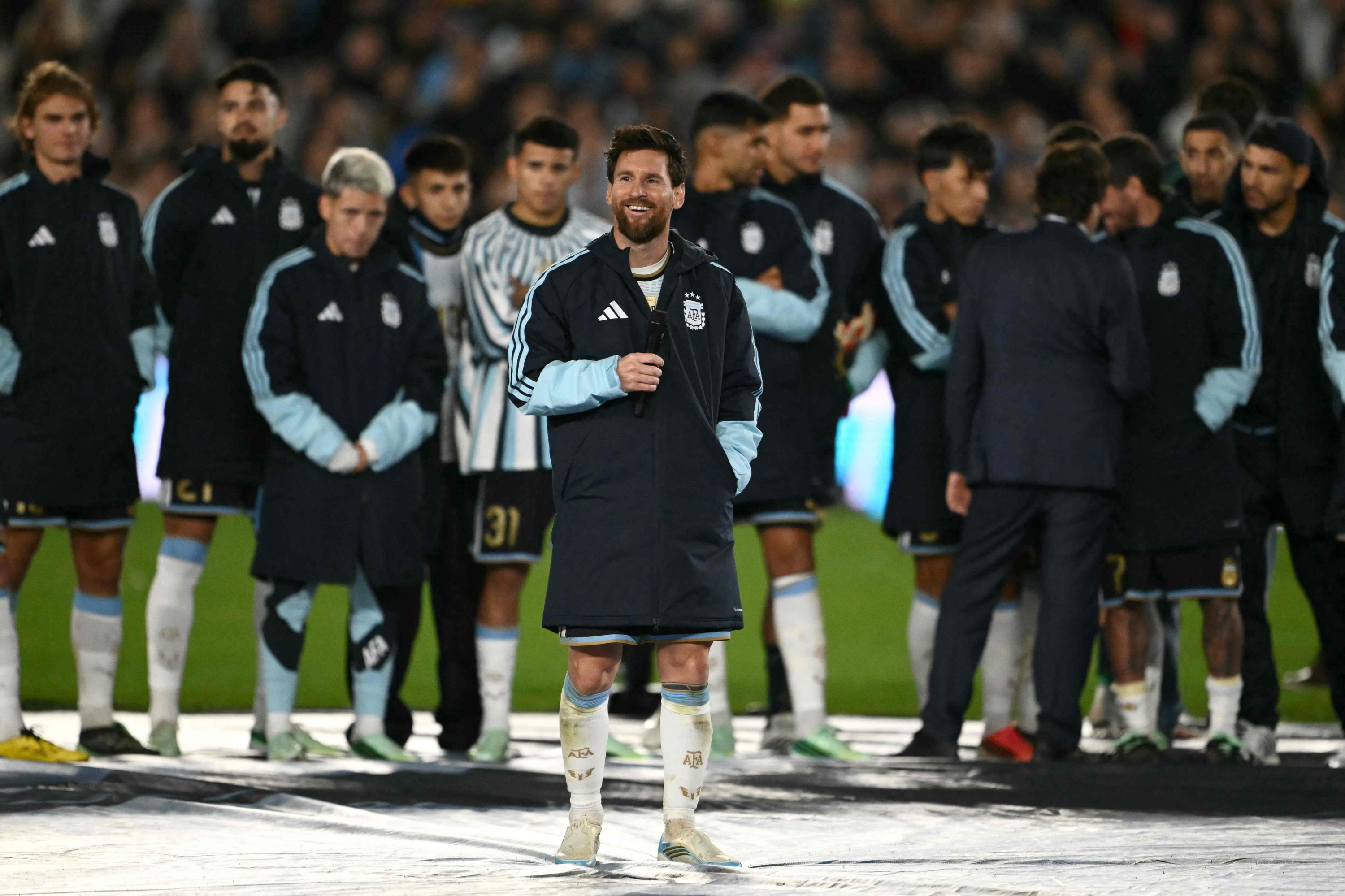
Those doubts persisted through years of heartbreak, including defeats in the 2014 World Cup final and consecutive Copa America finals in 2015 and 2016. After the latter loss, Messi briefly retired from international football.
Everything changed in 2021.
Argentina’s Copa America triumph over Brazil ended a 28-year trophy drought and redefined Messi’s standing at home. The World Cup victory in Qatar the following year completed the transformation, elevating him into the pantheon of Argentina’s greatest sporting figures.
“Winning disarmed his critics,” sports sociologist Diego Murzi said. “That’s how football works in Argentina.”
Messi leaves behind a glittering international resume: a World Cup title in 2022, Copa America crowns in 2021 and 2024, six World Cup appearances, 21 World Cup goals and more than two decades carrying the expectations of an entire nation.
The Argentine Football Association turned Tuesday’s match into a national celebration dubbed “The Last Tango.” More than 85,000 fans packed the Monumental, while former players from Argentina’s World Cup-winning teams of 1978, 1986 and 2022 returned to honor the captain.
Messi delivered one final masterclass.
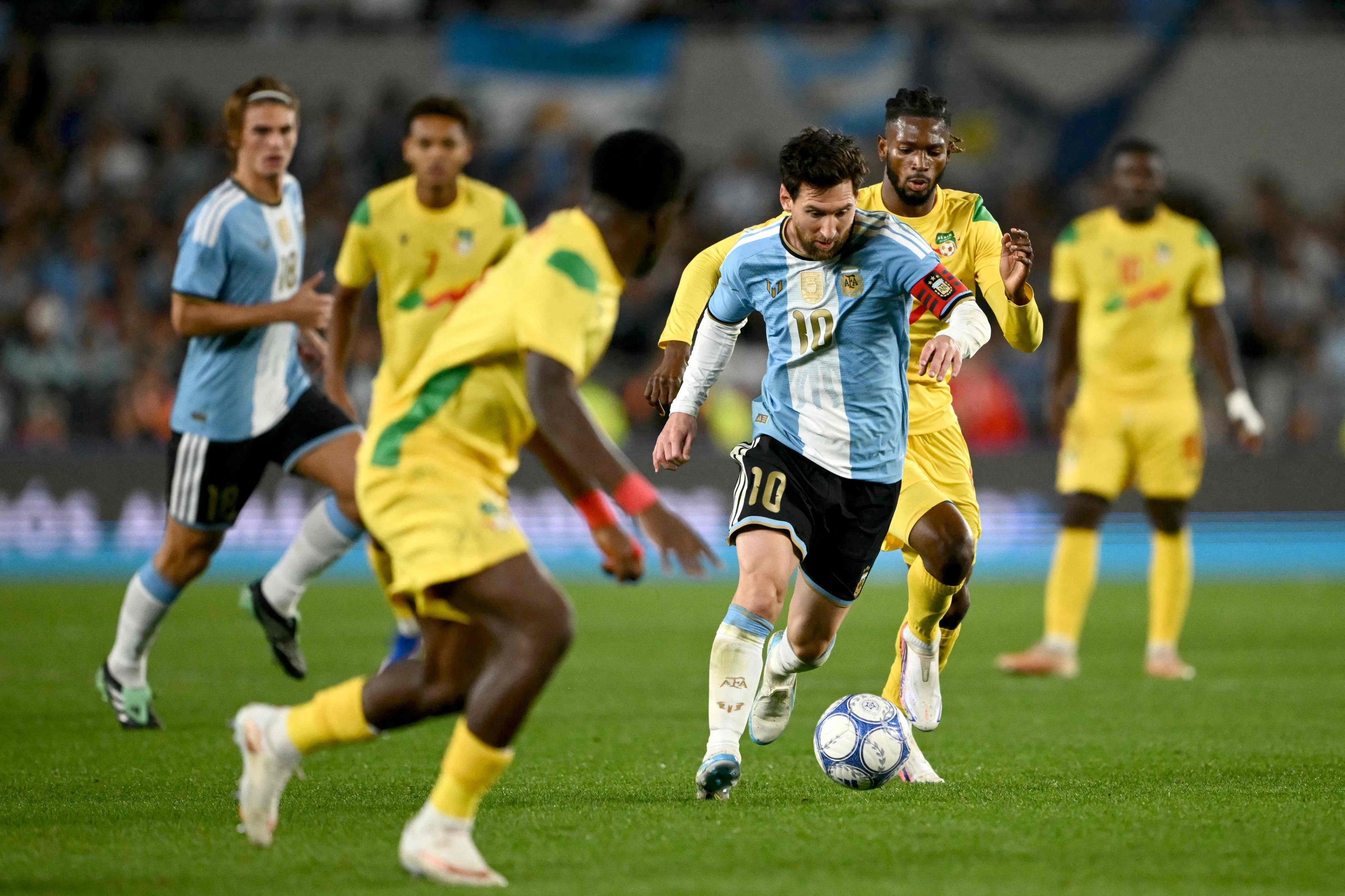
After a scoreless first half, his corner kick led to Nicolas Otamendi’s header shortly after the break. He then set up Nico Paz for Argentina’s second goal before calmly blasting a penalty into the top corner in the 70th minute after Agustin Giay was fouled.
As chants of “Messi, Messi” echoed around the stadium, teammates gathered around their captain after the final whistle. Banners hailed him as the “Eternal Captain,” while thousands remained in their seats simply to watch him take one last lap of honor.
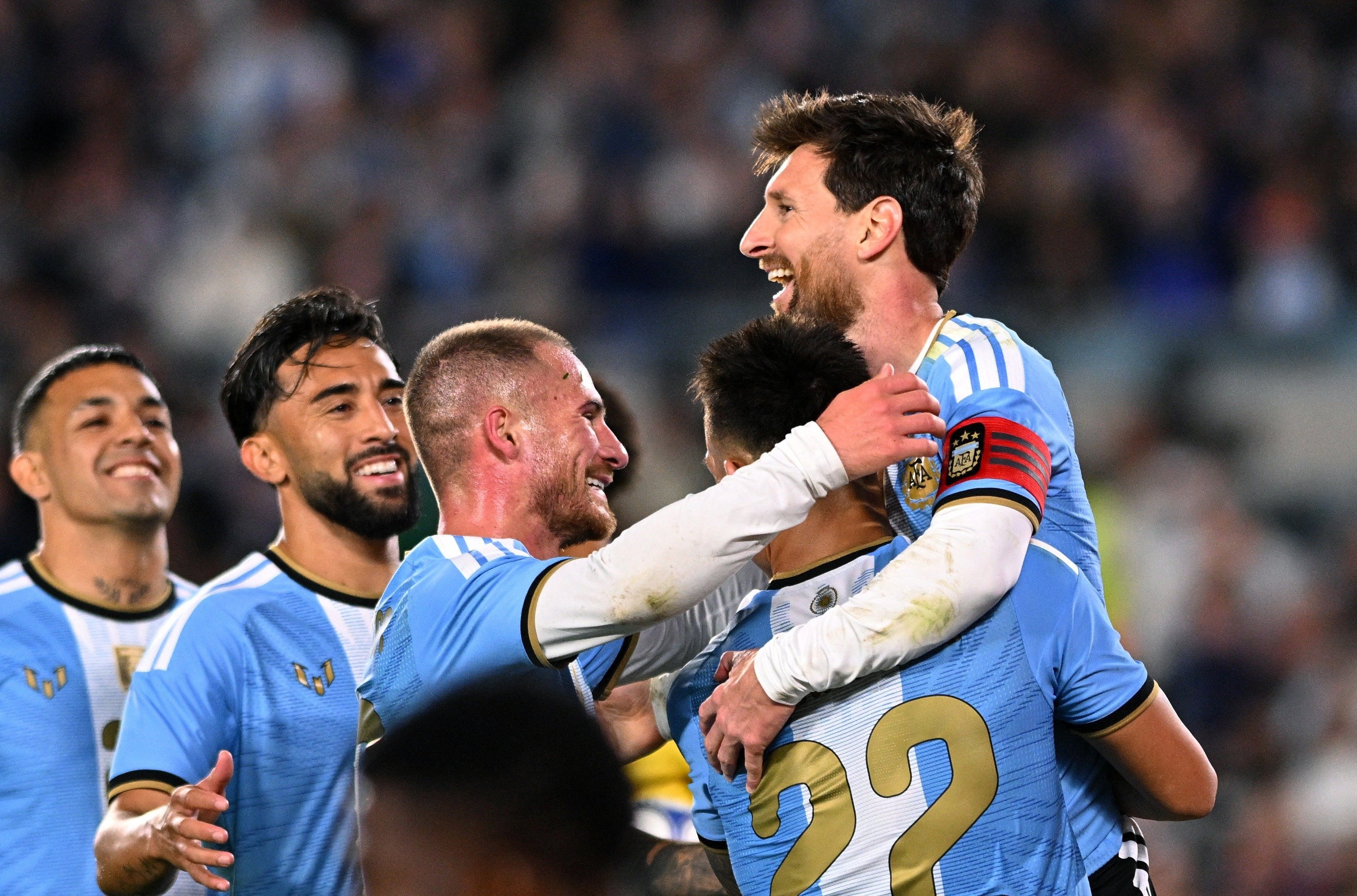
“The saddest day of my career has arrived,” Messi told supporters. “Playing for the Argentina national team is the most wonderful thing that can happen to you. I’m proud to be Argentine and grateful for every moment we shared.”
Messi also paid tribute to his father, Jorge Messi, who died in August at age 68 after an illness. His father had guided his career for decades as both adviser and agent.
Argentina coach Lionel Scaloni struggled to contain his emotions.
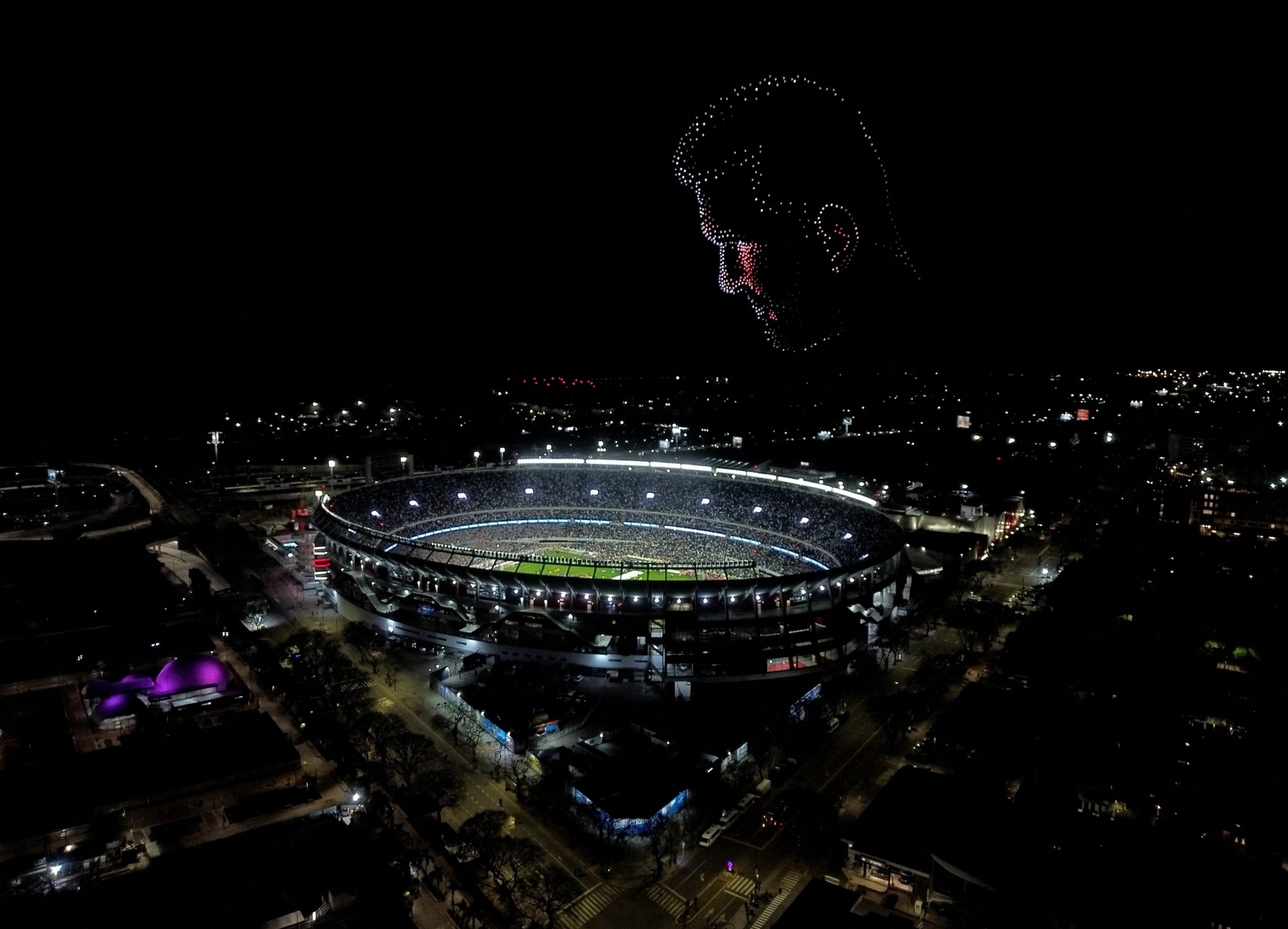
“I never imagined I would coach the best player in history,” Scaloni said. “He leaves us an incredible legacy. Having him on your side was incomparable.”
Tributes poured in from around the football world, including from Brazil star and former Barcelona teammate Neymar.
“It’s not just Argentina that thanks you,” Neymar wrote on social media. “The world thanks you for everything you did for football.”
Messi’s playing career is not over. He remains under contract with Inter Miami through the 2028 MLS season.
But for Argentina, something irreplaceable has ended.
For more than two decades, fans entered every match believing that anything was possible because Messi was on the field. That feeling, as much as the goals and trophies, is what the country will miss most.
Late Tuesday night, after the celebrations had faded and the stadium lights dimmed, Messi paused at the tunnel entrance, raised his arms toward the crowd one final time and disappeared into football history.
Daniil Medvedev was disqualified from his China Open semifinal against Novak Djokovic on Monday after hitting a spectator with a ball in an incident he described as an accident.
The spectator was escorted from the arena with a hand covering his left eye after being struck by Medvedev’s backhand.
“I feel terribly sorry for him actually and I just hope he’s OK,” Medvedev said. “Hopefully I can meet him and make up for it somehow.”
The incident occurred with Djokovic serving for the match at 7-5, 5-3. After Djokovic hit a forehand volley winner, the ball bounced off the advertising boards and back toward Medvedev. The Russian then struck a backhand that sailed into the front row and hit the spectator.
Medvedev immediately appeared to raise his left hand in apology but remained on the court.
“It was 100% an accident,” Medvedev said. “You can see that I didn’t hit the ball in anger. The ball was bouncing back, so I tried to just hit it anywhere, so it wouldn’t go out of the court.”
“When I saw the result, I felt horrible,” Medvedev said. “The most important thing is I hope that he’s OK because you never know with these types of situations.”
The chair umpire and tournament supervisor came onto the court to talk with Medvedev, who didn’t appear to put up much of an argument over the disqualification. Medvedev then walked to the net and shook hands with Djokovic.
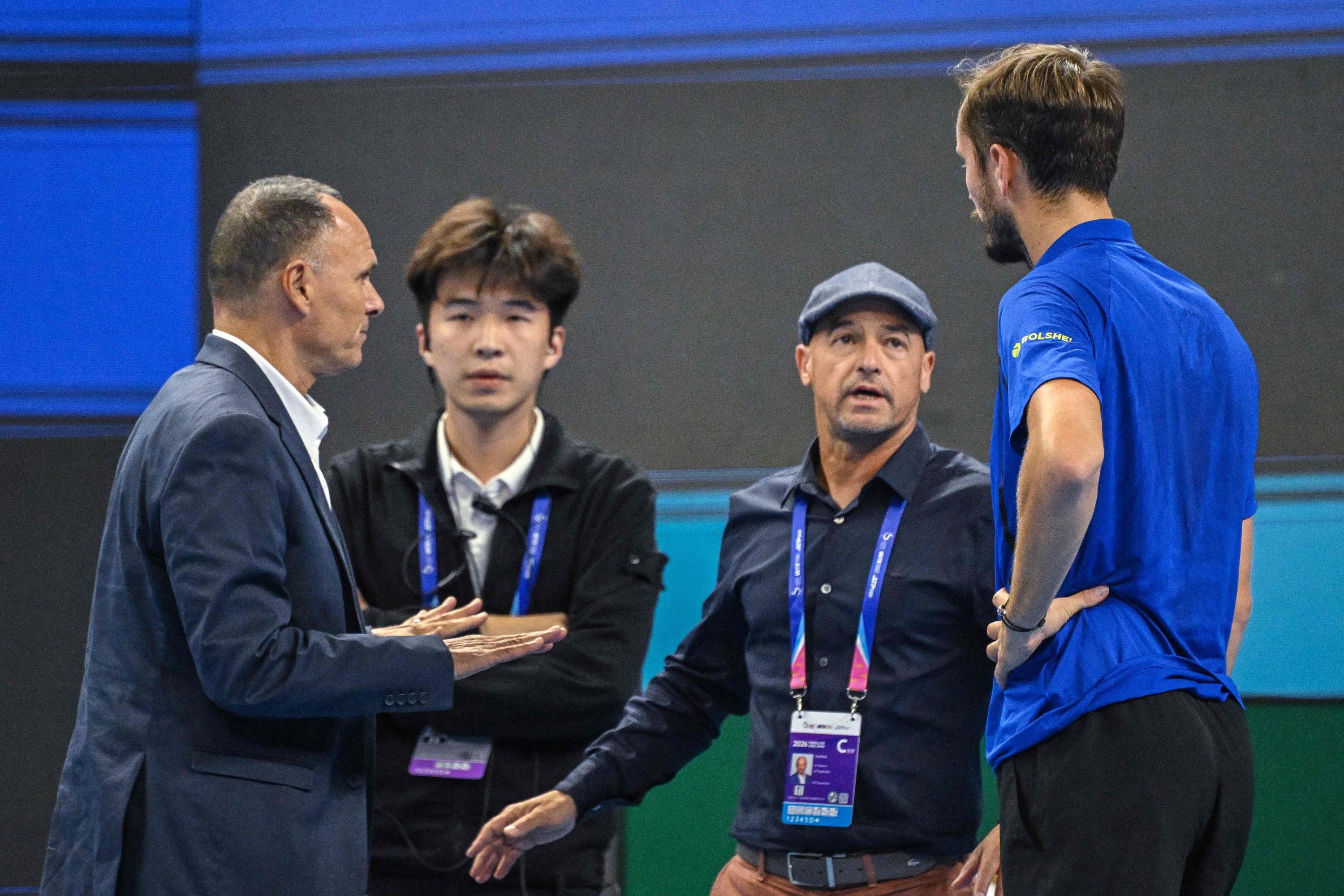
The incident was reminiscent of when Djokovic was defaulted from the 2020 U.S. Open for hitting a line judge in the throat with a ball. That was also accidental.
“A bit of a shock, to be honest,” Djokovic said. “I honestly didn’t see what happened. I hope that person is not badly injured. On the other hand, I also feel sorry for Daniil, because I know exactly how he feels to be disqualified in a big match. … I am sure that Daniil didn’t want to do this intentionally. It just happens.”
Medvedev has a history of on-court behavior issues. In April, he was fined 6,000 euros ($7,000) for unsportsmanlike conduct after smashing his racket seven times during a 6-0, 6-0 loss to Matteo Berrettini at the Monte Carlo Masters.
Djokovic extended his perfect career record at the China Open to 33-0.
Aiming for a seventh China Open title in Tuesday’s final, Djokovic will face ninth-ranked Alex de Minaur, who advanced when Hubert Hurkacz retired because of an apparent injury midway through the second set of their semifinal.
It will be Djokovic’s second final of the year after losing to Carlos Alcaraz at the Australian Open.
With his ranking down to No. 11, this is the first time in eight years that Djokovic is playing a tournament without being in the top 10. It’s also his first tournament since a first-round exit from the U.S. Open. The 39-year-old Serb rallied to beat top-seeded Alexander Zverev in the quarterfinals Sunday.
Against Medvedev, Djokovic was twice caught exceeding the time limit on the serve clock. After first receiving a warning, he was then stripped of his first serve on a crucial break point midway through the second set. But Djokovic still won the point.
Medvedev won only two of 18 break points as the pair of former No. 1s traded one grueling rally after another.
“It was a tough match for me,” Medvedev said. “He played really well. I felt he played like when we played our best matches. I had some opportunities, which I missed. He played incredibly, so I think he has big chances in the final.”
The match was 2 1/2 hours old when Medvedev was defaulted.
“I was three points away from the win,” Djokovic said. “It’s always a big battle with Daniil and it’s so hard to play him when he’s feeling the ball well in slower conditions with a big serve. But we move on.”
De Minaur led 6-4, 3-2 when Hurkacz, who was barely able to run for balls in the second set, stopped playing. The nature of Hurkacz’s injury was not immediately clear.
In the third round of the women’s tournament, which ends Sunday, Coco Gauff eliminated 16-year-old Chinese wild card Sun Xinran 7-5, 6-1. Sun recently won the U.S. Open junior title.
Also, six-time Grand Slam champion Iga Swiatek rallied past Donna Vekic 4-6, 7-6 (0), 6-2 and will next meet Iva Jovic, who beat Kamilla Rakhimova 6-1, 7-5.
Elina Svitolina beat Maria Sakkari 6-4, 7-5.
Türkiye Wrestling Federation President Taha Akgül says the country’s wrestling program is undergoing a long-term rebuild, with as much as 70% of the federation’s budget being directed toward developing young athletes and creating a new generation of wrestlers.
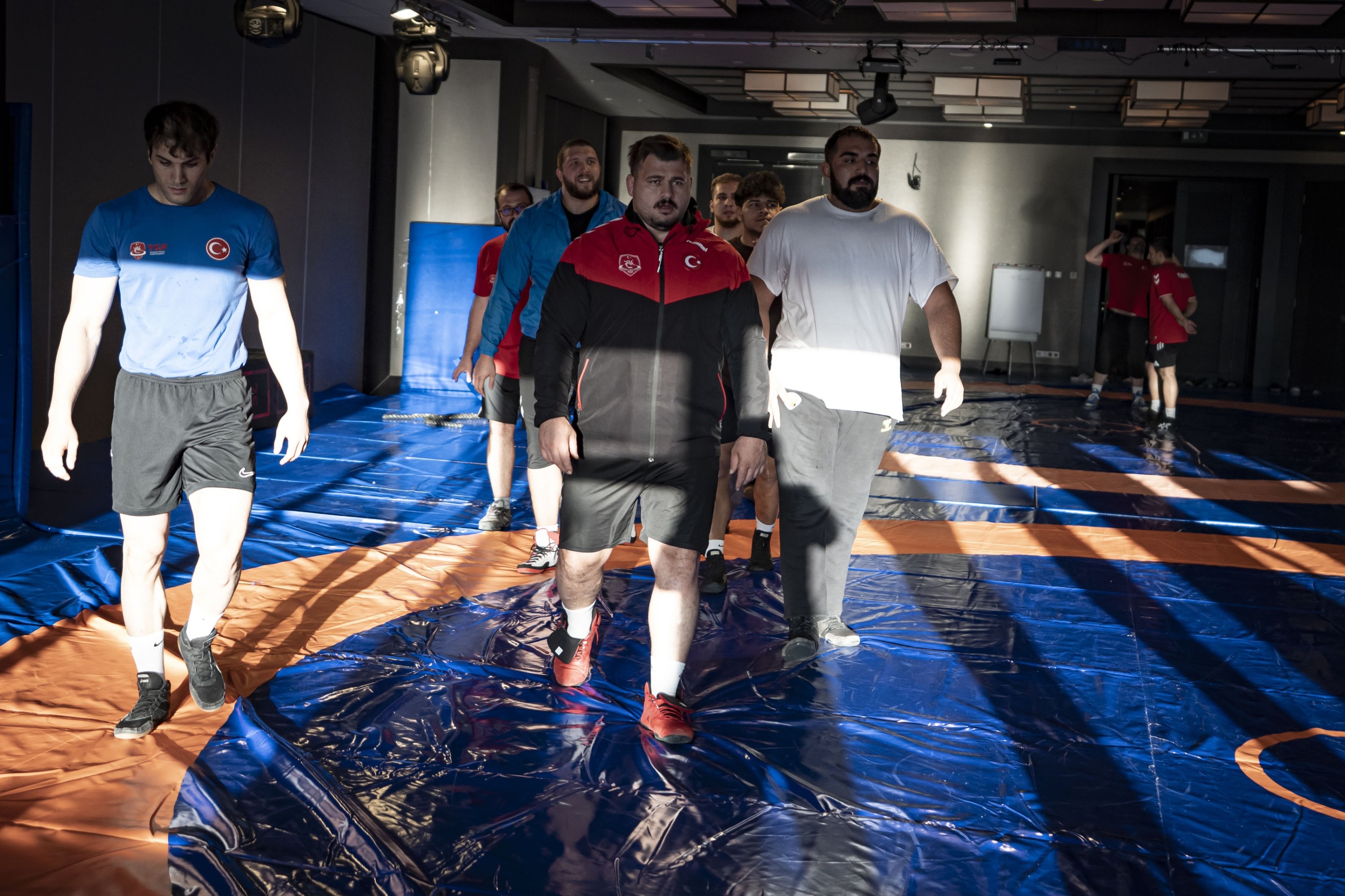
Akgül spoke to Anadolu Agency (AA) in Erzurum, where he traveled to follow the national team’s preparations at a training camp on Mount Palandöken ahead of the 2026 Senior World Wrestling Championships.
The Olympic champion said Türkiye needed to take the difficult step of investing heavily in an area where the results may not be immediately visible.
“We needed a new generation, a new period of sowing. We had the courage to do it and we started,” Akgül said. “It is not easy to start this because you are actually investing in an area that is not visible. It is similar to the investments municipalities make in youth development. They are not always seen.”
Akgül said the federation has committed a significant portion of its financial resources to youth development, with roughly 60% to 70% of its budget now being used for grassroots programs.
He said the federation’s staff are focused on expanding opportunities for young wrestlers and rebuilding the enthusiasm of athletes and their families.
“We are constantly thinking about what more we can do for the grassroots,” Akgül said. “For two years, we have been on the right path. We have restored the energy that the children and their families had lost.”
The federation has expanded competitions and development programs across Türkiye, including events and projects stretching from Hakkari in the east to Ankara.
Akgül said the federation intends to increase the number of such initiatives while using its available resources to improve the quality and reach of its programs.
Building the next generation
Akgül described the past two years as a period of planting seeds for the future of Turkish wrestling, acknowledging that the federation will have to endure the difficult part of the process before the benefits become fully visible.
“We have been in a serious period of sowing for two years,” he said. “Unfortunately, we will have to endure the hardship of this period. Whether we are here in the future or not, wrestling will win.”
He said the long-term success of Turkish wrestling matters more than the legacy of individual administrators or athletes.
“If we want Turkish wrestling to have a good future, we have to go through this period and endure the difficulties,” Akgül said. “We have the strength to shoulder this.”
The federation has also sought to increase participation at national championships, creating a broader pool from which promising athletes can be identified.
Akgül said nearly 10,000 wrestlers competed at this year’s Türkiye Championships, describing the figure as a major achievement for a sport practiced across all 81 provinces.
Managing an event of that scale presents logistical challenges, but Akgül said the federation is also trying to ensure athletes receive meaningful support, including competition gear with the help of sponsors.
The goal, he said, is not simply to produce elite wrestlers but to keep young athletes engaged with the sport long enough for their potential to emerge.
“We select talents according to different age groups,” Akgül said. “Those we identify are sent to wrestling education centers. They did not have development camps because it was not considered necessary to organize camps for those age groups. We believe it is necessary.”
850 youngsters in camps
The federation has already brought 850 young athletes together through camps held in 15 different cities, giving them opportunities to experience different parts of Türkiye while strengthening their connection with wrestling.
For some, the camps offered experiences beyond sport, including visiting Çanakkale and swimming in the sea for the first time.
Akgül said the broader social impact of wrestling should not be measured only by the number of future champions it produces.
“Maybe many of these children will not become champions, but they could become very good architects, lawyers, bureaucrats, governors or statesmen,” he said. “All of them will say, ‘We were wrestlers.’”
That, Akgül said, is another measure of the sport’s value.
“If we produce 10 top-level athletes out of 10,000, we can say that Turkish wrestling has been saved,” he said.
Olympic test
While the federation is investing in the future, Akgül said its immediate focus is the 2026 World Championships and the longer-term goal of the 2028 Los Angeles Olympics.
“We are always focused on the Olympics,” he said. “We have entered the Olympic atmosphere completely.”
The national team is preparing in the relative isolation of Erzurum, where Akgül believes the quiet surroundings, climate and natural environment provide ideal conditions for an intense training camp.
The 2026 World Championships will serve as an important test for a team undergoing significant generational change.
“We know it will be difficult, but we are in a renewal process,” Akgül said. “Hopefully, we will have a good championship.”
Türkiye’s wrestling program has traditionally been one of the country’s strongest sources of Olympic medals. At the most recent Olympics, wrestling produced two medals for Türkiye, and Akgül expects the sport to remain one of the country’s leading medal hopes.
The federation president has also remained closely involved with the athletes on the mat, training alongside the Olympic team after recently ending his own competitive career.
“I train one-on-one with my Olympic team,” Akgül said. “I have just retired from wrestling, so my performance has not dropped yet. We are there with the children on the field.”
For Akgül, the rebuilding process is ultimately about ensuring the next generation inherits a stronger wrestling system than the one it entered.
“We are on the right path,” he said. “Turkish wrestling will become even better. Our people should pray for us.”


-

 Economy3 days ago
Brazilian assets rally as Flavio Bolsonaro tops first-round vote
-

 Economy3 days ago
Top central bankers due in Istanbul to discuss policy challenges
-

 Politics3 days ago
3 jailed in Türkiye over FETÖ-linked infiltration of MASAK data systems
-
 Politics3 days ago
Türkiye-led Nusret-2026 drills bring together multinational naval forces
-

 Politics3 days ago
Türkiye’s CHP seeks removal of mayor with divided loyalty
-

 Economy3 days ago
Türkiye says Development Road could become $80B ‘energy corridor’
-

 Politics2 days ago
Türkiye condemns Israel’s deepening incursion into Syria
-
 Economy2 days ago
Over $16B shifted into deposits amid fund exits: Turkish central bank