
Politics
FM Fidan slams Greek Cyprus for hindering ties with EU

Foreign Minister Hakan Fidan criticized the Greek Cypriot administration on Wednesday in Brussels on the sidelines of the NATO foreign ministers’ meeting, highlighting Türkiye-European Union relations and peace efforts in the Black Sea region.
Commenting on the latest developments, Fidan noted the complaints about the Greek Cypriot administration: “Whoever I speak with, they all complain about the Greek Cypriot administration. There is a problem here: The issue of the synergy area that concerns the fate of more than 400 million people in the EU, and Türkiye is being held hostage by a small group of people.”
Recently, the Greek side on the island was slammed by Turkish officials and the Turkish Republic of Northern Cyprus (TRNC) over the Greek Cypriot administration quietly receiving advanced Israeli air defense systems, its growing military ties with external actors and a newly resigned maritime boundary agreement with Lebanon that exceeds the authority of the Greek Cypriot side.
Turkish officials have also long complained that opposition from the Greek Cypriot administration, along with Athens, has hindered closer Turkish cooperation with the EU.
Fidan underscored that his counterparts clearly saw this problem and expressed it “in the right way at the right time,” noting that in the EU, many issues requiring unanimity were being abused.
“What is important here is for Türkiye to continue on its path in foreign policy without giving anyone leverage while also not keeping the ball on its own side,” he added.
Ties with EU
Noting that he held very lengthy meetings on Tuesday with EU foreign policy chief Kaja Kallas and EU Commissioner for Enlargement Marta Kos, Fidan said they placed all issues openly on the table.
He said that Kos was responsible not only for enlargement files but also for connectivity files, highlighting that there were concrete projects concerning the connectivity of the EU and Türkiye with different regions such as the Caucasus and Central Asia.
He underlined that Türkiye and the EU were working on several fundamental issues, such as the customs union, visa liberalization and the full resumption of the European Investment Bank’s activities in Türkiye.
Fidan noted that Türkiye has made progress with the EU on key foreign policy issues such as the Russia-Ukraine conflict, Gaza and Syria.
He underscored that these matters are crucial for both sides and that effective cooperation between Türkiye and the EU in these areas is highly valuable for both parties’ foreign policy objectives.
Fidan said that issues in Africa, particularly North Africa and sub-Saharan Africa, as well as opportunities and areas of engagement, were subjects to which they attach importance.
“The groundwork created by Türkiye’s own efforts in these regions over many years now forms an important basis for cooperation with the EU and other global actors. This is frankly a major gain for us. At this point, we have issues with the EU that proceed on a win-win basis, as our president has emphasized,” he said.
Noting that Türkiye’s bilateral relations with EU member states were progressing well, Fidan said that Ankara is a reliable, fair and strong partner with a strong state tradition.
“When you bring all this together, Türkiye actually offers great potential. But for the institutional adventure, our story with the EU, to conclude at some point, some blockages need to be removed,” he added.
Russia-Ukraine peace talks
Fidan further remarked that his hope remained for a positive outcome in the Russia-Ukraine peace negotiations, emphasizing the technical importance of the negotiation process continuing and the parties not leaving the table.
He noted that in the Russia-Ukraine case, the initial positions of the sides were very far apart, but said that they could be brought to a middle point.
Pointing out that several intertwined issues exist within the Russia-Ukraine matter, Fidan said: “This is, of course, an issue related to Ukraine’s territory, an issue related to Russia’s strategic objectives and security, and in a sense, an issue related to Europe’s own security. There is this much interconnection. Each side wants different things based on different parameters.”
“Therefore, everyone is now making an effort to attach far more importance to the potential agreement than usual. Because this concerns not only today and stopping the war, but also what comes afterward,” he said, noting that Europeans were watching closely what had happened after previous agreements.
He added that everyone was assessing the risks and benefits not just for post-agreement European security but also in a broader context.
Explaining that they were advising their counterparts on what the focus should be and how, Fidan noted that he would soon enter an important meeting to learn the latest positions of the parties.
“Our President (Recep Tayyip Erdogan) continues his talks with European leaders and (Russian President Vladimir) Putin. Türkiye has reiterated that it wants to host the direct negotiations. Russia has a positive attitude toward this. I think Ukraine will also adopt a positive position on this soon,” he added.
He underlined that if a framework were to be accepted on paper, the parties would need to meet face-to-face to clarify the details.
Stating that there was no more suitable place for the talks than Türkiye, Fidan said: “We proved this through the three meetings we held in Istanbul last summer through our hosting and management of the talks. Each time, the parties left truly satisfied.”
He underlined that although the Istanbul talks could not resolve all issues between Russia and Ukraine, they laid an excellent foundation for the ongoing negotiations.
Recent attacks in Black Sea
Asked about the meeting held with the foreign ministers of Romania and Bulgaria after the attacks on commercial ships in Türkiye’s exclusive economic zone in the Black Sea, Fidan said that Bulgaria, Romania and Türkiye had established a working group to prevent wartime mines from drifting ashore.
Noting that naval forces had begun working on this issue, he said: “The recent attacks in the Black Sea actually showed how justified Türkiye’s warnings from the very beginning were. Because the geography of the war is expanding. This is extremely alarming.”
He said the attack on the two ships sailing in Türkiye’s exclusive economic zone not only endangered navigation safety in the Black Sea but also risked turning the Black Sea into a closed area for trade and human transit.
Fidan noted that although Türkiye had access to warm waters via the Aegean and the Mediterranean, countries like Romania and Bulgaria had only the Black Sea as their maritime outlet.
“This is a much bigger problem for them. But as the country with the longest coastline on the Black Sea, we also have to take on significant responsibility. And we are doing our part,” he said.
Fidan listed the important issues in the Black Sea: navigation safety, pipelines, energy routes, fiber lines, energy exploration activities and fishing.
“But when you are affected by wartime conditions, you cannot benefit from these economic opportunities. On the contrary, you are put at risk,” he said.
He added that during the meeting, they discussed what kinds of measures could be developed, in which institutions they would be coordinated, and how a coordination mechanism would be structured, noting that work would continue on several decisions taken.
Türkiye will open a Turkish school with capacity for about 1,000 students in the Syrian capital Damascus on Oct. 4 as Ankara and Damascus expand cooperation, the Turkish Education Ministry said.
The Damascus International Recep Tayyip Erdoğan Turkish School, named after Türkiye’s president, will open in the Artuz area of the Syrian capital and will begin providing education during the 2026-2027 academic year.
The school will operate under Türkiye’s Education Ministry and include kindergarten, primary, middle and high school levels, the ministry said in a statement on Friday.
The ministry said the school was established as part of growing education cooperation and coordination between Türkiye and Syria, including efforts aimed at expanding access to education for Syrian children and young people.
The facility has 36 classrooms and will accommodate about 1,000 students.
A delegation from the Turkish Education Ministry is expected to attend the opening ceremony and the school’s first class.
Ankara said the project was also intended to support children from families returning to Syria and help them adapt to education following their return.
The ministry described the school as part of broader efforts to strengthen educational links between the two countries, which share longstanding historical, cultural and social ties.
Türkiye has expanded its education-related activities in Syria as Ankara and Damascus have sought closer cooperation in several areas.
Turkish education officials have held a series of meetings and visits in Syria in recent months. Türkiye’s education office in Damascus said officials inspected the new school’s campus in September ahead of its planned opening.
The Education Ministry said it expects the school to provide students in Syria with access to Türkiye’s educational system while contributing to closer ties between the two countries.
The opening comes as Türkiye and Syria increase coordination on education following years of conflict that severely disrupted Syria’s education system and displaced millions of people.
Turkish officials have said supporting education and facilitating the adaptation of returning families are among the objectives of Ankara’s cooperation with Syrian authorities.
On Aug. 6, officials from Türkiye’s Council of Higher Education (YÖK) and Syria’s Ministry of Higher Education and Scientific Research also signed a memorandum of understanding to advance educational cooperation between the two countries.
Under the memorandum, the two parties will continue work on the legal framework, governance structure, academic organization, student admission procedures, quality assurance mechanisms and administrative regulations for the planned Syria-Türkiye University in Damascus.

Damaged vessels from the Global Sumud Flotilla are being repaired in Türkiye’s Antalya after an Israeli attack in international waters, with volunteers working to prepare the ships for another voyage toward Gaza.
Some of the vessels were left with damaged engines, broken masts and torn sails after the attack. They were later brought to Antalya, where local and international volunteers are carrying out repairs at a shipyard.
Two vessels have already been repaired and sent to Italy as part of preparations for another Gaza-bound mission, said Sümeyra Akdeniz Ordu, a board member of the Global Sumud Flotilla.
“We are trying to recover the ships drifting at sea one by one. We are carrying out a rescue mission,” Ordu told Anadolu Agency (AA). “We are repairing these ships so they can sail to Gaza again.”
Fourteen flotilla vessels are currently in Antalya, Ordu said, adding that volunteers from different countries were helping coordinate and repair the ships.
She said each vessel had a special significance for the activists and that they were treating the ships “like their own children” as they worked to restore them.
The damage was extensive, Ordu said, describing broken masts, damaged engines and cut hoses. She also said the sails had been torn with knives.
“The mast was broken, surface cleaner and coffee had been poured into the engines, and the hoses on each ship had been cut one by one,” she said. “They caused this damage by ramming them with larger ships.”
The repairs have been difficult because of the extent of the damage, but volunteers have continued working, Ordu said.
Türkiye has provided a safe port for the repair effort, she added.
Ordu said the activists remained determined to continue their efforts despite the damage to the vessels.
“If the enemy does not give up, we cannot give up,” she said. “We are trying to be a voice here for our Palestinian friends.”
She said the damage to the vessels showed what she described as the violence and hostility directed at the flotilla.
“We, too, insist on continuing every form of resistance,” Ordu said.
Türkiye condemned a drone attack on a power distribution station in the Saudi city of Medina that supplies electricity to the Prophet’s Mosque, reiterating its support for Saudi Arabia amid renewed regional tensions.
Ömer Çelik, spokesperson for Türkiye’s ruling Justice and Development Party (AK Party), condemned the attack on Friday, saying targeting infrastructure serving the Prophet’s Mosque was unacceptable.
“Attacks targeting our sacred values are illegitimate acts directed against all Muslims,” Çelik said in a social media post, adding that Türkiye strongly supported Saudi Arabia’s security and stability.
The targeted facility supplies electricity to the Prophet’s Mosque, Islam’s second-holiest site. The attack put one transformer out of service but did not affect the electricity network.
Türkiye’s Foreign Ministry also strongly condemned the attack, saying strikes targeting civilian infrastructure and threatening Saudi Arabia’s sovereignty and security should “cease immediately and unconditionally.”
The ministry reiterated Türkiye’s support for Saudi Arabia and called on parties to avoid steps that could further escalate tensions in the region.
“We reaffirm our strong support for Saudi Arabia and emphasize the need to avoid any steps that would further escalate tensions in the region,” the statement said.
Presidential Communications Director Burhanettin Duran on Friday separately condemned the strike and said Türkiye would continue to stand by Saudi Arabia.
The Saudi-led coalition said an investigation and examination of drone wreckage indicated Houthi involvement in the Sept. 29 attack.
Coalition spokesperson Maj. Gen. Turki Al Maliki said the targeted facility supplies electricity to the Prophet’s Mosque, one of Islam’s holiest sites.
Saudi Arabia said two weeks ago it had intercepted and destroyed a Houthi drone south of Mecca before it entered restricted airspace over the Muslim holy city. The coalition described that incident as the second Houthi attempt to target Mecca since 2017.
Earlier on Thursday, the Organisation of Islamic Cooperation (OIC) and several Arab countries, including the United Arab Emirates (UAE), Jordan, Kuwait and Bahrain, also condemned the attack on Medina.
The OIC described the targeting of vital infrastructure and facilities as “a dangerous escalation and a blatant violation of the sanctity of holy sites,” as well as international and humanitarian laws and norms.
Bashiqa-Zilkan, a key Turkish base in Iraq, will soon be handed over to Iraqi authorities while Turkish troops are expected to withdraw from the country. The development, which comes amid the withdrawal of U.S. forces from the country, which remained there as part of an anti-Daesh coalition, signals the start of a new era for Iraq and Türkiye. The Ministry of National Defense said in a statement on Thursday that the handover of the base did not mean an end to cooperation with Iraq and, on the contrary, Türkiye would continue supporting Iraq’s security and stability.
Türkiye and Iraq agreed earlier this month to deepen security cooperation, restore full Iraqi state authority in Sinjar and begin the gradual handover of the Bashiqa-Zilkan military base to Baghdad under an agreed timetable.
President Recep Tayyip Erdoğan and Iraqi Prime Minister Ali al-Zaidi announced the steps in a joint statement following talks in New York on the sidelines of the 81st United Nations General Assembly.
The ministry said Türkiye welcomed steps to ensure state authority in Sinjar. The base was set up in 2015 to help Iraq fight against Daesh and later maintained its presence when the terrorist group PKK sought to replace Daesh following the liberation of Sinjar.
“These steps will contribute to normalization of the region, establishing an environment of security and stability and a terror-free region,” the ministry said, using an expression referring to Ankara’s “terror-free Türkiye” initiative, which aims to disarm the PKK.
The statement also said it was decided to gradually hand over the compound to the central government in Baghdad, “based on improvement of security in Sinjar.”
“Our country, as it did in the past, stands with our neighbor Iraq in terms of maintaining an environment of security and stability. Throughout future contacts, we are planning to take steps that will further advance military and security cooperation. We will continue supporting Iraq’s armed forces in increasing military capacity, sharing know-how in counterterrorism and in the fields of military training and defense industry cooperation, based on bilateral agreements,” the ministry stated.
Ayhan Sarı, an assistant professor at the Turkish-German University and a security and foreign policy expert at the Turkish Research Foundation (TAV), noted that Türkiye’s withdrawal was linked to ending the PKK’s presence in Sinjar and the re-establishment of Baghdad’s authority there.
Sarı told Daily Sabah that Türkiye has been in Iraq as an exercise of its right to self-defense under international law, particularly Article 51 of the United Nations Charter, which recognizes the right to individual and collective self-defense against armed attacks. “Türkiye’s presence in Iraq has been due to the PKK threat in the north. (The dissolution) of the PKK will remove the need to remain in Iraq,” Sarı said.
He noted that the PKK and other terrorist groups had, for years, filled the power vacuum that emerged in Iraq’s northern region following the beginning of the Iraq War.
“Iraq’s central government claims it can find a solution to this vacuum through recent steps and establish full authority within its borders after the U.S. withdrawal,” Sarı said.
A U.S.-led coalition deployed in Iraq more than a decade ago against Daesh formally concluded its mission on Wednesday. Daesh was largely expelled from Iraq and Syria, also thanks to Türkiye’s cross-border operations in Assad-era Syria, but U.S. forces remained. Washington and Baghdad reached an agreement two years ago to wind down the mission.
Sarı said it was only natural that Türkiye was supportive of Iraq’s steps to ensure security on its own, since Ankara was committed to developing good relations with its neighbors and centered its foreign policy on peace and stability.
“As it did in Syria, Türkiye sides with central authority, stability and security in Iraq. Türkiye will support this move and will do whatever it can to ensure that this mission succeeds in maintaining stability and security, based on its neighborly relations,” he said.
Sarı added that Iraq’s efforts were compatible with Türkiye’s foreign policy and plans. “Iraq’s success will also mean the complete expulsion of the PKK from that country. This expulsion, removal of this malignant tumor between Türkiye and Iraq, will certainly add momentum to Turkish-Iraqi relations,” he also stated.
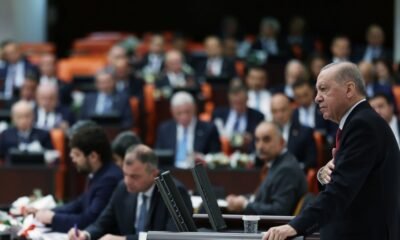
Speaking at the inauguration of the new legislative year at the Turkish Parliament on Thursday, President Recep Tayyip Erdoğan hailed a law passed by Parliament on terror-free Türkiye, which involves the disarmament of the terrorist group PKK.
“Consensus on a terror-free Türkiye has upset the country’s foes. (Terror-free Türkiye) is already having a deterrent effect on Türkiye’s foes and is empowering the country,” Erdoğan said.
The president also urged other political parties to strengthen the “home front” amid regional tensions and reach a “grand Türkiye consensus.”
The Law on Strengthening National Solidarity and Social Integration was approved by Parliament in August following months of political consultations over the government’s terror-free Türkiye initiative. The 12-article legislation received broad parliamentary backing, with 468 lawmakers voting in favor, 88 against and six abstaining. It mainly involves deferral of sentences and prosecution, as part of the initiative that paved the way for the dissolution of the PKK.
For decades, the PKK remained the main security threat for Türkiye, and its violent campaign is blamed for the deaths of thousands of people and immense economic losses, especially in southeastern Türkiye. Apart from small nationalist parties, almost all political parties openly supported the initiative, something rare in polarized Turkish politics.
“The era of opposition solely based on opposing what the government did is over. It is a grave mistake to reduce politics to antagonizing the rivals, to a war of attrition, instead of making it a race in offering the best public services. Regional and global developments require us to pursue a new style of politics,” Erdoğan told Parliament amid constant applause from lawmakers from his Justice and Development Party (AK Party). The main opposition New Party (YP) left Parliament’s general assembly hall as Erdoğan took the floor.
“We have two options now: We will either continue with the old way of politics focusing on polarization, or we will build new politics based on finding common ground, finding consensus amid competition,” he said.
“If we are meant to make Türkiye great and strong again, if we are meant to utilize historic opportunities, we have to adapt to this paradigm shift altogether and without losing more time,” he said.
The president said they did not expect all political parties to fully align or have the same opinion.
“Different views are certainly the wealth of Türkiye, Turkish democracy. But all political parties should prioritize Türkiye. Every party should draw power from its own dynamics, its grassroots, to carry out ‘Türkiye-oriented politics,'” Erdoğan said.
“Reconciliation and tolerance should replace conflict and polarization. We have to find common ground on matters essential for every member of our nation. This is what we call the ‘grand Türkiye consensus,'” Erdoğan added.
New constitution
The president also focused on drafting a new constitution. “The goal of a new and civilian constitution is a struggle for Turkish democracy to prove its maturity. Our esteemed Parliament is competent and authorized to draft a constitution under all circumstances and in every period. A new constitution that will broaden Türkiye’s horizons will be the product not of a politics of polarization, but of a new politics based on competition within consensus. Our nation’s longing for a new constitution must not be held hostage by manufactured fears. Our position regarding the first four articles of the Constitution currently in force is clear. Rolling up our sleeves for a new and civilian constitution worthy of the ‘Century of Türkiye’ is a genuine test of sincerity for everyone. I hope the current legislative year will be a year of constitutional reform that expands Türkiye’s opportunities and potential,” he said.
Since the founding of the Republic of Türkiye, constitutional design has served as the backbone of the country’s legal system. The current Constitution, adopted in 1982, has been repeatedly amended over the decades, most notably in 2017, when a national referendum paved the way for the country’s transition from a parliamentary model to an executive presidential system.
Despite numerous amendments over the decades, replacing the 1982 Constitution with a new, civilian-drafted charter remains a prominent issue in Türkiye’s political debate.
Erdoğan and Parliament Speaker Numan Kurtulmuş have repeatedly advocated for a new civilian constitution, arguing that the existing charter retains the legacy of military rule under which it was drafted despite extensive subsequent amendments.
Türkiye condemned Thursday a drone attack by Houthis on a power station in the Muslim holy city of Medina, reaffirming its support for Saudi Arabia.
The targeted facility supplies electricity to the Prophet’s Mosque, Islam’s second-holiest site. The attack put one transformer out of service but did not affect the electricity network.
The Saudi-led coalition in Yemen said on Thursday that an investigation and examination of drone wreckage confirmed Houthi involvement in planning and carrying out Tuesday’s attack.
“We strongly condemn the Houthis’ attack on civilian infrastructure serving the Prophet’s Mosque in Medina,” the Turkish Foreign Ministry said in a statement.
“These provocative attacks, which threaten Saudi Arabia’s sovereignty and security and target the sacred values of the Islamic world, must cease immediately and unconditionally,” it said.
Saudi Arabia said two weeks ago it had intercepted and destroyed a Houthi drone south of Mecca before it entered restricted airspace over the Muslim holy city. The coalition described that incident as the second Houthi attempt to target Mecca since 2017.
The Foreign Ministry emphasized the need to avoid any steps that would further escalate tensions.
“We reaffirm our strong support for Saudi Arabia and emphasize the need to avoid any steps that would further escalate tensions in the region,” the statement said.
Earlier Thursday, the Organization of Islamic Cooperation (OIC) and several Arab countries, including the United Arab Emirates, Jordan, Kuwait and Bahrain, also condemned the attack on Medina.
The OIC described the targeting of vital infrastructure and facilities as “a dangerous escalation and a blatant violation of the sanctity of holy sites,” as well as international and humanitarian laws and norms.
The organization affirmed its full solidarity with Saudi Arabia in measures taken to protect its territory, security and stability, defend Islamic holy sites and safeguard citizens and residents.
The UAE Foreign Ministry said the drone attack constituted “a flagrant violation of the sovereignty of Saudi Arabia and a threat to its security and stability.”
The Saudi-led coalition said the Medina attack was part of what it described as repeated Houthi attempts to target the Two Holy Mosques and “provoke” Muslims worldwide. It said it would continue taking measures to protect the holy sites and pilgrims.
Houthis denied the accusation.
The latest escalation is the most serious fighting between Saudi Arabia and the Iran-aligned Houthis since a U.N.-brokered truce largely halted cross-border attacks in 2022. Hostilities resumed this year after the Houthis declared a naval blockade on Saudi Arabia in July and began attacking Saudi territory and shipping, while Houthi forces also made major territorial gains along Yemen’s Red Sea coast.
Saudi Arabia has responded with airstrikes in Yemen and backed government forces fighting to push back the Houthis.


-
 Politics3 days ago
Turkish defense chief attends major joint military drills in Azerbaijan
-
 Politics3 days ago
Türkiye urges end to US-Israel-Iran war, return to talks
-
 Economy2 days ago
Türkiye moves to finalize capital markets law changes after fund turmoil
-

 Economy3 days ago
Eurozone, Asian factories show resilience despite energy challenges
-
 Economy3 days ago
Şimşek tells investors Türkiye has avoided systemic risk in fund turmoil
-

 Sports3 days ago
Ronaldo walks away as Jesus rules out start against Denmark
-

 Economy2 days ago
US tells European allies to release diesel stocks ‘immediately’
-
 Politics2 days ago
Erdoğan calls for ‘grand consensus’ amid terror-free Türkiye success