
Economy
Hormuz traffic down to 2-month low amid renewed US, Iran strikes

Tanker traffic through the Strait of Hormuz fell in the past day to a two-month low, according to shipping data Monday, amid heightened safety worries after renewed strikes between the U.S. and Iran and attacks on ships.
Shipping industry sources said vessels were increasingly switching off their public AIS tracking transponders, making it difficult to determine the full number of ships crossing the waterway.
Based on available data, oil and gas tanker traffic fell to its lowest level since May 25, according to analysis from Kpler.
“Should the renewed escalation in the strait lead to another prolonged closure of Hormuz, the world will find itself in a much tougher spot,” ship broker Gibson said in a report.
“With global inventories rapidly depleted in recent months, this is a recipe for much tighter supply, higher prices and significant downside risk for tanker markets.”
The Sea Faith oil products tanker was among the few visible vessels sailing toward the entrance to the Strait of Hormuz near the Iranian side of the waterway, with a destination of Sohar, according to LSEG and MarineTraffic ship-tracking data on Monday.
Commercial traffic through the Strait of Hormuz “continued at reduced levels,” the U.S. Navy-led Joint Maritime Information Center (JMIC) said in an advisory on Sunday.
“Traffic patterns continued to reflect operator caution following recent attacks.”
At least three pairs of tankers were involved in ship-to-ship transfers outside of Hormuz off Oman’s coast in the Gulf of Oman, according to the latest satellite imagery from July 11 reviewed by Reuters.
Ship-to-ship (STS) transfers typically involve the transfer of oil from one vessel to another. Since the conflict began on Feb. 28, STS transfers have enabled faster deliveries of oil onto waiting ships that do not need to sail through Hormuz.
“Some ships are slipping in and out,” one shipping official said on Monday.
“This has to be viewed as a managed conflict now similar to the Houthis in the Red Sea,” the source said, referring to the Yemeni militia, which paralyzed traffic through the Bab al Mandeb waterway for nearly two years before calling a cease-fire in 2026.
Trump, Iran differ over strait status
U.S. forces completed another wave of strikes against Iran on Sunday, hitting dozens of targets at multiple locations with precision munitions, the Central Command said.
U.S. President Donald Trump said on Sunday that the Strait of Hormuz is open to commercial traffic, although Iran declared earlier that it closed the strait after a vessel traveled on an unapproved route and was struck.
Iran’s Revolutionary Guards said on Monday that their navy stopped two ships in the Strait of Hormuz last night by shutting down their systems. They did not name the ships involved.
A container ship sustained damage from an unknown projectile which caused a fire in the engine room on Sunday, JMIC said.
Traffic slowdown
Six vessels transited the strait on Sunday, ship-tracking data from Kpler showed, the lowest number in five weeks.
Tankers that exited the strait included the Very Large Crude Carrier Humanity, laden with 2 million barrels of Iranian oil, and another tanker, Capetan Andreas, carrying about 500,000 barrels of Kuwaiti oil products, the data showed, while three empty tankers entered the Gulf to load oil.
Most of the tankers switched off their transponders when crossing the strait.
There were no liquefied natural gas tankers that entered the strait over the weekend that were visible on ship-tracking data.
One tanker controlled by the Abu Dhabi National Oil Co exited the strait between July 10 and July 12, Kpler data showed. The vessel was heading for Dahej port in India.

The European Union will move to limit young children’s access to social media across the 27-member bloc, European Commission President Ursula von der Leyen said on Monday, in what would be the biggest such effort to date to guard against online dangers.
Von der Leyen’s remarks came as a special EU panel looking into the challenge recommended forbidding access for those under 13 until tech companies can prove their platforms are safe.
Growing awareness of the dangers social media poses for young, developing brains has shown up in a wave of new restrictions globally. Australia, the U.K., Türkiye, Indonesia and others have passed bans on kids under 16 or 15 from using platforms like TikTok, YouTube and Instagram.
Laying out a list of her concerns about the use of social media by kids, von der Leyen, a doctor by training, said that children under 3 should have no exposure to screens at all.
“I believe we need to consider phased and gradual access for different age ranges because childhood won’t wait and once it’s gone, we can never give it back,” von der Leyen told reporters.
“Just as we don’t give our children keys to the car before they have their license, or we do not let them buy alcohol until they are legally allowed. We need to set the age at which they can, the children can, legally access social media,” she said.
“This is not about whether children can access social media. It is about whether and when social media can access our children.”
Von der Leyen noted infinite scrolling as one of the “addictive” traits that tech companies must address.
Beyond toddlers, she did not mention any precise restrictions, but she and the European Commission, the EU’s powerful executive branch, are likely to come up with a proposal for the 27 member countries to weigh in the near future.
Von der Leyen’s policy proposals carry great influence with EU member countries.
A special panel set up to study child safety online delivered its report to the EU chief on Monday. The report said that when it comes to safety, “the burden of proof needs to be on providers, not regulators, parents and children.”
“Until they demonstrate that their services are safe by design, social media and other digital services providers should have restricted access to children under the age of 13 in the EU,” said the report, which is likely to influence von der Leyen’s thinking.
It recommended that “further precautionary age restrictions” should be considered by EU countries for children over 13.
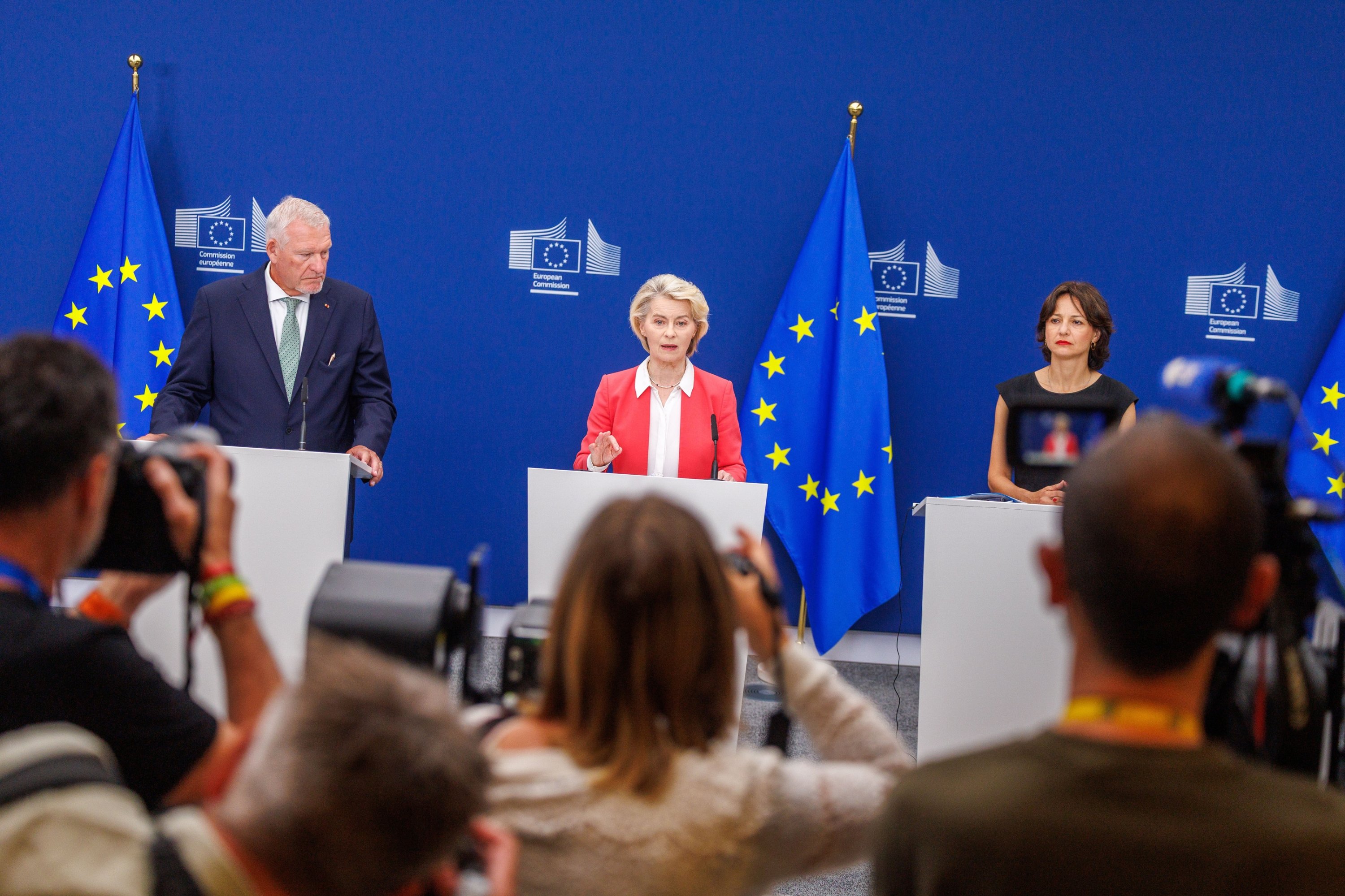
The European Union has been mulling a social media ban since a push by EU states, including Greece and France, for limiting access, with pressure intensifying for a bloc-wide ban.
A legal proposal will come in the second half of the year, von der Leyen added, but she is expected to give an indication of what the restrictions will look like in September.
The report by co-chairs child psychiatrist Jorg Fegert and epidemiologist Maria Melchior offered a glimpse of how the EU’s proposal could look like as they recommended:
No screens at all for babies and toddlers; Supervised use of “age-appropriate social media” and devices children aged between three and 12 by parents or teachers; For those aged 13 to 18, “evolving autonomous use” of social media and other digital platforms that have “key safety features.”
Many social media and video sharing platforms including TikTok and Meta’s Facebook and Instagram are only available to children aged 13 and over.
Platforms “must prove that their services do no harm. In Europe, whoever develops a product is responsible for its safety,” von der Leyen said.
“We are convinced that Europe must introduce protective measures to ensure the safety of children and adolescents in the digital world,” Melchior said, standing next to von der Leyen.
The EU has already ramped up the pressure on social media platforms to change in recent months, telling Facebook and Instagram Friday to dismantle their “addictive” features, after a similar warning to TikTok in February.
Divided EU positions
The report did not recommend a blanket ban on digital platforms including social media, and von der Leyen did not back such a move.
What the panel found was the Australian ban faced difficulties as children found ways around the limits, forcing the EU to reconsider its approach.
Instead, it wants platforms to remove or limit features like autoplay content, infinite scroll, and push notifications.
The European Parliament in October called for a ban on social media for children under the age of 16, a position some EU lawmakers continued to back – although divisions remain over the age.
“I still believe the age should be 15, not 13. 13 is already the minimum age used by most major social media platforms today,” EU lawmaker Christel Schaldemose said in a statement after the panel’s report.
There will likely be difficult negotiations since any EU proposal will only become law after talks between the parliament and member states.
Targeting harmful design
A dilemma for the EU is how to avoid different age limits across 27 countries. For example, Spain wants to ban under-16s accessing social networks, while France proposes prohibiting children aged 15 and under.
And then there are EU nations such as Estonia that oppose a ban.
Von der Leyen said the European Commission, the EU’s executive arm, would “have a very careful look” at the national proposals.
Brussels will “integrate” their work, she said, and then prepare its own proposal to “harmonize the approach and to find a common solution.”
The EU already has a bolstered armory to rein in Big Tech and protect users online, and the commission has said more rules are on the way.
EU consumer protection chief Michael McGrath vowed a new law, expected later this year, will give children stronger protection against addictive design.
Volkswagen may need to eliminate about 50,000 additional jobs to match the competitiveness of its rivals, its CEO told employees in an internal memo, effectively confirming for the first time that the carmaker is considering cuts of up to 100,000 positions.
Oliver Blume is battling to streamline Europe’s biggest carmaker, whose profits have slumped as its faces billions of euros in tariff costs, stiff competition in China and pressure on its German manufacturing network to become more efficient.
After already agreeing 50,000 job cuts across the group, including its Porsche and Audi subsidiaries, the company must work on reducing costs further, having calculated a cost disadvantage versus comparable companies of 20%, Blume said in the memo seen by Reuters.
This means a “theoretical deduction” of another 50,000 jobs worldwide, the memo said.
“We are currently assessing across all brands, companies and regions how many adjustments are actually necessary and feasible,” Blume said in the document.
Staff costs are determined not only by the number of employees but also by labor costs, he added. “We must also pull this lever,” he said, indicating that the exact scale of the job cuts has not yet been finalized.
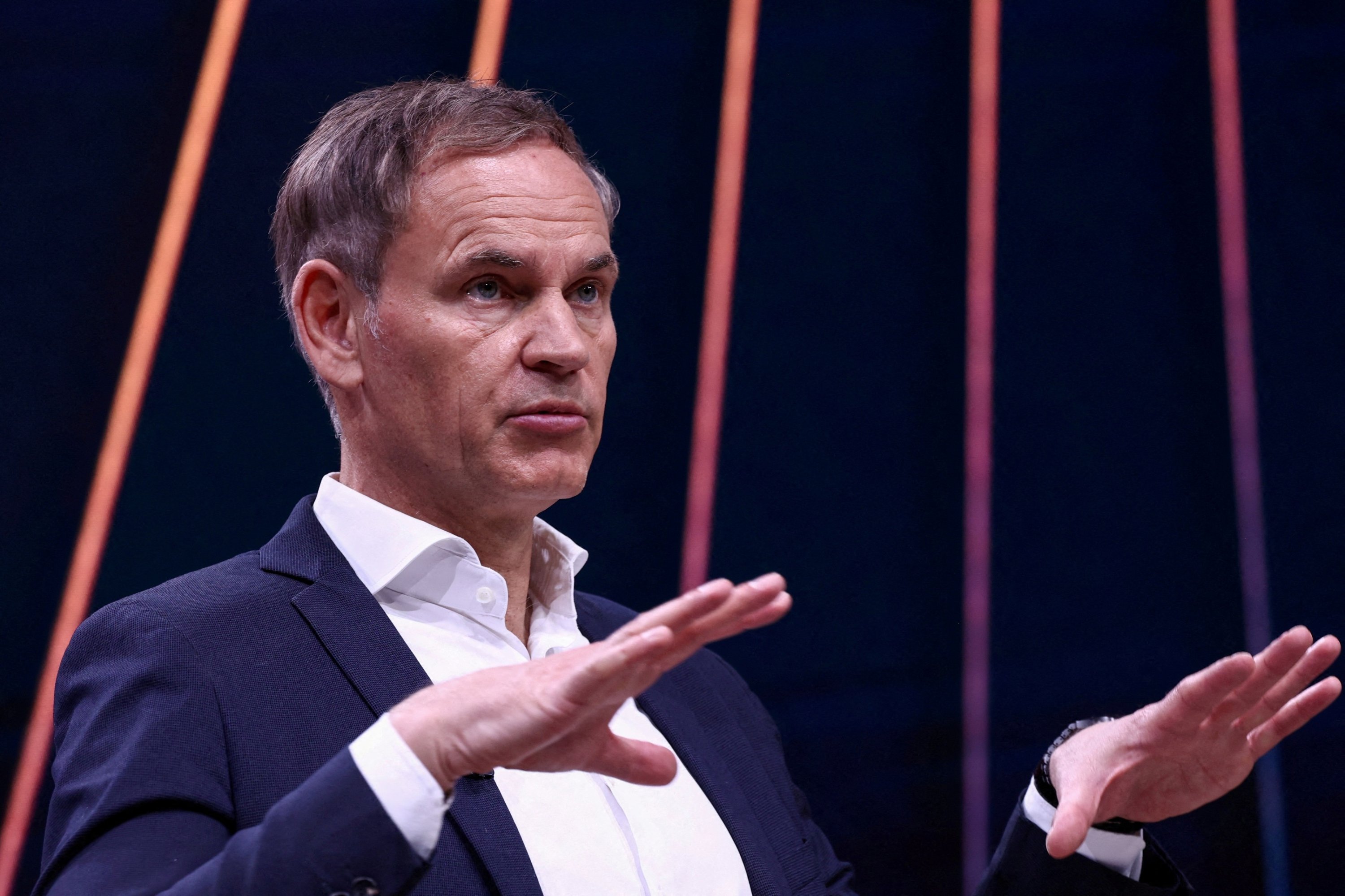
The company had previously declined to comment on reports it was considering up to 100,000 job losses.
The memo follows angry calls from workers for management to explain its restructuring plans, which Blume presented to the company’s supervisory board on Thursday.
Nationwide protests were held by trade union IG Metall on Thursday, while the company’s works council also outlined its fury over the weekend.
Sources familiar with the matter said labor representatives on the committee blocked the proposals, which were said to include job cuts and the possible closure of four factories.
“As of today, we still cannot confirm competitive use cases for the plants of Emden, Hanover, Zwickau and Neckarsulm in the 2030s,” Blume said in the memo.
He said he preferred “intelligent solutions” to closures, having previously pointed to the defense industry or the production of Chinese Volkswagen models in Europe as options for underutilized factories.
State energy company BOTAŞ on Monday started construction of a fourth storage tank at its terminal in northwestern Türkiye, a move that will increase the facility’s LNG storage capacity by nearly 60%.
The new 160,000-cubic-meter storage tank will raise the Marmaraereğlisi LNG Terminal’s total storage capacity to 415,000 cubic meters from the current 255,000 cubic meters, Energy and Natural Resources Minister Alparslan Bayraktar said.
The investment is expected to improve Türkiye’s flexibility in managing natural gas supplies by expanding its ability to store LNG delivered by ships, regasify it when needed and transport it via road tankers while maintaining it in liquid form.
Located in Tekirdağ province, the Marmaraereğlisi LNG Terminal plays a strategic role during periods of high natural gas demand, particularly in winter months, with a daily regasification capacity of 37 million cubic meters.
The terminal can accommodate conventional LNG carriers as well as large-capacity Q-Flex and Q-Max vessels, which are among the world’s largest LNG carriers.
Around 65 LNG vessels dock at the facility annually, with the terminal meeting approximately 15% of Türkiye’s annual natural gas demand.
In addition to LNG storage and regasification operations, the facility carries out road tanker loading, fuel supply and reload operations.
Strengthening resilience against energy shocks
Bayraktar said the terminal’s ability to source gas from multiple markets, combined with its storage capacity and regasification infrastructure, makes it a key component of Türkiye’s energy security strategy.
The minister noted that fluctuations in global energy markets have demonstrated the importance of having strong infrastructure.
Bayraktar said the new investment will “strengthen our natural gas infrastructure” and will “increase our resilience against crises.”
Türkiye currently has five LNG entry points, including two LNG terminals and three floating storage and regasification units (FSRUs).
Alongside the Marmaraereğlisi LNG Terminal, BOTAŞ operates the Dörtyol and Saros FSRU facilities.
As part of Türkiye’s National Energy and Mining Policy, LNG regasification capacity has increased nearly fivefold since 2016, rising from 34 million cubic meters per day to around 161 million cubic meters per day.
The government aims to raise total LNG regasification capacity to 200 million cubic meters per day with the addition of two new FSRU facilities.
Türkiye has informed Canada that it will participate in the Defense Security and Resilience Bank (DSRB) as a founding member, a report said on Monday
Canadian Prime Minister Mark Carney said at a NATO summit in Ankara last week that nine countries, including Türkiye, had committed to the bank, in what was seen as a boost for the multilateral drive to help rearm allied nations.
Defense Ministry sources said over the weekend that Türkiye was still evaluating possible participation.
“Türkiye has informed Canada that it will participate in the bank,” a Turkish official told Reuters on Monday.
According to Carney’s statement last week, Albania, Belgium, Greece, Latvia, Luxembourg, Romania, Türkiye and Ukraine had all pledged their support to the bank, which will be based in Canada.
The roster contained no heavyweight G-7 nations other than Canada, potentially limiting the bank’s financial firepower, although Canada’s foreign minister, Anita Anand, told Reuters it would remain open to new members.
The bank’s purpose is to bolster the defense of like-minded allied nations by raising up to 100 billion pounds ($134 billion) in cheap financing.
Carney is promoting the DSRB as part of his call this year for an alliance of “middle powers” to combat what he sees as the fracturing of the traditional U.S.-led world order.
A group of former NATO security advisers, senior ex-military personnel and bankers proposed the bank in 2024.
NATO nations and their allies are grappling with rising defense demands linked to the war in Ukraine, growing tensions with Russia and concerns about China’s military expansion.
NATO leaders agreed in June 2025 to spend 5% of GDP on defense and security-related investments by 2035.
Top banks, including JPMorgan, Deutsche Bank, Commerzbank and ING, have joined the project alongside Canada’s RBC, BMO, CIBC, National Bank of Canada, Scotiabank and TD Bank.
Europe has relied on jet fuel imports from the U.S. and Asia, boosted refinery output and tapped stockpiles to keep aircraft in the air. And yet it remains the region most vulnerable as renewed tensions in the Middle East increase the risk of further supply disruptions.
Britain, France and Germany are particularly exposed in a continent where decades of refinery closures left it more reliant than most on Middle Eastern shipments via the Strait of Hormuz.
The Strait, conduit for around a fifth of the world’s seaborne oil and liquefied natural gas until U.S.-Israeli airstrikes unleashed a war on Iran at the end of February, partly reopened in June.
In July, however, a fragile truce has come under threat from strikes by both sides.
Data from consultancy Energy Aspects dated June 18 already anticipates a supply deficit across Europe of nearly 600,000 barrels per day in the third quarter, against surpluses of 116,000 bpd in the United States and 425,000 bpd in Asia-Pacific.
Inventories stood at 38 million barrels at the start of June, compared with 99 million in the United States, Energy Aspects said. That leaves Europe with less than 30 days of demand cover, Reuters calculations show – the tightest of the major jet fuel markets.
The most recent data available from the International Energy Agency’s (IEA) latest monthly report, showed provisionally jet fuel stocks were 10% higher year-over-year at the end of May, while refinery output rose 30%. The figures also implied only a month of leeway.
“We still do expect some tightness through August at this rate,” said Janiv Shah, analyst at Rystad.
The European Commission has also acknowledged the situation could get worse.
EU Energy Commissioner Dan Jorgensen said in June the bloc faced tighter jet fuel stocks toward the end of the summer holiday season and that Brussels would coordinate releases of national reserves if needed.
Cargo from Canada to South Korea
Until war broke out at the end of February, Europe had relied on the Middle East for around half of its jet fuel imports.
In March, analysts had expected African countries, which sourced nearly all their jet fuel from the Middle East, to be the hardest hit.
However, they have managed to increased imports from Nigeria’s Dangote refinery, as well as India and Oman, according to data from commodities intelligence firm Kpler.
Europe, meanwhile, has so far prevented supplies running out by turning to new sellers, such as Canada.
In June, Europe overall imported 673,000 bpd of jet fuel, its highest since October 2025, Kpler data showed.
The U.S. and Nigeria were the biggest exporters to Europe, but Kuwait, Canada, India and South Korea also provided cargoes.
Imports from India in June reached their highest since February and nearly 25,000 bpd Kuwaiti barrels are due to arrive in August for the first time since early March through a ship-to-ship transfer on the ship Proteus Harvonne.
Before flows were interrupted, Kuwait was one of the biggest suppliers of jet fuel to the region.
Among those who increased production to ease the strain, Italian refiners increased jet fuel production by 10% in the first four months of the year.
The countries’ imports fell 6%, enabling domestic production to meet nearly 70% of demand in March and April, according to UNEM, Italy’s fuel producers’ association.
Eni, which accounts for around half of Italy’s jet fuel production capacity, boosted output by importing semifinished products from outside Europe, industry sources said.
Jet fuel prices in northwest Europe, meanwhile, have fallen to around $133.27 a barrel from a record $215.32 at the end of March, easing pressure on airlines. Fuel typically accounts for between 20% and 25% of operating costs.
Immediate discounts to air ticket prices are unlikely, analysts say, as demand is strong and capacity is limited, especially after many carriers cut flights to maximize fuel supplies.
Türkiye’s southeastern Diyarbakır Basin has the long-term potential to produce up to 250,000 barrels of oil per day (bpd), the chair of U.S. energy company TransAtlantic Petroleum said on Monday.
Türkiye currently consumes about 1 million barrels of oil per day, meaning the projected production from the Diyarbakır Basin could cover roughly one-quarter of national demand.
Potential daily gas production from the basin could be around 25 million cubic meters, TransAtlantic Petroleum CEO Malone Mitchell III told Anadolu Agency (AA) on the sidelines of an energy conference in Istanbul.
“Quite nice production, 25 to 50 million. That would be a substantial portion of Türkiye’s internal demand,” Mitchell said.
He said the full potential of the Diyarbakır Basin is difficult to quantify precisely as productivity is expected to vary across different parts of the play, but added that it could ultimately host more wells than all those currently operating across Türkiye.
“It certainly might represent more wells than all of the current wells that are in the country of Türkiye,” Mitchell said, noting that such a scenario would likely unfold over around 20 years.
He added that output is expected to build gradually over the first five years before reaching what he described as “a mature running level.”
The projection highlights the scale of unconventional oil and gas resources that industry players believe could be unlocked in the basin, one of Türkiye’s key exploration areas alongside the Thrace Basin in the country’s northwest.
Last year, Mitchell’s Texas-based oil and gas company entered into a joint venture with state-run Turkish Petroleum Corporation (TPAO) and Oklahoma-based Continental Resources to pursue unconventional opportunities in the Diyarbakır Basin.
Preliminary assessments by the Energy and Natural Resources Ministry and Continental Resources indicate the basin could hold 6.1 billion barrels of oil.
Energy and Natural Resources Minister Alparslan Bayraktar last year said they estimate the Diyarbakır Basin spans around 7,000 square kilometers and noted that they plan to drill 24 wells over three years as part of a horizontal drilling program.
Mitchell said the partnership aims to transfer the know-how, capital and operational experience gained from nearly two decades of unconventional production growth in North America to Türkiye, noting that such developments remain relatively rare outside those markets.
If development proceeds as expected, activity in the Diyarbakır Basin is set to ramp up significantly over the next several years.
“Probably five years from now, we will see 25 rigs drilling in the unconventional,” Mitchell said.
He said horizontal drilling techniques would allow operators to access large underground areas while minimizing the footprint on agricultural land.
“Each rig, because it would be drilling horizontally, would be as productive as four or five vertical wells,” he said.
Türkiye becoming increasingly important
Mitchell said that Türkiye’s strategic location and stability are becoming increasingly important as geopolitical tensions reshape global energy markets.
“It is the crossroads of energy, and it has become more important as the conflict in Ukraine and the area cut off part of the northern hub. Then the southern hub became more important,” he said.
He added that ongoing energy crises are fragmenting global energy flows, putting Türkiye in a position to exhibit stability in an increasingly unstable world.
Drawing on nearly two decades of experience in the country, Mitchell said Türkiye offers a reliable environment for international investors.
“What we have learned over 18 years is that the legal system works, the regulatory system works, we can rely on the banking system to be able to transfer money to make payments,” he said.
The CEO said he has advised U.S. policymakers and energy executives that while Türkiye may not have the largest resource base, its stability makes it an attractive hub for regional energy operations.
He added that the company’s operations in Türkiye have helped establish its credibility as it expands into new markets, with potential partners often encouraged to seek references from Turkish authorities.
Mitchell pointed to Uzbekistan as one of the countries the company has moved into, noting that Turkish contractors already play a key role in the country’s economic development, creating opportunities for its services.
Partnership with TPAO top priority
Although the company is exploring opportunities elsewhere, Mitchell said its partnership with TPAO remains its top priority.
He said the joint venture represents the company’s largest global opportunity, prompting it to scale back other activities to focus on the fastest path to success.
“To a certain degree, we are limiting the other things we do so that we can make sure there is the greatest, fastest path to success,” Mitchell said.
“Right now, probably the No. 1 opportunity set we have, maybe worldwide, is our joint venture with Turkish Petroleum,” he said, adding that success could pave the way for further collaboration.
“That is probably the most important relationship that we have and what we see as an opportunity set worldwide for our company right now,” Mitchell added.

Turkish intelligence captures top Daesh suspect in Syria

Questionable congress statement from Kemal Kılıçdaroğlu: Those who took the money and gave the statement were CHP members

Turkish VP says lessons learned from July 15 coup attempt
Turkish intelligence captures top Daesh suspect in Syria
Questionable congress statement from Kemal Kılıçdaroğlu: Those who took the money and gave the statement were CHP members
Turkish VP says lessons learned from July 15 coup attempt
-
 Daily Agenda3 days ago
A pipeline agreement was signed between Türkiye and TRNC! Minister Bayraktar: “We will continue all kinds of support with determination”
-

 Daily Agenda3 days ago
We will continue to support Lebanon – Last Minute News
-
 Economy1 day ago
Turkish ship, yacht exports hit $1.5B in H1, sector eyes new record
-
 Daily Agenda2 days ago
Bribery operation against Çankaya Municipality – Last Minute News
-
 Politics1 day ago
CHP may replace parliamentary group leader Özel: Turkish media report
-

 Economy1 day ago
China’s economy likely slowed down in Q2: Survey
-

 Daily Agenda2 days ago
Safety shield against earthquake risk
-
 Daily Agenda3 days ago
From purchasing weapons to selling missiles – DİLEK GÜNGÖR