
Politics
Legal troubles close in on prominent Turkish lawmaker Sarıgül

Mustafa Sarıgül, a larger-than-life figure in Turkish politics, is now embroiled in investigations targeting his close circle. Soon after the arrest of his two sons in a fraud and money laundering probe, the lawmaker for the main opposition New Party (YP) saw his personal bodyguard, Ömer B., detained on Thursday along with four other suspects.
The detention was linked to an investigation into the Sarıgül family, including the lawmaker’s ex-wife. However, media reports suggest there may be more to the investigation into Ömer B., who was reportedly the man seen in a video that surfaced online two years ago. The video, which showed B. having sex with Mustafa Sarıgül, was “fake,” according to the lawmaker, who shared a report by independent investigators verifying the footage’s inauthenticity. The head of the firm that conducted the verification was also among those detained in the investigation into allegations that the Sarıgül family set up companies in Türkiye and abroad to launder money. The Sabah newspaper reported on Thursday that the firm had asked Sarıgül for $200,000 to prepare a fake report claiming the sex video was not authentic.
Ömer, Sarıgül’s younger son, was the first to be detained in the money laundering investigation, while his other son, Emir, has not turned himself in for days amid claims that his father used his parliamentary immunity to hide him in his own home.
Sarıgül alternated between business and politics throughout his career and made a name for himself as Türkiye’s youngest lawmaker in the 1987 elections. He rose to further prominence as mayor of Şişli, an upscale Istanbul district, from 1999 to 2014. After a brief stint leading a political movement, he rejoined the opposition Republican People’s Party (CHP) in 2013, years after unsuccessfully challenging CHP leader Deniz Baykal in intra-party elections. Baykal stepped down in 2010 following a separate sex video scandal.
Sarıgül left the CHP again and established a new party in 2020. He returned to the party ahead of the 2023 general elections and was elected to represent his hometown of Erzincan in Parliament. He joined the YP after it was founded last July by former CHP Chair Özgür Özel. His latest stint in the CHP made him familiar to younger generations, as Sarıgül once again shot to fame with bizarre social media videos in which he is often seen slapping nearby objects and people in alternating fits of excitement and anger.

President Recep Tayyip Erdoğan reaffirmed Türkiye’s commitment to mediation and diplomatic engagement Friday, citing its role in the Russia-Ukraine prisoner exchanges and peace initiatives across Africa, as global conflicts intensify and confidence in international institutions weakens.
In a video message to the 9th Istanbul Mediation Conference, hosted by Foreign Minister Hakan Fidan under the theme “Partnerships and New Perspectives for Peace: Mediation in a Changing World,” Erdoğan said Ankara would continue working to create opportunities for dialogue even when prospects for peace appear limited.
“We are striving to pave the way for peace through the achievements we have made across a wide geography, from prisoner exchanges between Russia and Ukraine to our mediation efforts on the African continent,” Erdoğan emphasized.
The president warned that the international community was facing a period of escalating conflicts, mounting tensions and declining trust in international law and institutions.
“Even when parties refuse to speak to one another and hopes are fading, we have made it our principle never to abandon diplomacy,” he noted.
The president also criticized the structure of the United Nations Security Council, arguing that its decision-making system undermines confidence in international governance.
“Millions of people in Palestine, Lebanon, Sudan and other crisis regions who have placed their hopes in the United Nations are deeply disappointed.”
“A structure in which the will of more than 190 countries depends on the discretion of five countries is neither fair nor capable of fully establishing trust,” Erdoğan added, referring to the Security Council’s five permanent members.
He emphasized that Türkiye rejects an international political order built on mistrust and believes diplomatic channels must remain open even during the most difficult disputes.
“We will continue bringing parties together for peace, mediating for just solutions and assuming responsibility,” he stated.
Fidan calls for renewed trust
Addressing the conference, Foreign Minister Hakan Fidan warned that armed conflicts, repeated cease-fire violations and disruptions to critical trade and maritime routes were placing increasing pressure on the international system.
Citing United Nations estimates, Fidan said approximately one-quarter of the world’s population lives in conflict-affected areas, while more than 100 million people have been forcibly displaced, including a significant proportion of children.
He pointed to the humanitarian situation in Gaza and the West Bank, criticizing Israel’s military actions and cease-fire violations for further undermining confidence in international institutions.
The minister stressed that protecting civilians, particularly children, and ensuring humanitarian assistance must remain priorities, while reiterating Türkiye’s support for a just political settlement to the Palestinian issue.
Against this backdrop, he outlined three principles that should guide international mediation efforts: sincere dialogue, sustained mediation and regional ownership.
“Rebuilding trust is absolutely essential for mediation to work,” Fidan said, emphasizing that effective mediation depends on the consent of the parties, mutual confidence and inclusivity.
He argued that the growing number and complexity of conflicts were testing the international system’s ability to respond, making peaceful dispute resolution more urgent than ever.
Mediation from Ukraine to Africa
Highlighting Ankara’s diplomatic engagement in several regional crises, Fidan cited Türkiye’s involvement in Russia-Ukraine negotiations, the Black Sea Grain Initiative and the Ankara Process between Somalia and Ethiopia as examples of sustained mediation.
According to the Ethiopia-Somalia Ankara Declaration, the two parties decided to launch technical negotiations facilitated by Türkiye by the end of February 2025 and conclude them within four months. They also agreed to abandon differences of opinion and contentious issues and to move decisively toward shared prosperity.
Türkiye’s engagement with the continent gained unprecedented momentum after it declared 2005 the “Year of Africa.”
Ankara has repeatedly presented itself as a fairer player than the continent’s former colonial powers, touting cooperation based on “equal partnership and a win-win principle.”
Fidan further emphasized that resolving disputes requires patience, flexibility and a willingness to maintain communication with all relevant parties.
“You cannot resolve a dispute if you cannot engage with the parties concerned.”
He remarked that negotiations must continue even when comprehensive peace agreements remain out of reach, arguing that incremental progress can create the foundation for broader settlements.
“There is no single formula,” the minister noted, noting that every conflict has its own historical background, actors and circumstances.
Turning to Libya, Fidan said Türkiye was maintaining dialogue with stakeholders in both the country’s east and west, as well as international partners, to support a lasting political settlement.
He described a Libyan-led and inclusive dialogue process as the only viable path toward sustainable stability, expressing hope that progress toward a comprehensive solution could be achieved.
Fidan also emphasized the importance of regional ownership in resolving conflicts, arguing that locally driven initiatives are more likely to produce sustainable outcomes than externally imposed arrangements.
“Stability cannot be imported, and lasting solutions cannot be imposed from outside,” he said.
He explained that regional actors possess a deeper understanding of local dynamics and are better positioned to sustain peace efforts after international attention shifts elsewhere.
Fidan cited regional cooperation initiatives, including the Balkan Peace Platform and the Mecca Joint Defense Agreement, as examples of efforts to strengthen dialogue and encourage practical solutions among neighboring countries.
The Mecca agreement, signed on Aug. 7 by Erdoğan, Saudi Crown Prince Mohammed bin Salman and Pakistani Prime Minister Shahbaz Sharif in Mecca, establishes a collective defense framework among the three countries. Under the pact, an armed attack against any one of the three countries is considered an attack against all of them. The agreement also calls for broader defense cooperation and collective deterrence.
He also called for closer cooperation among governments, international organizations, civil society, universities and the private sector to improve mediation capabilities.
Fidan said Türkiye was working to transform mediation from a conventional diplomatic instrument into a strategic and institutionalized component of its foreign policy.
“Mediation is not about who wins, who loses or who makes concessions. It is about finding common ground and achieving a win-win solution for all parties,” he said.
He expressed hope that the Istanbul conference would provide an opportunity to exchange experiences, strengthen collective mediation capabilities and develop new approaches to resolving international disputes.
The first-ever R4+E3 foreign ministers’ meeting kicked off in Istanbul on Friday, hosted by Foreign Minister Hakan Fidan and bringing together eight countries, including Italy, to discuss regional conflicts and strengthen diplomatic coordination.
According to Turkish Foreign Ministry sources, the meeting brings together the R4 countries Türkiye, Egypt, Pakistan and Saudi Arabia and the E3 countries Britain, Germany and France with Italy also participating.
Discussions are expected to focus on Palestine, the Strait of Hormuz, developments involving Yemen and diplomatic efforts to resolve the Russia-Ukraine war, exploring opportunities for closer cooperation and coordination between the two diplomatic groups, diplomatic sources said.
On the sidelines of the gathering, Fidan held separate bilateral meetings with British Foreign Secretary Ed Miliband, Pakistani Foreign Minister Ishaq Dar and French Foreign Minister Jean-Noël Barrot, according to statements shared by the Turkish Foreign Ministry on the Turkish social media platform NSosyal.
The countries convened under the R4+E3 format for the first time at Türkiye’s initiative, marking a new platform for diplomatic coordination between regional and European powers.
Israel’s continued occupation and settlement expansion, Jerusalem’s historical and legal status and prospects for a two-state solution are also on the table.
Rome hails Ankara’s efforts
Meanwhile, Italian Deputy Prime Minister and Foreign Minister Antonio Tajani welcomed the Istanbul gathering, describing it as a timely diplomatic initiative aimed at bringing European and regional powers together to address ongoing conflicts.
Speaking to Anadolu Agency (AA) before departing for Istanbul, Tajani said Rome supported Türkiye’s efforts to promote dialogue between European countries and regional actors.
“The initiative of the Turkish government and Foreign Minister Hakan Fidan is timely and productive. Rome supports the idea of bringing together European and regional countries to discuss the conflicts in the Middle East,” Tajani said.
He emphasized that participating countries shared a common objective of restoring diplomacy as the primary means of resolving disputes and limiting the consequences of military confrontations.
Tajani noted the gathering sought to encourage a return to political engagement and increase pressure on parties involved in conflicts that have destabilized the region and harmed civilian populations.
He also reiterated Italy’s support for negotiations aimed at achieving a just and lasting peace between Russia and Ukraine.
“Disputes and rivalries must be resolved through diplomacy, not weapons,” he stated.
Turning to tensions in the Persian Gulf, Tajani warned against a renewed outbreak of large-scale hostilities, stressing that diplomatic engagement between Iran and the United States remained essential to regional stability.
He said participating countries were working on a joint declaration reflecting their shared commitment to peace in the Gulf and the broader Middle East.
Tajani welcomed indirect contacts between Washington and Tehran in New York and subsequent proposals for negotiations, describing them as encouraging developments despite persistent differences.
“Diplomacy is the only viable path toward a sustainable solution. We do not want a resumption of full-scale conflict,” he underlined.
He also highlighted the importance of protecting global food security amid disruptions to maritime trade routes.
Despite difficulties affecting grain shipments in the Black Sea and fertilizer transportation through the Strait of Hormuz, Tajani said Italy remained committed to safeguarding the international movement of essential agricultural supplies.
He pointed to cooperation with the Rome-based U.N. Food and Agriculture Organization (FAO) to protect access to grain, cereals and fertilizers.
Yemen, Red Sea security
Tajani also condemned Houthi attacks targeting Saudi Arabia and reaffirmed Italy’s solidarity with Riyadh, calling for a coordinated strategy to address the Yemen crisis and prevent instability from spreading across the region and threatening maritime traffic in the Red Sea.
According to Tajani, reviving Yemen’s peace process, preferably under United Nations auspices, remains the most viable path toward a sustainable settlement.
Addressing the Palestinian issue, Tajani reaffirmed Italy’s support for a two-state solution, arguing that the international community must preserve the possibility of establishing an independent Palestinian state.
He warned that expanding Israeli settlements and increasing settler violence in the occupied West Bank threatened regional stability and undermined prospects for a negotiated settlement.
Tajani said Italy and its European partners had repeatedly condemned such actions and would continue efforts to protect the territorial integrity and political future of the West Bank.
The Italian minister also expressed concern over the humanitarian situation in Gaza, describing conditions in the enclave as extremely severe despite ongoing diplomatic initiatives.
“The humanitarian situation in the Gaza Strip remains extremely grave,” Tajani noted, emphasizing the need to maintain uninterrupted aid deliveries as winter approaches.
He said Italy continued to support the 20-point peace plan for Gaza but considered progress in implementing U.N. Security Council Resolution 2803 insufficient.
Israel’s expansionist policies are deepening regional instability, undermining prospects for a two-state solution and increasing security risks for neighboring countries, according to a report released by Türkiye’s National Intelligence Academy (MIA) on Friday.
Titled “The Anatomy of Israeli Expansionism,” the report examines the historical, ideological, political and military roots of Israel’s policies, the role of U.S. support and the potential risks for Türkiye.
In the report’s foreword, academy President Talha Köse said Israel’s actions in Gaza reaching the level of genocide, its occupation of the West Bank and its expansionist policies in Lebanon and Syria were contributing to global instability.
Köse said Israel’s push for territorial expansion, from Syria to the Eastern Mediterranean and from the Red Sea to the Horn of Africa, was undermining prospects for a two-state solution, which he described as “essential to lasting regional peace.”
He contrasted Israel’s approach with Türkiye’s security policy, saying Ankara sought to strengthen the sovereignty, territorial integrity and institutional capacity of regional states. Israel, he argued, pursued security by keeping neighboring actors weak, fragmented and vulnerable to outside intervention.
The report says Israel has sought to legitimize its expansionist ambitions through theological claims to land. It argues that the growing influence of Zionist and far-right actors in political and bureaucratic institutions has helped turn expansionist demands into state policy, backed by military and intelligence capabilities.
It also says Israel’s policies extend beyond military occupation, combining territorial expansion with legal and administrative measures and demographic practices.
According to the report, developments on the ground create new realities that deepen conflicts and security concerns, reinforcing the cycle of instability.
It argues that the policies are not confined to the current government but have been embedded in state institutions and legal frameworks. A change of government alone, therefore, may not be enough to reverse them, the report says.
The report also says the far right has moved from the margins of Israel’s political system to its center. Settler movements, it argues, have become part of the state’s decision-making and implementation mechanisms, with figures from those circles taking positions in government ministries and the bureaucracy.
Israel has the military and technological capabilities to conduct operations far from its borders but cannot sustain a prolonged, high-intensity war on its own, the report says.
It cites the war involving the U.S., Israel and Iran as evidence of Israel’s structural dependence on Washington to sustain its military capabilities.
At the same time, the report points to criticism of Israel’s actions in Gaza, particularly among younger Americans, as a source of uncertainty over the future of U.S. support.
Israel’s military superiority can provide short-term advantages over neighboring countries but has not translated into lasting regional dominance, the report says.
It adds that although expansionist policies may increase Israel’s military freedom of action in the short term, they could prompt neighboring countries and other regional actors to seek alternative security arrangements over time.
Özgür Özel is no stranger to inciting riots, but this time he took it too far, threatening Daily Sabah’s sister company, broadcaster A Haber.
The leader of the main opposition New Party (YP) hurled insults and threats at the broadcaster, which is noted for its extensive coverage of corruption in municipalities run by mayors picked by Özel while he was the chair of the Republican People’s Party (CHP).
“You won’t be able to broadcast fake news if we call upon people to streets,” a bitter Özel told a crowd gathered outside the headquarters of YP’s mouthpiece, broadcaster Halk TV, on Wednesday evening in Istanbul.
The uncompromising Özel was harsh toward A Haber in the past during his tenure as CHP leader due to its coverage. However, it is the first blatant call by the politician to incite pro-YP groups against the broadcaster, which came under attack in 2016, during a coup attempt by the Gülenist Terror Group (FETÖ), by putschist soldiers seeking to storm its headquarters in Istanbul’s Beşiktaş district.
Eyyüp Kadir Inan, secretary-general of the ruling Justice and Development Party (AK Party), stood with A Haber and denounced Özel’s remarks. He said Özel lost his political prestige and “cannot fix it by threatening A Haber.” İnan said in a social media post on Wednesday that Özel has to clarify what he meant by saying A Haber would not be able to cover so-called fake news.
“Let us hear what you mean; let’s see whether you have the courage to stand by those words,” Inan said. Özel was also behind the 2025 riots in Istanbul, where he incited young supporters to take to the streets to protest the arrest of Istanbul mayor Ekrem Imamoğlu on charges of corruption.
The Turkish Press Federation (TÜBAF) released a statement on Thursday, condemning Özel’s statement. The federation said it was unacceptable that Özel painted a target on A Haber’s back, saying that the broadcaster had press freedom.
“No media outlet should be targeted for its broadcast journalism. The criticism is natural in democratic societies, but the delicate line between criticism and pointing at a media outlet as a target (to supporters) should be preserved. We believe that the political actors should maintain more responsible language in their remarks towards the press. We cannot accept the targeting of A Haber or any other broadcaster, newspaper, news agency and digital media outlet. The protection of press freedom is a joint responsibility for all. We call upon Mr. Özel to revise his stand, return from his erring ways and apologize to A Haber,” the federation said.
Commenting on the matter, Mehmet Karataş, chief of Special News at A Haber, said Özel’s remarks reflected a mindset. “This is the only straw they have, and actually we are not surprised,” Karataş told the broadcaster on Wednesday.
“We are accustomed to threats, but we are not to be intimidated. You can go out on the street or elsewhere, but we will continue our coverage,” Karataş said.
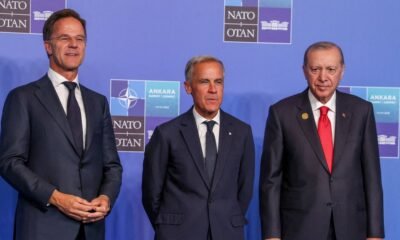
Canadian Prime Minister Mark Carney’s two-day visit to Türkiye officially began on Thursday.
President Recep Tayyip Erdoğan gave a warm welcome to the premier at the Presidential Complex as the two men eye starting a new chapter between their distant countries.
Erdoğan and Carney were scheduled to sign a series of deals in various fields later on Thursday.
This is the first bilateral visit by a Canadian prime minister to Türkiye, though Carney is no stranger to Ankara. He traveled in July to attend the NATO summit of heads of state and government. After talks in Ankara, Carney will leave for commercial hub Istanbul to attend business events as the two countries seek to deepen trade ties.
The Canadian prime minister has sought to diversify partnerships and reduce reliance on the United States amid an escalating trade war with U.S. President Donald Trump, marked by U.S. tariffs on Canadian goods, retaliatory measures by Canada and statements questioning Canadian sovereignty.
In an interview with Anadolu Agency (AA) earlier this week, Canada’s Ambassador to Türkiye Marcel Lebleu said this week that the visit’s main purpose was to “launch a strategic partnership through a joint declaration by the two leaders.”
Talks would focus on cooperation in energy, nuclear plants, sustainable mining and the defense industry.
The two countries would also hold negotiations on a free trade agreement, he said.
Türkiye is looking to build a second nuclear power plant on the Black Sea coast, in addition to one currently being built by Russia’s Rosatom on the Mediterranean coast.
In a sign of improving ties, Canada lifted its ban on the export of weapons to Türkiye in 2024. It had imposed the restrictions following Türkiye’s military operations into Syria and over Türkiye’s support for Azerbaijan in the war for liberation of Azerbaijani lands occupied by Armenian separatists, including providing equipment that used Canadian-made parts.
A statement from Carney’s office said two-way trade between Türkiye and Canada increased by 50% in the past five years. It said that during the visit, Carney will emphasize opportunities “to expand that growing trade relationship in priority sectors, including energy, aerospace, advanced technologies, and mining and critical minerals.”
Although trade between Canada and Türkiye is tiny (Türkiye accounted for less than 0.3% of Canada’s total merchandise trade or CA$4.34 billion ($3.09 billion)), bilateral trade has risen by nearly 50% in the past five years.
“This trip is part of the geopolitical necessity of signaling to Americans that we are not sitting around waiting for them,” said Bessma Momani, professor of political science at the University of Waterloo.
In the last year, Canada has signed more than 20 trade deals as part of Carney’s push to double non-U.S. exports in the next decade. He flew to Beijing in January to reset fractured relations with China, striking a deal that slashed tariffs on electric vehicles and canola.
Despite criticism that China is a security risk, given Canadian authorities previously found China had interfered in at least two federal elections, Carney has described China as a “more predictable” trading partner than the U.S.
However, Canada still sends nearly 70% of exports to the U.S.
At the NATO leaders’ summit, Carney and Erdoğan launched negotiations for a free-trade agreement, where Türkiye also agreed to join Canada’s Defence, Security and Resilience Bank as a founding member.
Türkiye has held talks with Canadian engineering firm AtkinsRealis as well as South Korea’s Korea Electric Power Corporation and China’s State Power Investment Corporation about potentially building its planned second and third nuclear power plants.
Canada mainly exports lentils, optical devices, aerospace products and electronics to Türkiye while Türkiye mostly exports iron and steel, machinery, fruits and dried fruits to Canada.
Izmir Metropolitan Mayor Cemil Tugay praised President Recep Tayyip Erdoğan as one of Türkiye’s most influential political figures, highlighting his leadership and contributions to the country while explaining the circumstances behind his political shift.
Speaking during a visit to the Izmir Union of Chambers of Tradesmen and Craftsmen, Tugay said his recent political decisions were driven by his responsibility to address the city’s longstanding problems and deliver better public services.
Tugay acknowledged public curiosity about his political transformation but insisted that his personal values and commitment to serving Izmir remained unchanged.
“The Cemil Tugay you know has not changed in any way, nor will he,” he said.
Tugay has recently resigned from the opposition Republican People’s Party (CHP) and joined the ruling Justice and Development Party (AK Party) on Oct. 7. His switch marks a major turning point for the opposition, which lost a large number of mayors to the AK Party since the 2024 election. This will be the first time the AK Party will run the municipality of Izmir.
Tugay further explained that political developments had increasingly complicated his ability to fulfill his responsibilities, eventually forcing him to reconsider his political direction.
He said his recent meetings with Erdoğan had given him an opportunity to better understand the president’s interest in Izmir.
“I consider our president one of the strongest, most experienced and most valuable politicians Türkiye has produced, particularly someone who has left his mark on the past 25 years.”
Tugay credited Erdoğan’s political achievements to his determination, intelligence and leadership abilities.
“I am certain that even 100 or 200 years from now, he will be remembered for the good things he has done and the services he has provided to this country,” he added.
Describing Erdoğan as hardworking, idealistic and compassionate, Tugay said direct engagement with the president had strengthened his appreciation of his leadership.
Turning to municipal services, Tugay announced plans to introduce a significant reduction in water tariffs, with a proposal expected to be submitted to the metropolitan municipal council.
He also pledged to avoid increasing public transportation fares next year and explore additional discounts to ease residents’ financial burdens.


-

 Politics2 days ago
Türkiye’s AK Party edges closer to reform local governance
-

 Sports1 day ago
Beşiktaş hold Palace with 10 men, Trabzonspor beat Hearts
-
 Economy1 day ago
Türkiye says waiting for Qatar sale contract for Eurofighter jets
-
 Politics2 days ago
Merz hails Turkish workers’ role in building modern Germany
-
 Economy2 days ago
Canada, Türkiye to deepen defense, energy ties during Carney visit
-
 Politics2 days ago
Turkish Parliament weighs Mecca Defense Alliance ratification
-
 Economy2 days ago
Türkiye, Qatar, Pakistan, Indonesia sign ‘Badr’ defense co-op accord
-
 Politics2 days ago
Türkiye says troops will stay in Syria, Iraq ‘until borders are secured’