
Politics
No ‘Future,’ but small parties in Türkiye close ranks

Leaders of five opposition parties that have no seats in Parliament held a meeting at a restaurant in Ankara on Saturday, though they remained quiet on the possibility of a future alliance. The meeting took place on the same day that the underdog Future Party (GP), led by former Prime Minister Ahmet Davutoğlu, announced its formal dissolution.
Although democracy is a relatively new concept in the country, Türkiye hosts dozens of political parties. Yet, most fail to secure parliamentary seats in elections, as voters are not as fragmented as the parties themselves. The next election is likely to be a two-horse race between the ruling Justice and Development Party (AK Party) and the main opposition New Party (YP), but this did not deter the chairs of the Victory Party (ZP), National Path Party (MYP), Independent Party of Türkiye (BTP), Justice Party (AP) and Blessed Party (Kutlu Party) from coming together for consultations over the weekend. Remzi Çayır, chair of the MYP, told reporters that they may form an alliance in the future, while BTP chair Hüseyin Baş denied that the meeting focused on one. Ümit Özdağ of the ZP described the meeting as “a platform for fruitful consultations” and declined to comment on the possibility of an alliance. Özdağ’s ZP formed a separate opposition alliance in the 2023 general elections to challenge the ruling AK Party and a six-party opposition bloc, but his ATA Alliance collapsed when its candidate, Sinan Oğan, withdrew in favor of President Recep Tayyip Erdoğan in the runoff.
It is unclear whether the five parties will be able to surpass other underdogs, such as the Peoples’ Equality and Democracy Party (DEM Party) and the Good Party (IP), in the next vote. Meanwhile, Davutoğlu’s GP gave up on July 29 when the politician announced he was ceasing political activities, roughly seven years after the party’s foundation. The GP was luckier than the ZP and others, managing to sneak 10 lawmakers into Parliament by placing them on the candidates’ list of the main opposition Republican People’s Party (CHP). However, seven of them resigned over the past three years, while the remaining members joined the New Path bloc led by the Felicity Party (SP).

A court in Istanbul is expected to deliver a verdict in a massive trial where a businessman is accused of collaborating with several opposition mayors in rampant tender corruption.
Aziz Ihsan Aktaş is at the heart of the trial. He was previously released under judicial control after collaborating with authorities and detailing how he paid off mayors and municipal bureaucrats to secure business with municipalities in Istanbul and elsewhere. The first hearing in the trial was held on Jan. 27, one year after Aktaş and several mayors from the Republican People’s Party (CHP) were arrested on corruption charges.
A total of 200 defendants, including seven mayors, are on trial in the case. The next hearing will be held in a massive courtroom-prison complex in Istanbul’s Silivri district on Monday.
The initial operation of the investigation launched by the Istanbul Chief Public Prosecutor’s Office was conducted on Jan. 13, 2025. As the process continued, numerous suspects were detained; while some were formally arrested, judicial control measures were applied to others.
In the prosecution’s 579-page indictment, completed on Oct. 20, 2025, Beşiktaş Municipality, Avcılar Municipality, Esenyurt Municipality, and two subsidiaries of the Istanbul Metropolitan Municipality (IBB) were named as “injured parties,” and 19 individuals were listed as “victims.” The indictment seeks multiple prison terms for Aktaş on charges of establishing a criminal organization, rigging public tenders, forging official documents, committing fraud to the detriment of public institutions, offering bribes, laundering crime-derived assets, and issuing fraudulent invoices.
Among the indicted officials are the mayors of Istanbul’s Avcılar, Esenyurt, and Beşiktaş districts, as well as the mayors of two districts in the southern province of Adana, Adana’s metropolitan mayor, and the mayor of the eastern province of Adıyaman.
Aktaş has also testified in a separate corruption case involving former Istanbul mayor Ekrem Imamoğlu. During a hearing last Monday, Aktaş described to the court an alleged system of pressure and extortion within the Istanbul Metropolitan Municipality (IBB). He claimed this scheme was designed in part to finance Imamoğlu’s political career as the sprawling trial involving 414 defendants continued.
Aktaş, who is being tried without pre-trial detention, presented his defense at the 68th hearing of the case before Istanbul’s 33rd High Criminal Court. Fifty-three of the 414 defendants are currently in custody.
The case centers on prosecutors’ allegations of a criminal organization led by Imamoğlu. The defendants face various charges of corruption involving the municipality and its affiliates.
Aktaş alleged that outstanding payments owed by municipal bodies were deliberately withheld to pressure businesses into making illicit payments. He claimed that companies refusing to comply faced threats of financial penalties, contract terminations, or obstruction with zoning and licensing procedures.
“One of the primary purposes of the system was to finance Ekrem Imamoğlu’s political career,” Aktaş told the court. He described a recurring pattern in which payments legitimately owed to contractors were delayed until business owners agreed to provide the money demanded by individuals tied to the network.
He testified that these payments were not deposited into municipal or official donation accounts, but were instead withdrawn in cash and delivered to intermediaries at locations including hotels and private offices. “The people, dates, and companies were different, but the method was always the same,” he said. Aktaş argued that the operation could not be explained as the isolated actions of lower-ranking municipal officials.
He further claimed that, in one instance, a demand for money was explicitly conveyed to him as an “instruction from Ekrem Imamoğlu,” while in another, he was warned that payments owed to his companies would be withheld if he did not comply.
Turkish Cypriot Prime Minister Ünal Üstel criticized the Greek Cypriot administration later on Sunday for taking a natural gas pipeline agreement between Türkiye and the Turkish Republic of Northern Cyprus (TRNC) to the United Nations, saying it has no authority to determine how the Turkish Cypriot side cooperates with Ankara.
Üstel said the Greek Cypriot move was another indication of what he described as its intolerance toward the development and future of the Turkish Cypriot people.
The Greek Cypriot administration has for years signed unilateral agreements on energy and other issues affecting the island while disregarding the will of Turkish Cypriots, Üstel said, calling its objection to an agreement between Türkiye and the TRNC a “major contradiction.”
He noted that the Greek Cypriot side had concluded energy agreements, issued licenses and taken decisions in the Eastern Mediterranean that directly concern the rights of Turkish Cypriots without seeking their approval.
Üstel rejected the argument that the TRNC should seek Greek Cypriot consent for a natural gas project aimed at strengthening its energy security and future supplies.
“We cannot accept such an approach,” he said. “The Turkish Republic of Northern Cyprus has the will to make decisions concerning its own future, development and energy security. The Greek Cypriot administration cannot decide in which areas we will cooperate with our motherland Türkiye.”
Üstel also pointed to a letter submitted by the Greek Cypriot administration to the United Nations, which said the proposed pipeline would create a permanent and strategic link between Türkiye and Northern Cyprus.
“That is what actually bothers them,” Üstel said, arguing that the Greek Cypriot side was uncomfortable with stronger ties between Türkiye and the TRNC and increased Turkish Cypriot energy security.
He emphasized that the Turkish Cypriot side would continue working with Türkiye to protect its rights, strengthen the TRNC and pursue energy projects despite Greek Cypriot objections.
The Greek Cypriot administration has taken a planned bidirectional natural gas pipeline between Türkiye and the TRNC to the United Nations, asking that the project be declared “illegal” and halted, according to the Greek Cypriot media.
According to reports, Maria Michael, the Greek Cypriot administration’s permanent representative to the U.N., sent a letter to U.N. Secretary-General Antonio Guterres objecting to a memorandum signed on July 10, 2026, for the construction of a bidirectional subsea natural gas pipeline between Türkiye and the TRNC.
In the letter, Michael referred to the TRNC as an “unrecognized secessionist entity” and described the planned project between Türkiye and the TRNC as “illegal” and “invalid.”
The planned pipeline would stretch 101 kilometers (63 miles), including 97 kilometers (60 miles) offshore and 4 kilometers (2.5 miles) onshore, connecting Anamur on Türkiye’s Mediterranean coast with Teknecik in the TRNC. The project envisages two 22-inch pipelines designed to operate in both directions, allowing natural gas to flow from Türkiye to the TRNC while also enabling any future gas production from the island to be transported to Türkiye and potentially onward to Europe.
Türkiye will continue strengthening its maritime security and technological capabilities as geopolitical competition intensifies and instability grows worldwide, senior officials said Sunday at the closing ceremony of Teknofest Blue Homeland.
Vice President Cevdet Yılmaz said protecting Türkiye’s maritime interests, known as the “Blue Homeland,” has become increasingly strategic as critical technologies, energy resources and trade routes emerge as central elements of global competition.
“At a time when global balances are rapidly changing, and instability is increasing, the security of our Blue Homeland has become more strategic than ever,” Yılmaz said at the event held at the Gölcük Naval Shipyard Command in northwestern Türkiye.
He underlined that Türkiye will protect its sovereignty and its rights in the Blue Homeland without hesitation and without compromise.
The maritime-focused edition of Türkiye’s flagship technology and aerospace festival brought together domestically developed naval platforms, defense technologies and competitions aimed at encouraging young people to pursue maritime and underwater technologies.
Yılmaz noted 37 vessels and four aircraft were showcased during the event, demonstrating Türkiye’s expanding capabilities in naval technology.
He highlighted platforms including the TCG Anadolu amphibious assault ship, TCG Istanbul frigate, TCG Derya replenishment ship and Murat Reis submarine, as well as unmanned surface vessels such as Marlin, Sancar, Ulaq and Salvo.
“The main achievement here is the progress we have made in terms of platform diversity, technological depth, localization and joint operational capability,” Yılmaz said.
He said Türkiye was increasingly developing an integrated architecture in which manned and unmanned systems could operate securely on the same network, pointing to the ability of TCG Anadolu to operate with the domestically developed Bayraktar TB3 unmanned combat aerial vehicle.
The vice president also remarked that Türkiye plans to further develop such capabilities through artificial intelligence, autonomous systems, advanced sensors and secure communications.
Defense localization tops 80%
Yılmaz linked Türkiye’s advances in defense technology to a long-term strategy pursued under President Recep Tayyip Erdoğan, saying the country’s defense industry localization rate had climbed from around 20% to more than 80%.
He underlined Türkiye had become the world’s 11th-largest defense exporter and was aiming to enter the top 10.
“Every step we take in the defense industry contributes to our national security while also providing significant strength and support to our independent foreign policy and economic and social welfare,” he said.
Yılmaz also highlighted a remote robotic surgery demonstration aboard TCG Anadolu as an example of civilian applications emerging from Türkiye’s technological development.
During the procedure, a surgical team aboard the vessel received real-time assistance from a specialist on land through a 5G connection, which Yılmaz described as the first operation of its kind performed aboard a ship.
He stressed that maintaining Türkiye’s technological transformation would ultimately depend on its human capital, particularly young engineers, entrepreneurs and researchers.
“A trained, well-equipped, innovative, entrepreneurial and self-confident workforce is the foundation of all success,” he said, adding that Türkiye’s long-term development goals would be built on a generation equipped with those qualities.
The festival included six competitions, including contests focusing on unmanned underwater systems, unmanned maritime vehicles and underwater rockets.
Turkish ‘determined march’
Presidential Communications Director Burhanettin Duran said separately that Teknofest Blue Homeland, attended by hundreds of thousands of people, demonstrated the progress of Türkiye’s defense industry and its drive for greater technological independence.
“Our Blue Homeland is our pride, and the Teknofest youth are our future,” Duran said in a social media post.
He described young people who “dream, research, develop and produce” as the strongest guarantee of Türkiye’s goal of becoming a fully independent and powerful country.
“Under the leadership of our President Recep Tayyip Erdoğan, with the energy of our youth and the unwavering will of our nation, we will continue building the Century of Türkiye,” Duran noted. “Türkiye’s rise in the skies, on land and in the Blue Homeland will continue with determination.”
Duran also thanked the Defense Ministry, the Turkish Technology Team Foundation (T3 Foundation), Teknofest Chair Selçuk Bayraktar and other institutions involved in organizing the event.
Moreover, speaking at Sunday’s closing ceremony, Selçuk Bayraktar said Türkiye’s presence in the Blue Homeland represented more than technological progress, describing it as a commitment to defending the country’s rights and interests.
“A single drop of water in the Blue Homeland is as sacred a trust as an inch of our land,” Bayraktar stressed.
He said the world was passing through a period in which international law was increasingly disregarded, and institutions established to safeguard peace and justice were losing effectiveness.
“Our presence in the Blue Homeland is more than a technological achievement; it is a moral stance that refuses to bow to injustice and imposition,” he noted.
Bayraktar praised young participants in Teknofest, saying they had demonstrated through their work that they were not only the protectors of Türkiye’s maritime future but also its architects.
He further said the festival aimed to cultivate a generation willing to assume responsibility for Türkiye’s technological independence and future development.
“Today we are setting sail from Gölcük Shipyard, but the wind of full independence filling our sails in the Blue Homeland will never die down,” he said. “On the contrary, it will continue to grow wave by wave.”
Bayraktar also invited the public to attend the next Teknofest event, scheduled to take place in the southeastern province of Şanlıurfa from Sept. 30 to Oct. 4.
Israeli media have stepped up criticism of Prime Minister Benjamin Netanyahu over rising tensions with Türkiye, warning that his government’s policies risk opening another front as Israel remains engaged in conflicts across the region.
Israeli newspaper Haaretz accused Netanyahu of dragging Israel into what it described as another “pointless conflict,” this time with Türkiye, amid heightened tensions following Israel’s Aug. 18 strike on Syria’s Abu al-Duhur military air base.
The newspaper said anti-Türkiye rhetoric in Israel had intensified and warned that a potential confrontation with Ankara could carry significant costs. It argued that military strikes alone could not guarantee Israel’s security and called for diplomacy and a coherent regional strategy.
“Has anyone considered what a war with Türkiye would look like and what its costs would be?” the newspaper asked, noting Türkiye’s membership in NATO and close ties with the United States.
The report also cited warnings from U.S. Ambassador to Türkiye and Special Envoy for Syria and Iraq Tom Barrack about the risk of a direct military confrontation between Türkiye and Israel.
Israeli news outlet Ynet similarly criticized Netanyahu’s government, warning that tensions with Türkiye could create an eighth front in Israel’s continuing regional war. It said public threats and political posturing were increasingly replacing diplomacy and risked turning a manageable dispute into a dangerous confrontation.
Israeli newspaper Maariv, meanwhile, reported concerns among senior officials over the possibility of opening another front.
The criticism comes as relations between Israel and Syria have also deteriorated following the Israeli strike.
On the other hand, Syrian Foreign Minister Asaad Hassan al-Shaibani said Damascus suspended contacts with Israel after the Aug. 18 attack and currently does not trust the Israeli government.
“We believe there should be communication, especially with a party that continuously threatens Syria’s security,” Shaibani told Reuters. “But if this communication does not produce results, we do not need it.”
Shaibani also emphasized Türkiye’s role in supporting Syria as Damascus seeks to rebuild its armed forces, saying the country benefits from Turkish assistance in military training and cooperation.
He expressed appreciation for Ankara’s support and indicated that Syria intends to maintain its defense cooperation with Türkiye despite Israeli concerns over the Turkish presence and influence in Syria.
In an interview last month with the UAE-based The National, Foreign Minister Hakan Fidan discussed tensions between Türkiye and Israel, as well as the Israeli government’s regional policies.
Fidan said there was no reason for a direct confrontation between Türkiye and Israel, arguing that Netanyahu has increasingly resorted to hostile rhetoric as he seeks a new political adversary ahead of the country’s upcoming elections.
Alparslan Kuytul and his wife Semra Kuytul are among 35 people remanded in custody on Sunday on charges of running a criminal organization, fraud, and money laundering. They were among 56 people detained on Aug. 19 in the latest crackdown on so-called religious movements accused of making illicit gains. Earlier this month, the leader of another group, known as the “Süleymancılar,” was also arrested.
Kuytul is based in the southern province of Adana and is the chair of the now-defunct Furkan Education and Service Foundation. He is known for his social media videos where he speaks on a broad range of issues and has cultivated a following, particularly in Adana, since the 1990s. He was arrested and detained in the past for kidnapping a dissident of his movement, as well as on charges of running a criminal organization in 2022 and 2018 respectively, before being released in 2020.
Justice Minister Akın Gürlek announced on Aug. 19 that simultaneous operations had been carried out across 49 addresses in six provinces against the group known to the public as the “Kuytulcular.” He stated that legal action had been initiated against 32 suspects on charges of “establishing and managing a criminal organization,” “membership in an organization,” “laundering assets derived from crime,” “aggravated fraud,” “forgery of official documents,” and “violations of the Tax Procedure Law.”
Minister Gürlek noted that access-blocking decisions had been issued for 349 social media accounts identified as carrying out activities in favor of the organization, and that trustee management had been appointed to five companies linked to the group.
Following the capture of the initial 32 suspects in the Aug. 19 operation, 24 additional suspects were detained.
Authorities announced that rooms protected by ciphered doors were located in the group’s so-called administrative building on Abidinpaşa Street in the central Seyhan district of Adana, where some computer towers had been removed and hard drives from others had been detached. Upon examining security camera footage around the building, teams identified the suspects who had taken the evidence, the retrieved computer towers and hard drives were subsequently taken in for forensic examination.
Israeli Prime Minister Benjamin Netanyahu is seeking to portray Türkiye as a new threat as part of “cheap politics” aimed at gaining an electoral advantage, Türkiye’s Communications Directorate said Friday, warning that Israel’s increasingly aggressive threat rhetoric poses serious risks to regional and global stability.
The directorate strongly rejected remarks by the Israeli Prime Minister’s Office concerning President Recep Tayyip Erdoğan, describing them as an “impertinent rant” devoid of historical facts and political seriousness and another sign of the desperation of an administration seeking to evade accountability for war crimes and crimes against humanity.
It said the “cheap politics” pursued by Netanyahu and his associates, which it said was also designed to secure an advantage in elections, has no resonance in Israeli society, the region, the international community or Türkiye.
The directorate said the remarks by an Israeli government facing genocide accusations before international justice mechanisms were a telling demonstration of how deeply Türkiye’s voice and Erdoğan’s refusal to remain silent in the face of injustice have unsettled the Netanyahu administration.
It also warned that Israel’s election campaign has increasingly fallen under the influence of irresponsible security-driven populism and an intensifying politics of threats.
“The Netanyahu government’s effort to construct Türkiye as a new threat figure is also part of this cheap politics,” the directorate said.
It warned that pursuing a politics of threats and escalating tensions for the sake of domestic political competition carries serious risks not only for Israeli society but also for regional and global peace and stability.
Türkiye will continue, as it has in the past, to stand against oppressors and alongside the oppressed and firmly defend peace, justice and stability in the region regardless of the cost, the directorate said.
Ahead of Israel’s Oct. 27 elections, Netanyahu’s Likud party has intensified its campaign rhetoric targeting Türkiye and President Erdoğan.
A new Likud billboard in Tel Aviv features Erdoğan alongside Iranian leader Mojtaba Khamenei, Hezbollah Secretary-General Naim Qassem and New York Mayor Zohran Mamdani under the message, “They want Netanyahu to lose. Don’t let them win.” The campaign comes amid increasingly hostile rhetoric toward Türkiye and Erdoğan from Israeli politicians in the run-up to the vote.


-

 Sports2 days ago
Hull roar back into Premier League with 2-0 rout of Man Utd
-
 Economy2 days ago
US imposes 50% tariffs on Canadian goods as trade talks collapse
-

 Sports2 days ago
Top 10 greatest sports rivalries in world, ranked
-
 Politics3 days ago
Ankara slams ‘reckless attacks’ of Israel, backs Syria’s stability
-
 Politics1 day ago
Erdoğan targeted for standing up to Netanyahu’s genocide: AK Party spox
-

 Economy1 day ago
At 55, China-Türkiye ties expand beyond trade into strategic co-op
-
 Economy3 days ago
Türkiye showcases growing naval capabilities at top maritime festival
-
 Politics3 days ago
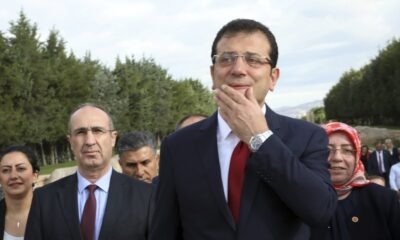
Businessman alleges Imamoğlu’s financing scheme in major Turkish graft case