
Politics
Pope wraps up Türkiye visit as he reaches out to Orthodox community

Pope Leo XIV’s first trip to Türkiye ended on Sunday after four days. The pontiff, who received warm welcome by Türkiye’s Christian community, was set to depart for Lebanon with a message of peace for the crisis-mired nation.
On the last day of his visit, his first trip overseas since being elected leader of the world’s 1.4 billion Catholics, Leo participated in several Sunday services in another demonstration of his desire for greater unity among different branches of the Church.
At the Armenian Cathedral, Leo said had words of encouragement for the largest of Türkiye’s Christian communities that counts some 50,000 members, thanking God “for the courageous Christian witness of the Armenian people throughout history, often amid tragic circumstances.”
It was an apparent nod to mass deaths of Armenians during the Ottoman rule between 1915 and 1916. Türkiye rejects the term of genocide for mass deaths, something that soured the relations with Armenia.
“The Armenian people do not forget the popes who raised their voice in our times of suffering, who stood with Christian communities in danger and who upheld truth when the world hesitated,” Armenian Patriarch Sahak Mashalian said. And he prayed Leo’s influence would help ensure the safety of “vulnerable Christian communities” in the Middle East, saying: “May the good Lord make you an angel of peace in those bleeding lands to herald glad tidings of enduring peace among war-worn peoples.”
Pope Francis did not visit any Armenian sites during his visit to Türkiye in 2014, but on his way to the airport before departing, he made an unscripted stop at a hospital where the ailing Armenian Patriarch Mesrob II was being treated. A year later, Francis drew Ankara’s ire by referring to the deaths of Armenians during the Ottoman era as “the first genocide of the 20th century.” He later visited Armenia, where he again used the term genocide.
Leo’s visit comes as Türkiye and Armenia appear to be moving closer toward a normalization of their ties and the pontiff’s visit is likely to lend support to those efforts, said Richard Giragosian, the founding director of the Regional Studies Center based in Yerevan, Armenia.
“More than just the symbolic importance of bringing the Vatican closer to the Armenian Church in terms of the eastern religion outreach, (the visit) is also, in some ways, promoting Armenia-Turkish normalization,” Giragosian told AP.
Türkiye and Armenia have no formal diplomatic ties and their border has remained closed since the 1990s. In 2021, the countries agreed to work toward normalization, appointing special envoys to explore steps toward reconciliation and reopening the frontier. Those talks have progressed in parallel with efforts to ease tensions between Armenia and Azerbaijan, a close Turkish ally. Türkiye supported Azerbaijan during its 2020 conflict with Armenia for control of the Armenian-occupied Karabakh region. Armenian Prime Minister Nikol Pashinyan visited Türkiye in June for talks with President Erdoğan. He later told a group of Turkish journalists in Yerevan that pursuing international recognition of the genocide is not among his government’s priorities, while emphasizing the genocide is an “indisputable fact” for Armenians.
The American pope then went to take part in a divine liturgy, the Orthodox equivalent of mass, at the Patriarchal Church of St. George, its glittering interior echoing with chants and ancient liturgy, the air filled with incense.
But before all his public duties, Leo met privately with a bereaved father whose 14-year-old Italian Turkish son died in February after being stabbed at a market in Istanbul.
“Today I cried, but I cried tears of joy, I came for Mattia Ahmet,” Italian chef Andrea Minguzzi said of his son in remarks to reporters afterwards, thanking the pope for meeting him and “fulfilling one of the greatest dreams of my life.”
“I wrote a letter two weeks ago and he received us today. I asked him for his support for our mission of peace and brotherhood. He is praying. This may be the best thing for us,” he said, fighting back tears.
Leo was to have lunch with Patriarch Bartholomew I, the leader of the world’s Orthodox Christians, a day after they signed a joint declaration pledging to take “new and courageous steps on the path towards unity.”
Despite doctrinal differences that led to the Great Schism of 1054 that divided Christians between the Roman Catholic Church in the West and the Eastern Orthodox Church, the two sides maintain dialogue and hold joint celebrations.
Pope Leo, the fifth pontiff to visit Türkiye, after Paul VI in 1967, John Paul II in 1979, Benedict XVI in 2006 and Francis in 2014, began his trip by holding talks with President Recep Tayyip Erdoğan.
Then he travelled to Iznik for a celebration marking 1,700 years since the First Council of Nicaea, one of the early Church’s most important gatherings.
In Istanbul on Saturday, thousands of worshippers braved heavy rain to celebrate mass with him, with many travelling across Türkiye to join the multilingual service that left participants and observers deeply moved by its beautiful and haunting choral interludes.
The six-day two-nation trip is the first major international test for the first pope from the United States, who was elected head of the Catholic Church in May and whose understated style contrasts with that of his charismatic and impulsive predecessor, Francis.
Although Leo’s visit drew little attention in Türkiye, a Muslim-majority nation of 86 million whose Christian community numbers only around 100,000, it is eagerly awaited in Lebanon, a religiously diverse country of 5.8 million inhabitants.
Since 2019, Lebanon has been ravaged by crises, including an economic collapse, a devastating port blast in Beirut in 2020 and the recent war with Israel.
Speaking to Daily Sabah on Friday, a professor at Istanbul Sabahattin Zaim University, Özcan Hıdır, described the pope’s visit as theo-political and stated: “The most important aim of the visit is not theological but rather theo-political. Accordingly, through his multifaceted diplomacy concerning both the Western and Islamic worlds, the pope wishes to deliver a message from Türkiye saying ‘We can cross the threshold of peace together,’ since Türkiye is one of the most crucial actors in resolving chaos-ridden areas such as the Gaza crisis, Syria and the Russia-Ukraine war.”
Welcomed by high-ranking Turkish officials, Pope Leo XVI and Erdoğan held a meeting in Ankara on Thursday at the Presidential Complex. The two leaders discussed Türkiye-Vatican relations as well as current regional and global issues, particularly focusing on the genocide in Gaza and efforts to ensure stability in the Middle East.
“Izmit holds a ‘privileged’ position for Vatican-papal visits. The three-day visit to Türkiye, which is rarely seen in diplomacy, is on the occasion of the 1,700th anniversary of the First Council of Nicaea, regarded as a “unifying platform” where the theological backbone of Christianity was shaped,” Hıdır said.
The 1,700th anniversary of the Council of Nicaea is considered a milestone in the Church’s history. Convened in A.D. 325 by Emperor Constantine, the council gathered leaders from across the Roman Empire and produced the Nicene Creed, which is a declaration of the faith in one God in three persons: the Father, the Son and the Holy Spirit. The creed still remains a foundation of Christian doctrine today.
Moreover, Bekir Zakir Çoban, a professor from Izmir Ege University, pointed out the significance of Pope Leo’s Türkiye trip and the diplomatic ties between Türkiye-Vatican. “He is the head of a significant community in the world and carries certain titles, such as being the representative of Jesus, the successor of Peter. This is a religious title. But at the same time, he is welcomed with official protocol, because he is also a head of state with whom Türkiye has had diplomatic relations since 1960,” he noted and added, “The fact that the current pope, Leo XIV, is making his first visit to Türkiye is also meaningful. This increases the importance of the messages he will give here, both religiously and politically, especially underlining Türkiye’s position in the region. From a religious perspective, these are the lands where Christianity was born, shaped and formed.”
After meeting the pope, President Erdoğan said they discussed bilateral relations as well as “current issues that concern the collective conscience of humanity,” including forced migration, poverty, injustice, climate change and ongoing conflicts around the world. He called the visit “a very important step” that reinforces common ground between the two sides and expressed hope that their meeting would bring “benefit to all humanity.”
Esma Çakır, a senior journalist based in Rome, also noted that, “The developments in the Middle East and Ukraine – which directly concern Christians – are among the pope’s priorities. Türkiye, with its geographical and historical significance, offers him a remarkable opportunity to deliver a message of peace.”
Emphasizing Türkiye’s key role in regional tensions and global crisis, she described Türkiye and the Vatican as “responsible humanitarian actors” on the international stage, asserting: “Türkiye and the Vatican both support a two-state solution in the Palestinian question. Pope Francis, who passed away in April, enabled the Vatican’s recognition of Palestine as a state in 2015. Pope Leo XIV uses a more cautious tone compared to his Argentine predecessor. He frequently expressed his deep sorrow over what has been happening in Gaza and called for immediate humanitarian aid for civilians, as well as a cease-fire and peace.”
“Türkiye’s role as an important actor within the Islamic world and the Vatican’s choice of Türkiye for this visit signals not conflict or division based on faith, but a pursuit of mutual understanding and dialogue,” she also noted.
Referring to his upcoming engagements in Türkiye and Lebanon, Pope Leo reiterated his intention to stress the importance of peace for everyone in the world. He also called on all people to unite in pursuing peace, noting that despite differences in religion and beliefs, humanity is fundamentally connected, and he hopes to contribute to efforts promoting peace and global unity.
In this respect, Hıdır stated that Türkiye’s growing impact in the region and “the fact that the Patriarch of Jerusalem delivered to President Erdoğan the ’emanname’ (letter of protection) that Caliph Omar gave to Christians in Jerusalem during the conquest is meaningful. This will bring about a diplomatic shift in the world from geo-politics to theo-politics, or what can be called religious-cultural diplomacy, revealing the growing importance of theo-politics.”
Regarding the Catholic and Orthodox Church’s meeting, comments such as “the churches are uniting” would not be accurate, Çoban noted, stressing that: “This is a courtesy meeting. It is also important for the peace message to be given together. With reference to the Council of Nicaea, the pope previously described it as one of the most fundamental elements that united Christians. Indeed, it is. It can almost be said that the Council of Nicaea is the only point where all Christians united. However, as I mentioned, the issue of the churches uniting is not possible because these churches are completely different in cultural, religious and ritual aspects.”
“Despite lacking military or economic power, the Vatican positions itself as a strong soft power actor in international relations through its moral authority, historical legacy and religious influence,” Çakır indicated.
The Ministry of Family and Social Services and the EU Delegation to Türkiye signed a protocol Thursday in Ankara to cooperate on social integration and education programs for foreign nationals in the country. Minister Mahinur Özdemir Göktaş and EU Ambassador to Türkiye Aivo Orav attended the signing ceremony.
The Social Safety Net with Education for Refugees protocol continues cooperation between the bloc and Türkiye that intensified during the escalating plight of Syrian refugees in Türkiye’s neighbor during the civil war there.
Göktaş told journalists that they already had two projects in cooperation with the EU and the Turkish Red Crescent (Kızılay) and were now merging them into a stronger assistance structure.
“This program will also help boost children’s school attendance, and we will provide support to their families,” she said.
Göktaş said the welfare state is the invisible force that keeps societies together.
“The welfare state is the backbone of society. It keeps families, children and the future together without allowing them to be shaken. It provides a secure source of support that people can rely on in difficult times. Türkiye’s approach to the welfare state is built on embracing all segments of society and making opportunities accessible to everyone,” she said.
Göktaş said that under the leadership of President Recep Tayyip Erdoğan, they had transformed this approach into a helping hand reaching every corner of the country.
“Through the extensive service network of social assistance and solidarity foundations, we have established a presence at the points closest to citizens. We have further expanded this structure with our field teams, who visit households one by one and listen to the concerns of every family. Through our Integrated Social Assistance Information System, we also deliver our support to citizens quickly, fairly and transparently. The World Bank and the Council of Europe cite this system as an example of good practice. With the Monitoring Unit we established last year, we closely track changes on the ground in real time,” she added.
“We reach families quickly, before their needs become more severe, and stand by them. Through this system, we identified more than 35,000 households within one year and directly reached more than 19,000 households. At the same time, our social risk maps allow us to identify in advance what is needed and where. We address vulnerabilities in different areas, from children and women to people with disabilities, older people and families, in a holistic manner. ‘Through the Family Guide and Children Are Safe’ programs, we regularly monitor households and quickly activate the services they need.”
Minister Göktaş said Türkiye is a country committed to sharing goodwill without regard to borders, adding that it embraces everyone who regards the country as home with compassion, extending a helping hand to those in need and opening its doors to those who knock.
Göktaş said the project they had been implementing since 2016 would be strengthened through the agreement, adding that they would launch a new structure for the Social Cohesion and Education Assistance Program for Foreigners.
Göktaş said they would continue to channel financial support provided by the European Union to vulnerable households through the program.
“We will continue to support families’ basic needs, such as food, shelter and education, through regular cash assistance. In this way, we will provide greater support to families in meeting their basic needs. We will help them integrate into society and lead their lives more safely. Through this program, we will also further strengthen children’s ties to school. We will continue to provide support to the families of children who attend school regularly.”
Aivo Orav, head of the EU Delegation to Türkiye, said another important step had been taken in the EU and Türkiye’s longstanding cooperation to support refugees, noting that Türkiye had assumed an extraordinary responsibility by hosting millions of refugees.
Orav emphasized that addressing migration issues through partnership, unity and close cooperation was the best approach, saying: “Today, with the signing of the Social Cohesion and Education Assistance Program for Foreigners, implemented with a contribution of 402 million euros ($449 million) from the European Union, we are reaffirming this commitment.”
Orav said they planned to provide an additional 203 million euros to the program next year, bringing total support to 605 million euros, and added that the program would help children build a better future.
Orav said poverty, education and child protection were interconnected, adding that the program aims to ensure children attend school regularly and strengthen their links with social services.

Speaking at a joint news conference with visiting Hungarian Foreign Minister Anita Orban on Thursday in Ankara, Foreign Minister Hakan Fidan said Türkiye was considering defense assistance to Saudi Arabia amid tensions with the Houthis in Yemen. He was answering questions about the Mecca Joint Defense Alliance, which was signed by Saudi Arabia and Pakistan. “This is a defense pact, not a pact of offense; Türkiye won’t send troops to another country for attacking another,” he said.
He also noted that the agreement on the alliance would soon be sent to Parliament for ratification.
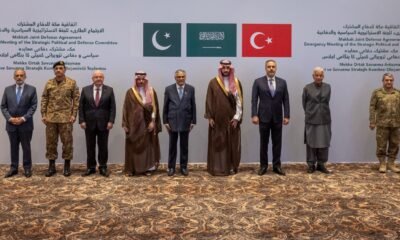
Fidan and Defense Minister Yaşar Güler joined Pakistani officials in Saudi Arabia’s Riyadh on Oct. 5 for the Strategic Political and Defense Committee of the alliance. This second meeting of the alliance after its inauguration in Istanbul was followed by a blunt statement underlining the collective defense and a pledge of military assistance to Saudi Arabia amid attacks by the Houthis.
“The Mecca agreement is a defense agreement; it is not an agreement of offense. If one country that is a party to the agreement is attacked, you are required to stand with it for the defense,” he stressed.
“Türkiye will not send soldiers to another country for an assault. We are forming a defense cooperation with Saudi Arabia. We are discussing what type of defense measures are needed through our military delegations, and how Pakistan can contribute. Saudi Arabia already has a major military infrastructure; they have a high amount of weapons, munitions and defense elements accumulated over the years,” Fidan said.
The Turkish opposition also claimed that Türkiye would not be able to send troops to Saudi Arabia as the agreement on the alliance was not ratified by Parliament yet. Fidan responded to this and said that they had completed the work to send it to Parliament. “We presented it to the president on Wednesday and decided to send it to Parliament as soon as possible,” he stated.
Sabah newspaper reported on Wednesday that Türkiye would provide low- and medium-altitude aerial defense systems to Saudi Arabia along with assistance in drone technologies and electronic warfare. The newspaper also reported that Saudi Arabia was working on setting up a base for Türkiye. A Foreign Ministry official told Daily Sabah that the Saudi side conveyed “some expectations” to Türkiye and they would examine those.
The move is the most concrete step since the agreement was signed in August by top officials of Türkiye, Pakistan and Saudi Arabia to showcase the impact of the alliance in the broader region.
As civil war in Yemen flared up this summer, the Houthis spread it to Saudi Arabia, prompting the central government in Yemen to launch an all-out operation against the group this week. Saudi Arabia’s oil and military installations are among the main targets of the Houthis.
Black Sea security
Fidan also touched upon the issue of Black Sea security after reports of multiple attacks on commercial vessels that escalated during the Russia-Ukraine war. Turkish-owned vessels in particular suffered from the drone attacks. Syria reported that nine citizens working as sailors on a commercial ship owned by a Turkish company went missing after a drone strike off the coast of Bulgaria early Tuesday. Eighteen Turkish and Indian crew members were rescued from the ship that caught fire.
Fidan said Türkiye had worked since the beginning of the conflict to prevent its spillover into the Black Sea, citing Türkiye’s tight enforcement of the Montreux Convention for passage through Turkish straits and a landmark grain deal. He added that the spillover was happening now.
“Increasing attacks on civilian vessels pose a grave threat to the safety of people, commodities and routes in our region. Regional countries and the international community should not allow a new front in the Black Sea, but unfortunately, with the conflict spreading across multiple fronts, it is emerging in the Black Sea as well,” he said.
Media reports on Thursday revealed how a deputy mayor amassed an otherwise improbable fortune through corruption, along with a huge cache of munitions for pistols.
Security forces have recently raided several locations on allegations of corruption at the municipality of Yahşihan, a small town in Kırıkkale, a province neighboring the capital, Ankara. Nine suspects, including acting Mayor Aydın Demirdirek, were detained while a total of 2,031 properties suspected of being obtained through bribery and illicit gains were seized.
The investigation revealed that deputy mayor S.S.Y., detained in the operation, owned 1,630 properties while Demirdirek had 11. Assembly members F.D. and Ö.H. owned 32 and 22 properties, respectively, an unnatural wealth apparently accumulated through corruption. A search of the residence of S.S.Y. also led to the discovery of an unlicensed pistol and a record amount of 11,312 rounds of ammunition.
Investigators also listed other unusual findings in the case, including 336 properties owned by the spouse, mother-in-law, sister-in-law and another suspect linked to U.B., former head of the municipality’s department issuing zoning and construction permits. Authorities said the assets owned by the suspects sharply contrasted with their official declaration of income. U.B. is also accused of laundering money, based on a suspiciously high amount of cash transfers between him and other suspects in the case.
Two former mayors of Yahşihan, from the ruling Justice and Development Party (AK Party) and government ally Nationalist Movement Party (MHP), were among 15 suspects remanded into custody last month on charges of corruption.
Ahmet Sungur and Osman Türkyılmaz were detained along with their deputies, municipal assembly members and businesspeople on Sept. 24. They are accused of running a criminal organization, bribery, rigging public tenders and fraud.
A crackdown on municipalities where mayors are suspected of corruption began a few years ago in Istanbul and soon spread across the country. Most of those arrested or detained for corruption are from the opposition Republican People’s Party (CHP). Probably the most notable among them is Ekrem Imamoğlu, mayor of Türkiye’s most populous city, Istanbul. Imamoğlu was arrested last year.
The head of Türkiye’s National Intelligence Organization (MIT), Ibrahim Kalın, met with Syrian Foreign Minister Asaad Hassan al-Shaibani in Ankara to discuss bilateral security cooperation, the integration of former SDF elements, counterterrorism efforts and regional stability, Turkish security sources said Thursday.
Kalın held talks with Syrian Foreign Minister Asaad Hassan al-Shaibani in the capital Ankara, focusing on strengthening bilateral ties and coordinating efforts to address regional security challenges.
According to security sources, the meeting covered Türkiye-Syria relations, potential areas of cooperation, ties with neighboring countries and measures aimed at promoting regional stability.
The officials also reviewed the status of the integration process following the dissolution of the Syrian Democratic Forces (SDF), while emphasizing the importance of maintaining close coordination in the fight against terrorist organizations, including Daesh.
The discussions addressed continued Israeli attacks in southern Syria and their implications for the country’s security and territorial integrity.
Kalın and al-Shaibani also examined the impact of the lifting of U.S. sanctions on Syria, particularly the potential benefits for rebuilding and strengthening the country’s defense capabilities.
The talks come as Ankara and Damascus seek to consolidate security cooperation following the dissolution of the YPG-dominated SDF and its integration into Syrian state institutions.
The integration process stems from agreements reached between the Syrian government and the SDF in March 2025 and January 2026, aimed at bringing armed groups, security structures and civilian institutions under central government authority.
In August, the SDF leadership announced that the integration of its military, security and administrative structures had been completed. Türkiye subsequently welcomed the group’s dissolution, describing it as an important development for Syria’s stability and territorial unity.
Ankara considers the YPG the Syrian branch of the PKK terrorist group, which has waged a decadeslong insurgency against the Turkish state. Türkiye has consistently called for a unified Syrian army and the elimination of armed groups operating outside Damascus’ authority.
Cemil Tugay, mayor of Türkiye’s third-largest city, Izmir, joined the ruling Justice and Development Party (AK Party) on Wednesday in a landmark move for the party, which has failed to win the city for years.
The AK Party portrayed the move as ushering in a new era for the Aegean city, which has been beset by chronic problems for years, with a video showing flowers blossoming over mountains of garbage as it announced Tugay’s switch.
Expectations are high following the switch, given the successful track record of AK Party-run municipalities in public services. Locals hope the new era will turn around the fortunes of a city grappling with pollution in the Gulf of Izmir, uncollected garbage, infrastructure shortcomings and transportation problems.
Tugay pledged that “good things are in store” for Izmir after joining the party. The mayor had been serving as an independent after resigning from the opposition Republican People’s Party (CHP), which has dominated municipal elections in Izmir for the past two decades.
Izmir has been under the spotlight since the 2024 local elections, particularly over strikes by workers and civil servants at district municipalities, from Karabağlar, Konak and Karşıyaka to Buca and Bayraklı. Delays in salary payments since the 2024 vote led to strikes whose impact was most visible in uncollected garbage piling up on the streets and threatening public health.
The garbage problem is the first emergency, and the municipality is expected to shut down a landfill in the Çiğli district and build new solid waste disposal facilities.
Second, severe sanctions are expected against businesses and individuals polluting the Gulf of Izmir, which has suffered mass fish deaths. A wastewater treatment plant that has been left to deteriorate will undergo a major renovation. This is expected to help the city tackle the nightmarish stench that engulfs Izmir, particularly in the summer.
Another issue requiring attention is urban transformation, including the demolition and renewal of decaying housing projects. Amid a corruption scandal involving the construction of new housing projects, Tugay’s predecessor, Tunç Soyer, was arrested last year, while some housing projects have remained incomplete for the past five years. Under the new administration, urban transformation projects are expected to be accelerated, particularly for low-income families.
The municipality is also expected to launch a drive to renew roads across Izmir, many of which have become riddled with potholes due to inadequate maintenance.
In terms of transportation, new projects are underway, including the construction of a new bypass and increased investment in railway systems.
Bilal Saygılı, chairperson of the AK Party’s Izmir branch, said they would work in coordination with Tugay to resolve the city’s problems. Yaşar Kırkpınar, an AK Party lawmaker from Izmir, described Tugay’s switch as a turning point for Izmir’s future and public services.
Ceyda Bölünmez Çankırı, another AK Party lawmaker from Izmir, said the city had longed for “real municipal services for years” and that they would work hard to deliver them to residents under Tugay’s leadership.
Turkish Cypriot President Tufan Erhürman and Greek Cypriot leader Nikos Christodoulides are set to meet on Oct. 13 in the United Nations-controlled buffer zone on the divided island of Cyprus, according to reports Wednesday.
The meeting between the leaders of the Turkish Republic of Northern Cyprus (TRNC) and the Greek Cypriot administration is scheduled for 3:30 p.m. local time and is expected to focus on efforts surrounding the Cyprus issue and confidence-building measures.
The two leaders last met on Sept. 17 at the office of the U.N. Good Offices Mission in the buffer zone. Their closed-door talks, which began at 11 a.m., lasted approximately two hours.
Following the meeting, the U.N. said Erhürman and Christodoulides had exchanged views on confidence-building measures, methodology and substantive aspects of the Cyprus issue.
Erhürman said after the talks that the two sides had yet to reach an agreement on confidence-building measures.
“On the remaining substantive issues, the two sides are only at the stage of listening to each other’s thoughts and views. That is the clear picture,” he said, noting that the meeting was “better” than their previous talks but that the sides remained at the stage of listening to each other’s positions on substantive issues.
He also stressed that concrete progress on the island would be necessary before another meeting could be held in an expanded format.
Erhürman and Christodoulides later traveled to New York for the U.N. General Assembly following their Sept. 17 meeting. The two leaders did not hold a bilateral meeting during their time in New York, although talks were held between their respective delegations.
Cyprus has remained divided for more than five decades between the Turkish Cypriot north and the Greek Cypriot south despite a series of diplomatic efforts by the U.N. to achieve a comprehensive settlement. The TRNC was established in 1983 and is recognized only by Türkiye, while the Greek Cypriot administration represents the island internationally and joined the European Union in 2004.
Turkish officials and leaders in Turkish Cyprus have increasingly advocated a two-state solution to the dispute, arguing that decades of United Nations-led negotiations for a federal settlement have failed to produce results.
The upcoming Oct. 13 meeting comes as efforts continue to find common ground between the two sides and determine the next steps in the long-running Cyprus issue.


-
 Politics3 days ago
Turkish police detain 14 suspects linked to Daesh, al-Qaida
-
 Economy3 days ago
Over $16B shifted into deposits amid fund exits: Turkish central bank
-
 Economy2 days ago
Inside Türkiye’s plan to repay investors caught up in fund turmoil
-
 Politics3 days ago
Mecca Alliance activates collective deterrence over Saudi attacks
-
 Economy3 days ago
Türkiye sets new record for solar, wind power generation
-
 Economy21 hours ago
Trump says anyone who doesn’t call AI ‘super intelligence’ is ‘enemy’
-
 Politics3 days ago
Erdoğan denounces Israel’s state terrorism on Gaza genocide anniversary
-
 Economy2 days ago
CBRT chief vows cautious stance to preserve disinflation gains