
Refugees
Trump sidetracks NATO with new Iran strikes while in Turkey

ANKARA, Turkey (AP) — President Donald Trump surprised NATO leaders he is meeting with in Turkey by launching a series of strikes on Iran late Tuesday and revoking a license that allowed Tehran to sell its oil on the world market, a major twist for a summit that had been aimed at showcasing how alliance members were stepping up spending on defense and focusing on support for Ukraine’s war with Russia.
The strikes were retaliation after three merchant ships were struck in the Strait of Hormuz, and underscored the fragility of an interim deal to end months of fighting between the two countries. Trump launched the attacks shortly after leaving a dinner hosted by Turkish President Recep Tayyip Erdogan where the leaders of the alliance’s 32 member countries had gathered ahead of Wednesday’s talks meant to focus on progress made toward meeting NATO’s spending targets.
Trump did not directly address the strikes Tuesday night. It is rare for U.S. presidents to launch military action while outside the U.S., though in 2011 former President Barack Obama authorized strikes in Libya while on a trip to Brazil.
European allies and Canada had been wary that Trump might raise fresh grievances over the U.S.-Israeli war on Iran, which they were never consulted about. Trump had demanded “loyalty” and branded NATO a “paper tiger” after some allies refused to grant open access to their bases for U.S. forces to attack Iran.
On Tuesday, during a meeting with Erdogan, Trump said he had been testing NATO allies when he asked for their help with the Iran war. “Italy turned us down and Germany turned us down and France turned us down,” Trump said. “And that’s OK. But, you know, why are we spending hundreds of billions of dollars and they’re not there for us?”
NATO leaders had been trying to show Trump how they were boosting defense
NATO summits are designed to be a show of unity aimed at deterring any potential adversary — a resolve more important than ever as Russia continues to wage war on Ukraine, and concerns mount that other European countries could be targeted.
In an attempt last month to mollify the U.S. leader, NATO Secretary-General Mark Rutte went to Washington to hail the “Trump Trillion” — the $1.2 trillion that European allies and Canada have added to defense spending since Trump came to power in 2017.
As leaders converged on Ankara, Rutte hosted a “big reveal” event to showcase the many deals planned for that money — much of it to be spent on U.S. companies, creating thousands of jobs for Americans.
NATO diplomats and officials had hoped that Trump would take the win, but judging by some of his remarks since arriving in Turkey, they are in for yet another dressing down.
Trump reopened old wounds over Greenland on the eve of the meeting by insisting that the United States should control the semiautonomous island rather than NATO ally Denmark. NATO is founded on the principle that its 32 members will defend each others’ territory, not threaten to seize it.
NATO braces for Trump’s grievances
Trump has long argued that the U.S. carries more than its fair share of the defense burden for NATO. At last year’s summit, the allies had agreed to invest 5% of their gross domestic product on defense — 3.5% on their defense budgets and 1.5% on roads, bridges and ports so troops and equipment can move faster in times of conflict.
Rutte had demanded ahead of this year’s meeting that members put forward “clear, concrete and credible plans” to reach the organization’s defense spending targets.
New figures released by NATO on Tuesday showed that Slovenia, Belgium, Spain and the Czech Republic could be in hot water with the Trump administration as they struggle to meet the alliance’s old target of investing 2% of their GDP.
The Trump administration wants to see a more lean and lethal “NATO 3.0,” with Europe taking responsibility for its own security, including Ukraine, with conventional weapons while America would continue to provide its nuclear umbrella.
However, European allies and Canada are still seeking clarity on just how deeply Trump intends to cut U.S. force numbers in Europe.
The Pentagon has launched a 6-month review of that presence and the drawdowns could depend on how fast the European allies increase defense spending and whether they are prepared to allow greater use of their bases.
Ukraine’s Zelenskyy pushes for NATO entry
President Volodymyr Zelenskyy made a fresh appeal Tuesday for Ukraine to be allowed to join the alliance, saying Ukrainian armed forces are highly experienced and would only boost NATO’s defense capabilities.
Zelenskyy, who is expected to meet with Trump in Ankara on Wednesday, highlighted Ukraine’s adaptability and its ability to strike deep inside Russia, hit Moscow’s oil refineries and other energy targets. He said Ukraine’s armed forces are “eliminating” on average 30,000 Russian troops every month.
Concern has been mounting among some northern, central and eastern European countries that Russia might be preparing a hybrid attack — a combination of conventional warfare with tactics like cyberattacks — on the continent as Russian President Vladimir Putin struggles to secure victory in Ukraine.
Trump will also meet with Syrian President Ahmad al-Sharaa, a former insurgent who led the offensive that unseated autocrat Bashar Assad in December 2024. Despite having once been an al-Qaida fighter, al-Sharaa has won Trump’s backing as he seeks to rebuild Syria and restore its long-shattered ties with the West.
Trump has repeatedly suggested that al-Sharaa would do a better job of rooting out Hezbollah in Lebanon than the Israeli army, raising alarms in Lebanon and Israel alike. The Syrian leader has said he has no interest in doing so.
BEIRUT (AP) — The U.S. special envoy to Syria and ambassador to Turkey on Sunday walked back his comments from two days ago that Israel “still” occupies the Golan Heights in violation of U.N. resolutions, remarks that went against U.S. President Donald Trump ‘s position on the disputed territory.
Israel captured the Golan Heights from Syria in the 1967 Mideast war and annexed it in 1981. The United Nations and most of the international community consider the territory occupied Syrian land and does not recognize Israel’s annexation of it.
In 2019, Trump recognized Israeli sovereignty over the territory, reversing decades of U.S. policy.
Ambassador Tom Barrack on Friday said that Israel “still” occupies the territory in an interview with Lebanese-Australian entrepreneur Mario Nawfal.
Barrack now says that was a description of the territory’s historical status, “not an endorsement of the United Nations’ position” on the Golan.
“United States policy on the Golan was set by President Trump in 2019 and is unchanged,” he said in a statement to The Associated Press on Sunday.
He said he intended to explain why he does not anticipate annexation in Lebanon, where Israeli forces are occupying parts of the south after the latest Israel-Hezbollah war, and to argue that negotiated agreements, rather than territorial maps, are more durable and that he had cited the Golan as an example that “territory taken by force remains contested for generations.”
In the Friday interview, Barrack had also criticized Israel’s strikes on an airbase in northern Syria earlier last week. Israeli officials said the strikes intended to prevent Turkey from establishing a presence at the base.
Israeli Defense Minister Israel Katz defended the strikes, saying on X on Sunday that critics who initially called it “unnecessary and politically motivated” changed their position after the government said they were based on “clear intelligence” and at the recommendation of the Israeli army. He added that Israel would not allow Turkey “to establish itself in Syria and threaten Israeli security.”
The strikes last Tuesday have highlighted growing tensions between Israel and Turkey over Ankara’s increased influence in Syria following the fall of Bashar Assad. Turkey and Syria have denied that Turkish forces were due to be deployed at the Abu Duhur base.
Barrack’s comments on the Golan also sparked a backlash in Washington.
Florida Republican Sen. Rick Scott wrote on X that the ambassador appears to have “forgotten” Trump’s recognition of Israeli sovereignty over the territory.
Barrack went further on the defensive on Sunday, responding to criticism of his assessment of ongoing negotiations between Israel and Lebanon over Israeli withdrawal and the disarmament of the militant group.
He had said “there are two people missing from that (negotiating) table – Hezbollah and Iran.” That remark prompted speculation Barrack meant Tehran and Hezbollah should join the U.S.-backed negotiations.
On Sunday, Barrack stressed that the U.S. does not negotiate with Hezbollah, but said he was pointing out that “the weapons in question are supplied and financed by Iran,” which complicates negotiations over their fate.
“I was describing the difficulty of the problem, not proposing a new table,” Barrack told the AP. “Hezbollah is a designated foreign terrorist organization. We do not negotiate with it, and nothing I said suggests otherwise.”
He also defended his remarks questioning who would replace Tehran’s financial support for Shiite communities in southern Lebanon, saying that raising those questions was “not conferring standing on anyone.”
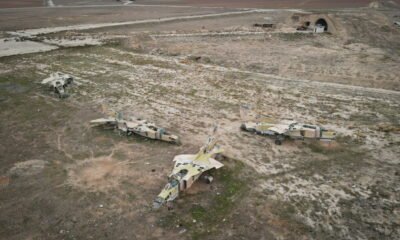
ISTANBUL (AP) — Israel did not warn the United States before it struck an air base in northern Syria this week, despite fears of an escalation with Turkey, the U.S. special envoy to Syria said.
Tom Barrack, who also serves as ambassador to Turkey, said the attack on Tuesday on the Abu Duhur base could have been Israel “baiting the Turks … that was the serious and worrying part.”
In the wake of the strikes, which caused damage but no casualties, the office of Israeli Prime Minister Benjamin Netanyahu said the base was attacked because Syria was “on the verge of breaching” an agreement by allowing Turkish troops to deploy there.
Barrack said it was likely that Israel had intelligence suggesting Turkey may be bolstering its presence in the area and “a commander somewhere in the field made a decision ‘We’re not going to let that happen’… What they didn’t do is tell us or Turkey.”
He added that another possible reason for the attack was miscommunication between the Israel’s military and intelligence agency.
Abu Duhur lies around 80 kilometers (50 miles) east of the Turkish border.
“When they (the Turkish military) see these jets coming towards the border and they don’t know what the purpose, direction or intention is, they start to say ‘We’re going to have to scramble our own,’” Barrack said as he outlined how close Israel and NATO member Turkey came to direct confrontation.
He pointed out that Turkey had shot down a Russian jet over its Syrian frontier in 2015.
The ambassador’s comments were published on X late Friday by Mario Nawfal, a Lebanese-Australian entrepreneur.
Two Syrian officials, who spoke on condition of anonymity because they were not authorized to comment publicly, said on Wednesday that a Turkish delegation had visited the air base in the northwestern province of Idlib a day before the air strike to review reconstruction work underway there.
Israel had raised concerns about Turkish military activity at the air base but the U.S. concluded that was “not happening,” Barrack said.
“The unintended consequence of a mistake could be really consequential,” he added.
Turkey has been supporting Syria’s effort to rebuild its armed forces by training Syrian personnel and supplying equipment and logistical support. The two countries signed an agreement last year that formalized their military cooperation.
Turkish officials have repeatedly stated that Ankara does not consider Syria’s security separate from its own.
Israel, meanwhile, has remained suspicious of the new authorities in Damascus, led by former Islamist insurgents. Syria’s interim President Ahmad al-Sharaa has said repeatedly that he does not want a conflict with Israel.
Israel carried out hundreds of airstrikes around Syria after the fall of Bashar Assad’s government in late 2024. The Israeli military also seized control of a U.N.-patrolled buffer zone in southern Syria, which it continues to occupy.
Turkey, which recently signed a defense pact with Saudi Arabia and Pakistan, gave no indication that it would respond militarily to the Israeli strikes in Syria, but the incident added further strain to already tense Turkish-Israeli relations.
___
Associated Press writer Ghaith Alsayed in Damascus, Syria, contributed to this report.
Iran’s president says the world has accepted that it’s won the war with the United States and remarks by the U.S. Ambassador to Turkey and special envoy for Syria appear to contradict official U.S. position over the Golan Heights.
Here’s a look at the latest developments in the Iran war and the wider Middle East on Saturday. Full coverage can be found here.
Iran’s President says the world has accepted that Iran won the war
Iranian state media reported Friday that President Masoud Pezeshkian said the war with the U.S. should end since the world has already accepted that Iran has won.
“The entire world approved our victory and the U.S. is hated,” he said according to IRNA news agency.
The remarks came as the Trump administration is touting a crushing financial campaign against Iran, promising an “economic D-Day” against the country. President Donald Trump announced that the U.S. would be imposing an “unprecedented” level of economic warfare and isolation on Iran, aiming to force its leadership to cave to demands to end its nuclear program and fully reopen the crucial Strait of Hormuz to oil and natural gas tankers.
U.S. Ambassador to Turkey and special envoy for Syria appears to contradict official U.S. position on the Golan Heights
In an interview Friday, Tom Barrack said that Israel “still” occupies the territory in violation of U.N. resolutions.
In his comments made to Mario Nawfal, a Lebanese-Australian entrepreneur, Barrack said that “in the Golan, with Syria, they (Israel) still occupy the Golan, against the U.N. resolutions.”
Israel captured the Golan Heights from Syria in the 1967 war and annexed it in 1981. The U.N. considers the territory occupied Syrian land and the annexation null and void, with U.N. resolutions calling for Israel’s withdrawal to the June 4, 1967, line.
In March 2019, Trump signed a proclamation recognizing Israeli sovereignty over the Golan Heights, reversing decades of U.S. policy. The move did not change the territory’s status under international law or win broader international recognition.
Colombia became the second country to recognize Israeli sovereignty over the Golan this month, joining the United States.
Barrack’s remarks sparked a backlash Saturday from conservative activist and U.S. presidential ally Laura Loomer, who posted on X that he “should resign for his lack of understanding of U.S. foreign policy.”
A projectile hit a ship as it sailed out of the Strait of Hormuz early Tuesday, according to the British military’s UK Maritime Trade Operations center, and an Iranian official said the waterway would not be reopened until the United States meets Iran’s conditions.
There was no immediate claim of responsibility but the attack highlights the danger of attempting to transit the strait as Iran throttles shipping traffic, even as it finalizes negotiations with Oman on a plan to manage the passage that’s critical to global supplies of oil and natural gas.
Here’s a look at the latest developments Monday in the Iran war and the wider Middle East. Full coverage can be found here.
A casualty is reported after a ship is hit in the strait
An unidentified projectile damaged the ship’s engine room and “resulted in a crew casualty” off the coast of Oman, the UKMTO said, citing a report from the company’s security office.
The maritime monitoring agency did not release any details about the ship or its cargo, and it was not clear whether the crew member was killed or wounded. It said the Omani Coast Guard was assisting other crew members and authorities were investigating.
There has been growing concern about oil spilling into the Persian Gulf and other area waters from vessels damaged as they attempted to transit the strait. The UKMTO said no environmental damage had been reported in the latest attack.
Iran effectively closed the strait — through which roughly one-fifth of the world’s traded oil supplies passed before the war — after Israel and the U.S. attacked the country on Feb. 28.
The U.S. is currently blockading Iranian shipping traffic through the strait.
Iran’s parliamentary speaker and negotiator in previous talks with the U.S., Mohammad Bagher Qalibaf, reiterated Tuesday that Tehran plans to maintain its grip on shipping traffic until Washington meet Iran’s conditions.
“Until the United States fulfills its commitments under the agreement, including lifting the blockade, releasing frozen assets, lifting oil sanctions, ending threats and military operations on all fronts, and implementing the other conditions to which it committed, the Strait of Hormuz will not reopen,” he said.
With negotiations between the U.S. and Iran stalled, Iran has been holding separate talks with Oman on a plan to manage ships transiting the strait, and said Monday it was finalizing details for a joint statement.
U.S. President Donald Trump reacted angrily, reportedly telling Fox News reporter Trey Yingst in a telephone interview that the U.S. would bomb Oman if it “gets in the way.”
Following a meeting between Egyptian Foreign Minister Badr Abdelatty and Omani counterpart Badr al-Busaidi, the Egyptian Foreign Ministry said Tuesday that the Iranian-Omani deal could pave the way for Washington and Tehran to return to negotiations for a “comprehensive and permanent deal that addresses all concerns and enhances regional security and stability.”
The statement did not address Trump’s latest threat against Oman.
Iran-backed Houthis claim an attack on a Saudi oil refinery
Yemen’s Iran-backed Houthi rebels claimed they fired drones at an oil refinery in neighboring Saudi Arabia, the latest attack threatening to reignite Yemen’s civil war and open another front in the Middle East.
The attack targeted a facility run by Saudi Aramco, Saudi Arabia’s state-owned oil company, according to a report by the Houthi-run SABA news agency. There were no immediate reports of damage or comment from Saudi Arabia.
The Houthis have escalated attacks against government forces in Yemen and oil facilities in Saudi Arabia, which supports the Yemeni government, and the kingdom’s shipping in the Red Sea, an important alternative to the Strait of Hormuz.
At least 17 Yemeni civilian deaths have been reported in government-controlled areas in Yemen as a result of rebel attacks since Aug. 6, while two casualties were reported in Houthi-controlled areas in late July, the United Nations said Monday.
The attacks included a Houthi missile strike on an internally displaced persons camp in Ma’rib province and an Aug. 11 attack on a cargo ship in the Bab el-Mandeb Strait, which killed four crew members and injured several others.
Turkey urges Trump to seek a diplomatic solution to the war
Turkish President Recep Tayyip Erdogan urged Trump in a telephone call to continue to seek a diplomatic solution to the conflict with Iran.
The call came late Monday as the 60-day negotiating period to find a peace deal between the United States and Iran was expiring, with no word of an extension and both sides seemingly as far apart as they were at the start.
“President Erdogan said it is important to make maximum use of diplomacy amid tensions between Iran and the United States,” according to a statement from the Turkish presidential communications office.
Turkey, a NATO member that borders Iran, earlier this month signed a joint defense agreement with Saudi Arabia and Pakistan, which stipulates “that any armed attack against any one of the three states shall be regarded as an attack against them all.”
Trump has praised the agreement, saying that “it shows how the Middle East is coming together, and how Countries will finally be able to defend themselves in a more meaningful way.”
Erdogan told Trump the deal reflected “a strong stance to ensure regional stability and security.”
WASHINGTON (AP) — The two most senior members of President Donald Trump’s Cabinet, Secretary of State Marco Rubio and Treasury Secretary Scott Bessent, flew out of last month’s NATO summit in Turkey on what was effectively a decoy plane following an Iranian threat, while Trump was secretly moved to a smaller military jet, a senior U.S. official said Wednesday.
The official, who was briefed on the situation and spoke on condition of anonymity to discuss sensitive details of presidential travel, said Rubio was aware of the switch and details of the threat behind it but could or would not say why he had stayed on the plane. The official said Bessent was likely aware but did not know for sure.
The official, however, noted that security precautions for the president — especially one who has been the target of several assassination attempts — are more robust than those for even top members of the Cabinet.
Under the U.S. Constitution, the secretaries of State and Treasury follow the vice president and the highest ranking member of each chamber of Congress in the presidential line of succession.
Trump had flown to the annual gathering of NATO country leaders in Ankara, Turkey, in a new Qatari-gifted and retrofitted red, white and navy blue jet. But ahead of departing Turkey, he said he would fly partway home on an older-model baby blue Air Force One plane instead.
The president at the time said the new luxury jet was being flown out ahead of his departure from Ankara to give some U.S. troops based in eastern England a chance to check out the new Air Force One.
The Washington Post reported this week that Trump wasn’t on the old Air Force One on the return flight from Turkey and that he instead was smuggled onto another jet via a catering cart to avoid a possible Iranian assassination plot. The ruse was carried out as journalists and some White House staff members were led to believe they were on the same plane as the president as he began his journey back to Washington.
The New York Times and CBS News had reported last month that intelligence officials had raised concerns about a potential attack on the president or his jet, triggering additional precautions and the decision not to use the newly inaugurated aircraft gifted to Trump by Qatar for the first leg of Trump’s trip home from Ankara.
Trump acknowledged the transfer late Tuesday.
“It’s only up to the Secret Service. I just follow what they’d like to do, so I go by Secret Service and the military,” the president told reporters at Joint Base Andrews. “They wanted me to go on a different flight, a different plane, equal safety, but they wanted me to do it, so I do it, I do what they say.”
CAIRO (AP) — A drone strike ignited a fire at a electrical substation in western Libya on Wednesday, knocking the facility out of service in the latest of a wave of attacks on energy and oil infrastructure that threaten to plunge the country into further chaos.
The state-run General Electricity Company said in a statement that a power substation in the city of Zawiya that links power plants to homes and businesses was completely burned down.
The city of about 250,000 people has been rattled by a series of drone strikes that hit oil and power facilities. Zawiya is home to critical energy infrastructure, including Libya’s largest oil refinery, an export terminal and a power plant.
No group has so far claimed responsibility for the drone strikes.
The power company said the attack resulted in outages across southern parts of the city, which is located about 47 kilometers (about 30 miles) west of the capital Tripoli. Footage shared by the company showed massive flames and fireballs erupting from the facility.
Abdul-Hamid Dbeibah, the prime minister of one of Libya’s two rival governments, denounced the attacks on energy and power installations as “a serious crime and an escalation that will not go unanswered.”
“We will reach those responsible for this attack, and the accountability will be firm. No one will be protected by their position, status, or influence,” he said in a statement.
On Monday, a drone strike hit a fuel-laden tank at Zawiya’s refinery, igniting a massive blaze which firefighters battled for over 15 hours. The refinery was repeatedly attacked over the weekend and on Tuesday, according to the state-run National Oil Corporation.
The power plant was hit by two drones on Tuesday, with one damaging its firefighting system while the second landed close to the facility’s main fuel storage, setting it on fire, the electricity company said.
The attacks come as tensions are rising between the government of western Libya and warlord Mohamed Bahroun, who controls the city of Zawiya. Much of western Libya is ruled by local militias loosely allied to Dbeibah’s government in Tripoli.
The country has been divided for years between rival administrations, each backed by armed groups and foreign governments. Dbeibah governs western Libya and the administration of Prime Minister Ossama Hammad governs the eastern part of the country.
After Tuesday’s attack on the power plant, the U.S. company General Electric withdrew its teams from the facility “until security conditions and a suitable and safe work environment are ensured,” the electricity company said. GE performs maintenance and upgrading services for the plant.
GE previously withdrew its staff from the plant over security concerns, prolonging the loss of more than 700 megawatts of the station’s production capacity, estimated at 1300 megawatts, the electricity company said.
The violence came as Turkish Foreign Minister Hakan Fidan was in Tripoli to meet with Dbeibah and Mohammad Younes Menfi, chairman of the Presidential Council.
Turkey is the main foreign backer of Dbeibah’s government, but in recent years has also reached out to the rival authorities in eastern Libya in an attempt to mend ties, and as part of regional efforts to unify the North African country.
Libya, an oil-rich country on the Mediterranean, has been wracked by conflict since a NATO-backed uprising-turned-civil war toppled and killed longtime dictator Moammar Gadhafi in 2011.


-

 Sports2 days ago
Hull roar back into Premier League with 2-0 rout of Man Utd
-

 Sports2 days ago
Top 10 greatest sports rivalries in world, ranked
-
 Economy2 days ago
US imposes 50% tariffs on Canadian goods as trade talks collapse
-
 Politics3 days ago
MHP’s Bahçeli warns Israel against ‘testing Türkiye’s patience’
-
 Economy3 days ago
Iraq working to expand oil exports via Türkiye, Syria, Jordan: PM
-
 Politics3 days ago
Ankara slams ‘reckless attacks’ of Israel, backs Syria’s stability
-
 Refugees2 days ago
US envoy Barrack says Israel gave no warning ahead of Syria air strike
-

 Politics3 days ago
Turkish police catch 2 fugitives in widening Kuriş investigation