
Economy
Turkish VP calls for more funding for industrial green transition

Vice President Cevdet Yılmaz has called on leaders at COP31 to redirect climate finance toward the green transition of heavy industry, highlighting that more investment is required in sectors such as steel and cement.
“Green industrialization is one of the areas where climate goals and economic competitiveness intersect,” he said at the Business and Investment Summit held as part of the U.N. climate event. It was organized by the Turkish Union of Chambers and Commodity Exchanges (TOBB).
Yılmaz stated that global climate finance needs to surge from $2 trillion in 2024 to at least $6.2 trillion by 2035.
Emerging markets and developing economies except for China currently receive about $426 billion, he said.
“A cumulative investment need of over $500 billion is projected for low- and near-zero-emission steel and cement production during the 2026-2035 period, but projects that have reached a final investment decision currently total only $20 billion,” he noted.
“This gap shows the importance of access to financing, infrastructure, reliable demand, and long-term market predictability for transforming technological solutions into investment decisions,” he said.
In this regard, the Antalya Green Industrialization Compact, introduced during COP31, commits nations to accelerating clean industrial transitions, he said.
Yılmaz stated that reducing reliance on imported fossil fuels will be key to achieving Ankara’s 2053 net-zero emissions target, tying the green transition to industrial competitiveness.
These efforts are also expected to reduce the country’s current account deficit.
Yılmaz also highlighted the recently introduced Climate Action Bridge, a special initiative assisting developing nations in transforming their localized climate and development priorities into investable projects.
He added that modernizing grid architecture and leveraging clean technologies powered by artificial intelligence and digital energy management systems will generate real economic value once fully implemented and scaled up across the economy.

Tech shares were under pressure Thursday as investors continued to follow developments on AI giant Nvidia, whose influential boss Jensen Huang is facing a board revolt amid a probe into an affair with a woman accused of spying for China.
Reports of another affair, between Huang and a senior Nvidia executive, piled on the pressure and reportedly prompted an emergency board meeting late Wednesday.
Shares in Nvidia, which is due to report quarterly earnings next Tuesday, slid about 6% in pre-market trading.
“A leadership scandal at one of the world’s biggest companies is enough to bring the tech stock rally to a halt, and the Nasdaq is pointing to a lower open,” said Kathleen Brooks, research director at trading group XTB.
She added that the Nvidia fallout was “helping to spur a rotation into European markets that are traditionally low-tech.”
London, Paris and Frankfurt all climbed in midday deals.
Frankfurt’s blue-chip DAX reached a record high above 27,000 points thanks to healthy corporate earnings and recent optimism about the artificial intelligence boom.
Companies linked to the AI sector had enjoyed a healthy bounce in recent days after last week’s sell-off sparked by regulatory concerns following the Democratic sweep of the U.S. Congress.
But the Nvidia leadership crisis rattled investors on Thursday, sending Asian stock markets lower.
Huang faces the boot after he admitted to an extramarital affair, reportedly with Alice Huang, a senior executive at Singapore-based data centre company Megaspeed who U.S. officials believe was working for Chinese intelligence.
Beijing has rejected the spying allegations.
The New York Times reported Wednesday that Huang was also involved in a second extramarital affair, with the company’s vice president of health care, Kimberly Powell.
That prompted a last-minute board meeting, but no official announcements have yet been made on the outcome.
The stock has shed 24% of its value over the past month, wiping around $1.4 trillion off its market capitalization.
“The integrity of the $1 trillion (revenue) forecast, in the wake of this scandal, is likely to be a key question on Nvidia’s earnings call next week,” Brooks said.
Huang has built Nvidia into one of the world’s biggest and most important companies, designing advanced chips crucial to the AI buildout that has helped drive stock markets to record highs and boosted economies around the world.
But analysts say the crisis has exposed an alarming lack of a succession plan for Huang, the only CEO Nvidia has ever had.
“Nvidia has spent years convincing investors that it is one of the most important companies in the AI revolution,” wrote Charu Chanana, chief investment strategist at Saxo Markets.
“An abrupt exit without a credible succession plan could force investors to reassess how much of Nvidia’s future depends on Huang personally,” she said.
Elsewhere, Burberry shares jumped 9% after the British luxury group returned to profit in the first half of the year.
Oil prices slipped as a report showed production in the Gulf had increased despite the U.S.-Iran war, while the dollar steadied after gains seen amid growing expectations the Federal Reserve will increase interest rates next month.
Türkiye has signed 10 agreements worth $5.1 billion (TL 256.30 billion) with four multilateral development banks on the fourth day of the COP31 climate summit in Antalya, Treasury and Finance Minister Mehmet Şimşek said Thursday.
The banks include the Asian Development Bank (ADB), the Asian Infrastructure Investment Bank (AIIB), the World Bank and the Islamic Development Bank (IsDB).
Speaking at a joint signing ceremony, Şimşek said the financing would help build a greener and more resilient economy through projects that support employment, industrial modernization and green and digital transitions.
Türkiye has secured about $50 billion in external financing from development partners since 2023, he said.
The funding has supported post-earthquake reconstruction, railways, decarbonization, renewable energy, resilient hospitals, exporters and small businesses.
Şimşek also emphasized that sound economic policies and structural reforms were essential for attracting long-term investment, while national budgets alone could not cover the transition’s financing needs.
ADB President Masato Kanda outlined a 620 million euro ($687 million) agreement to build disaster-resilient hospitals, strengthen health services and train doctors.
Another $500 million will be provided through Turkish lender VakıfBank to expand long-term financing for small businesses, particularly in less developed and earthquake-affected provinces and for women entrepreneurs.
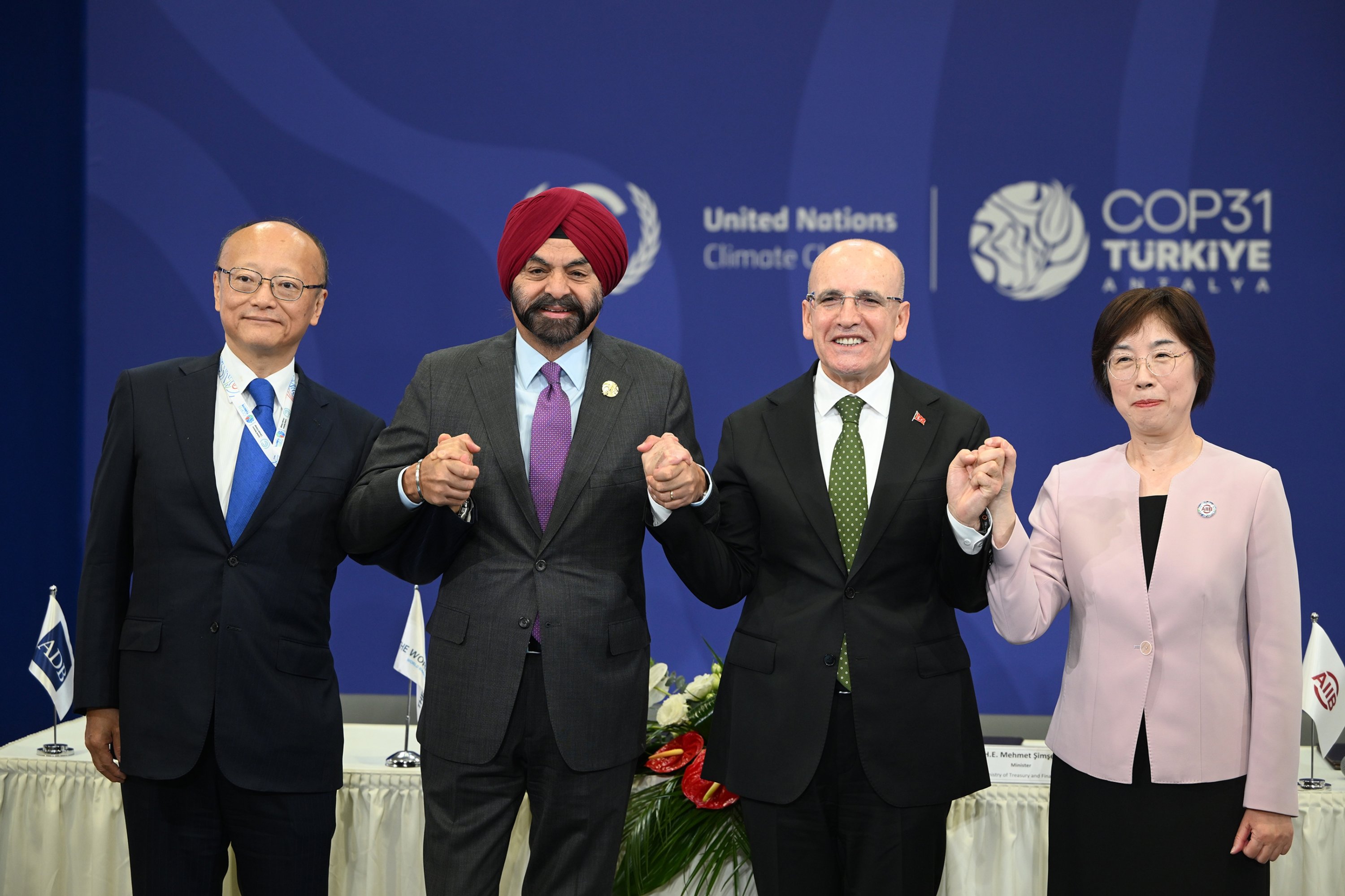
Şimşek said the agreements would bring ADB financing support to $3.1 billion.
Meanwhile, AIIB President Zou Jiayi announced $1.9 billion in financing, including $1.6 billion for Türkiye’s climate action acceleration program and additional financing.
The remaining $300 million will be channeled through Türk Eximbank to support businesses’ green transitions and resilience to economic shocks.
World Bank Group President Ajay Banga said three agreements totaling $1.5 billion would support cities, agriculture and industry, excluding additional private investment the institution seeks to mobilize.
He said the group’s portfolio in Türkiye had reached $32 billion, making it one of its largest worldwide, and highlighted the country’s economic transformation during a partnership spanning more than 75 years.
$1.6 billion for climate resilience
The Asian Infrastructure Investment Bank reached a record $1.6 billion financing deal with Türkiye to support a series of policy reforms aimed at attracting the investment it needs to hit its climate goals.
Türkiye, a founding member of the AIIB, will need an estimated $68 billion in additional climate investment by 2030, around half from private sources, the bank said in a statement on Thursday.
Covering fiscal policy, financial regulation and sectoral planning, the agreement will support the implementation of Türkiye’s Climate Law and its plan to cut planet-warming emissions, which includes an interim target for 2035 and aims to achieve net zero by 2053.
The money will help scale sustainable finance, accelerate decarbonization and boost climate resilience efforts across the country of 86 million people as global warming drives drought, floods and wildfires.
“This financing represents AIIB’s largest climate policy-based financing package to date, and we look forward to contributing to Türkiye delivering on its climate ambitions,” said AIIB Chief Investment Officer Konstantin Limitovskiy.
Help for Türkiye’s nascent trading scheme
Part of the sustainable finance support will go toward helping the country scale its nascent emissions trading scheme, under which companies in high-emitting sectors will receive and trade allowances.
A domestic carbon price could help exporters to the European Union in sectors such as steel and cement, as carbon costs paid in Türkiye can be taken into account under the bloc’s carbon border levy on emissions embedded in certain imported products.
Program targets include getting at least 180 facilities reporting baseline emissions under the scheme by April 2027 and securing production licences for 1,800 megawatts (MW) of wind and solar capacity by early 2027.
The plan also aims to help 225,000 farmers in water-stressed basins switch to less water-intensive crops by 2028 and to have 50,000 hectares (124,000 acres) designated as carbon sinks – where land absorbs climate-damaging carbon – by 2028.
As the country faces increasing pressure from water scarcity, drought, extreme heat, wildfires and urban flooding, the reform plan aims to help strengthen planning and risk management in areas including water, ecosystems and health.
The Turkish central bank revised its inflation forecasts upward on Thursday, setting a 2026 year-end forecast of 29.5% and a 21% forecast for next year, citing effects related to the war in Iran and broader geopolitical tensions.
“Supply-side shocks caused by geopolitical developments are limiting the decline in headline inflation. The continuation of this situation keeps upside risks to the inflation outlook alive and calls for a cautious policy stance,” Central Bank of the Republic of Türkiye (CBRT) Governor Fatih Karahan told a news conference while presenting the year’s final inflation report.
“We have revised our year-end 2026 inflation forecast upward to 29.5%,” he said.
He also said that the bank projects inflation to decline to the interim targets of 21% at end-2027, 13.5% at end-2028 and 9% at end of 2029.
Thus, the bank’s year-end inflation projections for 2027 and 2028 were revised upwards by 6 percentage points to 21% and 4.5 percentage points to 13.5%.
The forecast for 2029 remained unchanged at 9%, while the bank maintained its medium-term target of stabilizing inflation at 5%.
Karahan said higher oil prices, driven by rising regional tensions and fading expectations for a normalization of energy shipments through the Strait of Hormuz, had contributed to the upward revision.
“Geopolitical developments continue to be the leading risk factor in terms of further increases in oil prices and the persistence of high price levels,” he said.
Türkiye’s annual inflation rate stood at 29.77% in October, according to official data.
Inflation slightly picked up from a near five-year low of 29.73% in September, while monthly consumer prices rose 2.58%, accelerating from 1.84% in September.
Slowdown in disinflation process
Talking about the global and domestic macroeconomic outlook, Karahan flagged a slowdown in the disinflation process.
“In addition to the elevated levels of food inflation in the first months of the year, supply-side pressures stemming from the geopolitical developments at the end of February led to a deceleration in the disinflation process,” he said.
He also mentioned that deceleration in services inflation continues despite supply shocks, but pointed out that this diverges among subgroups, citing, for example, a higher-than-expected increase in the communications group and the increase in transport due to energy prices. Karahan also said that “disinflation continues in rents and other services.”
However, he also said that fresh fruits and vegetables prices cause fluctuations in food inflation.
“While inflation in fruits remains moderate owing to favorable crop production conditions, inflation in vegetables diverges from this course,” he said.
“Leading indicators suggest that the rise in vegetable prices continues in November as well,” he added.
Moreover, while raising overall forecasts for inflation, he said that the bank revised its assumptions for oil prices upwards for 2026 and 2027.
“The rise in natural gas prices has been more pronounced than that of oil prices. Disruptions in energy supply, rising refinery margins, and increasing transport costs also put upward pressure on import prices. Accordingly, we have revised our import price assumptions upwards for both years,” he also said.
The governor also said that the uncertainty concerning the economic outlook remains elevated “due to geopolitical developments, volatility in financial markets and commodity prices.”
In addition to the impact of energy and food price developments, Karahan also said that “supply shocks pose risks in terms of inflation expectations and pricing behavior.”
As for food prices, he said that the impact of the war and adverse weather conditions on international agricultural commodity and agricultural input prices remains significant.
“Moreover, price adjustments in administered items may also heighten such risks,” he said.
He also said that monetary policy is not being adjusted “based on one-month data” and noted that the bank remains attentive to the risks.
Türkiye and China have signed a preliminary agreement for China to invest $15 billion (TL 753.86 billion) to build solar and wind power plants with a total capacity of 7,000 megawatts (MW) in Türkiye, Energy and Natural Resources Minister Alparslan Bayraktar said Thursday.
Türkiye and China’s national energy administrations signed the memorandum of understanding (MoU) on cooperation in renewable energy on the sidelines of the COP31 climate summit in the Turkish city of Antalya, Bayraktar said in a post on X.
“Through this agreement, which envisions a massive investment of approximately $15 billion in our country, we aim to implement solar and wind power plants with a total capacity of 7,000 megawatts, along with new energy storage systems and 4,000 megawatts of electricity transmission infrastructure,” he said.
He also noted that the cooperation would facilitate technology transfer.
“This cooperation will not only increase our renewable energy capacity but also facilitate technology transfer, contributing significantly to the domestic production of wind turbine equipment and the development of our local industry,” Bayraktar said.
“In line with our ‘National Energy 2040’ vision, I hope that this historic agreement – which will strengthen our energy supply security and accelerate our green transition – proves beneficial for both our nations,” he added.
Türkiye last week unveiled a new energy vision aiming to increase the share of renewables in total installed capacity to 77% from the current level of some 63%.
Ankara aims for the combined wind and solar installed capacity to reach 175,000 MW by 2040.
The Asian Infrastructure Investment Bank (AIIB) reached a record $1.6 billion financing deal with COP31 climate conference host Türkiye to support a series of policy reforms aimed at attracting the investment it needs to hit its climate goals, the bank said.
Türkiye, a founding member of the AIIB, will need an estimated $68 billion in additional climate investment by 2030, around half from private sources, the bank said in a statement on Thursday, the fourth day of the two-week U.N. climate conference being held in Antalya.
Covering fiscal policy, financial regulation and sectoral planning, the agreement will support the implementation of Türkiye’s Climate Law and its plan to cut planet-warming emissions, which includes an interim target for 2035 and aims to achieve net zero by 2053.
The money will help scale sustainable finance, accelerate decarbonization and boost climate resilience efforts across the country of 86 million people as global warming drives drought, floods and wildfires.
“This financing represents AIIB’s largest climate policy-based financing package to date, and we look forward to contributing to Türkiye delivering on its climate ambitions,” said AIIB Chief Investment Officer Konstantin Limitovskiy.
Total AIIB climate financing in 2025 was a record $7.47 billion.
Help for Türkiye’s nascent trading scheme
Part of the sustainable finance support will go towards helping the country scale its nascent emissions trading scheme, under which companies in high-emitting sectors will receive and trade allowances.
A domestic carbon price could help exporters to the European Union in sectors such as steel and cement, as carbon costs paid in Türkiye can be taken into account under the bloc’s carbon border levy on emissions embedded in certain imported products.
Program targets include getting at least 180 facilities reporting baseline emissions under the scheme by April 2027 and securing production licences for 1,800 megawatts (MW) of wind and solar capacity by early 2027.
The plan also aims to help 225,000 farmers in water-stressed basins switch to less water-intensive crops by 2028 and to have 50,000 hectares (124,000 acres) designated as carbon sinks – where land absorbs climate-damaging carbon – by 2028.
As the country faces increasing pressure from water scarcity, drought, extreme heat, wildfires and urban flooding, the reform plan aims to help strengthen planning and risk management in areas including water, ecosystems and health.
State-owned Turkish Petroleum Corporation (TPAO) has signed a cooperation agreement with U.S. energy services firm Baker Hughes to develop Türkiye’s geothermal energy potential, Energy and Minister Alparslan Bayraktar said Wednesday.
The deal was signed on the sidelines of the COP31 climate summit in the southern city of Antalya after Bayraktar met Baker Hughes CEO Lorenzo Simonelli, the minister said on the social media platform X.
Bayraktar did not provide any financial details.
The potential across Türkiye will be assessed using data held by TPAO and the country’s General Directorate of Mineral Research and Exploration (MTA), he said.
They will then explore opportunities for commercial-scale development at suitable well locations, he added.
Bayraktar said he hoped the step would make a strong contribution to Türkiye’s goals of diversifying its energy resources and further strengthening its energy supply security.


-

 Politics3 days ago
Sea of Friendship: Türkiye, Egypt bond over Med drills
-

 Sports2 days ago
Messi extends FIFPRO World XI record to 18 as Kane misses out
-
 Politics3 days ago
Türkiye’s New Party launches one-man intra-party race
-

 Economy1 day ago
Fed officials consider faster hikes as higher prices seep into broader economy
-

 Lifestyle2 days ago
No mystery, just Italian glamor as Orient Express returns to Istanbul
-

 Sports2 days ago
Turkish sports honor Atatürk’s ideals on 88th death anniversary
-

 Sports2 days ago
TVF takes sustainability drive to COP31 with solar energy project
-

 Economy1 day ago
EBRD plans $6B investment in Türkiye’s clean energy projects