
Economy
Türkiye’s crude steel output surges 3.4% in February

Türkiye boosted its steel production to 3 million tons in February, marking a 3.4% surge in output on an annual basis, according to the Turkish Steel Producers’ Association (TCUD) on Wednesday.
The Turkish crude steel production volume for the first two months of the year reached 6.4 million tons, posting a 4.7% rise.
Final product consumption climbed 11.3% on an annual basis to 3.2 million tons in February and 4.1% to 6.7 million tons in the January-February period, the data showed.
Türkiye’s steel product exports surged 8.6% year-over-year in February to 1.1 million tons, while falling 9.2% in value to $714.8 million.
Exports in January-February fell 13.5% on an annual basis to 2 million tons, while declining 15.2% in value to $1.3 billion.
As for imports, Türkiye imported 1.5 million tons of steel products in February, up 9% year-over-year.
Imported steel products cost $1 billion, marking a rise of 7.2% in value.
In January-February, Turkish steel product imports declined 10.8% in volume to 2.7 million tons and 11.7% in value to $1.9 billion versus the same period last year.
The export-to-import ratio, standing at 72.5% in the first two months of last year, fell to 69.7% in January-February this year, the data showed.

Leading German economic institutes have more than halved their forecasts for the country’s growth on Wednesday, warning that the energy shock caused by the Middle East war would hit Europe’s top economy hard.
A group of leading institutes slashed their joint growth forecast for 2026 to 0.6%, down from a September prediction of 1.3%.
Inflation is now forecast to rise to 2.8%, up from 2.0%, “weighing on household purchasing power.”
“The energy price shock triggered by the Iran war is hitting the recovery hard,” said economist Timo Wollmershaeuser of the Ifo institute, adding that increased government spending was nevertheless “preventing a stronger slide.”
Oil and natural gas prices have surged since the end of February, when the U.S. and Israel attacked Iran, killed its supreme leader and plunged the Middle East into war.
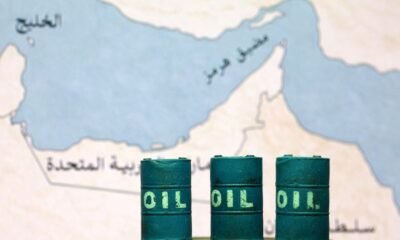
Iran has since closed the Strait of Hormuz to ships of countries it considers allied with the U.S. and Israel, effectively blocking a sea lane that normally transports about a fifth of the world’s oil and gas trade.
Higher inflation in Germany would hit consumer spending, the institutes said, weighing on an already weak economy that has barely grown since a burst of pent-up demand after the COVID-19 pandemic in 2022.
‘Zero growth’
Germany’s economy, struggling with fierce Chinese competition in sectors from cars to chemicals, was in the doldrums even before U.S. President Donald Trump last year imposed sweeping new tariffs before starting the Mideast war in late February.
Chancellor Friedrich Merz, who took office last May, vowed to borrow and spend hundreds of billions for a special infrastructure fund over the coming years in what was dubbed a spending “bazooka” aimed at getting Europe’s top economy back on its feet.
But the economists said that much of the money was simply paying for day-to-day spending.
“Government expenditure on consumption is rising much more sharply than investment,” economist Oliver Holtemoeller of the Halle Institute for Economic Research said. “That was not the idea behind changing the financing rules.”
The outlook for the longer term was also dire.
Citing low productivity, industrial decline and an ageing population, the institutes warned that Germany’s economy would soon be unable to grow sustainably.
“We have also reassessed the structural changes in the German economy and, in particular, revised our forecast for industrial growth downwards,” Wollmershaeuser said.
In an era when “demographic change is hitting with full force,” he said, “potential growth will come to a standstill by the end of the decade, and we will have to get used to average GDP growth rates of zero percent.”
In this phase of “multiple transformations,” the institutes recommend the German government “increase incentives for employment” and ease regulations to “improve conditions for investment and innovation.”
Short-term economic effects of the Iran war are negative but manageable for Türkiye, with energy supply security not at stake and fiscal space being deployed as a shock absorber, according to Treasury and Finance Minister Mehmet Şimşek.
“Limited warflation, wider current account deficit, slower growth,” are among the effects, according to a presentation by Şimşek to investors in London.
Despite the risks, the minister said there has been no change in the government’s macroeconomic policy priorities and that disinflation remains authorities’ top goal.
Annual inflation in Türkiye was 31.5% in February after a gradual decline from 75% in 2024. But expectations have risen amid the conflict, largely due to soaring global energy prices.
The U.S.-Israeli war on Iran has effectively shut the Strait of Hormuz, which normally carries around 20% of global crude, products and liquefied natural gas, stoking concerns about global energy supply.
Şimşek’s presentation said Türkiye’s energy supply security is not at stake.
The government’s policy framework remains focused on restoring price stability, maintaining fiscal discipline, achieving a sustainable current account balance and advancing structural reforms, the presentation said.
Higher energy costs pose risks
Şimşek said higher energy costs linked to the conflict could weigh on the economy.
If oil prices average around $85 per barrel in 2026, inflation could rise by roughly 3.6 to 4.4 percentage points, according to the presentation.
The same assumption could also reduce economic growth by around 0.6 to 1.5 percentage points.
Oil prices fell briefly below $100 per barrel on Wednesday after President Donald Trump said the U.S. could be done attacking Iran probably in two to three weeks, and that the U.S. “will not have anything to do with” what happens next in the Strait of Hormuz.
Şimşek said fiscal policy tools were being used to limit the pass-through of higher oil prices to domestic inflation.
To curb price hikes, authorities last month introduced a “sliding-scale” system, which adjusts the special consumption tax (ÖTV) on fuel products and prevents higher oil prices from being fully passed through to consumers.
Central Bank of the Republic of Türkiye (CBRT) Governor Fatih Karahan on Tuesday said their calculations showed the system reduces the impact of oil prices on inflation to one-third.
The central bank last month halted its easing cycle with the main rate at 37%, lifted its overnight rate by about 300 basis points to near 40% and undertook sales and swaps of foreign exchange and gold reserves to support the Turkish lira.
Karahan cautioned about the impact of the fallout from the Iran war on its fight against inflation, noting that in such situations it is a “natural choice” to turn to gold-based transactions to support liquidity.
Karahan said the monetary authority would maintain the needed tight policy to continue the disinflation process.
New trade corridors
In separate remarks on Tuesday, Şimşek said the Iran war is likely to reshape supply chains and create new trade corridors, presenting significant opportunities for Türkiye.
Şimşek said Türkiye is becoming an attractive destination once again for global talent and capital.
“In my view, Türkiye is once again becoming a center of attraction for global talent and capital,” he noted.
Şimşek said Türkiye remains not only a center of stability in a difficult global environment but also a strong manufacturing base and dynamic services center.
The conflict is likely to prompt companies to rethink and diversify supply chains, which Şimşek says could lead to the creation of new trade corridors.
Türkiye’s role in the Middle Corridor and its investments in regional connectivity could position the country to benefit from those changes, he added.
Şimşek also said the conflict would likely accelerate both the green transition and the digital transformation, creating additional opportunities across sectors.
“Our focus is on the twin transition, and we are making good progress in this area,” he said.
Factories across the world faced soaring input costs and supply chain disruptions in March due to the Iran war as underlying tepid demand threatened to undermine the manufacturing sector’s fragile recovery, surveys showed on Wednesday.
The conflict has disrupted global logistics networks, causing delivery delays, pushing up input price inflation and distorting headline growth measures.
Higher oil and energy prices led manufacturers to react and raise selling prices.
Headline PMI numbers – usually a sign of increased activity – were falsely elevated by the supply shock lengthening delivery times, said Chris Williamson, chief business economist at S&P Global.
That was the case for the headline eurozone reading. In Asia, many economies saw it fall, a sign surging fuel costs and heightening uncertainty from the Iran war were taking a toll.
Wednesday’s S&P Global eurozone Manufacturing Purchasing Managers’ Index (PMI) rose to 51.6 in March from February’s 50.8, higher than a preliminary estimate of 51.4.
A reading above 50.0 would normally indicate growth in activity.
“While the uptick in the headline index has been, at face value, somewhat surprising given the renewed energy shock in global markets – particularly as the flash release pointed to weaker services – the aggregate masks meaningful cross-country divergence,” said Mariana Monteiro at JPMorgan.
Germany and Italy recorded their strongest readings in 46 and 37 months respectively, while Spain was the only country in contraction territory. Greece posted the highest reading, followed by Ireland, while France’s manufacturing sector stagnated.
In Britain, outside the European Union, cost pressures soared and delivery delays – due to ships avoiding the Strait of Hormuz – were the longest since mid-2022.
Asian strain
The findings highlight the challenge policymakers face in Asia, a region that buys about 80% of the oil that is shipped through the Strait of Hormuz, making many countries vulnerable to the hit from the energy shock caused by the war.
Already, drivers in Manila are facing diesel prices that have tripled, while a jet-fuel squeeze looms in Vietnam and South Korea’s major cosmetics firms are searching far and wide for plastic resin.
China’s manufacturing sector expanded in March for a fourth straight month – albeit more slowly and as inflationary pressures and supply chain strains intensified, a private survey showed.
The RatingDog China General Manufacturing PMI fell to 50.8 in March from 52.1, missing analysts’ forecast of 51.6.
Manufacturing activity slowed in economies ranging from Indonesia, Vietnam, Taiwan and the Philippines, other PMIs showed, highlighting the pain the Middle East conflict was already inflicting on businesses.
Japanese factories also took a hit from the souring business mood and cost pressures, which hit a 19-month high.
The final S&P Global Japan Manufacturing PMI fell to 51.6 in March from 53.0. Input prices rose at the fastest rate since August 2024.
South Korea was an outlier with factory activity expanding at the strongest pace in more than four years, led by semiconductor demand and new product launches.
Inflation in the eurozone saw the steepest monthly increase since late 2022 and soared past the European Central Bank’s (ECB) 2% target in March as surging energy costs amid the Iran war drove up headline prices, according to official figures released Tuesday.
The annual rate for the 21 countries using the euro currency jumped to 2.5% compared to 1.9% for February before the war started and blocked supplies of oil and gas from the Persian Gulf.
Energy prices increased 4.9% in March compared to a 3.1% decline in February, data from Eurostat, the EU’s statistics agency, showed.
Oil prices have nearly doubled as a result of the Iran war and the ECB is now debating whether to raise interest rates to prevent this surge from becoming entrenched in the price of other goods and services.
“The previously price-stable environment is saying goodbye” said Alexander Krueger, chief economist at Hauck Aufhaeuser Lampe. “What matters is that this inflationary dirt does not feed through into the core rate.”
A closely-watched figure on underlying inflation, which excludes volatile food and energy, meanwhile, fell to 2.3% from 2.4%, Eurostat data showed.
“Looking ahead, although this was the biggest monthly increase in headline inflation since late 2022 it tells us little about how far headline inflation will rise or how much it will feed through to core and services inflation,” said Andrew Kenningham, chief Europe economist at Capital Economics.
The war’s impact on prices has already hit home at the vast Trionfale indoor market in Rome just north of the Vatican, where vegetable stand owner Anna Caruso said the higher cost of fuel was being reflected in prices for zucchini, eggplant and fruit.
“If the price of fuel increases, those who transport will increase the general price,” she said. “With many items, they say, I can’t afford this… and shift toward the cheaper items.”
Some prices were higher due to some produce not being in season, said stand owner Paola Ianzi, “but the increase is also partially due to the war because diesel and fuel increased and those who transport fruit and vegetables need to compensate that.”
Food price inflation came in at a relatively moderate 2.4% while services, the single largest item in the consumer price basket and the key gauge for domestic inflation, rose 3.2%.
ECB head Christine Lagarde has said that businesses may be quicker to raise prices during this outbreak of inflation due to bitter memories of the last episode of higher prices in 2022, when inflation rose to double digits. Russia cut off most supplies of natural gas to Europe and oil prices rose, sending energy costs through the roof.
Iran has blocked most of the tanker traffic through the Strait of Hormuz, the waterway through which some 20% of the world’s oil and gas typically passes. That is raising the prospect of sharply tighter markets for fuel in the coming weeks and months.
Hike or look past?
Basic economic theory argues that central banks should look past one-off price shocks generated by supply disruptions, especially because monetary policy works with long lags.
But a quick rise in energy inflation can easily broaden out if companies start building this into selling prices and workers begin demanding higher wages for the loss of disposable income.
Germany’s leading economic institutes cut their growth forecasts for this year and next in Europe’s biggest economy, while sharply raising their inflation forecasts in response to the Iran war, underscoring the drag the conflict is expected to exert on the economy.
High energy prices should make other goods more expensive and push up core inflation, said Commerzbank’s chief economist Joerg Kraemer, forecasting headline inflation will rise above 3% by May unless the war ends quickly.
The public may also start doubting the ECB’s resolve if it remains idle, firming the case for rate hikes even in the event of large but not so persistent inflation episodes, Lagarde said last week. Financial markets now see three interest-rate hikes from the ECB this year, with the first in either April or June.
“The mounting inflation pressure suggests that the ECB will raise its key interest rates in April or, at the latest, in June,” Kraemer said.
While some policymakers such as the influential Bundesbank head Joachim Nagel said a rate hike as soon as April was an option, others, including ECB board member Isabel Schnabel, have warned against hasty action.
But policymakers agree that the ECB must act if energy starts generating second round price pressures, especially since domestic inflation had been above 2% for years.
“The risk of a policy mistake is now substantial on either side of the incoming stagflation shock,” said Claus Vistesen, chief eurozone economist at Pantheon Macroeconomics.
If governments cushion the blow from higher prices with tax cuts, subsidies or cash handouts, central banks may have to tighten policy more aggressively, but if they leave households to absorb the shock, economic growth could weaken sharply and eventually force rate cuts, Vistesen said.
Ghosts of 2022
Part of the issue is that the ECB was late in recognizing the inflation problem in 2021/22, arguing for months that the surge was transitory and would pass. It only raised rates when price growth hit 8%, forcing the central bank into its steepest tightening cycle in its history.
“Consumers expect another rough ride, the past shock still fresh in memory,” said Bert Colijn, chief economist for the Netherlands at ING, adding that inflation expectations just increased to levels seen in the early 1990s and during the first half of 2022.
But the bloc is now in a very different position, so comparisons with 2022 are not entirely valid.
Rates are already higher, budget policy is tighter, the labor market has been weakening for months and there is no pent-up demand created by pandemic-era lockdowns.
The ECB will next meet on April 30.
“We find it hard to see the ECB moving at the next meeting at the end of April,” said Carsten Brzeski, global head of macro at ING. “Unless the ghosts of 2022 are really keeping policymakers awake at night.”
Türkiye is well-positioned to bolster its role in global value chains, attract investment and enhance its economic resilience, according to the World Economic Forum (WEF) on Monday.
The statement said that the WEF Türkiye Country Strategy Meeting was held in Istanbul under the chairpersonship of President Recep Tayyip Erdoğan.
It said that the meeting brought together prominent figures from global politics and business, adding: “As shifting geopolitical dynamics and economic fragmentation reshape global priorities, the meeting came at a critical time for dialogue.”
Emphasizing that Türkiye serves as a bridge between Europe, Asia and the Middle East, the WEF said: “Türkiye plays a strategic role amid evolving geopolitical dynamics and shifting trade patterns.”
The statement highlighted Türkiye’s strong industrial base and said the country is a major G-20 economy with growing influence on the global stage. It added that Türkiye also provides an important anchor for trade, investment and manufacturing networks.
The WEF underlined Türkiye’s unique connectivity across regions and access to major markets, saying: “Türkiye is well-positioned to strengthen its role in global value chains, attract investment and advance economic resilience.”
It added that the WEF Türkiye Country Strategy Meeting brought together leaders from different sectors and advanced Türkiye’s goal of deepening partnerships, reinforcing its global economic role and cementing its position as a key growth connector in an interconnected world.
The statement noted that, in addition to Erdoğan, Vice President Cevdet Yılmaz, Foreign Minister Hakan Fidan, Treasury and Finance Minister Mehmet Şimşek, Energy and Natural Resources Minister Alparslan Bayraktar, and the governor of the Turkish central bank, Fatih Karahan, also attended the meeting.
Türkiye officially launched 5G technology on Tuesday in what President Recep Tayyip Erdoğan said will mark the beginning of a new era not only in communications but in all other industries.
Commercial 5G services are scheduled to begin as of Wednesday and are expected to cover the whole country within about two years, according to officials.
Speaking at a launching ceremony, Erdoğan said the next-generation services would strengthen Türkiye’s competitiveness, improve productivity in communications, technology, energy and manufacturing and reinforce the country’s digital independence.
He said it would open a new chapter across transportation, health care, agriculture, manufacturing, the economy and education.
The technology is expected to enable users to experience significantly higher speeds and lower latency across all forms of internet use, supporting wider adoption of advanced digital services.
Erdoğan said sovereignty in today’s world is no longer limited to geography and physical borders, arguing that technological capability, cybersecurity and control over data have become central to national strength.
“In today’s data age, political stability, economic independence, military deterrence and digital sovereignty are inseparable,” he said.
He argued that countries seeking influence and credibility in an increasingly competitive global environment must invest in cyber technologies, cybersecurity measures and digital infrastructure.
Erdoğan said the collection, processing and protection of data now play a critical role in national security, particularly amid recent conflicts in places such as Gaza, Lebanon and Iran.
“The wars and conflicts occurring in our immediate vicinity, particularly in Lebanon, Gaza and Iran recently, have once again demonstrated the importance of cybersecurity,” he noted.
“If you want to be strong, deterrent, and respected on the global stage, you must accelerate your efforts in cyberspace and take the necessary cybersecurity measures.”
Cybersecurity seen as part of national defense
The president said 5G should be viewed not only as a communications technology but also as part of a broader digital sovereignty and national security strategy that includes data centers, cloud infrastructure, artificial intelligence and cybersecurity capacity.
“If you can protect your borders and airspace but cannot protect your cyber homeland and the data that is an inseparable part of it, then you have a serious weakness in your sovereignty,” Erdoğan said.
He said the government has spent the last 23 years building the foundations for this transition through investments in digital infrastructure and cybersecurity.
Türkiye’s fiber optic network has expanded from 81,000 kilometers in 2002 to 657,000 kilometers (408,240 miles) as of the third quarter of 2025, Erdoğan said.
During the same period, the number of broadband subscribers rose from 3,000 to 98 million, while mobile phone subscribers increased from 23 million to nearly 100 million.
Mobile use and cybersecurity efforts expand
Erdoğan said more than 55 million people in Türkiye currently use secure internet services, while total monthly voice traffic through mobile and fixed-line networks has reached 82 billion minutes.
Türkiye ranks first in Europe with an average monthly mobile usage time of 494 minutes, he added.
The 5G will be rolled out in all 81 provincial centers initially before becoming available across the country within two years, said Erdoğan.
The president also highlighted the work of the Cybersecurity Directorate, established last year to protect communications systems, critical infrastructure and national networks from cyber threats.
He said law enforcement, intelligence agencies and other public institutions are also developing contingency plans and response mechanisms against potential cyber risks.
Erdoğan added that the government is closely monitoring debates over foreign-owned messaging and calling applications, particularly since the conflict in Gaza, and will gradually introduce additional measures to strengthen the security of data belonging to state institutions.
Digital transformation
Also addressing the ceremony, Abdulkadir Uraloğlu, the transport and infrastructure minister, echoed the president’s view that 5G would transform Türkiye’s economy, industry, healthcare, transportation and agriculture.
Noting that information technology, artificial intelligence, cybersecurity, and high-speed connectivity play a vital role in countries’ economic development, competitiveness and national security, Uraloğlu said: “As Türkiye, we have taken decisive steps over the past quarter-century by making unique infrastructure investments.”
He stressed that more inclusive, fast and resilient communication systems need higher digitalization capacity.
The minister stated that 5G is not just about faster internet, but is also the key to a smarter, safer and more efficient future.
Noting that 5G, with data transfer speeds 10 times faster than the currently used 4.5G, ultra-low latency and the capacity for massive device connectivity, will position Türkiye at the center of digital transformation, he stated: “With this technology, we are providing a new infrastructure that will transform every aspect of life.
“In transportation, road safety will improve with fully autonomous driving and smart transportation systems, and traffic will become more efficiently manageable.”
He noted that production processes will be optimized through smart factories, autonomous robots and real-time data analysis in the industry field.
In smart cities, innovative solutions will emerge in every area, from energy management to parking systems, he said, adding that students will have access to world-class education through high-resolution and augmented reality-supported content.

Harsh reaction from AK Party Eskişehir Provincial Chairman Gürhan Albayrak to CHP’s Ayşe Ünlüce: Municipalism as if it were real!

Turkish govt ally supports Iranian people, calls for national unity

BREAKING NEWS… 14th day in the corruption case of the century! Ekrem İmamoğlu and the A Team are before the judge: All eyes will be on the interim decision to be made tomorrow…
Harsh reaction from AK Party Eskişehir Provincial Chairman Gürhan Albayrak to CHP’s Ayşe Ünlüce: Municipalism as if it were real!
Turkish govt ally supports Iranian people, calls for national unity
BREAKING NEWS… 14th day in the corruption case of the century! Ekrem İmamoğlu and the A Team are before the judge: All eyes will be on the interim decision to be made tomorrow…
-
 Economy3 days ago
Iran signals tighter control, possible tolls for Strait of Hormuz
-
 Daily Agenda3 days ago
Minister Kurum: “A more just world is possible with zero waste”
-
 Politics3 days ago
Israel biggest obstacle to peace, FM Fidan says
-

 Daily Agenda3 days ago
Yellice, one of the people closest to Muhittin Böcek, was arrested
-
 Daily Agenda3 days ago
APP license plate statement from Minister Çiftçi: It is not just a matter of shape
-
 Daily Agenda3 days ago
Dirty operation for Minister Çiftçi! The person who said ‘I am a farmer’ had a long criminal record…
-
 Politics2 days ago
Turkish intel captures defector who helped Assad regime
-
 Daily Agenda1 day ago
Let’s say ‘stop’ to food waste in the world together