
Economy
US economic worries mount amid tariffs, workforce cuts

WASHINGTON
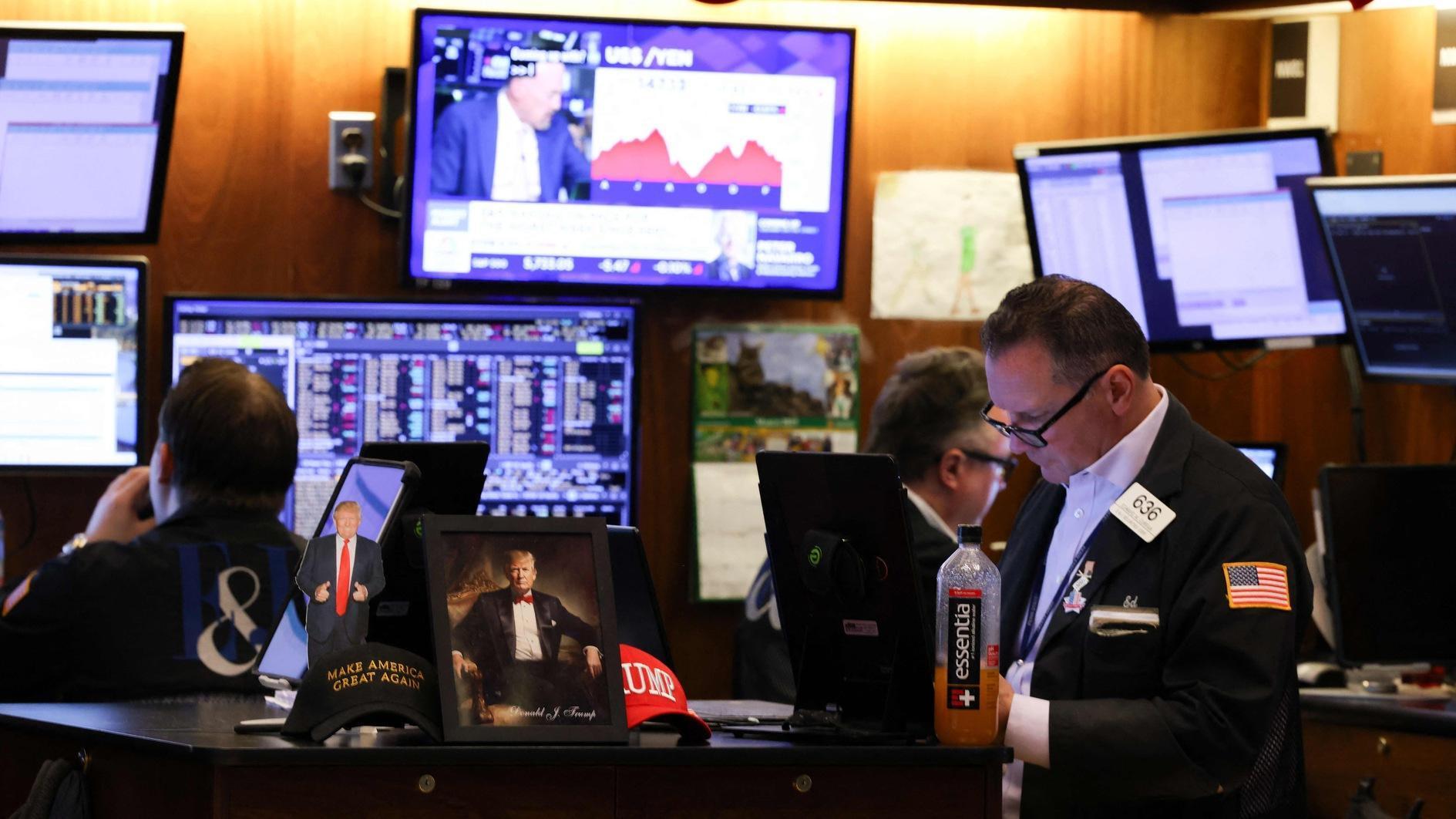
With his flurry of tariffs , government layoffs and spending freezes , there are growing worries President Donald Trump may be doing more to harm the U.S. economy than to fix it.
class=”cf”>
The labor market remains healthy with a 4.1 percent unemployment rate and 151,000 jobs added in February.
But employment report on March 7 also found that the number of people stuck working part-time because of economic circumstances jumped by 460,000 last month. In the leisure and hospitality sectors that reflect consumers having extra money to spend, 16,000 jobs were lost.
Since January, the economic policy uncertainty index has spiked 41 percent to a level, 334.5, that in the past signaled a recession.
“I have an increasing fear we will enter into what may become known as the ‘Trump recession,'”said Nicholas Bloom, a Stanford University economist and co-developer of the uncertainty index.
“Ongoing policy turbulence and a tariff war could tip the U.S. economy into its first recession in five years.” That last recession occurred under Trump because of the coronavirus pandemic.
For his part, Trump seems comfortable with the uncertainty that he’s generating, saying that any financial pain from import taxes is a mere “disruption” that will eventually lead to more factories relocating to the United States and stronger growth.
class=”cf”>
If Trump’s tariffs backfire, much of the price would be paid by everyday Americans who could suffer from job losses, lower wages, higher inflation and, possibly, an injured sense of national pride.
“Markets anticipate,” said John Silvia, CEO of Dynamic Economic Strategy. “The turn down the dark alley of tariffs signals higher inflation, slower economic growth and a weaker U.S. dollar. It is an economic horror movie in slow motion.”
There were multiple signs of uncertainty and concerns about the tariffs in the Federal Reserve’s beige book.
Published last week, the beige book included 47 references to uncertainty, up from just 17 in the previous edition in January.
“Many businesses noted heightened economic uncertainty and expressed concern about tariffs,” the Fed’s New York branch reported.
“Looking ahead, businesses were notably less optimistic.”
“This is the perfect storm for businesses,” said Brian Bethune, an economist at Boston College. “How can you possibly plan anything in this environment?”
class=”cf”>
Treasury Secretary Scott Bessent said on March 7 on CNBC that suggested a core problem is that the U.S. economy has become overly reliant on government deficits and that the Trump administration would be fostering stronger growth in the private sector.
“We’ve become addicted to this government spending, and there’s going to be a detox period,” he said.
This particular form of economic rehab is coming from Trump’s Department of Government Efficiency, which is led by Elon Musk.
class=”cf”>
But the initiative has started to downsize the federal workforce in ways that could surface in future jobs reports.
Roughly 75,000 employees took the deferred resignation plan. There are also thousands of probationary federal workers who were fired and tens of thousands of layoffs to come based on the administration’s plans.
Türkiye’s factory activity remained in contraction territory in September as the Middle East war continued to weigh on companies, a closely watched survey showed on Thursday.
S&P Global said on Thursday that its Türkiye Purchasing Managers’ Index (PMI) fell to 47.9 in September from 48.1 in August, with firms citing the war in the Middle East as a drag on new orders and output.
Operating conditions have now moderated on a monthly basis for 2-1/2 years, with input cost inflation reaching a four-month high in September as fuel, oil and transportation costs rose, tied to the Middle East conflict.
Softer demand conditions led to a further slowdown in new orders in September. New export orders also eased as international demand remained muted.
Uncertainty around geopolitical conditions put the handbrake on growth in the sector but the average PMI for Q3 was slightly higher than in Q2, suggesting “some tentative signs of recovery,” said Andrew Harker, economics director at S&P Global Market Intelligence.

Factory activity across Europe and Asia showed signs of resilience and remained firm last month, driven partly by the global AI spending boom, even as the energy price shock from the Iran war kept inflation elevated, surveys showed on Thursday.
Rising inflation pressures across the globe have pushed several central banks, including the Federal Reserve (Fed) and European Central Bank (ECB) to start hiking interest rates with more increases expected.
This has contributed to a sharp sell-off in bond markets, pushing up borrowing costs for firms already hit by increased production costs.
However, surveys show that, for now, many factories are reaping the benefit of a surge in demand for their products.
S&P Global’s Eurozone Manufacturing Purchasing Managers’ Index (PMI) rose to 52.9 in September from 52.7 in August, its highest level since May 2022, partly due to stronger demand for artificial intelligence-related goods.
Growth was broad-based across the bloc, with the Netherlands leading the expansion. Germany, the region’s largest economy, recorded solid growth while expansion was modest in France, Italy and Spain.
“The PMIs continue to paint a stronger picture of eurozone industry than the latest data. The sustained strength in surveys points to building underlying momentum over Q3 and to improved industrial support for growth,” said Iain Simmons, economist at Oxford Economics.
“The strength was concentrated in demand for capital goods, specifically AI and defence equipment, while consumer goods demand fell amid price pressure … However, faster cost and selling-price expectations will weigh on the outlook, so we expect the sector’s contribution to be stronger but uneven in Q3,” Simmons said.
South Korea and Taiwan accelerate, Japan lags
In Asia, manufacturing in major exporters Japan, South Korea and Taiwan also improved last month, benefiting from AI optimism.
South Korea, in particular, saw factory activity grow in September at the biggest margin in four months, as export demand grew at the fastest pace in 15.5 years.
Taiwan, a key player in the AI field, saw its PMI hit 56.7 in September, up from 54.7 in August. The 50-level divides expansion from contraction.
“Both new orders and production growth hit the highest for around five-and-a-half years, with anecdotal evidence often linking the expansions to the combined strength of the semiconductor and automotive sectors,” said Usamah Bhatti, economist at S&P Global Market Intelligence, about South Korea.
On Wednesday, surveys showed that China’s factory activity also expanded last month as easing weather disruptions allowed factories to resume operations.
Japan’s S&P Global PMI declined in September to its weakest in six months as output and new orders slowed, although new export orders rose for a ninth straight month due to robust demand from Asia and improved sales to the U.S.
Still, cost pressures remained elevated, with firms continuing to raise selling prices at one of the sharpest rates since late 2022, the Japanese survey showed.
India’s manufacturing sector expanded at the fastest pace in seven months, reviving hiring and lifting business confidence.
Factory activity for other Asian economies was patchy. While Indonesia and Vietnam saw activity expand, the Philippines and Malaysia contracted, surveys showed.
Global bond markets were under renewed pressure on Thursday as the sell-off deepened, with U.S. Treasury yields hitting their highest in decades and threatening stocks, even though tech firms managed to get some boost from AI chipmaker Micron’s blockbuster earnings.
The 10-year U.S. Treasury yield, a yardstick for global borrowing costs and asset prices, rose to 5.34%, its highest since 2002, before dip buyers stepped in, bringing it back to 5.28%.
It posted its biggest quarterly rise this century in the three months to September, with the selling pressure also rippling through bonds in France, Britain and Japan.
Yields have been surging around the world as soaring energy costs fan inflation and as the boom in AI and data center building lifts expectations for growth and for where short-term interest rates will settle.
Stalling peace talks between the U.S. and Iran to end the seven-month-long war in the Middle East have kept crude prices elevated. Brent futures surged 42% in the July-September quarter, and the December contract, the current benchmark, was last at $100 a barrel.
“We have had a prolonged selloff in bonds – they have been correlated with oil prices and also we’ve had strong U.S. data,” said Rory McPherson, chief market strategist at Wren Sterling.
“We don’t have enough buyers who want to buy bonds.”
That all left European shares under pressure, with the broad STOXX 600 down 0.75% and European banks off 1.8%, although U.S. share futures managed to hold steady.
Micron earnings help tech
Helping the U.S. were high-stakes earnings from Micron, a key supplier to AI bellwether Nvidia. They signalled strong demand for AI memory chips, with financial commitments under long-term supply agreements at $32 billion, up from $22 billion in June.
That helped push tech-heavy stock markets in Asia higher. Japan’s Nikkei jumped more than 3%, and South Korea’s KOSPI reversed earlier losses to gain 1.7%.
“Micron’s numbers are another strong validation of AI and memory demand, but markets may increasingly be asking whether we are closer to peak memory shortage, even if demand continues to exceed supply,” said Charu Chanana, chief investment strategist at Saxo.
Bond dip buyers arrive, but for how long?
Global yields surged in September as bond prices tumbled, amid soaring energy costs and the AI boom, leaving investors bracing for a period where interest rates stay higher for longer.
Market focus has been on how long U.S. Treasury yields stay above the psychologically important 5% level, while some investors even weigh the possibility of yields breaching 6%.
The U.S. 10-year yield gained 87 basis points in the July-September quarter, the biggest quarterly rise since 1994, LSEG data showed.
France’s 10-year yield gained 120 basis points in the quarter, the most since 1987, and its yield briefly jumped by a further 10 basis points on Thursday to 4.96%, closing in on the symbolic 5% level.
It too then eased back and was last down 2 bps at 4.82%, though the French budget process is keeping investors on edge.
Yields in Japan have also climbed to multi-decade highs, while Britain’s 30-year yield nudged above 6%.
Somewhere in the mix for bonds also was a reduction in bets on a further Federal Reserve rate hike in October after Wednesday’s softer-than-expected U.S. inflation reading.
Traders are pricing in a 38% chance of a Fed hike this month, versus 50% a day earlier, CME’s FedWatch tool showed.
In currency markets, the winner from the bond selloff has been the dollar, which was stronger again on Thursday.
The euro was down 0.3% at $1.1297, and sterling was down by a similar amount at $1.3223.
Gold was up a touch at $4,174 an ounce.
U.S. President Donald Trump unveiled on Wednesday a massive $200 billion in South Korean energy investment commitments, including $54 billion for a long-mooted Alaska liquified natural gas (LNG) project that Seoul said had yet to be decided on.
South Korea had previously agreed to invest $350 billion in the U.S. and increase purchases of U.S. energy under a July 2025 trade deal with Trump that set 15% tariffs on imports from the East Asian nation.
Besides the Alaska LNG project and pipeline, the Trump administration announced a $22.3 billion natural gas-fired power project in Texas that would be backed by South Korea.
“The United States and Korea have agreed to commence working together on the 50 Billion Dollar ALASKA LNG PROJECT,” Trump wrote on his Truth Social account Thursday, Seoul time.
“A huge 22 Billion Dollar, 6.4-gigawatt Natural Gas Fired Power Project in Encinal, Texas. This will bring tremendous new, reliable Power Capacity to Texas,” he added.
The facility in Texas will provide 6,472 MW of energy to data centers also located in Encinal, a U.S. Commerce Department statement said. It is expected to come fully online by 2032.
Seoul confirmed Thursday that both sides intended to “proceed with a $22.3 billion natural gas power facility” in Texas, dedicated to “supplying power to co-located data centers.”
But it said the Alaska LNG project “will be considered on the condition that it is commercially viable and subject to relevant domestic legal procedures.”
“No decision has been made regarding whether to invest in the project or the scale of any potential investment,” South Korea’s trade ministry said in a statement.
Commercial viability
South Korean President Lee Jae-myung also said Thursday that Seoul would begin working on it on the “condition that 1) its commercial viability is confirmed and 2) it complies with South Korea’s legal procedures.”
Lee said last month that negotiations on the projects had been “very complex and difficult,” adding he had found some terms “difficult to accept” without elaborating further.
Beyond the Alaska and Texas projects, Trump said the two countries were “moving forward” with a $120 billion nuclear power program to build eight large-scale reactors in the United States.
The figure includes $100 billion for construction costs and $20 billion in contingency reserves, the U.S. Commerce Department said.
Lee said Thursday that the nuclear power project would likewise depend on the “commercial viability” of each individual reactor.
The projects in the U.S. will be “pursued in a manner that serves the national interest,” South Korea’s trade ministry said.
The Alaska project, led by New York- and Houston-based developer Glenfarne Group, envisions a 1,300-kilometer (800-mile) pipeline carrying North Slope gas to a liquefaction facility near Anchorage for export to Asia.
While Alaska has decades of history as a petroleum producer, environmental concerns have historically constrained some developments.
But the Trump administration has largely brushed aside those concerns, canceling regulations to reduce emissions that are blamed for global warming.
Trump’s industrial ramp-up envisioned for his widespread energy projects faces a potential labor shortfall, experts say.
The United States needs to fill an estimated 1.7 million skilled trade openings through 2035, according to a report released Wednesday by the Alliance for America’s Skilled Trades, an organization of Ford, Blackstone, Nvidia and other large companies.
The report found today’s training programs produce just 55 workers for every 100 needed.
Inflation rose far quicker than expected in some of the eurozone’s biggest economies in September, as energy costs soared because of the Middle East war, official data showed Wednesday, boosting expectations for further interest rate hikes.
The annual rate hit 3.3% in Germany, Europe’s biggest economy, the fastest pace since December 2023, according to preliminary data from the statistics agency Destatis.
In France, consumer prices rose 3% in the month compared to a year earlier, the highest since February 2024 and a sharp increase from 2.4% in August, the statistics office Insee said.
In Italy, inflation jumped to 4.2%, nearly a full percentage point above the 3.3% recorded in August, the Istat agency reported.
In Spain, the inflation rate rose to 5% in September from 4.6% in August, data showed on Tuesday.
Energy inflation appears to have surprised on the upside in all countries that have reported so far, as has food inflation, although much more modestly, Mariana Monteiro from JPMorgan said.
The price hikes are well above the European Central Bank’s (ECB) inflation target of 2%, raising the likelihood it will raise interest rates further.
The ECB had expected inflation to accelerate from 3.3% in the third quarter to 3.6% in the final three months of the year, but economists say the actual peak is likely to be closer to 4%, given sky-high energy costs.
Diesel prices in particular have hit record highs in Germany, France, Italy and several other eurozone countries in recent weeks, a result of the Middle East war that has slowed shipments of both crude oil and refined fuels from the Gulf.
“With very few signs of a resolution of tensions in the Middle East on the horizon and winter approaching, a correction in energy prices is unlikely any time soon,” Rory Fennessy, senior European economist at Oxford Economics, said.
That has raised expectations among analysts that the ECB will tighten monetary policy further in the coming months to rein in inflation, potentially dampening the eurozone’s economic growth.
The central bank raised its benchmark rate to 2.5% earlier this month.
Inflation data for the full eurozone will be released Friday.
Because this year’s inflation surge has yet to generate dangerous second-round effects across the eurozone, a moderate policy response from the European Central Bank remains appropriate, ECB chief Christine Lagarde said Monday.
Inflation ‘feeding through’
Jack Allen-Reynolds, an economist at Capital Economics, said the inflation readings “suggest that the indirect effects of higher energy costs are beginning to feed through” to the wider economy.
But he added that “this is unlikely to tip the balance for the ECB” and he expects policymakers to keep rates steady at their next meeting in October, before hiking again in December.
His view was shared by other analysts who said the central bank would wait until December, when it also releases updated economic forecasts.
Some analysts also noted that core inflation in Germany, which excludes volatile food and energy costs, was steady at 2.4% in September.
“This should ease the immediate pressure on the ECB to implement further monetary tightening at its next meeting,” said Dirk Schumacher, chief economist at the German public lender KfW.
Still, Rory Fennessy of Oxford Economics said the latest inflation readings could shift the debate at the ECB.
“The fact that inflation has surprised to the upside in September will only strengthen the case among the hawks in the [ECB governing council] for a more aggressive pace of tightening,” he said.
Analysts at ING meanwhile said the French figures “suggest that inflation is likely to remain above 3% for the rest of 2026 before gradually declining in 2027.”
That will weigh on household purchasing power “at a time when consumption is weakening and rising interest rates are exacerbating France’s fiscal difficulties,” they said.
Consumer spending fell 0.5% in France in August, Insee also reported Wednesday, and the country’s public debt stood at 119% of GDP in the second quarter, nearly double the eurozone limit of 60%.
Inflation in the United States increased less than expected in August, even as consumers stepped up spending, according to data Wednesday that could prompt markets to further reduce the odds of another interest rate increase from the Federal Reserve (Fed) next month.
Consumer prices rose 3.4% last month compared with a year earlier, the Commerce Department said, below economists’ expectations of 3.7%. On a monthly basis, inflation climbed 0.3%, up from 0.1% in July, a sign that prices are still running hot.
Excluding the volatile energy and food categories, inflation also came in lower than expected, rising 3% in August from a year ago. And from July to August, core prices rose just 0.2%, up from 0.1% the previous month. Many economists feared core prices would rise more quickly month-to-month.
U.S. markets bounced higher immediately on the new inflation reading, with investors betting that an expected interest rate hike from the Fed might be delayed.
Even so, inflation remains above the Federal Reserve’s 2% target and the monthly increase in August suggests it isn’t moving back toward the target anytime soon.
The Fed lifted its key short-term interest rate two weeks ago for the first time in three years to combat inflation, and most economists expect it will do so at least once more this year, possibly as soon as late next month.
“Inflation’s trend is lower but still not close to their target and not improving, either,” Bill Adams, chief U.S. economist at Fifth Third Commercial Bank, said in an email.
Wednesday’s report covered a key inflation gauge closely watched by the Fed, known as the personal consumption expenditures price index. It is similar to the higher-profile consumer price index, which was released earlier this month.
High prices have cast a pall on the U.S. economy, even as growth is mostly solid and the unemployment rate is low. On Tuesday, the Conference Board’s consumer confidence survey fell to its lowest level since 2014, a period that includes both the Great Recession and a global pandemic.
Americans’ paychecks are growing but not as quickly as prices.
Inflation for July was previously reported at 3.7% but was revised lower to 3.4% by the government as part of an update in how it measures price changes in several categories, including investment management, computer software and accessories, and legal services.
For example, the government previously put a heavy weight on some computer accessories that have jumped in price because of outsized demand from the AI buildout. The revisions lowered that weight and as a result, the higher prices for some computer equipment are not driving up this measure of inflation as much.
Despite elevated prices, Americans accelerated their spending last month, the government said, with spending jumping 0.9% from July to August, up from just 0.1% the previous month.
Some of that increase was likely fueled by wealthier Americans cashing in their gains from higher stock prices, a recent report from JPMorgan suggests. Other consumers may be taking on more debt to support their spending.
After-tax incomes, adjusted for inflation, were unchanged on a monthly basis in August, after rising 0.3% in July, the report said.
Healthy consumer spending could fuel a pickup in growth. In a separate report Wednesday, the government said the economy expanded at a 2.2% annual pace in the July-September quarter. Analysts expect that to pick up to a 3% rate in the current quarter.


-

 Sports2 days ago
Türkiye slip to 31st in FIFA rankings after Nations League defeats
-

 Politics3 days ago
Türkiye celebrates anniversary of naval battle that cemented Med reign
-

 Politics3 days ago
Türkiye’s East Med leap leaves Tel Aviv cornered: Israeli media
-

 Economy3 days ago
Trump unveils $15B Iowa steel project in pre-election push
-
 Economy3 days ago
Erdoğan says Turkish capital market resilient, vows action in funds case
-

 Economy3 days ago
Potential Merz successor visits Türkiye with large business group
-
 Politics3 days ago
Erdoğan, Subianto discuss expanding Türkiye-Indonesia cooperation
-

 Politics2 days ago
Iraq says talks underway for withdrawal of Turkish troops